@arcgis/map-components 5.0.0-next.22 → 5.0.0-next.24
This diff represents the content of publicly available package versions that have been released to one of the supported registries. The information contained in this diff is provided for informational purposes only and reflects changes between package versions as they appear in their respective public registries.
- package/dist/cdn/{3WHUCCS5.js → 2BSSCO7C.js} +2 -2
- package/dist/cdn/{GS43PJYB.js → 2HUIPA4G.js} +2 -2
- package/dist/cdn/{MQTKUJWN.js → 2JRY4QVW.js} +2 -2
- package/dist/cdn/{HJLNIC46.js → 2OJISXJN.js} +2 -2
- package/dist/cdn/{DLV6ZOTC.js → 2SBUH2AY.js} +2 -2
- package/dist/cdn/{Y54D3L5M.js → 2UDMBLEC.js} +2 -2
- package/dist/cdn/{NSXSOVR6.js → 35BNUAF5.js} +2 -2
- package/dist/cdn/{EJQU64XQ.js → 3CUXCPCJ.js} +2 -2
- package/dist/cdn/{G4SJ2RWN.js → 3GG6H5MG.js} +2 -2
- package/dist/cdn/{AQFFDL65.js → 3H74ZFYL.js} +2 -2
- package/dist/cdn/{VDA6ALVS.js → 3KBCDJCG.js} +2 -2
- package/dist/cdn/{VZGOD36G.js → 3NP3F4R3.js} +2 -2
- package/dist/cdn/{GGDUDYXM.js → 3R4EOZWK.js} +2 -2
- package/dist/cdn/{OWYAOI7Y.js → 3XBOSNWC.js} +2 -2
- package/dist/cdn/{CDH7OVVK.js → 46VVJUI4.js} +1 -1
- package/dist/cdn/{B2VZWZ4P.js → 4ECBNDJ3.js} +2 -2
- package/dist/cdn/{HOQ5KRDI.js → 4KY33MEJ.js} +2 -2
- package/dist/cdn/{YGF5LZS3.js → 4OZAIUOD.js} +2 -2
- package/dist/cdn/{HM7EPFWV.js → 4P2NGT7M.js} +2 -2
- package/dist/cdn/{673GDEJA.js → 4T6QNS7H.js} +2 -2
- package/dist/cdn/{QPYZWZX4.js → 544ETKUT.js} +2 -2
- package/dist/cdn/{M7JW4WKW.js → 57JFTM2D.js} +2 -2
- package/dist/cdn/5KCNNIVD.js +4 -0
- package/dist/cdn/{O6TNDO7Z.js → 5MA5RW3P.js} +2 -2
- package/dist/cdn/{75SCVL6S.js → 5OKKC5SV.js} +2 -2
- package/dist/cdn/{4SUHXN5W.js → 6BRRNMGK.js} +2 -2
- package/dist/cdn/{D5ZETLQJ.js → 6LAZEYNB.js} +2 -2
- package/dist/cdn/{BJDCCDGH.js → 6ORRMU52.js} +2 -2
- package/dist/cdn/{S4XH7SHB.js → 6P5C2VXD.js} +2 -2
- package/dist/cdn/{P3GLI5BJ.js → 6QDD44LQ.js} +2 -2
- package/dist/cdn/{74R2OB7B.js → 6UDU2M3R.js} +2 -2
- package/dist/cdn/{WEYOXYM2.js → 6XP7O7KR.js} +2 -2
- package/dist/cdn/{DK3YSQ6X.js → 74U7W6H2.js} +2 -2
- package/dist/cdn/{YYXVN6ZO.js → 75LNMXIV.js} +2 -2
- package/dist/cdn/{JSVH4DHO.js → 77L6DRSX.js} +2 -2
- package/dist/cdn/{MQET45NC.js → 7DQEDGRA.js} +2 -2
- package/dist/cdn/{UHURTWBN.js → 7GKNQONE.js} +2 -2
- package/dist/cdn/{CFZLQYRB.js → 7IJHRLSH.js} +2 -2
- package/dist/cdn/{KEVUZRRD.js → 7PIKVPZS.js} +2 -2
- package/dist/cdn/{HSQXL4EH.js → 7U7ZOOGC.js} +2 -2
- package/dist/cdn/{H5PP3CFD.js → 7Z543FXE.js} +2 -2
- package/dist/cdn/{NWUF374J.js → A2K6Y7PG.js} +2 -2
- package/dist/cdn/{WIISREJR.js → ACMEZHNJ.js} +2 -2
- package/dist/cdn/{VNZIQKJ4.js → AEBRV2VV.js} +2 -2
- package/dist/cdn/{TOKB667I.js → AJ24JEWS.js} +2 -2
- package/dist/cdn/{6IEKHZUZ.js → AL2QTOJU.js} +2 -2
- package/dist/cdn/{DDJ77OUN.js → AMVPUY4A.js} +2 -2
- package/dist/cdn/{4NJDJY3L.js → BBGQG5VJ.js} +2 -2
- package/dist/cdn/{YAWO7FHP.js → BHXWBVIQ.js} +2 -2
- package/dist/cdn/{3JRDRKOQ.js → BQ3BLKJ4.js} +2 -2
- package/dist/cdn/{NZUEPDM5.js → BVUI2QTN.js} +2 -2
- package/dist/cdn/{DTGRWXIT.js → C2KFCYKE.js} +2 -2
- package/dist/cdn/{VWFYLCP4.js → C35KZYBW.js} +2 -2
- package/dist/cdn/{NOSY6DO2.js → C4PDJ4WL.js} +2 -2
- package/dist/cdn/{GBGCZNI4.js → C7KSHKKY.js} +2 -2
- package/dist/cdn/{W5MTT3Y2.js → CD775WSZ.js} +2 -2
- package/dist/cdn/{WQ32DGAT.js → CFMQOXEL.js} +2 -2
- package/dist/cdn/{275NTM66.js → CHEUSDMN.js} +2 -2
- package/dist/cdn/{6E6KN7RG.js → COWFY4Z3.js} +2 -2
- package/dist/cdn/{Z2WCWOXG.js → CYMPKLQR.js} +2 -2
- package/dist/cdn/{DO6DQMW5.js → D2SX65K7.js} +2 -2
- package/dist/cdn/{RSEBSJUC.js → D56BQL45.js} +2 -2
- package/dist/cdn/{TQYYIJOA.js → DCUFOVCX.js} +2 -2
- package/dist/cdn/{QAJ4AWIW.js → DCZ4XQRT.js} +2 -2
- package/dist/cdn/{AKOSN73C.js → DG7FRZ7E.js} +2 -2
- package/dist/cdn/{DEPC3JPI.js → DL2SV6PN.js} +1 -1
- package/dist/cdn/{62IPHFIH.js → DM5MTRFD.js} +2 -2
- package/dist/cdn/{XJR3WSJ4.js → DQ33237W.js} +2 -2
- package/dist/cdn/{OBJ5ZFVU.js → DT74VC3H.js} +2 -2
- package/dist/cdn/{WYRFUVBQ.js → E3V27YEQ.js} +2 -2
- package/dist/cdn/{4IHAOS7O.js → E7E5CLJK.js} +2 -2
- package/dist/cdn/{GDHBHLWE.js → EDDFBKN7.js} +2 -2
- package/dist/cdn/{XCODB7RI.js → EHDRX7SR.js} +2 -2
- package/dist/cdn/{74SVNEQ7.js → EU7ORLKE.js} +2 -2
- package/dist/cdn/EXS654KL.js +4 -0
- package/dist/cdn/{IOU2IXJJ.js → EYI4YNC4.js} +1 -1
- package/dist/cdn/{6WQILZIL.js → EZ3K3LCL.js} +2 -2
- package/dist/cdn/{LHVB66IU.js → F2MGB6FA.js} +2 -2
- package/dist/cdn/{DPB2JX4H.js → F2XBH52I.js} +2 -2
- package/dist/cdn/{TSMYGL6C.js → F5Y7QKJX.js} +2 -2
- package/dist/cdn/{SBDKWEKK.js → FACZROM2.js} +2 -2
- package/dist/cdn/{WZWK3NKT.js → FAEQ4HPP.js} +2 -2
- package/dist/cdn/{NS353BYY.js → FCHACAVB.js} +2 -2
- package/dist/cdn/{OXXBWYC5.js → FNATIXZI.js} +2 -2
- package/dist/cdn/{AROPATAW.js → FSXYK3GU.js} +2 -2
- package/dist/cdn/{TUINBEOO.js → FU6OJA6A.js} +2 -2
- package/dist/cdn/{Z4XDH6RQ.js → FUF4P4HD.js} +2 -2
- package/dist/cdn/{55WDMZEY.js → FUUFKRMF.js} +2 -2
- package/dist/cdn/{HIJRQPA7.js → GBDA5F2U.js} +2 -2
- package/dist/cdn/{EUY7JY35.js → GE56AXFQ.js} +2 -2
- package/dist/cdn/{LSC6U53S.js → GFOL46U5.js} +2 -2
- package/dist/cdn/{Y4CDUNOP.js → GGKKXYGL.js} +2 -2
- package/dist/cdn/{AL667NC3.js → GNDXVOTQ.js} +2 -2
- package/dist/cdn/GOC7ZJU2.js +4 -0
- package/dist/cdn/{DBEFAKCB.js → GSSVSKOJ.js} +1 -1
- package/dist/cdn/{QYSCCGR5.js → GT22QY43.js} +2 -2
- package/dist/cdn/{OMS4VEZK.js → HBPFDZ2X.js} +2 -2
- package/dist/cdn/{U6JYGFXM.js → HMLJXHXG.js} +2 -2
- package/dist/cdn/{PU6VE5HV.js → HQ5RVS4T.js} +3 -3
- package/dist/cdn/{BUW6A2IC.js → HZUBE3BY.js} +2 -2
- package/dist/cdn/{62H4JM4G.js → IBA6W7TQ.js} +2 -2
- package/dist/cdn/{DYL55UVI.js → ILW4BDY4.js} +2 -2
- package/dist/cdn/{42PCRMNQ.js → IMHZ5EO4.js} +2 -2
- package/dist/cdn/{BOPOGDAZ.js → INCBMTMT.js} +2 -2
- package/dist/cdn/{G3734GBQ.js → J6VBV6AF.js} +2 -2
- package/dist/cdn/{UTP5N42U.js → JBGQ5FEG.js} +2 -2
- package/dist/cdn/{VJZMEZL6.js → JCUCNEUT.js} +2 -2
- package/dist/cdn/{BESADMOB.js → JFTU7PRB.js} +2 -2
- package/dist/cdn/{QPAKBD6F.js → JMLYDUSZ.js} +2 -2
- package/dist/cdn/{2746AKR2.js → JNBZFKPR.js} +2 -2
- package/dist/cdn/{SGHTSOGZ.js → JP4ADYOT.js} +2 -2
- package/dist/cdn/{FAVWC4TO.js → JPTKG37X.js} +2 -2
- package/dist/cdn/{2S772PH6.js → JV3PIKEF.js} +2 -2
- package/dist/cdn/{RVIB4GCJ.js → K6PKWKYP.js} +2 -2
- package/dist/cdn/{OBGA7W7N.js → KCILYQOV.js} +1 -1
- package/dist/cdn/{JT5KVBRF.js → KHCKN7QZ.js} +2 -2
- package/dist/cdn/{DA3LJLY3.js → KKGMFR6A.js} +2 -2
- package/dist/cdn/{GDQW6VWV.js → KNS4DNO5.js} +2 -2
- package/dist/cdn/{42AUHWZJ.js → KU5UNRFT.js} +1 -1
- package/dist/cdn/{QS62DXEF.js → L7ICXT3H.js} +1 -1
- package/dist/cdn/{URF6UVU3.js → LDY6KA2A.js} +2 -2
- package/dist/cdn/{P3LZX3UI.js → LHELVIF4.js} +2 -2
- package/dist/cdn/{EH6D3S4R.js → LKD6SM77.js} +2 -2
- package/dist/cdn/{ETA5NJYQ.js → LM24R6DO.js} +2 -2
- package/dist/cdn/{KB4XTRMH.js → LXQ557UY.js} +2 -2
- package/dist/cdn/{DUVJWKD5.js → LXQR22RB.js} +2 -2
- package/dist/cdn/{K756BF42.js → MGLFNY6E.js} +2 -2
- package/dist/cdn/{GXHVTVNC.js → MLYFA7PP.js} +2 -2
- package/dist/cdn/{Q4RJ5YJL.js → MONBRNWM.js} +2 -2
- package/dist/cdn/{G6TYRPAI.js → MRGK64TX.js} +2 -2
- package/dist/cdn/{LUOXRY6Q.js → MWGAXVMA.js} +2 -2
- package/dist/cdn/{PBW53ES3.js → MYL54YVV.js} +2 -2
- package/dist/cdn/{JM22JGNM.js → N27CGPZA.js} +2 -2
- package/dist/cdn/{YSWYOYEZ.js → N6A52ZDW.js} +2 -2
- package/dist/cdn/{WVF5F6V5.js → NCBDDT53.js} +2 -2
- package/dist/cdn/{AXED6HWL.js → NDP6UJ5O.js} +1 -1
- package/dist/cdn/{CIIBIYLS.js → NFJ6TTNG.js} +2 -2
- package/dist/cdn/{2MD5DFJI.js → NGIQQBDH.js} +2 -2
- package/dist/cdn/{A2SML465.js → NQ3LWIVJ.js} +2 -2
- package/dist/cdn/{O3SLUQKI.js → NQS45V3I.js} +2 -2
- package/dist/cdn/{774G7VPV.js → NUS7CDPJ.js} +2 -2
- package/dist/cdn/{6FYX5X3E.js → NX4D3T4R.js} +2 -2
- package/dist/cdn/{E6YZKAUE.js → OEADOS2P.js} +2 -2
- package/dist/cdn/{BDA54W4H.js → OGL3KZO3.js} +2 -2
- package/dist/cdn/{OFEWGCOG.js → OPNB4NKV.js} +2 -2
- package/dist/cdn/{3FK5YQNP.js → OQFXUHOV.js} +2 -2
- package/dist/cdn/{KQZZ43X4.js → ORDPN35I.js} +2 -2
- package/dist/cdn/{XAIDLSPE.js → OSRBTC72.js} +2 -2
- package/dist/cdn/{CICNDJMO.js → OX4MPYTW.js} +2 -2
- package/dist/cdn/{KJC4KTZV.js → OZ3GMQS3.js} +2 -2
- package/dist/cdn/{S3DVL6ZC.js → P4ZD57A4.js} +2 -2
- package/dist/cdn/{HJEYERUD.js → P62UBLSF.js} +2 -2
- package/dist/cdn/{UBEMCTDW.js → PE3TY4RA.js} +2 -2
- package/dist/cdn/{FSK32QHJ.js → PG2EC5UG.js} +2 -2
- package/dist/cdn/{BH2ULII4.js → PJE22EQQ.js} +2 -2
- package/dist/cdn/{RWASZHM4.js → PMOQCVFK.js} +2 -2
- package/dist/cdn/{3XCHQ357.js → PMOZAIEP.js} +2 -2
- package/dist/cdn/{OD35KOWM.js → PWSIAO47.js} +2 -2
- package/dist/cdn/{QKL2JK3Z.js → PZB77IE7.js} +2 -2
- package/dist/cdn/{BKELFSZJ.js → QBQZBAXU.js} +2 -2
- package/dist/cdn/{EUSVWPRK.js → QEB2IKWH.js} +1 -1
- package/dist/cdn/{FK4YJUBX.js → QHRY746M.js} +2 -2
- package/dist/cdn/{2K2XAYBA.js → QHVIJ7YL.js} +2 -2
- package/dist/cdn/{FNCYPQST.js → QX2Z64HX.js} +2 -2
- package/dist/cdn/{MXD4TXEJ.js → QYZZBHGH.js} +2 -2
- package/dist/cdn/{S3XA3G7Y.js → R5H7YV2D.js} +1 -1
- package/dist/cdn/{RFZ2YVTS.js → RBV6KW5K.js} +2 -2
- package/dist/cdn/{ZHZ773EL.js → RD26MFLA.js} +2 -2
- package/dist/cdn/{HKOH4UGD.js → RDHIE6V7.js} +2 -2
- package/dist/cdn/{R5RNC2V3.js → RFZMOTUI.js} +2 -2
- package/dist/cdn/{HBSAPQGW.js → RID3BAB6.js} +2 -2
- package/dist/cdn/{A3SOTRU3.js → RKLM2POM.js} +2 -2
- package/dist/cdn/{X6WHZVAS.js → RMKN6EQD.js} +2 -2
- package/dist/cdn/{B245W5N6.js → RUYOIM4L.js} +2 -2
- package/dist/cdn/{6QAL2A64.js → RXHF5RLL.js} +2 -2
- package/dist/cdn/{AF6U42AQ.js → S32JRNLS.js} +2 -2
- package/dist/cdn/{CHUQZ4GK.js → SLK6DHXC.js} +2 -2
- package/dist/cdn/{AX556ZZP.js → SO3F4JXA.js} +1 -1
- package/dist/cdn/SPJ4HFEU.js +4 -0
- package/dist/cdn/{INUQGH2C.js → ST3IYGCW.js} +2 -2
- package/dist/cdn/{W2GPZOZF.js → STMQSJ2M.js} +2 -2
- package/dist/cdn/{D6AYCZF3.js → SYTHT6ER.js} +2 -2
- package/dist/cdn/{NCXD3QMF.js → T5FFHI36.js} +1 -1
- package/dist/cdn/{F5DRXN5B.js → TGRL45MQ.js} +2 -2
- package/dist/cdn/TUBDJ2TJ.js +4 -0
- package/dist/cdn/{PAPJNUE6.js → TX5ZKLGC.js} +2 -2
- package/dist/cdn/{XERFFFKG.js → U6FI5UMV.js} +2 -2
- package/dist/cdn/{H2X2VRYL.js → U7HVKM2E.js} +2 -2
- package/dist/cdn/{ZDMFGVNL.js → UJAU3FSU.js} +2 -2
- package/dist/cdn/{XPTWWD2L.js → ULLEMZNX.js} +2 -2
- package/dist/cdn/UO4YJUTK.js +4 -0
- package/dist/cdn/{2PD47VT2.js → UOEXV56Q.js} +2 -2
- package/dist/cdn/{JBL6GDOL.js → UTUWHHK3.js} +1 -1
- package/dist/cdn/{SS4TJEID.js → UYSHEUIP.js} +2 -2
- package/dist/cdn/{4LALXLZJ.js → UZTWG7LL.js} +2 -2
- package/dist/cdn/{GXJ6BYUR.js → V23HD6W2.js} +2 -2
- package/dist/cdn/{PJQW3WEA.js → V4SEB6DK.js} +1 -1
- package/dist/cdn/{OG7NUSC3.js → VFIZ5OQQ.js} +2 -2
- package/dist/cdn/{WE2DKJUO.js → VIGLZVYL.js} +2 -2
- package/dist/cdn/{P4C4ZUJC.js → VTTGW6DC.js} +2 -2
- package/dist/cdn/{MGHHOJMX.js → VVKOKOBM.js} +2 -2
- package/dist/cdn/{GWL7T2LD.js → WCZUZ63Q.js} +2 -2
- package/dist/cdn/{NBLZ23WR.js → WJ6R3IIX.js} +2 -2
- package/dist/cdn/WOANAN43.js +9 -0
- package/dist/cdn/{HQKV3ZKF.js → WT2F7EGW.js} +2 -2
- package/dist/cdn/{Q25SVI6X.js → X6M34W2U.js} +2 -2
- package/dist/cdn/{7VWMU2UC.js → X7SBTFPU.js} +2 -2
- package/dist/cdn/{4DQSPBUU.js → XIYW2UAK.js} +2 -2
- package/dist/cdn/{4DCJMQSJ.js → XQMDRKZP.js} +2 -2
- package/dist/cdn/{MBLLH4UD.js → XTK2PRDH.js} +1 -1
- package/dist/cdn/{E3WOZNLT.js → XWUVE66Z.js} +2 -2
- package/dist/cdn/{V56RVAN6.js → YDJMROQY.js} +2 -2
- package/dist/cdn/{QIUP76D5.js → YE2ZCAEH.js} +2 -2
- package/dist/cdn/{RQCJ7AZT.js → YGPEVWQY.js} +2 -2
- package/dist/cdn/{OQVSLGLD.js → YPEYG7L2.js} +2 -2
- package/dist/cdn/{YT32G6HH.js → YWVX4IMT.js} +2 -2
- package/dist/cdn/{OBM5WYPY.js → YXUPRQBJ.js} +2 -2
- package/dist/cdn/{X6BHFNHG.js → Z4EDZ4WK.js} +2 -2
- package/dist/cdn/{UKI7CC42.js → ZCKSWQ5A.js} +2 -2
- package/dist/cdn/{RFIDELEP.js → ZE7QO6H5.js} +2 -2
- package/dist/cdn/{IYHTURJS.js → ZH4A7JUM.js} +2 -2
- package/dist/cdn/{RDKO2ZXD.js → ZJWKXOND.js} +2 -2
- package/dist/cdn/{D7CCMDA3.js → ZP6XTDWN.js} +2 -2
- package/dist/cdn/{XIDKNXOO.js → ZWHFTWTZ.js} +2 -2
- package/dist/cdn/index.js +2 -2
- package/dist/chunks/AnalysisViewModel.js +1 -1
- package/dist/chunks/action-utils.js +1 -1
- package/dist/chunks/async-utils.js +1 -1
- package/dist/chunks/basemap-gallery-resources.js +1 -1
- package/dist/chunks/chart-utils.js +1 -1
- package/dist/chunks/chartCommon.js +1 -1
- package/dist/chunks/component-utils.js +1 -1
- package/dist/chunks/createCloseEvent.js +1 -1
- package/dist/chunks/esri-main.js +1 -1
- package/dist/chunks/feature-utils.js +1 -1
- package/dist/chunks/globalCss.js +1 -1
- package/dist/chunks/handle.js +1 -1
- package/dist/chunks/heading.js +1 -1
- package/dist/chunks/layer-list.js +1 -1
- package/dist/chunks/legacyIcon.js +1 -1
- package/dist/chunks/maybe.js +1 -1
- package/dist/chunks/measurementUtils.js +1 -1
- package/dist/chunks/runtime.js +1 -1
- package/dist/chunks/screenLocation.js +1 -1
- package/dist/chunks/slots.js +2 -2
- package/dist/chunks/svgUtils.js +1 -1
- package/dist/chunks/univariateUtils.js +1 -1
- package/dist/chunks/useArcgisViewReadyError.js +1 -1
- package/dist/chunks/useHandles.js +1 -1
- package/dist/chunks/useT9n.js +1 -1
- package/dist/chunks/useView.js +1 -1
- package/dist/chunks/useViewModel.js +1 -1
- package/dist/chunks/useWidget.js +1 -1
- package/dist/chunks/utils.js +1 -1
- package/dist/chunks/utils2.js +1 -1
- package/dist/components/arcgis-area-measurement-2d/customElement.d.ts +1 -1
- package/dist/components/arcgis-area-measurement-2d/customElement.js +1 -1
- package/dist/components/arcgis-area-measurement-3d/customElement.d.ts +1 -1
- package/dist/components/arcgis-area-measurement-3d/customElement.js +1 -1
- package/dist/components/arcgis-attachments/customElement.js +1 -1
- package/dist/components/arcgis-basemap-gallery/customElement.d.ts +1 -1
- package/dist/components/arcgis-basemap-gallery/customElement.js +1 -1
- package/dist/components/arcgis-basemap-gallery-item/customElement.js +4 -4
- package/dist/components/arcgis-basemap-layer-list/customElement.d.ts +1 -1
- package/dist/components/arcgis-basemap-layer-list/customElement.js +1 -1
- package/dist/components/arcgis-basemap-toggle/customElement.d.ts +1 -1
- package/dist/components/arcgis-basemap-toggle/customElement.js +1 -1
- package/dist/components/arcgis-bookmarks/customElement.d.ts +13 -5
- package/dist/components/arcgis-bookmarks/customElement.js +1 -1
- package/dist/components/arcgis-building-explorer/customElement.d.ts +1 -1
- package/dist/components/arcgis-building-explorer/customElement.js +1 -1
- package/dist/components/arcgis-catalog-layer-list/customElement.d.ts +1 -1
- package/dist/components/arcgis-catalog-layer-list/customElement.js +1 -1
- package/dist/components/arcgis-compass/customElement.d.ts +1 -1
- package/dist/components/arcgis-compass/customElement.js +1 -1
- package/dist/components/arcgis-coordinate-conversion/customElement.d.ts +1 -1
- package/dist/components/arcgis-coordinate-conversion/customElement.js +1 -1
- package/dist/components/arcgis-daylight/customElement.d.ts +79 -64
- package/dist/components/arcgis-daylight/customElement.js +58 -57
- package/dist/components/arcgis-daylight/index.d.ts +1 -0
- package/dist/components/arcgis-daylight/index.js +1 -0
- package/dist/components/arcgis-direct-line-measurement-3d/customElement.d.ts +1 -1
- package/dist/components/arcgis-direct-line-measurement-3d/customElement.js +1 -1
- package/dist/components/arcgis-directional-pad/customElement.d.ts +1 -1
- package/dist/components/arcgis-directional-pad/customElement.js +1 -1
- package/dist/components/arcgis-directions/customElement.d.ts +1 -1
- package/dist/components/arcgis-directions/customElement.js +1 -1
- package/dist/components/arcgis-distance-measurement-2d/customElement.d.ts +1 -1
- package/dist/components/arcgis-distance-measurement-2d/customElement.js +1 -1
- package/dist/components/arcgis-editor/customElement.d.ts +11 -3
- package/dist/components/arcgis-editor/customElement.js +2 -2
- package/dist/components/arcgis-elevation-profile/customElement.d.ts +1 -1
- package/dist/components/arcgis-elevation-profile/customElement.js +1 -1
- package/dist/components/arcgis-elevation-profile-legend/customElement.js +1 -1
- package/dist/components/arcgis-elevation-profile-legend-item/customElement.js +1 -1
- package/dist/components/arcgis-elevation-profile-next/customElement.d.ts +1 -1
- package/dist/components/arcgis-elevation-profile-next/customElement.js +1 -1
- package/dist/components/arcgis-elevation-profile-settings/customElement.js +1 -1
- package/dist/components/arcgis-elevation-profile-statistics/customElement.js +1 -1
- package/dist/components/arcgis-expand/customElement.d.ts +4 -1
- package/dist/components/arcgis-expand/customElement.js +1 -1
- package/dist/components/arcgis-feature/customElement.d.ts +12 -17
- package/dist/components/arcgis-feature/customElement.js +1 -1
- package/dist/components/arcgis-feature-attachments/customElement.js +1 -1
- package/dist/components/arcgis-feature-content/customElement.js +1 -1
- package/dist/components/arcgis-feature-element-info/customElement.js +1 -1
- package/dist/components/arcgis-feature-expression/customElement.js +1 -1
- package/dist/components/arcgis-feature-fields/customElement.js +1 -1
- package/dist/components/arcgis-feature-form/customElement.js +1 -1
- package/dist/components/arcgis-feature-media/customElement.js +1 -1
- package/dist/components/arcgis-feature-relationship/customElement.js +1 -1
- package/dist/components/arcgis-feature-table/customElement.d.ts +1 -1
- package/dist/components/arcgis-feature-table/customElement.js +1 -1
- package/dist/components/arcgis-feature-templates/customElement.js +1 -1
- package/dist/components/arcgis-feature-utility-network-association-list/customElement.js +1 -1
- package/dist/components/arcgis-feature-utility-network-associations/customElement.js +1 -1
- package/dist/components/arcgis-features/customElement.d.ts +18 -2
- package/dist/components/arcgis-features/customElement.js +6 -6
- package/dist/components/arcgis-floor-filter/customElement.d.ts +1 -1
- package/dist/components/arcgis-floor-filter/customElement.js +1 -1
- package/dist/components/arcgis-fullscreen/customElement.js +1 -1
- package/dist/components/arcgis-grid-controls/customElement.d.ts +1 -1
- package/dist/components/arcgis-grid-controls/customElement.js +1 -1
- package/dist/components/arcgis-histogram-range-slider/customElement.js +1 -1
- package/dist/components/arcgis-home/customElement.d.ts +1 -1
- package/dist/components/arcgis-home/customElement.js +1 -1
- package/dist/components/arcgis-labeled-switch/customElement.js +1 -1
- package/dist/components/arcgis-layer-list/customElement.d.ts +1 -1
- package/dist/components/arcgis-layer-list/customElement.js +1 -1
- package/dist/components/arcgis-layer-list-item/customElement.js +1 -1
- package/dist/components/arcgis-legend/customElement.d.ts +38 -19
- package/dist/components/arcgis-legend/customElement.js +1 -1
- package/dist/components/arcgis-legend-card-color-ramp/customElement.js +1 -1
- package/dist/components/arcgis-legend-card-element/customElement.js +1 -1
- package/dist/components/arcgis-legend-card-size-ramp/customElement.js +1 -1
- package/dist/components/arcgis-legend-card-univariate-above-and-below-ramp/customElement.js +1 -1
- package/dist/components/arcgis-legend-card-univariate-color-size-ramp/customElement.js +1 -1
- package/dist/components/arcgis-legend-card-view/customElement.js +1 -1
- package/dist/components/arcgis-legend-classic-color-ramp/customElement.js +1 -1
- package/dist/components/arcgis-legend-classic-element/customElement.js +1 -1
- package/dist/components/arcgis-legend-classic-size-ramp/customElement.js +1 -1
- package/dist/components/arcgis-legend-classic-univariate-above-and-below-ramp/customElement.js +1 -1
- package/dist/components/arcgis-legend-classic-univariate-color-size-ramp/customElement.js +1 -1
- package/dist/components/arcgis-legend-classic-view/customElement.js +1 -1
- package/dist/components/arcgis-legend-relationship-ramp/customElement.js +1 -1
- package/dist/components/arcgis-legend-spike-ramp/customElement.js +1 -1
- package/dist/components/arcgis-line-of-sight/customElement.d.ts +1 -1
- package/dist/components/arcgis-line-of-sight/customElement.js +1 -1
- package/dist/components/arcgis-link-chart/customElement.d.ts +10 -0
- package/dist/components/arcgis-link-chart/customElement.js +1 -1
- package/dist/components/arcgis-link-chart-layout-switcher/customElement.d.ts +1 -1
- package/dist/components/arcgis-link-chart-layout-switcher/customElement.js +1 -1
- package/dist/components/arcgis-locate/customElement.d.ts +1 -1
- package/dist/components/arcgis-locate/customElement.js +1 -1
- package/dist/components/arcgis-map/customElement.d.ts +10 -0
- package/dist/components/arcgis-map/customElement.js +1 -1
- package/dist/components/arcgis-measurement/customElement.d.ts +1 -1
- package/dist/components/arcgis-measurement/customElement.js +1 -1
- package/dist/components/arcgis-measurement-content/customElement.js +1 -1
- package/dist/components/arcgis-navigation-toggle/customElement.d.ts +1 -1
- package/dist/components/arcgis-navigation-toggle/customElement.js +1 -1
- package/dist/components/arcgis-oriented-imagery-viewer/customElement.d.ts +1 -1
- package/dist/components/arcgis-oriented-imagery-viewer/customElement.js +1 -1
- package/dist/components/arcgis-placement/customElement.d.ts +1 -1
- package/dist/components/arcgis-placement/customElement.js +1 -1
- package/dist/components/arcgis-popup/customElement.d.ts +1 -1
- package/dist/components/arcgis-popup/customElement.js +1 -1
- package/dist/components/arcgis-print/customElement.d.ts +1 -1
- package/dist/components/arcgis-print/customElement.js +1 -1
- package/dist/components/arcgis-print-custom-text-elements/customElement.js +1 -1
- package/dist/components/arcgis-print-dpi-input/customElement.js +1 -1
- package/dist/components/arcgis-print-export-button/customElement.js +1 -1
- package/dist/components/arcgis-print-exported-link/customElement.js +1 -1
- package/dist/components/arcgis-print-exports-panel/customElement.js +1 -1
- package/dist/components/arcgis-print-format-select/customElement.js +1 -1
- package/dist/components/arcgis-print-layout-advanced-options/customElement.js +1 -1
- package/dist/components/arcgis-print-layout-panel/customElement.js +1 -1
- package/dist/components/arcgis-print-main-panel/customElement.js +1 -1
- package/dist/components/arcgis-print-map-only-advanced-options/customElement.js +1 -1
- package/dist/components/arcgis-print-map-only-panel/customElement.js +1 -1
- package/dist/components/arcgis-print-out-spatial-reference-input/customElement.js +1 -1
- package/dist/components/arcgis-print-preview-input/customElement.js +1 -1
- package/dist/components/arcgis-print-scale-section/customElement.js +1 -1
- package/dist/components/arcgis-print-template-select/customElement.js +1 -1
- package/dist/components/arcgis-print-template-selector/customElement.js +1 -1
- package/dist/components/arcgis-scale-bar/customElement.d.ts +1 -1
- package/dist/components/arcgis-scale-bar/customElement.js +1 -1
- package/dist/components/arcgis-scale-range-slider/customElement.d.ts +2 -1
- package/dist/components/arcgis-scale-range-slider/customElement.js +1 -1
- package/dist/components/arcgis-scene/customElement.js +1 -1
- package/dist/components/arcgis-search/customElement.d.ts +1 -1
- package/dist/components/arcgis-search/customElement.js +1 -1
- package/dist/components/arcgis-search-result-renderer/customElement.js +1 -1
- package/dist/components/arcgis-shadow-cast/customElement.d.ts +1 -1
- package/dist/components/arcgis-shadow-cast/customElement.js +1 -1
- package/dist/components/arcgis-sketch/customElement.d.ts +5 -3
- package/dist/components/arcgis-sketch/customElement.js +2 -2
- package/dist/components/arcgis-slice/customElement.d.ts +1 -1
- package/dist/components/arcgis-slice/customElement.js +1 -1
- package/dist/components/arcgis-spinner/customElement.js +1 -1
- package/dist/components/arcgis-swipe/customElement.d.ts +1 -1
- package/dist/components/arcgis-swipe/customElement.js +1 -1
- package/dist/components/arcgis-table-list/customElement.d.ts +3 -1
- package/dist/components/arcgis-table-list/customElement.js +1 -1
- package/dist/components/arcgis-time-slider/customElement.d.ts +1 -1
- package/dist/components/arcgis-time-slider/customElement.js +1 -1
- package/dist/components/arcgis-time-zone-label/customElement.d.ts +1 -0
- package/dist/components/arcgis-time-zone-label/customElement.js +1 -1
- package/dist/components/arcgis-track/customElement.d.ts +1 -1
- package/dist/components/arcgis-track/customElement.js +1 -1
- package/dist/components/arcgis-unit-select/customElement.js +1 -1
- package/dist/components/arcgis-utility-network-association-list/customElement.js +1 -1
- package/dist/components/arcgis-utility-network-associations/customElement.d.ts +67 -23
- package/dist/components/arcgis-utility-network-associations/customElement.js +2 -2
- package/dist/components/arcgis-utility-network-result-feature-list/customElement.js +1 -1
- package/dist/components/arcgis-utility-network-subnetwork-info/customElement.js +1 -1
- package/dist/components/arcgis-utility-network-trace/customElement.d.ts +3 -1
- package/dist/components/arcgis-utility-network-trace/customElement.js +1 -1
- package/dist/components/arcgis-utility-network-trace-analysis/customElement.js +1 -1
- package/dist/components/arcgis-utility-network-trace-inputs/customElement.js +1 -1
- package/dist/components/arcgis-utility-network-trace-location/customElement.js +1 -1
- package/dist/components/arcgis-utility-network-trace-results/customElement.js +1 -1
- package/dist/components/arcgis-utility-network-validate-topology/customElement.d.ts +1 -1
- package/dist/components/arcgis-utility-network-validate-topology/customElement.js +1 -1
- package/dist/components/arcgis-value-picker/customElement.js +1 -1
- package/dist/components/arcgis-version-management/customElement.js +1 -1
- package/dist/components/arcgis-version-management-service-item/customElement.js +1 -1
- package/dist/components/arcgis-version-management-version-list/customElement.js +1 -1
- package/dist/components/arcgis-version-management-version-properties/customElement.js +1 -1
- package/dist/components/arcgis-video/customElement.js +1 -1
- package/dist/components/arcgis-video-player/customElement.d.ts +1 -1
- package/dist/components/arcgis-video-player/customElement.js +2 -2
- package/dist/components/arcgis-video-player-action-bar/customElement.js +1 -1
- package/dist/components/arcgis-video-player-actions-group/customElement.js +1 -1
- package/dist/components/arcgis-video-player-controls-group/customElement.js +1 -1
- package/dist/components/arcgis-video-player-metadata/customElement.js +1 -1
- package/dist/components/arcgis-video-player-settings/customElement.js +1 -1
- package/dist/components/arcgis-video-player-slider/customElement.js +1 -1
- package/dist/components/arcgis-weather/customElement.d.ts +1 -1
- package/dist/components/arcgis-weather/customElement.js +1 -1
- package/dist/components/arcgis-zoom/customElement.d.ts +1 -1
- package/dist/components/arcgis-zoom/customElement.js +1 -1
- package/dist/components/support/utility-components/component-wrapper.d.ts +1 -1
- package/dist/docs/api.json +465 -336
- package/dist/docs/docs.json +392 -292
- package/dist/docs/vscode.html-custom-data.json +36 -61
- package/dist/docs/web-types.json +106 -133
- package/dist/index.js +1 -1
- package/dist/loader.js +2 -2
- package/dist/types/lumina.d.ts +2 -2
- package/dist/types/preact.d.ts +2 -2
- package/dist/types/preact10.d.ts +2 -2
- package/dist/types/react.d.ts +2 -2
- package/dist/types/stencil.d.ts +2 -2
- package/package.json +3 -3
- package/dist/cdn/35CPQEOL.js +0 -4
- package/dist/cdn/5TGKYYFK.js +0 -9
- package/dist/cdn/DNZ74UXJ.js +0 -4
- package/dist/cdn/HXM55ZEK.js +0 -4
- package/dist/cdn/QHSC42EU.js +0 -4
- package/dist/cdn/WWPBQCZX.js +0 -4
- package/dist/cdn/ZIH2RMIF.js +0 -4
package/dist/docs/web-types.json
CHANGED
|
@@ -1,7 +1,7 @@
|
|
|
1
1
|
{
|
|
2
2
|
"$schema": "https://raw.githubusercontent.com/JetBrains/web-types/master/schema/web-types.json",
|
|
3
3
|
"name": "@arcgis/map-components",
|
|
4
|
-
"version": "5.0.0-next.
|
|
4
|
+
"version": "5.0.0-next.24",
|
|
5
5
|
"description-markup": "markdown",
|
|
6
6
|
"contributions": {
|
|
7
7
|
"html": {
|
|
@@ -156,7 +156,7 @@
|
|
|
156
156
|
},
|
|
157
157
|
{
|
|
158
158
|
"name": "view",
|
|
159
|
-
"description": "The view associated with the component. \n > **Note:** The recommended approach is to fully migrate applications to use map and scene components and avoid using MapView and SceneView directly. However, if you are migrating a large application from widgets to components, you might prefer a more gradual transition. To support this use case, the SDK includes this `view` property which connects a component to a MapView or SceneView. Ultimately, once migration is complete, the
|
|
159
|
+
"description": "The view associated with the component. \n > **Note:** The recommended approach is to fully migrate applications to use map and scene components and avoid using MapView and SceneView directly. However, if you are migrating a large application from widgets to components, you might prefer a more gradual transition. To support this use case, the SDK includes this `view` property which connects a component to a MapView or SceneView. Ultimately, once migration is complete, the Area Measurement 2D component will be associated with a map or scene component rather than using the `view` property.",
|
|
160
160
|
"type": "MapView"
|
|
161
161
|
}
|
|
162
162
|
],
|
|
@@ -323,7 +323,7 @@
|
|
|
323
323
|
},
|
|
324
324
|
{
|
|
325
325
|
"name": "view",
|
|
326
|
-
"description": "The view associated with the component. \n > **Note:** The recommended approach is to fully migrate applications to use map and scene components and avoid using MapView and SceneView directly. However, if you are migrating a large application from widgets to components, you might prefer a more gradual transition. To support this use case, the SDK includes this `view` property which connects a component to a MapView or SceneView. Ultimately, once migration is complete, the
|
|
326
|
+
"description": "The view associated with the component. \n > **Note:** The recommended approach is to fully migrate applications to use map and scene components and avoid using MapView and SceneView directly. However, if you are migrating a large application from widgets to components, you might prefer a more gradual transition. To support this use case, the SDK includes this `view` property which connects a component to a MapView or SceneView. Ultimately, once migration is complete, the Area Measurement 3D component will be associated with a map or scene component rather than using the `view` property.",
|
|
327
327
|
"type": "SceneView"
|
|
328
328
|
}
|
|
329
329
|
],
|
|
@@ -766,7 +766,7 @@
|
|
|
766
766
|
},
|
|
767
767
|
{
|
|
768
768
|
"name": "view",
|
|
769
|
-
"description": "The view associated with the component. \n > **Note:** The recommended approach is to fully migrate applications to use map and scene components and avoid using MapView and SceneView directly. However, if you are migrating a large application from widgets to components, you might prefer a more gradual transition. To support this use case, the SDK includes this `view` property which connects a component to a MapView or SceneView. Ultimately, once migration is complete, the
|
|
769
|
+
"description": "The view associated with the component. \n > **Note:** The recommended approach is to fully migrate applications to use map and scene components and avoid using MapView and SceneView directly. However, if you are migrating a large application from widgets to components, you might prefer a more gradual transition. To support this use case, the SDK includes this `view` property which connects a component to a MapView or SceneView. Ultimately, once migration is complete, the Basemap Gallery component will be associated with a map or scene component rather than using the `view` property.",
|
|
770
770
|
"type": "MapView | SceneView"
|
|
771
771
|
}
|
|
772
772
|
],
|
|
@@ -1228,7 +1228,7 @@
|
|
|
1228
1228
|
},
|
|
1229
1229
|
{
|
|
1230
1230
|
"name": "view",
|
|
1231
|
-
"description": "The view associated with the component. \n > **Note:** The recommended approach is to fully migrate applications to use map and scene components and avoid using MapView and SceneView directly. However, if you are migrating a large application from widgets to components, you might prefer a more gradual transition. To support this use case, the SDK includes this `view` property which connects a component to a MapView or SceneView. Ultimately, once migration is complete, the
|
|
1231
|
+
"description": "The view associated with the component. \n > **Note:** The recommended approach is to fully migrate applications to use map and scene components and avoid using MapView and SceneView directly. However, if you are migrating a large application from widgets to components, you might prefer a more gradual transition. To support this use case, the SDK includes this `view` property which connects a component to a MapView or SceneView. Ultimately, once migration is complete, the Basemap Layer List component will be associated with a map or scene component rather than using the `view` property.",
|
|
1232
1232
|
"type": "MapView | SceneView"
|
|
1233
1233
|
},
|
|
1234
1234
|
{
|
|
@@ -1407,7 +1407,7 @@
|
|
|
1407
1407
|
},
|
|
1408
1408
|
{
|
|
1409
1409
|
"name": "view",
|
|
1410
|
-
"description": "The view associated with the component. \n > **Note:** The recommended approach is to fully migrate applications to use map and scene components and avoid using MapView and SceneView directly. However, if you are migrating a large application from widgets to components, you might prefer a more gradual transition. To support this use case, the SDK includes this `view` property which connects a component to a MapView or SceneView. Ultimately, once migration is complete, the
|
|
1410
|
+
"description": "The view associated with the component. \n > **Note:** The recommended approach is to fully migrate applications to use map and scene components and avoid using MapView and SceneView directly. However, if you are migrating a large application from widgets to components, you might prefer a more gradual transition. To support this use case, the SDK includes this `view` property which connects a component to a MapView or SceneView. Ultimately, once migration is complete, the Basemap Toggle component will be associated with a map or scene component rather than using the `view` property.",
|
|
1411
1411
|
"type": "MapView | SceneView"
|
|
1412
1412
|
}
|
|
1413
1413
|
],
|
|
@@ -1427,7 +1427,7 @@
|
|
|
1427
1427
|
},
|
|
1428
1428
|
{
|
|
1429
1429
|
"name": "arcgis-bookmarks",
|
|
1430
|
-
"description": "The Bookmarks component allows end users to quickly navigate to a particular area of interest.\nIt displays a list of [bookmarks](https://developers.arcgis.com/javascript/latest/api-reference/esri-webmap-Bookmark.html),\nwhich are typically defined inside the [WebMap](https://developers.arcgis.com/javascript/latest/api-reference/esri-WebMap.html#bookmarks).\n\nEach bookmark may contain the following properties: `name`, `thumbnail`, `viewpoint` (defines rotation, scale, and target geometry), and `timeExtent`.\nWhen a bookmark with a timeExtent is selected, the [arcgis-map.timeExtent](https://developers.arcgis.com/javascript/latest/references/map-components/arcgis-map/#timeExtent) of the Map will be set to the timeExtent of the selected bookmark.\nTo disable time capability in the Bookmarks component, set [timeDisabled](https://developers.arcgis.com/javascript/latest/references/map-components/arcgis-bookmarks/#timeDisabled) to `true`.\n\nThe Bookmarks component can be used to create, edit, reorder, and delete bookmarks.\nTo enable these features, set the following properties to `true`:\n[showAddBookmarkButton](https://developers.arcgis.com/javascript/latest/references/map-components/arcgis-bookmarks/#showAddBookmarkButton), [showEditBookmarkButton](https://developers.arcgis.com/javascript/latest/references/map-components/arcgis-bookmarks/#showEditBookmarkButton), and [dragEnabled](https://developers.arcgis.com/javascript/latest/references/map-components/arcgis-bookmarks/#dragEnabled).\n\n**Note:** Bookmarks are supported in a 3D [Scene](https://developers.arcgis.com/javascript/latest/references/map-components/arcgis-scene/) only if they come from a [WebMap](https://developers.arcgis.com/javascript/latest/api-reference/esri-WebMap.html#bookmarks) or are [provided manually](#bookmarks). [Presentation](https://developers.arcgis.com/javascript/latest/api-reference/esri-webscene-Presentation.html) provides a similar experience for [WebScenes](https://developers.arcgis.com/javascript/latest/api-reference/esri-webscene-Presentation.html).\n--\n\n### Events\n- **arcgisBookmarkEdit** -
|
|
1430
|
+
"description": "The Bookmarks component allows end users to quickly navigate to a particular area of interest.\nIt displays a list of [bookmarks](https://developers.arcgis.com/javascript/latest/api-reference/esri-webmap-Bookmark.html),\nwhich are typically defined inside the [WebMap](https://developers.arcgis.com/javascript/latest/api-reference/esri-WebMap.html#bookmarks).\n\nEach bookmark may contain the following properties: `name`, `thumbnail`, `viewpoint` (defines rotation, scale, and target geometry), and `timeExtent`.\nWhen a bookmark with a timeExtent is selected, the [arcgis-map.timeExtent](https://developers.arcgis.com/javascript/latest/references/map-components/arcgis-map/#timeExtent) of the Map will be set to the timeExtent of the selected bookmark.\nTo disable time capability in the Bookmarks component, set [timeDisabled](https://developers.arcgis.com/javascript/latest/references/map-components/arcgis-bookmarks/#timeDisabled) to `true`.\n\nThe Bookmarks component can be used to create, edit, reorder, and delete bookmarks.\nTo enable these features, set the following properties to `true`:\n[showAddBookmarkButton](https://developers.arcgis.com/javascript/latest/references/map-components/arcgis-bookmarks/#showAddBookmarkButton), [showEditBookmarkButton](https://developers.arcgis.com/javascript/latest/references/map-components/arcgis-bookmarks/#showEditBookmarkButton), and [dragEnabled](https://developers.arcgis.com/javascript/latest/references/map-components/arcgis-bookmarks/#dragEnabled).\n\n**Note:** Bookmarks are supported in a 3D [Scene](https://developers.arcgis.com/javascript/latest/references/map-components/arcgis-scene/) only if they come from a [WebMap](https://developers.arcgis.com/javascript/latest/api-reference/esri-WebMap.html#bookmarks) or are [provided manually](#bookmarks). [Presentation](https://developers.arcgis.com/javascript/latest/api-reference/esri-webscene-Presentation.html) provides a similar experience for [WebScenes](https://developers.arcgis.com/javascript/latest/api-reference/esri-webscene-Presentation.html).\n--\n\n### Events\n- **arcgisBookmarkEdit** - Fires when a [Bookmark](https://developers.arcgis.com/javascript/latest/api-reference/esri-webmap-Bookmark.html) is edited.\n- **arcgisBookmarkSelect** - Fires when a [Bookmark](https://developers.arcgis.com/javascript/latest/api-reference/esri-webmap-Bookmark.html) is selected.\n- **arcgisClose** - Emitted when the component's close button is clicked.\n- **arcgisPropertyChange** - Emitted when the value of a property is changed. Use this to listen to changes to properties.\n- **arcgisReady** - Emitted when the component associated with a map or scene view is ready to be interacted with.\n\n### Methods\n- `componentOnReady(): Promise<void>` - Create a promise that resolves once component is fully loaded.\n- `destroy(): Promise<void>` - Permanently destroy the component.\n- `goTo(bookmark: __esri.Bookmark): Promise<void>` - Zoom to a specific bookmark.",
|
|
1431
1431
|
"doc-url": "https://developers.arcgis.com/javascript/latest/references/map-components/arcgis-bookmarks/",
|
|
1432
1432
|
"attributes": [
|
|
1433
1433
|
{
|
|
@@ -1628,7 +1628,7 @@
|
|
|
1628
1628
|
{
|
|
1629
1629
|
"name": "arcgisBookmarkEdit",
|
|
1630
1630
|
"type": "BookmarksBookmarkEditEvent",
|
|
1631
|
-
"description": "
|
|
1631
|
+
"description": "Fires when a [Bookmark](https://developers.arcgis.com/javascript/latest/api-reference/esri-webmap-Bookmark.html) is edited."
|
|
1632
1632
|
},
|
|
1633
1633
|
{
|
|
1634
1634
|
"name": "arcgisBookmarkSelect",
|
|
@@ -1670,12 +1670,12 @@
|
|
|
1670
1670
|
},
|
|
1671
1671
|
{
|
|
1672
1672
|
"name": "defaultCreateOptions",
|
|
1673
|
-
"description": "Specifies how new bookmarks will be created if [showAddBookmarkButton](https://developers.arcgis.com/javascript/latest/references/map-components/arcgis-bookmarks/#showAddBookmarkButton) is set to `true`.\nCan be used to enable or disable taking screenshots or capturing the bookmark's viewpoint based on the current\nview when a bookmark is created. See [BookmarkOptions](https://developers.arcgis.com/javascript/latest/api-reference/esri-widgets-Bookmarks-BookmarksViewModel
|
|
1673
|
+
"description": "Specifies how new bookmarks will be created if [showAddBookmarkButton](https://developers.arcgis.com/javascript/latest/references/map-components/arcgis-bookmarks/#showAddBookmarkButton) is set to `true`.\nCan be used to enable or disable taking screenshots or capturing the bookmark's viewpoint based on the current\nview when a bookmark is created. See [BookmarkOptions](https://developers.arcgis.com/javascript/latest/api-reference/esri-widgets-Bookmarks-BookmarksViewModel.html#BookmarkOptions)\nfor the full list of options.",
|
|
1674
1674
|
"type": "BookmarkOptions"
|
|
1675
1675
|
},
|
|
1676
1676
|
{
|
|
1677
1677
|
"name": "defaultEditOptions",
|
|
1678
|
-
"description": "Specifies how bookmarks will be edited, if [showEditBookmarkButton](https://developers.arcgis.com/javascript/latest/references/map-components/arcgis-bookmarks/#showEditBookmarkButton) is set to `true`.\nCan be used to enable or disable taking screenshots or capturing the bookmark's viewpoint based on the current\nview when a bookmark is edited. See [BookmarkOptions](https://developers.arcgis.com/javascript/latest/api-reference/esri-widgets-Bookmarks-BookmarksViewModel
|
|
1678
|
+
"description": "Specifies how bookmarks will be edited, if [showEditBookmarkButton](https://developers.arcgis.com/javascript/latest/references/map-components/arcgis-bookmarks/#showEditBookmarkButton) is set to `true`.\nCan be used to enable or disable taking screenshots or capturing the bookmark's viewpoint based on the current\nview when a bookmark is edited. See [BookmarkOptions](https://developers.arcgis.com/javascript/latest/api-reference/esri-widgets-Bookmarks-BookmarksViewModel.html#BookmarkOptions)\nfor the full list of options.",
|
|
1679
1679
|
"type": "BookmarkOptions"
|
|
1680
1680
|
},
|
|
1681
1681
|
{
|
|
@@ -1789,7 +1789,7 @@
|
|
|
1789
1789
|
},
|
|
1790
1790
|
{
|
|
1791
1791
|
"name": "view",
|
|
1792
|
-
"description": "The view associated with the component. \n > **Note:** The recommended approach is to fully migrate applications to use map and scene components and avoid using MapView and SceneView directly. However, if you are migrating a large application from widgets to components, you might prefer a more gradual transition. To support this use case, the SDK includes this `view` property which connects a component to a MapView or SceneView. Ultimately, once migration is complete, the
|
|
1792
|
+
"description": "The view associated with the component. \n > **Note:** The recommended approach is to fully migrate applications to use map and scene components and avoid using MapView and SceneView directly. However, if you are migrating a large application from widgets to components, you might prefer a more gradual transition. To support this use case, the SDK includes this `view` property which connects a component to a MapView or SceneView. Ultimately, once migration is complete, the Bookmarks component will be associated with a map or scene component rather than using the `view` property.",
|
|
1793
1793
|
"type": "MapView | SceneView"
|
|
1794
1794
|
}
|
|
1795
1795
|
],
|
|
@@ -1797,7 +1797,7 @@
|
|
|
1797
1797
|
{
|
|
1798
1798
|
"name": "arcgisBookmarkEdit",
|
|
1799
1799
|
"type": "BookmarksBookmarkEditEvent",
|
|
1800
|
-
"description": "
|
|
1800
|
+
"description": "Fires when a [Bookmark](https://developers.arcgis.com/javascript/latest/api-reference/esri-webmap-Bookmark.html) is edited."
|
|
1801
1801
|
},
|
|
1802
1802
|
{
|
|
1803
1803
|
"name": "arcgisBookmarkSelect",
|
|
@@ -1994,7 +1994,7 @@
|
|
|
1994
1994
|
},
|
|
1995
1995
|
{
|
|
1996
1996
|
"name": "view",
|
|
1997
|
-
"description": "The view associated with the component. \n > **Note:** The recommended approach is to fully migrate applications to use map and scene components and avoid using MapView and SceneView directly. However, if you are migrating a large application from widgets to components, you might prefer a more gradual transition. To support this use case, the SDK includes this `view` property which connects a component to a MapView or SceneView. Ultimately, once migration is complete, the
|
|
1997
|
+
"description": "The view associated with the component. \n > **Note:** The recommended approach is to fully migrate applications to use map and scene components and avoid using MapView and SceneView directly. However, if you are migrating a large application from widgets to components, you might prefer a more gradual transition. To support this use case, the SDK includes this `view` property which connects a component to a MapView or SceneView. Ultimately, once migration is complete, the Building Explorer component will be associated with a map or scene component rather than using the `view` property.",
|
|
1998
1998
|
"type": "SceneView"
|
|
1999
1999
|
}
|
|
2000
2000
|
],
|
|
@@ -2352,7 +2352,7 @@
|
|
|
2352
2352
|
},
|
|
2353
2353
|
{
|
|
2354
2354
|
"name": "view",
|
|
2355
|
-
"description": "The view associated with the component. \n > **Note:** The recommended approach is to fully migrate applications to use map and scene components and avoid using MapView and SceneView directly. However, if you are migrating a large application from widgets to components, you might prefer a more gradual transition. To support this use case, the SDK includes this `view` property which connects a component to a MapView or SceneView. Ultimately, once migration is complete, the
|
|
2355
|
+
"description": "The view associated with the component. \n > **Note:** The recommended approach is to fully migrate applications to use map and scene components and avoid using MapView and SceneView directly. However, if you are migrating a large application from widgets to components, you might prefer a more gradual transition. To support this use case, the SDK includes this `view` property which connects a component to a MapView or SceneView. Ultimately, once migration is complete, the Catalog Layer List component will be associated with a map or scene component rather than using the `view` property.",
|
|
2356
2356
|
"type": "MapView | SceneView"
|
|
2357
2357
|
},
|
|
2358
2358
|
{
|
|
@@ -2509,7 +2509,7 @@
|
|
|
2509
2509
|
},
|
|
2510
2510
|
{
|
|
2511
2511
|
"name": "view",
|
|
2512
|
-
"description": "The view associated with the component. \n > **Note:** The recommended approach is to fully migrate applications to use map and scene components and avoid using MapView and SceneView directly. However, if you are migrating a large application from widgets to components, you might prefer a more gradual transition. To support this use case, the SDK includes this `view` property which connects a component to a MapView or SceneView. Ultimately, once migration is complete, the
|
|
2512
|
+
"description": "The view associated with the component. \n > **Note:** The recommended approach is to fully migrate applications to use map and scene components and avoid using MapView and SceneView directly. However, if you are migrating a large application from widgets to components, you might prefer a more gradual transition. To support this use case, the SDK includes this `view` property which connects a component to a MapView or SceneView. Ultimately, once migration is complete, the Compass component will be associated with a map or scene component rather than using the `view` property.",
|
|
2513
2513
|
"type": "MapView | SceneView"
|
|
2514
2514
|
}
|
|
2515
2515
|
],
|
|
@@ -2828,7 +2828,7 @@
|
|
|
2828
2828
|
},
|
|
2829
2829
|
{
|
|
2830
2830
|
"name": "view",
|
|
2831
|
-
"description": "The view associated with the component. \n > **Note:** The recommended approach is to fully migrate applications to use map and scene components and avoid using MapView and SceneView directly. However, if you are migrating a large application from widgets to components, you might prefer a more gradual transition. To support this use case, the SDK includes this `view` property which connects a component to a MapView or SceneView. Ultimately, once migration is complete, the
|
|
2831
|
+
"description": "The view associated with the component. \n > **Note:** The recommended approach is to fully migrate applications to use map and scene components and avoid using MapView and SceneView directly. However, if you are migrating a large application from widgets to components, you might prefer a more gradual transition. To support this use case, the SDK includes this `view` property which connects a component to a MapView or SceneView. Ultimately, once migration is complete, the Coordinate Conversion component will be associated with a map or scene component rather than using the `view` property.",
|
|
2832
2832
|
"type": "MapView | SceneView"
|
|
2833
2833
|
}
|
|
2834
2834
|
],
|
|
@@ -2853,7 +2853,7 @@
|
|
|
2853
2853
|
},
|
|
2854
2854
|
{
|
|
2855
2855
|
"name": "arcgis-daylight",
|
|
2856
|
-
"description": "The Daylight component can be used to manipulate the lighting conditions of a\n[Scene](https://developers.arcgis.com/javascript/latest/references/map-components/arcgis-scene/).\
|
|
2856
|
+
"description": "The Daylight component can be used to manipulate the lighting conditions of a\n[Scene](https://developers.arcgis.com/javascript/latest/references/map-components/arcgis-scene/).\nTo achieve this, the component modifies the `lighting` property of the\n[environment](https://developers.arcgis.com/javascript/latest/references/map-components/arcgis-scene/#environment) of the Scene component.\n\nTo illuminate the scene, one can either use a configuration of date and time to position the\n[sun](https://developers.arcgis.com/javascript/latest/api-reference/esri-views-3d-environment-SunLighting.html) or switch to the\n[virtual](https://developers.arcgis.com/javascript/latest/api-reference/esri-views-3d-environment-VirtualLighting.html) mode,\nwhere the light source is relative to the camera.\n\nWhen illuminating the scene with **[sunlight](https://developers.arcgis.com/javascript/latest/api-reference/esri-views-3d-environment-SunLighting.html)**\nand adjusting the time and date, the positions of the sun and stars are updated accordingly. This also updates the\n[date](https://developers.arcgis.com/javascript/latest/api-reference/esri-views-3d-environment-SunLighting.html#date) property of\n[environment.lighting](https://developers.arcgis.com/javascript/latest/references/map-components/arcgis-scene/#environment).\n\n[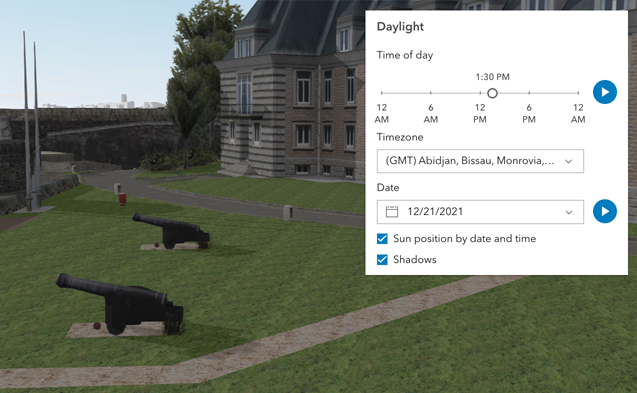](https://developers.arcgis.com/javascript/latest/sample-code/daylight/)\n\nThe component has an option to select the timezone. When the user makes any adjustments here, a new time\nin the chosen timezone is calculated and displayed in the slider. The timezone selector can be disabled\nby using the [hideTimezone](#hideTimezone) property.\n\nBy default, a calendar is displayed to select the day, month, and year.\nWith the [dateOrSeason](#dateOrSeason) property, the calendar can be replaced with\na dropdown menu where a season can be selected instead:\n\n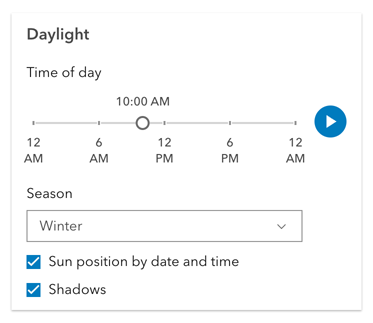\n\nThere are two play buttons: one corresponds to the time-of-day slider and animates the lighting\nover the course of a day, while the other corresponds to the date picker\nand animates the lighting over the course of a year (month by month). The speed of the animation can\nbe set using the [playSpeedMultiplier](#playSpeedMultiplier) property.\n\n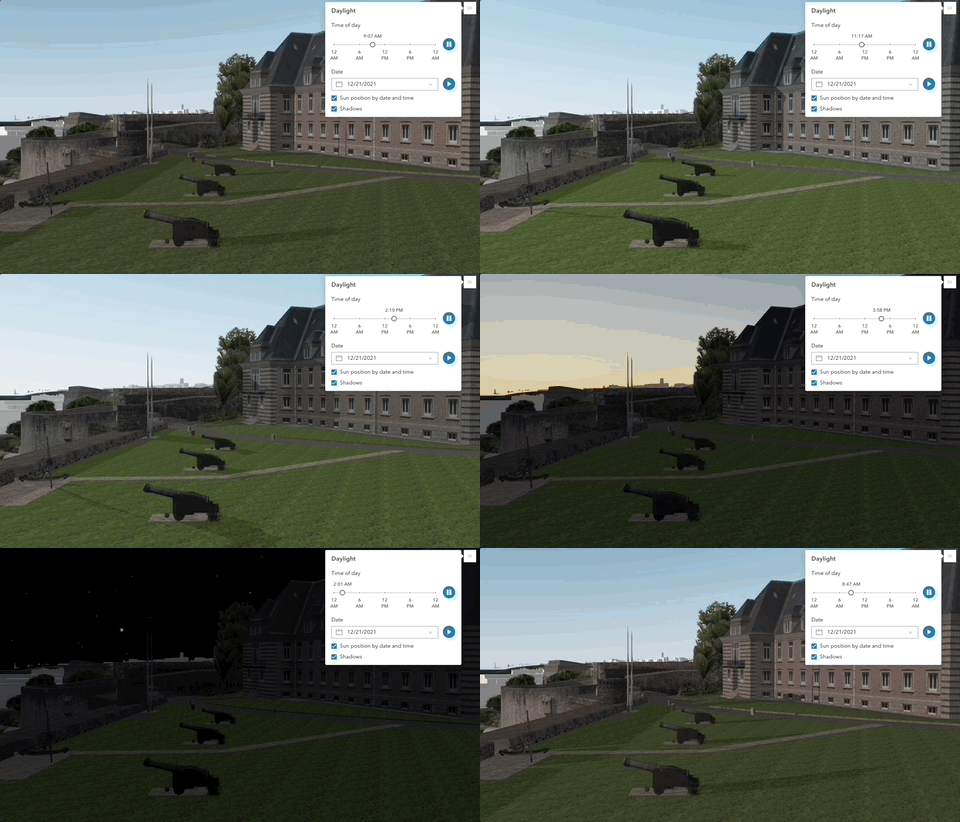\n\nExcept for the daytime slider, all the elements in the Daylight component can be hidden:\n\n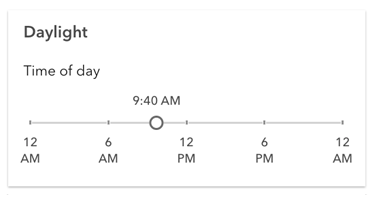\n\nWhenever the sun position option is unchecked, the scene applies the\n**[virtual light](https://developers.arcgis.com/javascript/latest/api-reference/esri-views-3d-environment-VirtualLighting.html)** source relative to the camera.\nWith this, the component's time slider, timezone, and date picker get automatically disabled:\n\n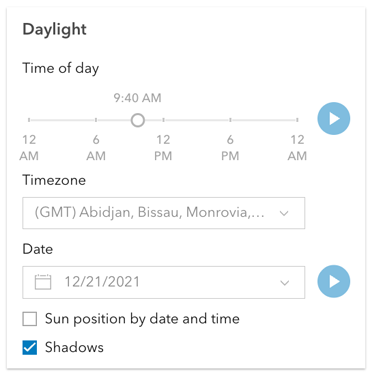\n\n**Things to consider**\n\n* Daylight is only supported in a 3D [Scene](https://developers.arcgis.com/javascript/latest/references/map-components/arcgis-scene/) component.\n* The Daylight component uses UTC time and does not account for the daylight savings times in different countries and regions of the world.\n* When using the [virtual light](https://developers.arcgis.com/javascript/latest/api-reference/esri-views-3d-environment-VirtualLighting.html),\nsetting the time and date programmatically does not have an influence on the lighting conditions of the scene.\n* When using the [sunlight](https://developers.arcgis.com/javascript/latest/api-reference/esri-views-3d-environment-SunLighting.html),\nthe time slider and time zone automatically react to the changes of the camera (e.g., position, rotation, pan, zoom) because the position of the simulated sun\nis updated to maintain a consistent solar time of day based on the camera's current longitude. This can be adjusted using the\n[cameraTrackingEnabled](https://developers.arcgis.com/javascript/latest/api-reference/esri-views-3d-environment-SunLighting.html#cameraTrackingEnabled)\nproperty on [environment.lighting](https://developers.arcgis.com/javascript/latest/references/map-components/arcgis-scene/#environment).\n--\n\n### Events\n- **arcgisReady** - Emitted when the component associated with a map or scene view is ready to be interacted with.\n- **arcgisUserDateTimeChange** - Fires when the user changes the date or time in the component by interacting with the slider, the date picker, the\nseason selector or the play buttons.\n\n### Methods\n- `componentOnReady(): Promise<void>` - Create a promise that resolves once component is fully loaded.\n- `destroy(): Promise<void>` - Permanently destroy the component.",
|
|
2857
2857
|
"doc-url": "https://developers.arcgis.com/javascript/latest/references/map-components/arcgis-daylight/",
|
|
2858
2858
|
"attributes": [
|
|
2859
2859
|
{
|
|
@@ -2866,7 +2866,7 @@
|
|
|
2866
2866
|
},
|
|
2867
2867
|
{
|
|
2868
2868
|
"name": "current-season",
|
|
2869
|
-
"description": "Sets the season that is used when the component displays
|
|
2869
|
+
"description": "Sets the season that is used when the component displays the season picker.\nEach season uses a fixed date corresponding to the seasonal equinoxes and solstices.",
|
|
2870
2870
|
"value": {
|
|
2871
2871
|
"type": [
|
|
2872
2872
|
"\"fall\"",
|
|
@@ -2895,14 +2895,6 @@
|
|
|
2895
2895
|
"type": "boolean"
|
|
2896
2896
|
}
|
|
2897
2897
|
},
|
|
2898
|
-
{
|
|
2899
|
-
"name": "direct-shadows-disabled",
|
|
2900
|
-
"description": "Indicates whether to hide shadows cast by the sun.\n\n**See also**\n\n- [SunLighting.directShadowsEnabled](https://developers.arcgis.com/javascript/latest/api-reference/esri-views-3d-environment-SunLighting.html#directShadowsEnabled)\n- [Scene's `environment`](https://developers.arcgis.com/javascript/latest/references/map-components/arcgis-scene/#environment)",
|
|
2901
|
-
"default": "false",
|
|
2902
|
-
"value": {
|
|
2903
|
-
"type": "boolean"
|
|
2904
|
-
}
|
|
2905
|
-
},
|
|
2906
2898
|
{
|
|
2907
2899
|
"name": "heading-level",
|
|
2908
2900
|
"description": "Indicates the heading level to use for the component title.",
|
|
@@ -2962,7 +2954,7 @@
|
|
|
2962
2954
|
},
|
|
2963
2955
|
{
|
|
2964
2956
|
"name": "icon",
|
|
2965
|
-
"description": "Icon which represents the component. Typically used when the component is controlled by another component (e.g. by the Expand component)
|
|
2957
|
+
"description": "Icon which represents the component. Typically used when the component is controlled by another component (e.g. by the Expand component).",
|
|
2966
2958
|
"default": "\"brightness\"",
|
|
2967
2959
|
"value": {
|
|
2968
2960
|
"type": "string"
|
|
@@ -2993,16 +2985,6 @@
|
|
|
2993
2985
|
"type": "number"
|
|
2994
2986
|
}
|
|
2995
2987
|
},
|
|
2996
|
-
{
|
|
2997
|
-
"name": "playing-state",
|
|
2998
|
-
"value": {
|
|
2999
|
-
"type": [
|
|
3000
|
-
"\"day\"",
|
|
3001
|
-
"\"none\"",
|
|
3002
|
-
"\"year\""
|
|
3003
|
-
]
|
|
3004
|
-
}
|
|
3005
|
-
},
|
|
3006
2988
|
{
|
|
3007
2989
|
"name": "position",
|
|
3008
2990
|
"description": "**Deprecated**: since 4.34, use [`slot`](https://developers.arcgis.com/javascript/latest/building-your-ui/#slots) instead.. ",
|
|
@@ -3027,14 +3009,6 @@
|
|
|
3027
3009
|
"type": "string"
|
|
3028
3010
|
}
|
|
3029
3011
|
},
|
|
3030
|
-
{
|
|
3031
|
-
"name": "sunlighting-disabled",
|
|
3032
|
-
"description": "When set, the light source is positioned relative to the camera, using\n[VirtualLighting](https://developers.arcgis.com/javascript/latest/api-reference/esri-views-3d-environment-VirtualLighting.html).\nOtherwise, [date and time](https://developers.arcgis.com/javascript/latest/api-reference/esri-views-3d-environment-SunLighting.html)\nare used to determine position of the light source.",
|
|
3033
|
-
"default": "false",
|
|
3034
|
-
"value": {
|
|
3035
|
-
"type": "boolean"
|
|
3036
|
-
}
|
|
3037
|
-
},
|
|
3038
3012
|
{
|
|
3039
3013
|
"name": "time-slider-position",
|
|
3040
3014
|
"description": "Slider position for the time of day in the timezone\ngiven by [utcOffset](#utcOffset). The position represents the time\nof the day in minutes. Possible values range between 0 and 1440.",
|
|
@@ -3044,7 +3018,7 @@
|
|
|
3044
3018
|
},
|
|
3045
3019
|
{
|
|
3046
3020
|
"name": "time-slider-steps",
|
|
3047
|
-
"description": "Sets the interval, in minutes, with which the time slider increments or decrements as it is dragged or changed via the keyboard
|
|
3021
|
+
"description": "Sets the interval, in minutes, with which the time slider increments or decrements as it is dragged or changed via the keyboard.",
|
|
3048
3022
|
"default": "5",
|
|
3049
3023
|
"value": {
|
|
3050
3024
|
"type": "number"
|
|
@@ -3087,7 +3061,7 @@
|
|
|
3087
3061
|
},
|
|
3088
3062
|
{
|
|
3089
3063
|
"name": "currentSeason",
|
|
3090
|
-
"description": "Sets the season that is used when the component displays
|
|
3064
|
+
"description": "Sets the season that is used when the component displays the season picker.\nEach season uses a fixed date corresponding to the seasonal equinoxes and solstices.",
|
|
3091
3065
|
"type": "\"fall\" | \"spring\" | \"summer\" | \"winter\""
|
|
3092
3066
|
},
|
|
3093
3067
|
{
|
|
@@ -3100,11 +3074,6 @@
|
|
|
3100
3074
|
"description": "Starts or pauses the daytime animation cycling through the minutes of the day.\nSet the property to `true` to start the animation and to `false` to pause it.",
|
|
3101
3075
|
"type": "boolean"
|
|
3102
3076
|
},
|
|
3103
|
-
{
|
|
3104
|
-
"name": "directShadowsDisabled",
|
|
3105
|
-
"description": "Indicates whether to hide shadows cast by the sun.\n\n**See also**\n\n- [SunLighting.directShadowsEnabled](https://developers.arcgis.com/javascript/latest/api-reference/esri-views-3d-environment-SunLighting.html#directShadowsEnabled)\n- [Scene's `environment`](https://developers.arcgis.com/javascript/latest/references/map-components/arcgis-scene/#environment)",
|
|
3106
|
-
"type": "boolean"
|
|
3107
|
-
},
|
|
3108
3077
|
{
|
|
3109
3078
|
"name": "headingLevel",
|
|
3110
3079
|
"description": "Indicates the heading level to use for the component title.",
|
|
@@ -3136,7 +3105,7 @@
|
|
|
3136
3105
|
},
|
|
3137
3106
|
{
|
|
3138
3107
|
"name": "icon",
|
|
3139
|
-
"description": "Icon which represents the component. Typically used when the component is controlled by another component (e.g. by the Expand component)
|
|
3108
|
+
"description": "Icon which represents the component. Typically used when the component is controlled by another component (e.g. by the Expand component).",
|
|
3140
3109
|
"type": "string"
|
|
3141
3110
|
},
|
|
3142
3111
|
{
|
|
@@ -3149,10 +3118,6 @@
|
|
|
3149
3118
|
"description": "The calendar date in the timezone given by [utcOffset](#utcOffset).",
|
|
3150
3119
|
"type": "Date | number | string"
|
|
3151
3120
|
},
|
|
3152
|
-
{
|
|
3153
|
-
"name": "playingState",
|
|
3154
|
-
"type": "\"day\" | \"none\" | \"year\""
|
|
3155
|
-
},
|
|
3156
3121
|
{
|
|
3157
3122
|
"name": "playSpeedMultiplier",
|
|
3158
3123
|
"description": "Controls the daytime and date animation speed.",
|
|
@@ -3167,15 +3132,6 @@
|
|
|
3167
3132
|
"description": "By assigning the `id` attribute of the Map or Scene component to this property, you can position a child component anywhere in the DOM while still maintaining a connection to the Map or Scene.",
|
|
3168
3133
|
"type": "HTMLArcgisLinkChartElement | HTMLArcgisMapElement | HTMLArcgisSceneElement | string"
|
|
3169
3134
|
},
|
|
3170
|
-
{
|
|
3171
|
-
"name": "sunlightingDisabled",
|
|
3172
|
-
"description": "When set, the light source is positioned relative to the camera, using\n[VirtualLighting](https://developers.arcgis.com/javascript/latest/api-reference/esri-views-3d-environment-VirtualLighting.html).\nOtherwise, [date and time](https://developers.arcgis.com/javascript/latest/api-reference/esri-views-3d-environment-SunLighting.html)\nare used to determine position of the light source.",
|
|
3173
|
-
"type": "boolean"
|
|
3174
|
-
},
|
|
3175
|
-
{
|
|
3176
|
-
"name": "supported",
|
|
3177
|
-
"type": "boolean"
|
|
3178
|
-
},
|
|
3179
3135
|
{
|
|
3180
3136
|
"name": "timeSliderPosition",
|
|
3181
3137
|
"description": "Slider position for the time of day in the timezone\ngiven by [utcOffset](#utcOffset). The position represents the time\nof the day in minutes. Possible values range between 0 and 1440.",
|
|
@@ -3183,8 +3139,8 @@
|
|
|
3183
3139
|
},
|
|
3184
3140
|
{
|
|
3185
3141
|
"name": "timeSliderSteps",
|
|
3186
|
-
"description": "Sets the interval, in minutes, with which the time slider increments or decrements as it is dragged or changed via the keyboard
|
|
3187
|
-
"type": "number"
|
|
3142
|
+
"description": "Sets the interval, in minutes, with which the time slider increments or decrements as it is dragged or changed via the keyboard.",
|
|
3143
|
+
"type": "Array<number> | number"
|
|
3188
3144
|
},
|
|
3189
3145
|
{
|
|
3190
3146
|
"name": "utcOffset",
|
|
@@ -3193,7 +3149,7 @@
|
|
|
3193
3149
|
},
|
|
3194
3150
|
{
|
|
3195
3151
|
"name": "view",
|
|
3196
|
-
"type": "
|
|
3152
|
+
"type": "SceneView"
|
|
3197
3153
|
},
|
|
3198
3154
|
{
|
|
3199
3155
|
"name": "yearPlaying",
|
|
@@ -3393,7 +3349,7 @@
|
|
|
3393
3349
|
},
|
|
3394
3350
|
{
|
|
3395
3351
|
"name": "view",
|
|
3396
|
-
"description": "The view associated with the component. \n > **Note:** The recommended approach is to fully migrate applications to use map and scene components and avoid using MapView and SceneView directly. However, if you are migrating a large application from widgets to components, you might prefer a more gradual transition. To support this use case, the SDK includes this `view` property which connects a component to a MapView or SceneView. Ultimately, once migration is complete, the
|
|
3352
|
+
"description": "The view associated with the component. \n > **Note:** The recommended approach is to fully migrate applications to use map and scene components and avoid using MapView and SceneView directly. However, if you are migrating a large application from widgets to components, you might prefer a more gradual transition. To support this use case, the SDK includes this `view` property which connects a component to a MapView or SceneView. Ultimately, once migration is complete, the Directional Pad component will be associated with a map or scene component rather than using the `view` property.",
|
|
3397
3353
|
"type": "MapView"
|
|
3398
3354
|
},
|
|
3399
3355
|
{
|
|
@@ -3667,7 +3623,7 @@
|
|
|
3667
3623
|
},
|
|
3668
3624
|
{
|
|
3669
3625
|
"name": "view",
|
|
3670
|
-
"description": "The view associated with the component. \n > **Note:** The recommended approach is to fully migrate applications to use map and scene components and avoid using MapView and SceneView directly. However, if you are migrating a large application from widgets to components, you might prefer a more gradual transition. To support this use case, the SDK includes this `view` property which connects a component to a MapView or SceneView. Ultimately, once migration is complete, the
|
|
3626
|
+
"description": "The view associated with the component. \n > **Note:** The recommended approach is to fully migrate applications to use map and scene components and avoid using MapView and SceneView directly. However, if you are migrating a large application from widgets to components, you might prefer a more gradual transition. To support this use case, the SDK includes this `view` property which connects a component to a MapView or SceneView. Ultimately, once migration is complete, the Directions component will be associated with a map or scene component rather than using the `view` property.",
|
|
3671
3627
|
"type": "MapView | SceneView"
|
|
3672
3628
|
}
|
|
3673
3629
|
],
|
|
@@ -3831,7 +3787,7 @@
|
|
|
3831
3787
|
},
|
|
3832
3788
|
{
|
|
3833
3789
|
"name": "view",
|
|
3834
|
-
"description": "The view associated with the component. \n > **Note:** The recommended approach is to fully migrate applications to use map and scene components and avoid using MapView and SceneView directly. However, if you are migrating a large application from widgets to components, you might prefer a more gradual transition. To support this use case, the SDK includes this `view` property which connects a component to a MapView or SceneView. Ultimately, once migration is complete, the
|
|
3790
|
+
"description": "The view associated with the component. \n > **Note:** The recommended approach is to fully migrate applications to use map and scene components and avoid using MapView and SceneView directly. However, if you are migrating a large application from widgets to components, you might prefer a more gradual transition. To support this use case, the SDK includes this `view` property which connects a component to a MapView or SceneView. Ultimately, once migration is complete, the Direct Line Measurement 3D component will be associated with a map or scene component rather than using the `view` property.",
|
|
3835
3791
|
"type": "SceneView"
|
|
3836
3792
|
}
|
|
3837
3793
|
],
|
|
@@ -3996,7 +3952,7 @@
|
|
|
3996
3952
|
},
|
|
3997
3953
|
{
|
|
3998
3954
|
"name": "view",
|
|
3999
|
-
"description": "The view associated with the component. \n > **Note:** The recommended approach is to fully migrate applications to use map and scene components and avoid using MapView and SceneView directly. However, if you are migrating a large application from widgets to components, you might prefer a more gradual transition. To support this use case, the SDK includes this `view` property which connects a component to a MapView or SceneView. Ultimately, once migration is complete, the
|
|
3955
|
+
"description": "The view associated with the component. \n > **Note:** The recommended approach is to fully migrate applications to use map and scene components and avoid using MapView and SceneView directly. However, if you are migrating a large application from widgets to components, you might prefer a more gradual transition. To support this use case, the SDK includes this `view` property which connects a component to a MapView or SceneView. Ultimately, once migration is complete, the Distance Measurement 2D component will be associated with a map or scene component rather than using the `view` property.",
|
|
4000
3956
|
"type": "MapView"
|
|
4001
3957
|
}
|
|
4002
3958
|
],
|
|
@@ -4291,7 +4247,7 @@
|
|
|
4291
4247
|
},
|
|
4292
4248
|
{
|
|
4293
4249
|
"name": "view",
|
|
4294
|
-
"description": "The view associated with the component. \n > **Note:** The recommended approach is to fully migrate applications to use map and scene components and avoid using MapView and SceneView directly. However, if you are migrating a large application from widgets to components, you might prefer a more gradual transition. To support this use case, the SDK includes this `view` property which connects a component to a MapView or SceneView. Ultimately, once migration is complete, the
|
|
4250
|
+
"description": "The view associated with the component. \n > **Note:** The recommended approach is to fully migrate applications to use map and scene components and avoid using MapView and SceneView directly. However, if you are migrating a large application from widgets to components, you might prefer a more gradual transition. To support this use case, the SDK includes this `view` property which connects a component to a MapView or SceneView. Ultimately, once migration is complete, the Editor component will be associated with a map or scene component rather than using the `view` property.",
|
|
4295
4251
|
"type": "MapView | SceneView"
|
|
4296
4252
|
}
|
|
4297
4253
|
],
|
|
@@ -4609,7 +4565,7 @@
|
|
|
4609
4565
|
},
|
|
4610
4566
|
{
|
|
4611
4567
|
"name": "view",
|
|
4612
|
-
"description": "The view associated with the component. \n > **Note:** The recommended approach is to fully migrate applications to use map and scene components and avoid using MapView and SceneView directly. However, if you are migrating a large application from widgets to components, you might prefer a more gradual transition. To support this use case, the SDK includes this `view` property which connects a component to a MapView or SceneView. Ultimately, once migration is complete, the
|
|
4568
|
+
"description": "The view associated with the component. \n > **Note:** The recommended approach is to fully migrate applications to use map and scene components and avoid using MapView and SceneView directly. However, if you are migrating a large application from widgets to components, you might prefer a more gradual transition. To support this use case, the SDK includes this `view` property which connects a component to a MapView or SceneView. Ultimately, once migration is complete, the Elevation Profile component will be associated with a map or scene component rather than using the `view` property.",
|
|
4613
4569
|
"type": "MapView | SceneView"
|
|
4614
4570
|
}
|
|
4615
4571
|
],
|
|
@@ -4960,7 +4916,7 @@
|
|
|
4960
4916
|
},
|
|
4961
4917
|
{
|
|
4962
4918
|
"name": "view",
|
|
4963
|
-
"description": "The view associated with the component. \n > **Note:** The recommended approach is to fully migrate applications to use map and scene components and avoid using MapView and SceneView directly. However, if you are migrating a large application from widgets to components, you might prefer a more gradual transition. To support this use case, the SDK includes this `view` property which connects a component to a MapView or SceneView. Ultimately, once migration is complete, the
|
|
4919
|
+
"description": "The view associated with the component. \n > **Note:** The recommended approach is to fully migrate applications to use map and scene components and avoid using MapView and SceneView directly. However, if you are migrating a large application from widgets to components, you might prefer a more gradual transition. To support this use case, the SDK includes this `view` property which connects a component to a MapView or SceneView. Ultimately, once migration is complete, the Elevation Profile Next component will be associated with a map or scene component rather than using the `view` property.",
|
|
4964
4920
|
"type": "MapView | SceneView"
|
|
4965
4921
|
}
|
|
4966
4922
|
],
|
|
@@ -5272,7 +5228,7 @@
|
|
|
5272
5228
|
},
|
|
5273
5229
|
{
|
|
5274
5230
|
"name": "view",
|
|
5275
|
-
"description": "The view associated with the component. \n > **Note:** The recommended approach is to fully migrate applications to use map and scene components and avoid using MapView and SceneView directly. However, if you are migrating a large application from widgets to components, you might prefer a more gradual transition. To support this use case, the SDK includes this `view` property which connects a component to a MapView or SceneView. Ultimately, once migration is complete, the
|
|
5231
|
+
"description": "The view associated with the component. \n > **Note:** The recommended approach is to fully migrate applications to use map and scene components and avoid using MapView and SceneView directly. However, if you are migrating a large application from widgets to components, you might prefer a more gradual transition. To support this use case, the SDK includes this `view` property which connects a component to a MapView or SceneView. Ultimately, once migration is complete, the Expand component will be associated with a map or scene component rather than using the `view` property.",
|
|
5276
5232
|
"type": "MapView | SceneView"
|
|
5277
5233
|
}
|
|
5278
5234
|
],
|
|
@@ -5292,7 +5248,7 @@
|
|
|
5292
5248
|
},
|
|
5293
5249
|
{
|
|
5294
5250
|
"name": "arcgis-feature",
|
|
5295
|
-
"description": "The Feature component displays a graphic according to its [PopupTemplate](https://developers.arcgis.com/javascript/latest/api-reference/esri-PopupTemplate.html).\nThis component is useful in instances where you want to display information about a feature but without\nthe use of a [Popup](https://developers.arcgis.com/javascript/latest/api-reference/esri-widgets-Popup.html).\n\nIf wanting to show a feature's content with [actions](https://developers.arcgis.com/javascript/latest/api-reference/esri-PopupTemplate.html#actions), [related](https://developers.arcgis.com/javascript/latest/api-reference/esri-popup-content-RelationshipContent.html), or [clustering](https://developers.arcgis.com/javascript/latest/api-reference/esri-layers-support-FeatureReductionCluster.html#popupTemplate), etc., then use the [arcgis-features](https://developers.arcgis.com/javascript/latest/references/map-components/arcgis-features/) component.\n\nWhen Arcade expressions that use `$map` or [geometry functions](https://developers.arcgis.com/arcade/function-reference/geometry_functions/) are defined in any popup template content or as expression elements,\nthe [map](#map) and [spatialReference](#spatialReference) properties need to be defined in the Feature component.\n--\n\n### Events\n- **arcgisPropertyChange** - Emitted when the value of a property is changed. Use this to listen to changes to properties.\n- **arcgisReady** - Emitted when the component associated with a map or scene view is ready to be interacted with.\n\n### Methods\n- `componentOnReady(): Promise<void>` - Create a promise that resolves once component is fully loaded.\n- `destroy(): Promise<void>` - Permanently destroy the component.\n- `nextMedia(contentElementIndex: number): Promise<void>` - Paginates to the next [media](https://developers.arcgis.com/javascript/latest/api-reference/esri-popup-content-MediaContent.html) info.\n- `previousMedia(contentElementIndex: number): Promise<void>` - Paginates to the previous [media](https://developers.arcgis.com/javascript/latest/api-reference/esri-popup-content-MediaContent.html) info
|
|
5251
|
+
"description": "The Feature component displays a graphic according to its [PopupTemplate](https://developers.arcgis.com/javascript/latest/api-reference/esri-PopupTemplate.html).\nThis component is useful in instances where you want to display information about a feature but without\nthe use of a [Popup](https://developers.arcgis.com/javascript/latest/api-reference/esri-widgets-Popup.html).\n\nIf wanting to show a feature's content with [actions](https://developers.arcgis.com/javascript/latest/api-reference/esri-PopupTemplate.html#actions), [related](https://developers.arcgis.com/javascript/latest/api-reference/esri-popup-content-RelationshipContent.html), or [clustering](https://developers.arcgis.com/javascript/latest/api-reference/esri-layers-support-FeatureReductionCluster.html#popupTemplate), etc., then use the [arcgis-features](https://developers.arcgis.com/javascript/latest/references/map-components/arcgis-features/) component.\n\nWhen Arcade expressions that use `$map` or [geometry functions](https://developers.arcgis.com/arcade/function-reference/geometry_functions/) are defined in any popup template content or as expression elements,\nthe [map](#map) and [spatialReference](#spatialReference) properties need to be defined in the Feature component.\n--\n\n### Events\n- **arcgisPropertyChange** - Emitted when the value of a property is changed. Use this to listen to changes to properties.\n- **arcgisReady** - Emitted when the component associated with a map or scene view is ready to be interacted with.\n\n### Methods\n- `componentOnReady(): Promise<void>` - Create a promise that resolves once component is fully loaded.\n- `destroy(): Promise<void>` - Permanently destroy the component.\n- `nextMedia(contentElementIndex: number): Promise<void>` - Paginates to the next [media](https://developers.arcgis.com/javascript/latest/api-reference/esri-popup-content-MediaContent.html) info.\n- `previousMedia(contentElementIndex: number): Promise<void>` - Paginates to the previous [media](https://developers.arcgis.com/javascript/latest/api-reference/esri-popup-content-MediaContent.html) info.\n- `setActiveMedia(contentElementIndex: number, mediaInfoIndex: number): Promise<void>` - Paginates to a specified [media](https://developers.arcgis.com/javascript/latest/api-reference/esri-popup-content-MediaContent.html) info object. For example,\nyou may have [media](https://developers.arcgis.com/javascript/latest/api-reference/esri-popup-content-MediaContent.html) content which contains\nmultiple `mediaInfos`. This method allows you to specify the index of the `mediaInfos`\nyou wish to display.\n- `updateGeometry(): Promise<void>` - Updates the geometry of the graphic.",
|
|
5296
5252
|
"doc-url": "https://developers.arcgis.com/javascript/latest/references/map-components/arcgis-feature/",
|
|
5297
5253
|
"attributes": [
|
|
5298
5254
|
{
|
|
@@ -5511,7 +5467,7 @@
|
|
|
5511
5467
|
},
|
|
5512
5468
|
{
|
|
5513
5469
|
"name": "show-utility-network-content",
|
|
5514
|
-
"description": "This property provides the ability to hide or show [utility network content](https://developers.arcgis.com/javascript/latest/api-reference/esri-popup-content-
|
|
5470
|
+
"description": "This property provides the ability to hide or show [utility network content](https://developers.arcgis.com/javascript/latest/api-reference/esri-popup-content-UtilityNetworkAssociationsContent.html) within the component.",
|
|
5515
5471
|
"default": "false",
|
|
5516
5472
|
"value": {
|
|
5517
5473
|
"type": "boolean"
|
|
@@ -5567,11 +5523,6 @@
|
|
|
5567
5523
|
"description": "Enables automatic creation of a popup template for layers that have popups enabled but no\npopupTemplate defined. Automatic popup templates are supported for layers that\nsupport the `createPopupTemplate()` method. (Supported for\n[FeatureLayer](https://developers.arcgis.com/javascript/latest/api-reference/esri-layers-FeatureLayer.html),\n[GeoJSONLayer](https://developers.arcgis.com/javascript/latest/api-reference/esri-layers-GeoJSONLayer.html),\n[SceneLayer](https://developers.arcgis.com/javascript/latest/api-reference/esri-layers-SceneLayer.html),\n[CSVLayer](https://developers.arcgis.com/javascript/latest/api-reference/esri-layers-CSVLayer.html),\n[OGCFeatureLayer](https://developers.arcgis.com/javascript/latest/api-reference/esri-layers-OGCFeatureLayer.html)\n[PointCloudLayer](https://developers.arcgis.com/javascript/latest/api-reference/esri-layers-PointCloudLayer.html),\n[StreamLayer](https://developers.arcgis.com/javascript/latest/api-reference/esri-layers-StreamLayer.html), and\n[ImageryLayer](https://developers.arcgis.com/javascript/latest/api-reference/esri-layers-ImageryLayer.html)).\n\n**Note:**\nStarting with version 4.28, `date` fields are formatted using the `short-date-short-time` preset [dateFormat](https://developers.arcgis.com/javascript/latest/api-reference/esri-popup-support-FieldInfoFormat.html#dateFormat)\nrather than `long-month-day-year` in the default [popup](https://developers.arcgis.com/javascript/latest/api-reference/esri-PopupTemplate.html) created by setting the `defaultPopupTemplateEnabled` property to `true`.\nFor example, previously a date that may have appeared as `\"December 30, 1997\"` will now appear as `\"12/30/1997 6:00 PM\"`.",
|
|
5568
5524
|
"type": "boolean"
|
|
5569
5525
|
},
|
|
5570
|
-
{
|
|
5571
|
-
"name": "flowItems",
|
|
5572
|
-
"description": "A collection of flow items that are used to manage drill-in navigation.",
|
|
5573
|
-
"type": "Collection<HTMLArcgisFeatureElement | HTMLArcgisFeatureRelationshipElement | HTMLArcgisFeatureUtilityNetworkAssociationsElement>"
|
|
5574
|
-
},
|
|
5575
5526
|
{
|
|
5576
5527
|
"name": "graphic",
|
|
5577
5528
|
"description": "The [Graphic](https://developers.arcgis.com/javascript/latest/api-reference/esri-Graphic.html) used to represent the feature.",
|
|
@@ -5694,7 +5645,7 @@
|
|
|
5694
5645
|
},
|
|
5695
5646
|
{
|
|
5696
5647
|
"name": "messageOverrides",
|
|
5697
|
-
"description": "
|
|
5648
|
+
"description": "Replace localized message strings with your own strings.\n\n_**Note**: Individual message keys may change between releases._",
|
|
5698
5649
|
"type": "Record<string, unknown>"
|
|
5699
5650
|
},
|
|
5700
5651
|
{
|
|
@@ -5713,7 +5664,7 @@
|
|
|
5713
5664
|
},
|
|
5714
5665
|
{
|
|
5715
5666
|
"name": "showUtilityNetworkContent",
|
|
5716
|
-
"description": "This property provides the ability to hide or show [utility network content](https://developers.arcgis.com/javascript/latest/api-reference/esri-popup-content-
|
|
5667
|
+
"description": "This property provides the ability to hide or show [utility network content](https://developers.arcgis.com/javascript/latest/api-reference/esri-popup-content-UtilityNetworkAssociationsContent.html) within the component.",
|
|
5717
5668
|
"type": "boolean"
|
|
5718
5669
|
},
|
|
5719
5670
|
{
|
|
@@ -5733,7 +5684,7 @@
|
|
|
5733
5684
|
},
|
|
5734
5685
|
{
|
|
5735
5686
|
"name": "view",
|
|
5736
|
-
"description": "The view associated with the component. \n > **Note:** The recommended approach is to fully migrate applications to use map and scene components and avoid using MapView and SceneView directly. However, if you are migrating a large application from widgets to components, you might prefer a more gradual transition. To support this use case, the SDK includes this `view` property which connects a component to a MapView or SceneView. Ultimately, once migration is complete, the
|
|
5687
|
+
"description": "The view associated with the component. \n > **Note:** The recommended approach is to fully migrate applications to use map and scene components and avoid using MapView and SceneView directly. However, if you are migrating a large application from widgets to components, you might prefer a more gradual transition. To support this use case, the SDK includes this `view` property which connects a component to a MapView or SceneView. Ultimately, once migration is complete, the Feature component will be associated with a map or scene component rather than using the `view` property.",
|
|
5737
5688
|
"type": "MapView | SceneView"
|
|
5738
5689
|
},
|
|
5739
5690
|
{
|
|
@@ -6910,7 +6861,7 @@
|
|
|
6910
6861
|
},
|
|
6911
6862
|
{
|
|
6912
6863
|
"name": "view",
|
|
6913
|
-
"description": "The view associated with the component. \n > **Note:** The recommended approach is to fully migrate applications to use map and scene components and avoid using MapView and SceneView directly. However, if you are migrating a large application from widgets to components, you might prefer a more gradual transition. To support this use case, the SDK includes this `view` property which connects a component to a MapView or SceneView. Ultimately, once migration is complete, the
|
|
6864
|
+
"description": "The view associated with the component. \n > **Note:** The recommended approach is to fully migrate applications to use map and scene components and avoid using MapView and SceneView directly. However, if you are migrating a large application from widgets to components, you might prefer a more gradual transition. To support this use case, the SDK includes this `view` property which connects a component to a MapView or SceneView. Ultimately, once migration is complete, the Feature Table component will be associated with a map or scene component rather than using the `view` property.",
|
|
6914
6865
|
"type": "LinkChartView | MapView | SceneView"
|
|
6915
6866
|
},
|
|
6916
6867
|
{
|
|
@@ -7887,7 +7838,7 @@
|
|
|
7887
7838
|
},
|
|
7888
7839
|
{
|
|
7889
7840
|
"name": "view",
|
|
7890
|
-
"description": "The view associated with the component. \n > **Note:** The recommended approach is to fully migrate applications to use map and scene components and avoid using MapView and SceneView directly. However, if you are migrating a large application from widgets to components, you might prefer a more gradual transition. To support this use case, the SDK includes this `view` property which connects a component to a MapView or SceneView. Ultimately, once migration is complete, the
|
|
7841
|
+
"description": "The view associated with the component. \n > **Note:** The recommended approach is to fully migrate applications to use map and scene components and avoid using MapView and SceneView directly. However, if you are migrating a large application from widgets to components, you might prefer a more gradual transition. To support this use case, the SDK includes this `view` property which connects a component to a MapView or SceneView. Ultimately, once migration is complete, the Floor Filter component will be associated with a map or scene component rather than using the `view` property.",
|
|
7891
7842
|
"type": "MapView | SceneView"
|
|
7892
7843
|
}
|
|
7893
7844
|
],
|
|
@@ -8439,7 +8390,7 @@
|
|
|
8439
8390
|
},
|
|
8440
8391
|
{
|
|
8441
8392
|
"name": "view",
|
|
8442
|
-
"description": "The view associated with the component. \n > **Note:** The recommended approach is to fully migrate applications to use map and scene components and avoid using MapView and SceneView directly. However, if you are migrating a large application from widgets to components, you might prefer a more gradual transition. To support this use case, the SDK includes this `view` property which connects a component to a MapView or SceneView. Ultimately, once migration is complete, the
|
|
8393
|
+
"description": "The view associated with the component. \n > **Note:** The recommended approach is to fully migrate applications to use map and scene components and avoid using MapView and SceneView directly. However, if you are migrating a large application from widgets to components, you might prefer a more gradual transition. To support this use case, the SDK includes this `view` property which connects a component to a MapView or SceneView. Ultimately, once migration is complete, the Grid Controls component will be associated with a map or scene component rather than using the `view` property.",
|
|
8443
8394
|
"type": "MapView"
|
|
8444
8395
|
}
|
|
8445
8396
|
],
|
|
@@ -8854,7 +8805,7 @@
|
|
|
8854
8805
|
},
|
|
8855
8806
|
{
|
|
8856
8807
|
"name": "view",
|
|
8857
|
-
"description": "The view associated with the component. \n > **Note:** The recommended approach is to fully migrate applications to use map and scene components and avoid using MapView and SceneView directly. However, if you are migrating a large application from widgets to components, you might prefer a more gradual transition. To support this use case, the SDK includes this `view` property which connects a component to a MapView or SceneView. Ultimately, once migration is complete, the
|
|
8808
|
+
"description": "The view associated with the component. \n > **Note:** The recommended approach is to fully migrate applications to use map and scene components and avoid using MapView and SceneView directly. However, if you are migrating a large application from widgets to components, you might prefer a more gradual transition. To support this use case, the SDK includes this `view` property which connects a component to a MapView or SceneView. Ultimately, once migration is complete, the Home component will be associated with a map or scene component rather than using the `view` property.",
|
|
8858
8809
|
"type": "MapView | SceneView"
|
|
8859
8810
|
},
|
|
8860
8811
|
{
|
|
@@ -9279,7 +9230,7 @@
|
|
|
9279
9230
|
},
|
|
9280
9231
|
{
|
|
9281
9232
|
"name": "view",
|
|
9282
|
-
"description": "The view associated with the component. \n > **Note:** The recommended approach is to fully migrate applications to use map and scene components and avoid using MapView and SceneView directly. However, if you are migrating a large application from widgets to components, you might prefer a more gradual transition. To support this use case, the SDK includes this `view` property which connects a component to a MapView or SceneView. Ultimately, once migration is complete, the
|
|
9233
|
+
"description": "The view associated with the component. \n > **Note:** The recommended approach is to fully migrate applications to use map and scene components and avoid using MapView and SceneView directly. However, if you are migrating a large application from widgets to components, you might prefer a more gradual transition. To support this use case, the SDK includes this `view` property which connects a component to a MapView or SceneView. Ultimately, once migration is complete, the Layer List component will be associated with a map or scene component rather than using the `view` property.",
|
|
9283
9234
|
"type": "MapView | SceneView"
|
|
9284
9235
|
},
|
|
9285
9236
|
{
|
|
@@ -9314,7 +9265,7 @@
|
|
|
9314
9265
|
},
|
|
9315
9266
|
{
|
|
9316
9267
|
"name": "arcgis-legend",
|
|
9317
|
-
"description": "The Legend component displays the symbols and labels used to represent layers in a [arcgis-map](https://developers.arcgis.com/javascript/latest/references/map-components/arcgis-map/) or [arcgis-scene](https://developers.arcgis.com/javascript/latest/references/map-components/arcgis-scene/).\nOnly layers and sublayers visible in the view are shown, unless [ignoreLayerVisibility](https://developers.arcgis.com/javascript/latest/references/map-components/arcgis-legend/#ignoreLayerVisibility) is set to `true`.\n\nThe legend automatically updates when:\n - the visibility of a layer or sublayer changes\n - a layer is added or removed from the map\n - a layer's `renderer`, `opacity`, or `title` is changed\n - the `legendEnabled` property is changed (set to `true` or `false` on the layer)\n\n## Known Limitations\n\n* Currently, the legend component does not support the following layer types:\n[ElevationLayer](https://developers.arcgis.com/javascript/latest/api-reference/esri-layers-ElevationLayer.html),\n[GraphicsLayer](https://developers.arcgis.com/javascript/latest/api-reference/esri-layers-GraphicsLayer.html),\n[IntegratedMeshLayer](https://developers.arcgis.com/javascript/latest/api-reference/esri-layers-IntegratedMeshLayer.html),\n[KMLLayer](https://developers.arcgis.com/javascript/latest/api-reference/esri-layers-KMLLayer.html),\n[MapNotesLayer](https://developers.arcgis.com/javascript/latest/api-reference/esri-layers-MapNotesLayer.html),\n[OpenStreetMapLayer](https://developers.arcgis.com/javascript/latest/api-reference/esri-layers-OpenStreetMapLayer.html),\n[VectorTileLayer](https://developers.arcgis.com/javascript/latest/api-reference/esri-layers-VectorTileLayer.html),\n[VideoLayer](https://developers.arcgis.com/javascript/latest/api-reference/esri-layers-VideoLayer.html), and\n[WebTileLayer](https://developers.arcgis.com/javascript/latest/api-reference/esri-layers-WebTileLayer.html).\n* [Symbol3D](https://developers.arcgis.com/javascript/latest/api-reference/esri-symbols-Symbol3D.html) with more than one\n[symbol](https://developers.arcgis.com/javascript/latest/api-reference/esri-symbols-Symbol3DLayer.html) are not supported.\n* [DictionaryRenderer](https://developers.arcgis.com/javascript/latest/api-reference/esri-renderers-DictionaryRenderer.html) is not supported.\n* [TrackInfo](https://developers.arcgis.com/javascript/latest/api-reference/esri-layers-support-TrackInfo.html) is not supported.\n* CIM Symbol [primitiveOverride](https://developers.arcgis.com/javascript/latest/api-reference/esri-symbols-CIMSymbol.html#PrimitiveOverride) is not supported.\n* RasterStretchRenderer [dynamicRangeAdjustment](https://developers.arcgis.com/javascript/latest/api-reference/esri-renderers-RasterStretchRenderer.html#dynamicRangeAdjustment) is not supported.\n\n## Various examples of legends based on renderer type.\n\n### Unique values\n\n[](https://developers.arcgis.com/javascript/latest/sample-code/visualization-location-types/)\n\n### Continuous color\n\n[](https://developers.arcgis.com/javascript/latest/sample-code/visualization-vv-color/)\n\n### Classed color\n\n[](https://developers.arcgis.com/javascript/latest/sample-code/visualization-classbreaks/)\n\n### Continuous size\n\n[](https://developers.arcgis.com/javascript/latest/sample-code/visualization-sm-size/)\n\n### Size - above and below\n\n[](https://developers.arcgis.com/javascript/latest/sample-code/visualization-sm-size-themes/)\n\n### Dot density\n\n[](https://developers.arcgis.com/javascript/latest/sample-code/visualization-dot-density/)\n\n### Predominance\n\n[](https://developers.arcgis.com/javascript/latest/sample-code/visualization-arcade/)\n\n### Relationship\n\n[](https://developers.arcgis.com/javascript/latest/sample-code/visualization-sm-relationship/)\n\n\n
|
|
9268
|
+
"description": "The Legend component displays the symbols and labels used to represent layers in a [arcgis-map](https://developers.arcgis.com/javascript/latest/references/map-components/arcgis-map/) or [arcgis-scene](https://developers.arcgis.com/javascript/latest/references/map-components/arcgis-scene/).\nOnly layers and sublayers visible in the view are shown, unless [ignoreLayerVisibility](https://developers.arcgis.com/javascript/latest/references/map-components/arcgis-legend/#ignoreLayerVisibility) is set to `true`.\n\nThe legend automatically updates when:\n - the visibility of a layer or sublayer changes\n - a layer is added or removed from the map\n - a layer's `renderer`, `opacity`, or `title` is changed\n - the `legendEnabled` property is changed (set to `true` or `false` on the layer)\n\n## Known Limitations\n\n* Currently, the legend component does not support the following layer types:\n[ElevationLayer](https://developers.arcgis.com/javascript/latest/api-reference/esri-layers-ElevationLayer.html),\n[GraphicsLayer](https://developers.arcgis.com/javascript/latest/api-reference/esri-layers-GraphicsLayer.html),\n[IntegratedMeshLayer](https://developers.arcgis.com/javascript/latest/api-reference/esri-layers-IntegratedMeshLayer.html),\n[KMLLayer](https://developers.arcgis.com/javascript/latest/api-reference/esri-layers-KMLLayer.html),\n[MapNotesLayer](https://developers.arcgis.com/javascript/latest/api-reference/esri-layers-MapNotesLayer.html),\n[OpenStreetMapLayer](https://developers.arcgis.com/javascript/latest/api-reference/esri-layers-OpenStreetMapLayer.html),\n[VectorTileLayer](https://developers.arcgis.com/javascript/latest/api-reference/esri-layers-VectorTileLayer.html),\n[VideoLayer](https://developers.arcgis.com/javascript/latest/api-reference/esri-layers-VideoLayer.html), and\n[WebTileLayer](https://developers.arcgis.com/javascript/latest/api-reference/esri-layers-WebTileLayer.html).\n* [Symbol3D](https://developers.arcgis.com/javascript/latest/api-reference/esri-symbols-Symbol3D.html) with more than one\n[symbol](https://developers.arcgis.com/javascript/latest/api-reference/esri-symbols-Symbol3DLayer.html) are not supported.\n* [DictionaryRenderer](https://developers.arcgis.com/javascript/latest/api-reference/esri-renderers-DictionaryRenderer.html) is not supported.\n* [TrackInfo](https://developers.arcgis.com/javascript/latest/api-reference/esri-layers-support-TrackInfo.html) is not supported.\n* CIM Symbol [primitiveOverride](https://developers.arcgis.com/javascript/latest/api-reference/esri-symbols-CIMSymbol.html#PrimitiveOverride) is not supported.\n* RasterStretchRenderer [dynamicRangeAdjustment](https://developers.arcgis.com/javascript/latest/api-reference/esri-renderers-RasterStretchRenderer.html#dynamicRangeAdjustment) is not supported.\n\n## Various examples of legends based on renderer type.\n\n### Unique values\n\n[](https://developers.arcgis.com/javascript/latest/sample-code/visualization-location-types/)\n\n### Continuous color\n\n[](https://developers.arcgis.com/javascript/latest/sample-code/visualization-vv-color/)\n\n### Classed color\n\n[](https://developers.arcgis.com/javascript/latest/sample-code/visualization-classbreaks/)\n\n### Continuous size\n\n[](https://developers.arcgis.com/javascript/latest/sample-code/visualization-sm-size/)\n\n### Size - above and below\n\n[](https://developers.arcgis.com/javascript/latest/sample-code/visualization-sm-size-themes/)\n\n### Dot density\n\n[](https://developers.arcgis.com/javascript/latest/sample-code/visualization-dot-density/)\n\n### Predominance\n\n[](https://developers.arcgis.com/javascript/latest/sample-code/visualization-arcade/)\n\n### Relationship\n\n[](https://developers.arcgis.com/javascript/latest/sample-code/visualization-sm-relationship/)\n\n\n## Legend Field Formatting Priority\n\nThe following list summarizes how legend field values are formatted for different renderer and visual variable types, and the order in which formatting options are applied.\n\n * **Visual variable stops (color, opacity, size)**\n * Data source:\n * Number field\n 1. Use `stop.label` if present\n 2. Use [FieldConfiguration](https://developers.arcgis.com/javascript/latest/api-reference/esri-layers-support-FieldConfiguration.html) formatting\n 3. Use default precision formatting with grouping\n * Number field with normalization field\n 1. Use `stop.label` if present\n 2. Use FieldConfiguration (applies to main field, not normalization field)\n 3. Use default precision formatting with grouping\n * Notes:\n * If any stop has a label, it is used directly; otherwise, labels are generated at runtime. See [ColorStop](https://developers.arcgis.com/javascript/latest/api-reference/esri-renderers-visualVariables-support-ColorStop.html), [OpacityStop](https://developers.arcgis.com/javascript/latest/api-reference/esri-renderers-visualVariables-support-OpacityStop.html), and [SizeStop](https://developers.arcgis.com/javascript/latest/api-reference/esri-renderers-visualVariables-support-SizeStop.html).\n * For normalization fields, only the main field’s formatting is used, not the normalization field. See [ColorVariable](https://developers.arcgis.com/javascript/latest/api-reference/esri-renderers-visualVariables-ColorVariable.html#normalizationField), [OpacityVariable](https://developers.arcgis.com/javascript/latest/api-reference/esri-renderers-visualVariables-OpacityVariable.html#normalizationField), and [SizeVariable](https://developers.arcgis.com/javascript/latest/api-reference/esri-renderers-visualVariables-SizeVariable.html#normalizationField).\n * **Visual variable (valueExpression)**\n 1. Use `stop.label` if present\n 2. Use default precision formatting with grouping\n * Note: Since there’s no field, field formatting does not apply; fallback is default formatting. See [VisualVariable value expressions](https://developers.arcgis.com/javascript/latest/api-reference/esri-renderers-visualVariables-ColorVariable.html#valueExpression).\n * **Unique-value renderer labels**\n 1. Use UniqueValueRenderer class label if present\n 2. Use domain name\n 3. Use FieldConfiguration formatting\n 4. Use [PopupTemplate](https://developers.arcgis.com/javascript/latest/api-reference/esri-PopupTemplate.html) formatting\n 5. Use raw field value (if string) or default precision formatting with grouping (for number)\n * **Renderer title**\n 1. Use FieldConfiguration formatting\n 2. Use PopupTemplate formatting\n * **General notes**\n * Labels generated at runtime by the legend are not persisted in the WebMap or Layer.\n--\n\n### Events\n- **arcgisPropertyChange** - Emitted when the value of a property is changed. Use this to listen to changes to properties.\n- **arcgisReady** - Emitted when the component associated with a map or scene view is ready to be interacted with.\n\n### Methods\n- `componentOnReady(): Promise<void>` - Create a promise that resolves once component is fully loaded.\n- `destroy(): Promise<void>` - Permanently destroy the component.",
|
|
9318
9269
|
"doc-url": "https://developers.arcgis.com/javascript/latest/references/map-components/arcgis-legend/",
|
|
9319
9270
|
"attributes": [
|
|
9320
9271
|
{
|
|
@@ -9538,7 +9489,7 @@
|
|
|
9538
9489
|
},
|
|
9539
9490
|
{
|
|
9540
9491
|
"name": "messageOverrides",
|
|
9541
|
-
"description": "
|
|
9492
|
+
"description": "Replace localized message strings with your own strings.\n\n_**Note**: Individual message keys may change between releases._",
|
|
9542
9493
|
"type": "Record<string, unknown>"
|
|
9543
9494
|
},
|
|
9544
9495
|
{
|
|
@@ -9567,7 +9518,7 @@
|
|
|
9567
9518
|
},
|
|
9568
9519
|
{
|
|
9569
9520
|
"name": "view",
|
|
9570
|
-
"description": "The view associated with the component. \n > **Note:** The recommended approach is to fully migrate applications to use map and scene components and avoid using MapView and SceneView directly. However, if you are migrating a large application from widgets to components, you might prefer a more gradual transition. To support this use case, the SDK includes this `view` property which connects a component to a MapView or SceneView. Ultimately, once migration is complete, the
|
|
9521
|
+
"description": "The view associated with the component. \n > **Note:** The recommended approach is to fully migrate applications to use map and scene components and avoid using MapView and SceneView directly. However, if you are migrating a large application from widgets to components, you might prefer a more gradual transition. To support this use case, the SDK includes this `view` property which connects a component to a MapView or SceneView. Ultimately, once migration is complete, the Legend component will be associated with a map or scene component rather than using the `view` property.",
|
|
9571
9522
|
"type": "MapView | SceneView"
|
|
9572
9523
|
}
|
|
9573
9524
|
],
|
|
@@ -9705,7 +9656,7 @@
|
|
|
9705
9656
|
},
|
|
9706
9657
|
{
|
|
9707
9658
|
"name": "view",
|
|
9708
|
-
"description": "The view associated with the component. \n > **Note:** The recommended approach is to fully migrate applications to use map and scene components and avoid using MapView and SceneView directly. However, if you are migrating a large application from widgets to components, you might prefer a more gradual transition. To support this use case, the SDK includes this `view` property which connects a component to a MapView or SceneView. Ultimately, once migration is complete, the
|
|
9659
|
+
"description": "The view associated with the component. \n > **Note:** The recommended approach is to fully migrate applications to use map and scene components and avoid using MapView and SceneView directly. However, if you are migrating a large application from widgets to components, you might prefer a more gradual transition. To support this use case, the SDK includes this `view` property which connects a component to a MapView or SceneView. Ultimately, once migration is complete, the Line Of Sight component will be associated with a map or scene component rather than using the `view` property.",
|
|
9709
9660
|
"type": "SceneView"
|
|
9710
9661
|
}
|
|
9711
9662
|
],
|
|
@@ -10506,7 +10457,7 @@
|
|
|
10506
10457
|
},
|
|
10507
10458
|
{
|
|
10508
10459
|
"name": "view",
|
|
10509
|
-
"description": "The view associated with the component. \n > **Note:** The recommended approach is to fully migrate applications to use map and scene components and avoid using MapView and SceneView directly. However, if you are migrating a large application from widgets to components, you might prefer a more gradual transition. To support this use case, the SDK includes this `view` property which connects a component to a MapView or SceneView. Ultimately, once migration is complete, the
|
|
10460
|
+
"description": "The view associated with the component. \n > **Note:** The recommended approach is to fully migrate applications to use map and scene components and avoid using MapView and SceneView directly. However, if you are migrating a large application from widgets to components, you might prefer a more gradual transition. To support this use case, the SDK includes this `view` property which connects a component to a MapView or SceneView. Ultimately, once migration is complete, the Link Chart Layout Switcher component will be associated with a map or scene component rather than using the `view` property.",
|
|
10510
10461
|
"type": "LinkChartView"
|
|
10511
10462
|
}
|
|
10512
10463
|
],
|
|
@@ -10703,7 +10654,7 @@
|
|
|
10703
10654
|
},
|
|
10704
10655
|
{
|
|
10705
10656
|
"name": "view",
|
|
10706
|
-
"description": "The view associated with the component. \n > **Note:** The recommended approach is to fully migrate applications to use map and scene components and avoid using MapView and SceneView directly. However, if you are migrating a large application from widgets to components, you might prefer a more gradual transition. To support this use case, the SDK includes this `view` property which connects a component to a MapView or SceneView. Ultimately, once migration is complete, the
|
|
10657
|
+
"description": "The view associated with the component. \n > **Note:** The recommended approach is to fully migrate applications to use map and scene components and avoid using MapView and SceneView directly. However, if you are migrating a large application from widgets to components, you might prefer a more gradual transition. To support this use case, the SDK includes this `view` property which connects a component to a MapView or SceneView. Ultimately, once migration is complete, the Locate component will be associated with a map or scene component rather than using the `view` property.",
|
|
10707
10658
|
"type": "MapView | SceneView"
|
|
10708
10659
|
}
|
|
10709
10660
|
],
|
|
@@ -11578,7 +11529,7 @@
|
|
|
11578
11529
|
},
|
|
11579
11530
|
{
|
|
11580
11531
|
"name": "view",
|
|
11581
|
-
"description": "The view associated with the component. \n > **Note:** The recommended approach is to fully migrate applications to use map and scene components and avoid using MapView and SceneView directly. However, if you are migrating a large application from widgets to components, you might prefer a more gradual transition. To support this use case, the SDK includes this `view` property which connects a component to a MapView or SceneView. Ultimately, once migration is complete, the
|
|
11532
|
+
"description": "The view associated with the component. \n > **Note:** The recommended approach is to fully migrate applications to use map and scene components and avoid using MapView and SceneView directly. However, if you are migrating a large application from widgets to components, you might prefer a more gradual transition. To support this use case, the SDK includes this `view` property which connects a component to a MapView or SceneView. Ultimately, once migration is complete, the Measurement component will be associated with a map or scene component rather than using the `view` property.",
|
|
11582
11533
|
"type": "MapView | SceneView"
|
|
11583
11534
|
}
|
|
11584
11535
|
],
|
|
@@ -11727,7 +11678,7 @@
|
|
|
11727
11678
|
},
|
|
11728
11679
|
{
|
|
11729
11680
|
"name": "view",
|
|
11730
|
-
"description": "The view associated with the component. \n > **Note:** The recommended approach is to fully migrate applications to use map and scene components and avoid using MapView and SceneView directly. However, if you are migrating a large application from widgets to components, you might prefer a more gradual transition. To support this use case, the SDK includes this `view` property which connects a component to a MapView or SceneView. Ultimately, once migration is complete, the
|
|
11681
|
+
"description": "The view associated with the component. \n > **Note:** The recommended approach is to fully migrate applications to use map and scene components and avoid using MapView and SceneView directly. However, if you are migrating a large application from widgets to components, you might prefer a more gradual transition. To support this use case, the SDK includes this `view` property which connects a component to a MapView or SceneView. Ultimately, once migration is complete, the Navigation Toggle component will be associated with a map or scene component rather than using the `view` property.",
|
|
11731
11682
|
"type": "SceneView"
|
|
11732
11683
|
}
|
|
11733
11684
|
],
|
|
@@ -11993,7 +11944,7 @@
|
|
|
11993
11944
|
},
|
|
11994
11945
|
{
|
|
11995
11946
|
"name": "view",
|
|
11996
|
-
"description": "The view associated with the component. \n > **Note:** The recommended approach is to fully migrate applications to use map and scene components and avoid using MapView and SceneView directly. However, if you are migrating a large application from widgets to components, you might prefer a more gradual transition. To support this use case, the SDK includes this `view` property which connects a component to a MapView or SceneView. Ultimately, once migration is complete, the
|
|
11947
|
+
"description": "The view associated with the component. \n > **Note:** The recommended approach is to fully migrate applications to use map and scene components and avoid using MapView and SceneView directly. However, if you are migrating a large application from widgets to components, you might prefer a more gradual transition. To support this use case, the SDK includes this `view` property which connects a component to a MapView or SceneView. Ultimately, once migration is complete, the Oriented Imagery Viewer component will be associated with a map or scene component rather than using the `view` property.",
|
|
11997
11948
|
"type": "MapView | SceneView"
|
|
11998
11949
|
}
|
|
11999
11950
|
],
|
|
@@ -12061,7 +12012,7 @@
|
|
|
12061
12012
|
},
|
|
12062
12013
|
{
|
|
12063
12014
|
"name": "view",
|
|
12064
|
-
"description": "The view associated with the component. \n > **Note:** The recommended approach is to fully migrate applications to use map and scene components and avoid using MapView and SceneView directly. However, if you are migrating a large application from widgets to components, you might prefer a more gradual transition. To support this use case, the SDK includes this `view` property which connects a component to a MapView or SceneView. Ultimately, once migration is complete, the
|
|
12015
|
+
"description": "The view associated with the component. \n > **Note:** The recommended approach is to fully migrate applications to use map and scene components and avoid using MapView and SceneView directly. However, if you are migrating a large application from widgets to components, you might prefer a more gradual transition. To support this use case, the SDK includes this `view` property which connects a component to a MapView or SceneView. Ultimately, once migration is complete, the Placement component will be associated with a map or scene component rather than using the `view` property.",
|
|
12065
12016
|
"type": "LinkChartView | MapView | SceneView"
|
|
12066
12017
|
}
|
|
12067
12018
|
],
|
|
@@ -12515,7 +12466,7 @@
|
|
|
12515
12466
|
},
|
|
12516
12467
|
{
|
|
12517
12468
|
"name": "view",
|
|
12518
|
-
"description": "The view associated with the component. \n > **Note:** The recommended approach is to fully migrate applications to use map and scene components and avoid using MapView and SceneView directly. However, if you are migrating a large application from widgets to components, you might prefer a more gradual transition. To support this use case, the SDK includes this `view` property which connects a component to a MapView or SceneView. Ultimately, once migration is complete, the
|
|
12469
|
+
"description": "The view associated with the component. \n > **Note:** The recommended approach is to fully migrate applications to use map and scene components and avoid using MapView and SceneView directly. However, if you are migrating a large application from widgets to components, you might prefer a more gradual transition. To support this use case, the SDK includes this `view` property which connects a component to a MapView or SceneView. Ultimately, once migration is complete, the Popup component will be associated with a map or scene component rather than using the `view` property.",
|
|
12519
12470
|
"type": "MapView | SceneView"
|
|
12520
12471
|
},
|
|
12521
12472
|
{
|
|
@@ -12840,7 +12791,7 @@
|
|
|
12840
12791
|
},
|
|
12841
12792
|
{
|
|
12842
12793
|
"name": "view",
|
|
12843
|
-
"description": "The view associated with the component. \n > **Note:** The recommended approach is to fully migrate applications to use map and scene components and avoid using MapView and SceneView directly. However, if you are migrating a large application from widgets to components, you might prefer a more gradual transition. To support this use case, the SDK includes this `view` property which connects a component to a MapView or SceneView. Ultimately, once migration is complete, the
|
|
12794
|
+
"description": "The view associated with the component. \n > **Note:** The recommended approach is to fully migrate applications to use map and scene components and avoid using MapView and SceneView directly. However, if you are migrating a large application from widgets to components, you might prefer a more gradual transition. To support this use case, the SDK includes this `view` property which connects a component to a MapView or SceneView. Ultimately, once migration is complete, the Print component will be associated with a map or scene component rather than using the `view` property.",
|
|
12844
12795
|
"type": "MapView"
|
|
12845
12796
|
}
|
|
12846
12797
|
],
|
|
@@ -12993,7 +12944,7 @@
|
|
|
12993
12944
|
},
|
|
12994
12945
|
{
|
|
12995
12946
|
"name": "view",
|
|
12996
|
-
"description": "The view associated with the component. \n > **Note:** The recommended approach is to fully migrate applications to use map and scene components and avoid using MapView and SceneView directly. However, if you are migrating a large application from widgets to components, you might prefer a more gradual transition. To support this use case, the SDK includes this `view` property which connects a component to a MapView or SceneView. Ultimately, once migration is complete, the
|
|
12947
|
+
"description": "The view associated with the component. \n > **Note:** The recommended approach is to fully migrate applications to use map and scene components and avoid using MapView and SceneView directly. However, if you are migrating a large application from widgets to components, you might prefer a more gradual transition. To support this use case, the SDK includes this `view` property which connects a component to a MapView or SceneView. Ultimately, once migration is complete, the Scale Bar component will be associated with a map or scene component rather than using the `view` property.",
|
|
12997
12948
|
"type": "MapView"
|
|
12998
12949
|
}
|
|
12999
12950
|
],
|
|
@@ -13249,7 +13200,7 @@
|
|
|
13249
13200
|
},
|
|
13250
13201
|
{
|
|
13251
13202
|
"name": "view",
|
|
13252
|
-
"description": "The view associated with the component. \n > **Note:** The recommended approach is to fully migrate applications to use map and scene components and avoid using MapView and SceneView directly. However, if you are migrating a large application from widgets to components, you might prefer a more gradual transition. To support this use case, the SDK includes this `view` property which connects a component to a MapView or SceneView. Ultimately, once migration is complete, the
|
|
13203
|
+
"description": "The view associated with the component. \n > **Note:** The recommended approach is to fully migrate applications to use map and scene components and avoid using MapView and SceneView directly. However, if you are migrating a large application from widgets to components, you might prefer a more gradual transition. To support this use case, the SDK includes this `view` property which connects a component to a MapView or SceneView. Ultimately, once migration is complete, the Scale Range Slider component will be associated with a map or scene component rather than using the `view` property.",
|
|
13253
13204
|
"type": "MapView | SceneView"
|
|
13254
13205
|
}
|
|
13255
13206
|
],
|
|
@@ -14378,7 +14329,7 @@
|
|
|
14378
14329
|
},
|
|
14379
14330
|
{
|
|
14380
14331
|
"name": "view",
|
|
14381
|
-
"description": "The view associated with the component. \n > **Note:** The recommended approach is to fully migrate applications to use map and scene components and avoid using MapView and SceneView directly. However, if you are migrating a large application from widgets to components, you might prefer a more gradual transition. To support this use case, the SDK includes this `view` property which connects a component to a MapView or SceneView. Ultimately, once migration is complete, the
|
|
14332
|
+
"description": "The view associated with the component. \n > **Note:** The recommended approach is to fully migrate applications to use map and scene components and avoid using MapView and SceneView directly. However, if you are migrating a large application from widgets to components, you might prefer a more gradual transition. To support this use case, the SDK includes this `view` property which connects a component to a MapView or SceneView. Ultimately, once migration is complete, the Search component will be associated with a map or scene component rather than using the `view` property.",
|
|
14382
14333
|
"type": "MapView | SceneView"
|
|
14383
14334
|
}
|
|
14384
14335
|
],
|
|
@@ -14784,7 +14735,7 @@
|
|
|
14784
14735
|
},
|
|
14785
14736
|
{
|
|
14786
14737
|
"name": "view",
|
|
14787
|
-
"description": "The view associated with the component. \n > **Note:** The recommended approach is to fully migrate applications to use map and scene components and avoid using MapView and SceneView directly. However, if you are migrating a large application from widgets to components, you might prefer a more gradual transition. To support this use case, the SDK includes this `view` property which connects a component to a MapView or SceneView. Ultimately, once migration is complete, the
|
|
14738
|
+
"description": "The view associated with the component. \n > **Note:** The recommended approach is to fully migrate applications to use map and scene components and avoid using MapView and SceneView directly. However, if you are migrating a large application from widgets to components, you might prefer a more gradual transition. To support this use case, the SDK includes this `view` property which connects a component to a MapView or SceneView. Ultimately, once migration is complete, the Shadow Cast component will be associated with a map or scene component rather than using the `view` property.",
|
|
14788
14739
|
"type": "SceneView"
|
|
14789
14740
|
},
|
|
14790
14741
|
{
|
|
@@ -15079,7 +15030,7 @@
|
|
|
15079
15030
|
},
|
|
15080
15031
|
{
|
|
15081
15032
|
"name": "toolbar-kind",
|
|
15082
|
-
"description": "Controls the appearance of the sketch widget, allowing
|
|
15033
|
+
"description": "Controls the appearance of the sketch widget, allowing the toolbar to adapt its appearance appropriately based on context.\n\nSet this to `docked` for use within the Expand component, or any other situation\nwhere Sketch is not floating within a large canvas.",
|
|
15083
15034
|
"default": "\"floating\"",
|
|
15084
15035
|
"value": {
|
|
15085
15036
|
"type": [
|
|
@@ -15309,7 +15260,7 @@
|
|
|
15309
15260
|
},
|
|
15310
15261
|
{
|
|
15311
15262
|
"name": "toolbarKind",
|
|
15312
|
-
"description": "Controls the appearance of the sketch widget, allowing
|
|
15263
|
+
"description": "Controls the appearance of the sketch widget, allowing the toolbar to adapt its appearance appropriately based on context.\n\nSet this to `docked` for use within the Expand component, or any other situation\nwhere Sketch is not floating within a large canvas.",
|
|
15313
15264
|
"type": "\"docked\" | \"floating\""
|
|
15314
15265
|
},
|
|
15315
15266
|
{
|
|
@@ -15324,7 +15275,7 @@
|
|
|
15324
15275
|
},
|
|
15325
15276
|
{
|
|
15326
15277
|
"name": "view",
|
|
15327
|
-
"description": "The view associated with the component. \n > **Note:** The recommended approach is to fully migrate applications to use map and scene components and avoid using MapView and SceneView directly. However, if you are migrating a large application from widgets to components, you might prefer a more gradual transition. To support this use case, the SDK includes this `view` property which connects a component to a MapView or SceneView. Ultimately, once migration is complete, the
|
|
15278
|
+
"description": "The view associated with the component. \n > **Note:** The recommended approach is to fully migrate applications to use map and scene components and avoid using MapView and SceneView directly. However, if you are migrating a large application from widgets to components, you might prefer a more gradual transition. To support this use case, the SDK includes this `view` property which connects a component to a MapView or SceneView. Ultimately, once migration is complete, the Sketch component will be associated with a map or scene component rather than using the `view` property.",
|
|
15328
15279
|
"type": "MapView | SceneView"
|
|
15329
15280
|
}
|
|
15330
15281
|
],
|
|
@@ -15539,7 +15490,7 @@
|
|
|
15539
15490
|
},
|
|
15540
15491
|
{
|
|
15541
15492
|
"name": "view",
|
|
15542
|
-
"description": "The view associated with the component. \n > **Note:** The recommended approach is to fully migrate applications to use map and scene components and avoid using MapView and SceneView directly. However, if you are migrating a large application from widgets to components, you might prefer a more gradual transition. To support this use case, the SDK includes this `view` property which connects a component to a MapView or SceneView. Ultimately, once migration is complete, the
|
|
15493
|
+
"description": "The view associated with the component. \n > **Note:** The recommended approach is to fully migrate applications to use map and scene components and avoid using MapView and SceneView directly. However, if you are migrating a large application from widgets to components, you might prefer a more gradual transition. To support this use case, the SDK includes this `view` property which connects a component to a MapView or SceneView. Ultimately, once migration is complete, the Slice component will be associated with a map or scene component rather than using the `view` property.",
|
|
15543
15494
|
"type": "SceneView"
|
|
15544
15495
|
}
|
|
15545
15496
|
],
|
|
@@ -15760,7 +15711,7 @@
|
|
|
15760
15711
|
},
|
|
15761
15712
|
{
|
|
15762
15713
|
"name": "view",
|
|
15763
|
-
"description": "The view associated with the component. \n > **Note:** The recommended approach is to fully migrate applications to use map and scene components and avoid using MapView and SceneView directly. However, if you are migrating a large application from widgets to components, you might prefer a more gradual transition. To support this use case, the SDK includes this `view` property which connects a component to a MapView or SceneView. Ultimately, once migration is complete, the
|
|
15714
|
+
"description": "The view associated with the component. \n > **Note:** The recommended approach is to fully migrate applications to use map and scene components and avoid using MapView and SceneView directly. However, if you are migrating a large application from widgets to components, you might prefer a more gradual transition. To support this use case, the SDK includes this `view` property which connects a component to a MapView or SceneView. Ultimately, once migration is complete, the Swipe component will be associated with a map or scene component rather than using the `view` property.",
|
|
15764
15715
|
"type": "MapView"
|
|
15765
15716
|
}
|
|
15766
15717
|
],
|
|
@@ -16130,7 +16081,7 @@
|
|
|
16130
16081
|
},
|
|
16131
16082
|
{
|
|
16132
16083
|
"name": "view",
|
|
16133
|
-
"description": "The view associated with the component. \n > **Note:** The recommended approach is to fully migrate applications to use map and scene components and avoid using MapView and SceneView directly. However, if you are migrating a large application from widgets to components, you might prefer a more gradual transition. To support this use case, the SDK includes this `view` property which connects a component to a MapView or SceneView. Ultimately, once migration is complete, the
|
|
16084
|
+
"description": "The view associated with the component. \n > **Note:** The recommended approach is to fully migrate applications to use map and scene components and avoid using MapView and SceneView directly. However, if you are migrating a large application from widgets to components, you might prefer a more gradual transition. To support this use case, the SDK includes this `view` property which connects a component to a MapView or SceneView. Ultimately, once migration is complete, the Table List component will be associated with a map or scene component rather than using the `view` property.",
|
|
16134
16085
|
"type": "LinkChartView | MapView | SceneView"
|
|
16135
16086
|
}
|
|
16136
16087
|
],
|
|
@@ -16402,7 +16353,7 @@
|
|
|
16402
16353
|
},
|
|
16403
16354
|
{
|
|
16404
16355
|
"name": "view",
|
|
16405
|
-
"description": "The view associated with the component. \n > **Note:** The recommended approach is to fully migrate applications to use map and scene components and avoid using MapView and SceneView directly. However, if you are migrating a large application from widgets to components, you might prefer a more gradual transition. To support this use case, the SDK includes this `view` property which connects a component to a MapView or SceneView. Ultimately, once migration is complete, the
|
|
16356
|
+
"description": "The view associated with the component. \n > **Note:** The recommended approach is to fully migrate applications to use map and scene components and avoid using MapView and SceneView directly. However, if you are migrating a large application from widgets to components, you might prefer a more gradual transition. To support this use case, the SDK includes this `view` property which connects a component to a MapView or SceneView. Ultimately, once migration is complete, the Time Slider component will be associated with a map or scene component rather than using the `view` property.",
|
|
16406
16357
|
"type": "MapView | SceneView"
|
|
16407
16358
|
}
|
|
16408
16359
|
],
|
|
@@ -16792,7 +16743,7 @@
|
|
|
16792
16743
|
},
|
|
16793
16744
|
{
|
|
16794
16745
|
"name": "view",
|
|
16795
|
-
"description": "The view associated with the component. \n > **Note:** The recommended approach is to fully migrate applications to use map and scene components and avoid using MapView and SceneView directly. However, if you are migrating a large application from widgets to components, you might prefer a more gradual transition. To support this use case, the SDK includes this `view` property which connects a component to a MapView or SceneView. Ultimately, once migration is complete, the
|
|
16746
|
+
"description": "The view associated with the component. \n > **Note:** The recommended approach is to fully migrate applications to use map and scene components and avoid using MapView and SceneView directly. However, if you are migrating a large application from widgets to components, you might prefer a more gradual transition. To support this use case, the SDK includes this `view` property which connects a component to a MapView or SceneView. Ultimately, once migration is complete, the Track component will be associated with a map or scene component rather than using the `view` property.",
|
|
16796
16747
|
"type": "MapView | SceneView"
|
|
16797
16748
|
}
|
|
16798
16749
|
],
|
|
@@ -16841,6 +16792,7 @@
|
|
|
16841
16792
|
},
|
|
16842
16793
|
{
|
|
16843
16794
|
"name": "hide-connectivity-associations-settings-color-picker",
|
|
16795
|
+
"description": "If true, hides the connectivity association color picker.",
|
|
16844
16796
|
"default": "false",
|
|
16845
16797
|
"value": {
|
|
16846
16798
|
"type": "boolean"
|
|
@@ -16848,6 +16800,7 @@
|
|
|
16848
16800
|
},
|
|
16849
16801
|
{
|
|
16850
16802
|
"name": "hide-connectivity-associations-settings-style-picker",
|
|
16803
|
+
"description": "If true, hides the connectivity association style picker.",
|
|
16851
16804
|
"default": "false",
|
|
16852
16805
|
"value": {
|
|
16853
16806
|
"type": "boolean"
|
|
@@ -16855,6 +16808,7 @@
|
|
|
16855
16808
|
},
|
|
16856
16809
|
{
|
|
16857
16810
|
"name": "hide-connectivity-associations-settings-width-input",
|
|
16811
|
+
"description": "If true, hides the connectivity association width input.",
|
|
16858
16812
|
"default": "false",
|
|
16859
16813
|
"value": {
|
|
16860
16814
|
"type": "boolean"
|
|
@@ -16862,6 +16816,7 @@
|
|
|
16862
16816
|
},
|
|
16863
16817
|
{
|
|
16864
16818
|
"name": "hide-structural-attachment-associations-settings-color-picker",
|
|
16819
|
+
"description": "If true, hides the structural attachment associations color picker.",
|
|
16865
16820
|
"default": "false",
|
|
16866
16821
|
"value": {
|
|
16867
16822
|
"type": "boolean"
|
|
@@ -16869,6 +16824,7 @@
|
|
|
16869
16824
|
},
|
|
16870
16825
|
{
|
|
16871
16826
|
"name": "hide-structural-attachment-associations-settings-style-picker",
|
|
16827
|
+
"description": "If true, hides the structural attachment associations style picker.",
|
|
16872
16828
|
"default": "false",
|
|
16873
16829
|
"value": {
|
|
16874
16830
|
"type": "boolean"
|
|
@@ -16876,6 +16832,7 @@
|
|
|
16876
16832
|
},
|
|
16877
16833
|
{
|
|
16878
16834
|
"name": "hide-structural-attachment-associations-settings-width-input",
|
|
16835
|
+
"description": "If true, hides the structural attachment associations width input.",
|
|
16879
16836
|
"default": "false",
|
|
16880
16837
|
"value": {
|
|
16881
16838
|
"type": "boolean"
|
|
@@ -16991,6 +16948,7 @@
|
|
|
16991
16948
|
},
|
|
16992
16949
|
{
|
|
16993
16950
|
"name": "show-connectivity-associations-settings-arrows-toggle",
|
|
16951
|
+
"description": "If true, shows the connectivity association arrows toggle.",
|
|
16994
16952
|
"default": "false",
|
|
16995
16953
|
"value": {
|
|
16996
16954
|
"type": "boolean"
|
|
@@ -16998,6 +16956,7 @@
|
|
|
16998
16956
|
},
|
|
16999
16957
|
{
|
|
17000
16958
|
"name": "show-connectivity-associations-settings-cap-select",
|
|
16959
|
+
"description": "If true, shows the connectivity association cap select.",
|
|
17001
16960
|
"default": "false",
|
|
17002
16961
|
"value": {
|
|
17003
16962
|
"type": "boolean"
|
|
@@ -17005,6 +16964,7 @@
|
|
|
17005
16964
|
},
|
|
17006
16965
|
{
|
|
17007
16966
|
"name": "show-max-allowable-associations-slider",
|
|
16967
|
+
"description": "If true, hides the max allowable associations slider.",
|
|
17008
16968
|
"default": "false",
|
|
17009
16969
|
"value": {
|
|
17010
16970
|
"type": "boolean"
|
|
@@ -17012,6 +16972,7 @@
|
|
|
17012
16972
|
},
|
|
17013
16973
|
{
|
|
17014
16974
|
"name": "show-structural-attachment-associations-settings-arrows-toggle",
|
|
16975
|
+
"description": "If true, shows the structural attachment associations arrow toggle.",
|
|
17015
16976
|
"default": "false",
|
|
17016
16977
|
"value": {
|
|
17017
16978
|
"type": "boolean"
|
|
@@ -17019,6 +16980,7 @@
|
|
|
17019
16980
|
},
|
|
17020
16981
|
{
|
|
17021
16982
|
"name": "show-structural-attachment-associations-settings-cap-select",
|
|
16983
|
+
"description": "If true, shows the structural attachment associations cap select.",
|
|
17022
16984
|
"default": "false",
|
|
17023
16985
|
"value": {
|
|
17024
16986
|
"type": "boolean"
|
|
@@ -17026,7 +16988,7 @@
|
|
|
17026
16988
|
},
|
|
17027
16989
|
{
|
|
17028
16990
|
"name": "visible-elements-connectivity-associations-settings-arrows-toggle",
|
|
17029
|
-
"description": "**Deprecated**: since 4.32, showConnectivityAssociationsSettingsArrowsToggle instead
|
|
16991
|
+
"description": "**Deprecated**: since 4.32, showConnectivityAssociationsSettingsArrowsToggle instead.. ",
|
|
17030
16992
|
"default": "false",
|
|
17031
16993
|
"value": {
|
|
17032
16994
|
"type": "boolean"
|
|
@@ -17034,7 +16996,7 @@
|
|
|
17034
16996
|
},
|
|
17035
16997
|
{
|
|
17036
16998
|
"name": "visible-elements-connectivity-associations-settings-cap-select",
|
|
17037
|
-
"description": "**Deprecated**: since 4.32, use showConnectivityAssociationsSettingsCapSelect instead
|
|
16999
|
+
"description": "**Deprecated**: since 4.32, use showConnectivityAssociationsSettingsCapSelect instead.. ",
|
|
17038
17000
|
"default": "false",
|
|
17039
17001
|
"value": {
|
|
17040
17002
|
"type": "boolean"
|
|
@@ -17042,7 +17004,7 @@
|
|
|
17042
17004
|
},
|
|
17043
17005
|
{
|
|
17044
17006
|
"name": "visible-elements-connectivity-associations-settings-color-picker",
|
|
17045
|
-
"description": "**Deprecated**: since 4.32, use hideConnectivityAssociationsSettingsColorPicker instead
|
|
17007
|
+
"description": "**Deprecated**: since 4.32, use hideConnectivityAssociationsSettingsColorPicker instead.. ",
|
|
17046
17008
|
"default": "true",
|
|
17047
17009
|
"value": {
|
|
17048
17010
|
"type": "boolean"
|
|
@@ -17050,7 +17012,7 @@
|
|
|
17050
17012
|
},
|
|
17051
17013
|
{
|
|
17052
17014
|
"name": "visible-elements-connectivity-associations-settings-style-picker",
|
|
17053
|
-
"description": "**Deprecated**: since 4.32, use hideConnectivityAssociationsSettingsStylePicker instead
|
|
17015
|
+
"description": "**Deprecated**: since 4.32, use hideConnectivityAssociationsSettingsStylePicker instead.. ",
|
|
17054
17016
|
"default": "true",
|
|
17055
17017
|
"value": {
|
|
17056
17018
|
"type": "boolean"
|
|
@@ -17058,7 +17020,7 @@
|
|
|
17058
17020
|
},
|
|
17059
17021
|
{
|
|
17060
17022
|
"name": "visible-elements-connectivity-associations-settings-width-input",
|
|
17061
|
-
"description": "**Deprecated**: since 4.32, use hideConnectivityAssociationsSettingsWidthInput instead
|
|
17023
|
+
"description": "**Deprecated**: since 4.32, use hideConnectivityAssociationsSettingsWidthInput instead.. ",
|
|
17062
17024
|
"default": "true",
|
|
17063
17025
|
"value": {
|
|
17064
17026
|
"type": "boolean"
|
|
@@ -17066,7 +17028,7 @@
|
|
|
17066
17028
|
},
|
|
17067
17029
|
{
|
|
17068
17030
|
"name": "visible-elements-max-allowable-associations-slider",
|
|
17069
|
-
"description": "**Deprecated**: since 4.32, use showMaxAllowableAssociationsSlider instead
|
|
17031
|
+
"description": "**Deprecated**: since 4.32, use showMaxAllowableAssociationsSlider instead.. ",
|
|
17070
17032
|
"default": "false",
|
|
17071
17033
|
"value": {
|
|
17072
17034
|
"type": "boolean"
|
|
@@ -17074,7 +17036,7 @@
|
|
|
17074
17036
|
},
|
|
17075
17037
|
{
|
|
17076
17038
|
"name": "visible-elements-structural-attachment-associations-settings-arrows-toggle",
|
|
17077
|
-
"description": "**Deprecated**: since 4.32, use showStructuralAttachmentAssociationsSettingsArrowsToggle instead
|
|
17039
|
+
"description": "**Deprecated**: since 4.32, use showStructuralAttachmentAssociationsSettingsArrowsToggle instead.. ",
|
|
17078
17040
|
"default": "false",
|
|
17079
17041
|
"value": {
|
|
17080
17042
|
"type": "boolean"
|
|
@@ -17082,7 +17044,7 @@
|
|
|
17082
17044
|
},
|
|
17083
17045
|
{
|
|
17084
17046
|
"name": "visible-elements-structural-attachment-associations-settings-cap-select",
|
|
17085
|
-
"description": "**Deprecated**: since 4.32, use showStructuralAttachmentAssociationsSettingsCapSelect instead
|
|
17047
|
+
"description": "**Deprecated**: since 4.32, use showStructuralAttachmentAssociationsSettingsCapSelect instead.. ",
|
|
17086
17048
|
"default": "false",
|
|
17087
17049
|
"value": {
|
|
17088
17050
|
"type": "boolean"
|
|
@@ -17090,7 +17052,7 @@
|
|
|
17090
17052
|
},
|
|
17091
17053
|
{
|
|
17092
17054
|
"name": "visible-elements-structural-attachment-associations-settings-color-picker",
|
|
17093
|
-
"description": "**Deprecated**: since 4.32, use hideStructuralAttachmentAssociationsSettingsColorPicker instead
|
|
17055
|
+
"description": "**Deprecated**: since 4.32, use hideStructuralAttachmentAssociationsSettingsColorPicker instead.. ",
|
|
17094
17056
|
"default": "true",
|
|
17095
17057
|
"value": {
|
|
17096
17058
|
"type": "boolean"
|
|
@@ -17098,7 +17060,7 @@
|
|
|
17098
17060
|
},
|
|
17099
17061
|
{
|
|
17100
17062
|
"name": "visible-elements-structural-attachment-associations-settings-style-picker",
|
|
17101
|
-
"description": "**Deprecated**: since 4.32, use hideStructuralAttachmentAssociationsSettingsStylePicker instead
|
|
17063
|
+
"description": "**Deprecated**: since 4.32, use hideStructuralAttachmentAssociationsSettingsStylePicker instead.. ",
|
|
17102
17064
|
"default": "true",
|
|
17103
17065
|
"value": {
|
|
17104
17066
|
"type": "boolean"
|
|
@@ -17106,7 +17068,7 @@
|
|
|
17106
17068
|
},
|
|
17107
17069
|
{
|
|
17108
17070
|
"name": "visible-elements-structural-attachment-associations-settings-width-input",
|
|
17109
|
-
"description": "**Deprecated**: since 4.32, use hideStructuralAttachmentAssociationsSettingsWidthInput instead
|
|
17071
|
+
"description": "**Deprecated**: since 4.32, use hideStructuralAttachmentAssociationsSettingsWidthInput instead.. ",
|
|
17110
17072
|
"default": "true",
|
|
17111
17073
|
"value": {
|
|
17112
17074
|
"type": "boolean"
|
|
@@ -17139,26 +17101,32 @@
|
|
|
17139
17101
|
},
|
|
17140
17102
|
{
|
|
17141
17103
|
"name": "hideConnectivityAssociationsSettingsColorPicker",
|
|
17104
|
+
"description": "If true, hides the connectivity association color picker.",
|
|
17142
17105
|
"type": "boolean"
|
|
17143
17106
|
},
|
|
17144
17107
|
{
|
|
17145
17108
|
"name": "hideConnectivityAssociationsSettingsStylePicker",
|
|
17109
|
+
"description": "If true, hides the connectivity association style picker.",
|
|
17146
17110
|
"type": "boolean"
|
|
17147
17111
|
},
|
|
17148
17112
|
{
|
|
17149
17113
|
"name": "hideConnectivityAssociationsSettingsWidthInput",
|
|
17114
|
+
"description": "If true, hides the connectivity association width input.",
|
|
17150
17115
|
"type": "boolean"
|
|
17151
17116
|
},
|
|
17152
17117
|
{
|
|
17153
17118
|
"name": "hideStructuralAttachmentAssociationsSettingsColorPicker",
|
|
17119
|
+
"description": "If true, hides the structural attachment associations color picker.",
|
|
17154
17120
|
"type": "boolean"
|
|
17155
17121
|
},
|
|
17156
17122
|
{
|
|
17157
17123
|
"name": "hideStructuralAttachmentAssociationsSettingsStylePicker",
|
|
17124
|
+
"description": "If true, hides the structural attachment associations style picker.",
|
|
17158
17125
|
"type": "boolean"
|
|
17159
17126
|
},
|
|
17160
17127
|
{
|
|
17161
17128
|
"name": "hideStructuralAttachmentAssociationsSettingsWidthInput",
|
|
17129
|
+
"description": "If true, hides the structural attachment associations width input.",
|
|
17162
17130
|
"type": "boolean"
|
|
17163
17131
|
},
|
|
17164
17132
|
{
|
|
@@ -17227,22 +17195,27 @@
|
|
|
17227
17195
|
},
|
|
17228
17196
|
{
|
|
17229
17197
|
"name": "showConnectivityAssociationsSettingsArrowsToggle",
|
|
17198
|
+
"description": "If true, shows the connectivity association arrows toggle.",
|
|
17230
17199
|
"type": "boolean"
|
|
17231
17200
|
},
|
|
17232
17201
|
{
|
|
17233
17202
|
"name": "showConnectivityAssociationsSettingsCapSelect",
|
|
17203
|
+
"description": "If true, shows the connectivity association cap select.",
|
|
17234
17204
|
"type": "boolean"
|
|
17235
17205
|
},
|
|
17236
17206
|
{
|
|
17237
17207
|
"name": "showMaxAllowableAssociationsSlider",
|
|
17208
|
+
"description": "If true, hides the max allowable associations slider.",
|
|
17238
17209
|
"type": "boolean"
|
|
17239
17210
|
},
|
|
17240
17211
|
{
|
|
17241
17212
|
"name": "showStructuralAttachmentAssociationsSettingsArrowsToggle",
|
|
17213
|
+
"description": "If true, shows the structural attachment associations arrow toggle.",
|
|
17242
17214
|
"type": "boolean"
|
|
17243
17215
|
},
|
|
17244
17216
|
{
|
|
17245
17217
|
"name": "showStructuralAttachmentAssociationsSettingsCapSelect",
|
|
17218
|
+
"description": "If true, shows the structural attachment associations cap select.",
|
|
17246
17219
|
"type": "boolean"
|
|
17247
17220
|
},
|
|
17248
17221
|
{
|
|
@@ -17257,7 +17230,7 @@
|
|
|
17257
17230
|
},
|
|
17258
17231
|
{
|
|
17259
17232
|
"name": "view",
|
|
17260
|
-
"description": "The view associated with the component. \n > **Note:** The recommended approach is to fully migrate applications to use map and scene components and avoid using MapView and SceneView directly. However, if you are migrating a large application from widgets to components, you might prefer a more gradual transition. To support this use case, the SDK includes this `view` property which connects a component to a MapView or SceneView. Ultimately, once migration is complete, the
|
|
17233
|
+
"description": "The view associated with the component. \n > **Note:** The recommended approach is to fully migrate applications to use map and scene components and avoid using MapView and SceneView directly. However, if you are migrating a large application from widgets to components, you might prefer a more gradual transition. To support this use case, the SDK includes this `view` property which connects a component to a MapView or SceneView. Ultimately, once migration is complete, the Utility Network Associations component will be associated with a map or scene component rather than using the `view` property.",
|
|
17261
17234
|
"type": "MapView"
|
|
17262
17235
|
},
|
|
17263
17236
|
{
|
|
@@ -17538,7 +17511,7 @@
|
|
|
17538
17511
|
},
|
|
17539
17512
|
{
|
|
17540
17513
|
"name": "view",
|
|
17541
|
-
"description": "The view associated with the component. \n > **Note:** The recommended approach is to fully migrate applications to use map and scene components and avoid using MapView and SceneView directly. However, if you are migrating a large application from widgets to components, you might prefer a more gradual transition. To support this use case, the SDK includes this `view` property which connects a component to a MapView or SceneView. Ultimately, once migration is complete, the
|
|
17514
|
+
"description": "The view associated with the component. \n > **Note:** The recommended approach is to fully migrate applications to use map and scene components and avoid using MapView and SceneView directly. However, if you are migrating a large application from widgets to components, you might prefer a more gradual transition. To support this use case, the SDK includes this `view` property which connects a component to a MapView or SceneView. Ultimately, once migration is complete, the Utility Network Trace component will be associated with a map or scene component rather than using the `view` property.",
|
|
17542
17515
|
"type": "MapView"
|
|
17543
17516
|
}
|
|
17544
17517
|
],
|
|
@@ -18103,7 +18076,7 @@
|
|
|
18103
18076
|
},
|
|
18104
18077
|
{
|
|
18105
18078
|
"name": "view",
|
|
18106
|
-
"description": "The view associated with the component. \n > **Note:** The recommended approach is to fully migrate applications to use map and scene components and avoid using MapView and SceneView directly. However, if you are migrating a large application from widgets to components, you might prefer a more gradual transition. To support this use case, the SDK includes this `view` property which connects a component to a MapView or SceneView. Ultimately, once migration is complete, the
|
|
18079
|
+
"description": "The view associated with the component. \n > **Note:** The recommended approach is to fully migrate applications to use map and scene components and avoid using MapView and SceneView directly. However, if you are migrating a large application from widgets to components, you might prefer a more gradual transition. To support this use case, the SDK includes this `view` property which connects a component to a MapView or SceneView. Ultimately, once migration is complete, the Utility Network Validate Topology component will be associated with a map or scene component rather than using the `view` property.",
|
|
18107
18080
|
"type": "MapView"
|
|
18108
18081
|
}
|
|
18109
18082
|
],
|
|
@@ -18845,7 +18818,7 @@
|
|
|
18845
18818
|
},
|
|
18846
18819
|
{
|
|
18847
18820
|
"name": "view",
|
|
18848
|
-
"description": "The view associated with the component. \n > **Note:** The recommended approach is to fully migrate applications to use map and scene components and avoid using MapView and SceneView directly. However, if you are migrating a large application from widgets to components, you might prefer a more gradual transition. To support this use case, the SDK includes this `view` property which connects a component to a MapView or SceneView. Ultimately, once migration is complete, the
|
|
18821
|
+
"description": "The view associated with the component. \n > **Note:** The recommended approach is to fully migrate applications to use map and scene components and avoid using MapView and SceneView directly. However, if you are migrating a large application from widgets to components, you might prefer a more gradual transition. To support this use case, the SDK includes this `view` property which connects a component to a MapView or SceneView. Ultimately, once migration is complete, the Video Player component will be associated with a map or scene component rather than using the `view` property.",
|
|
18849
18822
|
"type": "MapView"
|
|
18850
18823
|
}
|
|
18851
18824
|
],
|
|
@@ -19015,7 +18988,7 @@
|
|
|
19015
18988
|
},
|
|
19016
18989
|
{
|
|
19017
18990
|
"name": "view",
|
|
19018
|
-
"description": "The view associated with the component. \n > **Note:** The recommended approach is to fully migrate applications to use map and scene components and avoid using MapView and SceneView directly. However, if you are migrating a large application from widgets to components, you might prefer a more gradual transition. To support this use case, the SDK includes this `view` property which connects a component to a MapView or SceneView. Ultimately, once migration is complete, the
|
|
18991
|
+
"description": "The view associated with the component. \n > **Note:** The recommended approach is to fully migrate applications to use map and scene components and avoid using MapView and SceneView directly. However, if you are migrating a large application from widgets to components, you might prefer a more gradual transition. To support this use case, the SDK includes this `view` property which connects a component to a MapView or SceneView. Ultimately, once migration is complete, the Weather component will be associated with a map or scene component rather than using the `view` property.",
|
|
19019
18992
|
"type": "SceneView"
|
|
19020
18993
|
}
|
|
19021
18994
|
],
|
|
@@ -19163,7 +19136,7 @@
|
|
|
19163
19136
|
},
|
|
19164
19137
|
{
|
|
19165
19138
|
"name": "view",
|
|
19166
|
-
"description": "The view associated with the component. \n > **Note:** The recommended approach is to fully migrate applications to use map and scene components and avoid using MapView and SceneView directly. However, if you are migrating a large application from widgets to components, you might prefer a more gradual transition. To support this use case, the SDK includes this `view` property which connects a component to a MapView or SceneView. Ultimately, once migration is complete, the
|
|
19139
|
+
"description": "The view associated with the component. \n > **Note:** The recommended approach is to fully migrate applications to use map and scene components and avoid using MapView and SceneView directly. However, if you are migrating a large application from widgets to components, you might prefer a more gradual transition. To support this use case, the SDK includes this `view` property which connects a component to a MapView or SceneView. Ultimately, once migration is complete, the Zoom component will be associated with a map or scene component rather than using the `view` property.",
|
|
19167
19140
|
"type": "MapView | SceneView"
|
|
19168
19141
|
}
|
|
19169
19142
|
],
|