tabby-ai-tools 1.1.0 → 1.2.2
This diff represents the content of publicly available package versions that have been released to one of the supported registries. The information contained in this diff is provided for informational purposes only and reflects changes between package versions as they appear in their respective public registries.
- package/README.md +49 -139
- package/README.zh-CN.md +49 -141
- package/VALIDATION.md +20 -0
- package/dist/index.js +1 -1
- package/dist/mcp/electron-host.cjs +65 -19
- package/dist/mcp/utility.cjs +81 -27
- package/dist/pi/sidecar.mjs +39 -5
- package/docs/antigravity.md +11 -0
- package/docs/assets/overview.png +0 -0
- package/docs/assets/overview.svg +42 -19
- package/docs/assets/ssh-command-demo.gif +0 -0
- package/docs/assets/ssh-command-demo.png +0 -0
- package/docs/assets/two-terminal-demo.gif +0 -0
- package/docs/assets/two-terminal-demo.png +0 -0
- package/docs/attachments.md +18 -4
- package/docs/development.md +26 -6
- package/docs/guide.md +29 -7
- package/docs/mcp.md +96 -15
- package/docs/releases/1.2.0.md +3 -0
- package/docs/releases/1.2.1.md +3 -0
- package/docs/releases/1.2.2.md +16 -0
- package/docs/releases/unreleased.md +1 -18
- package/package.json +1 -1
- package/skills/tabby/SKILL.md +6 -4
- package/skills/tabby/references/operations.md +10 -6
- package/skills/tabby-mcp/SKILL.md +16 -0
package/README.md
CHANGED
|
@@ -1,167 +1,77 @@
|
|
|
1
1
|
<div align="center">
|
|
2
2
|
|
|
3
|
-
|
|
4
|
-
|
|
3
|
+
<h1>Tabby AI Tools</h1>
|
|
4
|
+
<p>An AI sidebar for local and SSH terminals, from a single command to a multi-server workflow.</p>
|
|
5
5
|
|
|
6
6
|
[](https://github.com/Hanlen/tabby-ai-tools/releases/latest)
|
|
7
|
-
[](#
|
|
7
|
+
[](#quick-start)
|
|
8
8
|
[](LICENSE)
|
|
9
9
|
|
|
10
|
-
[
|
|
10
|
+
[Features](#features) · [Demos](#demos) · [Quick start](#quick-start) · [Model connections](#model-connections) · [User guide](docs/guide.md) · [Release notes](https://github.com/Hanlen/tabby-ai-tools/releases) · [简体中文](README.zh-CN.md)
|
|
11
11
|
|
|
12
|
-
<
|
|
13
|
-
|
|
14
|
-
<
|
|
15
|
-
|
|
16
|
-
<img src="https://raw.githubusercontent.com/Hanlen/tabby-ai-tools/main/docs/assets/robot-multitask.gif" alt="A cheerful little robot typing while coordinating tasks across multiple terminal windows" width="560" height="280">
|
|
17
|
-
</picture>
|
|
12
|
+
<picture>
|
|
13
|
+
<source media="(prefers-reduced-motion: reduce)" srcset="https://raw.githubusercontent.com/Hanlen/tabby-ai-tools/main/docs/assets/robot-multitask.png">
|
|
14
|
+
<img src="https://raw.githubusercontent.com/Hanlen/tabby-ai-tools/main/docs/assets/robot-multitask.gif" alt="A small robot coordinating work across terminals" width="176" height="88">
|
|
15
|
+
</picture>
|
|
18
16
|
|
|
19
17
|
</div>
|
|
20
18
|
|
|
21
|
-
|
|
22
|
-
|
|
23
|
-
**Unreleased MCP setup fix:** preserved older skills now show token-mode guidance, the current source and copyable connection instructions. Register the generated configuration in the intended Codex space, reload the client and verify MCP tools; `auto` applies only to checked terminals. [Connection steps](docs/mcp.md).
|
|
24
|
-
|
|
25
|
-
**v1.0.0: external MCP terminal connections, faster reads and private Codex sign-in.** Connect local AI clients to explicitly shared terminals with read-only or controlled input permissions. Terminal snapshots wake on fresh output; private Codex spaces support browser sign-in and bounded login-cache recovery without replaying tasks. [Release notes](docs/releases/1.0.0.md).
|
|
26
|
-
|
|
27
|
-
**Conversation navigation and CLI recovery.** The shared Agent panel has a question index in the right scrollbar strip: hover or focus to preview a question, click to jump, and use “latest” to resume streaming follow. The centered, compact 1px lines share an 18px right strip with a draggable conversation scroll thumb, freeing the former left gutter. Previews open to the left; theme-aware ↑ / ↓ buttons appear when needed. Green means confirmed completion; pale green means an ordinary interruption without a user Stop. Blue means running or waiting for an external prerequisite. Red means a confirmed user Stop, unfinished task, or execution limit. Completed turns wait for goal confirmation; automatic continuation returns to blue. History with no known execution result remains neutral.
|
|
28
|
-
|
|
29
|
-
<br>
|
|
30
|
-
|
|
31
|
-
Tabby AI Tools is an AI assistant inside [Tabby](https://github.com/Eugeny/tabby). It reads terminal output, sends commands, and uses the results to decide what to do next. Describe your goal in the sidebar, follow the work in your terminals, and reclaim terminal input whenever needed.
|
|
32
|
-
|
|
33
|
-
|
|
19
|
+
## Features
|
|
34
20
|
|
|
35
|
-
**
|
|
21
|
+
- **Run commands in local and SSH terminals.** Work in one tab or across multiple tabs and split panes. The assistant reads output, runs commands in the selected terminal, and uses the results to decide the next step. [Multi-terminal tasks](docs/guide.md#任务编排与多服务器协作)
|
|
22
|
+
- **Interact with running programs.** Send text and keystrokes to supported foreground programs, including a terminal-based AI agent. Choose read-only access or an approval policy, stop the AI turn, or release terminal input. [Terminal controls](docs/guide.md#标签访问与终端控制)
|
|
23
|
+
- **Transfer files using a connected SSH session.** Paste or drag files and screenshots into the sidebar to upload them, or ask the assistant to download a remote file. The target tab shows progress, and the plugin verifies the transfer with SHA-256. [File transfers](docs/attachments.md)
|
|
24
|
+
- **Send screenshots and files to a model.** Add, paste or drop a file in the sidebar, then select which attachments to send with the message. Sent images move from the composer to their message and can be opened from conversation history. File support depends on the active connection and model. [Model attachments](docs/attachments.md#send-attachments-to-the-sidebar-model)
|
|
25
|
+
- **Choose a model by task complexity.** Optionally use a separate classifier to route new tasks to simple, medium, or hard execution tiers. Choose the connections and models for each tier. [Task routing](docs/guide.md#按任务难度自动选模)
|
|
26
|
+
- **Record and reuse workflows.** Start with `/remember` to record commands and verification steps, then run the saved workflow with an alias such as `/check-app`. Workflows can use checks and AI decisions. [Workflows](docs/task-workflows.md)
|
|
27
|
+
- **Schedule AI tasks.** Describe what to check, when to run it, and what to do if the check fails. Set up a one-time, interval, or daily task, then use `/schedules` to see results or pause it. Tasks run while Tabby is open. [Scheduled tasks](docs/scheduled-tasks.md)
|
|
28
|
+
- **Review and resume work.** Expand tool calls to see what ran, use `/resume` to reopen a conversation for the current directory, and optionally save searchable terminal logs for tasks. [Session history](docs/guide.md#工作目录与线程) · [Task logs](docs/terminal-logs.md)
|
|
29
|
+
- **Connect external AI clients over MCP.** Enable the local MCP service in AI Tools settings so a compatible client can read terminal output and send input to Tabby. [MCP setup](docs/mcp.md)
|
|
36
30
|
|
|
37
|
-
|
|
31
|
+
## Demos
|
|
38
32
|
|
|
39
|
-
|
|
33
|
+
### Run a command in an SSH terminal
|
|
40
34
|
|
|
41
|
-
|
|
35
|
+
Open an SSH tab in Tabby, then open **AI Tools**. Send a request like this, using the name of your SSH tab. Approve the operation if prompted.
|
|
42
36
|
|
|
43
|
-
|
|
37
|
+
> In the `staging` SSH tab, run `pwd` and show the result.
|
|
44
38
|
|
|
45
|
-
|
|
39
|
+
<picture>
|
|
40
|
+
<source media="(prefers-reduced-motion: reduce)" srcset="https://raw.githubusercontent.com/Hanlen/tabby-ai-tools/main/docs/assets/ssh-command-demo.png">
|
|
41
|
+
<img src="https://raw.githubusercontent.com/Hanlen/tabby-ai-tools/main/docs/assets/ssh-command-demo.gif" alt="The user asks AI Tools to run ./check-health in the staging SSH tab. The command runs in the SSH shell, which returns HTTP 200. The sidebar reports the verified result." width="1080">
|
|
42
|
+
</picture>
|
|
46
43
|
|
|
47
|
-
|
|
44
|
+
*In this recording, a local test backend runs `./check-health` through a real Tabby SSH connection to a loopback test server. AI Tools reads the shell output and reports HTTP 200.*
|
|
48
45
|
|
|
49
|
-
|
|
46
|
+
<details>
|
|
47
|
+
<summary>Another example · Two-way file handoff between tabs</summary>
|
|
50
48
|
|
|
51
|
-
|
|
49
|
+
<picture>
|
|
50
|
+
<source media="(prefers-reduced-motion: reduce)" srcset="https://raw.githubusercontent.com/Hanlen/tabby-ai-tools/main/docs/assets/two-terminal-demo.png">
|
|
51
|
+
<img src="https://raw.githubusercontent.com/Hanlen/tabby-ai-tools/main/docs/assets/two-terminal-demo.gif" alt="In Tabby, the assistant copies brief.md from Tab 1 to Tab 2, then copies checks.txt from Tab 2 to Tab 1 and verifies both." width="1100">
|
|
52
|
+
</picture>
|
|
52
53
|
|
|
53
|
-
|
|
54
|
+
*A six-second example recorded in Tabby with a local test backend. The assistant copies `brief.md` from Tab 1 to Tab 2, copies `checks.txt` back, and verifies both files.*
|
|
54
55
|
|
|
55
|
-
|
|
56
|
+
</details>
|
|
56
57
|
|
|
57
|
-
|
|
58
|
+
## Quick start
|
|
58
59
|
|
|
59
|
-
|
|
60
|
+
1. In [Tabby](https://github.com/Eugeny/tabby), open **Settings → Plugins**, install `tabby-ai-tools`, and restart Tabby.
|
|
61
|
+
2. Open **AI Tools** from the robot icon. Choose a connection or add one under **Settings → AI Tools → Connections and models**.
|
|
62
|
+
3. Open the terminals you want to use. Describe the task in the sidebar and send with **Ctrl+Enter** or **Cmd+Enter**.
|
|
63
|
+
4. When the sidebar is idle, click **New session** in its header to start a fresh conversation. Use `/resume` to return to a previous one.
|
|
60
64
|
|
|
61
|
-
|
|
65
|
+
## Model connections
|
|
62
66
|
|
|
63
|
-
|
|
67
|
+
Switch connections in the sidebar. Use `/model` to select a model and its supported reasoning level.
|
|
64
68
|
|
|
65
|
-
|
|
66
|
-
|
|
67
|
-
**v0.5.1 installation fix:** Pi's SDK is now bundled with the plugin. Installing or updating through Tabby no longer installs Pi's dependency tree or requires a system `node` command. Pi now defaults to Tabby’s built-in Node in an isolated Electron utility process. No separate Node installation is needed on a compatible Tabby; an optional Node 22.19+ path is retained for compatibility.
|
|
68
|
-
|
|
69
|
-
## Multiple model providers, including your ChatGPT subscription
|
|
70
|
-
|
|
71
|
-
**Have a ChatGPT subscription with Codex access? Use your existing account through Codex CLI on your own computer, with no separate API key for this mode.** The plugin reuses the local Codex login. Model availability and usage limits follow your account and workspace permissions. See [OpenAI's authentication documentation](https://learn.chatgpt.com/docs/auth).
|
|
72
|
-
|
|
73
|
-
| Connection | How to use it |
|
|
69
|
+
| Connection | Setup |
|
|
74
70
|
| --- | --- |
|
|
75
|
-
| **ChatGPT
|
|
76
|
-
| **Claude
|
|
77
|
-
| **
|
|
78
|
-
| **DeepSeek** | Add
|
|
79
|
-
| **
|
|
80
|
-
| **Kimi API** | Select **Kimi API**, choose China mainland or International, and use an open-platform key. |
|
|
81
|
-
| **Kimi Coding Plan** | Select **Kimi Coding Plan**, choose the region, and use a Kimi Code membership key. |
|
|
82
|
-
| **Alibaba Cloud Coding Plan** | Select the dedicated Coding Plan provider and region, then use its plan key (`sk-sp-`). |
|
|
83
|
-
| **Claude / Anthropic** | Add a Claude API connection with its API key and model ID. |
|
|
84
|
-
| **Custom OpenAI-compatible service** | Select **Custom (OpenAI compatible)**, enter a Base URL and model ID, and choose Chat Completions (default) or Responses. Use a direct key, an environment variable, or no key for services without authentication. |
|
|
85
|
-
|
|
86
|
-
**Claude Code subscription support is available in v0.4.1.** The plugin runs the local official CLI without reading or saving subscription credentials. Entitlements, limits, and authentication follow the CLI; API keys or cloud configuration may use separate billing. See [setup and limitations](docs/claude-code.md). A real subscription end-to-end run remains unverified.
|
|
87
|
-
|
|
88
|
-
Kimi and Alibaba Cloud Coding Plan connections are available in v0.4.1, with separate China mainland and international presets. See [endpoints, keys and setup](docs/coding-plans.md). Plans are for personal interactive coding; use an appropriate ordinary API for unattended schedules. Real plan access and quota deduction remain unverified.
|
|
89
|
-
|
|
90
|
-
Choose a model, then choose reasoning effort in the sidebar model picker, including for API connections and Claude Code. Provider defaults and manual effort values are available. API and Claude Code goals continue automatically by default without asking you to click Continue; stop controls, token budgets, and explicitly configured tool limits still apply.
|
|
91
|
-
|
|
92
|
-
Save multiple named connections and switch them in the sidebar. Discover available models or enter a model ID manually. API connections use the selected provider's credentials and billing plan; they can be used without Codex CLI. Compatible proxies must implement the selected provider's protocol.
|
|
93
|
-
|
|
94
|
-
Custom connections are available in v0.4.1. For example, use `https://gateway.example/v1` or `http://localhost:1234/v1` as the Base URL, without `/chat/completions` or `/responses`. Terminal tasks require SSE streaming and function calling; model discovery uses `/models` with manual entry as a fallback. HTTP is restricted to loopback addresses. See [custom connection setup and limitations (中文)](docs/guide.md#自定义-openai-兼容接口).
|
|
95
|
-
|
|
96
|
-
## Work with servers on a private network
|
|
97
|
-
|
|
98
|
-
Your servers do not need internet access. If your computer can reach the AI service and connect to the servers through Tabby, the assistant can use their SSH terminals to inspect logs, troubleshoot, run commands, and verify results. No server-side AI Agent is required. Terminal content needed for analysis is sent from your computer to your selected model service.
|
|
99
|
-
|
|
100
|
-
## Coordinate servers without installing an Agent on each one
|
|
101
|
-
|
|
102
|
-
Use Tabby's connections and signed-in accounts to inspect and operate different servers through tabs and split panes. There is no need to install an Agent, configure a model, or manage separate Agent login credentials on every server.
|
|
103
|
-
|
|
104
|
-
## Enter sudo passwords yourself, then continue
|
|
105
|
-
|
|
106
|
-
When elevated access is needed, manually run `sudo ls` or `sudo -v` in the same terminal on the target server and enter your password there. Let the assistant continue afterward without sharing the password with the model. Authentication reuse and expiry follow the server's sudo configuration.
|
|
107
|
-
|
|
108
|
-
## Start with your local ChatGPT subscription login
|
|
109
|
-
|
|
110
|
-
1. Install [Codex CLI](https://learn.chatgpt.com/docs/cli) on the computer running Tabby.
|
|
111
|
-
2. Open **Settings → AI Tools → Connections & models → Codex → CLI session storage**. An empty private space can import your local ChatGPT login. If it cannot recover an expired login, open the account button at the top right of the sidebar and choose **Sign in**. You can also generate a login command for the selected space in Settings. Unused connections default to a private space. For an existing **System space (legacy compatibility)** connection, the ordinary commands are:
|
|
112
|
-
|
|
113
|
-
```bash
|
|
114
|
-
codex login
|
|
115
|
-
codex login status
|
|
116
|
-
```
|
|
117
|
-
|
|
118
|
-
3. AI Tools opens automatically when Tabby starts, using **Codex (local login)** by default. Reconnect after logging in to the selected space, then choose a model available to your account or use the Codex default.
|
|
119
|
-
|
|
120
|
-
For a private Codex space, the account menu also offers official browser sign-in and local sign-out. Automatic cache recovery accepts only a newer imported credential for the same user/workspace; explicit sign-in or sign-out disables imports. Tasks are never resent.
|
|
121
|
-
|
|
122
|
-
Only your computer needs this Codex installation and login. The assistant can then use your existing Tabby SSH terminals to work on servers; those servers do not need their own ChatGPT login or AI Agent installation.
|
|
123
|
-
|
|
124
|
-
Automatic discovery covers standalone installations (including `CODEX_INSTALL_DIR` and `CODEX_HOME/packages/standalone/current/bin`), Homebrew and npm global prefixes, and compatible Codex binaries in VS Code extensions as a final fallback. On macOS, it checks `ChatGPT.app/Contents/Resources/codex-cli/bin/codex` and the older `Contents/Resources/codex` entry under `/Applications` and `~/Applications`, including the former `Codex.app` name. For other locations, set the full path in **Settings → AI Tools → Connections & models → Codex → CLI path & working directory**. See the [discovery matrix (中文)](docs/guide.md#cli-自动发现与启动排查).
|
|
125
|
-
|
|
126
|
-
On Windows, leave the Codex CLI executable blank (or `codex`) to compare actual versions across PATH, desktop, standalone and known npm installations and select the newest discovered CLI. Upgrades are rescanned on each new connection. Explicit file paths keep a fixed version; a stable `OpenAI\Codex\bin` directory limits comparison to that installation. See the [discovery guide](docs/guide.md#cli-自动发现与启动排查).
|
|
127
|
-
|
|
128
|
-
Valid explicit CLI selectors keep their priority. In v0.9.4, unavailable saved Codex paths or commands are cleared and saved, then automatic discovery runs once; existing session history is retained. New configurations leave the CLI field blank; `codex` has the same discovery behavior. See [recovery behavior and limits](docs/codex-installation-recovery.md).
|
|
129
|
-
|
|
130
|
-
## Orchestrate tasks in natural language
|
|
131
|
-
|
|
132
|
-
Describe the targets, order, conditions, and verification criteria. The assistant can work through multiple servers and steps, using terminal feedback to guide each action. For example:
|
|
133
|
-
|
|
134
|
-
> Check application-to-database connectivity on staging-app and staging-db. Verify the database first, then inspect the application configuration. Explain any issue before asking me to authorize a fix, and verify the application health check afterward.
|
|
135
|
-
|
|
136
|
-
Workflows can branch based on observed results and interact with other terminal Agents. Start a recording with `/remember TASK`. After successful completion, give the workflow an alias such as `task1` (in the sidebar or by asking the assistant to save it); send `/task1` to execute it again with fresh environment checks. Each step retains the server IP, stable connection/server ID, operation path and completion checks. Multi-server steps follow their saved order; a result checkpoint must confirm the preceding step before the next operation. The assistant can query recording/archive status and save aliases with `workflow_status` / `workflow_set_alias`; checkpoint success alone does not guarantee archival, and rejection reasons are shown. Ordinary tasks are not recorded and cannot be saved retroactively. Workflows containing sudo ask you to authenticate with `sudo -v` or `sudo ls` in each execution terminal, then keep that terminal’s credentials refreshed during the task. [Orchestration and reuse guide (中文)](docs/guide.md#任务编排与多服务器协作).
|
|
137
|
-
|
|
138
|
-
Interactive `/remember` workflows retain conditional rules and response intent for stdin, keys, process attachment and sidebar questions. The runtime handles saved if/else conditions locally, uses an optional helper model on the current connection for uncertain interactions, and resumes the pending step. Configure it in **AI Tools → Tasks & workflows → Workflows & preferences → Interaction helper model**. Helper usage counts toward the task budget; missing machine checks return to the main model for verification. [Conditional workflow details (中文)](docs/task-workflows.md#条件与交互流程). In v0.9.4, recordings preserve complete commands and multiline scripts up to the terminal’s 10,000-character limit. Fixed steps use machine checks; `policy.decision` returns to the main AI before a step that requires live judgment, then scripted execution resumes.
|
|
139
|
-
|
|
140
|
-
## Schedule checks, decisions, actions, and verification
|
|
141
|
-
|
|
142
|
-
Create one-time, interval, or daily tasks with an explicit timezone in chat. For example:
|
|
143
|
-
|
|
144
|
-
> Every day at 09:00 Asia/Shanghai, check service health on the server in the production profile. If unhealthy, analyze logs and attempt repairs within the authorized scope, at most three times. Recheck after each action and record the result.
|
|
145
|
-
|
|
146
|
-
Use `/schedules` to inspect plans and run records, pause or resume, run immediately, or stop a run. Delete tasks in Settings. Saved tasks reload after restart and **run only while Tabby is open**. Unattended runs stop and record the reason when secrets or additional authorization are required. [Scheduled task guide (中文)](docs/scheduled-tasks.md).
|
|
147
|
-
|
|
148
|
-
## Install and start
|
|
149
|
-
|
|
150
|
-
**External MCP (v1.0.0, controlled-input preview):** Settings → AI Tools → External AI connections (MCP) exposes explicitly selected terminals to local clients. Clients start read-only; choose per-operation confirmation or automatic operations to use `send_input`, `send_keys`, `attach_process` and `release_tab`. Input shares the sidebar/scheduler controller, never automatically interrupts a foreground task, and uses client-bound leases. Revocation or lease expiry releases input without killing a command. It uses Tabby's runtime and works with the sidebar closed; configuration snippets are merged manually. Linux Tabby/Codex read-only acceptance is recorded; controlled-input validation and remaining platform/client boundaries are detailed in the guide. Included in v1.0.0. [Setup and limits](docs/mcp.md). A portable `tabby-mcp` Agent Skill helps local agents find the service and pairing route; it does not configure or authorize an MCP client.
|
|
151
|
-
|
|
152
|
-
The sidebar header uses matching 32px icon buttons for reconnect, the Codex account menu (when available), and collapse. The account menu shows sign-in status; Arrow Down focuses its action and Escape closes it and returns focus. Connection progress respects reduced-motion preferences.
|
|
153
|
-
|
|
154
|
-
**Unreleased: token-free local MCP.** Enable the service and copy the URL-only configuration; no client creation, token issuance, permission selection or tab selection is needed. Local programs share automatic read/write access to all terminal tabs, including newly opened and reconnected tabs, and share input leases. Optional bearer clients remain available. See the [updated setup](docs/mcp.md).
|
|
155
|
-
|
|
156
|
-
|
|
157
|
-
The redesigned settings page groups **Connections & models**, **Tasks & workflows**, **External AI connections (MCP)** and **General**. A compact connection picker gives the editor the available width, up to 1080px. Models and permissions appear first; CLI paths, custom instructions, session storage, workflow preferences and helper models expand only when needed. Default connection and language live under General, with startup and log switches folded below. Connection drafts still require Save; instructions and session storage retain their own Save actions. This layout is an unreleased local change.
|
|
158
|
-
|
|
159
|
-
1. In Tabby, open **Settings → Plugins**, find **`tabby-ai-tools`**, and install it. Click Tabby's **Restart the app to apply changes** prompt when ready; installations and updates take effect after the restart.
|
|
160
|
-
2. Use your local Codex login, or add an API connection under **Settings → AI Tools**.
|
|
161
|
-
3. AI Tools opens automatically after restart. Open the target terminal, describe a task in the sidebar, and send with **Ctrl+Enter / Cmd+Enter**. Use the robot icon to reopen a hidden sidebar. To disable automatic opening, uncheck **Open AI Tools when Tabby starts** in **Settings → AI Tools → General → Startup & logs**; an existing opt-out is preserved.
|
|
162
|
-
|
|
163
|
-
**[Full configuration and user guide (中文) →](docs/guide.md)** covers prerequisites, source installation, connections, models, permissions, sudo, orchestration, all feature entry points, and troubleshooting.
|
|
164
|
-
|
|
165
|
-
One bundled [Tabby skill](skills/tabby/SKILL.md) retains all feature entry points for the model. The build embeds it, installation includes it, and the plugin supplies it to Codex and API models automatically. No separate skill installation is required.
|
|
71
|
+
| **ChatGPT via Codex CLI** | Install Codex CLI, run `codex login` with a ChatGPT account that has Codex access, and select **Codex (local login)**. This mode uses your ChatGPT entitlement. [Codex sign-in](https://learn.chatgpt.com/docs/auth#codex-cli) · [ChatGPT plan access](https://help.openai.com/en/articles/11369540-using-codex-with-your-chatgpt-plan) |
|
|
72
|
+
| **Claude Code local login** | Install Claude Code. For a private session space, generate its login command in AI Tools, run it in a local terminal, then check and reconnect. [Claude Code setup](docs/claude-code.md) |
|
|
73
|
+
| **Antigravity local login** | Install Google’s Antigravity CLI, run `agy acp --login` locally, and select **Antigravity (local login)**. Leaving model and reasoning blank uses the CLI defaults. The model picker reuses its catalog and refreshes it in the background after 30 minutes. [Antigravity setup](docs/antigravity.md) |
|
|
74
|
+
| **OpenAI, DeepSeek, GLM, or Claude API** | Add the provider in AI Tools and enter its API key and model ID. |
|
|
75
|
+
| **Kimi, Alibaba Cloud Coding Plan, or a custom endpoint** | Choose a provider preset or configure an endpoint and model. [Coding plans](docs/coding-plans.md) · [Pi and custom connections](docs/pi.md) |
|
|
166
76
|
|
|
167
|
-
[
|
|
77
|
+
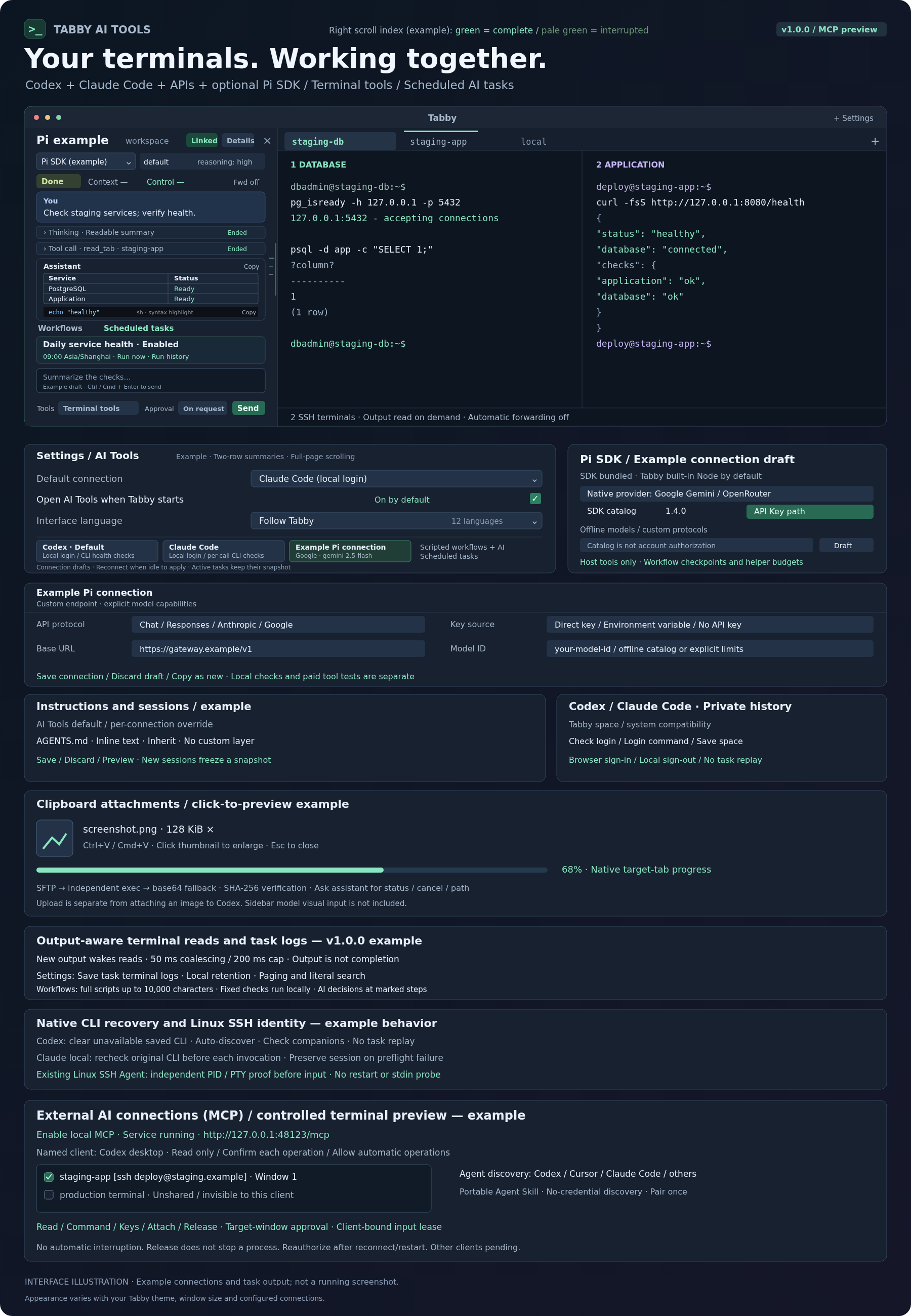
[Interface overview (illustration)](https://raw.githubusercontent.com/Hanlen/tabby-ai-tools/main/docs/assets/overview.png) · [Development](docs/development.md)
|
package/README.zh-CN.md
CHANGED
|
@@ -1,169 +1,77 @@
|
|
|
1
1
|
<div align="center">
|
|
2
2
|
|
|
3
|
-
|
|
4
|
-
|
|
3
|
+
<h1>Tabby AI Tools</h1>
|
|
4
|
+
<p>在 Tabby 的 AI 侧栏操作本地和 SSH 终端,从执行一条命令到协作处理多台服务器。</p>
|
|
5
5
|
|
|
6
6
|
[](https://github.com/Hanlen/tabby-ai-tools/releases/latest)
|
|
7
|
-
[](
|
|
7
|
+
[](#快速开始)
|
|
8
8
|
[](LICENSE)
|
|
9
9
|
|
|
10
|
-
[
|
|
10
|
+
[主要功能](#主要功能) · [操作演示](#操作演示) · [快速开始](#快速开始) · [模型连接](#模型连接) · [使用指南](docs/guide.md) · [发布说明](https://github.com/Hanlen/tabby-ai-tools/releases) · [English](README.md)
|
|
11
11
|
|
|
12
|
-
<
|
|
13
|
-
|
|
14
|
-
<
|
|
15
|
-
|
|
16
|
-
<img src="https://raw.githubusercontent.com/Hanlen/tabby-ai-tools/main/docs/assets/robot-multitask.gif" alt="萌萌的小机器人敲着键盘,同时协调多个终端窗口中的任务" width="560" height="280">
|
|
17
|
-
</picture>
|
|
12
|
+
<picture>
|
|
13
|
+
<source media="(prefers-reduced-motion: reduce)" srcset="https://raw.githubusercontent.com/Hanlen/tabby-ai-tools/main/docs/assets/robot-multitask.png">
|
|
14
|
+
<img src="https://raw.githubusercontent.com/Hanlen/tabby-ai-tools/main/docs/assets/robot-multitask.gif" alt="小机器人正在协调多个终端的工作" width="176" height="88">
|
|
15
|
+
</picture>
|
|
18
16
|
|
|
19
17
|
</div>
|
|
20
18
|
|
|
21
|
-
|
|
22
|
-
|
|
23
|
-
**未发布的 MCP 接入提示修复:**保留旧 skill 时明确提示令牌模式差异,提供当前来源和可复制连接说明。生成配置仍需在目标 Codex 空间注册、重载客户端并验证 MCP 工具;`auto` 只作用于已勾选终端。[连接步骤](docs/mcp.md)。
|
|
24
|
-
|
|
25
|
-
**未发布的 Claude 独立登录修复:**认证提示提供目标空间的官方登录命令和检查重连;不再复制系统 OAuth 缓存,保留历史及草稿,不重发任务。
|
|
26
|
-
|
|
27
|
-
**v1.0.0:外部 MCP 终端连接、读取提速与 Codex 独立空间登录。** 本机 AI 客户端可访问明确共享的终端,使用只读或受控输入权限;新输出可提前唤醒读取。Codex 独立空间支持官方浏览器登录与有界缓存恢复,不重发任务。[发布说明](docs/releases/1.0.0.md)。
|
|
28
|
-
|
|
29
|
-
**v0.9.4:会话内问题导航与更安全的 CLI 恢复。** 通用 Agent 面板在右侧滚动条区域提供问题索引:悬停或聚焦预览原问题,点击跳转,回到最新消息恢复流式跟随。居中的紧凑 1px 短线不附加符号,与聊天滚动滑块共用右侧 18px 窄区域,去掉左侧占位;预览向左展开,过多时使用主题一致的 ↑ / ↓ 按钮翻动。绿色表示确认完成,淡绿色表示没有用户 Stop 证据的普通中断,蓝色表示执行中或等待外部条件,红色表示确认主动 Stop、任务未完成便终止或达到执行上限。回合结束后等待 Goal 确认,自动续行恢复蓝色;证据不足的历史保持灰色。
|
|
30
|
-
|
|
31
|
-
<br>
|
|
32
|
-
|
|
33
|
-
Tabby AI Tools 是集成在 [Tabby](https://github.com/Eugeny/tabby) 中的 AI 助手插件。它可以读取终端输出、发送命令,并根据执行结果继续分析和操作。你在侧栏描述目标,在终端查看过程,也可以随时取回输入控制。
|
|
19
|
+
## 主要功能
|
|
34
20
|
|
|
35
|
-
|
|
21
|
+
- **操作本地和 SSH 终端。** 可以使用单个终端,也可以跨多个标签页或分屏协作。AI 在指定终端读取输出、运行命令,并根据结果判断下一步。 [多终端协作](docs/guide.md#任务编排与多服务器协作)
|
|
22
|
+
- **与正在运行的程序交互。** 向支持的前台程序发送文本和按键,包括终端中运行的 AI Agent。可以设置只读或操作审批,点击「停止」中断 AI 回合,点击「释放」取回终端输入权。 [终端控制](docs/guide.md#标签访问与终端控制)
|
|
23
|
+
- **通过已有 SSH 会话传文件。** 粘贴或拖入文件、截图后可让 AI 上传,也可以让它从远端下载文件。目标标签页显示进度,插件用 SHA-256 校验传输结果。 [文件传输](docs/attachments.md)
|
|
24
|
+
- **把截图和文件发给模型。** 在侧栏添加、粘贴或拖入文件,勾选要随消息发送的附件。图片发出后移到对应消息,可从会话历史点开查看。可发送的格式取决于当前连接和模型。 [模型附件](docs/attachments.md#send-attachments-to-the-sidebar-model)
|
|
25
|
+
- **按任务难度自动选模。** 可选用独立模型判断新任务难度,再交给简单、中等或困难档对应的连接和模型执行。 [任务分配](docs/guide.md#按任务难度自动选模)
|
|
26
|
+
- **录制并复用工作流。** 用 `/remember` 开始录制命令和验证步骤,完成后设置别名,下次直接发送 `/check-app` 之类的命令。流程可执行预设检查,也能在需要时交给 AI 判断。 [工作流](docs/task-workflows.md)
|
|
27
|
+
- **设置定时 AI 任务。** 在对话中说明执行时间、检查目标和异常处理规则,支持单次、按间隔或每日执行。用 `/schedules` 查看记录或暂停。任务在 Tabby 打开时运行。 [定时任务](docs/scheduled-tasks.md)
|
|
28
|
+
- **查看记录并恢复会话。** 展开工具调用查看执行过程,用 `/resume` 恢复当前目录的历史会话,也可开启任务终端日志,供以后查看和搜索。 [会话历史](docs/guide.md#工作目录与线程) · [终端日志](docs/terminal-logs.md)
|
|
29
|
+
- **通过 MCP 接入外部 AI。** 在 AI Tools 设置中启用本地 MCP 服务,兼容的客户端即可读终端输出并向 Tabby 发送输入。 [MCP 配置](docs/mcp.md)
|
|
36
30
|
|
|
37
|
-
|
|
31
|
+
## 操作演示
|
|
38
32
|
|
|
39
|
-
|
|
33
|
+
### 在 SSH 终端运行命令
|
|
40
34
|
|
|
41
|
-
|
|
35
|
+
先在 Tabby 打开一个 SSH 标签页,再打开 **AI Tools**。发送下面的指令,把 `staging` 换成你的 SSH 标签页名称。若出现审批,确认后执行。
|
|
42
36
|
|
|
43
|
-
|
|
37
|
+
> 在 `staging` SSH 标签页执行 `pwd`,然后告诉我结果。
|
|
44
38
|
|
|
45
|
-
|
|
39
|
+
<picture>
|
|
40
|
+
<source media="(prefers-reduced-motion: reduce)" srcset="https://raw.githubusercontent.com/Hanlen/tabby-ai-tools/main/docs/assets/ssh-command-demo.png">
|
|
41
|
+
<img src="https://raw.githubusercontent.com/Hanlen/tabby-ai-tools/main/docs/assets/ssh-command-demo.gif" alt="用户在 AI Tools 发出指令,Tabby 在 staging 的 SSH Shell 执行 ./check-health,读回并报告 HTTP 200。" width="1080">
|
|
42
|
+
</picture>
|
|
46
43
|
|
|
47
|
-
|
|
44
|
+
*实录通过 Tabby 的真实 SSH 连接在回环测试服务器上执行 `./check-health`。侧栏使用本地测试后端,从 Shell 读回 HTTP 200 并报告结果。*
|
|
48
45
|
|
|
49
|
-
<
|
|
46
|
+
<details>
|
|
47
|
+
<summary>另一个例子 · 两个标签页双向交接文件</summary>
|
|
50
48
|
|
|
51
|
-
|
|
49
|
+
<picture>
|
|
50
|
+
<source media="(prefers-reduced-motion: reduce)" srcset="https://raw.githubusercontent.com/Hanlen/tabby-ai-tools/main/docs/assets/two-terminal-demo.png">
|
|
51
|
+
<img src="https://raw.githubusercontent.com/Hanlen/tabby-ai-tools/main/docs/assets/two-terminal-demo.gif" alt="Tabby 侧栏将 brief.md 从终端 1 复制到终端 2,再将 checks.txt 从终端 2 复制回终端 1,并验证两份副本。" width="1100">
|
|
52
|
+
</picture>
|
|
52
53
|
|
|
53
|
-
|
|
54
|
+
*这段 6 秒实录使用本地测试后端。AI 将 `brief.md` 从 Tab 1 复制到 Tab 2,再将 `checks.txt` 复制回来,最后核对两份副本。*
|
|
54
55
|
|
|
55
|
-
|
|
56
|
+
</details>
|
|
56
57
|
|
|
57
|
-
|
|
58
|
+
## 快速开始
|
|
58
59
|
|
|
59
|
-
|
|
60
|
+
1. 在 [Tabby](https://github.com/Eugeny/tabby) 打开 **设置 → 插件**,安装 `tabby-ai-tools` 后重启。
|
|
61
|
+
2. 点击机器人图标打开 **AI Tools**。选择已有连接,或在 **设置 → AI Tools → 连接与模型** 中添加。
|
|
62
|
+
3. 打开需要使用的终端,在侧栏描述任务,按 **Ctrl+Enter** 或 **Cmd+Enter** 发送。
|
|
63
|
+
4. 侧栏空闲时,点击顶部的 **新会话** 开始新对话。输入 `/resume` 可回到之前的会话。
|
|
60
64
|
|
|
61
|
-
|
|
65
|
+
## 模型连接
|
|
62
66
|
|
|
63
|
-
|
|
67
|
+
在侧栏切换连接,用 `/model` 选择模型和它支持的推理强度。
|
|
64
68
|
|
|
65
|
-
|
|
66
|
-
|
|
67
|
-
**v0.5.1 安装修复:** Pi SDK 已打包进插件。通过 Tabby 安装或升级时,不再安装 Pi 的依赖链,也不要求系统中能找到 `node` 命令;Pi 也默认复用 Tabby 自带 Node,通过 Electron 独立进程运行;兼容版本的 Tabby 无需额外安装 Node,仅保留可选的 Node 22.19+ 兼容路径。
|
|
68
|
-
|
|
69
|
-
## 多模型适配,支持本机 ChatGPT 订阅登录
|
|
70
|
-
|
|
71
|
-
**已有具备 Codex 使用权限的 ChatGPT 订阅账号,可以通过本机 Codex CLI 登录直接使用,无需为此模式额外配置 API Key。** 插件复用本机 Codex 登录,可用模型、用量限制和工作区权限以账号实际权益为准。参见 [OpenAI 官方认证说明](https://learn.chatgpt.com/docs/auth)。
|
|
72
|
-
|
|
73
|
-
| 连接方式 | 如何使用 |
|
|
69
|
+
| 连接方式 | 配置 |
|
|
74
70
|
| --- | --- |
|
|
75
|
-
| **ChatGPT 订阅 →
|
|
76
|
-
| **Claude
|
|
77
|
-
| **
|
|
78
|
-
| **DeepSeek** |
|
|
79
|
-
| **
|
|
80
|
-
| **Kimi API** | 选择 **Kimi API** 和中国内地/国际区域,使用开放平台 Key,按量计费。 |
|
|
81
|
-
| **Kimi Coding Plan** | 选择 **Kimi Coding Plan** 和服务区域,使用 Kimi Code 会员套餐 Key。 |
|
|
82
|
-
| **阿里云百炼 Coding Plan** | 选择专用的 Coding Plan 供应商和区域,使用套餐 Key(`sk-sp-`)。 |
|
|
83
|
-
| **Claude/Anthropic** | 添加 Claude API 连接,配置其 API Key 和模型 ID。 |
|
|
84
|
-
| **自定义 OpenAI 兼容服务** | 选择 **自定义(OpenAI 兼容)**,填写 Base URL 和模型 ID;协议默认 Chat Completions,也可选 Responses。支持直接输入密钥、环境变量或无需密钥。 |
|
|
85
|
-
|
|
86
|
-
**v0.4.1 已支持 Claude Code 订阅接入。** 插件运行本机官方 CLI,不读取或保存订阅凭据;账号权益、额度和实际认证方式由 CLI 决定。已有 API Key 或云平台配置可能走独立计费。安装与限制见 [Claude Code 接入说明](docs/claude-code.md)。尚未完成真实订阅账号的端到端验证。
|
|
87
|
-
|
|
88
|
-
v0.4.1 已支持 Kimi 与阿里云百炼 Coding Plan 接入,均提供国内与国际端点预设。详见[端点、密钥与配置说明](docs/coding-plans.md)。套餐用于个人交互式编程,无人值守定时任务应使用适合该场景的普通 API。真实套餐准入和扣费尚未验证。
|
|
89
|
-
|
|
90
|
-
侧栏模型浮窗统一先选模型,再选 reasoning/推理强度,适用于 API 连接和 Claude Code;可选服务商默认或手动填写等级。API 与 Claude Code 的未完成目标默认自动继续,无需点击 Continue;停止、token 预算及主动设置的工具轮数上限仍然生效。
|
|
91
|
-
|
|
92
|
-
可保存多个命名连接,在侧栏切换;支持获取模型列表或手动填写模型 ID。API 连接使用对应供应商的 API 凭据和计费,无需安装 Codex CLI。使用代理时,端点须兼容所选供应商协议。
|
|
93
|
-
|
|
94
|
-
v0.4.1 已支持自定义连接。Base URL 示例为 `https://gateway.example/v1` 或 `http://localhost:1234/v1`,不要附加 `/chat/completions` 或 `/responses`。终端任务要求 SSE 流式响应和工具调用;使用 `/models` 获取模型,不支持时可手动填写。HTTP 仅限本地回环地址。详见[自定义接口配置与限制](docs/guide.md#自定义-openai-兼容接口)。
|
|
95
|
-
|
|
96
|
-
## 内网服务器,也能使用 AI
|
|
97
|
-
|
|
98
|
-
服务器无法访问外网时,只要你的电脑能连接 AI 服务,同时能通过 Tabby 连接服务器,就可以让 AI 通过 SSH 终端读取日志、排查问题、执行命令并验证结果。服务器无需访问模型服务,也无需安装 AI Agent;用于分析的终端内容由本机发送给所选模型服务。
|
|
99
|
-
|
|
100
|
-
## 多台服务器协同,无需逐台部署 Agent
|
|
101
|
-
|
|
102
|
-
沿用 Tabby 的连接和登录账户,让 AI 在不同服务器的标签页、分屏之间读取状态、执行操作、核对结果。无需在每台服务器上安装 Agent、配置模型或单独管理一套 Agent 登录凭据。
|
|
103
|
-
|
|
104
|
-
## sudo 密码由你输入,临时认证后继续
|
|
105
|
-
|
|
106
|
-
需要管理员权限时,先在目标服务器的同一终端中手动执行 `sudo ls` 或 `sudo -v` 并输入密码,再让 AI 继续。无需将 sudo 密码交给模型;认证的有效期与复用范围遵循服务器的 sudo 配置。
|
|
107
|
-
|
|
108
|
-
## ChatGPT 订阅用户如何开始
|
|
109
|
-
|
|
110
|
-
1. 在运行 Tabby 的本机安装 [Codex CLI](https://learn.chatgpt.com/docs/cli)。
|
|
111
|
-
2. 打开 **Settings → AI Tools → 连接与模型 → Codex → CLI 会话存储**,空的独立空间可以导入本机 ChatGPT 登录。登录失效且无法恢复时,在侧栏右上角账号菜单选择**登录**,也可以在设置中生成所选空间的登录命令。未使用过的连接默认采用独立空间。已有的**系统空间(旧版兼容)**连接可使用以下普通命令:
|
|
112
|
-
|
|
113
|
-
```bash
|
|
114
|
-
codex login
|
|
115
|
-
codex login status
|
|
116
|
-
```
|
|
117
|
-
|
|
118
|
-
3. 启动 Tabby 后 AI Tools 会自动打开,默认使用 **Codex(本机登录)**。在选定空间登录后点击侧栏重连,再选择账号可用模型,或沿用 Codex 默认模型。
|
|
119
|
-
|
|
120
|
-
独立 Codex 空间还可在账号菜单使用官方浏览器登录或本地退出。自动缓存恢复只接受同一用户/工作区较新的已导入凭据;主动登录或退出后停用导入,恢复不会重发任务。
|
|
121
|
-
|
|
122
|
-
只需在本机安装和登录 Codex,即可沿用 Tabby 已连接的 SSH 终端协助操作服务器;服务器无需逐台登录 ChatGPT 或安装 AI Agent。
|
|
123
|
-
|
|
124
|
-
自动查找覆盖 standalone 安装(含 `CODEX_INSTALL_DIR` 和 `CODEX_HOME/packages/standalone/current/bin`)、Homebrew/npm 全局 prefix,并以 VS Code 扩展中的兼容 Codex 作为最后兜底。macOS 检查 `/Applications` 和 `~/Applications` 下的 `ChatGPT.app/Contents/Resources/codex-cli/bin/codex` 及旧 `Contents/Resources/codex` 入口,也兼容原 `Codex.app` 名称。其他位置可在 **Settings → AI Tools → 连接与模型 → Codex → CLI 路径与工作目录** 中填写完整路径。[查看完整发现矩阵](docs/guide.md#cli-自动发现与启动排查)。
|
|
125
|
-
|
|
126
|
-
Windows 默认留空(或填 `codex`)即可比较 PATH、桌面版、standalone 和已知 npm 安装的实际版本,选择已发现的最新 CLI,每次新连接重新扫描。明确填写文件路径可固定版本;填写稳定的 `OpenAI\Codex\bin` 目录则只比较这套安装。[查看路径查找说明](docs/guide.md#cli-自动发现与启动排查)。
|
|
127
|
-
|
|
128
|
-
原生 CLI 安装检查保留显式选择范围及现有会话历史。见[恢复行为与限制](docs/codex-installation-recovery.md)。
|
|
129
|
-
|
|
130
|
-
## 用自然语言编排任务
|
|
131
|
-
|
|
132
|
-
把目标、执行顺序、条件和验证要求一次说清,AI 就可以根据终端反馈推进跨服务器、多步骤任务。例如:
|
|
133
|
-
|
|
134
|
-
> 在 staging-app 和 staging-db 上检查应用与数据库连接。先确认数据库正常,再检查应用配置;发现问题先说明原因,在我授权后修复,最后验证应用健康检查。
|
|
135
|
-
|
|
136
|
-
支持按执行结果决定下一步,也可以操作终端中的其他交互式 Agent。用 `/remember 任务描述` 开始录制,任务成功结束后可在侧栏或直接告诉助手设置别名(如 `task1`),下次发送 `/task1` 即执行该流程,并重新核对当前环境。各步骤保存服务器 IP、持久连接/服务器 ID、操作路径及验收条件;多服务器按顺序执行,前一步通过结果验收后才放行下一步。助手可用 `workflow_status` / `workflow_set_alias` 查询录制、归档状态并保存别名;checkpoint 成功不等于归档成功,无法归档时显示原因。普通任务不录制,也不能事后补存。含 sudo 的流程会提前提示在各执行终端运行 `sudo -v` 或 `sudo ls`,任务期间保持认证有效。[查看编排与复用方法](docs/guide.md#任务编排与多服务器协作)。
|
|
137
|
-
|
|
138
|
-
交互式 `/remember` 流程可保存 stdin、按键、进程接管和侧栏提问的条件规则与回答意图。运行器本地处理已保存的 if/else,不确定交互交给当前连接的可选辅助模型,再从当前步骤继续。在 **AI Tools → 任务与流程 → 任务流程与偏好 → 交互辅助模型** 配置;辅助用量计入任务预算,缺少机器验收时仍由主模型核对。[条件与交互流程](docs/task-workflows.md#条件与交互流程)。 更新:命令和多行脚本可按终端上限完整录制最多 10000 字符;固定步骤通过机器验收推进,需现场判断的步骤用 `policy.decision` 在执行前交回主 AI,处理后继续脚本流程。
|
|
139
|
-
|
|
140
|
-
## 定时任务:到点检查、判断、执行与验证
|
|
141
|
-
|
|
142
|
-
在对话中创建单次、固定间隔或指定时区的每日任务。例如:
|
|
143
|
-
|
|
144
|
-
> 每天北京时间 9 点检查 production 配置对应服务器的服务健康状态。异常时分析日志,在授权范围内尝试修复,最多三次;每次操作后重新检查,最后记录结果。
|
|
145
|
-
|
|
146
|
-
通过 `/schedules` 查看计划和执行记录、暂停或恢复、立即运行及停止;在设置中删除任务。任务重启后自动加载,**仅在 Tabby 保持打开时执行**。无人值守运行遇到需要额外授权或秘密信息的情况会停止留档。[查看定时任务用法](docs/scheduled-tasks.md)。
|
|
147
|
-
|
|
148
|
-
## 安装与开始使用
|
|
149
|
-
|
|
150
|
-
**v1.0.0:外部 MCP 终端连接(受控输入预览)。** 在「设置 → AI Tools → 外部 AI 连接(MCP)」添加客户端并勾选终端。默认只读;另选「每次操作确认」或「允许自动操作」后,可用 `send_input`、`send_keys`、`attach_process`、`release_tab` 执行命令和交互。输入与侧栏/调度共用控制,不自动中断已有任务,租约绑定客户端;撤销或租约到期仅解锁,不终止进程。复用 Tabby 内置运行时,侧栏关闭仍可用,配置手动复制合并。Linux Tabby/Codex 已有只读验收;受控输入验证及平台/客户端边界见指南。此功能包含于 v1.0.0。[配置与边界](docs/mcp.md)。 随附通用 `tabby-mcp` Agent Skill 与无凭据发现记录,帮助支持技能的本机 Agent 找到服务和配对入口;首次仍需独立客户端配置与授权。
|
|
151
|
-
|
|
152
|
-
侧栏右上角统一为 32px 图标按钮:重连、Codex 账号菜单(可用时)和收起。账号菜单显示登录状态,按 ↓ 可进入操作,Esc 关闭并返回按钮;连接中的动画遵循减少动态效果设置。
|
|
153
|
-
|
|
154
|
-
**未发布:本机 MCP 免令牌连接。** 启用服务并复制仅含地址的配置即可,无需创建客户端、签发令牌或选择权限和 Tab。本机程序默认共享所有终端 Tab 的读写权限及输入租约,新开和重连的终端自动纳入;独立令牌客户端保留为可选项。见[最新配置步骤](docs/mcp.md)。
|
|
155
|
-
|
|
156
|
-
|
|
157
|
-
新版设置分为 **连接与模型、任务与流程、外部 AI 连接(MCP)、通用设置**。紧凑连接选择栏让详情使用可用宽度(最多 1080px),优先显示模型与权限;CLI 路径、自定义指令、会话存储、操作偏好和交互辅助模型按需展开。默认连接与语言移入通用设置,启动和日志开关默认折叠。连接草稿仍需保存,指令与会话存储保留各自的保存操作。本次布局调整尚未发布。
|
|
158
|
-
|
|
159
|
-
1. 在 Tabby 的 **Settings → Plugins** 搜索并安装 **`tabby-ai-tools`**,完成后点击设置页的重启提示(**Restart the app to apply changes**);安装和升级均在重启后生效。
|
|
160
|
-
2. 使用本机 Codex 登录,或在 **Settings → AI Tools** 添加 API 连接。
|
|
161
|
-
3. 重启后 AI Tools 会默认自动打开。打开目标终端,在侧栏输入任务,按 **Ctrl+Enter / Cmd+Enter** 发送。收起后可点击工具栏机器人图标重新打开;如需关闭自动打开,在 **Settings → AI Tools → 通用设置 → 启动与日志** 取消勾选 **启动 Tabby 时自动打开 AI Tools**。已明确关闭的配置会保留。
|
|
162
|
-
|
|
163
|
-
**[完整配置与使用指南 →](docs/guide.md)** 包含环境准备、源码安装、连接与模型配置、权限、sudo、任务编排、全部操作入口和常见问题。
|
|
164
|
-
|
|
165
|
-
插件自带一个供模型使用的 [Tabby skill](skills/tabby/SKILL.md),保留全部功能入口。构建时自动内嵌,随插件安装并提供给 Codex 和 API 模型,无需另行安装。
|
|
166
|
-
|
|
167
|
-
[开发与验证](docs/development.md) · [验证范围](VALIDATION.md) · [问题反馈](https://github.com/Hanlen/tabby-ai-tools/issues) · [MIT](LICENSE)
|
|
71
|
+
| **ChatGPT 订阅 → Codex CLI** | 安装 Codex CLI,运行 `codex login`,用有 Codex 权限的 ChatGPT 账号登录,然后选择 **Codex(本机登录)**。此模式使用 ChatGPT 账号权益。 [Codex 登录说明](https://learn.chatgpt.com/docs/auth#codex-cli) · [ChatGPT 套餐权益](https://help.openai.com/en/articles/11369540-using-codex-with-your-chatgpt-plan) |
|
|
72
|
+
| **Claude Code 本机登录** | 安装 Claude Code。使用独立会话空间时,在 AI Tools 生成该空间的登录命令,在本地终端完成登录,再检查并重连。 [Claude Code 配置](docs/claude-code.md) |
|
|
73
|
+
| **Antigravity 本机登录** | 安装 Google Antigravity CLI,在本机运行 `agy acp --login` 后选择 **Antigravity(本机登录)**。模型和推理强度留空时沿用 CLI 默认值。模型列表缓存 30 分钟,到期后台刷新,下次打开时显示新列表。 [Antigravity 配置](docs/antigravity.md) |
|
|
74
|
+
| **OpenAI、DeepSeek、GLM、Claude API** | 在 AI Tools 添加对应供应商,填写 API Key 和模型 ID。 |
|
|
75
|
+
| **Kimi、阿里云 Coding Plan 或自定义服务** | 选择供应商预设,或填写自定义服务地址和模型。 [Coding Plan 配置](docs/coding-plans.md) · [Pi 和自定义连接](docs/pi.md) |
|
|
168
76
|
|
|
169
|
-
|
|
77
|
+
[界面示意图](https://raw.githubusercontent.com/Hanlen/tabby-ai-tools/main/docs/assets/overview.png) · [开发说明](docs/development.md)
|
package/VALIDATION.md
CHANGED
|
@@ -1,3 +1,23 @@
|
|
|
1
|
+
# 1.2.2 release validation
|
|
2
|
+
|
|
3
|
+
This patch fixes Antigravity ACP permission handling for session-scoped Tabby MCP tools. Previously, `AntigravityAcpClient` cancelled every `session/request_permission` request unconditionally, preventing active-session Tabby MCP tools such as `agent_goal_update` from running when `agy` requested ACP permission. `AntigravityAdapter` now passes `onPermissionRequest` to approve only tools in the current turn's exposed Tabby MCP tool set for the active `sessionId` using `allow_once` (never `allow_always`), after `session/prompt` has been submitted. Native CLI tools (including forged titles), non-Tabby MCP tools, read-only disallowed tools, wrong-session requests, and requests without `allow_once` remain cancelled, while Tabby's own MCP tool handlers continue enforcing sandbox and `item/commandExecution/requestApproval` policies.
|
|
4
|
+
|
|
5
|
+
Offline regressions in `test/antigravity.test.js` (with `test/fixtures/antigravity-acp.cjs`) verify `allow_once` approval for `agent_goal_update` completing a goal in a single prompt, cancellation of native/other-MCP/cross-session/disallowed/non-`allow_once` requests, and Tabby approval-policy enforcement when a mutation tool (`send_input`) passes ACP permission and is declined by the user. Local Linux validation on Node 22 runs `npm run skill:bundle`, `npm run skill:check`, `npm run typecheck`, `npm test` (1,196 tests: 1,190 passed, 6 Windows-only skipped, 0 failed), `npm run build`, `npm run test:package` (lifecycle scripts enabled with no `node` on `PATH`), and `git diff --check`. Both READMEs, the synchronized 1800 × 2600 `docs/assets/overview.svg` / `overview.png`, and the robot GIF / reduced-motion PNG were reviewed.
|
|
6
|
+
|
|
7
|
+
Codex default discovery and process fixtures cover empty and bare selectors, helper version checks, update/removal races during launch, bounded idle recovery, tool RPC, stop and no replay. Claude local independently covers original-selector re-resolution per invocation, native and npm launchers, capability/auth checks, MCP tool round trips, stop and session retention. Three-platform GitHub Actions CI, verified tarball SHA-256 and npm registry readback are recorded on the GitHub Release. Real Windows/macOS desktop runs, live user-account entitlements and user SSH acceptance remain outside automated CI.
|
|
8
|
+
|
|
9
|
+
# 1.2.1 release validation
|
|
10
|
+
|
|
11
|
+
This release adds the sidebar New session action, Antigravity local login, attachment messages, optional task routing, connection-aware model selection and MCP transport improvements. Review corrected the settings template scope for saved API connections, registered Antigravity's connection and history fields with Tabby's configuration service, and removed automatic approval of native ACP permission requests. The ACP client also checks the negotiated protocol version before accessing sessions.
|
|
12
|
+
|
|
13
|
+
The v1.2.0 tag failed the macOS HTTP body limit test when its client failed to read the response during an oversized upload. The known-length check now returns HTTP 413 without closing the socket while the body drains. The chunked limit retains its existing streaming guard. The regression checks the HTTP status, connection handling and JSON-RPC error.
|
|
14
|
+
|
|
15
|
+
The Windows tag check also hit a transient `EBUSY` removing the old executable in the native CLI upgrade fixture. The fixture now awaits the full client shutdown and gives Windows a bounded retry window to release the old installation directory before testing the new one.
|
|
16
|
+
|
|
17
|
+
The test suite exercises the genuine application code with local CLI and HTTP fixtures. The header test covers idle gating, duplicate clicks, preservation of unsent text and zero model requests. The Antigravity process tests cover login checks, default and explicit model selection, attachment content, native session resumption without replay, incompatible protocol versions, native permission cancellation and the 30-minute model catalog cache across backend instances. The cache regression checks stale selection, one shared background refresh, the updated next list and authentication invalidation. Image history regressions cover accepted sends, retained drafts on send failure, persisted image metadata, display-only refs across connection handoff, and previews for supported image data in older history. Both README files were rendered and their links checked against the source tree. The synchronized SVG and PNG were reviewed at 1800 × 2600, and the animated robot and reduced-motion fallback were inspected.
|
|
18
|
+
|
|
19
|
+
Codex default discovery and process fixtures cover empty and bare selectors, helper version checks, removal during launch, bounded idle recovery, tool RPC, stop and no replay. Claude local independently tests original-selector resolution, native and npm launchers, model-list authentication, MCP tool round trips, stop and session retention. Fixture results do not establish actual account entitlements or end-to-end behavior. Any Linux Electron, three-platform CI, package installation and registry results are reported separately on the GitHub Release. Real Windows/macOS desktop, user-account model execution and user SSH acceptance are outside this release's automated checks.
|
|
20
|
+
|
|
1
21
|
# Claude private-space authentication — 2026-11-15 (unreleased)
|
|
2
22
|
|
|
3
23
|
Claude Code now owns login and token refresh in the selected `CLAUDE_CONFIG_DIR`; Tabby no longer reads, imports or overwrites its system OAuth cache. The authentication warning generates a selectable/copyable official login command for the failed connection, followed by a login check and reconnect. Active turns and pending interactions block recovery. History, native session references and drafts are retained without inference or tool replay. Generating a command never executes it.
|