tabby-ai-tools 0.5.1 → 0.5.3
This diff represents the content of publicly available package versions that have been released to one of the supported registries. The information contained in this diff is provided for informational purposes only and reflects changes between package versions as they appear in their respective public registries.
- package/README.md +1 -1
- package/README.zh-CN.md +1 -1
- package/VALIDATION.md +10 -0
- package/docs/assets/overview.png +0 -0
- package/docs/assets/overview.svg +3 -3
- package/docs/development.md +4 -0
- package/docs/releases/0.5.2.md +11 -0
- package/docs/releases/0.5.3.md +11 -0
- package/docs/releases/unreleased.md +1 -1
- package/package.json +1 -1
package/README.md
CHANGED
|
@@ -22,7 +22,7 @@
|
|
|
22
22
|
|
|
23
23
|
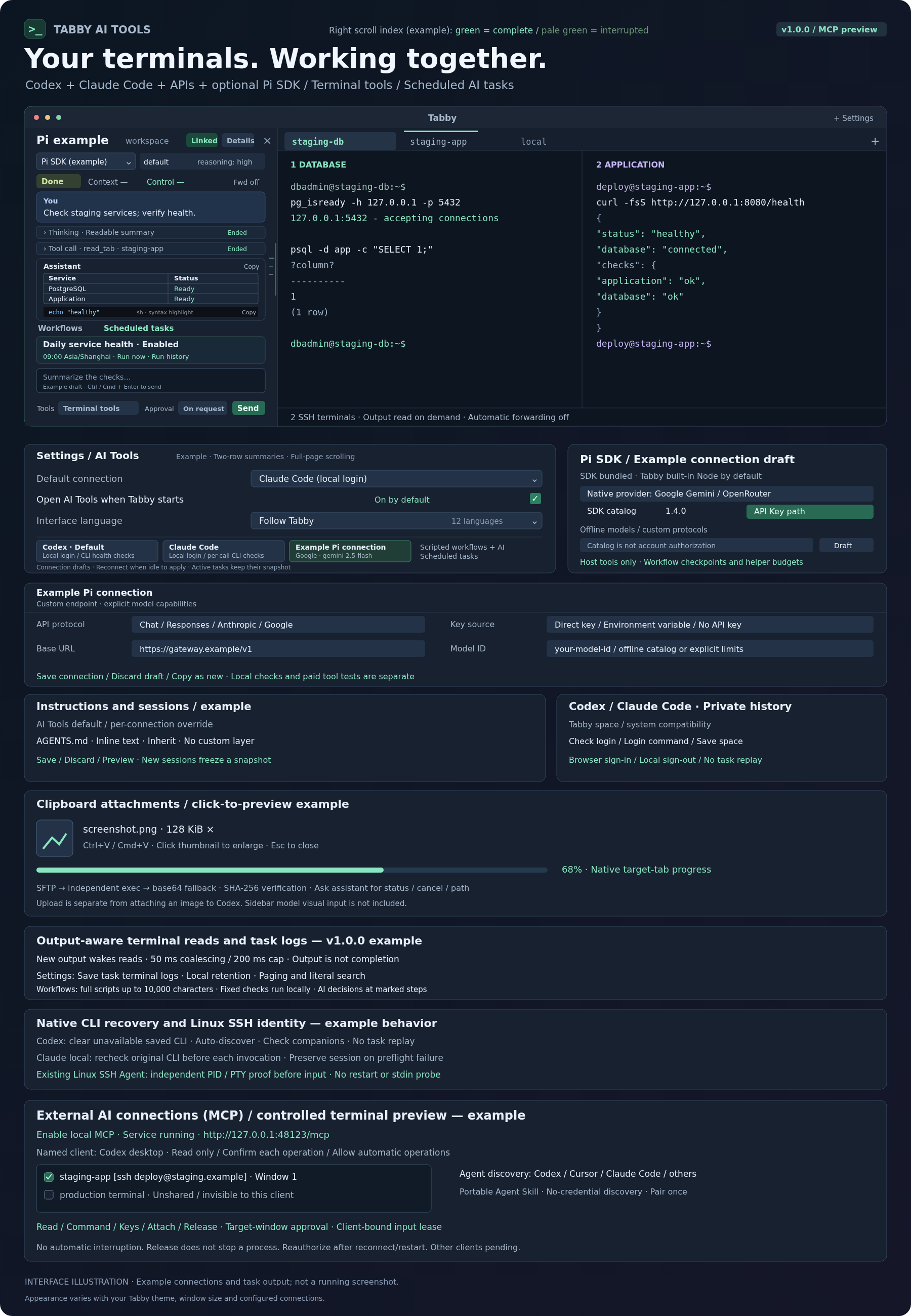
Tabby AI Tools is an AI assistant inside [Tabby](https://github.com/Eugeny/tabby). It reads terminal output, sends commands, and uses the results to decide what to do next. Describe your goal in the sidebar, follow the work in your terminals, and reclaim terminal input whenever needed.
|
|
24
24
|
|
|
25
|
-
|
|
26
26
|
|
|
27
27
|
<sub>Interface illustration with example tasks and connections; appearance varies with your Tabby theme and window size.</sub>
|
|
28
28
|
|
package/README.zh-CN.md
CHANGED
|
@@ -22,7 +22,7 @@
|
|
|
22
22
|
|
|
23
23
|
Tabby AI Tools 是集成在 [Tabby](https://github.com/Eugeny/tabby) 中的 AI 助手插件。它可以读取终端输出、发送命令,并根据执行结果继续分析和操作。你在侧栏描述目标,在终端查看过程,也可以随时取回输入控制。
|
|
24
24
|
|
|
25
|
-

|
|
26
26
|
|
|
27
27
|
<sub>根据当前功能绘制的英文界面示意,任务和连接均为示例;实际外观随 Tabby 主题与窗口尺寸变化。</sub>
|
|
28
28
|
|
package/VALIDATION.md
CHANGED
|
@@ -1,3 +1,13 @@
|
|
|
1
|
+
# v0.5.3 trusted publishing validation (2026-10-31)
|
|
2
|
+
|
|
3
|
+
The release workflow uses npm Trusted Publishing with GitHub OIDC. It has read-only repository/actions access plus the publish job's id-token permission, with no stored npm token. A published stable GitHub Release triggers validation of its annotated tag, the exact commit's branch/tag three-platform checks, the attached tarball digest and review-note checksum, package identity, required artifacts and private-file exclusions. The same attachment is published without rebuilding; registry processing and downloaded bytes are verified before success. Manual dispatch defaults to a dry run. Already-published identical versions are no-ops; version overwrites and a backward latest tag are rejected.
|
|
4
|
+
|
|
5
|
+
Local Linux / Node 22.19.0 passed all seven release checks and 772 tests (766 passed, 6 Windows-only skips). Five new policy tests cover stable-tag parsing, wrong source commits/workflows, incomplete or failed platform checks, wrong package/repository/version, install hooks, SDK dependencies, archive traversal and local instructions/research. A real dry run validated the existing v0.5.1 GitHub artifact, both successful CI matrices and npm integrity, without sending a publish request. The one-time npm publisher binding and the first actual OIDC publication are checked during release; they are not inferred from dry-run success.
|
|
6
|
+
|
|
7
|
+
The v0.5.2 tag exposed a macOS timing assumption in the existing sudo lease test: a fixed 120 ms delay did not guarantee multiple refreshes. The test now waits for actual refresh events and removal of the worker directory with bounded deadlines; it retains command, refresh and stop assertions. The v0.5.2 tag is preserved without npm publication.
|
|
8
|
+
|
|
9
|
+
The runtime and missing-Node installation checks from 0.5.1 remain in the full test/build/package pipeline. The version label in the SVG/PNG overview and both README image descriptions is current; the robot GIF and static fallback remain unchanged. No paid inference or original-task replay is performed. CI/publish results and the exact release artifact checksum are recorded in the GitHub Release.
|
|
10
|
+
|
|
1
11
|
# v0.5.1 installation compatibility validation (2026-10-31)
|
|
2
12
|
|
|
3
13
|
The 0.5.0 release checks did not exercise installation without system Node. Its ordinary Pi dependencies caused every installation to install the SDK dependency tree, including a `protobufjs` postinstall script. A local reproduction with lifecycle scripts enabled, an explicit system shell and no `node` on PATH failed with `protobufjs@7.6.6 postinstall`, `node scripts/postinstall`, `/bin/sh: node: not found` and exit 127. The same environment successfully installs the 0.5.1 tarball.
|
package/docs/assets/overview.png
CHANGED
|
Binary file
|
package/docs/assets/overview.svg
CHANGED
|
@@ -1,6 +1,6 @@
|
|
|
1
1
|
<svg xmlns="http://www.w3.org/2000/svg" width="1800" height="1440" viewBox="0 0 1800 1440" role="img" aria-labelledby="title desc">
|
|
2
|
-
<title id="title">Tabby AI Tools v0.5.
|
|
3
|
-
<desc id="desc">Interface illustration, not a running screenshot. The assistant sidebar coordinates example staging database and application terminals. Connection and model controls share one compact row. Scheduled tasks, provider connections, startup opening enabled by default and twelve interface languages and the Claude Code local-login connection are shown below. Active goals continue automatically by default. Terminal output is read on demand without automatic forwarding; a completed explicit recording and a saved workflow alias are shown. Archive status distinguishes successful checkpoints from successful persistence. Pi runtime settings show the built-in runtime and an optional Node override, host-only tools and opt-in automatic context compaction. The provider list includes Kimi and Alibaba Cloud Coding Plan connections. Custom OpenAI-compatible settings show an example Base URL, model, protocol and authentication. Version 0.5.
|
|
2
|
+
<title id="title">Tabby AI Tools v0.5.3 interface illustration — verified workflow recording, conversational aliases, local login and API connections</title>
|
|
3
|
+
<desc id="desc">Interface illustration, not a running screenshot. The assistant sidebar coordinates example staging database and application terminals. Connection and model controls share one compact row. Scheduled tasks, provider connections, startup opening enabled by default and twelve interface languages and the Claude Code local-login connection are shown below. Active goals continue automatically by default. Terminal output is read on demand without automatic forwarding; a completed explicit recording and a saved workflow alias are shown. Archive status distinguishes successful checkpoints from successful persistence. Pi runtime settings show the built-in runtime and an optional Node override, host-only tools and opt-in automatic context compaction. The provider list includes Kimi and Alibaba Cloud Coding Plan connections. Custom OpenAI-compatible settings show an example Base URL, model, protocol and authentication. Version 0.5.3 example with optional Pi SDK runtime, built-in Node 22.19+, manual context compaction and structured retry waiting.</desc>
|
|
4
4
|
<defs>
|
|
5
5
|
<linearGradient id="background" x2="1" y2="1"><stop stop-color="#0c1622"/><stop offset="1" stop-color="#151729"/></linearGradient>
|
|
6
6
|
<linearGradient id="outline"><stop stop-color="#375d5d"/><stop offset="1" stop-color="#3b3d5c"/></linearGradient>
|
|
@@ -15,7 +15,7 @@ text{font-family:"DejaVu Sans",sans-serif;fill:#e8eff9}
|
|
|
15
15
|
<text x="56" y="65" font-size="23" font-weight="700" style="fill:#8ae6c2" class="mono">>_</text>
|
|
16
16
|
<text x="106" y="66" font-size="21" font-weight="700" style="fill:#a7b8cb">TABBY AI TOOLS</text>
|
|
17
17
|
<rect x="1534" y="44" width="218" height="28" rx="6" fill="#22313f"/>
|
|
18
|
-
<text x="1544" y="64" font-size="16" font-weight="600" style="fill:#8ae6c2">v0.5.
|
|
18
|
+
<text x="1544" y="64" font-size="16" font-weight="600" style="fill:#8ae6c2">v0.5.3 / Pi optional</text>
|
|
19
19
|
<text x="48" y="134" font-size="54" font-weight="700" style="fill:#f1f6ff">Your terminals. Working together.</text>
|
|
20
20
|
<text x="50" y="176" font-size="23" font-weight="400" style="fill:#a7b8cb">Codex + Claude Code + APIs + optional Pi SDK / Terminal tools / Scheduled AI tasks</text>
|
|
21
21
|
<rect x="48" y="210" width="1704" height="632" rx="14" fill="#0d1520" stroke="url(#outline)"/>
|
package/docs/development.md
CHANGED
|
@@ -137,3 +137,7 @@ Use Node 22.19+ (`.nvmrc` and both CI workflows pin 22.19.0). Angular 15/webpack
|
|
|
137
137
|
`dist/pi/electron-host.cjs` runs in Electron main through Tabby’s existing remote bridge and Node `createRequire`. This avoids relying on the bundled app’s `process.mainModule.require`. It forks the fixed packaged sidecar with Electron `utilityProcess`, bounds the JSON/diagnostic channels, strips loader injection variables and owns termination on renderer/window destruction. SDK traffic uses `process.parentPort`; final done/fatal IPC is acknowledged before shutdown so the utility cannot remain alive after a completed turn. Explicit compatibility paths retain the existing Node subprocess transport. Empty paths do not search PATH for node. The selected runtime must provide Node 22.19+; older hosts should update Tabby first.
|
|
138
138
|
|
|
139
139
|
Tests cover default host selection without node on PATH, main-process bridge selection, output acknowledgment, cancellation waiting for exit and owner/crash cleanup. Actual isolated Linux Tabby 1.0.238 / Electron 43.7.0 / Node 24.21.0 exercised SDK streaming, a host-tool round trip, cancellation while waiting for a tool result and owner-window termination without system Node on PATH. It uses only local HTTP fixtures. Windows/macOS utility-process desktop behavior remains a separate validation scope.
|
|
140
|
+
|
|
141
|
+
## Trusted npm publishing
|
|
142
|
+
|
|
143
|
+
Stable GitHub Releases trigger `.github/workflows/publish.yml`. After exact-commit branch/tag CI verification, the workflow publishes the reviewed release attachment through GitHub OIDC, without a stored npm token or rebuilding the tarball. npm performs a one-time trusted publisher binding to `Hanlen/tabby-ai-tools` and `publish.yml`; direct publishing must be allowed. Create Releases as drafts, attach the verified tarball and checksum, then publish. The workflow waits for registry processing and verifies downloaded bytes. See [release setup and recovery](../.github/RELEASING.md).
|
|
@@ -0,0 +1,11 @@
|
|
|
1
|
+
# v0.5.2 — Trusted GitHub Actions publishing
|
|
2
|
+
|
|
3
|
+
Formal GitHub Releases now trigger npm Trusted Publishing through GitHub OIDC. The workflow publishes the exact reviewed tarball attachment; no long-lived npm token, repeated browser publish authentication or second build is required after the one-time publisher binding. Existing account and package 2FA policies remain in place.
|
|
4
|
+
|
|
5
|
+
Publication requires the annotated release tag and successful Linux/macOS/Windows checks for both its branch commit and tag. It verifies the attached artifact checksum, release-note checksum, package identity and archive contents, rejects version overwrites or a backward latest tag, then waits for npm processing and compares the registry download byte for byte. Manual workflow dispatch defaults to validation only.
|
|
6
|
+
|
|
7
|
+
Both README illustrations and the SVG/PNG version label are current. The robot GIF and reduced-motion image are preserved. The bundled Pi SDK and default Electron utility runtime from 0.5.1 are retained, including installation without system Node and the optional compatibility Node path.
|
|
8
|
+
|
|
9
|
+
Local Linux / Node 22.19.0 validation passed the full offline suite (772 tests: 766 passed, 6 Windows-only skips), type checks, bundle checks, production builds and actual tarball installation with no node on PATH and lifecycle scripts enabled. New publishing-policy tests cover malformed tags, wrong commits, failed/missing platform checks, package identity, install hooks, traversal and private files. A real dry run checks the already-published 0.5.1 release without submitting it again. Final three-platform checks and the first real OIDC publication are recorded in the GitHub Release and publish workflow.
|
|
10
|
+
|
|
11
|
+
Release status: the tag is retained, but this version was not published to npm. Tag CI found a timing-dependent sudo refresher test on macOS; 0.5.3 fixes the test and carries the trusted publishing setup.
|
|
@@ -0,0 +1,11 @@
|
|
|
1
|
+
# v0.5.3 — Trusted GitHub Actions publishing
|
|
2
|
+
|
|
3
|
+
Formal GitHub Releases now trigger npm Trusted Publishing through GitHub OIDC. The workflow publishes the exact reviewed tarball attachment; no long-lived npm token, repeated browser publish authentication or second build is required after the one-time publisher binding. Existing account and package 2FA policies remain in place.
|
|
4
|
+
|
|
5
|
+
Publication requires the annotated release tag and successful Linux/macOS/Windows checks for both its branch commit and tag. It verifies the attached artifact checksum, release-note checksum, package identity and archive contents, rejects version overwrites or a backward latest tag, then waits for npm processing and compares the registry download byte for byte. Manual workflow dispatch defaults to validation only.
|
|
6
|
+
|
|
7
|
+
Both README illustrations and the SVG/PNG version label are current. The robot GIF and reduced-motion image are preserved. The bundled Pi SDK and default Electron utility runtime from 0.5.1 are retained, including installation without system Node and the optional compatibility Node path.
|
|
8
|
+
|
|
9
|
+
Local Linux / Node 22.19.0 validation passed the full offline suite (772 tests: 766 passed, 6 Windows-only skips), type checks, bundle checks, production builds and actual tarball installation with no node on PATH and lifecycle scripts enabled. New publishing-policy tests cover malformed tags, wrong commits, failed/missing platform checks, package identity, install hooks, traversal and private files. A real dry run checks the already-published 0.5.1 release without submitting it again. Final three-platform checks and the first real OIDC publication are recorded in the GitHub Release and publish workflow.
|
|
10
|
+
|
|
11
|
+
The v0.5.2 tag is retained without an npm publication after its macOS CI found a timing-dependent sudo lease test. The test now waits for observed refreshes and worker cleanup with bounded deadlines instead of assuming that a busy runner schedules the background process within 120 milliseconds. Runtime behavior is unchanged.
|
package/package.json
CHANGED
|
@@ -1,6 +1,6 @@
|
|
|
1
1
|
{
|
|
2
2
|
"name": "tabby-ai-tools",
|
|
3
|
-
"version": "0.5.
|
|
3
|
+
"version": "0.5.3",
|
|
4
4
|
"description": "A persistent AI agent sidebar for Tabby with Codex, Claude Code, OpenAI-compatible providers, DeepSeek, GLM, Kimi, and Alibaba Cloud Coding Plan support",
|
|
5
5
|
"repository": {
|
|
6
6
|
"type": "git",
|