react-advanced-odontogram 2.0.2 → 2.1.0
This diff represents the content of publicly available package versions that have been released to one of the supported registries. The information contained in this diff is provided for informational purposes only and reflects changes between package versions as they appear in their respective public registries.
- package/README.md +35 -1336
- package/dist/index.d.ts +581 -4
- package/dist/odontogram.js +932 -931
- package/dist/odontogram.js.map +1 -1
- package/package.json +7 -8
- package/dist/App.d.ts +0 -148
- package/dist/DualStateConfirm.d.ts +0 -25
- package/dist/ExportOptionsModal.d.ts +0 -26
- package/dist/PerioChart.d.ts +0 -67
- package/dist/PerioSidebar.d.ts +0 -1
- package/dist/SettingsModal.d.ts +0 -84
- package/dist/bridgeOverlay.d.ts +0 -116
- package/dist/fhir/codesystems.d.ts +0 -51
- package/dist/fhir/fieldMappings.d.ts +0 -35
- package/dist/fhir/fromFhir.d.ts +0 -7
- package/dist/fhir/primitives.d.ts +0 -16
- package/dist/fhir/toFhir.d.ts +0 -20
- package/dist/fhir/toFhirPerio.d.ts +0 -70
- package/dist/fhir/types.d.ts +0 -108
- package/dist/i18n/translations.d.ts +0 -27
- package/dist/i18n/useI18n.d.ts +0 -39
- package/dist/odontogram.d.ts +0 -1214
- package/dist/perioClassification.d.ts +0 -90
- package/dist/perioExport.d.ts +0 -13
- package/dist/perioGraphic.d.ts +0 -496
- package/dist/perioIndexNames.d.ts +0 -29
- package/dist/perioPdf.d.ts +0 -77
- package/dist/plugin.d.ts +0 -63
- package/dist/registry/axes.d.ts +0 -9
- package/dist/registry/fhir.d.ts +0 -3
- package/dist/registry/fromFhir.d.ts +0 -3
- package/dist/registry/restorations.d.ts +0 -26
- package/dist/registry/svgActivate.d.ts +0 -15
- package/dist/registry/svgLayers.d.ts +0 -14
- package/dist/registry/types.d.ts +0 -70
- package/dist/registry/uiOptions.d.ts +0 -17
- package/dist/registry/validate.d.ts +0 -4
- package/dist/status_extras.d.ts +0 -58
- package/dist/theme.d.ts +0 -51
- package/dist/tour.d.ts +0 -9
- package/dist/utils/numbering.d.ts +0 -23
package/README.md
CHANGED
|
@@ -1,1382 +1,81 @@
|
|
|
1
1
|
# 🦷 React Odontogram Modul
|
|
2
2
|
|
|
3
|
-
[](https://github.com/ZoliQua/React-Odontogram-Modul/releases)
|
|
4
|
-
[](https://github.com/ZoliQua/React-Odontogram-Modul)
|
|
5
3
|
[](https://www.npmjs.com/package/react-advanced-odontogram)
|
|
4
|
+
[](https://github.com/ZoliQua/React-Odontogram-Modul/releases)
|
|
6
5
|
[](https://github.com/ZoliQua/React-Odontogram-Modul/blob/main/LICENSE)
|
|
7
|
-
[](https://doi.org/10.5281/zenodo.21156787)
|
|
6
|
+
[](https://doi.org/10.5281/zenodo.21156787)
|
|
8
7
|
|
|
9
|
-
[](https://reactjs.org/)
|
|
8
|
+
[](https://reactjs.org/)
|
|
10
9
|
[](https://www.typescriptlang.org/)
|
|
11
10
|
|
|
12
|
-
|
|
13
|
-
|
|
14
|
-
> 🌐 **Languages:** 🇬🇧 [English](#-english) | 🇪🇸 [Español](#-español) | 🇩🇪 [Deutsch](lang/README-de.md) | 🇭🇺 [Magyar](lang/README-hu.md) | 🇮🇹 [Italiano](lang/README-it.md) | 🇸🇰 [Slovenčina](lang/README-sk.md) | 🇵🇱 [Polski](lang/README-pl.md) | 🇷🇺 [Русский](lang/README-ru.md) | 🇧🇷 [Português (BR)](lang/README-pt-br.md) | 🇸🇦 [العربية](lang/README-ar.md) | 🇨🇳 [简体中文](lang/README-zh.md)
|
|
15
|
-
|
|
16
|
-
## 🇬🇧 English
|
|
11
|
+
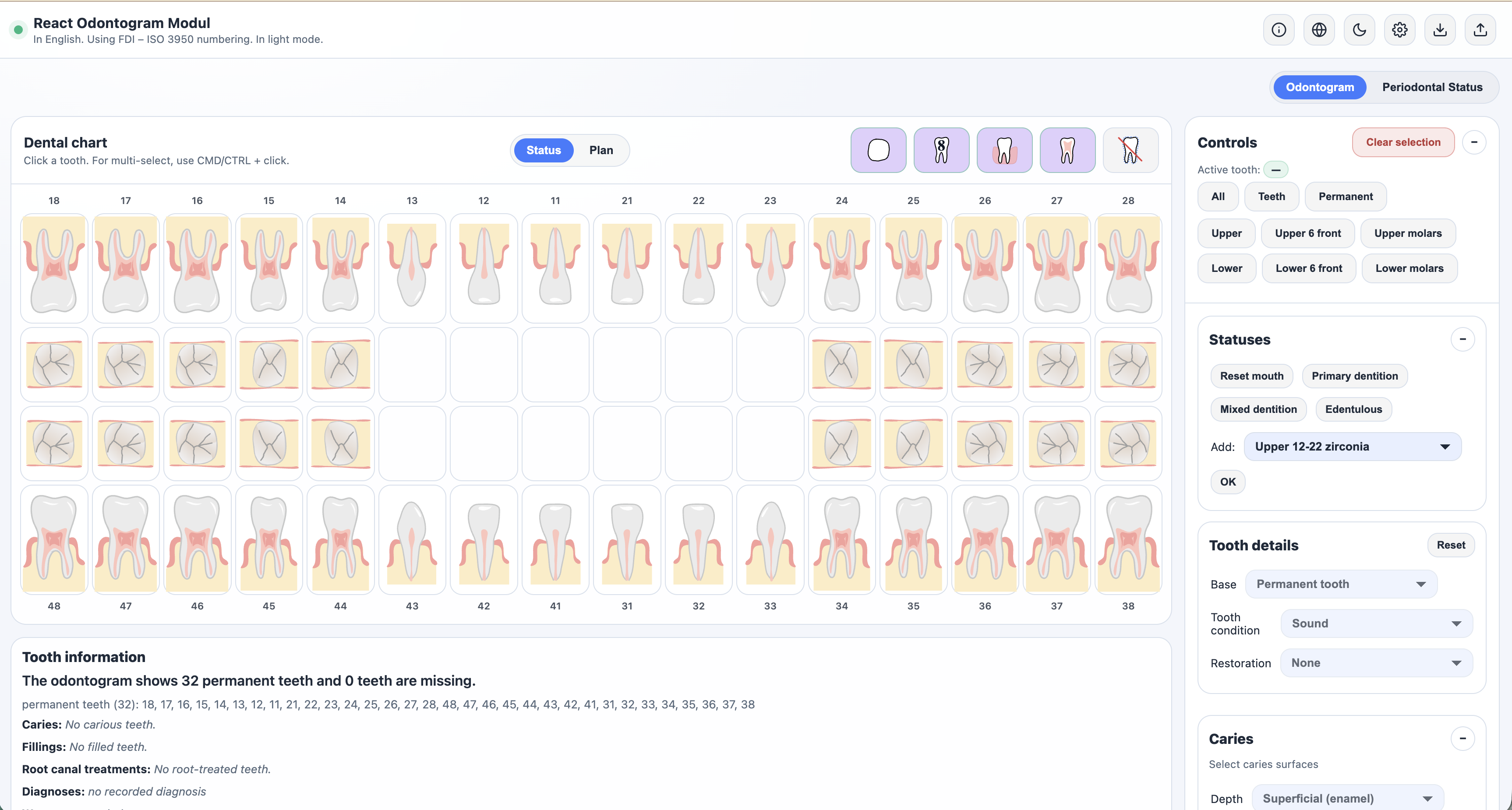
An interactive, SVG-based **dental odontogram (dental chart) editor** for **React + TypeScript** — with a full **periodontal charting module**, multi-surface caries/restorations, endodontic/prosthetic states, FDI/Universal/Palmer numbering, **HL7 FHIR R4** export/import, optional ICDAS scoring, and an 11-language UI.
|
|
17
12
|
|
|
18
|
-
|
|
19
|
-
This project is an interactive, browser-based odontogram editor that supports fast dental charting with a clean UI. It renders layered SVG tooth templates to represent restorations, caries, endodontic status, mobility, and other clinical details, while providing multi-select, selection filters, and predefined status presets.
|
|
20
|
-
|
|
21
|
-
---
|
|
22
|
-

|
|
13
|
+
🔗 **Live demo:** https://react-advanced-odontogram.vercel.app/ · 📚 **API docs:** https://zoliqua.github.io/React-Odontogram-Modul/
|
|
23
14
|
|
|
24
|
-
|
|
15
|
+
|
|
25
16
|
|
|
26
17
|
---
|
|
27
18
|
|
|
28
|
-
|
|
29
|
-
|
|
30
|
-
The odontogram ships as a self-contained React component library on npm:
|
|
31
|
-
[`react-advanced-odontogram`](https://www.npmjs.com/package/react-advanced-odontogram).
|
|
32
|
-
|
|
33
|
-
#### Requirements
|
|
34
|
-
- **React 18 or 19** (declared as a peer dependency — provided by your app).
|
|
35
|
-
- A **bundler** that understands the `exports` field and ESM: Vite, webpack 5, Next.js, Rollup, esbuild, Parcel. The package is **ESM-only**.
|
|
36
|
-
- Node **≥ 18** for tooling.
|
|
37
|
-
|
|
38
|
-
#### Installation
|
|
19
|
+
## 📦 Installation
|
|
39
20
|
|
|
40
21
|
```bash
|
|
41
22
|
npm install react-advanced-odontogram react react-dom
|
|
42
23
|
```
|
|
43
24
|
|
|
44
|
-
|
|
45
|
-
|
|
46
|
-
Render `OdontogramShell` and import the stylesheet **once** anywhere in your app:
|
|
47
|
-
|
|
48
|
-
```tsx
|
|
49
|
-
import { OdontogramShell } from "react-advanced-odontogram";
|
|
50
|
-
import "react-advanced-odontogram/style.css";
|
|
51
|
-
|
|
52
|
-
export function Chart() {
|
|
53
|
-
return (
|
|
54
|
-
<OdontogramShell
|
|
55
|
-
language="en" // hu | en | de | es | it | sk | pl | ru | pt-br | ar | zh
|
|
56
|
-
numberingSystem="FDI" // FDI | Universal | Palmer
|
|
57
|
-
darkMode={false}
|
|
58
|
-
/>
|
|
59
|
-
);
|
|
60
|
-
}
|
|
61
|
-
```
|
|
62
|
-
|
|
63
|
-
#### Component props
|
|
64
|
-
|
|
65
|
-
`OdontogramShell` is a controlled component. The most common props:
|
|
66
|
-
|
|
67
|
-
| Prop | Type | Default | Description |
|
|
68
|
-
|------|------|---------|-------------|
|
|
69
|
-
| `language` | `Language` | `"hu"` | UI language (`hu`/`en`/`de`/`es`/`it`/`sk`/`pl`/`ru`/`pt-br`/`ar`/`zh`). |
|
|
70
|
-
| `numberingSystem` | `"FDI" \| "Universal" \| "Palmer"` | `"FDI"` | Tooth numbering system. |
|
|
71
|
-
| `darkMode` | `boolean` | `false` | Dark theme toggle. |
|
|
72
|
-
| `readOnly` | `boolean` | `false` | Disable all editing (view-only). |
|
|
73
|
-
| `themeConfig` | `OdontogramThemeConfig` | — | Override theme CSS variables (`--odon-*`). |
|
|
74
|
-
| `plugins` | `OdontogramPlugin[]` | — | Register custom state plugins / extra layers. |
|
|
75
|
-
| `enableNotes` | `boolean` | `false` | Enable per-tooth notes. |
|
|
76
|
-
| `enableIcdas` | `boolean` | `false` | Enable ICDAS II caries scoring. |
|
|
77
|
-
| `onLanguageChange` / `onNumberingChange` / `onDarkModeChange` | `(value) => void` | — | Fire when the user changes the setting from the UI. |
|
|
25
|
+
**Requirements:** React **18 or 19** (peer dependency); a bundler that supports the `exports` field and ESM (Vite, webpack 5, Next.js, Rollup, esbuild, Parcel). The package is **ESM-only**.
|
|
78
26
|
|
|
79
|
-
|
|
27
|
+
## 🚀 Quick start
|
|
80
28
|
|
|
81
|
-
|
|
82
|
-
|
|
83
|
-
`OdontogramShell` is both the default export and a named export. The imperative state API, the standalone `PerioChart` component, the guided tour, and all public types are named exports from the same entry point:
|
|
84
|
-
|
|
85
|
-
```ts
|
|
86
|
-
import {
|
|
87
|
-
OdontogramShell, // also the default export
|
|
88
|
-
PerioChart, // standalone periodontal chart component
|
|
89
|
-
// read state
|
|
90
|
-
getOdontogramSummary,
|
|
91
|
-
getToothStateSummary,
|
|
92
|
-
onStateChange, // subscribe to state changes
|
|
93
|
-
// export / import
|
|
94
|
-
exportFhir, // HL7 FHIR R4 bundle
|
|
95
|
-
exportSvg, exportImage, // vector / raster chart export
|
|
96
|
-
setImportFormat,
|
|
97
|
-
// control
|
|
98
|
-
setReadOnly, getReadOnly,
|
|
99
|
-
clearSelection,
|
|
100
|
-
registerPlugins, setPluginState, getPluginState,
|
|
101
|
-
startIntroTour, // launch the onboarding tour
|
|
102
|
-
// …and many more setX/getX settings functions
|
|
103
|
-
} from "react-advanced-odontogram";
|
|
104
|
-
```
|
|
105
|
-
|
|
106
|
-
The full surface (≈ 44 functions + types such as `OdontogramSummary`, `OdontogramThemeConfig`, `OdontogramPlugin`, `FhirExportOptions`, `PerioViewMode`, …) is fully typed in the bundled declarations.
|
|
107
|
-
|
|
108
|
-
#### Using it with Next.js (App Router)
|
|
109
|
-
|
|
110
|
-
The component is client-only, so render it from a Client Component:
|
|
111
|
-
|
|
112
|
-
```tsx
|
|
113
|
-
"use client";
|
|
114
|
-
import { OdontogramShell } from "react-advanced-odontogram";
|
|
115
|
-
import "react-advanced-odontogram/style.css";
|
|
116
|
-
|
|
117
|
-
export default function OdontogramClient() {
|
|
118
|
-
return <OdontogramShell language="en" numberingSystem="FDI" />;
|
|
119
|
-
}
|
|
120
|
-
```
|
|
121
|
-
|
|
122
|
-
Or load it with a client-only dynamic import: `dynamic(() => import("./OdontogramClient"), { ssr: false })`.
|
|
123
|
-
|
|
124
|
-
#### Important notes & current limitations
|
|
125
|
-
- **ESM-only** — the package publishes a single ES module (`dist/odontogram.js`) plus a type-declaration entry (`dist/index.d.ts`). It targets bundler module resolution; there is no CommonJS build.
|
|
126
|
-
- **The stylesheet is separate** — you **must** import `react-advanced-odontogram/style.css` once; it is not injected automatically. Styling is global CSS scoped under `.odontogram-root` and driven by `--odon-*` CSS variables.
|
|
127
|
-
- **SSR / client-only** — the component reads the DOM on mount (`document`), so it must run in the browser. In SSR frameworks, render it in a Client Component (`"use client"`) or via a client-only dynamic import.
|
|
128
|
-
- **Assets are self-contained** — the tooth and icon SVGs are inlined into the JavaScript bundle at build time; there is **no runtime asset fetch** to configure and nothing extra to copy to your public folder.
|
|
129
|
-
- **One instance per page** — engine state is currently a module-level singleton, so rendering two `<OdontogramShell>` instances on the same page would make them share a single chart's state. Multi-instance support is planned for a future release.
|
|
130
|
-
|
|
131
|
-
---
|
|
132
|
-
|
|
133
|
-
### ✨ Key Features
|
|
134
|
-
- 🖱️ Fast selection and multi-select (CMD/CTRL + click)
|
|
135
|
-
- 🦷 Tooth types: permanent, primary (milk), implant, subgingival, missing
|
|
136
|
-
- 🦷 Tooth substrate (orthogonal to any restoration): natural, radix (root remnant), broken, prepared for crown
|
|
137
|
-
- 👑 Restorations by type × material: crown / inlay / onlay / veneer / bridge in e.max, gold, gradia, zirconia, metal, metal-ceramic, telescope or temporary (onlay is occlusal-view only) — chosen from one combined low-click "Fix: Crown – …" picker; legacy `metal` crowns migrate to `metal-ceramic` (PFM); implants use the same type × material model, composed with an implant connector layer. The picker is scoped by tooth kind: an implant offers only crown/bridge (plus its five attachment options, below); a missing/gap tooth offers only a bridge pontic (plus removable-partial/-full); a `radix` substrate hides the restoration control entirely (no restoration can be authored on a root remnant)
|
|
138
|
-
- 🦿 Removable/attachment prosthetics on the dedicated `prosthesis` axis ("Kivehető:" entries in the combined picker): implant healing abutment, locator, locator with overdenture, bar, bar with overdenture; tooth-supported removable partial or full denture
|
|
139
|
-
- 🌉 Bridge teeth render both the crown cap and the saddle connector; a multi-tooth bridge-span overlay renders one continuous, arch-aware connector across consecutive bridge teeth (pontics + abutments) and the inter-tooth gaps between them (upper vs. lower arch use mirrored saddle geometry, keeping the connector aligned on both arches), included in PNG/JPG/SVG export; applying a bridge via a Statuses preset recomputes the overlay immediately
|
|
140
|
-
- 🔍 Caries charting on 6 surfaces: mesial, distal, buccal, lingual, occlusal, subcrown
|
|
141
|
-
- 🪥 Filling materials per surface: amalgam, composite, GIC, temporary
|
|
142
|
-
- 🏥 One merged "Pulp / Endo status" selector (grouped: vital pulp vs. treated/endo): endodontic states (medicinal filling, root canal filling, incomplete root filling, glass fiber post, metal post) and AAE pulp diagnosis (`pulpDx`: normal / reversible / irreversible pulpitis / necrosis) are mutually exclusive — a root-treated tooth (`endo` set) cannot also carry a vital pulp diagnosis; on treatment, `pulpDx` is normalized to `normal` and the diseased-pulp glyph is suppressed. Reversible pulpitis renders a reduced pulp glyph. An optional 3-level pulp detail setting (`pulpDetailLevel`: simple / AAE / practical-Latin) surfaces 9 practical-Latin pulp subtypes (pulpa sana … gangraena pulpae) via `pulpLatin`; resection and parapulpal pin remain separate special indicators
|
|
143
|
-
- 🦴 Apical diagnosis (`apicalDx`: symptomatic/asymptomatic apical periodontitis, acute/chronic apical abscess, condensing osteitis) drives the periapical glyph directly; a granuloma/cyst lesion-subtype qualifier is shown only under symptomatic/asymptomatic apical periodontitis (the redundant "abscess" subtype was dropped — it's already covered by the apical diagnosis)
|
|
144
|
-
- 🩹 Merged "Root and periodontium" card (single collapsible section for root/periapical and periodontal findings)
|
|
145
|
-
- ⚕️ Modifications: periapical inflammation (shown only on missing/extraction-socket teeth; hidden on present teeth, where `apicalDx` alone drives the periapical glyph, and on implants, where `periImplant` covers it), periodontal disease, mobility grades (M1/M2/M3, hidden on implants)
|
|
146
|
-
- 🦷🔩 Peri-implant status (`periImplant`: none / mucositis / peri-implantitis-mild / -moderate / -severe) — 2018 World Workshop staging, shown as a dedicated selector on implants; mucositis reuses the periodontal gum glyph, peri-implantitis adds a graded `peri-implant-bone-loss` layer (opacity 0.4/0.7/1.0). Implants no longer render the periapical lesion glyph — their inflammation is expressed through this axis instead — and the periodontal-modifier checkboxes are hidden on implants (the ad-hoc "Peri-implantitis" checkbox relabel is retired)
|
|
147
|
-
- 🏷️ Special indicators: crown needed, crown replacement needed, missing closed gap, extraction plan, fissure sealing, contact point loss
|
|
148
|
-
- 👁️ Occlusal view, wisdom teeth, bone and pulp visibility toggles
|
|
149
|
-
- 🔢 12 selection filters (all, present, permanent, milk, implants, missing, upper/lower, front/molars)
|
|
150
|
-
- 📊 Predefined status presets (reset, primary dentition, mixed dentition, edentulous)
|
|
151
|
-
- 📦 34 predefined restoration templates (bridges, removable dentures, bar dentures with implants)
|
|
152
|
-
- 💾 Status export/import in JSON (version 2.19; imports still accept legacy 1.4 and 2.0 through 2.18 and migrate automatically, with plugin custom states and per-tooth notes)
|
|
153
|
-
- 🔗 HL7 FHIR R4 export (collection Bundle of per-tooth Observations, ISO 3950 tooth coding for permanent dentition, local code system — SNOMED CT mapping planned)
|
|
154
|
-
- ✚ Cross/plus surface selection UI (B/M/O/D/L) for caries and fillings
|
|
155
|
-
- 🧱 Per-surface restoration materials (mixed fillings, e.g. buccal amalgam + distal composite)
|
|
156
|
-
- 🖼️ PNG/JPG/SVG image export of the chart (downloadable; PNG/JPG rasterized from vector SVG)
|
|
157
|
-
- 🦷 Caries/subcaries is a per-surface state machine: a caried surface with no filling renders as primary caries (ICDAS-tiered opacity); once a filling is present on that surface it renders as recurrent caries instead (the `subcaries-{surface}` layer, CARS-scored) — the two are never both active on the same surface
|
|
158
|
-
- 🎯 Unified per-surface severity (`cariesSeverity`, 0–6, replacing the old separate ICDAS-depth + CARS fields): read as ICDAS depth on a primary surface, as a named CARS score (Sound … Extensive cavity) on a recurrent one, via a contextual popup that shows only the scale relevant to the surface's current state
|
|
159
|
-
- 🌱 Root caries (`rootCaries`: none / active / arrested / active-cavitated), wiring the dedicated root-caries artwork layer at a severity-driven opacity (active 0.5 / arrested 0.7 / active-cavitated full)
|
|
160
|
-
- 📡 Radiographic caries depth (`radiographicDepth`: none / E1 / E2 / D1 / D2 / D3 per surface), independent of the visual ICDAS/CARS severity scale, surfaced as a badge and round-tripped through its own FHIR Observation
|
|
161
|
-
- 🎚️ Three caries granularity settings (`secondaryCariesMode`, `rootCariesMode`, `radiographicDepthMode`) plus a `cariesDepthEnabled` toggle, collapsing each scale to a simpler picker view without losing the stored value
|
|
162
|
-
- 🩹 Fillings-panel subcaries summary line: lists any selected tooth with recurrent caries and its surfaces below the filling controls (e.g. "36 (O) has subcaries set on its filling.")
|
|
163
|
-
- 🪛 Per-surface filling defects (`fillingDefect`: none / marginal / fracture / wear) on direct restorations, independent of recurrent caries — authored via a per-surface indicator on the Fillings card (mirroring the caries-depth indicator, its option list stacked vertically), rendered on the chart, and shown in the tooltip and the whole-mouth fillings summary with an explicit label (e.g. "36 (O) – Filling defect: O: marginal"), the same way recurrent caries is labeled on the Caries line; the Fillings card also shows a hint note for any selected tooth with a recorded filling defect (e.g. "36 has a filling defect recorded."), parallel to the existing subcaries hint note
|
|
164
|
-
- 🦷💥 Tooth wear typed by clinical cause and location (`wearEdge`: none / attrition / erosion, incisal/occlusal; `wearCervical`: none / abrasion / abfraction / erosion, cervical) — replacing the two on/off bruxism-wear flags; authored via two dropdowns on the wear row, reuses the existing wear artwork, and shown in the tooltip and a new whole-mouth "Wear" summary section
|
|
165
|
-
- 🎨 Tooth discoloration by cause (`discoloration`: none / tetracycline / fluorosis / nonvital / extrinsic / other) on permanent and milk teeth — tints the shown natural crown a representative colour when the tooth has no restoration and natural substrate; shown in the tooltip and a new whole-mouth "Discoloration" summary section; completes the surface & structural conditions set alongside filling defects and wear
|
|
166
|
-
- ✏️ Anterior teeth (incisors/canines) label their occlusal surface "incisal" throughout the UI (picker, popup, summaries); the stored surface key stays `occlusal`
|
|
167
|
-
- 🔤 Position-aware surface notation (Settings → Tooth details → "Surface notation", simple/full, default full): in full mode the caries/filling surface letter and label follow tooth anatomy — occlusal → I/incisal on anterior teeth, buccal → L/labial on anterior teeth, lingual → P/palatal on upper teeth and L/lingual on lower teeth (mesial/distal/subcrown are unaffected); simple mode always uses the generic B/M/O/D/L/SC set regardless of tooth position. Applies to the whole-mouth summary and to both the caries and filling-defect surface pickers (letter + caption); the stored surface key is unaffected
|
|
168
|
-
- 🦷↕️ Per-tooth orthodontic charting (`orthoAppliance`: none / bracket / band; `orthoDrift`: none / mesial / distal; `orthoVertical`: none / extrusion / intrusion; `orthoRotation`: boolean) on a present natural tooth (permanent or milk) — reuses the dormant v2.5.0 ortho artwork (no new SVG); shown on the chart, in the tooltip, and a new whole-mouth "Orthodontics" summary section
|
|
169
|
-
- 🪨 Calculus, and root resorption typed as internal or external-cervical (`resorptionType`)
|
|
170
|
-
- 📏 Per-surface caries depth (superficial / dentin / deep), or optional ICDAS II scoring (0–6) via `enableIcdas`
|
|
171
|
-
- 🩹 Crown marginal-leakage toggle, shown only for a crown or bridge restoration
|
|
172
|
-
- 🧰 Unified topbar icon row with a tabbed Settings modal (General / Panels / Tooth details / Caries / Pulpa / Notes / Periodontal — numbering, notes, panel visibility, ICDAS, caries-depth toggle, root/radiographic caries granularity, pulp detail level, tooth wear/discoloration detail level, tooth information)
|
|
173
|
-
- 🗂️ Settings → "Panels" tab: independently show/hide the Statuses and Orthodontics whole-mouth summary panels
|
|
174
|
-
- 🦷🩺 Settings → "Periodontal" tab: 16 per-index show/hide toggles for the perio-chart rows (grouped pocket/hygiene/mucogingival/support/peri-implant — PD/GM/CAL/BOP, plaque, PI, GI, CEJ visibility, root concavity, KG, GT, furcation, mobility, Miller class, mPI, mBI), each with a description, plus a translated-vs-canonical index-name display option (canonical = a fixed English/Latin scientific name in every UI language; tooltips always stay localized regardless of this setting). Both are app-level preferences (like `perioViewMode`) — never part of the export payload
|
|
175
|
-
- 🩹 Secondary-caries (CARS) settings control merged into the Caries settings tab, positioned above Radiographic depth (the separate "Secondary caries" tab is retired)
|
|
176
|
-
- 🎚️ Tooth details detail level (Settings → Tooth details): a simple/complex setting for tooth wear and for discoloration. Simple mode shows a yes/no toggle per finding (wear on → attrition/abrasion, discoloration on → other); complex mode (default) keeps the type/cause dropdowns, and the stored value is preserved when switching levels
|
|
177
|
-
- 📋 Tooth information panel: live text summary of the whole chart (tooth counts, present/missing lists, caries incl. secondary, fillings, root canals, prosthetics, implants, periodontal status) — shown by default, toggleable in Settings
|
|
178
|
-
- 🗂️ Consolidated Export dropdown (Status JSON / FHIR / PNG / JPG)
|
|
179
|
-
- 📥 Import dropdown with FHIR import (round-trips exported Bundles)
|
|
180
|
-
- ⏳ Progress overlay during image export
|
|
181
|
-
- 🎓 12-step interactive intro tour
|
|
182
|
-
- 🔢 Three numbering systems (FDI, Universal, Palmer)
|
|
183
|
-
- 🌐 I18n — 11 UI languages (HU/EN/DE/ES/IT/SK/PL/RU/PT-BR/AR/ZH) with a language switcher; Arabic renders the UI right-to-left with the dental/perio charts pinned left-to-right (machine-translated, native-speaker review pending for AR/ZH)
|
|
184
|
-
- 🌗 Dark mode support with toggle button (standalone or controlled by parent app)
|
|
185
|
-
- 🎨 Custom theme configuration (`themeConfig` prop) with CSS custom properties (`--odon-*`)
|
|
186
|
-
- 📱 Mobile touch UX: tap-to-zoom popover, long-press context menu, pinch-to-zoom, WCAG 44px touch targets, arch toggle navigation
|
|
187
|
-
- 🔌 Custom SVG plugin system: inject visual overlays, per-tooth custom state, JSON export/import support
|
|
188
|
-
- ⚠️ State validation warnings for incompatible tooth state combinations
|
|
189
|
-
- 🏷️ Automatic state tooltip on tooth tiles (shows all active states)
|
|
190
|
-
- 🩺 Modernized per-tooth tooltip and whole-mouth summary panel: both surface the full set of clinical findings (pulp/apical diagnosis + lesion subtype, root resorption, peri-implant status, graded root caries, calculus, crown marginal leakage, fracture, contact loss, typed edge/cervical wear), with a dedicated "Diagnoses" section in the panel, a dedicated "Wear" section, and a coarse caries-severity qualifier (superficial/moderate/deep)
|
|
191
|
-
- ♿ Keyboard accessibility (WCAG): ARIA listbox/option roles, Enter/Space selection, arrow key navigation, focus-visible outlines
|
|
192
|
-
- 🔒 Read-only mode: disable all interactions for print/report/view use cases
|
|
193
|
-
- ✨ Selection animations: pulsing dashed border and glowing drop-shadow on selected teeth (with prefers-reduced-motion support)
|
|
194
|
-
- 📝 Per-tooth notes: double-click to add/edit notes, note icon next to tooth number, hover tooltip with note text, JSON export/import
|
|
195
|
-
- 🔀 Status ↔ Plan chart split: a `Status | Plan` toggle in the chart header switches between a current-**status** chart and a **plan** (intended post-treatment) chart, each with its own tooth states; the plan chart starts as a copy of status the first time you switch to it, and edits in one chart never affect the other. Export/import (`exportStatus`/`exportFhir`/file import) always target the status chart; the plan chart is read/written separately via its own API (see Public API below) and — when it differs from status — is included as an additive `plan` section in the JSON export
|
|
196
|
-
- 📝 "What changes" box: whenever the plan differs from the current status, a box under the Tooth-information panel lists every difference per tooth and per treatment axis (presence, substrate, restoration, prosthesis, planned crown, orthodontics, pulp/endo, apical) as a `tooth: axis from → to` line; also available programmatically via `getPlanChanges()`
|
|
197
|
-
|
|
198
|
-

|
|
199
|
-
|
|
200
|
-
- 🩺 Periodontal charting: per-site **probing depth**, **gingival margin**, **bleeding on probing** (+ suppuration) at the six standard sites per tooth, with derived **clinical attachment level (CAL = PD + gingival margin)**, recession, and whole-mouth **%BOP**. A **graphical full-mouth perio chart** — each arch drawn as **two separate buccal/palatal(lingual) SVGs** (reusing the tooth artwork with a uniform crowns-to-band orientation on both aspects; an **implant graphic** for implant teeth) with a red **CEJ line**, a **numbered millimeter guide grid**, and a **gingival-margin / pocket-depth curve** over the teeth, split by a **central perio index band** (labeled `▲ Buccal … Lingual/Palatal ▼`) that carries the shared per-tooth indices — **Miller class** at the very top, and **Plaque/PI/GI/mPI/mBI** rendered as an **anatomical diamond tile** per tooth (buccal tip up, lingual tip down, mesial/distal on the middle row swapped per side so mesial always points toward the arch midline); the number rows (full index names — PD/GM/CAL/BOP + mobility + furcation — in larger, more touch-friendly cells) aligned in columns and a summary (avg PD/CAL, %BOP, PI%), with **keyboard auto-advance** entry; the chart **dynamically scales to fill the available width**, responsive at any window size. Presented as an `Odontogram | Periodontal Status` **view toggle**, whose right panel is repurposed into a **perio-context sidebar** (patient data, the 2017 classification, and the whole-mouth summary) while that view is active (a Settings option switches the whole presentation back to a **popup**), and still a **separately-invocable component** (`PerioChart` export) so a host app can call up the perio chart independently of the base odontogram. Per-site **FHIR** export via the LOINC periodontal panel (`74029-0`; PD `32910-2`, recession `32911-0`, CAL `32912-8`)
|
|
201
|
-
- 🅿️ Proposed styling: in Plan mode, findings the plan **adds** vs the current status (planned crown, extraction, orthodontic movement, prosthesis, …) render with a distinct **dashed, tinted "proposed" outline** so the plan reads as intent, not fact — with a "dashed = proposed" legend in the chart card. Status-mode rendering is byte-identical; the treatment is plan-only and fully reset on switching back
|
|
202
|
-
- 🧪 1721 automated tests passing (1 additional test skipped) (Vitest) across 163 test files (164 total) covering numbering, translations, presets, i18n, App component, theme, touch, plugins, accessibility, and clinical-axis/diagnosis parity
|
|
203
|
-
- 📖 TypeDoc API documentation with JSDoc comments on all public exports (`npm run docs`)
|
|
204
|
-
|
|
205
|
-
### 📦 Modules
|
|
206
|
-
- 🦷 Odontogram grid and tooth tile UI
|
|
207
|
-
- 🎛️ Controls and status panel
|
|
208
|
-
- 🎨 SVG layering engine and templates
|
|
209
|
-
- 🔢 Tooth numbering and label mapping (FDI/Universal/Palmer)
|
|
210
|
-
- 🌐 Localization — 11 UI languages (HU/EN/DE/ES/IT/SK/PL/RU/PT-BR/AR/ZH), including Arabic (RTL)
|
|
211
|
-
- 💾 Status export/import
|
|
212
|
-
- 📋 Status extras: predefined restoration templates
|
|
213
|
-
- 🎨 Theme configuration: customizable color palette via `--odon-*` CSS properties
|
|
214
|
-
- 📱 Mobile touch interactions (tap-to-zoom, long-press, pinch-to-zoom, arch toggle)
|
|
215
|
-
- 🔌 Custom SVG plugin system
|
|
216
|
-
- ⚠️ State validation and tooltip system
|
|
217
|
-
- ♿ Keyboard accessibility and ARIA support
|
|
218
|
-
- 🔒 Read-only mode
|
|
219
|
-
- ✨ Selection animations
|
|
220
|
-
- 📝 Per-tooth notes system
|
|
221
|
-
- 🧪 Automated test suite (Vitest + Testing Library)
|
|
222
|
-
|
|
223
|
-
### 🛠️ UI Controls
|
|
224
|
-
|
|
225
|
-
**🔝 Topbar:**
|
|
226
|
-
- Language switcher (HU/EN/DE/ES/IT/SK/PL/RU/PT-BR/AR/ZH dropdown)
|
|
227
|
-
- Dark mode toggle button (sun/moon icon, switches between light and dark theme)
|
|
228
|
-
- Numbering system switcher (FDI/Universal/Palmer dropdown)
|
|
229
|
-
- Export Status / Import Status buttons
|
|
230
|
-
|
|
231
|
-
**📊 Chart header:**
|
|
232
|
-
- Occlusal view toggle
|
|
233
|
-
- Wisdom teeth visibility toggle
|
|
234
|
-
- Bone visibility toggle
|
|
235
|
-
- Pulp visibility toggle
|
|
236
|
-
- Clear selection button
|
|
237
|
-
|
|
238
|
-
**🔍 Selection filters:**
|
|
239
|
-
- Select All / All Present / Permanent / Milk / Implants / All Missing
|
|
240
|
-
- Select Upper / Upper Front 6 / Upper Molars
|
|
241
|
-
- Select Lower / Lower Front 6 / Lower Molars
|
|
242
|
-
|
|
243
|
-
**📋 Status presets:**
|
|
244
|
-
- Reset All (reset mouth)
|
|
245
|
-
- Primary Dentition
|
|
246
|
-
- Mixed Dentition
|
|
247
|
-
- Edentulous toggle
|
|
248
|
-
|
|
249
|
-
**📦 Status extras dropdown:**
|
|
250
|
-
- Upper/Lower zircon bridges (12-22, 13-23, 16-26, full arch)
|
|
251
|
-
- Upper/Lower metal bridges (12-22, 13-23, 16-26, full arch)
|
|
252
|
-
- Upper/Lower partial removable dentures
|
|
253
|
-
- Upper/Lower full removable dentures
|
|
254
|
-
- Upper/Lower bar dentures with implants
|
|
255
|
-
|
|
256
|
-
**🦷 Tooth editor panel** (for the selected tooth/teeth, grouped into collapsible cards):
|
|
257
|
-
- **Base row:** tooth selection (base type incl. broken-crown variants) and tooth substrate (natural/radix/broken/crownprep)
|
|
258
|
-
- **Restoration row:** the combined "Fix: …" / "Kivehető: …" restoration dropdown (`restorationType`×`restorationMaterial` fixed options plus the `prosthesis` attachment/removable options, gated by tooth kind); crown marginal-leakage checkbox (crown/bridge only); broken-crown location checkboxes; crown needed / crown replacement needed toggles
|
|
259
|
-
- **Wear & discoloration row:** incisal/occlusal wear type dropdown, cervical wear type dropdown, discoloration cause dropdown (each swaps to a simple yes/no toggle under Settings → Tooth details → simple mode)
|
|
260
|
-
- **Orthodontics card:** appliance, mesial/distal drift, vertical movement (extrusion/intrusion), rotation toggle — shown on a present natural tooth
|
|
261
|
-
- **Caries card:** caries-depth mode dropdown, subcrown caries checkbox, root-caries severity dropdown, and the B/M/O/D/L per-surface caries picker with a contextual ICDAS-depth/CARS popup and a radiographic-depth badge
|
|
262
|
-
- **Fillings card:** filling-material dropdown, per-surface filling picker (with per-surface material), per-surface filling-defect indicator (marginal/fracture/wear), subcaries and filling-defect hint notes
|
|
263
|
-
- **Root and periodontium card:** merged "Pulp / Endo status" selector, apical diagnosis selector, periapical lesion subtype selector (symptomatic/asymptomatic apical periodontitis only), root resorption type selector, mobility grade selector, peri-implant status selector (implants only)
|
|
264
|
-
- **Special indicators:** extraction plan/wound, missing-closed, fissure sealing, contact-point loss, calculus, parapulpal pin, endo resection, bridge pillar
|
|
265
|
-
|
|
266
|
-
### 🦷 Tooth Types and States
|
|
267
|
-
|
|
268
|
-
**Tooth selection (base type):**
|
|
269
|
-
| Value | Description |
|
|
270
|
-
|---|---|
|
|
271
|
-
| `none` | Missing tooth |
|
|
272
|
-
| `tooth-base` | Permanent tooth |
|
|
273
|
-
| `milktooth` | Primary (deciduous) tooth |
|
|
274
|
-
| `implant` | Dental implant |
|
|
275
|
-
| `tooth-under-gum` | Subgingival (unerupted) tooth |
|
|
276
|
-
|
|
277
|
-
**Broken tooth variants:**
|
|
278
|
-
`tooth-broken-inicisal`, `tooth-broken-distal-inicisal`, `tooth-broken-distal`, `tooth-broken-mesial-distal-inicisal`, `tooth-broken-mesial-distal`, `tooth-broken-mesial-inicisal`, `tooth-broken-mesial`, `no-tooth-after-extraction`
|
|
279
|
-
|
|
280
|
-
**Tooth substrate (permanent teeth):**
|
|
281
|
-
`natural` (default), `radix` (root remnant), `broken`, `crownprep` (prepared for crown)
|
|
282
|
-
|
|
283
|
-
**Restoration type (permanent teeth):**
|
|
284
|
-
`none`, `crown`, `inlay`, `onlay` (occlusal view only), `veneer`, `bridge`
|
|
285
|
-
|
|
286
|
-
**Restoration material (permanent teeth):**
|
|
287
|
-
`none`, `emax`, `gold`, `gradia`, `zircon`, `metal`, `metal-ceramic` (legacy `metal` crowns migrate here), `telescope`, `temporary`
|
|
288
|
-
|
|
289
|
-
**Restoration options are gated by tooth kind** (`restorationOptions()` in `src/registry/restorations.ts`): an implant offers only `crown`/`bridge` restoration types (composed with an implant connector layer) plus the five `prosthesis` attachment entries below; a missing/gap tooth offers only a `bridge` pontic plus the two removable-denture `prosthesis` entries; a `radix` substrate hides the restoration control entirely. The legacy flat `crownMaterial`/`bridgeUnit` fields (pre-v1.14 implant/bridge attachment values) are retired from the live model — only accepted as a read-only migration path for old payloads.
|
|
290
|
-
|
|
291
|
-
**Prosthesis** (`prosthesis`; orthogonal removable/attachment axis, surfaced as "Kivehető:" entries in the combined restoration dropdown):
|
|
292
|
-
`none`, `healing-abutment`, `locator`, `locator-denture`, `bar`, `bar-denture` (implant attachments, with or without an overdenture), `removable-partial`, `removable-full` (tooth-supported dentures on a missing/gap tooth). A tooth has either a fixed restoration or a prosthesis, never both — setting one clears the other.
|
|
293
|
-
|
|
294
|
-
**Crown marginal leakage** (`crownLeakage`; boolean): shown only when `restorationType` is `crown` or `bridge`; activates the `crown-leakage` artwork layer.
|
|
295
|
-
|
|
296
|
-
**Endodontic options (permanent teeth):**
|
|
297
|
-
`none`, `endo-medical-filling`, `endo-filling`, `endo-filling-incomplete`, `endo-glass-pin`, `endo-metal-pin`
|
|
298
|
-
|
|
299
|
-
**Endodontic options (milk teeth):**
|
|
300
|
-
`none`, `endo-medical-filling`
|
|
301
|
-
|
|
302
|
-
`endo` and `pulpDx` are surfaced through one merged "Pulp / Endo status" `<select>` (grouped: vital pulp vs. treated/endo) and are mutually exclusive — choosing a treated (`endo != none`) option resets `pulpDx` to `normal` and choosing a pulp diagnosis resets `endo` to `none`.
|
|
303
|
-
|
|
304
|
-
**Filling materials (permanent teeth):**
|
|
305
|
-
`amalgam`, `composite`, `gic`, `temporary`
|
|
306
|
-
|
|
307
|
-
**Filling materials (milk teeth):**
|
|
308
|
-
`composite`, `gic`, `temporary`
|
|
309
|
-
|
|
310
|
-
**Filling/caries surfaces:**
|
|
311
|
-
`mesial`, `distal`, `buccal`, `lingual`, `occlusal`, `subcrown` (caries only)
|
|
312
|
-
|
|
313
|
-
**Modifications:**
|
|
314
|
-
`inflammation` (periapical), `parodontal` (periodontal), `mobility` (M1/M2/M3)
|
|
315
|
-
|
|
316
|
-
**Periapical lesion type** (`periapicalType`; qualifies the periapical glyph, shown only under symptomatic/asymptomatic apical periodontitis):
|
|
317
|
-
`none`, `granuloma`, `cyst` — authoring options; the legacy `abscess` value is still accepted/stored but no longer offered in the picker, since it duplicates the apical diagnosis. On import it is dropped: folded into `apicalDx` when the tooth carries the inflammation modifier, otherwise cleared to `none`
|
|
318
|
-
|
|
319
|
-
**Pulp diagnosis** (AAE terminology; `pulpDx`):
|
|
320
|
-
`normal`, `reversible-pulpitis` (renders a reduced pulp glyph), `irreversible-pulpitis`, `necrosis` — mutually exclusive with `endo`; normalized to `normal` on a root-treated tooth
|
|
321
|
-
|
|
322
|
-
**Pulp diagnosis, practical Latin** (`pulpLatin`; shown by the pulp picker only when `pulpDetailLevel` is `latin`):
|
|
323
|
-
`none`, `pulpa-sana`, `hyperaemia-pulpae`, `pulpitis-acuta-serosa`, `pulpitis-acuta-purulenta`, `pulpitis-chronica-clausa`, `pulpitis-chronica-ulcerosa`, `pulpitis-chronica-hyperplastica`, `necrosis-pulpae`, `gangraena-pulpae`
|
|
324
|
-
|
|
325
|
-
**Pulp detail level** (`pulpDetailLevel`, global setting): `simple`, `aae` (default), `latin` — controls which pulp vocabulary the picker offers
|
|
326
|
-
|
|
327
|
-
**Apical diagnosis** (`apicalDx`; drives the periapical glyph):
|
|
328
|
-
`normal`, `symptomatic-apical-periodontitis`, `asymptomatic-apical-periodontitis`, `acute-apical-abscess`, `chronic-apical-abscess`, `condensing-osteitis`
|
|
329
|
-
|
|
330
|
-
**Root resorption type** (`resorptionType`):
|
|
331
|
-
`none`, `internal`, `external-cervical`
|
|
332
|
-
|
|
333
|
-
**Peri-implant status** (`periImplant`; implant-only, 2018 World Workshop staging): `mucositis` reuses the periodontal gum glyph; `peri-implantitis-*` adds the `peri-implant-bone-loss` layer at severity-scaled opacity (mild 0.4 / moderate 0.7 / severe 1.0). Implants no longer render the periapical lesion glyph (their inflammation is expressed via this axis instead), and the `mods` inflammation/parodontal checkboxes are hidden on implants:
|
|
334
|
-
`none`, `mucositis`, `peri-implantitis-mild`, `peri-implantitis-moderate`, `peri-implantitis-severe`
|
|
335
|
-
|
|
336
|
-
**Caries severity** (`cariesSeverity`; unified per-surface field, `0`–`6`): on a surface with no filling it is read as the ICDAS caries-depth scale (`superficial` / `dentin` / `deep`, or the raw ICDAS II codes `0–6` when `enableIcdas` is set) and renders the primary `caries-{surface}` layer; on a surface with a filling it is read as a named CARS score (`0` sound … `6` extensive cavity) and renders the `subcaries-{surface}` (recurrent-caries) layer instead — a surface is never both primary and recurrent at once
|
|
337
|
-
|
|
338
|
-
**Root caries** (`rootCaries`; wires the `caries-root` artwork layer on a present tooth, opacity driven by severity — `active` 0.5 / `arrested` 0.7 / `active-cavitated` full):
|
|
339
|
-
`none`, `active`, `arrested`, `active-cavitated`
|
|
340
|
-
|
|
341
|
-
**Radiographic caries depth** (`radiographicDepth`; per surface, independent of the visual ICDAS/CARS `cariesSeverity` scale):
|
|
342
|
-
`none`, `E1`, `E2`, `D1`, `D2`, `D3`
|
|
343
|
-
|
|
344
|
-
**Caries granularity settings** (global): `secondaryCariesMode` (`simple`/`standard`/`full`, default `standard`), `rootCariesMode` (`simple`/`severity`, default `simple`), `radiographicDepthMode` (`off`/`threeLevel`/`detailed`, default `off`), `cariesDepthEnabled` (boolean, default `true`) — each collapses its scale to a simpler picker view without altering the stored value
|
|
345
|
-
|
|
346
|
-
**Special indicators:**
|
|
347
|
-
`crownNeeded`, `crownReplace`, `missingClosed`, `extractionPlan`, `extractionWound`, `bridgePillar`, `fissureSealing`, `contactMesial`, `contactDistal`, `endoResection`, `calculus`, `parapulpalPin`
|
|
348
|
-
|
|
349
|
-
**Tooth wear** (`wearEdge`, `wearCervical`; per-location clinical type, gated on tooth-base + no restoration + natural substrate; render the existing `tooth-bruxism-wear`/`tooth-bruxism-neck-wear` layers):
|
|
350
|
-
`wearEdge`: `none`, `attrition`, `erosion` — `wearCervical`: `none`, `abrasion`, `abfraction`, `erosion`
|
|
351
|
-
|
|
352
|
-
**Discoloration** (`discoloration`; per-tooth cause, gated on a natural tooth-base or milk tooth + no restoration + natural substrate; tints the shown natural crown's fill — no new SVG):
|
|
353
|
-
`none`, `tetracycline`, `fluorosis`, `nonvital`, `extrinsic`, `other`
|
|
354
|
-
|
|
355
|
-
**Filling defect** (`fillingDefect`; per surface, direct-restoration finding independent of recurrent caries — gated to surfaces present in `fillingSurfaceMaterials`; renders the `defect-{surface}` artwork layer):
|
|
356
|
-
`none`, `marginal`, `fracture`, `wear`
|
|
357
|
-
|
|
358
|
-
**Orthodontics** (`orthoAppliance`, `orthoDrift`, `orthoVertical`, `orthoRotation`; per-tooth, gated on a present natural tooth — permanent or milk):
|
|
359
|
-
`orthoAppliance`: `none`, `bracket`, `band` — `orthoDrift`: `none`, `mesial`, `distal` — `orthoVertical`: `none`, `extrusion` (arrow-up glyph), `intrusion` (arrow-down glyph) — `orthoRotation`: boolean
|
|
360
|
-
|
|
361
|
-
**Tooth detail / notation settings** (global session settings, Settings → Tooth details): `wearDetailLevel` and `discolorationDetailLevel` (`ToothDetailLevel`: `simple`/`complex`, default `complex` — simple mode shows a yes/no toggle instead of the full type/cause dropdown, without mutating the stored value) and `surfaceNotation` (`simple`/`full`, default `full` — controls whether caries/filling surface letters/labels are position-aware; see "Position-aware surface notation" above)
|
|
362
|
-
|
|
363
|
-
### ⚙️ Settings
|
|
364
|
-
Opened from the topbar gear icon; a focus-trapped, ARIA `dialog` with a tabbed layout (Esc/backdrop-click to close, arrow keys to switch tabs). All settings are session-level UI state only, unless noted — none of them mutate per-tooth data or the export payload.
|
|
365
|
-
|
|
366
|
-
- **General:** numbering system (FDI/Universal/Palmer), language, dark/light theme, tooth-information panel visibility
|
|
367
|
-
- **Panels:** independently show/hide the whole-mouth Statuses card and the Orthodontics card (both default visible)
|
|
368
|
-
- **Tooth details:** wear detail level and discoloration detail level (simple/complex, each default complex), surface notation (simple/full, default full)
|
|
369
|
-
- **Caries:** ICDAS II scoring toggle (`enableIcdas`), caries-depth toggle (`cariesDepthEnabled`), root-caries granularity (`rootCariesMode`: simple/severity), secondary/CARS granularity (`secondaryCariesMode`: simple/standard/full), radiographic-depth granularity (`radiographicDepthMode`: off/threeLevel/detailed) — the former separate "Secondary caries" tab is merged into this one, with the CARS control positioned directly above radiographic depth
|
|
370
|
-
- **Pulpa:** pulp detail level (`pulpDetailLevel`: simple/AAE/practical-Latin, default AAE) — controls which vocabulary the "Pulp / Endo status" picker offers; changing it live-refreshes the whole-mouth summary and every open tooltip
|
|
371
|
-
- **Notes:** enable/disable per-tooth notes (`enableNotes`)
|
|
372
|
-
- **Periodontal:** per-index show/hide toggles for all 16 perio-chart rows (`perioRowVisibility`, default all visible), grouped Pocket (PD/GM/CAL/BOP) / Hygiene (Plaque/PI/GI) / Mucogingival (CEJ visibility/Root concavity/KG/GT) / Support (Furcation/Mobility/Miller class) / Peri-implant (mPI/mBI), each row with its own description; plus a translated-vs-canonical index-name mode (`perioIndexNameMode`: `translated` default / `canonical` — a fixed English/Latin scientific name shown in every UI language). App-level preferences only (mirrors `perioViewMode`) — never serialized, tooltips stay localized in either mode
|
|
373
|
-
|
|
374
|
-
### 🖼️ SVG Template System
|
|
375
|
-
|
|
376
|
-
**Tooth templates** (in `src/assets/teeth-svgs/`):
|
|
377
|
-
| Template | Teeth using it |
|
|
378
|
-
|---|---|
|
|
379
|
-
| `11.svg` | 11, 12, 21, 22, 31, 32, 41, 42 (incisors) |
|
|
380
|
-
| `13.svg` | 13, 23, 33, 43 (canines) |
|
|
381
|
-
| `14.svg` / `14_occl.svg` | 14, 15, 24, 25, 34, 35, 44, 45 (premolars) |
|
|
382
|
-
| `16.svg` / `16_occl.svg` | 16, 17, 18, 26, 27, 28, 36, 37, 38, 46, 47, 48 (molars) |
|
|
383
|
-
|
|
384
|
-
Templates are rotated 180 degrees for the lower jaw and mirrored horizontally for the left side.
|
|
385
|
-
|
|
386
|
-
**Icon SVGs** (in `src/assets/icon-svgs/`):
|
|
387
|
-
`icon_8.svg` (wisdom), `icon_gum.svg` (bone), `icon_no_selection.svg` (clear), `icon_occl.svg` (occlusal view), `icon_pulp.svg` (pulp)
|
|
388
|
-
|
|
389
|
-
### 🔢 Numbering Systems
|
|
390
|
-
|
|
391
|
-
**FDI (ISO 3950):** Adult teeth 11-18, 21-28, 31-38, 41-48. Primary teeth 51-55, 61-65, 71-75, 81-85.
|
|
392
|
-
|
|
393
|
-
**Universal (USA):** Adult teeth numbered 1-32. Primary teeth lettered A-T.
|
|
394
|
-
|
|
395
|
-
**Palmer (Zsigmondy-Palmer):** Quadrant + position format (e.g. UR-1, LL-5). Primary teeth use letters A-E per quadrant.
|
|
396
|
-
|
|
397
|
-
### 🚀 Usage
|
|
398
|
-
Development:
|
|
399
|
-
```bash
|
|
400
|
-
npm install
|
|
401
|
-
npm run dev
|
|
402
|
-
```
|
|
403
|
-
Build:
|
|
404
|
-
```bash
|
|
405
|
-
npm run build
|
|
406
|
-
```
|
|
407
|
-
Preview:
|
|
408
|
-
```bash
|
|
409
|
-
npm run preview
|
|
410
|
-
```
|
|
411
|
-
|
|
412
|
-
### 🔗 Integration
|
|
413
|
-
The component can be embedded in any React app.
|
|
414
|
-
Example:
|
|
415
|
-
```tsx
|
|
416
|
-
import App from "./App";
|
|
417
|
-
|
|
418
|
-
export default function Host(){
|
|
419
|
-
return (
|
|
420
|
-
<App
|
|
421
|
-
language="en"
|
|
422
|
-
onLanguageChange={(lang) => console.log(lang)}
|
|
423
|
-
numberingSystem="FDI"
|
|
424
|
-
onNumberingChange={(system) => console.log(system)}
|
|
425
|
-
darkMode={false}
|
|
426
|
-
onDarkModeChange={(dark) => console.log(dark)}
|
|
427
|
-
/>
|
|
428
|
-
);
|
|
429
|
-
}
|
|
430
|
-
```
|
|
431
|
-
|
|
432
|
-
**Dark mode integration:**
|
|
433
|
-
- **Standalone mode:** Omit `darkMode` prop — the component manages its own theme state via the topbar toggle button and adds/removes the `.dark` class on `<html>`.
|
|
434
|
-
- **Controlled mode:** Pass `darkMode` and `onDarkModeChange` — the parent app controls the theme. The toggle button still appears but calls `onDarkModeChange` instead of managing internal state. The parent is responsible for adding/removing the `.dark` class on `<html>`.
|
|
435
|
-
|
|
436
|
-
**Custom theme:**
|
|
437
|
-
```tsx
|
|
438
|
-
<App
|
|
439
|
-
themeConfig={{
|
|
440
|
-
colors: {
|
|
441
|
-
accent: '#e74c3c',
|
|
442
|
-
background: '#fafafa',
|
|
443
|
-
text: '#222222',
|
|
444
|
-
},
|
|
445
|
-
}}
|
|
446
|
-
/>
|
|
447
|
-
```
|
|
448
|
-
|
|
449
|
-
**Plugin integration:**
|
|
450
|
-
```tsx
|
|
451
|
-
import App, { type OdontogramPlugin, setPluginState } from "./App";
|
|
452
|
-
|
|
453
|
-
const myPlugin: OdontogramPlugin = {
|
|
454
|
-
id: "implant-brand",
|
|
455
|
-
label: { en: "Implant Brand", hu: "Implantátum márka" },
|
|
456
|
-
layer: "overlay",
|
|
457
|
-
renderSvg: (toothNo, _quadrant, state) => {
|
|
458
|
-
if (!state) return null;
|
|
459
|
-
return `<text x="16" y="60" font-size="6" fill="#3b7bff">${state}</text>`;
|
|
460
|
-
},
|
|
461
|
-
};
|
|
462
|
-
|
|
463
|
-
<App plugins={[myPlugin]} />
|
|
464
|
-
|
|
465
|
-
// Set plugin state for a tooth:
|
|
466
|
-
setPluginState(11, "implant-brand", "Straumann");
|
|
467
|
-
```
|
|
468
|
-
|
|
469
|
-
### 🧪 Testing
|
|
470
|
-
```bash
|
|
471
|
-
npm run test # Run all 1704 tests (1 additional test skipped)
|
|
472
|
-
npm run test:watch # Watch mode
|
|
473
|
-
npm run test:coverage # Coverage report
|
|
474
|
-
```
|
|
475
|
-
|
|
476
|
-
### 📖 API Documentation
|
|
477
|
-
```bash
|
|
478
|
-
npm run docs # Generate TypeDoc docs in docs/
|
|
479
|
-
```
|
|
480
|
-
|
|
481
|
-
### 📡 Public API
|
|
482
|
-
|
|
483
|
-
**Component props:**
|
|
484
|
-
|
|
485
|
-
| Prop | Type | Default | Description |
|
|
486
|
-
|---|---|---|---|
|
|
487
|
-
| `language` | `string` | `'hu'` | UI language (hu/en/de/es/it/sk/pl/ru/pt-br/ar/zh) |
|
|
488
|
-
| `onLanguageChange` | `(lang) => void` | — | Callback when language changes |
|
|
489
|
-
| `numberingSystem` | `string` | `'FDI'` | Numbering system (FDI/Universal/Palmer) |
|
|
490
|
-
| `onNumberingChange` | `(system) => void` | — | Callback when numbering changes |
|
|
491
|
-
| `darkMode` | `boolean` | `undefined` | Dark mode state. Omit for standalone mode. |
|
|
492
|
-
| `onDarkModeChange` | `(dark) => void` | — | Callback when dark mode toggles. Required for controlled mode. |
|
|
493
|
-
| `themeConfig` | `OdontogramThemeConfig` | `undefined` | Custom color overrides via CSS custom properties (`--odon-*`). |
|
|
494
|
-
| `plugins` | `OdontogramPlugin[]` | `undefined` | Custom SVG plugins for visual overlays and per-tooth custom state. |
|
|
495
|
-
| `readOnly` | `boolean` | `undefined` | Disable all interactions (click, touch, keyboard). Useful for print/report views. |
|
|
496
|
-
| `enableNotes` | `boolean` | `undefined` | Enable per-tooth notes. Double-click a tooth to add/edit notes. |
|
|
497
|
-
|
|
498
|
-
**Exported functions for external control:**
|
|
499
|
-
|
|
500
|
-
| Function | Description |
|
|
501
|
-
|---|---|
|
|
502
|
-
| `initOdontogram()` | Initialize the engine and render all teeth |
|
|
503
|
-
| `destroyOdontogram()` | Clean up the engine and remove event listeners |
|
|
504
|
-
| `setNumberingSystem(system)` | Switch between FDI, Universal, Palmer |
|
|
505
|
-
| `clearSelection()` | Deselect all teeth |
|
|
506
|
-
| `setOcclusalVisible(on)` | Toggle occlusal view on/off |
|
|
507
|
-
| `setWisdomVisible(on)` | Show/hide wisdom teeth |
|
|
508
|
-
| `setShowBase(on)` | Show/hide bone layer |
|
|
509
|
-
| `setHealthyPulpVisible(on)` | Show/hide healthy pulp |
|
|
510
|
-
| `registerPlugins(plugins)` | Register custom SVG plugins |
|
|
511
|
-
| `setPluginState(toothNo, pluginId, value)` | Set a plugin's custom state for a tooth |
|
|
512
|
-
| `getPluginState(toothNo, pluginId)` | Get a plugin's custom state for a tooth |
|
|
513
|
-
| `getToothStateSummary(toothNo)` | Get localized summary of all active states |
|
|
514
|
-
| `getOdontogramSummary()` | Get a structured, localized text summary of the whole chart (counts, sections) |
|
|
515
|
-
| `onStateChange(callback)` | Subscribe to state changes; returns an unsubscribe function |
|
|
516
|
-
| `setReadOnly(value)` | Enable/disable read-only mode |
|
|
517
|
-
| `getReadOnly()` | Get current read-only state |
|
|
518
|
-
| `setNotesEnabled(value)` | Enable/disable per-tooth notes |
|
|
519
|
-
| `getNotesEnabled()` | Get current notes-enabled state |
|
|
520
|
-
| `setPulpDetailLevel(level)` | Set the pulp picker's vocabulary — `"simple"`, `"aae"`, or `"latin"` |
|
|
521
|
-
| `getPulpDetailLevel()` | Get the current pulp detail level |
|
|
522
|
-
| `getChartMode()` | Get the currently active chart — `"status"` or `"plan"` |
|
|
523
|
-
| `setChartMode(mode)` | Switch the active chart to `"status"` or `"plan"`; the plan chart is deep-copied from status the first time it's entered |
|
|
524
|
-
| `getStatusChart()` | Get the status chart's payload (`{version, globals, teeth}`), independent of which chart is currently active |
|
|
525
|
-
| `getPlanChart()` | Get the plan chart's payload (`{version, globals, teeth}`), independent of which chart is currently active |
|
|
526
|
-
| `setPlanChart(payload)` | Replace the plan chart's teeth from a payload (status is left untouched); marks the plan chart initialized |
|
|
527
|
-
| `getPlanChanges()` | Get the structured status→plan diff (`{ toothNo, axis, from, to }[]`) — one entry per tooth per treatment axis that differs between the status and plan charts; empty when no plan exists. Also surfaced on `getOdontogramSummary()` as `plannedChanges` |
|
|
528
|
-
| `setPerioSite(toothNo, site, patch)` | Set periodontal data for one of the six sites (`patch` = `{ pd?, gm?, bop?, sup? }`); `pd` null/`<1` un-charts the site. Validates + clamps (PD 1–15, GM −10…+20) |
|
|
529
|
-
| `getToothPerio(toothNo)` | Get a tooth's per-site periodontal record (charted sites only) |
|
|
530
|
-
| `getToothCal(toothNo)` | Get derived per-site CAL (`pd + gingival margin`) for a tooth |
|
|
531
|
-
| `getPerioSummary()` | Whole-mouth periodontal aggregates: charted-site count, bleeding count, %BOP, worst CAL, max PD |
|
|
532
|
-
| `getPerioChart()` | Get the active chart's per-tooth periodontal records |
|
|
533
|
-
| `PerioChart` | React component (named export) — the full-mouth perio-chart overlay (`{ open, onClose }`), mountable independently of `OdontogramShell` for host integration |
|
|
534
|
-
| `openPerioOverlay()` / `closePerioOverlay()` / `isPerioOverlayOpen()` | Programmatically open/close/query the perio-chart overlay — lets a host call up the periodontal chart separately from the base odontogram (shared case state) |
|
|
535
|
-
| `getPerioViewMode()` / `setPerioViewMode(mode)` | Get/set how the perio chart is surfaced — `"toggle"` (an `Odontogram \| Dental Chart` view toggle, default) or `"popup"` (the overlay) |
|
|
536
|
-
| `getPerioOverlayLayer()` / `setPerioOverlayLayer(layer)` | Get/set the Dental Chart highlight overlay — `"none"` (default) / `"pd"` / `"cal"` / `"gr"` / `"plaque"` / `"bop"` / `"pd5"` / `"pd6"` / `"cairo"`; repaints the teeth by that measure (display-only over existing data) |
|
|
537
|
-
| `getToothRecessionType(toothNo)` | Get the derived **Cairo recession type** — `"none"` / `"rt1"` / `"rt2"` / `"rt3"` (computed from the tooth's interproximal vs buccal CAL) |
|
|
538
|
-
| `setCejVisibility(toothNo, v)` / `getCejVisibility(toothNo)` | Per-tooth CEJ visibility — `"none"` / `"detectable"` / `"not-detectable"` |
|
|
539
|
-
| `setRootConcavity(toothNo, v)` / `getRootConcavity(toothNo)` | Per-tooth root-surface concavity — `"none"` / `"mild"` / `"deep"` |
|
|
540
|
-
| `setPlaqueIndex(toothNo, surface, grade)` / `getPlaqueIndex(toothNo, surface)` | Per-surface Silness-Löe Plaque Index grade — `0`-`3` |
|
|
541
|
-
| `setGingivalIndex(toothNo, surface, grade)` / `getGingivalIndex(toothNo, surface)` | Per-surface Löe-Silness Gingival Index grade — `0`-`3` |
|
|
542
|
-
| `setKeratinizedWidth(toothNo, mm)` / `getKeratinizedWidth(toothNo)` | Per-tooth buccal keratinized gingiva width in mm — `0`-`15`, or `null` if not charted |
|
|
543
|
-
| `setGingivalThickness(toothNo, v)` / `getGingivalThickness(toothNo)` | Per-tooth gingival thickness phenotype — `"unknown"` / `"thin"` / `"medium"` / `"thick"` |
|
|
544
|
-
| `setMillerClass(toothNo, v)` / `getMillerClass(toothNo)` | Per-tooth Miller recession class — `"none"` / `"i"` / `"ii"` / `"iii"` / `"iv"` |
|
|
545
|
-
| `setPeriImplantPlaque(toothNo, surface, grade)` / `getPeriImplantPlaque(toothNo, surface)` | Implant-only — per-surface Mombelli modified Plaque Index (mPI) grade — `0`-`3`; no-op on a non-implant tooth |
|
|
546
|
-
| `setPeriImplantBleeding(toothNo, surface, grade)` / `getPeriImplantBleeding(toothNo, surface)` | Implant-only — per-surface Mombelli modified Sulcus Bleeding Index (mBI) grade — `0`-`3`; no-op on a non-implant tooth |
|
|
547
|
-
| `furcationEntrances(toothNo)` | The furcation entrances for a tooth — `["mesial","distal","buccal"]` (upper molars), `["buccal","lingual"]` (lower molars), `["mesial","distal"]` (upper first premolars), else `[]` |
|
|
548
|
-
| `setFurcation(toothNo, entrance, grade)` / `getToothFurcation(toothNo)` | Set/get per-entrance furcation involvement (Glickman `1`–`4`; `null` clears) |
|
|
549
|
-
| `setPlaque(toothNo, surface, present)` / `getToothPlaque(toothNo)` | Set/get O'Leary plaque presence per surface (mesial/distal/buccal/lingual); feeds the whole-mouth PI% in `getPerioSummary()` |
|
|
550
|
-
| `getCaseMeta()` | Get the case-level metadata object (`{age, smokingStatus, cigarettesPerDay, diabetesStatus, hba1c, toothLossPerio, maxRblPercent, patientName, examDate}`) — a single shared block, not per-tooth/dual-state (mirrors the top-level `globals` payload key); feeds the periodontal staging/grading classification and the PDF report header |
|
|
551
|
-
| `setPatientName(v)` | Set the case's patient name (trimmed; empty string or `null` clears it) — identity-only, never fed into the periodontal derivation |
|
|
552
|
-
| `setExamDate(v)` | Set the case's exam date (`YYYY-MM-DD`; invalid/empty clears it) |
|
|
553
|
-
| `setCaseAge(v)` | Set the case's patient age in years — `0`-`120`, or `null` to clear |
|
|
554
|
-
| `setSmokingStatus(v)` | Set the case's smoking status — `"unknown"` / `"never"` / `"former"` / `"current"` |
|
|
555
|
-
| `setCigarettesPerDay(v)` | Set cigarettes/day (only meaningful when smoking status is `"current"`) — `0`-`99`, or `null` to clear |
|
|
556
|
-
| `setDiabetesStatus(v)` | Set the case's diabetes status — `"unknown"` / `"none"` / `"present"` |
|
|
557
|
-
| `setHba1c(v)` | Set HbA1c % (only meaningful when diabetes status is `"present"`) — `3.0`-`20.0` (one decimal), or `null` to clear |
|
|
558
|
-
| `setToothLossPerio(v)` | Set teeth lost to periodontitis — `0`-`32`, or `null` to clear |
|
|
559
|
-
| `setMaxRblPercent(v)` | Set max radiographic bone loss % — `0`-`100`, or `null` to clear |
|
|
560
|
-
| `resetCaseMeta()` | Reset the case-level metadata object to its empty defaults |
|
|
561
|
-
| `getPerioClassification()` | Get the 2017 World Workshop periodontal classification (`{diagnosis, stage, grade, extent, derived, overridden}`) — diagnosis/stage/grade/extent derived from the charted perio data and case metadata, each axis replaced by its clinician override when set (`derived` always exposes the untouched computed values, `overridden` flags which axes were overridden) |
|
|
562
|
-
| `setDiagnosisOverride(v)` | Override the derived periodontal diagnosis — `"health"` / `"gingivitis"` / `"periodontitis"`, or `null` to clear (revert to derived) |
|
|
563
|
-
| `setStageOverride(v)` | Override the derived periodontal stage — `"I"` / `"II"` / `"III"` / `"IV"`, or `null` to clear (revert to derived) |
|
|
564
|
-
| `setGradeOverride(v)` | Override the derived periodontal grade — `"A"` / `"B"` / `"C"`, or `null` to clear (revert to derived) |
|
|
565
|
-
| `setExtentOverride(v)` | Override the derived periodontal extent — `"localized"` / `"generalized"` / `"molar-incisor"`, or `null` to clear (revert to derived) |
|
|
566
|
-
| `exportFhir(options?)` | Export the chart as an HL7 FHIR R4 collection Bundle (JSON download). Optional `{ subject }` reference; otherwise a placeholder Patient is embedded |
|
|
567
|
-
| `exportImage(format)` | Download the chart as an image — `"png"` or `"jpg"` |
|
|
568
|
-
| `exportSvg()` | Download the chart as a scalable SVG (vector) |
|
|
569
|
-
| `hasAnyPerioData()` | `true` iff any periodontal axis is charted anywhere in the mouth — drives the perio export auto-skip and disables the perio export-menu items on a blank chart |
|
|
570
|
-
| `exportPerioSvg()` | Download the full periodontal chart (tooth graphics + numeric rows + 2017 classification) as one standalone vector SVG, built headlessly from state via `buildPerioSvg()` |
|
|
571
|
-
| `exportPerioImage(format)` | Download the periodontal chart as a rasterized image — `"png"` or `"jpg"` |
|
|
572
|
-
| `exportPdf(opts)` | Download a jsPDF-native PDF report (`{patientData, odontogram, perioStatus, perioDescription}`, each section optional) — vector text plus raster tooth/perio-chart images; the two perio sections auto-skip whenever `hasAnyPerioData()` is false, regardless of `opts` |
|
|
573
|
-
| `importFhirBundle(input)` | Import a FHIR R4 Bundle (object or JSON string) produced by this module |
|
|
574
|
-
| `setImportFormat(format)` | Set the next file import's parser — `"status"` or `"fhir"` |
|
|
575
|
-
| `startIntroTour()` | Launch the 12-step interactive intro tour |
|
|
576
|
-
|
|
577
|
-
### 💾 Status Export/Import Format
|
|
578
|
-
The export creates a JSON file (version `2.19`; imports also accept legacy `1.4` and `2.0` through `2.18` and migrate automatically) containing:
|
|
579
|
-
|
|
580
|
-
**Global fields:**
|
|
581
|
-
- `wisdomVisible` - wisdom teeth visible
|
|
582
|
-
- `showBase` - bone layer visible
|
|
583
|
-
- `occlusalVisible` - occlusal view active
|
|
584
|
-
- `showHealthyPulp` - healthy pulp visible
|
|
585
|
-
- `edentulous` - edentulous mode active
|
|
586
|
-
|
|
587
|
-
**Per-tooth fields (32 teeth):**
|
|
588
|
-
- `toothSelection` - base tooth type
|
|
589
|
-
- `toothSubstrate` - tooth substrate (natural/radix/broken/crownprep), orthogonal to any restoration
|
|
590
|
-
- `restorationType` - restoration type (none/crown/inlay/onlay/veneer/bridge)
|
|
591
|
-
- `restorationMaterial` - restoration material (emax/gold/gradia/zircon/metal/metal-ceramic/telescope/temporary), paired with `restorationType`
|
|
592
|
-
- `prosthesis` - removable/attachment axis (none/healing-abutment/locator/locator-denture/bar/bar-denture/removable-partial/removable-full), mutually exclusive with a fixed `restorationType` of crown/bridge
|
|
593
|
-
- `crownLeakage` - crown marginal-leakage flag, meaningful only when `restorationType` is crown or bridge
|
|
594
|
-
- `endo` - endodontic state; mutually exclusive with `pulpDx` (surfaced together via one merged "Pulp / Endo status" picker — treating a tooth normalizes `pulpDx` to `normal`)
|
|
595
|
-
- `mods` - modifications array (inflammation, parodontal); `inflammation` is retired from the UI on present teeth (`apicalDx` drives the glyph there) but still applies to missing/extraction-socket teeth
|
|
596
|
-
- `caries` - active caries surfaces
|
|
597
|
-
- `cariesActiveDepth` - the ICDAS depth value staged by the caries-depth picker when a new surface is applied (not a per-surface stored value; see `cariesSeverity` for the stored per-surface field)
|
|
598
|
-
- `rootCaries` - root caries severity (none/active/arrested/active-cavitated)
|
|
599
|
-
- `cariesSeverity` - unified per-surface severity (0-6): ICDAS depth on a primary (unfilled) surface, CARS score on a recurrent (filled) surface
|
|
600
|
-
- `radiographicDepth` - per-surface radiographic caries depth (none/E1/E2/D1/D2/D3), independent of the visual ICDAS/CARS scale
|
|
601
|
-
- `fillingMaterial` - filling material
|
|
602
|
-
- `fillingSurfaces` - filled surfaces
|
|
603
|
-
- `fillingSurfaceMaterials` - per-surface filling material (mixed fillings, e.g. buccal amalgam + distal composite)
|
|
604
|
-
- `fillingDefect` - per-surface filling defect (none/marginal/fracture/wear), filled-surface-gated, independent of recurrent caries
|
|
605
|
-
- `pulpDx` - AAE pulp diagnosis (normal/reversible-pulpitis/irreversible-pulpitis/necrosis); reversible-pulpitis renders a reduced glyph
|
|
606
|
-
- `pulpLatin` - practical-Latin pulp subtype (shown by the pulp picker only when `pulpDetailLevel` is `latin`)
|
|
607
|
-
- `apicalDx` - apical diagnosis driving the periapical glyph
|
|
608
|
-
- `periapicalType` - periapical lesion subtype (none/granuloma/cyst), shown only under symptomatic/asymptomatic apical periodontitis; legacy `abscess` still accepted on import
|
|
609
|
-
- `resorptionType` - root resorption type (none/internal/external-cervical)
|
|
610
|
-
- `periImplant` - implant-only peri-implant status (none/mucositis/peri-implantitis-mild/-moderate/-severe), 2018 World Workshop staging
|
|
611
|
-
- `endoResection` - apicoectomy flag
|
|
612
|
-
- `fissureSealing` - fissure sealant flag
|
|
613
|
-
- `calculus` - calculus flag
|
|
614
|
-
- `contactMesial` - mesial contact point loss
|
|
615
|
-
- `contactDistal` - distal contact point loss
|
|
616
|
-
- `wearEdge` - incisal/occlusal wear type (none/attrition/erosion)
|
|
617
|
-
- `wearCervical` - cervical wear type (none/abrasion/abfraction/erosion)
|
|
618
|
-
- `discoloration` - per-tooth discoloration cause (none/tetracycline/fluorosis/nonvital/extrinsic/other), tints the natural crown fill on a natural tooth-base/milk tooth with no restoration
|
|
619
|
-
- `orthoAppliance` - orthodontic appliance (none/bracket/band)
|
|
620
|
-
- `orthoDrift` - orthodontic drift (none/mesial/distal)
|
|
621
|
-
- `orthoVertical` - orthodontic vertical movement (none/extrusion/intrusion)
|
|
622
|
-
- `orthoRotation` - orthodontic rotation flag
|
|
623
|
-
- `brokenMesial`, `brokenIncisal`, `brokenDistal` - fracture locations
|
|
624
|
-
- `extractionWound` - post-extraction wound
|
|
625
|
-
- `extractionPlan` - planned extraction
|
|
626
|
-
- `parapulpalPin` - parapulpal pin flag
|
|
627
|
-
- `bridgePillar` - bridge abutment tooth
|
|
628
|
-
- `mobility` - mobility grade (none/m1/m2/m3)
|
|
629
|
-
- `crownNeeded` - crown needed indicator
|
|
630
|
-
- `crownReplace` - crown replacement needed indicator
|
|
631
|
-
- `missingClosed` - gap closed after extraction
|
|
632
|
-
- `customStates` - plugin custom states (object, keyed by plugin ID)
|
|
633
|
-
- `note` - per-tooth text note (string, optional — only present when non-empty)
|
|
634
|
-
|
|
635
|
-
**Top-level `plan` field (version 2.11+):**
|
|
636
|
-
- `plan` - optional object, same shape as `teeth` (per-tooth fields above), holding the **plan** (intended post-treatment) chart. Present only when the plan chart has been initialized (the `Status | Plan` toggle has been switched to Plan at least once) AND its content differs from the status chart — a status-only export omits it entirely and stays byte-identical to a pre-2.11 export apart from the version number. On import, an absent `plan` clears/uninitializes the plan chart (it never resurrects a stale plan left over from before the import); a present `plan` restores the plan chart alongside status. The plan chart can also be read/written independently of import/export via `getPlanChart()`/`setPlanChart()` (see Public API above), and `getStatusChart()` always returns the status-primary payload regardless of the active chart mode.
|
|
637
|
-
|
|
638
|
-
**Top-level `case` field (version 2.17+, extended in 2.18 and 2.19):**
|
|
639
|
-
- `case` - optional object holding case-level (not per-tooth) metadata, shared by both the status and plan charts (mirrors the top-level `globals` key). Omit-when-empty: absent entirely when every field is at its default, so a case-less export stays byte-identical apart from the version number. Fields (each omitted when at its default): `age`; `smokingStatus` (+ `cigarettesPerDay`); `diabetesStatus` (+ `hba1c`); `toothLossPerio`; `maxRblPercent`; the four 2017-classification per-axis clinician overrides `diagnosisOverride` / `stageOverride` / `gradeOverride` / `extentOverride`; and (version 2.19) `patientName` / `examDate`. It feeds the periodontal staging/grading classification and the PDF report header; read/written via `getCaseMeta()` and the `setCase*` setters (see Public API above). Patient name and exam date are chart-identity metadata only — they are **not** part of the FHIR export.
|
|
640
|
-
|
|
641
|
-
### 🖨️ Export
|
|
642
|
-
Beyond the odontogram's own Status JSON / FHIR / PNG / JPG / SVG export, the **periodontal chart** has its own export path:
|
|
643
|
-
- **Perio SVG/PNG/JPG:** `exportPerioSvg()` / `exportPerioImage("png"|"jpg")` render the full perio chart (tooth graphics + numeric rows + the 2017 classification) as one standalone vector SVG (`buildPerioSvg()`), independent of the mounted `PerioChart` DOM. The three export-menu items are disabled whenever `hasAnyPerioData()` is false (a blank chart has nothing perio to export).
|
|
644
|
-
- **PDF report:** the export menu's "PDF report…" item opens `ExportOptionsModal` — a settings dialog (patient name + exam date fields, wired straight to the case metadata; four section checkboxes: patient data, odontogram, perio status, perio description) before calling `exportPdf(opts)`. The PDF is assembled jsPDF-natively — vector text via `.text()`, raster tooth/perio-chart images via `.addImage()` — with **no svg2pdf.js dependency**. The two perio sections are auto-skipped whenever `hasAnyPerioData()` is false, regardless of the dialog's checkboxes.
|
|
645
|
-
- **mPI/mBI implant-gating:** the peri-implant Mombelli indices (mPI/mBI) only render as rows in an arch that contains at least one implant tooth — on both the live perio chart and the SVG/PDF exports.
|
|
646
|
-
- Patient name and exam date are chart-identity metadata only (payload `2.19`, additive) — they are **not** part of the FHIR export.
|
|
647
|
-
|
|
648
|
-
### 📁 Folder Structure
|
|
649
|
-
- `src/App.tsx` - shell UI, topbar controls, language/numbering/dark mode/theme/plugin switcher
|
|
650
|
-
- `src/odontogram.ts` - SVG layering engine, tooth state management, touch interactions, plugin overlays, UI wiring
|
|
651
|
-
- `src/plugin.ts` - `OdontogramPlugin` type, `PluginLayer`, `getQuadrant()`, `LAYER_Z` z-index priorities
|
|
652
|
-
- `src/theme.ts` - `OdontogramThemeConfig` type and `applyThemeConfig()` utility
|
|
653
|
-
- `src/status_extras.ts` - 34 predefined restoration templates (bridges, dentures, bar constructions)
|
|
654
|
-
- `src/i18n/` - translations (HU/EN/DE/ES/IT/SK/PL/RU/PT-BR/AR/ZH) and i18n hook
|
|
655
|
-
- `src/utils/numbering.ts` - FDI, Universal, Palmer numbering conversion
|
|
656
|
-
- `src/registry/` - declarative clinical-axis registry: FHIR field mappings, SVG-clear-set/boolean-flag activation, restoration type×material matrix, UI option lists (single source of truth generating export/import, FHIR, and picker UI)
|
|
657
|
-
- `src/fhir/` - HL7 FHIR R4 export/import: `toFhir.ts`/`fromFhir.ts`, code systems, field mappings, primitives
|
|
658
|
-
- `src/bridgeOverlay.ts` - multi-tooth bridge-span connector overlay (arch-aware saddle geometry)
|
|
659
|
-
- `src/SettingsModal.tsx` - tabbed Settings dialog (General/Panels/Tooth details/Caries/Pulpa/Notes/Periodontal)
|
|
660
|
-
- `src/perioExport.ts` - `buildPerioSvg()`: the full perio chart as one standalone vector SVG
|
|
661
|
-
- `src/perioPdf.ts` - `exportPdf()`'s pure jsPDF report assembler (`assemblePdf`)
|
|
662
|
-
- `src/ExportOptionsModal.tsx` - the "PDF report…" export-settings dialog
|
|
663
|
-
- `src/__tests__/` + `src/registry/__tests__/` - Vitest test suite (1721 tests passing, 1 skipped, across 163 files, 164 total)
|
|
664
|
-
- `src/assets/teeth-svgs/` - SVG tooth templates (6 files: incisors, canines, premolars, molars + occlusal views)
|
|
665
|
-
- `src/assets/icon-svgs/` - toolbar icon SVGs (5 files)
|
|
666
|
-
|
|
667
|
-
### ⚙️ Tech Stack
|
|
668
|
-
- React 18 + Vite + TypeScript
|
|
669
|
-
- Tailwind CSS for UI styling
|
|
670
|
-
- SVG layering via DOM manipulation (non-React state for performance)
|
|
671
|
-
- Lightweight custom i18n system
|
|
672
|
-
- Vitest + Testing Library for automated tests
|
|
673
|
-
- TypeDoc for API documentation
|
|
674
|
-
- Vite path alias: `@` mapped to `./src`
|
|
675
|
-
|
|
676
|
-
### 📝 Notes
|
|
677
|
-
- SVG templates are loaded from `src/assets/teeth-svgs` and `src/assets/icon-svgs`, so static hosting must serve the public folder.
|
|
678
|
-
- The odontogram engine uses its own internal state (not React state) for performance and simplicity.
|
|
679
|
-
- Milk teeth have a reduced set of available materials (no amalgam fillings, no pin-based endo).
|
|
680
|
-
- Implant teeth have a different set of crown/abutment options than natural teeth.
|
|
681
|
-
|
|
682
|
-
### 📖 How to cite
|
|
683
|
-
|
|
684
|
-
If you use this module in your work, please cite it.
|
|
685
|
-
|
|
686
|
-
**This version (v1.49.0):**
|
|
687
|
-
> Dul, Z. (2026). *React Odontogram Modul* (v1.49.0). Zenodo. https://doi.org/10.5281/zenodo.21156787
|
|
688
|
-
|
|
689
|
-
**All versions (concept DOI):** https://doi.org/10.5281/zenodo.21156787
|
|
690
|
-
|
|
691
|
-
> The all-versions concept DOI above always resolves to the most recent archived
|
|
692
|
-
> release; a version-specific DOI is minted per release when it is archived on
|
|
693
|
-
> Zenodo. Until v1.49.0 is archived, cite it via the concept DOI.
|
|
694
|
-
|
|
695
|
-
Machine-readable citation metadata is in [`CITATION.cff`](CITATION.cff).
|
|
696
|
-
|
|
697
|
-
## 🇪🇸 Español
|
|
698
|
-
|
|
699
|
-
### 📋 Descripción general
|
|
700
|
-
Este proyecto es un editor de odontograma interactivo basado en navegador que permite un registro rápido del estado dental con una interfaz limpia. Renderiza plantillas SVG de dientes en capas para representar restauraciones, caries, estado endodóntico, movilidad y otros detalles clínicos, proporcionando selección múltiple, filtros de selección y estados predefinidos.
|
|
701
|
-
|
|
702
|
-
---
|
|
703
|
-

|
|
704
|
-
|
|
705
|
-
🔗 **Test URL:** https://react-advanced-odontogram.vercel.app/
|
|
706
|
-
|
|
707
|
-
---
|
|
708
|
-
|
|
709
|
-
### 📦 Uso como paquete npm
|
|
710
|
-
|
|
711
|
-
El odontograma se publica como una biblioteca de componentes React autocontenida en npm:
|
|
712
|
-
[`react-advanced-odontogram`](https://www.npmjs.com/package/react-advanced-odontogram).
|
|
713
|
-
|
|
714
|
-
#### Requisitos
|
|
715
|
-
- **React 18 o 19** (declarado como dependencia peer — lo proporciona tu aplicación).
|
|
716
|
-
- Un **bundler** que entienda el campo `exports` y ESM: Vite, webpack 5, Next.js, Rollup, esbuild, Parcel. El paquete es **solo ESM**.
|
|
717
|
-
- Node **≥ 18** para las herramientas.
|
|
718
|
-
|
|
719
|
-
#### Instalación
|
|
720
|
-
|
|
721
|
-
```bash
|
|
722
|
-
npm install react-advanced-odontogram react react-dom
|
|
723
|
-
```
|
|
724
|
-
|
|
725
|
-
#### Uso básico
|
|
726
|
-
|
|
727
|
-
Renderiza `OdontogramShell` e importa la hoja de estilos **una sola vez** en tu aplicación:
|
|
29
|
+
Render `OdontogramShell` and import the stylesheet **once**:
|
|
728
30
|
|
|
729
31
|
```tsx
|
|
730
32
|
import { OdontogramShell } from "react-advanced-odontogram";
|
|
731
33
|
import "react-advanced-odontogram/style.css";
|
|
732
34
|
|
|
733
35
|
export function Chart() {
|
|
734
|
-
return
|
|
735
|
-
<OdontogramShell
|
|
736
|
-
language="es" // hu | en | de | es | it | sk | pl | ru | pt-br | ar | zh
|
|
737
|
-
numberingSystem="FDI" // FDI | Universal | Palmer
|
|
738
|
-
darkMode={false}
|
|
739
|
-
/>
|
|
740
|
-
);
|
|
36
|
+
return <OdontogramShell language="en" numberingSystem="FDI" darkMode={false} />;
|
|
741
37
|
}
|
|
742
38
|
```
|
|
743
39
|
|
|
744
|
-
|
|
745
|
-
|
|
746
|
-
`OdontogramShell` es un componente controlado. Las props más habituales:
|
|
747
|
-
|
|
748
|
-
| Prop | Tipo | Por defecto | Descripción |
|
|
749
|
-
|------|------|-------------|-------------|
|
|
750
|
-
| `language` | `Language` | `"hu"` | Idioma de la interfaz (`hu`/`en`/`de`/`es`/`it`/`sk`/`pl`/`ru`/`pt-br`/`ar`/`zh`). |
|
|
751
|
-
| `numberingSystem` | `"FDI" \| "Universal" \| "Palmer"` | `"FDI"` | Sistema de numeración dental. |
|
|
752
|
-
| `darkMode` | `boolean` | `false` | Activa el tema oscuro. |
|
|
753
|
-
| `readOnly` | `boolean` | `false` | Desactiva toda edición (solo lectura). |
|
|
754
|
-
| `themeConfig` | `OdontogramThemeConfig` | — | Sobrescribe las variables CSS del tema (`--odon-*`). |
|
|
755
|
-
| `plugins` | `OdontogramPlugin[]` | — | Registra plugins de estado / capas adicionales. |
|
|
756
|
-
| `enableNotes` | `boolean` | `false` | Habilita las notas por diente. |
|
|
757
|
-
| `enableIcdas` | `boolean` | `false` | Habilita la puntuación de caries ICDAS II. |
|
|
758
|
-
| `onLanguageChange` / `onNumberingChange` / `onDarkModeChange` | `(value) => void` | — | Se disparan cuando el usuario cambia el ajuste desde la interfaz. |
|
|
759
|
-
|
|
760
|
-
También se aceptan props de nivel de detalle más finas (`pulpDetailLevel`, `secondaryCariesMode`, `rootCariesMode`, `radiographicDepthMode`, `wearDetailLevel`, `discolorationDetailLevel`, `surfaceNotation`, `showStatusCard`, `showOrthoCard`) — consulta los tipos `.d.ts` incluidos para la lista completa y tipada.
|
|
761
|
-
|
|
762
|
-
#### API pública (exports con nombre)
|
|
763
|
-
|
|
764
|
-
`OdontogramShell` es a la vez el export por defecto y un export con nombre. La API de estado imperativa, el componente `PerioChart` independiente, el tour guiado y todos los tipos públicos son exports con nombre del mismo punto de entrada:
|
|
40
|
+
The imperative state API, the standalone `PerioChart` component, the guided tour, and all public types are named exports from the same entry point (`OdontogramShell` is also the default export):
|
|
765
41
|
|
|
766
42
|
```ts
|
|
767
43
|
import {
|
|
768
|
-
OdontogramShell,
|
|
769
|
-
PerioChart,
|
|
770
|
-
// leer estado
|
|
44
|
+
OdontogramShell, // also the default export
|
|
45
|
+
PerioChart, // standalone periodontal chart
|
|
771
46
|
getOdontogramSummary,
|
|
772
|
-
|
|
773
|
-
|
|
774
|
-
// exportar / importar
|
|
775
|
-
exportFhir, // bundle HL7 FHIR R4
|
|
776
|
-
exportSvg, exportImage, // exportación vectorial / ráster
|
|
777
|
-
setImportFormat,
|
|
778
|
-
// control
|
|
779
|
-
setReadOnly, getReadOnly,
|
|
780
|
-
clearSelection,
|
|
781
|
-
registerPlugins, setPluginState, getPluginState,
|
|
782
|
-
startIntroTour, // lanzar el tour de introducción
|
|
783
|
-
// …y muchas más funciones setX/getX de ajustes
|
|
47
|
+
exportFhir, exportSvg, exportImage,
|
|
48
|
+
setReadOnly, startIntroTour,
|
|
784
49
|
} from "react-advanced-odontogram";
|
|
785
50
|
```
|
|
786
51
|
|
|
787
|
-
|
|
788
|
-
|
|
789
|
-
|
|
790
|
-
|
|
791
|
-
El componente es solo de cliente, así que renderízalo desde un Client Component:
|
|
792
|
-
|
|
793
|
-
```tsx
|
|
794
|
-
"use client";
|
|
795
|
-
import { OdontogramShell } from "react-advanced-odontogram";
|
|
796
|
-
import "react-advanced-odontogram/style.css";
|
|
797
|
-
|
|
798
|
-
export default function OdontogramClient() {
|
|
799
|
-
return <OdontogramShell language="es" numberingSystem="FDI" />;
|
|
800
|
-
}
|
|
801
|
-
```
|
|
802
|
-
|
|
803
|
-
O cárgalo con un import dinámico solo de cliente: `dynamic(() => import("./OdontogramClient"), { ssr: false })`.
|
|
804
|
-
|
|
805
|
-
#### Notas importantes y limitaciones actuales
|
|
806
|
-
- **Solo ESM** — el paquete publica un único módulo ES (`dist/odontogram.js`) más un punto de entrada de tipos (`dist/index.d.ts`). Está pensado para la resolución de módulos de un bundler; no hay build CommonJS.
|
|
807
|
-
- **La hoja de estilos es aparte** — **debes** importar `react-advanced-odontogram/style.css` una vez; no se inyecta automáticamente. Los estilos son CSS global bajo `.odontogram-root`, gobernados por variables CSS `--odon-*`.
|
|
808
|
-
- **SSR / solo cliente** — el componente lee el DOM al montarse (`document`), por lo que debe ejecutarse en el navegador. En frameworks con SSR, renderízalo en un Client Component (`"use client"`) o mediante un import dinámico solo de cliente.
|
|
809
|
-
- **Recursos autocontenidos** — los SVG de dientes e iconos se incrustan en el bundle de JavaScript en tiempo de compilación; **no hay ninguna descarga de recursos en tiempo de ejecución** que configurar ni nada extra que copiar a tu carpeta pública.
|
|
810
|
-
- **Una instancia por página** — el estado del motor es actualmente un singleton a nivel de módulo, por lo que renderizar dos instancias de `<OdontogramShell>` en la misma página haría que compartieran el estado de un único gráfico. El soporte multi-instancia está previsto para una versión futura.
|
|
811
|
-
|
|
812
|
-
---
|
|
813
|
-
|
|
814
|
-
### ✨ Características principales
|
|
815
|
-
- 🖱️ Selección rápida y selección múltiple (CMD/CTRL + clic)
|
|
816
|
-
- 🦷 Tipos de dientes: permanente, primario (de leche), implante, subgingival, ausente
|
|
817
|
-
- 🦷 Sustrato dental (ortogonal a cualquier restauración): natural, radix (resto radicular), fracturado, preparado para corona
|
|
818
|
-
- 👑 Restauraciones por tipo × material: corona / incrustación (inlay) / incrustación oclusal (onlay) / carilla / puente en e.max, oro, gradia, circonio, metal, metal-cerámica, telescópica o temporal (el onlay es solo de vista oclusal) — se eligen desde un único selector combinado "Fix: Corona – …" de pocos clics; las coronas `metal` heredadas migran a `metal-ceramic` (metal-cerámica); los implantes usan el mismo modelo tipo × material, compuesto con una capa de conector de implante. El selector se acota según el tipo de diente: un implante solo ofrece corona/puente (más sus cinco opciones de anclaje, ver abajo); un diente ausente/hueco solo ofrece póntico de puente (más removible parcial/completa); un sustrato `radix` oculta por completo el control de restauración (no se puede registrar restauración sobre un resto radicular)
|
|
819
|
-
- 🦿 Prótesis removibles/de anclaje en el eje dedicado `prosthesis` (entradas "Kivehető:" en el selector combinado): pilar de cicatrización del implante, localizador, localizador con sobredentadura, barra, barra con sobredentadura; prótesis parcial o completa removible soportada por dientes
|
|
820
|
-
- 🌉 Los dientes de puente renderizan tanto la corona como el conector de silla de montar; una superposición de tramo de puente multidiente renderiza un conector continuo y adaptado a la arcada a través de los dientes de puente consecutivos (pónticos + pilares) y los espacios entre ellos (la arcada superior e inferior usan geometría de silla espejada, manteniendo el conector alineado en ambas arcadas), incluido en la exportación PNG/JPG/SVG; añadir un puente mediante un estado predefinido recalcula la superposición de inmediato
|
|
821
|
-
- 🔍 Registro de caries en 6 superficies: mesial, distal, bucal, lingual, oclusal, subcoronal
|
|
822
|
-
- 🪥 Materiales de obturación por superficie: amalgama, composite, ionómero de vidrio, temporal
|
|
823
|
-
- 🏥 Un único selector combinado "Estado pulpar / endo" (agrupado: pulpa vital vs. tratada/endo): los estados endodónticos (obturación medicinal, tratamiento de conductos, obturación incompleta, poste de fibra de vidrio, poste metálico) y el diagnóstico pulpar AAE (`pulpDx`: normal / pulpitis reversible / irreversible / necrosis) son mutuamente excluyentes — un diente con tratamiento de conducto (`endo` distinto de `none`) no puede tener a la vez un diagnóstico pulpar vital; al tratarlo, `pulpDx` se normaliza a `normal` y se suprime el glifo de pulpa enferma. La pulpitis reversible se renderiza con un glifo reducido. Un ajuste opcional de 3 niveles de detalle pulpar (`pulpDetailLevel`: simple / AAE / latín práctico) muestra 9 subtipos en latín práctico (pulpa sana … gangraena pulpae) mediante `pulpLatin`; resección y pin parapulpar siguen siendo indicadores especiales aparte
|
|
824
|
-
- 🦴 Diagnóstico apical (`apicalDx`: periodontitis apical sintomática/asintomática, absceso apical agudo/crónico, osteítis condensante) determina directamente el glifo periapical; el subtipo de lesión granuloma/quiste solo se muestra bajo periodontitis apical sintomática/asintomática (se eliminó el subtipo redundante "absceso", ya cubierto por el diagnóstico apical)
|
|
825
|
-
- 🩹 Tarjeta combinada "Raíz y periodonto" (sección colapsable única para hallazgos radiculares/periapicales y periodontales)
|
|
826
|
-
- ⚕️ Modificaciones: inflamación periapical (visible solo en dientes ausentes/alvéolo de extracción; oculta en dientes presentes, donde el glifo periapical lo determina únicamente `apicalDx`, y en implantes, donde lo cubre `periImplant`), enfermedad periodontal, grados de movilidad (M1/M2/M3, ocultos en implantes)
|
|
827
|
-
- 🦷🔩 Estado periimplantario (`periImplant`: none / mucositis / peri-implantitis-mild / -moderate / -severe) — clasificación del World Workshop 2018, mostrada como un selector dedicado en los implantes; la mucositis reutiliza el glifo gingival periodontal, y la periimplantitis añade una capa graduada `peri-implant-bone-loss` (opacidad 0.4/0.7/1.0). Los implantes ya no renderizan el glifo de lesión periapical — su inflamación se expresa mediante este eje — y las casillas de modificadores periodontales quedan ocultas en los implantes (se retira el renombrado ad-hoc "Peri-implantitis" de la casilla)
|
|
828
|
-
- 🏷️ Indicadores especiales: corona necesaria, reemplazo de corona necesario, espacio cerrado, plan de extracción, sellado de fisuras, pérdida de punto de contacto
|
|
829
|
-
- 👁️ Vista oclusal, muelas del juicio, visibilidad de hueso y pulpa
|
|
830
|
-
- 🔢 12 filtros de selección (todos, presentes, permanentes, de leche, implantes, ausentes, superior/inferior, frontales/molares)
|
|
831
|
-
- 📊 Estados predefinidos (restablecer, dentición primaria, dentición mixta, edéntulo)
|
|
832
|
-
- 📦 34 plantillas de restauración predefinidas (puentes, prótesis removibles, prótesis con barra e implantes)
|
|
833
|
-
- 💾 Exportación/importación de estado en JSON (versión 2.19; las importaciones siguen aceptando las versiones heredadas 1.4 y 2.0 a 2.18, y se migran automáticamente, con estados personalizados de plugins y notas por diente)
|
|
834
|
-
- 🔗 Exportación HL7 FHIR R4 (Bundle de colección con Observations por diente, codificación dental ISO 3950 para dentición permanente, sistema de códigos local — mapeo SNOMED CT planificado)
|
|
835
|
-
- ✚ Selección de superficies en cruz (B/M/O/D/L) para caries y obturaciones
|
|
836
|
-
- 🧱 Materiales de obturación por superficie (obturaciones mixtas, p. ej. bucal amalgama + distal composite)
|
|
837
|
-
- 🖼️ Exportación de imagen PNG/JPG/SVG del odontograma (descargable; PNG/JPG rasterizado desde SVG vectorial)
|
|
838
|
-
- 🦷 Caries/subcaries como máquina de estados por superficie: una superficie cariada sin obturación se renderiza como caries primaria (opacidad por niveles ICDAS); en cuanto esa superficie tiene una obturación, se renderiza como caries recurrente (capa `subcaries-{surface}`, puntuada con CARS) — ambas nunca están activas a la vez en la misma superficie
|
|
839
|
-
- 🎯 Severidad unificada por superficie (`cariesSeverity`, 0–6, sustituye los antiguos campos separados de profundidad ICDAS + CARS): se lee como profundidad ICDAS en una superficie primaria y como puntuación CARS con nombre (Sana … Cavidad extensa) en una recurrente, mediante un popup contextual que muestra solo la escala relevante para el estado actual de la superficie
|
|
840
|
-
- 🌱 Caries radicular (`rootCaries`: none / active / arrested / active-cavitated), que activa la capa de ilustración dedicada de caries radicular con una opacidad según la severidad (active 0.5 / arrested 0.7 / active-cavitated completa)
|
|
841
|
-
- 📡 Profundidad radiográfica de caries (`radiographicDepth`: none / E1 / E2 / D1 / D2 / D3 por superficie), independiente de la escala visual ICDAS/CARS, mostrada como una insignia y recuperable mediante su propia Observation FHIR
|
|
842
|
-
- 🎚️ Tres ajustes de granularidad de caries (`secondaryCariesMode`, `rootCariesMode`, `radiographicDepthMode`) más un interruptor `cariesDepthEnabled`, que reducen cada escala a una vista de selector más simple sin perder el valor almacenado
|
|
843
|
-
- 🩹 Línea de resumen de subcaries en el panel de obturaciones: lista, debajo de los controles de obturación, cualquier diente seleccionado con caries recurrente y sus superficies (p. ej. "36 (O) tiene subcaries junto a su obturación.")
|
|
844
|
-
- 🪛 Defectos de obturación por superficie (`fillingDefect`: none / marginal / fracture / wear) en restauraciones directas, independientes de la caries recurrente — se registran mediante un indicador por superficie en la tarjeta de Obturaciones (espejo del indicador de profundidad de caries, con su lista de opciones apilada verticalmente), se renderizan en el odontograma y se muestran en el tooltip y en el resumen de obturaciones de toda la boca con una etiqueta explícita (p. ej. "36 (O) – Defecto de obturación: O: marginal"), igual que la caries recurrente se etiqueta en la línea de Caries; la tarjeta de Obturaciones también muestra una nota para cualquier diente seleccionado con un defecto de obturación registrado (p. ej. "En 36 hay un defecto de obturación registrado."), en paralelo a la nota de subcaries ya existente
|
|
845
|
-
- 🦷💥 Desgaste dental tipificado por causa clínica y localización (`wearEdge`: none / attrition / erosion, incisal/oclusal; `wearCervical`: none / abrasion / abfraction / erosion, cervical) — sustituye los dos indicadores on/off de desgaste por bruxismo; se registra mediante dos menús desplegables en la fila de desgaste, reutiliza el arte existente y se muestra en el tooltip y en una nueva sección de resumen "Desgaste" de toda la boca
|
|
846
|
-
- 🎨 Decoloración dental por causa (`discoloration`: none / tetracycline / fluorosis / nonvital / extrinsic / other) en dientes permanentes y temporales — tiñe la corona natural mostrada con un color representativo cuando el diente no tiene restauración y su sustrato es natural; se muestra en el tooltip y en una nueva sección de resumen "Decoloración" de toda la boca; completa el conjunto de condiciones de superficie y estructurales junto con los defectos de obturación y el desgaste
|
|
847
|
-
- ✏️ Los dientes anteriores (incisivos/caninos) rotulan su superficie oclusal como "incisal" en toda la interfaz (selector, popup, resúmenes); la clave de superficie almacenada sigue siendo `occlusal`
|
|
848
|
-
- 🔤 Notación de superficie según la posición del diente (Ajustes → Detalles del diente → "Notación de superficie", simple/completa, por defecto completa): en modo completo, la letra y la etiqueta de superficie de caries/obturación siguen la anatomía dental — oclusal → I/incisal en dientes anteriores, bucal → L/labial en dientes anteriores, lingual → P/palatino en dientes superiores y L/lingual en dientes inferiores (mesial/distal/subcoronal no cambian); el modo simple usa siempre el conjunto genérico B/M/O/D/L/SC, sin importar la posición del diente. Se aplica al resumen de toda la boca y a ambos selectores de superficie (caries y defecto de obturación), tanto la letra como el texto; la clave de superficie almacenada no se ve afectada
|
|
849
|
-
- 🦷↕️ Registro ortodóntico por diente (`orthoAppliance`: none / bracket / band; `orthoDrift`: none / mesial / distal; `orthoVertical`: none / extrusion / intrusion; `orthoRotation`: booleano) en un diente natural presente (permanente o temporal) — reutiliza el arte ortodóntico inactivo de la v2.5.0 (sin SVG nuevo); se muestra en el gráfico, en el tooltip y en una nueva sección de resumen "Ortodoncia" de toda la boca
|
|
850
|
-
- 🪨 Cálculo, y reabsorción radicular tipificada como interna o cervical externa (`resorptionType`)
|
|
851
|
-
- 📏 Profundidad de caries por superficie (superficial / dentina / profunda), o puntuación ICDAS II opcional (0–6) con `enableIcdas`
|
|
852
|
-
- 🩹 Indicador de filtración marginal de corona, visible solo con una restauración de corona o puente
|
|
853
|
-
- 🧰 Barra superior unificada de iconos con un modal de Ajustes por pestañas (General / Paneles / Detalles del diente / Caries / Pulpa / Notas / Periodontal — numeración, notas, visibilidad de paneles, ICDAS, interruptor de profundidad de caries, granularidad de caries radicular/radiográfica, nivel de detalle pulpar, nivel de detalle de desgaste/decoloración dental, información dental)
|
|
854
|
-
- 🗂️ Ajustes → pestaña "Paneles": muestra/oculta de forma independiente los paneles de resumen de Estados y de Ortodoncia
|
|
855
|
-
- 🦷🩺 Ajustes → pestaña "Periodontal": 16 interruptores de mostrar/ocultar por índice para las filas del odontograma periodontal (agrupados en bolsa/higiene/mucogingival/soporte/periimplantario — PD/GM/CAL/BOP, placa, PI, GI, visibilidad de CEJ, concavidad radicular, KG, GT, furca, movilidad, clase de Miller, mPI, mBI), cada uno con su propia descripción, más una opción de nombre de índice traducido frente a canónico (canónico = un nombre científico fijo en inglés/latín en todos los idiomas de la interfaz; los tooltips siempre permanecen localizados con independencia de este ajuste). Ambas son preferencias a nivel de aplicación (como `perioViewMode`) — nunca forman parte de la carga de exportación
|
|
856
|
-
- 🩹 El control de caries secundaria (CARS) se fusionó en la pestaña de Ajustes de Caries, colocado encima de Profundidad radiográfica (se retira la pestaña separada "Caries secundaria")
|
|
857
|
-
- 🎚️ Nivel de detalle dental: un ajuste simple/complejo para el desgaste dental y la decoloración (Ajustes → Detalles del diente). El modo simple muestra un interruptor sí/no por hallazgo (desgaste activado → attrition/abrasion, decoloración activada → other); el modo complejo (por defecto) conserva los menús desplegables de tipo/causa, y el valor almacenado se conserva al cambiar de nivel
|
|
858
|
-
- 📋 Panel de información dental: resumen de texto en vivo de todo el odontograma (recuentos de dientes, listas presentes/ausentes, caries incl. secundaria, obturaciones, endodoncias, prótesis, implantes, estado periodontal) — visible por defecto, conmutable en Ajustes
|
|
859
|
-
- 🗂️ Menú de exportación unificado (Estado JSON / FHIR / PNG / JPG)
|
|
860
|
-
- 📥 Menú de importación con importación FHIR (recupera Bundles exportados)
|
|
861
|
-
- ⏳ Superposición de progreso durante la exportación de imagen
|
|
862
|
-
- 🎓 Tour interactivo de introducción de 12 pasos
|
|
863
|
-
- 🔢 Tres sistemas de numeración (FDI, Universal, Palmer)
|
|
864
|
-
- 🌐 I18n — 11 idiomas de interfaz (HU/EN/DE/ES/IT/SK/PL/RU/PT-BR/AR/ZH) con selector de idioma; el árabe muestra la interfaz de derecha a izquierda, con los odontogramas periodontal y dental fijados de izquierda a derecha (AR/ZH son traducciones automáticas, pendientes de revisión por hablantes nativos)
|
|
865
|
-
- 🌗 Modo oscuro con botón de alternancia (independiente o controlado por la aplicación principal)
|
|
866
|
-
- 🎨 Configuración de tema personalizado (prop `themeConfig`) con CSS custom properties (`--odon-*`)
|
|
867
|
-
- 📱 UX táctil móvil: popover de zoom al tocar, menú contextual con pulsación larga, zoom con pellizco, áreas táctiles WCAG 44px, navegación por arcada
|
|
868
|
-
- 🔌 Sistema de plugins SVG personalizados: superposiciones visuales, estado personalizado por diente, soporte de exportación/importación JSON
|
|
869
|
-
- ⚠️ Validación de estado con advertencias para combinaciones incompatibles
|
|
870
|
-
- 🏷️ Tooltip automático de estado en las losetas dentales (muestra todos los estados activos)
|
|
871
|
-
- 🩺 Tooltip por diente y panel de resumen de toda la boca modernizados: ambos muestran el conjunto completo de hallazgos clínicos (diagnóstico pulpar/apical + subtipo de lesión, reabsorción radicular, estado periimplantario, caries radicular graduada, cálculo, filtración marginal de corona, fractura, pérdida de contacto, desgaste tipificado incisal/oclusal y cervical), con una sección "Diagnósticos" dedicada, una sección "Desgaste" dedicada en el panel y un calificador de gravedad de caries de grano grueso (superficial/moderada/profunda)
|
|
872
|
-
- ♿ Accesibilidad por teclado (WCAG): roles ARIA listbox/option, selección con Enter/Espacio, navegación con flechas, contornos focus-visible
|
|
873
|
-
- 🔒 Modo solo lectura: desactivar todas las interacciones para vistas de impresión/informes
|
|
874
|
-
- ✨ Animaciones de selección: borde punteado pulsante y sombra brillante en los dientes seleccionados (compatible con prefers-reduced-motion)
|
|
875
|
-
- 📝 Notas por diente: doble clic para añadir/editar notas, icono de nota junto al número de diente, tooltip con texto de nota, exportación/importación JSON
|
|
876
|
-
- 🔀 División de odontograma Estado ↔ Plan: un selector `Estado | Plan` en la cabecera del odontograma alterna entre un odontograma de **estado** actual y un odontograma de **plan** (tratamiento propuesto), cada uno con sus propios estados por diente; el odontograma de plan se inicia como copia del de estado la primera vez que se cambia a él, y las ediciones en uno nunca afectan al otro. La exportación/importación (`exportStatus`/`exportFhir`/importación de archivo) siempre operan sobre el odontograma de estado; el odontograma de plan se lee/escribe por separado mediante su propia API (ver API pública más abajo) y — cuando difiere del estado — se incluye como sección adicional `plan` en la exportación JSON
|
|
877
|
-
- 📝 Cuadro "Qué cambia": cuando el plan difiere del estado actual, un cuadro bajo el panel de información dental enumera cada diferencia por diente y por eje de tratamiento (presencia, sustrato, restauración, prótesis, corona planificada, ortodoncia, pulpa/endo, apical) como una línea `diente: eje de → a`; también disponible mediante programación a través de `getPlanChanges()`
|
|
878
|
-
|
|
879
|
-

|
|
880
|
-
|
|
881
|
-
- 🩺 Registro periodontal: **profundidad de sondaje**, **margen gingival** y **sangrado al sondaje** (+ supuración) por sitio, en los seis sitios estándar de cada diente, con un **nivel de inserción clínica derivado (CAL = PD + margen gingival)**, recesión y **%BOP** de toda la boca. Un **odontograma periodontal gráfico de boca completa** — cada arcada se dibuja como **dos SVG independientes, bucal y palatino/lingual** (reutilizando el arte dental con una orientación uniforme de corona hacia la banda en ambos aspectos; un **gráfico de implante** para los dientes con implante) con una **línea CEJ** roja, una **cuadrícula numerada en milímetros** y una **curva de margen gingival/profundidad de bolsa** sobre los dientes, dividida por una **banda central de índices periodontales** (etiquetada `▲ Buccal … Lingual/Palatal ▼`) que agrupa los índices compartidos por diente — la **clase de Miller** en la parte superior, y **Placa/PI/GI/mPI/mBI** representados como una **loseta romboidal anatómica** por diente (vértice bucal arriba, vértice lingual abajo, mesial/distal de la fila central intercambiados según el lado para que mesial siempre apunte hacia la línea media de la arcada); las filas numéricas (con los nombres completos de los índices — PD/GM/CAL/BOP + movilidad + furca — en celdas más grandes y táctiles) alineadas en columnas, y un resumen (PD/CAL promedio, %BOP, %PI), con entrada por **avance automático de teclado**; el odontograma **se escala dinámicamente para llenar el ancho disponible**, siendo responsivo en cualquier tamaño de ventana. Se presenta como un **selector de vista** `Odontogram | Periodontal Status`, cuyo panel derecho se reconvierte en una **barra lateral de contexto periodontal** (datos del paciente, la clasificación de 2017 y el resumen de toda la boca) mientras esa vista está activa (una opción de Ajustes permite volver a toda la presentación como **ventana emergente**), y sigue siendo un **componente invocable por separado** (exportación `PerioChart`) para que una aplicación anfitriona pueda abrir el odontograma periodontal de forma independiente del odontograma base. Exportación **FHIR** por sitio mediante el panel periodontal LOINC (`74029-0`; PD `32910-2`, recesión `32911-0`, CAL `32912-8`)
|
|
882
|
-
- 🅿️ Estilo de propuesta: en el modo Plan, los hallazgos que el plan **añade** respecto al estado actual (corona planificada, extracción, movimiento ortodóntico, prótesis, …) se renderizan con un **contorno "propuesto" distintivo, punteado y con tinte**, de modo que el plan se lea como intención y no como hecho — con una leyenda "punteado = propuesto" en la tarjeta del odontograma. El renderizado en modo Estado es idéntico byte a byte; el tratamiento visual es exclusivo del plan y se restablece por completo al volver al estado
|
|
883
|
-
- 🧪 1704 pruebas automatizadas superadas (1 prueba adicional omitida) (Vitest) en 163 archivos de test, para numeración, traducciones, plantillas, i18n, componente App, tema, táctil, plugins, accesibilidad y paridad de ejes clínicos/diagnósticos
|
|
884
|
-
- 📖 Documentación API TypeDoc con comentarios JSDoc en todas las exportaciones públicas (`npm run docs`)
|
|
885
|
-
|
|
886
|
-
### 📦 Módulos
|
|
887
|
-
- 🦷 Cuadrícula del odontograma e interfaz de mosaicos dentales
|
|
888
|
-
- 🎛️ Panel de controles y estado
|
|
889
|
-
- 🎨 Motor de capas SVG y plantillas
|
|
890
|
-
- 🔢 Numeración dental y mapeo de etiquetas (FDI/Universal/Palmer)
|
|
891
|
-
- 🌐 Localización — 11 idiomas de interfaz (HU/EN/DE/ES/IT/SK/PL/RU/PT-BR/AR/ZH), incluyendo árabe (RTL)
|
|
892
|
-
- 💾 Exportación/importación de estado
|
|
893
|
-
- 📋 Extras de estado: plantillas de restauración predefinidas
|
|
894
|
-
- 🎨 Configuración de tema: paleta de colores personalizable mediante propiedades CSS `--odon-*`
|
|
895
|
-
- 📱 Interacciones táctiles móviles (zoom al tocar, pulsación larga, zoom con pellizco, alternador de arcada)
|
|
896
|
-
- 🔌 Sistema de plugins SVG personalizados
|
|
897
|
-
- ⚠️ Sistema de validación de estado y tooltips
|
|
898
|
-
- ♿ Accesibilidad por teclado y soporte ARIA
|
|
899
|
-
- 🔒 Modo solo lectura
|
|
900
|
-
- ✨ Animaciones de selección
|
|
901
|
-
- 📝 Notas por diente
|
|
902
|
-
- 🧪 Suite de pruebas automatizadas (Vitest + Testing Library)
|
|
903
|
-
|
|
904
|
-
### 🛠️ Controles de interfaz
|
|
905
|
-
|
|
906
|
-
**🔝 Barra superior:**
|
|
907
|
-
- Selector de idioma (HU/EN/DE/ES/IT/SK/PL/RU/PT-BR/AR/ZH desplegable)
|
|
908
|
-
- Botón de modo oscuro (icono sol/luna, alterna entre tema claro y oscuro)
|
|
909
|
-
- Selector de sistema de numeración (FDI/Universal/Palmer desplegable)
|
|
910
|
-
- Botones Exportar estado / Importar estado
|
|
911
|
-
|
|
912
|
-
**📊 Encabezado del gráfico:**
|
|
913
|
-
- Alternador de vista oclusal
|
|
914
|
-
- Alternador de visibilidad de muelas del juicio
|
|
915
|
-
- Alternador de visibilidad de hueso
|
|
916
|
-
- Alternador de visibilidad de pulpa
|
|
917
|
-
- Botón borrar selección
|
|
918
|
-
|
|
919
|
-
**🔍 Filtros de selección:**
|
|
920
|
-
- Seleccionar todos / Todos presentes / Permanentes / De leche / Implantes / Todos ausentes
|
|
921
|
-
- Superior / Superior 6 frontales / Molares superiores
|
|
922
|
-
- Inferior / Inferior 6 frontales / Molares inferiores
|
|
923
|
-
|
|
924
|
-
**📋 Estados predefinidos:**
|
|
925
|
-
- Restablecer todo (restablecer boca)
|
|
926
|
-
- Dentición primaria
|
|
927
|
-
- Dentición mixta
|
|
928
|
-
- Edéntulo alternador
|
|
929
|
-
|
|
930
|
-
**📦 Desplegable de extras de estado:**
|
|
931
|
-
- Puentes de circonio superiores/inferiores (12-22, 13-23, 16-26, arco completo)
|
|
932
|
-
- Puentes metálicos superiores/inferiores (12-22, 13-23, 16-26, arco completo)
|
|
933
|
-
- Prótesis parciales removibles superiores/inferiores
|
|
934
|
-
- Prótesis completas removibles superiores/inferiores
|
|
935
|
-
- Prótesis con barra superiores/inferiores con implantes
|
|
936
|
-
|
|
937
|
-
**🦷 Panel editor de diente** (para el diente/dientes seleccionados, agrupado en tarjetas colapsables):
|
|
938
|
-
- **Fila base:** selección de diente (tipo base incl. variantes de corona fracturada) y sustrato dental (natural/radix/fracturado/preparación de corona)
|
|
939
|
-
- **Fila de restauración:** el menú desplegable combinado de restauración "Fix: …" / "Kivehető: …" (opciones fijas `restorationType`×`restorationMaterial` más las opciones de anclaje/removible de `prosthesis`, condicionadas por el tipo de diente); casilla de filtración marginal de corona (solo corona/puente); casillas de ubicación de corona fracturada; interruptores de corona necesaria / reemplazo de corona necesario
|
|
940
|
-
- **Fila de desgaste y decoloración:** menú desplegable de tipo de desgaste incisal/oclusal, menú desplegable de tipo de desgaste cervical, menú desplegable de causa de decoloración (cada uno cambia a un interruptor simple sí/no en Ajustes → Detalles del diente → modo simple)
|
|
941
|
-
- **Tarjeta de ortodoncia:** aparato, desplazamiento mesial/distal, movimiento vertical (extrusión/intrusión), interruptor de rotación — visible en un diente natural presente
|
|
942
|
-
- **Tarjeta de caries:** menú desplegable de modo de profundidad de caries, casilla de caries subcoronal, menú desplegable de severidad de caries radicular, y el selector de caries por superficie B/M/O/D/L con un popup contextual de profundidad ICDAS/CARS y una insignia de profundidad radiográfica
|
|
943
|
-
- **Tarjeta de obturaciones:** menú desplegable de material de obturación, selector de obturación por superficie (con material por superficie), indicador de defecto de obturación por superficie (marginal/fractura/desgaste), notas de subcaries y de defecto de obturación
|
|
944
|
-
- **Tarjeta de raíz y periodonto:** selector combinado "Estado pulpar / endo", selector de diagnóstico apical, selector de subtipo de lesión periapical (solo periodontitis apical sintomática/asintomática), selector de tipo de reabsorción radicular, selector de grado de movilidad, selector de estado periimplantario (solo implantes)
|
|
945
|
-
- **Indicadores especiales:** plan/herida de extracción, espacio cerrado, sellado de fisuras, pérdida de punto de contacto, cálculo, pin parapulpar, resección endodóntica, pilar de puente
|
|
946
|
-
|
|
947
|
-
### 🦷 Tipos de dientes y estados
|
|
948
|
-
|
|
949
|
-
**Selección de diente (tipo base):**
|
|
950
|
-
| Valor | Descripción |
|
|
951
|
-
|---|---|
|
|
952
|
-
| `none` | Diente ausente |
|
|
953
|
-
| `tooth-base` | Diente permanente |
|
|
954
|
-
| `milktooth` | Diente primario (deciduo) |
|
|
955
|
-
| `implant` | Implante dental |
|
|
956
|
-
| `tooth-under-gum` | Diente subgingival (no erupcionado) |
|
|
957
|
-
|
|
958
|
-
**Variantes de diente fracturado:**
|
|
959
|
-
`tooth-broken-inicisal`, `tooth-broken-distal-inicisal`, `tooth-broken-distal`, `tooth-broken-mesial-distal-inicisal`, `tooth-broken-mesial-distal`, `tooth-broken-mesial-inicisal`, `tooth-broken-mesial`, `no-tooth-after-extraction`
|
|
960
|
-
|
|
961
|
-
**Sustrato dental (dientes permanentes):**
|
|
962
|
-
`natural` (predeterminado), `radix` (resto radicular), `broken`, `crownprep` (preparado para corona)
|
|
963
|
-
|
|
964
|
-
**Tipo de restauración (dientes permanentes):**
|
|
965
|
-
`none`, `crown`, `inlay`, `onlay` (solo vista oclusal), `veneer`, `bridge`
|
|
966
|
-
|
|
967
|
-
**Material de restauración (dientes permanentes):**
|
|
968
|
-
`none`, `emax`, `gold`, `gradia`, `zircon`, `metal`, `metal-ceramic` (las coronas `metal` heredadas migran aquí), `telescope`, `temporary`
|
|
969
|
-
|
|
970
|
-
**Las opciones de restauración están condicionadas por el tipo de diente** (`restorationOptions()` en `src/registry/restorations.ts`): un implante solo ofrece los tipos de restauración `crown`/`bridge` (compuestos con una capa de conector de implante) más las cinco entradas de anclaje `prosthesis` descritas abajo; un diente ausente/hueco solo ofrece un póntico `bridge` más las dos entradas de prótesis removible de `prosthesis`; un sustrato `radix` oculta por completo el control de restauración. Los campos planos heredados `crownMaterial`/`bridgeUnit` (valores de anclaje de implante/puente previos a v1.14) se retiran del modelo activo — solo se aceptan como ruta de migración de solo lectura para payloads antiguos.
|
|
971
|
-
|
|
972
|
-
**Prótesis** (`prosthesis`; eje ortogonal removible/de anclaje, mostrado como entradas "Kivehető:" en el menú desplegable combinado de restauración):
|
|
973
|
-
`none`, `healing-abutment`, `locator`, `locator-denture`, `bar`, `bar-denture` (anclajes de implante, con o sin sobredentadura), `removable-partial`, `removable-full` (prótesis soportadas por dientes en un diente ausente/hueco). Un diente tiene una restauración fija o una prótesis, nunca ambas — establecer una borra la otra.
|
|
974
|
-
|
|
975
|
-
**Filtración marginal de corona** (`crownLeakage`; booleano): solo se muestra cuando `restorationType` es `crown` o `bridge`; activa la capa de ilustración `crown-leakage`.
|
|
976
|
-
|
|
977
|
-
**Opciones endodónticas (dientes permanentes):**
|
|
978
|
-
`none`, `endo-medical-filling`, `endo-filling`, `endo-filling-incomplete`, `endo-glass-pin`, `endo-metal-pin`
|
|
979
|
-
|
|
980
|
-
**Opciones endodónticas (dientes de leche):**
|
|
981
|
-
`none`, `endo-medical-filling`
|
|
982
|
-
|
|
983
|
-
`endo` y `pulpDx` se presentan mediante un único `<select>` combinado "Estado pulpar / endo" (agrupado: pulpa vital vs. tratada/endo) y son mutuamente excluyentes — elegir una opción tratada (`endo` distinto de `none`) restablece `pulpDx` a `normal`, y elegir un diagnóstico pulpar restablece `endo` a `none`.
|
|
984
|
-
|
|
985
|
-
**Materiales de obturación (dientes permanentes):**
|
|
986
|
-
`amalgam`, `composite`, `gic`, `temporary`
|
|
987
|
-
|
|
988
|
-
**Materiales de obturación (dientes de leche):**
|
|
989
|
-
`composite`, `gic`, `temporary`
|
|
990
|
-
|
|
991
|
-
**Superficies de obturación/caries:**
|
|
992
|
-
`mesial`, `distal`, `buccal`, `lingual`, `occlusal`, `subcrown` (solo caries)
|
|
993
|
-
|
|
994
|
-
**Modificaciones:**
|
|
995
|
-
`inflammation` (periapical), `parodontal` (periodontal), `mobility` (M1/M2/M3)
|
|
996
|
-
|
|
997
|
-
**Tipo de lesión periapical** (`periapicalType`; califica el glifo periapical, solo se muestra bajo periodontitis apical sintomática/asintomática):
|
|
998
|
-
`none`, `granuloma`, `cyst` — opciones del selector; el valor heredado `abscess` sigue aceptándose/almacenándose pero ya no se ofrece en el selector, por ser redundante con el diagnóstico apical. Al importar se descarta: se incorpora a `apicalDx` si el diente tiene el modificador de inflamación, o se limpia a `none` en caso contrario
|
|
999
|
-
|
|
1000
|
-
**Diagnóstico pulpar** (terminología AAE; `pulpDx`):
|
|
1001
|
-
`normal`, `reversible-pulpitis` (renderiza un glifo reducido), `irreversible-pulpitis`, `necrosis` — mutuamente excluyente con `endo`; se normaliza a `normal` en un diente con tratamiento de conducto
|
|
1002
|
-
|
|
1003
|
-
**Diagnóstico pulpar, latín práctico** (`pulpLatin`; el selector de pulpa solo lo muestra cuando `pulpDetailLevel` es `latin`):
|
|
1004
|
-
`none`, `pulpa-sana`, `hyperaemia-pulpae`, `pulpitis-acuta-serosa`, `pulpitis-acuta-purulenta`, `pulpitis-chronica-clausa`, `pulpitis-chronica-ulcerosa`, `pulpitis-chronica-hyperplastica`, `necrosis-pulpae`, `gangraena-pulpae`
|
|
1005
|
-
|
|
1006
|
-
**Nivel de detalle pulpar** (`pulpDetailLevel`, ajuste global): `simple`, `aae` (por defecto), `latin` — controla el vocabulario que ofrece el selector de pulpa
|
|
1007
|
-
|
|
1008
|
-
**Diagnóstico apical** (`apicalDx`; determina el glifo periapical):
|
|
1009
|
-
`normal`, `symptomatic-apical-periodontitis`, `asymptomatic-apical-periodontitis`, `acute-apical-abscess`, `chronic-apical-abscess`, `condensing-osteitis`
|
|
1010
|
-
|
|
1011
|
-
**Tipo de reabsorción radicular** (`resorptionType`):
|
|
1012
|
-
`none`, `internal`, `external-cervical`
|
|
1013
|
-
|
|
1014
|
-
**Estado periimplantario** (`periImplant`; solo implantes, clasificación del World Workshop 2018): `mucositis` reutiliza el glifo gingival periodontal; `peri-implantitis-*` añade la capa `peri-implant-bone-loss` con opacidad graduada por severidad (leve 0.4 / moderada 0.7 / severa 1.0). Los implantes ya no renderizan el glifo de lesión periapical (su inflamación se expresa mediante este eje), y las casillas de modificadores inflamación/periodontal quedan ocultas en los implantes:
|
|
1015
|
-
`none`, `mucositis`, `peri-implantitis-mild`, `peri-implantitis-moderate`, `peri-implantitis-severe`
|
|
1016
|
-
|
|
1017
|
-
**Severidad de caries** (`cariesSeverity`; campo unificado por superficie, `0`–`6`): en una superficie sin obturación se lee como escala de profundidad ICDAS (`superficial` / `dentin` / `deep`, o los códigos ICDAS II sin procesar `0–6` cuando `enableIcdas` está activado) y renderiza la capa primaria `caries-{surface}`; en una superficie con obturación se lee como una puntuación CARS con nombre (`0` sana … `6` cavidad extensa) y renderiza en su lugar la capa `subcaries-{surface}` (caries recurrente) — una superficie nunca es primaria y recurrente a la vez
|
|
1018
|
-
|
|
1019
|
-
**Caries radicular** (`rootCaries`; activa la capa de ilustración `caries-root` en un diente presente, con opacidad según la severidad — `active` 0.5 / `arrested` 0.7 / `active-cavitated` completa):
|
|
1020
|
-
`none`, `active`, `arrested`, `active-cavitated`
|
|
1021
|
-
|
|
1022
|
-
**Profundidad radiográfica de caries** (`radiographicDepth`; por superficie, independiente de la escala visual ICDAS/CARS `cariesSeverity`):
|
|
1023
|
-
`none`, `E1`, `E2`, `D1`, `D2`, `D3`
|
|
1024
|
-
|
|
1025
|
-
**Ajustes de granularidad de caries** (globales): `secondaryCariesMode` (`simple`/`standard`/`full`, por defecto `standard`), `rootCariesMode` (`simple`/`severity`, por defecto `simple`), `radiographicDepthMode` (`off`/`threeLevel`/`detailed`, por defecto `off`), `cariesDepthEnabled` (booleano, por defecto `true`) — cada uno reduce su escala a una vista de selector más simple sin alterar el valor almacenado
|
|
1026
|
-
|
|
1027
|
-
**Indicadores especiales:**
|
|
1028
|
-
`crownNeeded`, `crownReplace`, `missingClosed`, `extractionPlan`, `extractionWound`, `bridgePillar`, `fissureSealing`, `contactMesial`, `contactDistal`, `endoResection`, `calculus`, `parapulpalPin`
|
|
1029
|
-
|
|
1030
|
-
**Desgaste dental** (`wearEdge`, `wearCervical`; tipo clínico por localización, condicionado a diente natural + sin restauración + sustrato natural; renderizan las capas existentes `tooth-bruxism-wear`/`tooth-bruxism-neck-wear`):
|
|
1031
|
-
`wearEdge`: `none`, `attrition`, `erosion` — `wearCervical`: `none`, `abrasion`, `abfraction`, `erosion`
|
|
1032
|
-
|
|
1033
|
-
**Decoloración** (`discoloration`; causa por diente, condicionada a un diente natural (permanente o temporal) sin restauración y sustrato natural; tiñe el relleno de la corona natural mostrada — sin SVG nuevo):
|
|
1034
|
-
`none`, `tetracycline`, `fluorosis`, `nonvital`, `extrinsic`, `other`
|
|
1035
|
-
|
|
1036
|
-
**Defecto de obturación** (`fillingDefect`; por superficie, hallazgo de restauración directa independiente de la caries recurrente — condicionado a las superficies presentes en `fillingSurfaceMaterials`; renderiza la capa de ilustración `defect-{surface}`):
|
|
1037
|
-
`none`, `marginal`, `fracture`, `wear`
|
|
1038
|
-
|
|
1039
|
-
**Ortodoncia** (`orthoAppliance`, `orthoDrift`, `orthoVertical`, `orthoRotation`; por diente, condicionado a un diente natural presente — permanente o de leche):
|
|
1040
|
-
`orthoAppliance`: `none`, `bracket`, `band` — `orthoDrift`: `none`, `mesial`, `distal` — `orthoVertical`: `none`, `extrusion` (glifo de flecha hacia arriba), `intrusion` (glifo de flecha hacia abajo) — `orthoRotation`: booleano
|
|
1041
|
-
|
|
1042
|
-
**Ajustes de detalle / notación dental** (ajustes de sesión globales, Ajustes → Detalles del diente): `wearDetailLevel` y `discolorationDetailLevel` (`ToothDetailLevel`: `simple`/`complex`, por defecto `complex` — el modo simple muestra un interruptor sí/no en lugar del menú desplegable completo de tipo/causa, sin alterar el valor almacenado) y `surfaceNotation` (`simple`/`full`, por defecto `full` — controla si las letras/etiquetas de superficie de caries/obturación son sensibles a la posición del diente; ver "Notación de superficie según la posición del diente" arriba)
|
|
1043
|
-
|
|
1044
|
-
### ⚙️ Ajustes
|
|
1045
|
-
Se abre desde el icono de engranaje de la barra superior; un `dialog` ARIA con foco atrapado y diseño por pestañas (Esc/clic en el fondo para cerrar, flechas para cambiar de pestaña). Todos los ajustes son solo estado de UI a nivel de sesión, salvo que se indique lo contrario — ninguno modifica los datos por diente ni el payload de exportación.
|
|
1046
|
-
|
|
1047
|
-
- **General:** sistema de numeración (FDI/Universal/Palmer), idioma, tema claro/oscuro, visibilidad del panel de información dental
|
|
1048
|
-
- **Paneles:** muestra/oculta de forma independiente la tarjeta de resumen de Estados de toda la boca y la tarjeta de Ortodoncia (ambas visibles por defecto)
|
|
1049
|
-
- **Detalles del diente:** nivel de detalle de desgaste y nivel de detalle de decoloración (simple/complejo, ambos por defecto complejo), notación de superficie (simple/completa, por defecto completa)
|
|
1050
|
-
- **Caries:** interruptor de puntuación ICDAS II (`enableIcdas`), interruptor de profundidad de caries (`cariesDepthEnabled`), granularidad de caries radicular (`rootCariesMode`: simple/severidad), granularidad secundaria/CARS (`secondaryCariesMode`: simple/estándar/completa), granularidad de profundidad radiográfica (`radiographicDepthMode`: desactivada/tresNiveles/detallada) — la antigua pestaña separada "Caries secundaria" se fusiona en esta, con el control CARS colocado justo encima de la profundidad radiográfica
|
|
1051
|
-
- **Pulpa:** nivel de detalle pulpar (`pulpDetailLevel`: simple/AAE/latín práctico, por defecto AAE) — controla el vocabulario que ofrece el selector "Estado pulpar / endo"; al cambiarlo se actualiza en vivo el resumen de toda la boca y todos los tooltips abiertos
|
|
1052
|
-
- **Notas:** activar/desactivar notas por diente (`enableNotes`)
|
|
1053
|
-
- **Periodontal:** interruptores de mostrar/ocultar por índice para las 16 filas del gráfico periodontal (`perioRowVisibility`, por defecto todas visibles), agrupados en Bolsa (PD/GM/CAL/BOP) / Higiene (Placa/PI/GI) / Mucogingival (visibilidad de CEJ/Concavidad radicular/KG/GT) / Soporte (Furcación/Movilidad/Clase de Miller) / Periimplantario (mPI/mBI), cada fila con su propia descripción; además de un modo de nombre de índice traducido-vs-canónico (`perioIndexNameMode`: `translated` por defecto / `canonical` — un nombre científico fijo en inglés/latín mostrado en todos los idiomas de la interfaz). Preferencias solo a nivel de aplicación (refleja `perioViewMode`) — nunca se serializa, los tooltips permanecen localizados en ambos modos
|
|
1054
|
-
|
|
1055
|
-
### 🖼️ Sistema de plantillas SVG
|
|
1056
|
-
|
|
1057
|
-
**Plantillas dentales** (`src/assets/teeth-svgs/`):
|
|
1058
|
-
| Plantilla | Dientes que la usan |
|
|
1059
|
-
|---|---|
|
|
1060
|
-
| `11.svg` | 11, 12, 21, 22, 31, 32, 41, 42 (incisivos) |
|
|
1061
|
-
| `13.svg` | 13, 23, 33, 43 (caninos) |
|
|
1062
|
-
| `14.svg` / `14_occl.svg` | 14, 15, 24, 25, 34, 35, 44, 45 (premolares) |
|
|
1063
|
-
| `16.svg` / `16_occl.svg` | 16, 17, 18, 26, 27, 28, 36, 37, 38, 46, 47, 48 (molares) |
|
|
1064
|
-
|
|
1065
|
-
Las plantillas se rotan 180 grados para la mandíbula inferior y se reflejan horizontalmente para el lado izquierdo.
|
|
1066
|
-
|
|
1067
|
-
**SVGs de iconos** (`src/assets/icon-svgs/`):
|
|
1068
|
-
`icon_8.svg` (muela del juicio), `icon_gum.svg` (hueso), `icon_no_selection.svg` (borrar), `icon_occl.svg` (vista oclusal), `icon_pulp.svg` (pulpa)
|
|
1069
|
-
|
|
1070
|
-
### 🔢 Sistemas de numeración
|
|
1071
|
-
|
|
1072
|
-
**FDI (ISO 3950):** Dientes adultos 11-18, 21-28, 31-38, 41-48. Dientes primarios 51-55, 61-65, 71-75, 81-85.
|
|
1073
|
-
|
|
1074
|
-
**Universal (EE.UU.):** Dientes adultos numerados 1-32. Dientes primarios con letras A-T.
|
|
1075
|
-
|
|
1076
|
-
**Palmer (Zsigmondy-Palmer):** Formato cuadrante + posición (ej. UR-1, LL-5). Dientes primarios usan letras A-E por cuadrante.
|
|
1077
|
-
|
|
1078
|
-
### 🚀 Uso
|
|
1079
|
-
Desarrollo:
|
|
1080
|
-
```bash
|
|
1081
|
-
npm install
|
|
1082
|
-
npm run dev
|
|
1083
|
-
```
|
|
1084
|
-
Build:
|
|
1085
|
-
```bash
|
|
1086
|
-
npm run build
|
|
1087
|
-
```
|
|
1088
|
-
Vista previa:
|
|
1089
|
-
```bash
|
|
1090
|
-
npm run preview
|
|
1091
|
-
```
|
|
1092
|
-
|
|
1093
|
-
### 🔗 Integración
|
|
1094
|
-
El componente se puede integrar en cualquier aplicación React.
|
|
1095
|
-
Ejemplo:
|
|
1096
|
-
```tsx
|
|
1097
|
-
import App from "./App";
|
|
1098
|
-
|
|
1099
|
-
export default function Host(){
|
|
1100
|
-
return (
|
|
1101
|
-
<App
|
|
1102
|
-
language="es"
|
|
1103
|
-
onLanguageChange={(lang) => console.log(lang)}
|
|
1104
|
-
numberingSystem="FDI"
|
|
1105
|
-
onNumberingChange={(system) => console.log(system)}
|
|
1106
|
-
darkMode={false}
|
|
1107
|
-
onDarkModeChange={(dark) => console.log(dark)}
|
|
1108
|
-
/>
|
|
1109
|
-
);
|
|
1110
|
-
}
|
|
1111
|
-
```
|
|
1112
|
-
|
|
1113
|
-
**Integración del modo oscuro:**
|
|
1114
|
-
- **Modo independiente:** Omitir la prop `darkMode` — el componente gestiona su propio estado de tema a través del botón en la barra superior y añade/elimina la clase `.dark` en `<html>`.
|
|
1115
|
-
- **Modo controlado:** Pasar `darkMode` y `onDarkModeChange` — la aplicación principal controla el tema. El botón de alternancia sigue apareciendo pero llama a `onDarkModeChange` en lugar de gestionar el estado interno. La aplicación principal es responsable de añadir/eliminar la clase `.dark` en `<html>`.
|
|
1116
|
-
|
|
1117
|
-
**Tema personalizado:**
|
|
1118
|
-
```tsx
|
|
1119
|
-
<App
|
|
1120
|
-
themeConfig={{
|
|
1121
|
-
colors: {
|
|
1122
|
-
accent: '#e74c3c',
|
|
1123
|
-
background: '#fafafa',
|
|
1124
|
-
text: '#222222',
|
|
1125
|
-
},
|
|
1126
|
-
}}
|
|
1127
|
-
/>
|
|
1128
|
-
```
|
|
1129
|
-
|
|
1130
|
-
**Integración de plugins:**
|
|
1131
|
-
```tsx
|
|
1132
|
-
import App, { type OdontogramPlugin, setPluginState } from "./App";
|
|
1133
|
-
|
|
1134
|
-
const myPlugin: OdontogramPlugin = {
|
|
1135
|
-
id: "implant-brand",
|
|
1136
|
-
label: { en: "Implant Brand", hu: "Implantátum márka" },
|
|
1137
|
-
layer: "overlay",
|
|
1138
|
-
renderSvg: (toothNo, _quadrant, state) => {
|
|
1139
|
-
if (!state) return null;
|
|
1140
|
-
return `<text x="16" y="60" font-size="6" fill="#3b7bff">${state}</text>`;
|
|
1141
|
-
},
|
|
1142
|
-
};
|
|
1143
|
-
|
|
1144
|
-
<App plugins={[myPlugin]} />
|
|
1145
|
-
|
|
1146
|
-
// Establecer el estado del plugin para un diente:
|
|
1147
|
-
setPluginState(11, "implant-brand", "Straumann");
|
|
1148
|
-
```
|
|
1149
|
-
|
|
1150
|
-
### 🧪 Pruebas
|
|
1151
|
-
```bash
|
|
1152
|
-
npm run test # Ejecutar las 1704 pruebas (1 prueba adicional omitida)
|
|
1153
|
-
npm run test:watch # Modo watch
|
|
1154
|
-
npm run test:coverage # Informe de cobertura
|
|
1155
|
-
```
|
|
1156
|
-
|
|
1157
|
-
### 📖 Documentación API
|
|
1158
|
-
```bash
|
|
1159
|
-
npm run docs # Generar documentación TypeDoc en docs/
|
|
1160
|
-
```
|
|
1161
|
-
|
|
1162
|
-
### 📡 API pública
|
|
1163
|
-
|
|
1164
|
-
**Props del componente:**
|
|
1165
|
-
|
|
1166
|
-
| Prop | Tipo | Predeterminado | Descripción |
|
|
1167
|
-
|---|---|---|---|
|
|
1168
|
-
| `language` | `string` | `'hu'` | Idioma de la UI (hu/en/de/es/it/sk/pl/ru/pt-br/ar/zh) |
|
|
1169
|
-
| `onLanguageChange` | `(lang) => void` | — | Callback cuando cambia el idioma |
|
|
1170
|
-
| `numberingSystem` | `string` | `'FDI'` | Sistema de numeración (FDI/Universal/Palmer) |
|
|
1171
|
-
| `onNumberingChange` | `(system) => void` | — | Callback cuando cambia la numeración |
|
|
1172
|
-
| `darkMode` | `boolean` | `undefined` | Estado del modo oscuro. Omitir para modo independiente. |
|
|
1173
|
-
| `onDarkModeChange` | `(dark) => void` | — | Callback al alternar modo oscuro. Requerido para modo controlado. |
|
|
1174
|
-
| `themeConfig` | `OdontogramThemeConfig` | `undefined` | Personalización de colores mediante CSS custom properties (`--odon-*`). |
|
|
1175
|
-
| `plugins` | `OdontogramPlugin[]` | `undefined` | Plugins SVG personalizados para superposiciones visuales y estado personalizado por diente. |
|
|
1176
|
-
| `readOnly` | `boolean` | `undefined` | Desactivar todas las interacciones (clic, táctil, teclado). Útil para vistas de impresión/informes. |
|
|
1177
|
-
| `enableNotes` | `boolean` | `undefined` | Activar notas por diente. Doble clic en un diente para añadir/editar notas. |
|
|
1178
|
-
|
|
1179
|
-
**Funciones exportadas para control externo:**
|
|
1180
|
-
|
|
1181
|
-
| Función | Descripción |
|
|
1182
|
-
|---|---|
|
|
1183
|
-
| `initOdontogram()` | Inicializar el motor y renderizar todos los dientes |
|
|
1184
|
-
| `destroyOdontogram()` | Limpiar el motor y eliminar los event listeners |
|
|
1185
|
-
| `setNumberingSystem(system)` | Cambiar entre FDI, Universal, Palmer |
|
|
1186
|
-
| `clearSelection()` | Deseleccionar todos los dientes |
|
|
1187
|
-
| `setOcclusalVisible(on)` | Alternar vista oclusal on/off |
|
|
1188
|
-
| `setWisdomVisible(on)` | Mostrar/ocultar muelas del juicio |
|
|
1189
|
-
| `setShowBase(on)` | Mostrar/ocultar capa de hueso |
|
|
1190
|
-
| `setHealthyPulpVisible(on)` | Mostrar/ocultar pulpa sana |
|
|
1191
|
-
| `registerPlugins(plugins)` | Registrar plugins SVG personalizados |
|
|
1192
|
-
| `setPluginState(toothNo, pluginId, value)` | Establecer estado personalizado del plugin para un diente |
|
|
1193
|
-
| `getPluginState(toothNo, pluginId)` | Obtener estado personalizado del plugin de un diente |
|
|
1194
|
-
| `getToothStateSummary(toothNo)` | Obtener resumen localizado de todos los estados activos |
|
|
1195
|
-
| `getOdontogramSummary()` | Obtener un resumen de texto estructurado y localizado de todo el odontograma (recuentos, secciones) |
|
|
1196
|
-
| `onStateChange(callback)` | Suscribirse a los cambios de estado; devuelve una función para cancelar la suscripción |
|
|
1197
|
-
| `setReadOnly(value)` | Activar/desactivar modo solo lectura |
|
|
1198
|
-
| `getReadOnly()` | Obtener estado actual de solo lectura |
|
|
1199
|
-
| `setNotesEnabled(value)` | Activar/desactivar notas por diente |
|
|
1200
|
-
| `getNotesEnabled()` | Obtener estado actual de notas |
|
|
1201
|
-
| `setPulpDetailLevel(level)` | Definir el vocabulario del selector de pulpa — `"simple"`, `"aae"` o `"latin"` |
|
|
1202
|
-
| `getPulpDetailLevel()` | Obtener el nivel de detalle pulpar actual |
|
|
1203
|
-
| `getChartMode()` | Obtener el odontograma actualmente activo — `"status"` o `"plan"` |
|
|
1204
|
-
| `setChartMode(mode)` | Cambiar el odontograma activo a `"status"` o `"plan"`; el odontograma de plan se copia del de estado la primera vez que se activa |
|
|
1205
|
-
| `getStatusChart()` | Obtener el payload del odontograma de estado (`{version, globals, teeth}`), independientemente de cuál esté activo |
|
|
1206
|
-
| `getPlanChart()` | Obtener el payload del odontograma de plan (`{version, globals, teeth}`), independientemente de cuál esté activo |
|
|
1207
|
-
| `setPlanChart(payload)` | Reemplazar los dientes del odontograma de plan a partir de un payload (el estado no se modifica); marca el odontograma de plan como inicializado |
|
|
1208
|
-
| `getPlanChanges()` | Obtener el diff estructurado estado→plan (`{ toothNo, axis, from, to }[]`) — una entrada por diente y por eje de tratamiento que difiere entre los odontogramas de estado y de plan; vacío cuando no hay plan. También expuesto en `getOdontogramSummary()` como `plannedChanges` |
|
|
1209
|
-
| `setPerioSite(toothNo, site, patch)` | Establecer los datos periodontales de uno de los seis sitios (`patch` = `{ pd?, gm?, bop?, sup? }`); `pd` nulo/`<1` descarta el registro del sitio. Valida y limita los valores (PD 1–15, GM −10…+20) |
|
|
1210
|
-
| `getToothPerio(toothNo)` | Obtener el registro periodontal por sitio de un diente (solo los sitios registrados) |
|
|
1211
|
-
| `getToothCal(toothNo)` | Obtener el CAL derivado por sitio (`pd + margen gingival`) de un diente |
|
|
1212
|
-
| `getPerioSummary()` | Agregados periodontales de toda la boca: recuento de sitios registrados, recuento de sangrado, %BOP, peor CAL, PD máxima |
|
|
1213
|
-
| `getPerioChart()` | Obtener los registros periodontales por diente del odontograma activo |
|
|
1214
|
-
| `PerioChart` | Componente React (exportación con nombre) — la superposición del odontograma periodontal de boca completa (`{ open, onClose }`), montable de forma independiente de `OdontogramShell` para integración con la aplicación anfitriona |
|
|
1215
|
-
| `openPerioOverlay()` / `closePerioOverlay()` / `isPerioOverlayOpen()` | Abrir/cerrar/consultar programáticamente la superposición del odontograma periodontal — permite que una aplicación anfitriona invoque el odontograma periodontal por separado del odontograma base (estado de caso compartido) |
|
|
1216
|
-
| `getPerioViewMode()` / `setPerioViewMode(mode)` | Obtener/definir cómo se presenta el odontograma periodontal — `"toggle"` (un selector de vista `Odontogram \| Dental Chart`, predeterminado) o `"popup"` (la superposición) |
|
|
1217
|
-
| `getPerioOverlayLayer()` / `setPerioOverlayLayer(layer)` | Obtener/definir la superposición de resaltado del odontograma dental — `"none"` (predeterminado) / `"pd"` / `"cal"` / `"gr"` / `"plaque"` / `"bop"` / `"pd5"` / `"pd6"` / `"cairo"`; repinta los dientes según esa medida (solo visualización sobre los datos existentes) |
|
|
1218
|
-
| `getToothRecessionType(toothNo)` | Obtener el **tipo de recesión de Cairo** derivado — `"none"` / `"rt1"` / `"rt2"` / `"rt3"` (calculado a partir del CAL interproximal frente al bucal del diente) |
|
|
1219
|
-
| `setCejVisibility(toothNo, v)` / `getCejVisibility(toothNo)` | Visibilidad de la CEJ por diente — `"none"` / `"detectable"` / `"not-detectable"` |
|
|
1220
|
-
| `setRootConcavity(toothNo, v)` / `getRootConcavity(toothNo)` | Concavidad de la superficie radicular por diente — `"none"` / `"mild"` / `"deep"` |
|
|
1221
|
-
| `setPlaqueIndex(toothNo, surface, grade)` / `getPlaqueIndex(toothNo, surface)` | Grado del Índice de Placa de Silness-Löe por superficie — `0`-`3` |
|
|
1222
|
-
| `setGingivalIndex(toothNo, surface, grade)` / `getGingivalIndex(toothNo, surface)` | Grado del Índice Gingival de Löe-Silness por superficie — `0`-`3` |
|
|
1223
|
-
| `setKeratinizedWidth(toothNo, mm)` / `getKeratinizedWidth(toothNo)` | Ancho de encía queratinizada bucal por diente, en mm — `0`-`15`, o `null` si no está registrado |
|
|
1224
|
-
| `setGingivalThickness(toothNo, v)` / `getGingivalThickness(toothNo)` | Fenotipo de grosor gingival por diente — `"unknown"` / `"thin"` / `"medium"` / `"thick"` |
|
|
1225
|
-
| `setMillerClass(toothNo, v)` / `getMillerClass(toothNo)` | Clase de recesión de Miller por diente — `"none"` / `"i"` / `"ii"` / `"iii"` / `"iv"` |
|
|
1226
|
-
| `setPeriImplantPlaque(toothNo, surface, grade)` / `getPeriImplantPlaque(toothNo, surface)` | Solo implantes — grado del Índice de Placa modificado de Mombelli (mPI) por superficie — `0`-`3`; no hace nada en un diente que no sea implante |
|
|
1227
|
-
| `setPeriImplantBleeding(toothNo, surface, grade)` / `getPeriImplantBleeding(toothNo, surface)` | Solo implantes — grado del Índice de Sangrado del Surco modificado de Mombelli (mBI) por superficie — `0`-`3`; no hace nada en un diente que no sea implante |
|
|
1228
|
-
| `furcationEntrances(toothNo)` | Las entradas de furca de un diente — `["mesial","distal","buccal"]` (molares superiores), `["buccal","lingual"]` (molares inferiores), `["mesial","distal"]` (primeros premolares superiores), si no `[]` |
|
|
1229
|
-
| `setFurcation(toothNo, entrance, grade)` / `getToothFurcation(toothNo)` | Establecer/obtener la afectación de furca por entrada (Glickman `1`–`4`; `null` la borra) |
|
|
1230
|
-
| `setPlaque(toothNo, surface, present)` / `getToothPlaque(toothNo)` | Establecer/obtener la presencia de placa de O'Leary por superficie (mesial/distal/bucal/lingual); alimenta el %PI de toda la boca en `getPerioSummary()` |
|
|
1231
|
-
| `getCaseMeta()` | Obtener el objeto de metadatos a nivel de caso (`{age, smokingStatus, cigarettesPerDay, diabetesStatus, hba1c, toothLossPerio, maxRblPercent, patientName, examDate}`) — un único bloque compartido, no por diente ni de doble estado (refleja la clave `globals` del payload de nivel superior); alimenta la clasificación de estadificación/graduación periodontal y el encabezado del informe PDF |
|
|
1232
|
-
| `setPatientName(v)` | Establecer el nombre del paciente del caso (recortado; una cadena vacía o `null` lo borra) — solo identidad, nunca se introduce en la derivación periodontal |
|
|
1233
|
-
| `setExamDate(v)` | Establecer la fecha de examen del caso (`YYYY-MM-DD`; un valor inválido/vacío lo borra) |
|
|
1234
|
-
| `setCaseAge(v)` | Establecer la edad del paciente del caso en años — `0`-`120`, o `null` para borrarla |
|
|
1235
|
-
| `setSmokingStatus(v)` | Establecer el estado de tabaquismo del caso — `"unknown"` / `"never"` / `"former"` / `"current"` |
|
|
1236
|
-
| `setCigarettesPerDay(v)` | Establecer los cigarrillos/día (solo relevante cuando el estado de tabaquismo es `"current"`) — `0`-`99`, o `null` para borrarlo |
|
|
1237
|
-
| `setDiabetesStatus(v)` | Establecer el estado de diabetes del caso — `"unknown"` / `"none"` / `"present"` |
|
|
1238
|
-
| `setHba1c(v)` | Establecer el % de HbA1c (solo relevante cuando el estado de diabetes es `"present"`) — `3.0`-`20.0` (un decimal), o `null` para borrarlo |
|
|
1239
|
-
| `setToothLossPerio(v)` | Establecer los dientes perdidos por periodontitis — `0`-`32`, o `null` para borrarlo |
|
|
1240
|
-
| `setMaxRblPercent(v)` | Establecer el % máximo de pérdida ósea radiográfica — `0`-`100`, o `null` para borrarlo |
|
|
1241
|
-
| `resetCaseMeta()` | Restablecer el objeto de metadatos a nivel de caso a sus valores predeterminados vacíos |
|
|
1242
|
-
| `getPerioClassification()` | Obtener la clasificación periodontal del World Workshop 2017 (`{diagnosis, stage, grade, extent, derived, overridden}`) — diagnóstico/estadio/grado/extensión derivados de los datos periodontales registrados y los metadatos del caso, cada eje reemplazado por su anulación clínica cuando está definida (`derived` siempre expone los valores calculados sin modificar, `overridden` indica qué ejes fueron anulados) |
|
|
1243
|
-
| `setDiagnosisOverride(v)` | Anular el diagnóstico periodontal derivado — `"health"` / `"gingivitis"` / `"periodontitis"`, o `null` para borrarlo (revertir al derivado) |
|
|
1244
|
-
| `setStageOverride(v)` | Anular el estadio periodontal derivado — `"I"` / `"II"` / `"III"` / `"IV"`, o `null` para borrarlo (revertir al derivado) |
|
|
1245
|
-
| `setGradeOverride(v)` | Anular el grado periodontal derivado — `"A"` / `"B"` / `"C"`, o `null` para borrarlo (revertir al derivado) |
|
|
1246
|
-
| `setExtentOverride(v)` | Anular la extensión periodontal derivada — `"localized"` / `"generalized"` / `"molar-incisor"`, o `null` para borrarlo (revertir al derivado) |
|
|
1247
|
-
| `exportFhir(options?)` | Exportar el odontograma como Bundle de colección HL7 FHIR R4 (descarga JSON). Referencia `{ subject }` opcional; si no, se incluye un Patient de marcador |
|
|
1248
|
-
| `exportImage(format)` | Descargar el odontograma como imagen — `"png"` o `"jpg"` |
|
|
1249
|
-
| `exportSvg()` | Descargar el odontograma como SVG escalable (vectorial) |
|
|
1250
|
-
| `hasAnyPerioData()` | `true` si hay algún eje periodontal registrado en cualquier parte de la boca — determina la omisión automática de la exportación periodontal y desactiva los elementos del menú de exportación periodontal en un odontograma vacío |
|
|
1251
|
-
| `exportPerioSvg()` | Descargar el odontograma periodontal completo (gráficos dentales + filas numéricas + clasificación de 2017) como un único SVG vectorial independiente, construido sin interfaz a partir del estado mediante `buildPerioSvg()` |
|
|
1252
|
-
| `exportPerioImage(format)` | Descargar el odontograma periodontal como imagen rasterizada — `"png"` o `"jpg"` |
|
|
1253
|
-
| `exportPdf(opts)` | Descargar un informe PDF nativo de jsPDF (`{patientData, odontogram, perioStatus, perioDescription}`, cada sección opcional) — texto vectorial más imágenes rasterizadas del odontograma/odontograma periodontal; las dos secciones periodontales se omiten automáticamente siempre que `hasAnyPerioData()` sea `false`, independientemente de `opts` |
|
|
1254
|
-
| `importFhirBundle(input)` | Importar un Bundle FHIR R4 (objeto o cadena JSON) producido por este módulo |
|
|
1255
|
-
| `setImportFormat(format)` | Definir el parser de la próxima importación — `"status"` o `"fhir"` |
|
|
1256
|
-
| `startIntroTour()` | Iniciar el tour interactivo de introducción de 12 pasos |
|
|
1257
|
-
|
|
1258
|
-
### 💾 Formato de exportación/importación de estado
|
|
1259
|
-
La exportación genera un archivo JSON (versión `2.19`; las importaciones también aceptan las versiones heredadas `1.4` y de `2.0` a `2.18`, migrando automáticamente) que contiene:
|
|
1260
|
-
|
|
1261
|
-
**Campos globales:**
|
|
1262
|
-
- `wisdomVisible` - muelas del juicio visibles
|
|
1263
|
-
- `showBase` - capa de hueso visible
|
|
1264
|
-
- `occlusalVisible` - vista oclusal activa
|
|
1265
|
-
- `showHealthyPulp` - pulpa sana visible
|
|
1266
|
-
- `edentulous` - modo edéntulo activo
|
|
1267
|
-
|
|
1268
|
-
**Campos por diente (32 dientes):**
|
|
1269
|
-
- `toothSelection` - tipo base del diente
|
|
1270
|
-
- `toothSubstrate` - sustrato dental (natural/radix/fracturado/preparación de corona), ortogonal a cualquier restauración
|
|
1271
|
-
- `restorationType` - tipo de restauración (none/crown/inlay/onlay/veneer/bridge)
|
|
1272
|
-
- `restorationMaterial` - material de restauración (emax/gold/gradia/zircon/metal/metal-ceramic/telescope/temporary), emparejado con `restorationType`
|
|
1273
|
-
- `prosthesis` - eje removible/de anclaje (none/healing-abutment/locator/locator-denture/bar/bar-denture/removable-partial/removable-full), mutuamente excluyente con un `restorationType` fijo de corona/puente
|
|
1274
|
-
- `crownLeakage` - indicador de filtración marginal de corona, significativo solo cuando `restorationType` es corona o puente
|
|
1275
|
-
- `endo` - estado endodóntico; mutuamente excluyente con `pulpDx` (mostrados juntos mediante un único selector combinado "Estado pulpar / endo" — tratar un diente normaliza `pulpDx` a `normal`)
|
|
1276
|
-
- `mods` - array de modificaciones (inflammation, parodontal); `inflammation` se retira de la UI en dientes presentes (allí el glifo lo determina `apicalDx`) pero sigue aplicándose a dientes ausentes/alvéolo de extracción
|
|
1277
|
-
- `caries` - superficies con caries activa
|
|
1278
|
-
- `cariesActiveDepth` - el valor de profundidad ICDAS preparado por el selector de profundidad de caries al aplicar una nueva superficie (no es un valor almacenado por superficie; ver `cariesSeverity` para el campo almacenado por superficie)
|
|
1279
|
-
- `rootCaries` - severidad de la caries radicular (none/active/arrested/active-cavitated)
|
|
1280
|
-
- `cariesSeverity` - severidad unificada por superficie (0-6): profundidad ICDAS en una superficie primaria (sin obturar), puntuación CARS en una superficie recurrente (obturada)
|
|
1281
|
-
- `radiographicDepth` - profundidad radiográfica de caries por superficie (none/E1/E2/D1/D2/D3), independiente de la escala visual ICDAS/CARS
|
|
1282
|
-
- `fillingMaterial` - material de obturación
|
|
1283
|
-
- `fillingSurfaces` - superficies obturadas
|
|
1284
|
-
- `fillingSurfaceMaterials` - material de obturación por superficie (obturaciones mixtas, p. ej. bucal amalgama + distal composite)
|
|
1285
|
-
- `fillingDefect` - defecto de obturación por superficie (none/marginal/fracture/wear), condicionado a superficie obturada, independiente de la caries recurrente
|
|
1286
|
-
- `pulpDx` - diagnóstico pulpar AAE (normal/reversible-pulpitis/irreversible-pulpitis/necrosis); pulpitis reversible renderiza un glifo reducido
|
|
1287
|
-
- `pulpLatin` - subtipo pulpar en latín práctico (el selector de pulpa solo lo muestra cuando `pulpDetailLevel` es `latin`)
|
|
1288
|
-
- `apicalDx` - diagnóstico apical que determina el glifo periapical
|
|
1289
|
-
- `periapicalType` - subtipo de lesión periapical (none/granuloma/cyst), solo se muestra bajo periodontitis apical sintomática/asintomática; el valor heredado `abscess` sigue aceptándose al importar
|
|
1290
|
-
- `resorptionType` - tipo de reabsorción radicular (none/internal/external-cervical)
|
|
1291
|
-
- `periImplant` - estado periimplantario, solo implantes (none/mucositis/peri-implantitis-mild/-moderate/-severe), clasificación del World Workshop 2018
|
|
1292
|
-
- `endoResection` - indicador de apicectomía
|
|
1293
|
-
- `fissureSealing` - indicador de sellado de fisuras
|
|
1294
|
-
- `calculus` - indicador de cálculo
|
|
1295
|
-
- `contactMesial` - pérdida de punto de contacto mesial
|
|
1296
|
-
- `contactDistal` - pérdida de punto de contacto distal
|
|
1297
|
-
- `wearEdge` - tipo de desgaste incisal/oclusal (none/attrition/erosion)
|
|
1298
|
-
- `wearCervical` - tipo de desgaste cervical (none/abrasion/abfraction/erosion)
|
|
1299
|
-
- `discoloration` - causa de decoloración por diente (none/tetracycline/fluorosis/nonvital/extrinsic/other), tiñe el relleno de la corona natural en un diente con sustrato natural/de leche sin restauración
|
|
1300
|
-
- `orthoAppliance` - aparato de ortodoncia (none/bracket/band)
|
|
1301
|
-
- `orthoDrift` - desplazamiento ortodóntico (none/mesial/distal)
|
|
1302
|
-
- `orthoVertical` - movimiento vertical ortodóntico (none/extrusion/intrusion)
|
|
1303
|
-
- `orthoRotation` - indicador de rotación ortodóntica
|
|
1304
|
-
- `brokenMesial`, `brokenIncisal`, `brokenDistal` - ubicaciones de fractura
|
|
1305
|
-
- `extractionWound` - herida post-extracción
|
|
1306
|
-
- `extractionPlan` - extracción planificada
|
|
1307
|
-
- `parapulpalPin` - indicador de pin parapulpar
|
|
1308
|
-
- `bridgePillar` - diente pilar de puente
|
|
1309
|
-
- `mobility` - grado de movilidad (none/m1/m2/m3)
|
|
1310
|
-
- `crownNeeded` - indicador de corona necesaria
|
|
1311
|
-
- `crownReplace` - indicador de reemplazo de corona necesario
|
|
1312
|
-
- `missingClosed` - espacio cerrado tras extracción
|
|
1313
|
-
- `customStates` - estados personalizados de plugins (objeto, indexado por ID de plugin)
|
|
1314
|
-
- `note` - nota de texto por diente (cadena, opcional — presente solo cuando no está vacía)
|
|
1315
|
-
|
|
1316
|
-
**Campo de nivel superior `plan` (versión 2.11+):**
|
|
1317
|
-
- `plan` - objeto opcional, con la misma forma que `teeth` (campos por diente arriba), que contiene el odontograma de **plan** (tratamiento propuesto). Presente solo cuando el odontograma de plan se ha inicializado (se ha activado el selector `Estado | Plan` a Plan al menos una vez) Y su contenido difiere del odontograma de estado — una exportación solo de estado lo omite por completo y se mantiene idéntica byte a byte a una exportación anterior a 2.11 salvo por el número de versión. Al importar, la ausencia de `plan` limpia/desinicializa el odontograma de plan (nunca resucita un plan obsoleto de una importación anterior); si `plan` está presente, restaura el odontograma de plan junto con el de estado. El odontograma de plan también puede leerse/escribirse de forma independiente a la importación/exportación mediante `getPlanChart()`/`setPlanChart()` (ver API pública arriba), y `getStatusChart()` siempre devuelve el payload de estado, sin importar cuál odontograma esté activo.
|
|
1318
|
-
|
|
1319
|
-
**Objeto de nivel superior `case` (versión 2.17+, ampliado en 2.18 y 2.19):**
|
|
1320
|
-
- `case` - objeto opcional de metadatos a nivel de caso — NO es por diente ni de doble estado (el mismo objeto se comparte entre los odontogramas de estado y de plan, reflejando la clave `globals` de nivel superior). Contiene la edad del paciente (`age`, 0-120), el estado de tabaquismo (`smokingStatus`: unknown/never/former/current, con `cigarettesPerDay` 0-99), el estado de diabetes (`diabetesStatus`: unknown/none/present, con `hba1c` 3.0-20.0), dos estadísticas resumen del resultado periodontal (`toothLossPerio` 0-32 y `maxRblPercent` 0-100), las anulaciones clínicas de la clasificación periodontal 2017 (`diagnosisOverride`/`stageOverride`/`gradeOverride`/`extentOverride`), y dos campos de identidad del caso — `patientName` (cadena recortada o `null`) y `examDate` (`AAAA-MM-DD` o `null`) — usados únicamente en el encabezado del informe PDF y en ningún otro sitio; ninguno de los dos forma parte de la exportación FHIR. Se serializa omitiendo los campos vacíos, y el objeto `case` completo está ausente cuando todos sus campos están en su valor predeterminado. Se gestiona mediante `getCaseMeta()`/`resetCaseMeta()` y los setters individuales (ver API pública arriba).
|
|
1321
|
-
|
|
1322
|
-
### 🖨️ Exportación
|
|
1323
|
-
Además de la propia exportación de Estado JSON / FHIR / PNG / JPG / SVG del odontograma, el **gráfico periodontal** cuenta con su propia vía de exportación:
|
|
1324
|
-
- **SVG/PNG/JPG periodontal:** `exportPerioSvg()` / `exportPerioImage("png"|"jpg")` renderizan el gráfico periodontal completo (gráficos dentales + filas numéricas + la clasificación de 2017) como un único SVG vectorial independiente (`buildPerioSvg()`), sin depender del DOM montado de `PerioChart`. Los tres elementos del menú de exportación se desactivan siempre que `hasAnyPerioData()` sea `false` (un gráfico en blanco no tiene nada periodontal que exportar).
|
|
1325
|
-
- **Informe PDF:** el elemento "Informe PDF…" del menú de exportación abre `ExportOptionsModal` — un diálogo de ajustes (campos de nombre del paciente + fecha de examen, conectados directamente a los metadatos del caso; cuatro casillas de sección: datos del paciente, odontograma, estado periodontal, descripción periodontal) antes de llamar a `exportPdf(opts)`. El PDF se ensambla de forma nativa con jsPDF — texto vectorial mediante `.text()`, imágenes rasterizadas del odontograma/gráfico periodontal mediante `.addImage()` — **sin dependencia de svg2pdf.js**. Las dos secciones periodontales se omiten automáticamente siempre que `hasAnyPerioData()` sea `false`, independientemente de las casillas del diálogo.
|
|
1326
|
-
- **Restricción de implante para mPI/mBI:** los índices de Mombelli periimplantarios (mPI/mBI) solo se renderizan como filas en una arcada que contenga al menos un diente con implante — tanto en el gráfico periodontal en vivo como en las exportaciones SVG/PDF.
|
|
1327
|
-
- El nombre del paciente y la fecha de examen son solo metadatos de identidad del caso (payload `2.19`, aditivo) — **no** forman parte de la exportación FHIR.
|
|
52
|
+
> **SSR:** the component is client-only (reads the DOM on mount). In Next.js render it in a Client Component (`"use client"`) or via a client-only dynamic import.
|
|
53
|
+
> **Assets are self-contained** — tooth/icon SVGs are inlined into the bundle; there is no runtime asset fetch to configure.
|
|
54
|
+
> **One instance per page** in this release (engine state is a module-level singleton).
|
|
1328
55
|
|
|
1329
|
-
|
|
1330
|
-
- `src/App.tsx` - UI principal, controles de barra superior, selector de idioma/numeración/modo oscuro/tema/plugins
|
|
1331
|
-
- `src/odontogram.ts` - motor de capas SVG, gestión de estado dental, interacciones táctiles, superposiciones de plugins, cableado UI
|
|
1332
|
-
- `src/plugin.ts` - tipo `OdontogramPlugin`, `PluginLayer`, `getQuadrant()`, prioridades Z `LAYER_Z`
|
|
1333
|
-
- `src/theme.ts` - tipo `OdontogramThemeConfig` y función `applyThemeConfig()`
|
|
1334
|
-
- `src/status_extras.ts` - 34 plantillas de restauración predefinidas (puentes, prótesis, construcciones con barra)
|
|
1335
|
-
- `src/i18n/` - traducciones (HU/EN/DE/ES/IT/SK/PL/RU/PT-BR/AR/ZH) y hook i18n
|
|
1336
|
-
- `src/utils/numbering.ts` - conversión de numeración FDI, Universal, Palmer
|
|
1337
|
-
- `src/registry/` - registro declarativo de ejes clínicos: mapeos de campos FHIR, conjunto de limpieza SVG/activación de indicadores booleanos, matriz tipo×material de restauración, listas de opciones de UI (fuente única de verdad que genera la UI de exportación/importación, FHIR y de selectores)
|
|
1338
|
-
- `src/fhir/` - exportación/importación HL7 FHIR R4: `toFhir.ts`/`fromFhir.ts`, sistemas de códigos, mapeos de campos, primitivas
|
|
1339
|
-
- `src/bridgeOverlay.ts` - superposición de conector de tramo de puente multidiente (geometría de silla adaptada a la arcada)
|
|
1340
|
-
- `src/SettingsModal.tsx` - diálogo de Ajustes por pestañas (General/Paneles/Detalles del diente/Caries/Pulpa/Notas/Periodontal)
|
|
1341
|
-
- `src/perioExport.ts` - `buildPerioSvg()`: el gráfico periodontal completo como un único SVG vectorial independiente
|
|
1342
|
-
- `src/perioPdf.ts` - ensamblador puro jsPDF del informe de `exportPdf()` (`assemblePdf`)
|
|
1343
|
-
- `src/ExportOptionsModal.tsx` - el diálogo de ajustes de exportación "Informe PDF…"
|
|
1344
|
-
- `src/__tests__/` + `src/registry/__tests__/` - suite de pruebas Vitest (1704 pruebas superadas, 1 omitida, en 163 archivos)
|
|
1345
|
-
- `src/assets/teeth-svgs/` - plantillas SVG dentales (6 archivos: incisivos, caninos, premolares, molares + vistas oclusales)
|
|
1346
|
-
- `src/assets/icon-svgs/` - SVGs de iconos de barra de herramientas (5 archivos)
|
|
56
|
+
## 🦷 Periodontal charting
|
|
1347
57
|
|
|
1348
|
-
|
|
1349
|
-
- React 18 + Vite + TypeScript
|
|
1350
|
-
- Tailwind CSS para estilos de UI
|
|
1351
|
-
- Capas SVG mediante manipulación del DOM (no React state por rendimiento)
|
|
1352
|
-
- Sistema i18n propio ligero
|
|
1353
|
-
- Vitest + Testing Library para pruebas automatizadas
|
|
1354
|
-
- TypeDoc para documentación de API
|
|
1355
|
-
- Alias de ruta Vite: `@` mapeado a `./src`
|
|
58
|
+
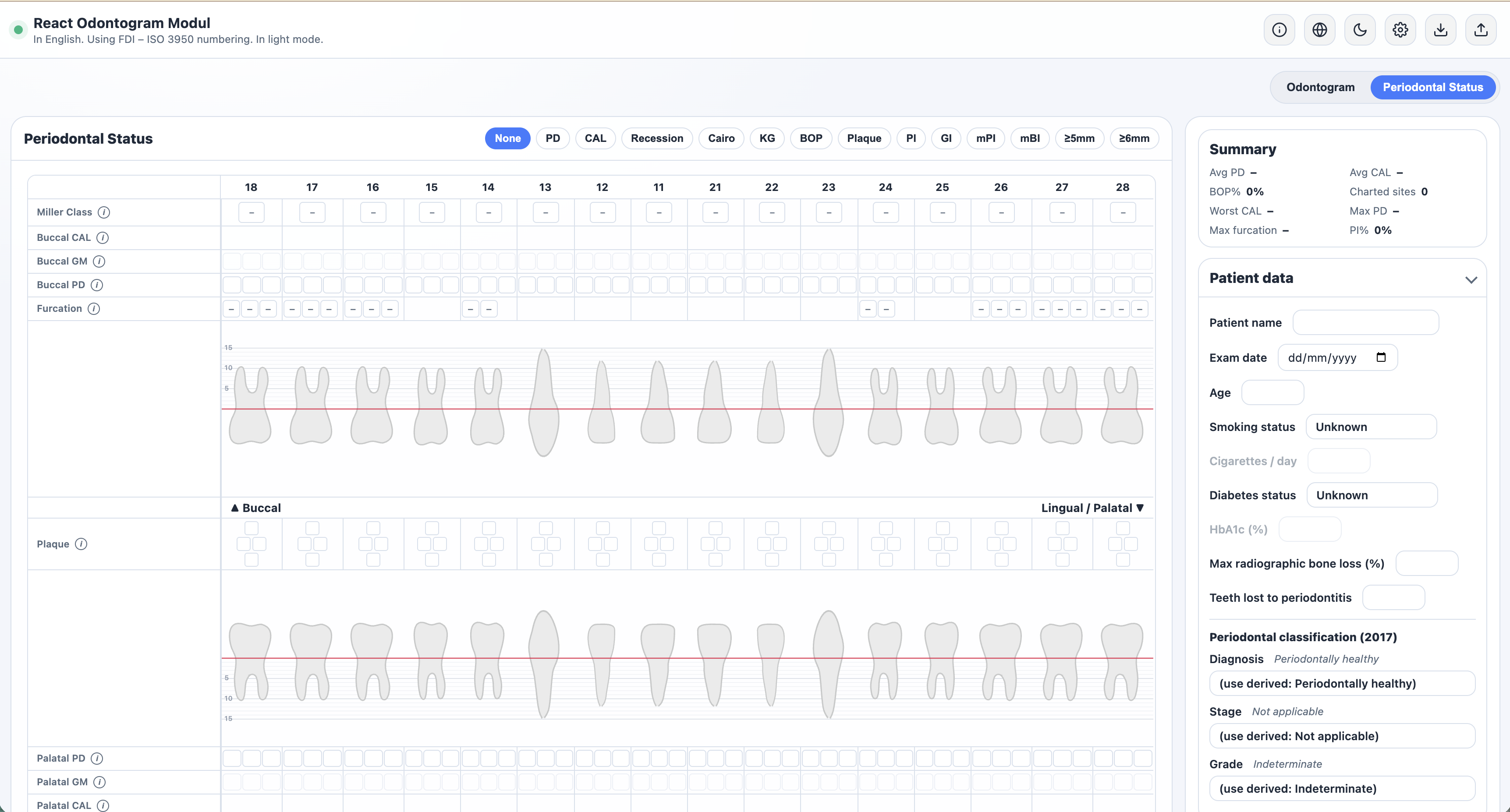
|
|
1356
59
|
|
|
1357
|
-
|
|
1358
|
-
- Las plantillas SVG se cargan desde `src/assets/teeth-svgs` y `src/assets/icon-svgs`, por lo que el hosting estático debe servir la carpeta pública.
|
|
1359
|
-
- El motor del odontograma usa su propio estado interno (no el estado de React) por rendimiento y simplicidad.
|
|
1360
|
-
- Los dientes de leche tienen un conjunto reducido de materiales disponibles (sin obturaciones de amalgama, sin endodoncia con pines).
|
|
1361
|
-
- Los dientes con implante tienen un conjunto diferente de opciones de corona/pilar que los dientes naturales.
|
|
60
|
+
Per-site probing depth, gingival margin, bleeding on probing (+ suppuration) at the six standard sites, with derived CAL, recession and whole-mouth %BOP; a graphical full-mouth perio chart (CEJ line, mm guide grid, pocket/margin curve, anatomical diamond index tiles), 2017 staging/grading, and per-site FHIR export (LOINC periodontal panel `74029-0`). Available as an `Odontogram | Periodontal Status` view toggle and as a separately-invocable `PerioChart` component.
|
|
1362
61
|
|
|
1363
|
-
|
|
62
|
+
## ✨ Highlights
|
|
1364
63
|
|
|
1365
|
-
|
|
64
|
+
- 🦷 Permanent / primary / implant / missing teeth; substrate, restorations (crown/inlay/onlay/veneer/bridge × materials), removable & implant prosthetics
|
|
65
|
+
- 🔍 Multi-surface caries & fillings (ICDAS / CARS severity, root & radiographic caries), endo & AAE pulp diagnosis, apical diagnosis, peri-implant status, wear, discoloration, orthodontics
|
|
66
|
+
- 🩺 Full periodontal module (see above) + 2017 classification
|
|
67
|
+
- 🔗 **HL7 FHIR R4** export/import; JSON export/import with migrations
|
|
68
|
+
- 🖼️ PNG / JPG / SVG chart export and a **PDF report** (jsPDF, lazy-loaded)
|
|
69
|
+
- 🔢 FDI / Universal / Palmer numbering · 🌐 11 UI languages (HU/EN/DE/ES/IT/SK/PL/RU/PT-BR/AR/ZH, Arabic RTL) · 🎨 theming via `--odon-*` CSS variables · 🧩 plugin system · ⌨️ keyboard accessibility
|
|
1366
70
|
|
|
1367
|
-
|
|
1368
|
-
> Dul, Z. (2026). *React Odontogram Modul* (v1.49.0). Zenodo. https://doi.org/10.5281/zenodo.21156787
|
|
71
|
+
## 📖 Documentation
|
|
1369
72
|
|
|
1370
|
-
|
|
73
|
+
Full documentation is available per language:
|
|
1371
74
|
|
|
1372
|
-
|
|
1373
|
-
> archivada más reciente; se emite un DOI específico de versión por cada lanzamiento
|
|
1374
|
-
> cuando se archiva en Zenodo. Hasta que la v1.49.0 sea archivada, cítala mediante
|
|
1375
|
-
> el DOI de concepto.
|
|
75
|
+
🇬🇧 [English](lang/README-en.md) · 🇪🇸 [Español](lang/README-es.md) · 🇩🇪 [Deutsch](lang/README-de.md) · 🇭🇺 [Magyar](lang/README-hu.md) · 🇮🇹 [Italiano](lang/README-it.md) · 🇸🇰 [Slovenčina](lang/README-sk.md) · 🇵🇱 [Polski](lang/README-pl.md) · 🇷🇺 [Русский](lang/README-ru.md) · 🇧🇷 [Português (BR)](lang/README-pt-br.md) · 🇸🇦 [العربية](lang/README-ar.md) · 🇨🇳 [简体中文](lang/README-zh.md)
|
|
1376
76
|
|
|
1377
|
-
|
|
77
|
+
📚 **API reference (TypeDoc):** https://zoliqua.github.io/React-Odontogram-Modul/
|
|
1378
78
|
|
|
1379
|
-
## 📄 License
|
|
79
|
+
## 📄 License & citation
|
|
1380
80
|
|
|
1381
|
-
|
|
1382
|
-
Released under the MIT License.
|
|
81
|
+
MIT © Zoltán Dul. If you use this software in research, please cite it — see [`CITATION.cff`](CITATION.cff) and the [Zenodo record](https://doi.org/10.5281/zenodo.21156787).
|