pi-fold 2.0.0 → 3.0.0
This diff represents the content of publicly available package versions that have been released to one of the supported registries. The information contained in this diff is provided for informational purposes only and reflects changes between package versions as they appear in their respective public registries.
- package/README.md +49 -28
- package/extensions/active-context.ts +1011 -444
- package/extensions/index.js +16 -3
- package/extensions/lib/curation.ts +56 -60
- package/extensions/lib/editor-ui.ts +739 -0
- package/extensions/lib/folding.ts +26 -42
- package/extensions/lib/instrumentation.ts +10 -3
- package/extensions/lib/measurement.ts +6 -12
- package/extensions/lib/persistence.ts +62 -38
- package/extensions/lib/policy.ts +171 -89
- package/extensions/lib/scheduling.ts +341 -108
- package/extensions/lib/selection.ts +6 -78
- package/extensions/lib/tool-surface.ts +29 -33
- package/extensions/lib/transcript.ts +17 -60
- package/extensions/settings.ts +481 -0
- package/package.json +4 -1
package/README.md
CHANGED
|
@@ -6,9 +6,9 @@ Agent-governed lossless context folding for Pi. A session folds its own transcri
|
|
|
6
6
|
|
|
7
7
|
The full write-up, with interactive versions of every mechanism on this page and the complete measurement story, is at [shaneconner.com/projects/pi-fold](https://shaneconner.com/projects/pi-fold/).
|
|
8
8
|
|
|
9
|
-
|
|
10
10
|
|
|
11
|
-
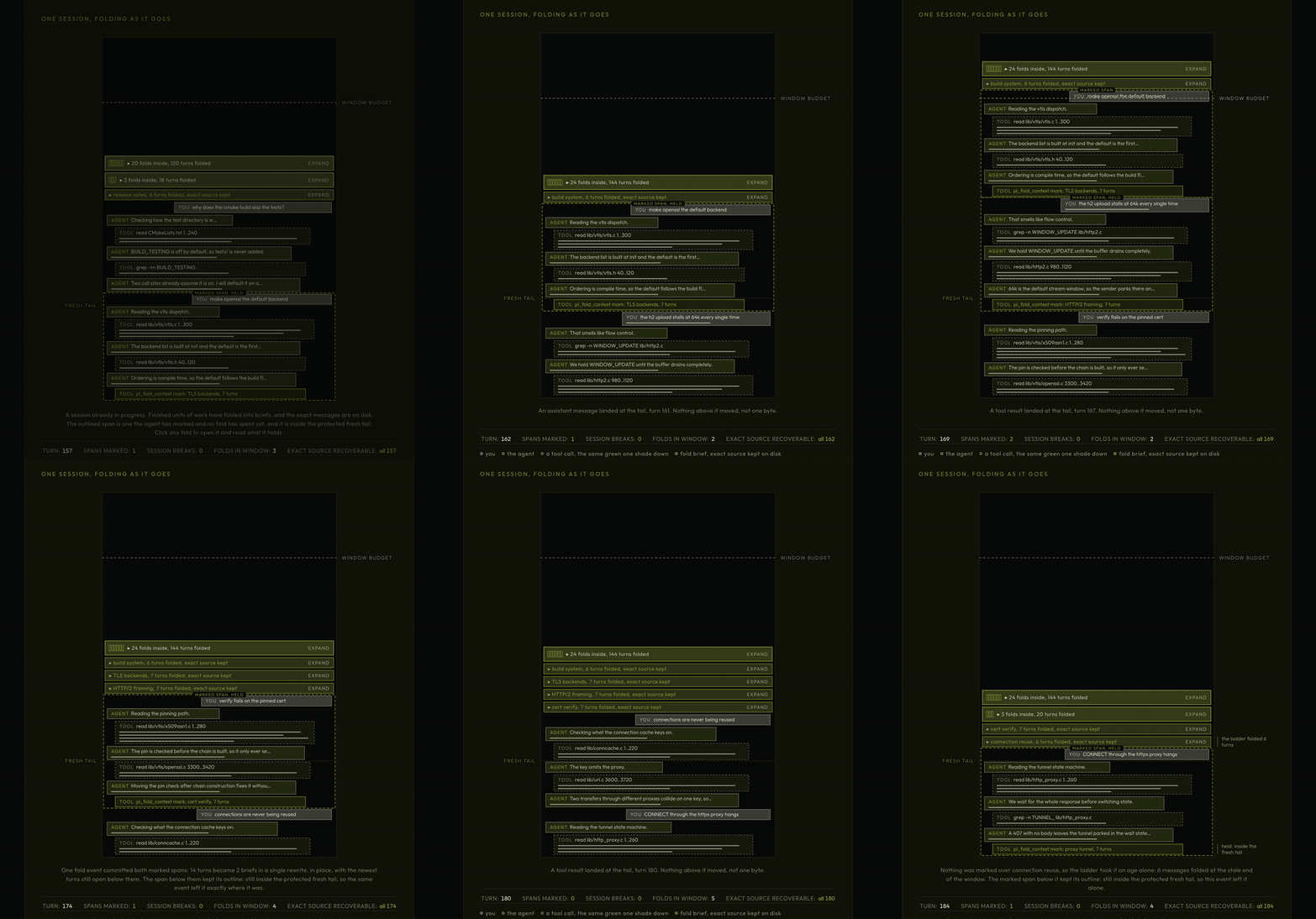
*The mechanism, drawn. One session runs as the transcript it is, user messages in cream, the agent's replies in green, tool results a quieter shade of the same green.
|
|
11
|
+
*The mechanism, drawn. One session runs as the transcript it is, user messages in cream, the agent's replies in green, tool results a quieter shade of the same green. Marks outline spans as they complete and move nothing; the next fold event commits every standing mark in one rewrite, two outlined spans collapsing to two briefs at once. The exact messages stay on disk, addressed and verified by SHA-256, and expanding a brief brings them back byte for byte. Illustrative animation, not a screen capture, and it draws the 2.x surface, where the agent laid the marks and a protected fresh tail held the newest turns; since 3.0 the runtime lays each mark the moment a unit completes and the agent's job is the brief, so the marks arrive earlier and nothing waits to age out. The measured numbers are further down. A 6 MB mp4 of the same clip is at [media/fold-demo.mp4](https://github.com/shaneconner/pi-fold/blob/main/media/fold-demo.mp4).*
|
|
12
12
|
|
|
13
13
|
## Install
|
|
14
14
|
|
|
@@ -22,7 +22,7 @@ pi-fold serves the working tier of a four-tier memory stack. [pi-canon](https://
|
|
|
22
22
|
|
|
23
23
|
## What it is
|
|
24
24
|
|
|
25
|
-
pi-fold registers one tool, `pi_fold_context`, and gives the session's own agent nine actions over its transcript: `status`, `peek`, `
|
|
25
|
+
pi-fold registers one tool, `pi_fold_context`, and gives the session's own agent nine actions over its transcript: `status`, `peek`, `brief`, `expand`, `refold`, `pin`, `unpin`, `reboundary`, and `unmark`. It also registers `/fold`, `/fold-editor`, `/fold-status` and `/fold-settings` for the human.
|
|
26
26
|
|
|
27
27
|
A fold takes a contiguous span of session entries and replaces it, in the window only, with a short brief. The entries themselves go to a fold store, byte for byte, addressed by their SHA-256 hash. The brief carries a handle, the handle resolves to the original, and expansion restores the exact bytes after verifying the hash. A fold is therefore a claim the runtime can check, not a claim the reader has to trust.
|
|
28
28
|
|
|
@@ -32,13 +32,17 @@ Everything else follows from one invariant, and it is the reason several otherwi
|
|
|
32
32
|
|
|
33
33
|
**So the runtime may move a byte in the window only at a moment it is already rewriting the window**, which is a commit or a fold. Everything else is a pure append at the tail, and an appended byte is never later altered, shortened, removed, or repositioned. Stated plainly: never mutate the window, and never show something and then take it back. The second half is the one that costs features. Anything that displays state and then updates it in place is out, however useful the display was, because updating in place is a mid-prefix write with better manners.
|
|
34
34
|
|
|
35
|
-
|
|
35
|
+
Pinning is the other half of governing a window. `pin` holds entries raw through every fold, automatic or marked, so it is how an agent keeps a span expanded on purpose. It is tracked as a claim beside the marks and reported with them, and it frees nothing: the commit still takes its drop from whatever is left, so pinned mass makes the rest of the window fold sooner. A pinned share cap stops that from becoming a window nothing can reclaim.
|
|
36
|
+
|
|
37
|
+
**Marks are free, because a mark moves nothing.** The runtime stages the marks itself: the moment a tool batch or a chapter closes, the frontier cuts it into a pending fold mark, event by event, up to eight cuts per pass, stalest first. A mark lives in durable session state, outside the window; the projection stays byte-identical and the cached prefix survives. What the agent owns is the words. Once enough cut folds are waiting, one bounded notice names them, and `brief` writes the agent's own sentence onto a pending fold for free, because the brief reaches the window only when the commit writes that placeholder for the first time. A supplied brief is kept verbatim; a fold left unbriefed commits with a deterministic brief the runtime writes from the span itself, and the provenance records which happened.
|
|
38
|
+
|
|
39
|
+
Curation is correctable until the commit. `reboundary` with ids re-cuts a span into exactly one fold, merging adjacent cuts when the span covers several and splitting one when the span sits inside it; with a single id it returns that fold's span to raw. `unmark` withdraws a pending mark entirely, and `brief` may be rewritten on a pending fold any number of times at no cost. A standing fold's brief is never rewritten, because rewriting it rewrites the projection at that fold's placeholder and costs the whole prefix cache from there on.
|
|
36
40
|
|
|
37
41
|
**A commit is the one moment bytes move, and every accumulated decision lands at once.** It goes through the preparation and commit machinery every fold has always used, so a committed mark produces the ordinary fold record. Committing is the runtime's call, not a verb the agent can spend: measured 2026-08-07, an agent given the verb called it twice and the runtime correctly held it both times, which is surface without function.
|
|
38
42
|
|
|
39
|
-
**Folds are lossless, and there are two ways back in.** Folds form a DAG whose leaves are the exact session entries, and every fold record keeps ordered references down to those leaves. `peek` is the cheap read: it returns one fold's exact SHA-256-verified source as a tool result, at any depth, with the ancestors still collapsed, without touching the projection. It takes `offset` and `bytes` for a bounded slice, and any child fold id is peekable, so a large fold has a narrow read. `expand` is the commitment, restoring that source in place until the fold is refolded, outside-in and one level at a time. Looking is not the same as taking, and most of the time an agent needs to check one detail rather than reopen an hour of work.
|
|
43
|
+
**Folds are lossless, and there are two ways back in.** Folds form a DAG whose leaves are the exact session entries, and every fold record keeps ordered references down to those leaves. `peek` is the cheap read: it returns one fold's exact SHA-256-verified source as a tool result, at any depth, with the ancestors still collapsed, without touching the projection. It takes `offset` and `bytes` for a bounded slice, and any child fold id is peekable, so a large fold has a narrow read. A peek is ephemeral by default: the bytes ride the window until the model's next message, then their place holds a one-line placeholder and the reply that used them is the surviving trace, so an agent extracts what it needs into that reply. Peeking again is lossless and costs one append, and `ephemeral: false` keeps a result standing when the bytes are needed across several turns. The default follows what agents actually chose: on the sealed run measured for this, six of seven peeks asked for ephemeral at first exposure, and the one durable read was the probe that needed the bytes to persist. `expand` is the commitment, restoring that source in place until the fold is refolded, outside-in and one level at a time. Looking is not the same as taking, and most of the time an agent needs to check one detail rather than reopen an hour of work.
|
|
40
44
|
|
|
41
|
-
When the agent
|
|
45
|
+
When the agent never annotates, the same folds still happen with deterministic briefs: the cuts are the runtime's either way, and only the words on them change. Pinned and blacklisted material never folds, and the fresh end of the window is protected structurally, because an incomplete unit is never proposable and the commit cuts stalest first and stops at its aim. A session that never calls the tool degrades gracefully into lossless hierarchical compaction.
|
|
42
46
|
|
|
43
47
|
## Folding against compaction
|
|
44
48
|
|
|
@@ -123,21 +127,21 @@ Native compaction lost a different continuation key in each attempt, after stage
|
|
|
123
127
|
|
|
124
128
|
Both pi-fold end-block turns included context recovery. The agent made five context calls in repetition 1 and nine in repetition 2 before answering. At the answering requests, the corrected carriage sweep classified 53 of 60 expected end-block values as visible raw and seven as recoverable but not visible, all seven in repetition 1. Those seven answers were correct, but the final projection does not identify how their bytes reached the answer: 60 of 60 is the scored outcome, not proof that recovery made the whole ledger visible. All eight withdrawn correction values were visible raw, and the agent selected the correction every time. The same 102-row certification found one ordinary miss with its expected value visible in a brief and the other recoverable but not visible, while the same matched control in both runs had its value absent from the answering branch.
|
|
125
129
|
|
|
126
|
-
There is no direct cross-arm end-block score and no cost ratio from this campaign: neither native run completed, and native repetition 1 is excluded from cost comparison because of the harness runaway. Two attempts do not estimate a population failure rate. The portable result contains all 102 rows and the source artifact hashes: [hidden-mass-results.json](https://github.com/shaneconner/pi-fold/blob/main/docs/fold_vs_compaction/hidden-mass-results.json). The full chronology and stop rule are in the [experiment log](https://github.com/shaneconner/pi-fold/blob/main/docs/fold_vs_compaction/experiment-log.md).
|
|
130
|
+
There is no direct cross-arm end-block score and no cost ratio from this campaign: neither native run completed, and native repetition 1 is excluded from cost comparison because of the harness runaway. Two attempts do not estimate a population failure rate. The portable result contains all 102 rows and the source artifact hashes: [hidden-mass-results.json](https://github.com/shaneconner/pi-fold/blob/main/docs/fold_vs_compaction/hidden-mass-results.json). The full chronology and stop rule are in the [experiment log](https://github.com/shaneconner/pi-fold/blob/main/docs/fold_vs_compaction/experiment-log.md). The campaign is written up as its own paper, with the frozen plan and seeds, the sealed evidence set, and SHA-256 manifests deposited beside it: [doi.org/10.5281/zenodo.21980747](https://doi.org/10.5281/zenodo.21980747). The story of what it caught is on [Medium](https://medium.com/@shane.conner/the-summary-kept-the-story-it-threw-away-the-key-feafdf5f4132).
|
|
127
131
|
|
|
128
132
|
## How it works
|
|
129
133
|
|
|
130
134
|
pi-fold maps canonical session entries into a fold lattice. Collapsed folds double as a browsable index of earlier work: the briefs sit in the stable prefix of the window, which providers typically serve from cache, so the agent can page through them at little cost, note which spans matter to its current task, expand those, and leave the rest folded. `status` with `detail: "tree"` lists every fold, nested ones included, in transcript order with its depth and parent.
|
|
131
135
|
|
|
132
|
-
The
|
|
136
|
+
The cutting is the runtime's. As units complete, the frontier stages each one as a pending fold mark, at the level of events rather than turns: a completed tool batch is proposable the moment its results land, and an incomplete one never is. The agent's actions ride on top: it briefs the cut folds in its own words, expands any fold whose detail is needed again, dissolves a mis-cut boundary with `reboundary`, withdraws a mark with `unmark`, and pins entries that must stay raw. Curation the agent cannot fix afterwards is curation it will not risk making, which is why `reboundary` is part of the ordinary surface rather than an extra.
|
|
133
137
|
|
|
134
|
-
Every fold
|
|
138
|
+
Every fold obeys the same structural rules. Folds nest rather than partially overlap. Chapter folds align to closed user, assistant and tool-batch units, consolidations take two or more adjacent folds, and pinned or blacklisted evidence never folds. The frontier keeps its own cuts bite-sized, because nobody vouched for a bigger boundary, and a fold that hides more than it says is a fold nobody reads back. A span someone names, through `reboundary` or the editor, is taken whole at any size: a person or the agent cut that boundary on purpose, and a large fold stays cheap to read because peek takes an offset and a byte count, states the middle it omitted, and reads any child fold by id.
|
|
135
139
|
|
|
136
|
-
The automatic law folds only completed tool batches and structurally closed chapters, absorbs only the tool-result folds inside a chapter's own span, and treats fold placeholders as ordinary span material once the window carries `consolidateAfter` unpinned folds, which keeps the brief index tidy long before pressure matters. Briefs are bounded at 2,000 characters each, one cap for supplied and runtime-written briefs alike, so the visible index normally costs a low single-digit share of the window. Automatic foldability is membership, not position: a span folds because it is a completed tool batch or older material a chapter can compose, and what holds it back is the agent's pins
|
|
140
|
+
The automatic law folds only completed tool batches and structurally closed chapters, absorbs only the tool-result folds inside a chapter's own span, and treats fold placeholders as ordinary span material once the window carries `consolidateAfter` unpinned folds, which keeps the brief index tidy long before pressure matters. Briefs are bounded at 2,000 characters each, one cap for supplied and runtime-written briefs alike, so the visible index normally costs a low single-digit share of the window. Automatic foldability is membership, not position: a span folds because it is a completed tool batch or older material a chapter can compose, and what holds it back is the agent's pins and the blacklist. Openness is structural and event-level: an incomplete tool batch is never proposable, and the routine commit cuts stalest first and stops at its aim, so the newest events stay raw for exactly as long as there is room for them.
|
|
137
141
|
|
|
138
|
-
Below `maxTarget` occupancy of the serving budget, 80% by default, the
|
|
142
|
+
Below `maxTarget` occupancy of the serving budget, 80% by default, the window is quiet: marks accumulate but nothing commits, because a commit is an epoch transition that risks the whole prefix cache, and the cadence has to be the fewest commits that still keep the window inside its budget. The remaining fifth of the budget is the runway the commit itself spends. Every occupancy number in this document is a share of that one serving budget: there is a single denominator, `capacityAccounting.budgetTokens`, and no threshold is stated against the raw provider window.
|
|
139
143
|
|
|
140
|
-
Every brief is deterministic, written by the runtime from the span itself with no model call: a tool fold carries the call, its arguments, the head and tail of the result, and the agent's own notes from the batch; a chapter carries its opening text and every assistant note in span order; a consolidation indexes each child. A model-written brief generator shipped through 1.0.x and was deleted on its own measurement: across 15 sealed runs it wrote 1,186 upgraded briefs, 75 percent of which were never consulted by the agent or never became visible before the session ended, and a build with the generator removed scored the same recall for less money. The agent that wants better words on a fold writes them itself: `
|
|
144
|
+
Every brief is deterministic, written by the runtime from the span itself with no model call: a tool fold carries the call, its arguments, the head and tail of the result, and the agent's own notes from the batch; a chapter carries its opening text and every assistant note in span order; a consolidation indexes each child. A model-written brief generator shipped through 1.0.x and was deleted on its own measurement: across 15 sealed runs it wrote 1,186 upgraded briefs, 75 percent of which were never consulted by the agent or never became visible before the session ended, and a build with the generator removed scored the same recall for less money. The agent that wants better words on a fold writes them itself: `brief` puts them on the pending fold and a supplied brief is kept verbatim. There is no way to rewrite a standing fold's brief, because doing so rewrites the projection at that fold's placeholder and costs the whole prefix cache from there on. Sessions already holding model-written briefs keep them on load.
|
|
141
145
|
|
|
142
146
|
The serving budget is what the deployment states it may fill, because the per-request max-input descriptor a provider advertises assumes a full output reservation and understates the real ceiling. With no `providerInputBudget` supplied the runtime falls back to the transport's descriptor and estimates a reservation out of it, which is the conservative default for a model it has no budget fact for; the descriptor is reported in status either way, so the gap stays auditable. A provider-window fence aborts an unsafe request before transmission if no lossless fold can make room, and says so out of band rather than by writing into the window.
|
|
143
147
|
|
|
@@ -149,21 +153,25 @@ Evidence ingestion writes read-only artifact files under the session directory's
|
|
|
149
153
|
|
|
150
154
|
Folding is cheap to decide and expensive to apply, and the expense has nothing to do with how much a fold saves. The bill is set by how often the projection changes, not by how many tokens each change reclaims. A session that folds once per turn re-sends its prefix once per turn; a session that folds three times in total re-sends it three times.
|
|
151
155
|
|
|
152
|
-
Epoch scheduling is the only scheduler, and it splits folding into the two phases described above:
|
|
156
|
+
Epoch scheduling is the only scheduler, and it splits folding into the two phases described above: the frontier records free pending marks as units complete, `unmark` withdraws a standing decision, and a commit applies every pending mark in one projection rewrite. Applying each fold at the moment it was made shipped as an option through 1.0.2 and was deleted once measured: on the pairing below it cost 54 prefix rewrites where epoch paid 3.
|
|
153
157
|
|
|
154
158
|
Two runs from the campaign put a number on the difference. This is the second of the two experiments: pi-fold against itself, both runs on gpt-5.6-luna, same plan, same seed, same configuration with fold scheduling as the only variable. It is internally controlled, and its numbers are not comparable across to the gpt-5.6-sol pairings above. Applying folds immediately spent 19,623,502 fresh input tokens across 105 requests at a pooled cache share of 0.119. Recording marks and landing them together spent 3,603,440 across 99 requests at 0.756: a 5.4x reduction in the tokens the provider had to read for the first time, carrying the total from 22,316,589 tokens down to 14,818,833. Epoch was slower in wall clock on that pairing, 33.5 minutes against 26.7, so the trade bought tokens and not time, and it is one run per arm rather than a rate.
|
|
155
159
|
|
|
156
|
-
The
|
|
160
|
+
The runtime leads here: it marks as the session works, event by event, and the agent's briefs ride the marks. It commits the epoch on one condition: occupancy reaching `maxTarget` of the serving budget. Nothing else fires a commit automatically. Each automatic commit carries a depth bound: it applies marks stalest first and stops once the window is back at `minTarget`, so the newest events stay raw and a mark past the bound simply waits for the next epoch. The gap between the two lines is the hysteresis, which is what makes the spacing between events structural rather than hoped for.
|
|
161
|
+
|
|
162
|
+
Reading stays out of the way of both phases. `peek` is immediate, because it appends a tool result and never edits the prefix, so checking what a fold holds costs nothing a commit has to pay for. And a peek result is itself a completed read, so at the next commit it folds away automatically unless the agent committed to what it saw, which keeps look, decide, discard nearly free. There is no exemption for a span near the tail: a cut is a mark whatever the span's distance from the newest message, and it moves nothing until the commit.
|
|
157
163
|
|
|
158
|
-
|
|
164
|
+
The agent is told as the cuts stage, while a brief still changes what a fold will say. Once three or more staged folds are waiting without an agent brief, one bounded notice, at most 1,200 bytes, is appended once per frozen projection: it names the cut folds with their kinds and estimated sizes, and shows the `brief` call that annotates them. It is appended rather than re-rendered, so it never moves, never costs the cache, and never asks twice for a brief the agent has written. Whatever is still unbriefed when the commit fires folds with the brief the runtime wrote.
|
|
159
165
|
|
|
160
|
-
|
|
166
|
+
Every curation action answers with the same arithmetic, because an agent sees no occupancy and no threshold and cannot aim at a drop nobody states: what the next commit must free and what the standing marks will free when it runs. Both numbers are as of that moment and rise as new results arrive.
|
|
167
|
+
|
|
168
|
+
Protection is unchanged. The frontier never cuts protected evidence, and a pending mark that has become protected refuses at commit with a message naming it, leaving the rest of the epoch to apply. `pi_fold_context {"action":"status"}` reports the pending marks under `automatic.scheduling` with their origin, the estimated share of the serving budget a commit would free, and the estimated prefix tokens it would rewrite.
|
|
161
169
|
|
|
162
170
|
## Reclaiming peek output
|
|
163
171
|
|
|
164
|
-
A `peek` returns a fold's exact stored source, bounded by the chapter cap. That copy then sits in the window as raw evidence while the fold it came from sits beside it as a placeholder: the same bytes, held twice, and the copy is the one
|
|
172
|
+
A `peek` returns a fold's exact stored source, bounded by the chapter cap. That copy then sits in the window as raw evidence while the fold it came from sits beside it as a placeholder: the same bytes, held twice, and the copy is the one automatic folding cannot take. A runtime that does not classify a peek batch as a completed read measures the pressure at every rung and finds nothing eligible. On a workload that peeks freely this is the whole failure: a measured 64-stage session ended with 14 raw peek results holding 1.9M characters, 82% of everything still unfolded, while the runtime had already folded 53 of the 56 stage results and had no supply left.
|
|
165
173
|
|
|
166
|
-
So a peek result is classified as a completed read, unconditionally. The peek batch is eligible for the same tool rung under the same protections:
|
|
174
|
+
So a peek result is classified as a completed read, unconditionally. The peek batch is eligible for the same tool rung under the same protections: protected evidence is still refused, and the fold record is the ordinary reversible one, so the source recovers exactly. Nothing about the commit's thresholds changes; only what counts as foldable does. The cost is that a peeked span the agent is about to work from can fold back before it is used, which means peeking again to read it; the duplicate window it otherwise leaves behind is the larger bill.
|
|
167
175
|
|
|
168
176
|
## What the invariant cost
|
|
169
177
|
|
|
@@ -171,17 +179,19 @@ Three separate features shipped that each rewrote the window mid-prefix, and eac
|
|
|
171
179
|
|
|
172
180
|
Peek reclamation was the costliest. It removed duplicate bytes from the window after a peek and deferred the removal until a later assistant message existed, so the edit would land behind the tail. That deferral is what makes it look tail-local and what guarantees it is not: waiting for a later message is precisely the condition under which the window has already grown over the site of the edit. Measured 2026-08-07, two such reclamations cost 100k fresh tokens. A peek is now append-only, and its duplicate bytes are reclaimed by the tool-fold rung at the next commit, the one moment a rewrite is already being paid for.
|
|
173
181
|
|
|
174
|
-
The ephemeral surfacing slate went the same way, and it deserves its own note because the idea was not the problem. It scored the fold set against the live window and offered the agent a short slate of folds worth peeking at or expanding, and the selection was useful. What failed was the delivery: the slate was shown on one pass and withdrawn on the next so a recomputed slate could take its place, which is a show-then-retract. Its bytes occupy prefix positions in one request and different bytes occupy them in the next, so the cached prefix dies.
|
|
182
|
+
The ephemeral surfacing slate went the same way, and it deserves its own note because the idea was not the problem. It scored the fold set against the live window and offered the agent a short slate of folds worth peeking at or expanding, and the selection was useful. What failed was the delivery: the slate was shown on one pass and withdrawn on the next so a recomputed slate could take its place, which is a show-then-retract. Its bytes occupy prefix positions in one request and different bytes occupy them in the next, so the cached prefix dies. The delivery was deleted first, and the selector followed on its own measurement: re-homed to the commit boundary as one persisted suggestion per epoch, the sealed corpus showed 86 surfacings with 7 taken, all seven on earlier builds, so the subsystem was deleted whole. What remains is the browsable index the briefs already are, and the agent's `status` and `peek` reads over it.
|
|
183
|
+
|
|
184
|
+
Anticipatory guidance went with them: pressure milestones, the live advisory, curation reminders, the last-call notice. Guidance about a coming event has to arrive before the event, so it can never ride a rewrite the runtime was already paying for; it has to create one. What is left in the window is a bounded receipt of what the runtime just did, built only when a commit produced one, landing inside the freeze, never rendered twice.
|
|
175
185
|
|
|
176
|
-
|
|
186
|
+
Earlier releases read those runs as evidence about agents: eleven runs at a voluntary fold share of 0.00, and three runs built to invite curation producing 0, 1 and 0 voluntary folds. That reading is withdrawn. Two things made marking impossible rather than unattractive in those runs. The ladder marked on every measurement, so by the time any invitation reached the agent there was nothing unclaimed left to name, which the records show directly: the unmarked remainder was zero at every measured crossing. And the invitation was anchored to the serving budget rather than to the commit threshold, which on a real deployment puts it above the threshold rather than below it, so it arrived after the commit was already due. Both are fixed below. The numbers stand as measurements of that design; they are not evidence about what an agent will do, and the question is open until it is measured on a runtime where marking is possible.
|
|
177
187
|
|
|
178
|
-
Earlier releases shipped truthful capacity accounting, admission control on `peek` and `expand`, retained pending marks, stage-identified fold briefs, the
|
|
188
|
+
Earlier releases shipped truthful capacity accounting, admission control on `peek` and `expand`, retained pending marks, stage-identified fold briefs, the pinned-mass backstop, the status index diet and the append-only projection itself as individually opt-in levers. All of them are now simply how pi-fold works, and the flags are gone rather than deprecated; git history is the lineage.
|
|
179
189
|
|
|
180
190
|
`pi_fold_context {"action":"status"}` reports real projection rewrites separately from observed provider-side cache misses, per-message digests included: a miss on a projection the runtime did not rewrite is provider-side by construction, and conflating the two hides exactly the bug this invariant exists to prevent. On the complete 64-stage run that instrument read 76 pure appends, 6 rewrites, and 0 unattributed rewrites, with the six rewrites landing batches of 12, 14, 9, 11, 9 and 7 folds.
|
|
181
191
|
|
|
182
192
|
## Relation to prior work
|
|
183
193
|
|
|
184
|
-
pi-fold combines two recent lines of work in one mechanism. Lossless hierarchical compaction, exemplified by LCM ([arXiv:2605.04050](https://arxiv.org/abs/2605.04050)) with an interactive walkthrough at [losslesscontext.ai](https://www.losslesscontext.ai/), builds a summary DAG over older messages with lossless pointers to every original, but the system alone decides when to compact and the folds accrete from the beginning of the conversation as it ages, so the cuts track position. Self-GC ([arXiv:2607.00692](https://arxiv.org/abs/2607.00692)) treats context as indexed, recoverable objects with fold, mask and prune actions, proposed by a side-channel planner under harness enforcement. In pi-fold the
|
|
194
|
+
pi-fold combines two recent lines of work in one mechanism. Lossless hierarchical compaction, exemplified by LCM ([arXiv:2605.04050](https://arxiv.org/abs/2605.04050)) with an interactive walkthrough at [losslesscontext.ai](https://www.losslesscontext.ai/), builds a summary DAG over older messages with lossless pointers to every original, but the system alone decides when to compact and the folds accrete from the beginning of the conversation as it ages, so the cuts track position. Self-GC ([arXiv:2607.00692](https://arxiv.org/abs/2607.00692)) treats context as indexed, recoverable objects with fold, mask and prune actions, proposed by a side-channel planner under harness enforcement. In pi-fold the runtime cuts in-band at event boundaries and the session agent holds the annotation and correction verbs over the cuts, so what a fold says can track relevance; a session that never touches the tool degrades into lossless hierarchical compaction.
|
|
185
195
|
|
|
186
196
|
Context-Folding ([arXiv:2510.11967](https://arxiv.org/abs/2510.11967), ByteDance Seed) has the agent branch into a sub-trajectory and fold it on completion, with the behavior shaped by reinforcement learning; the fold keeps a summary of the outcome rather than a lossless path back. MemGPT and its successor [Letta](https://github.com/letta-ai/letta) are the canonical agent-held memory-verb systems: the agent edits its own memory blocks and archives while the window pages against external stores. Two things separate pi-fold from that line. First, what is governed: Letta manages traffic between the window and outside storage, and when its message queue overflows the in-window record becomes a lossy recursive summary; pi-fold restructures the transcript in place. Second, recovery: theirs is retrieval, a search that re-ingests whatever comes back as new tokens; ours is expansion, which restores the exact folded entries after SHA-256 verification.
|
|
187
197
|
|
|
@@ -191,14 +201,25 @@ The design also pairs with Pi's session trees: a fold's collapsed-or-expanded st
|
|
|
191
201
|
|
|
192
202
|
## Configuration
|
|
193
203
|
|
|
194
|
-
The package entry calls `registerPiFold(pi)` with the defaults below, and that is the whole surface:
|
|
204
|
+
The package entry calls `registerPiFold(pi)` with the defaults below, and that is the whole surface: three options, one of which no longer appears in the settings screen, and every other name is refused with the replacement or the deletion reason named in the message. A host still passing `summarizer` or `guidance` is refused with the deletion message rather than silently ignored. Hosts that call the named `registerPiFold` export directly may pass an options object. Replacement sets replace the defaults; they are not additive.
|
|
205
|
+
|
|
206
|
+
Four commands ship for the human: `/fold-status` (fold roots and paging state), `/fold` (commit every staged mark in one epoch; with explicit ids, folds exactly that span now), `/fold-editor` (the interactive map of the working window: occupancy against the serving budget, fold roots with their briefs, staged marks, pins; Enter expands a fold or deepens an entry's preview, `m` lays a user mark over a raw span with an optional typed brief, `u` withdraws a staged mark, `p` pins or unpins, and every gesture runs the same validated paths the agent's tool actions run), and `/fold-settings` (edit the configuration below from inside the TUI). The settings command reads and writes `~/.config/pi-fold/settings.json`, whose only key is `thresholds`; each edit is applied against the whole current object and re-validated through the same `resolveThresholds` path registration uses, so only a policy that would register is ever written. A missing file means package defaults. A stored file never stops the agent: one written before a setting existed is migrated, keeping every value it carries, gaining the new one at its default, and rewritten whole so a partial object is never re-read against later defaults; a file that is genuinely invalid is left alone, the package defaults apply, and `/fold-settings` names the reason. The four values in `thresholds` are everything a person tunes: `maxTarget` is when to fold, `minTarget` is how far down, `consolidateAfter` is how wide a group gets a parent, and `minFoldChars` is how big a fold has to be to be worth making.
|
|
195
207
|
|
|
196
208
|
| Option | Default | Effect |
|
|
197
209
|
| --- | --- | --- |
|
|
198
|
-
| `thresholds` | `{ maxTarget: 0.80, minTarget: 0.
|
|
199
|
-
| `providerInputBudget` | the transport's descriptor |
|
|
200
|
-
| `blacklistAutoFoldTools` | `new Set()` | The exception list. Every completed tool batch is foldable by the runtime on its own, without an agent mark; name a tool here and its results stay raw instead. Empty by default, because foldability is not the protection: pins
|
|
201
|
-
|
|
210
|
+
| `thresholds` | `{ maxTarget: 0.80, minTarget: 0.40, consolidateAfter: 10, minFoldChars: 8000 }` | The band, set whole or not at all. The first two are proportions of the serving budget: fold at `maxTarget`, fold down to `minTarget`. Against a 272,000-token descriptor the defaults hold the session in roughly a 100k to 250k band: the trigger fires at 80% and the session runs one epoch's inflow past it before the commit lands, and the aim leaves about 100k of the freshest context raw across the whole cycle. `consolidateAfter` is a positive integer count of visible roots per parent owed. `minFoldChars` is the size in characters a fold has to reach to be worth making, and the same number is the floor a gap between two folds has to clear to stay raw: anything smaller is absorbed by the fold beside it. Characters rather than tokens because a token means a different amount of text on every wire. Validated atomically at registration, and an impossible policy is refused by name rather than clamped. User policy only: no agent action can read it back as a mutable surface, though status reports the values. |
|
|
211
|
+
| `providerInputBudget` | the transport's descriptor | Machine surface, off the `/fold-settings` screen as of 2.1: the tokens this deployment may actually put into a request, already net of whatever output reservation it holds back. Every ratio, fence and budget divides by it directly, and pi-fold subtracts nothing from a declared value. It exists for a harness that needs runs comparable across descriptor changes. Shares otherwise apply to the model's own window: the runtime falls back to the transport's descriptor and estimates the reservation out of it, and the descriptor is reported in status either way, so the gap stays auditable. |
|
|
212
|
+
| `blacklistAutoFoldTools` | `new Set()` | The exception list. Every completed tool batch is foldable by the runtime on its own, without an agent mark; name a tool here and its results stay raw instead. Empty by default, because foldability is not the protection: pins are, and they apply to a blacklisted tool and an ordinary one alike. Pass a `ReadonlySet<string>`. Blacklisting is not free: the mass stays in the window until a chapter fold takes it, and a closed unit that alone exceeds the chapter cap is reclaimed whole rather than in pieces. |
|
|
213
|
+
|
|
214
|
+
### Migrating from 2.x
|
|
215
|
+
|
|
216
|
+
Version 3.0 moves the cutting from the agent to the runtime, on the first live session's measurement: a session that never closes its turn never handed the old design a boundary to fold at, so the guard that waited for one held everything while occupancy climbed. Boundaries are now events, not turns.
|
|
217
|
+
|
|
218
|
+
- The `fold` action is deleted from the tool surface. The runtime stages every completed unit itself; the agent annotates with `brief`, corrects with `reboundary` and `unmark`, and protects with `pin`.
|
|
219
|
+
- Remove `guidance`. The option is refused by name: it switched the copy that taught the agent to choose spans, and the agent no longer chooses spans. The post-fold notice that replaced it is not optional, because a fold the agent is never told about is one it can never brief.
|
|
220
|
+
- `thresholds.freshTail` is gone: fresh-tail protection is deleted, because openness is structural per event and the commit's depth bound already stops at the aim. A settings file carrying the key is migrated by dropping it, with every tuned value kept.
|
|
221
|
+
- The default `thresholds` are `maxTarget: 0.80` and `minTarget: 0.40`, which against a 272,000-token descriptor holds a session in roughly a 100k to 250k band.
|
|
222
|
+
- Existing sessions remain readable, folds and briefs included.
|
|
202
223
|
|
|
203
224
|
### Migrating from 1.x
|
|
204
225
|
|
|
@@ -206,7 +227,7 @@ Version 2.0 makes the measured deletions explicit instead of accepting options t
|
|
|
206
227
|
|
|
207
228
|
- Remove `summarizer` and `summarizeContextSpan`. The model brief generator is deleted; every new fold carries a deterministic or agent-supplied brief. Passing either name is refused with the deletion reason.
|
|
208
229
|
- Remove `guidance.thresholdNotices`. `guidance` now contains only `actionResponses`.
|
|
209
|
-
- The default `thresholds.minTarget` is now `0.
|
|
230
|
+
- The default `thresholds.minTarget` is now `0.40`. A host supplying the whole threshold object keeps its declared value.
|
|
210
231
|
- Existing sessions remain readable. Fold records already carrying model-authored briefs keep those briefs and their provenance on load.
|
|
211
232
|
|
|
212
233
|
### Projection candidate records
|