ossclip 0.1.36 → 0.1.38
This diff represents the content of publicly available package versions that have been released to one of the supported registries. The information contained in this diff is provided for informational purposes only and reflects changes between package versions as they appear in their respective public registries.
- package/README.md +11 -1
- package/editor-dist/assets/{index-pWbFr8vc.js → index-DpySfDtS.js} +37 -37
- package/editor-dist/index.html +1 -1
- package/package.json +4 -4
- package/src/analyze.ts +4 -0
- package/src/doctor.ts +38 -6
- package/src/edit.ts +137 -32
- package/src/interactive/produce-wizard.ts +7 -2
- package/src/produce.ts +145 -44
- package/src/program.ts +47 -0
- package/src/setup/plan.ts +18 -0
- package/src/whisper-backend.ts +103 -0
package/README.md
CHANGED
|
@@ -2,7 +2,7 @@
|
|
|
2
2
|
|
|
3
3
|
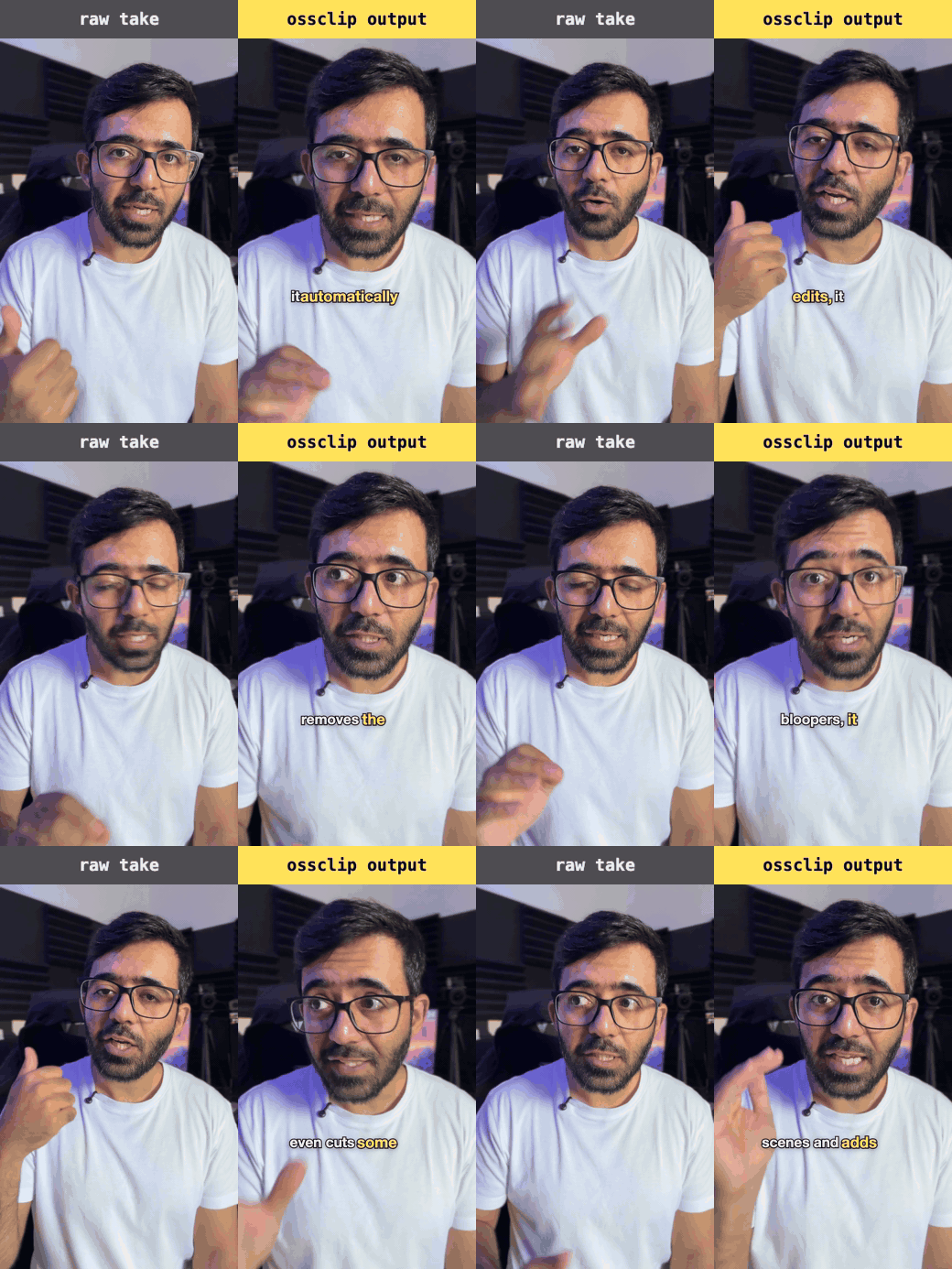
**A local-first CLI that turns a talking-head take into a finished short.** It cuts silence and filler words, writes word-timed kinetic captions, frames on the measured face, and has an LLM plan **code-rendered on-screen graphics** — title cards, stat cards, diagrams, terminal and chat mockups — from what was actually said.
|
|
4
4
|
|
|
5
|
-
Transcription is local (whisper.cpp), rendering is local (Remotion); the only network calls are the LLM planning ones, on your own key or your existing Claude Code / Google Antigravity subscription. Vertical 9:16 by default, landscape 16:9 with `--aspect`.
|
|
5
|
+
Transcription is local (whisper.cpp — a remote server is opt-in, see below), rendering is local (Remotion); the only network calls are the LLM planning ones, on your own key or your existing Claude Code / Google Antigravity subscription. Vertical 9:16 by default, landscape 16:9 with `--aspect`.
|
|
6
6
|
|
|
7
7
|
|
|
8
8
|
|
|
@@ -40,8 +40,18 @@ ossclip edit "<work directory>"
|
|
|
40
40
|
|
|
41
41
|
**Scope, honestly:** ossclip is at its best polishing a take you have already cut down. `--clip` selects a single strongest window from long-form input — one clip, not N.
|
|
42
42
|
|
|
43
|
+
**Color grading:** `--color-grade <preset|file.cube>` grades the footage — six presets (`talking-head`, `teal-orange`, `filmic-fade`, `cwa`, `punchy`, `mono`), or any `.cube` LUT you drop in `~/.ossclip/luts`. Presets preview live in the editor, where intensity, exposure, temperature, saturation and contrast are sliders; a LUT bakes into the mezzanine at render time. `"colorGrade"` in `~/.ossclip/config.json` sets a channel's look once, and `--no-color-grade` is a hard off for one run.
|
|
44
|
+
|
|
45
|
+
**Sound effects:** `--sfx` places whooshes, dings and risers on the beats the producer planned (`--sfx-level subtle|normal|meme` — `meme` is what unlocks the record scratch). Needs `--produce`. A CC0 starter pack ships with the CLI; your own packs live in `~/.ossclip/sfx`. The editor gets an SFX lane: retime, swap, gain, mute-with-a-way-back, or add one at the playhead, audible in the preview.
|
|
46
|
+
|
|
47
|
+
**Keep a 4K source's pixels:** `--resolution auto` renders at what the source still has after the crop (capped at 2160, never under 1080p) instead of forcing 1080p — invisible on the platforms that cap at 1080p, real on YouTube. `1080` (default), `1440` and `2160` are the fixed choices.
|
|
48
|
+
|
|
49
|
+
**Frame 1 is the cover on some platforms:** `--cover-in-video` overlays the cover image on the opening frames — nothing is inserted, the overlay ends at the first spoken word, so no audio or caption timing moves. Off by default; `"coverInVideo": true` in the config turns it on for good.
|
|
50
|
+
|
|
43
51
|
**Keep your own editor:** `ossclip analyze` exports every suggested cut as a labelled span marker — reason, duration, confidence — in the dialect your NLE actually reads (`premiere-xml`, `resolve-edl` with colours, or `fcpxml` for Final Cut). Review the markers, cut in your own timeline; nothing is applied for you. Import steps per NLE are in the repo README.
|
|
44
52
|
|
|
53
|
+
**Weak CPU?** On an older machine whisper is the dominant cost of a run, so transcription can go to any OpenAI-compatible `/v1/audio/transcriptions` server instead — [Groq](https://console.groq.com)'s free tier, or your own [speaches](https://github.com/speaches-ai/speaches)/whisper.cpp server, which needs no key. Export `OSSCLIP_WHISPER_URL` (plus `OSSCLIP_WHISPER_API_KEY` where the server wants one) and every run transcribes remotely; `--whisper-backend local` opts a single run back out, and `ossclip doctor` and `ossclip setup` stop asking for whisper.cpp and the model file. Your audio leaves the machine on that path — which is why it is off until you configure it. Caps and self-hosting notes in the repo README.
|
|
54
|
+
|
|
45
55
|
AI can make mistakes: the cut, the captions and every graphic are generated — review the output before publishing.
|
|
46
56
|
|
|
47
57
|
**Telemetry:** ossclip sends anonymous usage events (counts, durations, provider name) — never footage, transcripts, file names or paths. Turn it off any time with `ossclip telemetry off`, `OSSCLIP_TELEMETRY=0`, or `DO_NOT_TRACK=1`. Full detail in the repo README's Telemetry section.
|