openclaw-code-agent 4.2.4 → 4.3.1
This diff represents the content of publicly available package versions that have been released to one of the supported registries. The information contained in this diff is provided for informational purposes only and reflects changes between package versions as they appear in their respective public registries.
- package/README.md +7 -2
- package/dist/index.js +141 -140
- package/openclaw.plugin.json +11 -5
- package/package.json +7 -6
- package/skills/code-agent-orchestration/SKILL.md +2 -1
package/README.md
CHANGED
|
@@ -14,6 +14,7 @@ Use it when you want to start coding work from Telegram, Discord, or another Ope
|
|
|
14
14
|
- **Delegated worktree isolation**. New sessions default to `delegate`; opt into `ask`, `off`, `manual`, `auto-merge`, or `auto-pr` when you want a different branch follow-through policy.
|
|
15
15
|
- **State-driven decision UX**. `ask` sends explicit action buttons for **Merge**, **Open PR**, **Later**, and **Discard**. The same action-token model backs Telegram and Discord interactive callbacks.
|
|
16
16
|
- **Lifecycle-first cleanup**. Worktrees are temporary task sandboxes. The plugin distinguishes `merged` from `released` so different-SHA branches whose content already landed on the base branch can still be cleaned safely.
|
|
17
|
+
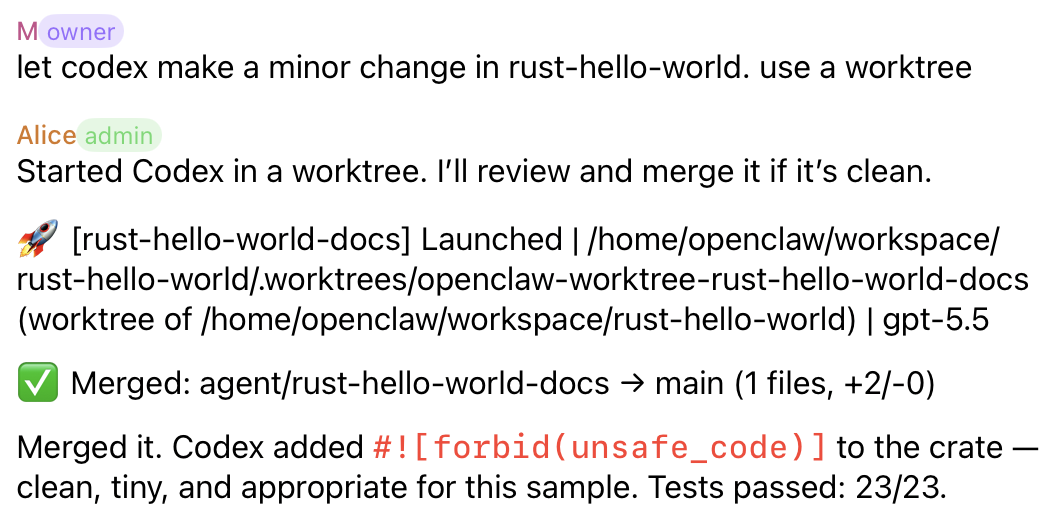
- **Routed outcome summaries**. Merge and PR actions deliver the canonical status first, then wake the orchestrator to send one concise factual follow-up in the originating chat/thread.
|
|
17
18
|
- **Full session lifecycle**. Suspend, resume, fork, interrupt, and recover sessions across restarts with persisted metadata and output.
|
|
18
19
|
- **Explicit goal-task loops**. Opt into verifier-driven repair loops or Ralph-style completion loops when you need iterative autonomous execution toward a specific goal.
|
|
19
20
|
- **Real operator visibility**. `agent_sessions`, `agent_output`, and `agent_stats` show status, buffered output, duration, and USD cost.
|
|
@@ -51,6 +52,8 @@ In `ask`, the user controls branch follow-through after the agent finishes. Curr
|
|
|
51
52
|
|
|
52
53
|
In `delegate`, the orchestrator reviews the completed worktree and attempts the merge follow-through when the change is clean. The agent edits files in the managed worktree so the main checkout is not touched during implementation; after review, delegated follow-through merges the finished branch back to the base branch unless a conflict, error, or explicit policy requires escalation.
|
|
53
54
|
|
|
55
|
+
After merge or PR follow-through, the plugin sends the canonical status line and wakes the orchestrator to read the full session output and send the routed factual summary. That summary is orchestrator-owned, so it preserves the original chat/thread instead of depending on whichever route handled the tool call.
|
|
56
|
+
|
|
54
57
|
|
|
55
58
|
|
|
56
59
|
### Worktree Lifecycle
|
|
@@ -124,9 +127,9 @@ Because worktree isolation defaults to `delegate`, `defaultWorkdir` should norma
|
|
|
124
127
|
|
|
125
128
|
Chat-launched sessions route updates back to their originating chat thread. For agent-launched tool sessions without an origin route, configure `fallbackChannel` or `agentChannels` in the reference guide.
|
|
126
129
|
|
|
127
|
-
This release targets the OpenClaw SDK package `openclaw@2026.5.
|
|
130
|
+
This release targets and validates against the OpenClaw SDK package `openclaw@2026.5.22`, while keeping the plugin peer floor at `>=2026.4.21`. No host upgrade or host config change is required for this plugin compatibility update. OpenClaw `2026.5.22` adds SDK/runtime surfaces for channel-message polls, row-level session helpers, harness task completions, and provider capabilities, but `openclaw-code-agent` does not need new imports for them: the manifest already declares `contracts.tools`, the plugin still imports only `openclaw/plugin-sdk/plugin-entry`, and its own session store, wake routing, callbacks, worktree flows, and Codex/Claude harness model restrictions remain plugin-owned.
|
|
128
131
|
|
|
129
|
-
If you use Codex, make sure the local `codex` command or `OPENCLAW_CODEX_APP_SERVER_COMMAND` override is available and authenticated. When Codex auth is inconsistent, this is the recommended `~/.codex/config.toml` setting:
|
|
132
|
+
If you use Codex, make sure the local `codex` command or `OPENCLAW_CODEX_APP_SERVER_COMMAND` override is available and authenticated. Codex-specific defaults live under `harnesses.codex`: `reasoningEffort` is sent as `reasoningEffort`, and `fastMode: true` sends `service_tier: "fast"` on Codex App Server thread, resume, and turn payloads. When Codex auth is inconsistent, this is the recommended `~/.codex/config.toml` setting:
|
|
130
133
|
|
|
131
134
|
```toml
|
|
132
135
|
forced_login_method = "chatgpt"
|
|
@@ -174,6 +177,8 @@ New sessions use delegated worktree follow-through unless configured otherwise.
|
|
|
174
177
|
|
|
175
178
|
Ask OpenClaw for worktree status before cleaning resolved sandboxes.
|
|
176
179
|
|
|
180
|
+
Merge and PR outcomes use a two-step completion contract: the plugin delivers the canonical outcome status, then wakes the orchestrator with the original route/thread metadata and `completionWakeSummaryRequired=true`. The orchestrator should read the full output, avoid repeating the status line, and send one short factual summary to the session origin route.
|
|
181
|
+
|
|
177
182
|
### Goal Tasks
|
|
178
183
|
|
|
179
184
|
Goal tasks are explicit autonomous loops for work that should keep iterating toward a defined finish line. They do not replace ordinary coding sessions.
|