next-observer 0.3.18 → 0.3.19
This diff represents the content of publicly available package versions that have been released to one of the supported registries. The information contained in this diff is provided for informational purposes only and reflects changes between package versions as they appear in their respective public registries.
- package/README.md +87 -20
- package/package.json +4 -3
package/README.md
CHANGED
|
@@ -1,40 +1,101 @@
|
|
|
1
1
|
# next-observer
|
|
2
2
|
|
|
3
|
-
The observer for
|
|
4
|
-
|
|
5
|
-
into your app's dependencies.
|
|
3
|
+
The **observer** for Next.js: one process that receives your app's telemetry, shows it, and has **AI agents** investigate
|
|
4
|
+
it. A server, a UI, an anomaly detector and the agents — started with `npx`, never installed into your app.
|
|
6
5
|
|
|
7
6
|
```bash
|
|
8
|
-
npx next-observer
|
|
7
|
+
npx next-observer init # once: connects the app (installs the APM agent, next-observe, into it)
|
|
8
|
+
npm run observe # the observer + `next dev`; open http://127.0.0.1:4318
|
|
9
9
|
```
|
|
10
10
|
|
|
11
|
-
-
|
|
12
|
-
|
|
13
|
-
with exact errors, N+1 patterns — with evidence cards built from the data, not by the model
|
|
14
|
-
- **Anomaly detector** that starts an investigation by itself when error rates or latency jump
|
|
15
|
-
- **Cold starts are not regressions:** the first request of a route after a server start (in `next dev` it includes
|
|
16
|
-
compiling the route) is left out of latency stats and the detector, and marked in traces (needs next-observe ≥ 0.2.2)
|
|
11
|
+
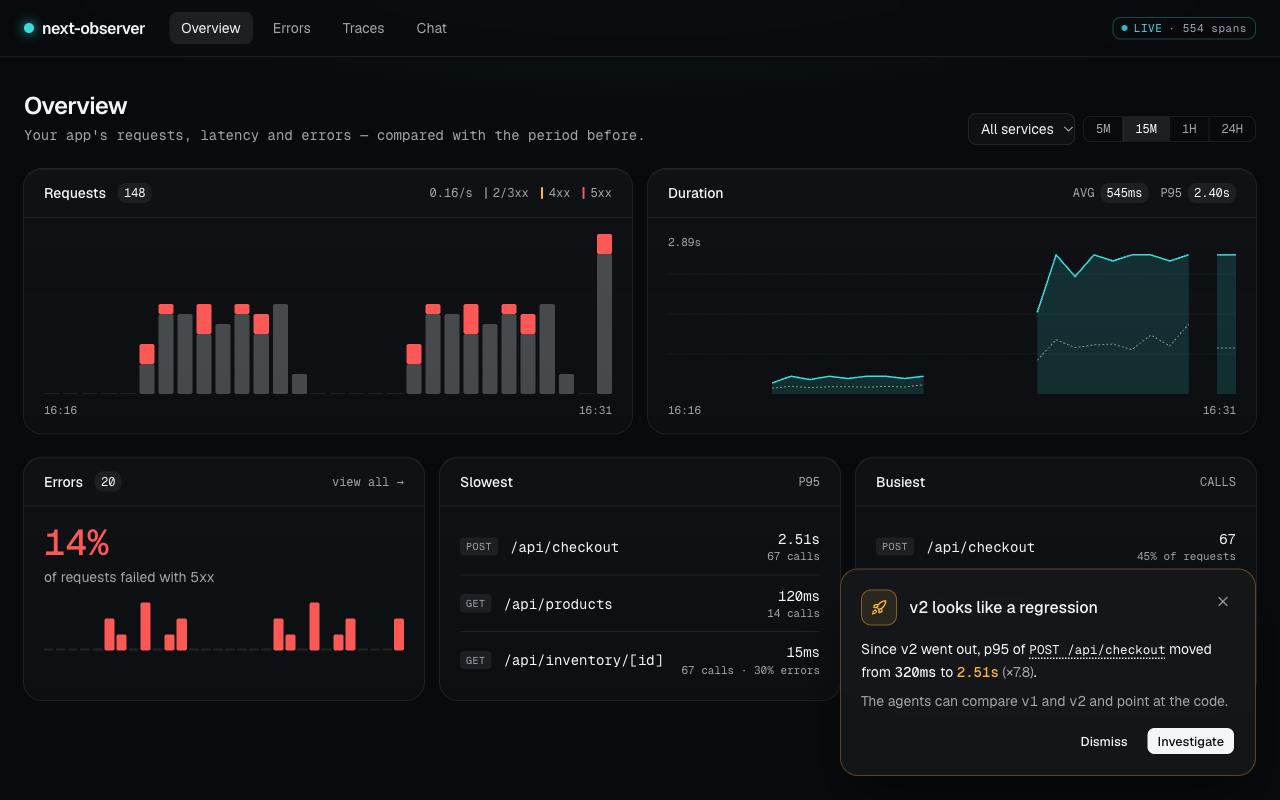
No app at hand? `npx next-observer collector --demo` starts the observer with a sample shop that has four things to
|
|
12
|
+
find: a deployment that made checkout slower, a failing endpoint, an N+1 query, and an error the last deployment brought.
|
|
17
13
|
|
|
18
|
-
|
|
14
|
+
|
|
15
|
+
|
|
16
|
+
## Two packages, one letter apart
|
|
17
|
+
|
|
18
|
+
| | [`next-observe`](https://www.npmjs.com/package/next-observe) | [`next-observer`](https://www.npmjs.com/package/next-observer) |
|
|
19
|
+
|---|---|---|
|
|
20
|
+
| **What it is** | the **APM agent** | the **observer** — a server with a UI and **AI agents** |
|
|
21
|
+
| **Where it runs** | inside your Next.js app (a dependency) | next to the app, started with `npx` (never a dependency) |
|
|
22
|
+
| **What it does** | collects telemetry and sends it | receives telemetry, shows it, investigates it |
|
|
23
|
+
| **Contains AI?** | no — OpenTelemetry only | yes — the AI agents live here |
|
|
24
|
+
|
|
25
|
+
```
|
|
26
|
+
your Next.js app the observer
|
|
27
|
+
┌──────────────────────────┐ ┌──────────────────────────────────┐
|
|
28
|
+
│ next-observe │ traces │ next-observer (port 4318) │
|
|
29
|
+
│ the APM agent │ ───────────▶ │ server · UI · anomaly detector │
|
|
30
|
+
│ collects and sends │ OTLP/HTTP │ AI agents that investigate │
|
|
31
|
+
└──────────────────────────┘ └──────────────────────────────────┘
|
|
32
|
+
```
|
|
33
|
+
|
|
34
|
+
**Two kinds of "agent" — they are not the same thing:**
|
|
35
|
+
|
|
36
|
+
- **APM agent** = `next-observe`. The classic meaning from application performance monitoring: a library inside the app
|
|
37
|
+
that records what happens (requests, timings, errors) and ships it out. It decides nothing.
|
|
38
|
+
- **AI agents** = inside `next-observer`. Language models with tools that query the recorded telemetry and answer
|
|
39
|
+
"what is slow, since which deployment, and where in the code". They never run inside your app.
|
|
40
|
+
|
|
41
|
+
## What you get
|
|
42
|
+
|
|
43
|
+
**Overview** — requests by status class, latency and 5xx rate, each compared with the period before; the slowest and
|
|
44
|
+
the busiest routes. When the latest deployment made a route slower or more error-prone, a banner says so with the
|
|
45
|
+
measured numbers, and **Investigate** hands the question to the AI agents.
|
|
46
|
+
|
|
47
|
+
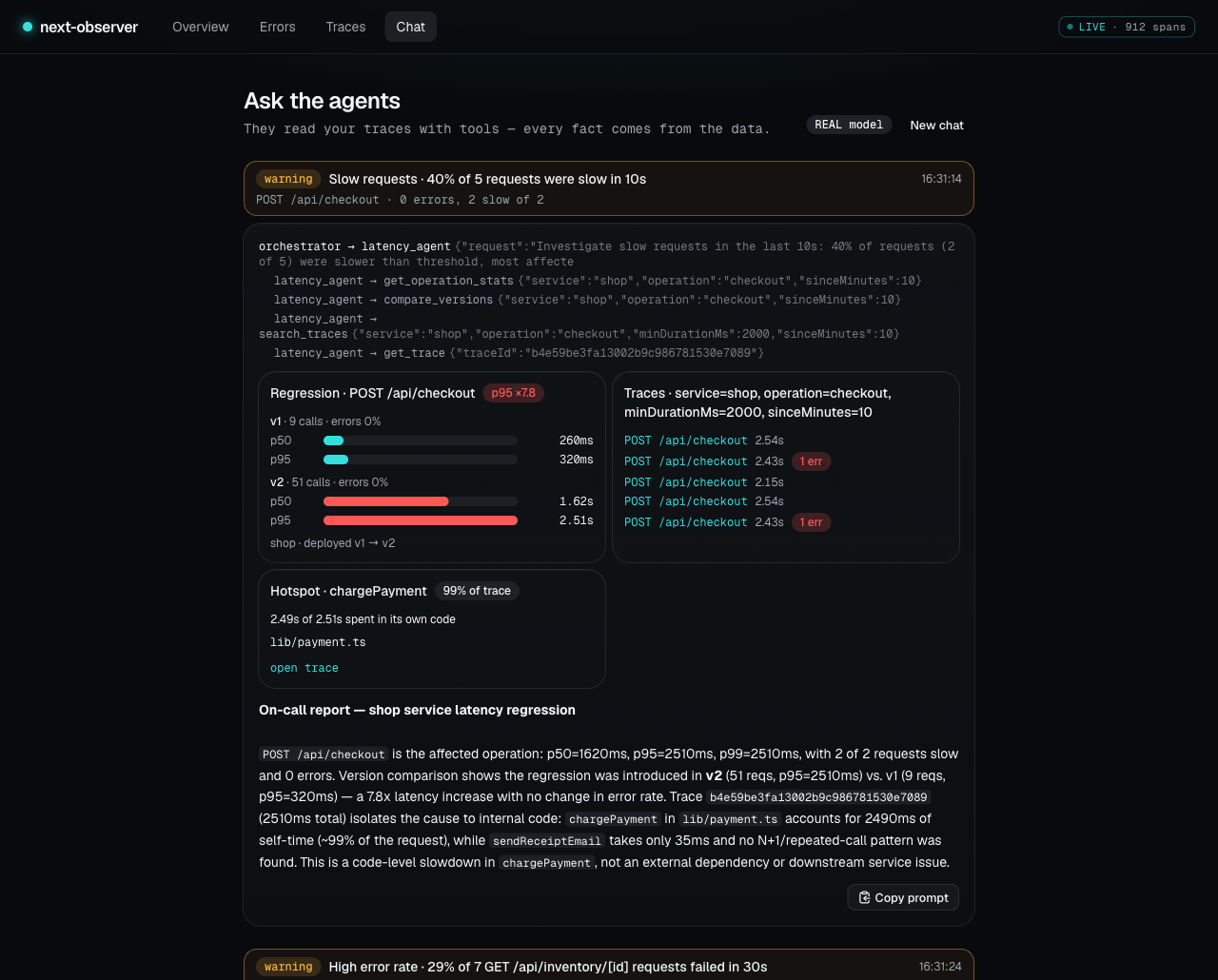
**AI agents that investigate — asked or on their own.** The anomaly detector watches incoming traces; when errors or
|
|
48
|
+
latency jump it starts an investigation by itself. The agents get facts only from tools over your telemetry, and the
|
|
49
|
+
evidence cards under a report are built by code from those tool results, not written by the model.
|
|
50
|
+
|
|
51
|
+
|
|
52
|
+
|
|
53
|
+
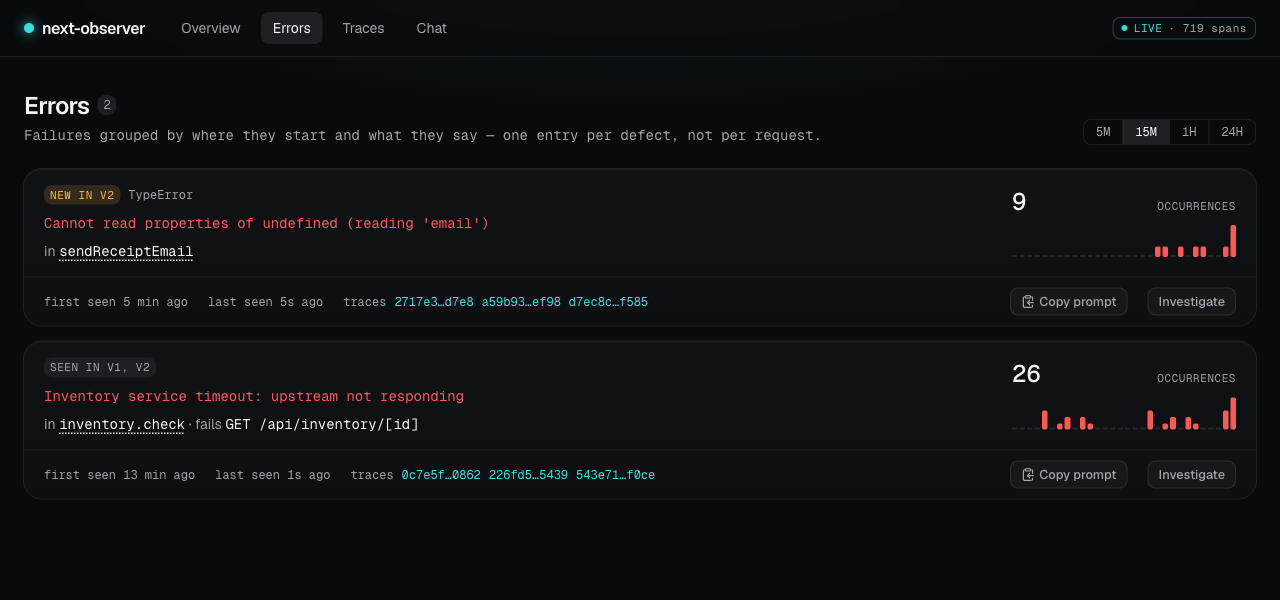
**Errors as defects** — one entry per "this operation fails with this message", not per failed request: where the
|
|
54
|
+
error originated, which requests fail because of it, when it was first seen, and whether the last deployment brought it.
|
|
55
|
+
|
|
56
|
+
|
|
57
|
+
|
|
58
|
+
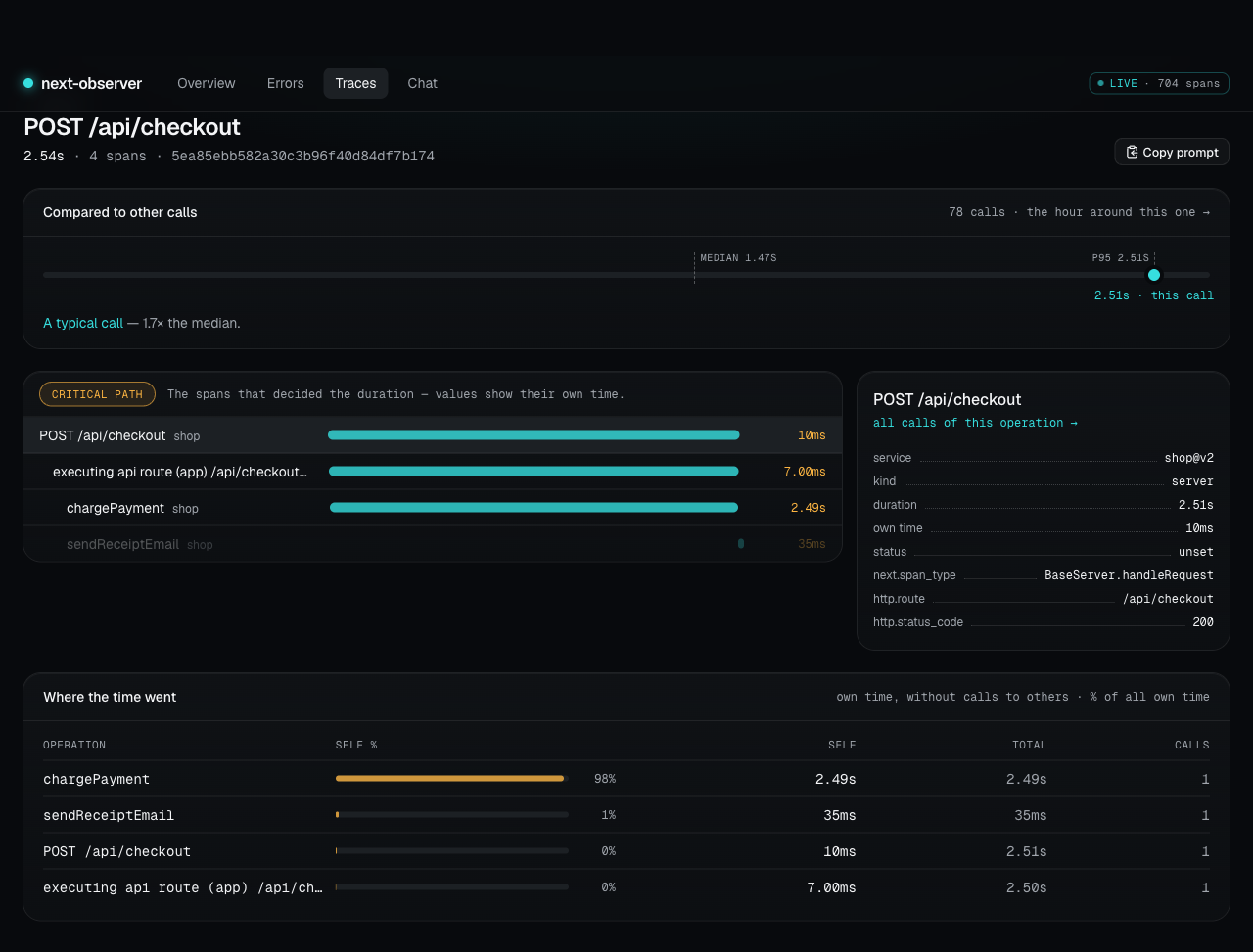
**Traces** — a waterfall, the critical path (the spans that decided the duration), each operation's own time, and how
|
|
59
|
+
this call compares with the others of its kind.
|
|
60
|
+
|
|
61
|
+
|
|
62
|
+
|
|
63
|
+
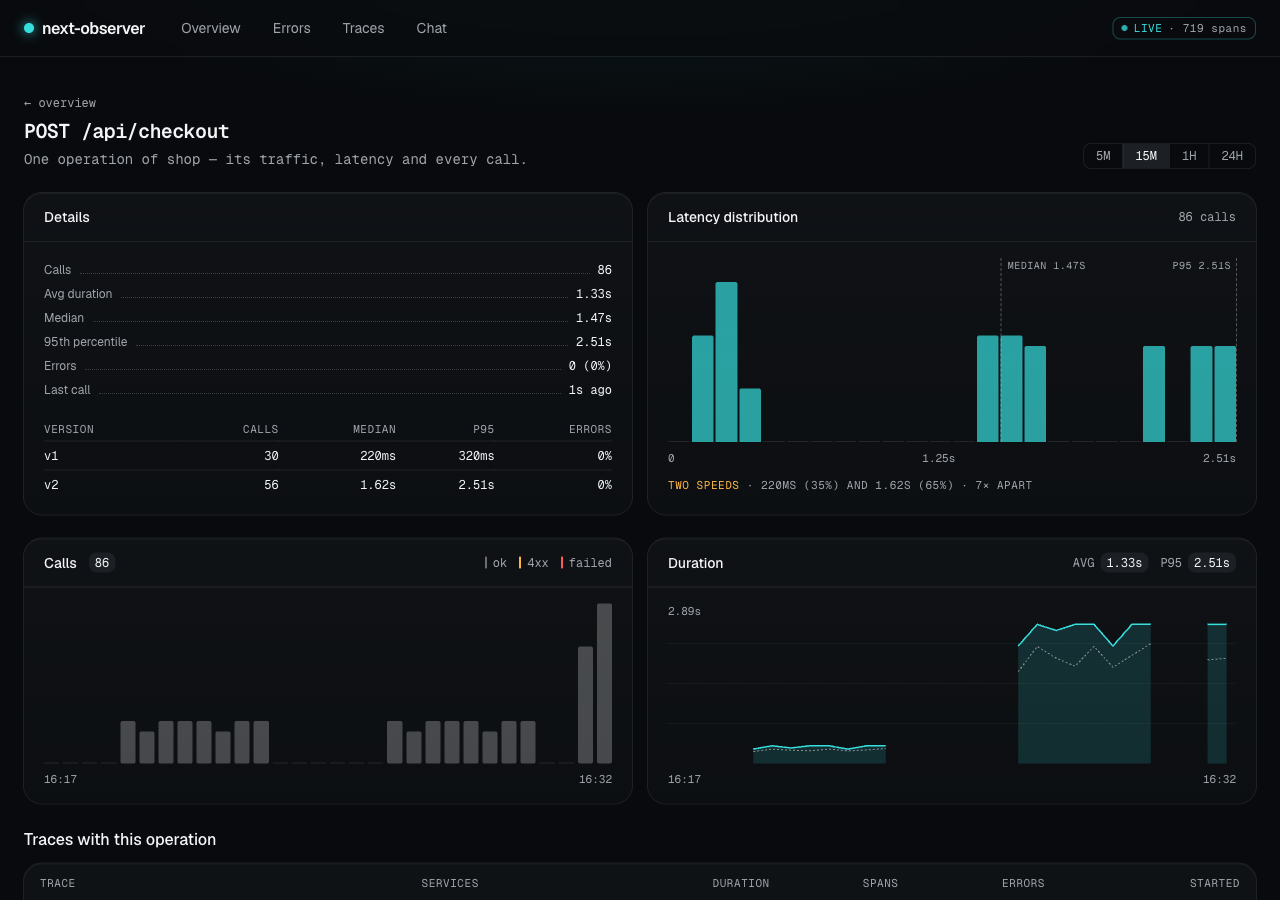
**One operation up close** — its latency distribution, and a note when the calls fall into two clearly separate speeds
|
|
64
|
+
(a fast and a slow path, or the version before and after a deployment).
|
|
65
|
+
|
|
66
|
+
|
|
67
|
+
|
|
68
|
+
**Copy prompt** — on a trace, a defect or a finished investigation: a ready prompt for a coding agent (Claude Code,
|
|
69
|
+
Cursor, …) with the measured facts and the task, so the fix starts from data instead of a retelling.
|
|
70
|
+
|
|
71
|
+
Also: cold starts are not regressions (the first request of a route after a server start is left out of latency and
|
|
72
|
+
marked), no Docker and no external backend, and it accepts OTLP/HTTP from any OpenTelemetry SDK — not only `next-observe`.
|
|
73
|
+
|
|
74
|
+
Requires Node.js 22.18+.
|
|
19
75
|
|
|
20
76
|
## Commands
|
|
21
77
|
|
|
22
78
|
```bash
|
|
23
79
|
next-observer init [--root <dir>] [--proxy] # connect a Next.js app (see below)
|
|
24
|
-
next-observer dev [--root <dir>] [--port <n>] [-- <next dev args>] # observer + next dev
|
|
25
|
-
next-observer collector [--host <h>] [--port <n>] [--api-key <k>] [--ui-password <p>] [--demo]
|
|
80
|
+
next-observer dev [--root <dir>] [--port <n>] [-- <next dev args>] # the observer + your app's `next dev`
|
|
81
|
+
next-observer collector [--host <h>] [--port <n>] [--api-key <k>] [--ui-password <p>] [--demo] # the observer alone
|
|
26
82
|
```
|
|
27
83
|
|
|
28
84
|
Run them with `npx next-observer <command>`; installed globally (`npm i -g next-observer`) the command is also
|
|
29
85
|
available as `nxo`.
|
|
30
86
|
|
|
31
|
-
`next-observer init` installs `next-observe
|
|
87
|
+
`next-observer init` installs the APM agent, `next-observe`, with the project's package manager, wraps the exported `next.config` in
|
|
32
88
|
`withObserve()`, creates `instrumentation.ts` and `instrumentation-client.ts` (in `src/` when the app lives there; `.js`
|
|
33
89
|
without TypeScript) and adds an `observe` script. Already connected files stay untouched; an existing `register()` is
|
|
34
90
|
never rewritten — init says what to add. `--proxy` also creates the runtime proxy route for browser spans.
|
|
35
91
|
|
|
36
|
-
`next-observer
|
|
37
|
-
|
|
92
|
+
`next-observer dev` is a convenience for local work: it starts the observer and then your app's own `next dev` in the
|
|
93
|
+
same terminal. The app stays yours — the observer only launches it.
|
|
94
|
+
|
|
95
|
+
`next-observer collector` runs the observer alone — next to `next dev` in another terminal, or on a server for
|
|
96
|
+
production. ("Collector" is the OpenTelemetry word for the server that receives telemetry; here it comes with the UI,
|
|
97
|
+
the detector and the AI agents.) `--demo` preloads the sample shop and keeps sending live traffic, so the detector and
|
|
98
|
+
the AI agents have something to find without an app.
|
|
38
99
|
|
|
39
100
|
## On a server
|
|
40
101
|
|
|
@@ -47,16 +108,21 @@ next-observer collector --host 0.0.0.0 --api-key <ingest key> --ui-password <pas
|
|
|
47
108
|
`--api-key` is for the apps sending traces (`OBSERVE_API_KEY` in the app), `--ui-password` for the people opening the
|
|
48
109
|
UI and the chat (the browser asks for it). `/health` stays open for uptime checks. Without them the banner warns.
|
|
49
110
|
|
|
50
|
-
## Models
|
|
111
|
+
## Models for the AI agents
|
|
51
112
|
|
|
52
113
|
| `OBSERVE_AI` | Model |
|
|
53
114
|
|---|---|
|
|
54
|
-
| `mock` (default) | deterministic stand-in — the whole pipeline runs without tokens |
|
|
115
|
+
| `mock` (default) | deterministic stand-in — the whole pipeline runs without a model, tokens or a network |
|
|
55
116
|
| `real` | Gemini when `GEMINI_API_KEY` + `GEMINI_MODEL` are set, otherwise [Kitana](https://www.npmjs.com/package/@kitana-sdk/adk) (Claude / Codex CLI, Ollama, API keys) |
|
|
56
117
|
|
|
57
|
-
|
|
118
|
+
One investigation makes 7–12 model calls. A call that hangs is started again once; "too many requests" (429) and
|
|
119
|
+
"overloaded" (5xx) are waited for and retried — up to a minute, as the provider asks. A free Gemini tier allows only a
|
|
120
|
+
few requests per minute, so an investigation may pause for that minute; a key without credits, a wrong key or a wrong
|
|
121
|
+
model name is explained in the chat in plain words.
|
|
122
|
+
|
|
123
|
+
## Your own AI agents
|
|
58
124
|
|
|
59
|
-
|
|
125
|
+
The built-in AI agents are an orchestrator and three specialists (latency, errors, traffic). To change them, put `observe.agents.ts` (or `.mts`, `.js`, `.mjs`) in the app root. A specialist with a built-in name
|
|
60
126
|
(`latency_agent`, `error_agent`, `traffic_agent`) replaces it; a new name adds one. The orchestrator picks specialists by
|
|
61
127
|
their `description`; the rules "facts from tools only" and "own tools only" are added to every instruction.
|
|
62
128
|
|
|
@@ -82,6 +148,7 @@ Tools: `get_services`, `get_operation_stats`, `compare_versions`, `get_errors`,
|
|
|
82
148
|
|---|---|---|
|
|
83
149
|
| `OBSERVE_AI` | `mock` | `mock` \| `real` |
|
|
84
150
|
| `OBSERVE_DETECTOR` | on | `off` disables the anomaly detector |
|
|
151
|
+
| `OBSERVE_MODEL_TIMEOUT_MS` | `90000` | how long one model call may take before it is started again |
|
|
85
152
|
| `OBSERVE_API_KEY` | — | require `x-api-key` on ingest (`/v1/traces`) |
|
|
86
153
|
| `OBSERVE_UI_PASSWORD` | — | require a password for the UI, the query API and the chat (browser login, any user name) |
|
|
87
154
|
| `OBSERVE_PORT`, `OBSERVE_HOST`, `OBSERVE_ROOT` | `4318`, `127.0.0.1`, `.` | same as `--port`, `--host`, `--root` |
|
package/package.json
CHANGED
|
@@ -1,7 +1,7 @@
|
|
|
1
1
|
{
|
|
2
2
|
"name": "next-observer",
|
|
3
|
-
"version": "0.3.
|
|
4
|
-
"description": "The observer for
|
|
3
|
+
"version": "0.3.19",
|
|
4
|
+
"description": "The observer for Next.js: a server with a UI and AI agents that receives your app's OpenTelemetry traces, shows them and investigates them. Run with npx next-observer dev. The APM agent that goes into the app is next-observe.",
|
|
5
5
|
"keywords": [
|
|
6
6
|
"nextjs",
|
|
7
7
|
"opentelemetry",
|
|
@@ -9,7 +9,8 @@
|
|
|
9
9
|
"tracing",
|
|
10
10
|
"ai-agents",
|
|
11
11
|
"adk",
|
|
12
|
-
"collector"
|
|
12
|
+
"collector",
|
|
13
|
+
"apm"
|
|
13
14
|
],
|
|
14
15
|
"author": "Andrei Tazetdinov",
|
|
15
16
|
"license": "MIT",
|