codex-supervisor-mcp 0.5.7 → 0.5.8
This diff represents the content of publicly available package versions that have been released to one of the supported registries. The information contained in this diff is provided for informational purposes only and reflects changes between package versions as they appear in their respective public registries.
- package/README.en.md +208 -286
- package/README.md +206 -284
- package/package.json +1 -1
- package/src/mcp-server.js +5 -2
- package/src/task-store.js +15 -1
- package/src/worktree.js +11 -3
package/README.en.md
CHANGED
|
@@ -8,317 +8,206 @@ English | [中文](README.md)
|
|
|
8
8
|
[](https://github.com/zriyox/codex-supervisor-mcp/actions/workflows/ci.yml)
|
|
9
9
|
[](package.json)
|
|
10
10
|
|
|
11
|
-
Let one main thread (Claude Code, Codex, any MCP client) run several Codex workers at once.
|
|
11
|
+
Let one main thread (Claude Code, Codex, or any MCP client) run several Codex workers at once. One Git worktree per worker, every state change on disk, and a web board to watch the batch.
|
|
12
12
|
|
|
13
|
-
|
|
14
14
|
|
|
15
|
-
*30 seconds, recorded live
|
|
15
|
+
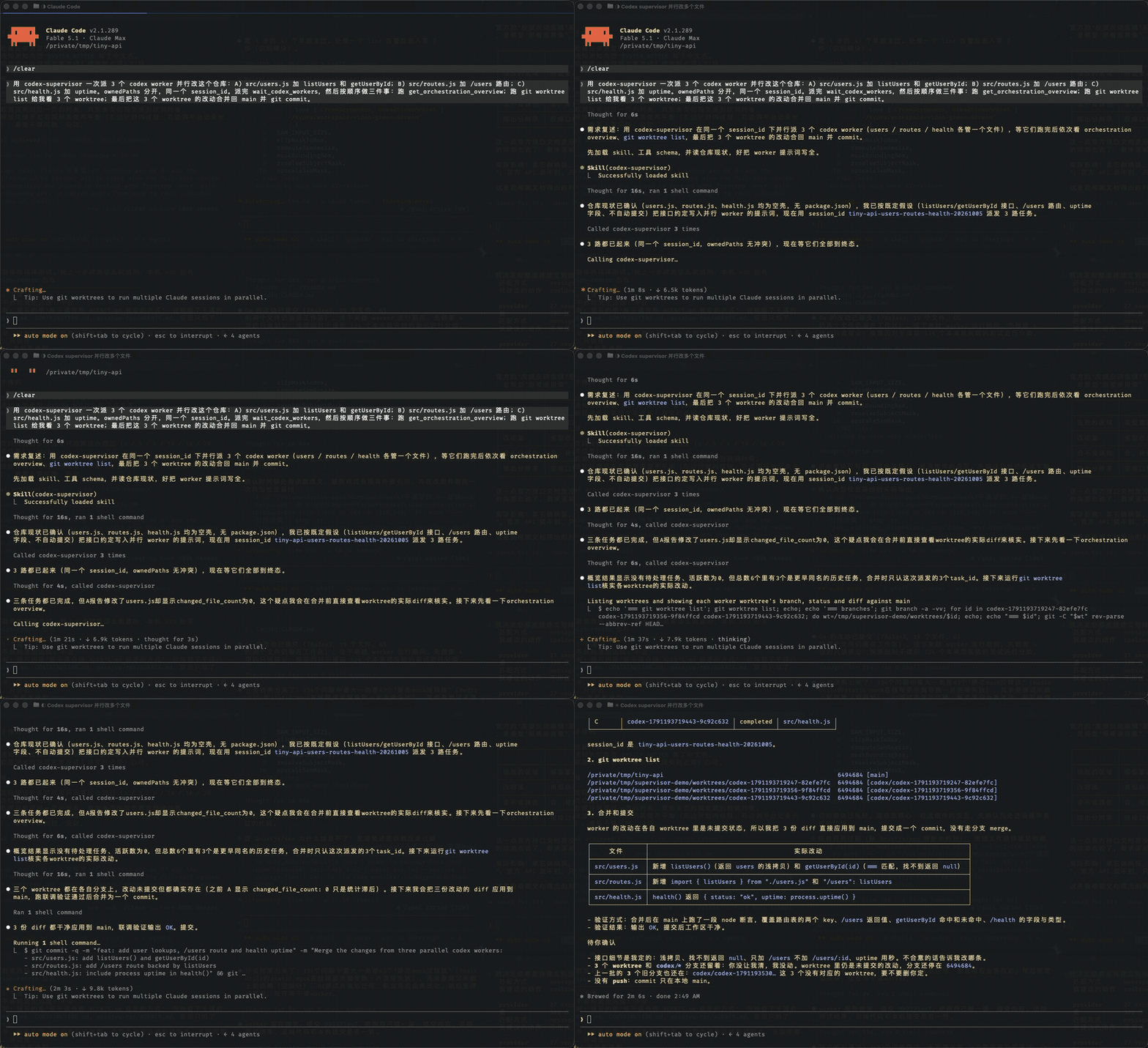
*30 seconds, recorded live: the main thread calls `create_codex_worker` three times, the workers run in parallel in their own worktrees, the main thread collects three diffs and makes one commit.*
|
|
16
16
|
|
|
17
|
-
|
|
17
|
+
## What it is
|
|
18
18
|
|
|
19
|
-
|
|
19
|
+
Point several agents at one repository and they overwrite each other, and nobody can say afterwards who changed what. This MCP takes dispatching and bookkeeping out of the model's context and puts them on disk:
|
|
20
20
|
|
|
21
|
-
|
|
22
|
-
|
|
23
|
-
| Problem | How it's handled |
|
|
21
|
+
| Problem | What happens here |
|
|
24
22
|
|---|---|
|
|
25
|
-
| Workers
|
|
26
|
-
|
|
|
27
|
-
| One read
|
|
28
|
-
|
|
|
29
|
-
| A new session
|
|
30
|
-
| "It failed" and "the process
|
|
31
|
-
|
|
32
|
-
## How is this different from Claude Code subagents?
|
|
23
|
+
| Workers step on each other's files | One Git worktree per worker; `ownedPaths` is checked for overlap before anything starts |
|
|
24
|
+
| A worker's output floods the main thread | Events go to `data/runs/<taskId>.jsonl`; reads have `limit` / `maxChars` / `kinds` gates |
|
|
25
|
+
| One status read fills the context | `get_orchestration_overview` fits every worker into 7000 bytes |
|
|
26
|
+
| Nobody knows who is still running after a restart | `supervisor.sqlite` has one row per work, with the `thread_id` |
|
|
27
|
+
| A new session cannot pick up an old worker | `resume_codex_worker` runs `codex exec resume <thread_id>`, the same Codex conversation |
|
|
28
|
+
| "It failed" and "the process vanished" look alike | The state machine keeps `failed` and `lost` apart |
|
|
29
|
+
| You cannot see where a batch is | `codex-supervisor-web` opens a board, one session at a time, one line per worker |
|
|
33
30
|
|
|
34
|
-
|
|
31
|
+
Workers are `codex exec` processes and `model` is passed straight through. The main thread stays on Claude for judgement; the workers can run DeepSeek or whatever Codex has a provider for, on a separate bill.
|
|
35
32
|
|
|
36
|
-
|
|
33
|
+
## Five minutes to a running batch
|
|
37
34
|
|
|
38
|
-
|
|
39
|
-
|
|
40
|
-
| | Claude Code subagent | codex-supervisor worker |
|
|
41
|
-
|---|---|---|
|
|
42
|
-
| Models it can run | Claude only: an alias or a full Claude model ID | `model` goes to the Codex CLI, so DeepSeek works |
|
|
43
|
-
| What does the work | Claude Code itself | A separate `codex exec` process |
|
|
44
|
-
| Working directory | Shared with the main thread by default, or `isolation: worktree` | One Git worktree per worker |
|
|
45
|
-
| Two workers writing the same file | Separated by worktrees, with no declared paths and no conflict check | `ownedPaths` is intersected before dispatch; on overlap no worktree is created and you get `ownership_conflict` |
|
|
46
|
-
| Main thread context | Subagent results come back into it | Events go to `data/runs/<taskId>.jsonl`; the overview runs on a hard 7000-byte budget (`src/mcp-server.js:32`) |
|
|
47
|
-
| Main thread process dies | Workers die with it | `thread_id` is in sqlite; `resume_codex_worker` reattaches the same session |
|
|
48
|
-
| What can drive it | Claude Code only | Any MCP client |
|
|
49
|
-
| Watching a worker work | Only the conclusion it returns | Raw JSONL, read through `kinds` / `limit` / `maxChars` |
|
|
35
|
+
Requirements: Node.js 22.13.0 or newer, and the `codex` CLI on `PATH`. macOS, Linux and Windows.
|
|
50
36
|
|
|
51
|
-
|
|
37
|
+
### 1. Install
|
|
52
38
|
|
|
53
|
-
```
|
|
54
|
-
|
|
55
|
-
│ stdio (MCP)
|
|
56
|
-
▼
|
|
57
|
-
codex-supervisor-mcp
|
|
58
|
-
│ spawn: codex exec --json
|
|
59
|
-
▼
|
|
60
|
-
Codex worker ──► data/runs/<taskId>.jsonl raw JSONL event stream
|
|
61
|
-
──► supervisor.sqlite tasks + task_events
|
|
62
|
-
──► worktrees/<taskId>/ the worker's own Git worktree
|
|
39
|
+
```bash
|
|
40
|
+
npm install -g codex-supervisor-mcp
|
|
63
41
|
```
|
|
64
42
|
|
|
65
|
-
|
|
66
|
-
|
|
67
|
-
Requirements: **Node.js >= 22.13.0** (`node:sqlite` had no unflagged build before that) and the `codex` CLI on `PATH`. macOS, Linux, and Windows are all supported.
|
|
68
|
-
|
|
69
|
-
### Quick start
|
|
43
|
+
A global install's `postinstall` does two things: it copies the bundled skill into `~/.claude/skills/`, `~/.agents/skills/` and `~/.codex/skills/`, and it registers the MCP with `claude mcp add -s user` and `codex mcp add`. Check:
|
|
70
44
|
|
|
71
45
|
```bash
|
|
72
|
-
# 1. install
|
|
73
|
-
npm install -g codex-supervisor-mcp
|
|
74
|
-
|
|
75
|
-
# 2. confirm it registered
|
|
76
46
|
claude mcp list | grep codex-supervisor
|
|
77
47
|
codex mcp list | grep codex-supervisor
|
|
78
48
|
```
|
|
79
49
|
|
|
80
|
-
|
|
81
|
-
|
|
82
|
-
1. Copies the bundled skill into whichever client directories it finds: `~/.claude/skills/`, `~/.agents/skills/`, `~/.codex/skills/`.
|
|
83
|
-
2. Registers the MCP server through the client's own CLI: `claude mcp add -s user` / `codex mcp add`, pointing at `node <absolute path inside the package>`.
|
|
84
|
-
|
|
85
|
-
If a skill already exists with different content, it writes `SKILL.md.bak-<timestamp>` first and then overwrites. A failure in either step does not fail the install.
|
|
86
|
-
|
|
87
|
-
### Registering by hand
|
|
88
|
-
|
|
89
|
-
When `postinstall` doesn't run (`--ignore-scripts`, `npx`, pnpm, and similar), add the line yourself:
|
|
90
|
-
|
|
91
|
-
| Client | Command |
|
|
92
|
-
|---|---|
|
|
93
|
-
| Claude Code | `claude mcp add -s user codex-supervisor -- npx -y codex-supervisor-mcp` |
|
|
94
|
-
| Codex | `codex mcp add codex-supervisor -- npx -y codex-supervisor-mcp` |
|
|
95
|
-
|
|
96
|
-
To re-run it, repair it, target one client only, or just see what it plans to do:
|
|
50
|
+
If it is missing (`npx`, `--ignore-scripts` and pnpm installs skip `postinstall`), add it by hand:
|
|
97
51
|
|
|
98
52
|
```bash
|
|
99
|
-
codex-supervisor
|
|
100
|
-
codex-supervisor
|
|
101
|
-
codex-supervisor-setup --skill-only # skill only, leave MCP config alone
|
|
102
|
-
codex-supervisor-setup --mcp-only # register MCP only, no skill
|
|
103
|
-
codex-supervisor-setup --dry-run # print the plan, change nothing
|
|
53
|
+
claude mcp add -s user codex-supervisor -- npx -y codex-supervisor-mcp
|
|
54
|
+
codex mcp add codex-supervisor -- npx -y codex-supervisor-mcp
|
|
104
55
|
```
|
|
105
56
|
|
|
106
|
-
|
|
107
|
-
|
|
108
|
-
Write the config file yourself and add this block. GUI clients never run `postinstall`:
|
|
109
|
-
|
|
110
|
-
```json
|
|
111
|
-
{
|
|
112
|
-
"mcpServers": {
|
|
113
|
-
"codex-supervisor": {
|
|
114
|
-
"command": "npx",
|
|
115
|
-
"args": ["-y", "codex-supervisor-mcp"]
|
|
116
|
-
}
|
|
117
|
-
}
|
|
118
|
-
}
|
|
119
|
-
```
|
|
57
|
+
Restart Claude Code / Codex so the MCP process is the new one.
|
|
120
58
|
|
|
121
|
-
|
|
122
|
-
|---|---|---|---|
|
|
123
|
-
| Claude Desktop | `~/Library/Application Support/Claude/claude_desktop_config.json` | `%APPDATA%\Claude\claude_desktop_config.json` | `~/.config/Claude/claude_desktop_config.json` |
|
|
124
|
-
| Cursor | `~/.cursor/mcp.json` | `%APPDATA%\Cursor\mcp.json` | `~/.config/cursor/mcp.json` |
|
|
125
|
-
| Windsurf | `~/.codeium/windsurf/mcp_config.json` | `%APPDATA%\Codeium\windsurf\mcp_config.json` | `~/.config/.codeium/windsurf/mcp_config.json` |
|
|
59
|
+
### 2. Dispatch a batch
|
|
126
60
|
|
|
127
|
-
|
|
61
|
+
In Claude Code, say it in plain words; the skill makes it follow the right sequence:
|
|
128
62
|
|
|
129
|
-
|
|
63
|
+
> Fill in the unit tests for these three modules. Use codex-supervisor, three workers in parallel, session title "unit tests".
|
|
130
64
|
|
|
131
|
-
|
|
65
|
+
What the main thread does underneath (you can call the tools yourself):
|
|
132
66
|
|
|
133
|
-
```bash
|
|
134
|
-
npm install -g codex-supervisor-mcp@latest
|
|
135
|
-
npm ls -g --depth=0 | grep codex-supervisor # confirm the version actually changed
|
|
136
67
|
```
|
|
137
|
-
|
|
138
|
-
|
|
139
|
-
|
|
140
|
-
Three known traps:
|
|
141
|
-
|
|
142
|
-
- **A freshly published version lags a few minutes behind the registry's `latest`.** If the version number didn't move, wait and reinstall, or pin it: `npm install -g codex-supervisor-mcp@0.5.3`.
|
|
143
|
-
- **`npm link` / `npm i -g .` produce a symlink.** Editing `src/` takes effect immediately, but editing `skills/SKILL.md` does not sync on its own; run `codex-supervisor-setup` once. To go back to a normal install, `npm install -g codex-supervisor-mcp@latest` overwrites the symlink.
|
|
144
|
-
- **Switching Node versions breaks the registration.** What gets registered is an absolute path (`~/.nvm/versions/node/<version>/lib/node_modules/...`), and `postinstall` sees "already registered" and skips, so the path is never rewritten. Remove it first, then install:
|
|
145
|
-
|
|
146
|
-
```bash
|
|
147
|
-
claude mcp remove -s user codex-supervisor
|
|
148
|
-
codex mcp remove codex-supervisor
|
|
149
|
-
npm install -g codex-supervisor-mcp@latest
|
|
68
|
+
create_codex_worker ×3 each with session_id, session_title, ownedPaths, goal
|
|
69
|
+
wait_codex_workers two-minute budget by default; returns a snapshot, call again if still running
|
|
70
|
+
get_worker_result ×3 the full report and change list per worker
|
|
150
71
|
```
|
|
151
72
|
|
|
152
|
-
|
|
73
|
+
Each worker's changes sit on its own `codex/<taskId>` branch. Whether and how to merge is the main thread's call.
|
|
153
74
|
|
|
154
|
-
###
|
|
75
|
+
### 3. Open the board
|
|
155
76
|
|
|
156
77
|
```bash
|
|
157
|
-
|
|
158
|
-
|
|
159
|
-
codex
|
|
160
|
-
rm -rf ~/.claude/skills/codex-supervisor ~/.agents/skills/codex-supervisor ~/.codex/skills/codex-supervisor
|
|
161
|
-
rm -rf ~/.codex-supervisor # state directory: sqlite, event streams, worktrees
|
|
78
|
+
codex-supervisor-web
|
|
79
|
+
# without a global install:
|
|
80
|
+
npx -p codex-supervisor-mcp codex-supervisor-web
|
|
162
81
|
```
|
|
163
82
|
|
|
164
|
-
|
|
83
|
+
Open `http://127.0.0.1:7877`. The left column lists sessions with the title given at dispatch and how many workers are still running; a session opens into its worker ledger; a worker opens a drawer with its full report, change list, commands, event stream, task text and token usage. It refreshes every 2.5 seconds while something runs, every 8 seconds otherwise.
|
|
165
84
|
|
|
166
|
-
|
|
167
|
-
- Cross-process cancel uses `taskkill /PID <pid> /T /F` to take down the whole tree. Confirming that pid is still Codex reads its command line through PowerShell's `Get-CimInstance Win32_Process`, falling back to `tasklist`. `ps` is only used on macOS and Linux.
|
|
168
|
-
- Besides `PATH`, it probes `%APPDATA%\npm`, `%LOCALAPPDATA%\pnpm`, `%LOCALAPPDATA%\Volta\bin`, and `%ProgramFiles%\nodejs`.
|
|
85
|
+
`SUPERVISOR_WEB_PORT` changes the port; `SUPERVISOR_HOME` points it at a state directory (it has to be the one the MCP uses). The board reads. It does not dispatch or cancel.
|
|
169
86
|
|
|
170
|
-
|
|
87
|
+
## What the board shows
|
|
171
88
|
|
|
172
|
-
|
|
89
|
+
| Where | What |
|
|
90
|
+
|---|---|
|
|
91
|
+
| Left column | One line per session: title (the `session_title` from dispatch, or a line built from the workers' goals when none was given), worker count, how many are running, last activity. The current version and any update notice sit at the bottom |
|
|
92
|
+
| Session page | Title, note, first dispatch and last activity; a count line (total / running / completed / failed / lost); while workers run, the command each one is executing; when idle, the last report |
|
|
93
|
+
| Worker ledger | One row per worker: status, title, the running command or the last line reported, time taken, files changed (the worktree's real diff, committed work included), commands run, last update. Hovering the title shows the full goal, the owned paths and the branch |
|
|
94
|
+
| Worker drawer | Duration / exit code / run count; model, tokens, sandbox, thread, session; branch, base commit, worktree path; Codex startup notices folded away; five tabs: report (rendered markdown), changes, commands, events (virtualized), task text |
|
|
173
95
|
|
|
174
|
-
|
|
175
|
-
|---|---|---|
|
|
176
|
-
| `claude mcp list` has no `codex-supervisor` | `npx` / `--ignore-scripts` installs don't run `postinstall` | Run `codex-supervisor-setup`, or register by hand above |
|
|
177
|
-
| Dispatch fails with `codex only resolved to a shell shim` | On Windows only the `.cmd` was found and the npm package entry point behind it is gone | Reinstall `@openai/codex`, or point `CODEX_BIN` at the real executable / `codex.js` |
|
|
178
|
-
| A worker goes `failed` immediately with `spawn codex ENOENT` | The process started by a GUI client has no `codex` on `PATH` | Set `CODEX_BIN` explicitly in the client config |
|
|
179
|
-
| `Cannot find module 'node:sqlite'` | Node < 22.13.0 | Upgrade Node |
|
|
180
|
-
| A worker is stuck in `lost` | The MCP process was killed and the worker was orphaned | Let `list_codex_workers` settle it, or pick it back up with `resume_codex_worker` |
|
|
181
|
-
| `ownedPaths overlap with active worker(s)` | Two workers claimed the same path | Change the path, or `cancel_codex_worker` whichever is holding it |
|
|
96
|
+
Light and dark follow the system. System fonts only, nothing fetched from the network.
|
|
182
97
|
|
|
183
98
|
## Tools
|
|
184
99
|
|
|
185
|
-
Sixteen
|
|
100
|
+
Sixteen.
|
|
186
101
|
|
|
187
102
|
| Tool | Arguments | What it does |
|
|
188
103
|
|---|---|---|
|
|
189
|
-
| `create_codex_worker` | `task`, `cwd`, **`ownedPaths`**, **`goal`**, `session_id`, `session_title`, `session_note`, `dependsOn`, `baseRef`, `sandbox`, `model`, `reasoningEffort`, `title`, `skipGitRepoCheck` | Start a worker. `session_title` / `session_note`
|
|
190
|
-
| `create_codex_followup_worker` | `task_id`, `followup_prompt`, `session_id`, plus the
|
|
191
|
-
| `resume_codex_worker` | `task_id`, `prompt` | Continue the
|
|
192
|
-
| `
|
|
193
|
-
| `get_orchestration_overview` | `status`, `limit` |
|
|
194
|
-
| `
|
|
195
|
-
| `
|
|
196
|
-
| `
|
|
197
|
-
| `
|
|
198
|
-
| `
|
|
199
|
-
| `
|
|
200
|
-
| `get_session_works` | `session_id` | Every worker
|
|
201
|
-
| `
|
|
202
|
-
| `
|
|
203
|
-
| `check_for_update` | `force` | Ask the
|
|
204
|
-
| `cancel_codex_worker` | `task_id` | Stop a worker
|
|
205
|
-
|
|
206
|
-
###
|
|
207
|
-
|
|
208
|
-
- `ownedPaths`: the paths this worker
|
|
209
|
-
- `goal`:
|
|
210
|
-
|
|
211
|
-
|
|
212
|
-
|
|
213
|
-
|
|
214
|
-
|
|
215
|
-
|
|
216
|
-
|
|
217
|
-
|
|
|
218
|
-
|
|
219
|
-
| `
|
|
220
|
-
| `maxChars` | Long strings inside a single event are truncated in the middle, keeping head and tail |
|
|
221
|
-
| `kinds` | Only these event types; the filter runs before `limit` is applied |
|
|
104
|
+
| `create_codex_worker` | `task`, `cwd`, **`ownedPaths`**, **`goal`**, `session_id`, `session_title`, `session_note`, `dependsOn`, `baseRef`, `sandbox`, `model`, `reasoningEffort`, `title`, `skipGitRepoCheck` | Start a worker. `session_title` / `session_note` say what the batch is for; `baseRef` picks the commit the worktree is cut from (default: the repository's `HEAD`), pass another worker's `codex/<id>` branch to build on work not yet on the main line |
|
|
105
|
+
| `create_codex_followup_worker` | `task_id`, `followup_prompt`, `session_id`, plus the above | A new session seeded with the old worker's prompt, status and recent events |
|
|
106
|
+
| `resume_codex_worker` | `task_id`, `prompt` | Continue the same Codex conversation; `thread_id` stays |
|
|
107
|
+
| `wait_codex_workers` | `task_ids`, `mode` (any/all), `timeoutMinutes`, `timeoutMs`, `includeEvents`, `eventLimit`, `eventMaxChars`, `eventKinds` | Wait for terminal states. Two minutes by default, then a snapshot; `still_running: true` means call again with the same ids. Events off by default |
|
|
108
|
+
| `get_orchestration_overview` | `status`, `limit` | Every worker in one table, capped at 7000 bytes. Carries `version` and `update` |
|
|
109
|
+
| `get_worker_result` | `task_id`, `limit`, `maxChars` | The worker's own full report plus `status` / `exit_code` / `changed_files`. The door for conclusions |
|
|
110
|
+
| `get_worker_summary` | `task_id` | One paragraph: goal, status, changes, last command and message |
|
|
111
|
+
| `get_codex_worker_status` | `task_id`, `includePrompt`, `promptMaxChars` | One worker in detail; the prompt is clipped to 300 characters unless asked for |
|
|
112
|
+
| `get_codex_worker_events` | `task_id`, `limit`, `maxChars`, `kinds` | The raw event stream |
|
|
113
|
+
| `get_worker_goal` | `task_id` | The goal recorded at dispatch plus the native Codex goal (tokens, time) |
|
|
114
|
+
| `list_codex_workers` | `status`, `includeHistory`, `includeDetails` | List workers, active ones by default |
|
|
115
|
+
| `get_session_works` | `session_id` | Every worker of one session, with its title and note. The way back after a main-thread restart |
|
|
116
|
+
| `describe_session` | `session_id`, `title`, `note` | Record a title and note; fields left out keep their value |
|
|
117
|
+
| `search_works` | `query`, `limit` | Substring search over title / goal / prompt / last_message, newest first |
|
|
118
|
+
| `check_for_update` | `force` | Ask the registry for a newer version and whether the installed files match the published tarball |
|
|
119
|
+
| `cancel_codex_worker` | `task_id` | Stop a worker. Falls back to the pid when the handle is in another process, after confirming that pid runs codex |
|
|
120
|
+
|
|
121
|
+
### The three things to always pass
|
|
122
|
+
|
|
123
|
+
- `ownedPaths`: the paths this worker may write. Checked against every running worker before dispatch; an overlap refuses the call with the conflicting `task_id` and no worktree is created. It is a dispatch-time check, not a runtime sandbox.
|
|
124
|
+
- `goal.objective`: one line on what the worker is for. The worker creates a native Codex goal from it and marks it complete when done.
|
|
125
|
+
- `session_id`: not required by the schema, but without it nothing groups the batch and neither the board nor `get_session_works` can find it again. Same value for the whole batch, and `session_title` on the first dispatch.
|
|
126
|
+
|
|
127
|
+
### Reading results without filling the context
|
|
128
|
+
|
|
129
|
+
| Want | Use | Cost |
|
|
130
|
+
|---|---|---|
|
|
131
|
+
| Status of every worker | `get_orchestration_overview` | 7000 bytes, hard cap |
|
|
132
|
+
| One worker's conclusion | `get_worker_result` | The full report, tens of thousands of characters for a big job |
|
|
133
|
+
| Alive or finished | `get_worker_summary` | A paragraph |
|
|
134
|
+
| What it did | `get_codex_worker_events` | Filter with `kinds`, bound with `limit`, clip with `maxChars` |
|
|
222
135
|
|
|
223
|
-
The
|
|
136
|
+
The dispatch receipt is small and does not echo the task text. `wait_codex_workers` clips `last_message` to 400 characters and `current_action` to 300; the full text is behind `get_worker_result` and `get_codex_worker_events`. That clipping is what takes a five-worker wait from tens of KB to a few KB, which matters when a client backgrounds a timed-out call and replays the result as a notification.
|
|
224
137
|
|
|
225
|
-
|
|
226
|
-
Warning: truncated output (original token count: N)
|
|
227
|
-
Total output lines: M
|
|
228
|
-
```
|
|
138
|
+
## How this differs from Claude Code subagents
|
|
229
139
|
|
|
230
|
-
|
|
140
|
+
File isolation is not the difference: subagents can open their own worktree (`isolation: worktree`). The difference is the model and the process.
|
|
141
|
+
|
|
142
|
+
| | Claude Code subagent | codex-supervisor worker |
|
|
143
|
+
|---|---|---|
|
|
144
|
+
| Models | Claude only | `model` goes to the Codex CLI; DeepSeek works |
|
|
145
|
+
| Who does the work | Claude Code itself | A separate `codex exec` process |
|
|
146
|
+
| Two workers, one file | Separate worktrees, no path declaration | `ownedPaths` intersection before dispatch; overlap is refused |
|
|
147
|
+
| Main thread dies | Workers die with it | `thread_id` is in SQLite; `resume_codex_worker` picks the conversation back up |
|
|
148
|
+
| Who can drive it | Claude Code only | Any MCP client |
|
|
149
|
+
| Watching the work | Only the returned conclusion | Raw JSONL and the web board |
|
|
231
150
|
|
|
232
|
-
## The
|
|
151
|
+
## The state machine
|
|
233
152
|
|
|
234
|
-
`status` is the lifecycle
|
|
153
|
+
`status` is the lifecycle, one value per work:
|
|
235
154
|
|
|
236
155
|
| Value | Meaning |
|
|
237
156
|
|---|---|
|
|
238
157
|
| `queued` | Dispatched, not started |
|
|
239
158
|
| `running` | Running |
|
|
240
|
-
| `completed` |
|
|
241
|
-
| `failed` |
|
|
242
|
-
| `cancelled` |
|
|
243
|
-
| `lost` | Killed by an
|
|
244
|
-
|
|
245
|
-
`phase` only has a value while `running`, and goes back to `null` at a terminal state:
|
|
159
|
+
| `completed` | Finished with exit code 0 |
|
|
160
|
+
| `failed` | Non-zero exit, `turn.failed`, or spawn failure |
|
|
161
|
+
| `cancelled` | Stopped by `cancel_codex_worker` |
|
|
162
|
+
| `lost` | Killed by an outside signal, the MCP process vanished, or the row was written and no process ever started |
|
|
246
163
|
|
|
247
|
-
|
|
248
|
-
starting → thinking → command → editing → reporting
|
|
249
|
-
```
|
|
164
|
+
`phase` has a value only while `running`: `starting → thinking → command → editing → reporting`.
|
|
250
165
|
|
|
251
|
-
|
|
166
|
+
`failed` sends you to the logs; `lost` means run it again. A terminal state lands in two steps: `turn.completed` sets `completed`, the process exit writes `exit_code`. `wait_codex_workers` waits for the second step; a direct status read that sees `completed` with `exit_code: null` is in the gap, read again.
|
|
252
167
|
|
|
253
|
-
Windows has no signals
|
|
168
|
+
Windows has no signals. An outside kill and the process calling `exit(1)` look the same to the parent, so there it reports `failed` with the exit code.
|
|
254
169
|
|
|
255
|
-
|
|
256
|
-
|
|
257
|
-
A native Codex goal has six states. They map onto work status like this:
|
|
258
|
-
|
|
259
|
-
| Goal state | Work status | Note |
|
|
260
|
-
|---|---|---|
|
|
261
|
-
| `active` | `running` | Progressing normally |
|
|
262
|
-
| `paused` | `running` | Paused, waiting on a person |
|
|
263
|
-
| `blocked` | `running` | Stuck, needs the main thread to step in |
|
|
264
|
-
| `usageLimited` / `usage_limited` | `failed` | Quota exhausted |
|
|
265
|
-
| `budgetLimited` / `budget_limited` | `failed` | Budget exhausted |
|
|
266
|
-
| `complete` | `completed` | Done |
|
|
267
|
-
|
|
268
|
-
`paused` and `blocked` are not endings. They mean someone needs to look. `get_orchestration_overview` lists both under `needs_attention`, so you don't have to guess with a timeout.
|
|
170
|
+
Native Codex goal states map like this: `active` / `paused` / `blocked` are `running` (the last two land in `needs_attention`), `usageLimited` / `budgetLimited` are `failed`, `complete` is `completed`.
|
|
269
171
|
|
|
270
172
|
## Where state lives
|
|
271
173
|
|
|
272
|
-
|
|
174
|
+
`~/.codex-supervisor/` by default:
|
|
273
175
|
|
|
274
|
-
| File |
|
|
176
|
+
| File | Content |
|
|
275
177
|
|---|---|
|
|
276
|
-
| `data/supervisor.sqlite` | `tasks` (one row per work)
|
|
277
|
-
| `data/runs/<taskId>.jsonl` |
|
|
278
|
-
| `
|
|
279
|
-
|
|
280
|
-
A database from 0.1.x migrates automatically the first time it's opened. Process values that used to live in `status` (`editing`, `command`, `command_completed`, `reporting`) move into `phase`, and `status` becomes `running`. Nothing is dropped. The migration runs inside one `BEGIN IMMEDIATE` transaction, so if several processes start at once only one of them actually migrates.
|
|
281
|
-
|
|
282
|
-
`changed_files` has three sources: Codex's `file_change` events, `git status --porcelain` in the worker's own worktree (the uncommitted part), and `git diff --name-only <base_commit> HEAD` (the committed part). The last two exist because a worker that edits files through a shell command (`printf > file`) never emits a `file_change` event, and once it commits on its branch `git status` is clean again - a real batch of five workers did exactly that and every read came back empty. `base_commit` is recorded on the row at dispatch; rows older than that column fall back to the oldest reflog entry of the `codex/<taskId>` branch, which is where the branch was created.
|
|
283
|
-
|
|
284
|
-
## The board
|
|
178
|
+
| `data/supervisor.sqlite` | `tasks` (one row per work), `task_events` (structured events), `sessions` (titles and notes) |
|
|
179
|
+
| `data/runs/<taskId>.jsonl` | The raw `codex --json` output |
|
|
180
|
+
| `data/update-check.json` | Cache for the update check |
|
|
181
|
+
| `worktrees/<taskId>/` | That worker's Git worktree |
|
|
285
182
|
|
|
286
|
-
The
|
|
183
|
+
`changed_files` has three sources: Codex's `file_change` events; `git status --porcelain` in the worktree (uncommitted); `git diff --name-only <base_commit> HEAD` (committed). The last two exist because a worker editing through the shell emits no `file_change` event, and once it commits `git status` is clean again. A real batch of five did exactly that and every read came back empty. `base_commit` is recorded at dispatch; older rows fall back to the oldest reflog entry of the branch. Every git read passes `core.quotePath=false`, so non-ASCII file names come back as written instead of octal-escaped.
|
|
287
184
|
|
|
288
|
-
|
|
289
|
-
codex-supervisor-web # after a global install
|
|
290
|
-
npx -p codex-supervisor-mcp codex-supervisor-web # without installing
|
|
291
|
-
```
|
|
292
|
-
|
|
293
|
-
It listens on `http://127.0.0.1:7877`; `SUPERVISOR_WEB_PORT` / `SUPERVISOR_WEB_HOST` move it, `SUPERVISOR_HOME` points it at another state directory.
|
|
294
|
-
|
|
295
|
-
The left column lists sessions by the `session_title` recorded at dispatch (or, failing that, a line built from the workers' goals) and how many of their workers are still running. A session opens into its worker ledger: status, title, the command being run or the last line reported, time taken, files changed (the worktree's real diff, committed work included), commands run. A worker opens a drawer with the full report rendered from markdown, the change list, commands, the raw event stream, the task text, token usage and the native Codex goal. It refreshes every 2.5 seconds while something is running, every 8 seconds otherwise.
|
|
296
|
-
|
|
297
|
-
It reads. It does not dispatch or cancel; that stays with the MCP.
|
|
185
|
+
A 0.1.x database migrates itself the first time it is opened, without losing a row.
|
|
298
186
|
|
|
299
187
|
## Update check
|
|
300
188
|
|
|
301
|
-
When the MCP process starts it asks the npm registry which version is `latest` and what that tarball's integrity is, then compares two things:
|
|
189
|
+
When the MCP process starts it asks the npm registry which version is `latest` and what that tarball's integrity is, then compares two things with the install:
|
|
302
190
|
|
|
303
|
-
- The
|
|
304
|
-
- The
|
|
191
|
+
- The version. If it is behind, `get_orchestration_overview`, the dispatch receipt and the `wait_codex_workers` response gain an `update` field with `latest_version` and `npm i -g codex-supervisor-mcp@latest`. The skill tells the main thread to pass that on.
|
|
192
|
+
- The files. A global install records the unpacked tarball's integrity in `node_modules/.package-lock.json`; if it differs from the registry's value for that version, the files on disk are not the published build and the notice says to reinstall. A git checkout has no such value and reports its commit.
|
|
305
193
|
|
|
306
|
-
|
|
194
|
+
Cached an hour, re-checked every six while running. An unreachable registry is not an error; the result says `source: "offline"`. The board shows the same result in the lower left. `CODEX_SUPERVISOR_NO_UPDATE_CHECK=1` turns it off, `CODEX_SUPERVISOR_REGISTRY` points at a private registry.
|
|
307
195
|
|
|
308
196
|
## Environment variables
|
|
309
197
|
|
|
310
198
|
| Variable | Default | Effect |
|
|
311
199
|
|---|---|---|
|
|
312
|
-
| `SUPERVISOR_HOME` | `~/.codex-supervisor` | State root.
|
|
313
|
-
| `CODEX_HOME` | `~/.codex` | Read-only
|
|
314
|
-
| `CODEX_BIN` | `codex`
|
|
315
|
-
| `GIT_BIN` | `git`
|
|
200
|
+
| `SUPERVISOR_HOME` | `~/.codex-supervisor` | State root. The MCP and the board must use the same one |
|
|
201
|
+
| `CODEX_HOME` | `~/.codex` | Read-only, for Codex's native `goals_1.sqlite` |
|
|
202
|
+
| `CODEX_BIN` | `codex` | Path to the Codex CLI. The Windows `.cmd` shim is bypassed; a `.js` target is started with `node` |
|
|
203
|
+
| `GIT_BIN` | `git` | Path to git |
|
|
316
204
|
| `SUPERVISOR_WEB_PORT` / `SUPERVISOR_WEB_HOST` | `7877` / `127.0.0.1` | Where the board listens |
|
|
317
|
-
| `CODEX_SUPERVISOR_NO_UPDATE_CHECK` | unset |
|
|
318
|
-
| `CODEX_SUPERVISOR_REGISTRY` | `https://registry.npmjs.org` | Registry the update check
|
|
319
|
-
| `CODEX_SUPERVISOR_UPDATE_TIMEOUT_MS` | `4000` | How long
|
|
205
|
+
| `CODEX_SUPERVISOR_NO_UPDATE_CHECK` | unset | `1` disables the update check |
|
|
206
|
+
| `CODEX_SUPERVISOR_REGISTRY` | `https://registry.npmjs.org` | Registry for the update check |
|
|
207
|
+
| `CODEX_SUPERVISOR_UPDATE_TIMEOUT_MS` | `4000` | How long to wait for the registry |
|
|
208
|
+
| `CODEX_SUPERVISOR_SKIP_SETUP` | unset | `1` skips the `postinstall` setup |
|
|
320
209
|
|
|
321
|
-
|
|
210
|
+
A process started by a GUI client often has no `codex` on `PATH`; set `CODEX_BIN` in the config:
|
|
322
211
|
|
|
323
212
|
```json
|
|
324
213
|
{
|
|
@@ -332,81 +221,114 @@ When the MCP client starts without `codex` on `PATH`, which is common for GUI-la
|
|
|
332
221
|
}
|
|
333
222
|
```
|
|
334
223
|
|
|
335
|
-
##
|
|
224
|
+
## Install details
|
|
336
225
|
|
|
337
|
-
|
|
338
|
-
- **The worktree is created from a commit, so uncommitted work isn't in it.** The default is the repository's `HEAD`; `baseRef` accepts any branch, tag or sha (one that doesn't resolve refuses the dispatch with `invalid_base_ref` instead of quietly falling back to `HEAD`). Modified and untracked files sitting in the main thread's checkout don't exist inside the worker's worktree. Give the task absolute paths, or commit first. The worker's own changes land on the `codex/<taskId>` branch and never touch the main checkout.
|
|
339
|
-
- **Only the working directory is isolated.** Temp directories (`TMPDIR`), databases, and ports are process-level resources and stay shared, so two workers writing the same temp file still collide. Give each one its own paths, database name, and port in the task if you need that.
|
|
340
|
-
- **`ownedPaths` is a pre-dispatch conflict check, not a runtime sandbox.** It stops two workers from registering the same file; it does not stop a worker from creating a file it never listed, because the sandbox is `workspace-write` and any path inside its own worktree is writable. Verify the output from the diff.
|
|
341
|
-
- **It reports "it finished", not "it's correct".** Terminal states come from Codex's `turn.completed` and the process exit code; `exit_code: 0` only means it didn't crash. Judging the output is the main thread's job: run the checks, spot-read the content.
|
|
342
|
-
- **A terminal state lands in two steps, and wait only returns once both have.** `turn.completed` flips `status` to `completed` first; `exit_code` is written when the process exits. `wait_codex_workers` counts a worker as finished only once `exit_code` is recorded (or nobody is left to record it), so the snapshot it returns matches the next `get_codex_worker_status` read. A direct status read can still land between the two steps: `completed` with `exit_code: null` is that gap, read again a moment later.
|
|
343
|
-
- **Don't expect one `wait_codex_workers` call to cover a long job.** Your client's MCP tool timeout is a hard wall (the `timeout` field in `.mcp.json`, or `MCP_TOOL_TIMEOUT`), and hitting it kills the call. The default wait returns after 2 minutes with a progress snapshot; loop instead of waiting once.
|
|
344
|
-
- **Long text comes back clipped by default.** `current_action` is cut at 300 characters, the prompt inside `get_codex_worker_status` is cut at 300 (`includePrompt: true` lifts that), and `last_message` is cut at 400 in the overview and the wait response (4000 in the status response). Nothing is lost: the full command stream is in `get_codex_worker_events` and the full report is in `get_worker_result`. This is what takes one `wait_codex_workers` round trip from tens of KB down to a few KB - which matters because a client that backgrounds a timed-out call replays the whole result as a notification.
|
|
345
|
-
- **Nothing is written to Codex's native goal store.** `goals_1.sqlite` belongs to Codex and this MCP only reads it. Once a worker starts, it calls Codex's own `create_goal`; this MCP only splices that instruction into the prompt at dispatch time.
|
|
346
|
-
- **Native goals depend on the model complying.** `codex exec` does not create a goal on its own; the instruction at dispatch time is what makes the worker create one. The model occasionally skips it, in which case `native_goal` is `null` and `get_worker_goal` falls back to the copy recorded at dispatch. The state machine is unaffected.
|
|
347
|
-
- **`search_works` is substring matching, not a full-text index.** At a few hundred works, a `LIKE` scan is fast enough and costs nothing to maintain. Talk about something else at tens of thousands.
|
|
348
|
-
- **Cross-process cancel goes through the pid.** When the process handle isn't in this process, it first confirms the pid's command line contains `codex` (`ps` on macOS and Linux, CIM on Windows, `tasklist` as a fallback), then sends `SIGTERM` (`taskkill /T /F` on Windows), so a recycled pid doesn't get killed by mistake.
|
|
349
|
-
- **`create_codex_followup_worker` and `resume_codex_worker` are not the same thing.** The first opens a new session and restates the context in prose; the second reattaches the same session. Use the second when details matter.
|
|
350
|
-
- **`session_id` comes from the dispatcher; this MCP doesn't generate it.** Pass the same value for a batch of work and `get_session_works` can group it afterwards. Without it the column is `NULL` and the batch is unrecoverable by session.
|
|
226
|
+
### GUI clients
|
|
351
227
|
|
|
352
|
-
|
|
228
|
+
GUI clients do not run `postinstall`; add the JSON above to the config file:
|
|
353
229
|
|
|
354
|
-
|
|
355
|
-
|
|
356
|
-
|
|
357
|
-
|
|
358
|
-
|
|
359
|
-
|
|
360
|
-
|
|
361
|
-
8. ~~Worker-native goals: inject a `create_goal` instruction at dispatch~~
|
|
362
|
-
9. ~~Windows support: `.cmd` shim bypass, `taskkill` process tree, cross-platform `PATH` / `PATHEXT`~~ ✅
|
|
363
|
-
10. Resident daemon: move dispatch and process lifetime out of the MCP process
|
|
364
|
-
11. ~~A live React board~~ ✅
|
|
365
|
-
12. ~~Session titles and notes, update check~~ ✅
|
|
366
|
-
|
|
367
|
-
Rejected, with the reasoning, so nobody brings them up again:
|
|
368
|
-
|
|
369
|
-
| Idea | Why not |
|
|
370
|
-
|---|---|
|
|
371
|
-
| Vector search | `search_works` substring matching is faster and needs zero maintenance at a few hundred works. Both vendors' official memory systems (Codex `memories`, Claude auto-memory) are file search too, not vectors |
|
|
372
|
-
| Sorting by `usage_count` | Measured: of 80 works, only 2 were ever referenced again. Every counter sat at 0 or 1, so sorting did nothing |
|
|
373
|
-
| Reusing Codex's `usage_count` | That number counts how often a memory entry was cited, which is a different question from how often the main thread looked it up |
|
|
374
|
-
| A three-layer memory index | The current data volume can't justify one layer. `get_worker_summary` is enough |
|
|
230
|
+
| Client | macOS | Windows | Linux |
|
|
231
|
+
|---|---|---|---|
|
|
232
|
+
| Claude Desktop | `~/Library/Application Support/Claude/claude_desktop_config.json` | `%APPDATA%\Claude\claude_desktop_config.json` | `~/.config/Claude/claude_desktop_config.json` |
|
|
233
|
+
| Cursor | `~/.cursor/mcp.json` | `%APPDATA%\Cursor\mcp.json` | `~/.config/cursor/mcp.json` |
|
|
234
|
+
| Windsurf | `~/.codeium/windsurf/mcp_config.json` | `%APPDATA%\Codeium\windsurf\mcp_config.json` | `~/.config/.codeium/windsurf/mcp_config.json` |
|
|
235
|
+
|
|
236
|
+
### Running the setup again
|
|
375
237
|
|
|
376
|
-
|
|
238
|
+
```bash
|
|
239
|
+
codex-supervisor-setup # detect clients, install the skill, register the MCP
|
|
240
|
+
codex-supervisor-setup --target claude,codex
|
|
241
|
+
codex-supervisor-setup --skill-only
|
|
242
|
+
codex-supervisor-setup --mcp-only
|
|
243
|
+
codex-supervisor-setup --dry-run # print the plan only
|
|
244
|
+
```
|
|
245
|
+
|
|
246
|
+
An existing skill with different content is backed up to `SKILL.md.bak-<timestamp>` before it is overwritten.
|
|
377
247
|
|
|
378
|
-
|
|
248
|
+
### Upgrading
|
|
379
249
|
|
|
380
250
|
```bash
|
|
381
|
-
|
|
382
|
-
|
|
383
|
-
|
|
251
|
+
npm install -g codex-supervisor-mcp@latest
|
|
252
|
+
npm ls -g --depth=0 | grep codex-supervisor
|
|
253
|
+
```
|
|
254
|
+
|
|
255
|
+
Then restart Claude Code / Codex. Three things to know:
|
|
384
256
|
|
|
385
|
-
|
|
386
|
-
|
|
387
|
-
|
|
257
|
+
- The registry takes a few minutes to move `latest` after a publish. If the version did not change, wait, or pin the version.
|
|
258
|
+
- `npm link` installs a symlink: `src/` changes apply at once, the skill does not sync by itself; run `codex-supervisor-setup`.
|
|
259
|
+
- Switching Node versions breaks the registered absolute path. Run `claude mcp remove -s user codex-supervisor` and `codex mcp remove codex-supervisor` first, then install.
|
|
260
|
+
|
|
261
|
+
### Uninstall
|
|
262
|
+
|
|
263
|
+
```bash
|
|
264
|
+
npm uninstall -g codex-supervisor-mcp
|
|
265
|
+
claude mcp remove -s user codex-supervisor
|
|
266
|
+
codex mcp remove codex-supervisor
|
|
267
|
+
rm -rf ~/.claude/skills/codex-supervisor ~/.agents/skills/codex-supervisor ~/.codex/skills/codex-supervisor
|
|
268
|
+
rm -rf ~/.codex-supervisor
|
|
388
269
|
```
|
|
389
270
|
|
|
390
|
-
|
|
271
|
+
### Windows
|
|
272
|
+
|
|
273
|
+
- The npm-installed CLI is `codex.cmd`, and Node refuses to spawn it directly since 18.20 / 20.12 (the behaviour after CVE-2024-27980). `shell: true` is not used, because cancelling would then only kill the shell. Instead the package's own entry, `node_modules/@openai/codex/bin/codex.js`, is started with `node`.
|
|
274
|
+
- Cross-process cancel runs `taskkill /PID <pid> /T /F` on the whole tree, after `Get-CimInstance Win32_Process` confirms the pid runs codex.
|
|
275
|
+
- Beyond `PATH` it probes `%APPDATA%\npm`, `%LOCALAPPDATA%\pnpm`, `%LOCALAPPDATA%\Volta\bin` and `%ProgramFiles%\nodejs`.
|
|
276
|
+
|
|
277
|
+
### Troubleshooting
|
|
278
|
+
|
|
279
|
+
| Symptom | Cause | Fix |
|
|
280
|
+
|---|---|---|
|
|
281
|
+
| Not in `claude mcp list` | The install method skipped `postinstall` | `codex-supervisor-setup`, or `claude mcp add` by hand |
|
|
282
|
+
| Dispatch says `codex only resolved to a shell shim` | Windows found only the `.cmd`; the package entry behind it is gone | Reinstall `@openai/codex`, or point `CODEX_BIN` at `codex.js` |
|
|
283
|
+
| Worker is `failed` at once with `spawn codex ENOENT` | No `codex` on the process's `PATH` | Set `CODEX_BIN` in the config |
|
|
284
|
+
| `Cannot find module 'node:sqlite'` | Node older than 22.13.0 | Upgrade Node |
|
|
285
|
+
| Worker stuck in `lost` | The MCP process was killed and the worker orphaned | `resume_codex_worker`, or dispatch again |
|
|
286
|
+
| `ownedPaths overlap with active worker(s)` | Two workers claimed the same paths | Split differently, or cancel the one holding them |
|
|
287
|
+
| The board is empty | The board and the MCP use different `SUPERVISOR_HOME`s | Start the board with the same one |
|
|
288
|
+
|
|
289
|
+
## Known limitations
|
|
290
|
+
|
|
291
|
+
- A worker's lifetime is tied to the MCP process. Kill the MCP and the worker is left behind, settled as `lost` on the next read. The fix is a resident daemon; see the Roadmap.
|
|
292
|
+
- The worktree is cut from a commit, so uncommitted work in your checkout is not in it. Give the task absolute paths, or commit first.
|
|
293
|
+
- Only the working directory is isolated. Temp directories, databases and ports are shared; workers that would hit the same dev server need to be kept apart in the task.
|
|
294
|
+
- `ownedPaths` is checked at dispatch only; it does not stop a worker from creating a file it never listed. Review the diff.
|
|
295
|
+
- It reports "finished", not "correct". `exit_code: 0` means it did not crash; acceptance is the main thread's job.
|
|
296
|
+
- Do not expect one `wait_codex_workers` call to cover a long job. The client's MCP tool timeout is a hard wall; the default returns a snapshot after two minutes, loop instead.
|
|
297
|
+
- Nothing is written to Codex's native goal store; `goals_1.sqlite` is read-only here. The worker creates its own goal and sometimes skips it, in which case `native_goal` is `null` and the state machine is unaffected.
|
|
298
|
+
- `search_works` is substring matching. Fine at hundreds of rows; revisit at tens of thousands.
|
|
299
|
+
|
|
300
|
+
## Roadmap
|
|
301
|
+
|
|
302
|
+
1. ~~`CODEX_BIN` / `SUPERVISOR_HOME` / `GIT_BIN`~~ ✅
|
|
303
|
+
2. ~~`status` and `phase` split, `lost` added~~ ✅
|
|
304
|
+
3. ~~`ownedPaths` / `goal` / `dependsOn`, event gates~~ ✅
|
|
305
|
+
4. ~~`thread_id` on disk + `resume_codex_worker`~~ ✅
|
|
306
|
+
5. ~~Concurrency: crash points, ownership conflicts, multi-process writes~~ ✅
|
|
307
|
+
6. ~~`session_id` + `get_session_works`~~ ✅
|
|
308
|
+
7. ~~`search_works`~~ ✅
|
|
309
|
+
8. ~~Native worker goals~~ ✅
|
|
310
|
+
9. ~~Windows~~ ✅
|
|
311
|
+
10. ~~Web board~~ ✅
|
|
312
|
+
11. ~~Session titles, update check, `baseRef`, committed changes visible~~ ✅
|
|
313
|
+
12. Resident daemon: move dispatch and process lifetime out of the MCP process
|
|
314
|
+
|
|
315
|
+
Not planned: vector search (substring matching is faster at this scale and costs nothing to maintain), `usage_count` ordering (2 of 80 real works were ever referenced again), a layered memory index (not enough data to need one).
|
|
391
316
|
|
|
392
317
|
## Development
|
|
393
318
|
|
|
394
319
|
```bash
|
|
395
320
|
npm install
|
|
396
|
-
npm test #
|
|
321
|
+
npm test # truncation, state machine, migration, setup, Windows routing, 23 regression cases, 40 edge cases
|
|
397
322
|
npm run test:edge # test/edge only: update check against a fake registry, session titles, baseRef, non-ASCII paths, ghost rows, board API
|
|
398
|
-
npm run test:real # end
|
|
399
|
-
npm run smoke # basic smoke test (real codex)
|
|
323
|
+
npm run test:real # end to end with the real codex CLI
|
|
400
324
|
npm run smoke:mcp # MCP protocol smoke test
|
|
401
325
|
npm run monitor # Ink terminal board
|
|
402
|
-
npm run web:install # board dependencies
|
|
403
|
-
npm run web:build # bundle the board into web/dist; runs before publish
|
|
326
|
+
npm run web:install # board dependencies
|
|
404
327
|
npm run web:dev # board with hot reload, /api proxied to 7877
|
|
328
|
+
npm run web:build # bundle into web/dist; runs before publish
|
|
405
329
|
```
|
|
406
330
|
|
|
407
|
-
`npm test` replays
|
|
408
|
-
|
|
409
|
-
CI runs on Ubuntu, macOS, and Windows, plus a separate Node 22.13.0 job that pins the lower bound declared in `engines`, since `node:sqlite` had no unflagged build before it. The four `setup-windows-test.js` cases use a real filesystem to simulate the `.cmd` shim under `%APPDATA%\npm`, verifying that automatic MCP registration genuinely works rather than just passing a parser unit test.
|
|
331
|
+
`npm test` replays fixed Codex event streams through `src/test-fixtures/fake-codex.js`, fast and deterministic; `npm run test:real` is the evidence of compatibility with the current Codex. CI runs Ubuntu / macOS / Windows plus one Node 22.13.0 job that pins the `engines` floor.
|
|
410
332
|
|
|
411
333
|
## License
|
|
412
334
|
|