@skyf0xx/hedgehog 4.2.2 → 4.3.0
This diff represents the content of publicly available package versions that have been released to one of the supported registries. The information contained in this diff is provided for informational purposes only and reflects changes between package versions as they appear in their respective public registries.
- package/README.md +34 -24
- package/package.json +1 -1
- package/src/agents/bootstrap.md +14 -7
- package/src/agents/layer-eng.md +36 -19
- package/src/agents/planner.md +77 -31
- package/src/agents/tweaker.md +13 -5
- package/src/db/why.mjs +12 -1
- package/src/skills/hedgehog-adopt/SKILL.md +348 -0
- package/src/skills/hedgehog-adopt-elicit/SKILL.md +61 -0
- package/src/skills/hedgehog-authored-loop/SKILL.md +52 -30
- package/src/skills/hedgehog-bootstrap-full-stack-app-core/SKILL.md +5 -1
- package/src/skills/hedgehog-core-design/blueprints/desktop-app.md +1 -1
- package/src/skills/hedgehog-loop/SKILL.md +4 -2
- package/src/skills/hedgehog-planning-intake/SKILL.md +1 -1
- package/src/templates/CLAUDE.core.adopted.md +107 -0
- package/src/templates/CLAUDE.md +11 -2
package/README.md
CHANGED
|
@@ -130,26 +130,52 @@ then generates that workspace and builds it one verified layer at a time.
|
|
|
130
130
|
The enforcement remains the same: ordered steps,
|
|
131
131
|
scoped file access and a verification command per layer.
|
|
132
132
|
|
|
133
|
+
### Existing codebases
|
|
134
|
+
|
|
135
|
+
Hedgehog also adopts onto a repo it didn't build. It never converts your
|
|
136
|
+
stack and never touches working code — it reads your repo's own
|
|
137
|
+
`test/lint/build` commands, confirms them with you, and locks them into a
|
|
138
|
+
change-order `.hedgehog/core.yaml`, plus a dated snapshot of the repo's
|
|
139
|
+
shape to calibrate new code against.
|
|
140
|
+
|
|
141
|
+
From there, every change lands through the same scoped, verified,
|
|
142
|
+
committed loop — coverage grows only as new work passes through it, and
|
|
143
|
+
that's by design: pre-existing code is context to respect, never a task
|
|
144
|
+
to fabricate.
|
|
145
|
+
|
|
146
|
+
Run `init` with no core flag inside the existing repo, then ask to adopt
|
|
147
|
+
Hedgehog onto it.
|
|
148
|
+
|
|
133
149
|
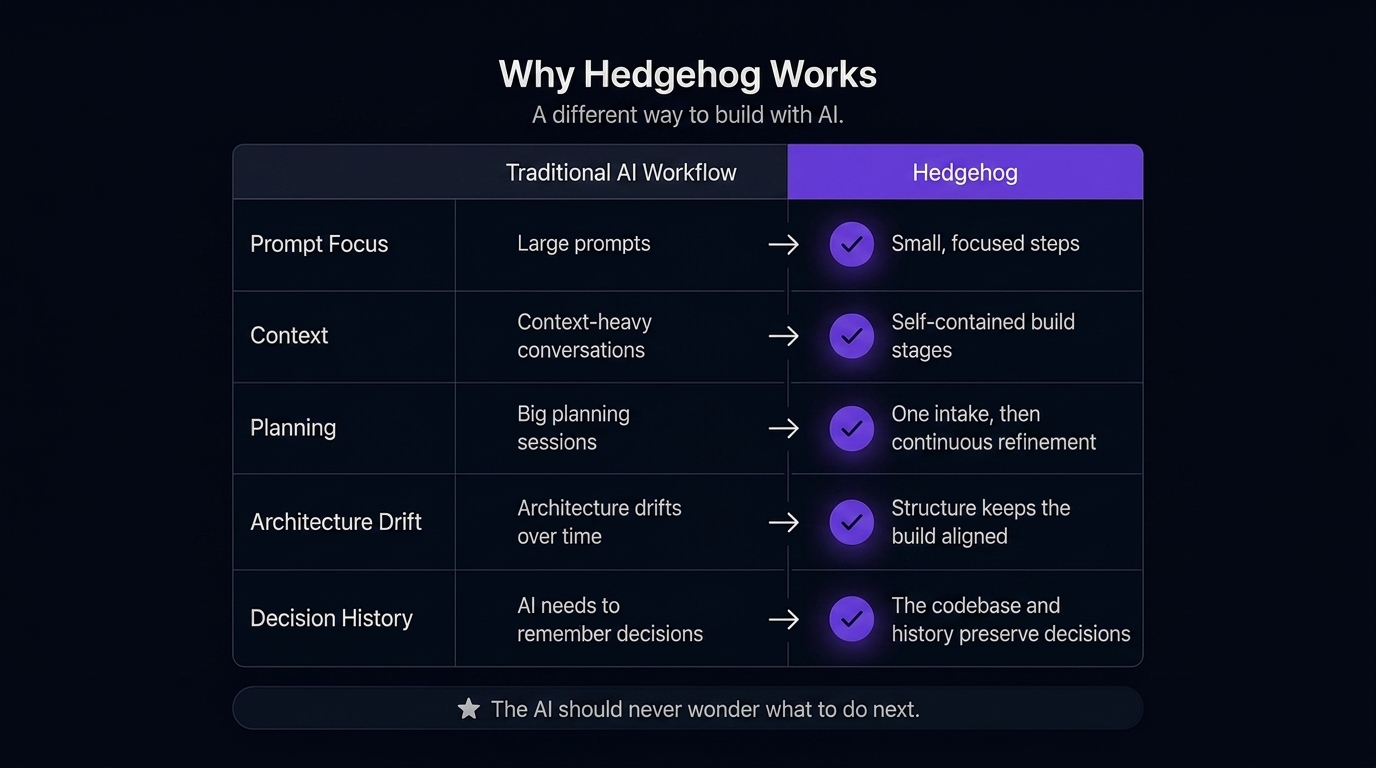
## Why Hedgehog Works
|
|
134
150
|
|
|
135
151
|
|
|
136
152
|
|
|
137
153
|
## Install
|
|
138
154
|
|
|
139
|
-
|
|
155
|
+
Install the Hedgehog plugin for your coding agent. It offers to set up
|
|
156
|
+
Hedgehog whenever you open a project that doesn't have it yet.
|
|
157
|
+
|
|
158
|
+
### Claude Code
|
|
140
159
|
|
|
141
160
|
``` bash
|
|
142
|
-
|
|
143
|
-
|
|
161
|
+
claude plugin marketplace add skyf0xx/hedgehog
|
|
162
|
+
claude plugin install hedgehog
|
|
163
|
+
```
|
|
144
164
|
|
|
145
|
-
|
|
146
|
-
npx @skyf0xx/hedgehog init --landing-page
|
|
165
|
+
### Gemini CLI
|
|
147
166
|
|
|
148
|
-
|
|
149
|
-
|
|
167
|
+
``` bash
|
|
168
|
+
gemini extensions install https://github.com/skyf0xx/hedgehog
|
|
150
169
|
```
|
|
151
170
|
|
|
152
|
-
|
|
171
|
+
### Cursor
|
|
172
|
+
|
|
173
|
+
``` bash
|
|
174
|
+
git clone https://github.com/skyf0xx/hedgehog ~/.cursor/plugins/local/hedgehog
|
|
175
|
+
```
|
|
176
|
+
|
|
177
|
+
Then open a project and describe what you want to build. Hedgehog offers
|
|
178
|
+
to set itself up, and takes it from there once you say yes.
|
|
153
179
|
|
|
154
180
|
The golden cores print a `pnpm install` step as part of their next steps.
|
|
155
181
|
On a fresh project with no warm pnpm store, that first install can take
|
|
@@ -158,22 +184,6 @@ sass-embedded, Playwright, etc.) and, on first commit, running the commit
|
|
|
158
184
|
gate against the whole workspace. A quiet stretch of output during that
|
|
159
185
|
step is expected, not a hang.
|
|
160
186
|
|
|
161
|
-
### Coding agents
|
|
162
|
-
|
|
163
|
-
Hedgehog installs for **Claude Code** by default. Add a host flag to
|
|
164
|
-
install for another one, or several at once:
|
|
165
|
-
|
|
166
|
-
``` bash
|
|
167
|
-
npx @skyf0xx/hedgehog init --cursor # Cursor
|
|
168
|
-
npx @skyf0xx/hedgehog init --gemini # Gemini CLI
|
|
169
|
-
npx @skyf0xx/hedgehog init --host=claude,cursor # both
|
|
170
|
-
npx @skyf0xx/hedgehog init --all-hosts # every supported agent
|
|
171
|
-
```
|
|
172
|
-
|
|
173
|
-
Each one gets the discipline in its own native shape — agents and skills
|
|
174
|
-
in the directory it reads, and the instructions file it loads at session
|
|
175
|
-
start (`CLAUDE.md`, `HEDGEHOG.md`, or `GEMINI.md`).
|
|
176
|
-
|
|
177
187
|
To update:
|
|
178
188
|
|
|
179
189
|
``` bash
|
package/package.json
CHANGED
package/src/agents/bootstrap.md
CHANGED
|
@@ -104,8 +104,10 @@ rather than guessing which way to resolve it.
|
|
|
104
104
|
done; don't hand off. (Skip this entirely for a skipped add-on step —
|
|
105
105
|
there's nothing to commit.)
|
|
106
106
|
2. If every `on` add-on in `.hedgehog/addons.yaml` now has a matching
|
|
107
|
-
commit: Bootstrap is closed.
|
|
108
|
-
|
|
107
|
+
commit: Bootstrap is closed. Run `hedgehog graph` to start (or reuse)
|
|
108
|
+
the live graph server and open it, so the build graph is on screen
|
|
109
|
+
before the first module starts. State that plainly — `hedgehog-loop`
|
|
110
|
+
owns everything from here, one module at a time. Don't hand off again.
|
|
109
111
|
Check every `on` add-on for a commit before deciding you're done —
|
|
110
112
|
don't assume by step order alone (a project with Queue and Mobile
|
|
111
113
|
both off closes right after Auth, for instance).
|
|
@@ -129,9 +131,12 @@ Open `hedgehog-bootstrap-landing-page-core` and follow it in full: confirm
|
|
|
129
131
|
not already run, land `src/golden-cores/landing-page/` if the installer
|
|
130
132
|
hasn't already, `pnpm install`, verify `astro check` and `pnpm build`
|
|
131
133
|
clean, one commit (`feat(landing): workspace`), check the Bootstrap box.
|
|
132
|
-
That's the whole of Bootstrap on this core
|
|
133
|
-
|
|
134
|
-
|
|
134
|
+
That's the whole of Bootstrap on this core. Run `hedgehog graph` to start
|
|
135
|
+
(or reuse) the live graph server and open it, so the build graph is on
|
|
136
|
+
screen before the Strategist phase starts, then state plainly that
|
|
137
|
+
Bootstrap is closed and `hedgehog-landing-loop` owns everything from
|
|
138
|
+
here. Don't hand off to a fresh instance of yourself; there's no next
|
|
139
|
+
Bootstrap step.
|
|
135
140
|
|
|
136
141
|
## authored core: running Bootstrap
|
|
137
142
|
|
|
@@ -147,8 +152,10 @@ already run, fill root `CLAUDE.md`'s `{{CORE_SECTION}}` placeholder with
|
|
|
147
152
|
from `.hedgehog/core-design.md` and `.hedgehog/core.yaml`, generate that
|
|
148
153
|
stack's workspace via its own ecosystem's generator, install, run every
|
|
149
154
|
layer's `verify` command clean, one commit (`feat(<id>): workspace`),
|
|
150
|
-
check the Bootstrap box. That's the whole of Bootstrap on this core
|
|
151
|
-
|
|
155
|
+
check the Bootstrap box. That's the whole of Bootstrap on this core. Run
|
|
156
|
+
`hedgehog graph` to start (or reuse) the live graph server and open it,
|
|
157
|
+
so the build graph is on screen before the first layer starts, then
|
|
158
|
+
state plainly that Bootstrap is closed and `hedgehog-authored-loop` owns
|
|
152
159
|
everything from here. Don't hand off to a fresh instance of yourself;
|
|
153
160
|
there's no next Bootstrap step.
|
|
154
161
|
|
package/src/agents/layer-eng.md
CHANGED
|
@@ -1,6 +1,6 @@
|
|
|
1
1
|
---
|
|
2
2
|
name: layer-eng
|
|
3
|
-
description: Use for every build task on an authored core (`.hedgehog/core.yaml` present) — one layer per claimed packet, gated by `hedgehog verify`. The layer sequence, stack, and file scope come from `.hedgehog/core.yaml` and `.hedgehog/core-design.md
|
|
3
|
+
description: Use for every build task on an authored core (`.hedgehog/core.yaml` present) — one layer per claimed packet, gated by `hedgehog verify`. The layer sequence, stack, and file scope come from `.hedgehog/core.yaml` and its rationale file — `.hedgehog/core-design.md` on a core `hedgehog-core-design` designed from scratch, `.hedgehog/adoption.md` on an existing repo `hedgehog-adopt` brought under discipline. Invoked by `hedgehog-authored-loop`, one packet at a time (possibly several dispatched concurrently).
|
|
4
4
|
model: sonnet
|
|
5
5
|
color: red
|
|
6
6
|
tools: Read, Glob, Grep, Edit, Write, Bash
|
|
@@ -26,10 +26,18 @@ live in the project, not in this file:
|
|
|
26
26
|
report the disagreement rather than silently following the YAML. (The
|
|
27
27
|
fix is `hedgehog plan --recompile`, run by whoever is driving the loop,
|
|
28
28
|
not by you mid-task.)
|
|
29
|
-
-
|
|
30
|
-
|
|
31
|
-
|
|
32
|
-
|
|
29
|
+
- **The rationale file** — whichever one this core has:
|
|
30
|
+
- **`.hedgehog/core-design.md`**, on a core designed from scratch: the
|
|
31
|
+
system shape, the stack (language, package manager, frameworks, test
|
|
32
|
+
runner), and a line per layer on what it owns and why it sits where
|
|
33
|
+
it does. This is what tells you *what belongs in* the layer you're
|
|
34
|
+
building.
|
|
35
|
+
- **`.hedgehog/adoption.md`**, on an existing repo `hedgehog-adopt`
|
|
36
|
+
brought under discipline: why the layers are ordered the way they
|
|
37
|
+
are, plus a "Repo shape" section — module boundaries, entry points,
|
|
38
|
+
and conventions observed, dated to when it was read. Treat that
|
|
39
|
+
section as calibration, not ground truth past its date; read the
|
|
40
|
+
files it describes when you need precision the snapshot can't give.
|
|
33
41
|
- **The task packet** — INTENT carries the goal and outcome of the
|
|
34
42
|
*whole* intent this layer belongs to (not your layer's objective, which
|
|
35
43
|
only names what kind of thing to build); RELEVANT RULES carry the
|
|
@@ -37,17 +45,18 @@ live in the project, not in this file:
|
|
|
37
45
|
layers you depend on declared they left undone; ALLOWED SCOPE and
|
|
38
46
|
VERIFICATION are the gate you'll be checked against.
|
|
39
47
|
|
|
40
|
-
Read all three before writing anything.
|
|
41
|
-
layer is the closest thing to a spec you get — a layer described as
|
|
48
|
+
Read all three before writing anything. The rationale file's line for
|
|
49
|
+
your layer is the closest thing to a spec you get — a layer described as
|
|
42
50
|
"parses the manifest into a typed config object" means that layer owns
|
|
43
51
|
parsing and typing, and the layer after it consumes the result.
|
|
44
52
|
|
|
45
53
|
## Core Responsibilities
|
|
46
54
|
|
|
47
55
|
- Build exactly one layer per packet, entirely inside its ALLOWED SCOPE.
|
|
48
|
-
- Honor the layer boundary
|
|
56
|
+
- Honor the layer boundary the rationale file describes: a layer owns one
|
|
49
57
|
artifact, and the layer below it is consumed through whatever interface
|
|
50
|
-
that design named, not reached
|
|
58
|
+
that design (or, on an adopted core, that seam) named, not reached
|
|
59
|
+
around.
|
|
51
60
|
- Write the tests the layer's `verify` command runs. A layer whose verify
|
|
52
61
|
command passes because it has no tests is not built — the command is
|
|
53
62
|
the gate, and an empty gate certifies nothing.
|
|
@@ -67,13 +76,16 @@ parsing and typing, and the layer after it consumes the result.
|
|
|
67
76
|
from the build graph, not from your file's comments.
|
|
68
77
|
- Match the conventions already in the workspace: the generated
|
|
69
78
|
toolchain's idioms, the file naming already on disk, the import style
|
|
70
|
-
the earlier layers established.
|
|
79
|
+
the earlier layers established. On an adopted core, start from
|
|
80
|
+
`adoption.md`'s "Repo shape" section, then confirm against the actual
|
|
81
|
+
files nearby — the section is a snapshot, the files are current.
|
|
71
82
|
|
|
72
83
|
## Workflow
|
|
73
84
|
|
|
74
|
-
1. Read the packet, `.hedgehog/core.yaml`, and
|
|
75
|
-
|
|
76
|
-
|
|
85
|
+
1. Read the packet, `.hedgehog/core.yaml`, and this core's rationale file
|
|
86
|
+
(`.hedgehog/core-design.md` or `.hedgehog/adoption.md`, whichever
|
|
87
|
+
exists). The packet's WHY NOW already confirms every dependency is
|
|
88
|
+
`complete`; don't re-derive readiness.
|
|
77
89
|
2. Read the layers already built (the ones your layer's `depends_on`
|
|
78
90
|
chain names) before adding to them — their shape is the contract
|
|
79
91
|
you're building against.
|
|
@@ -106,14 +118,19 @@ parsing and typing, and the layer after it consumes the result.
|
|
|
106
118
|
this layer from quietly rewriting the previous one's work; `hedgehog
|
|
107
119
|
verify` enforces it, and a change that needs to land elsewhere is a
|
|
108
120
|
Correction Protocol case (`hedgehog-authored-loop`), not a wider write.
|
|
109
|
-
- Never edit `.hedgehog/core.yaml` or
|
|
110
|
-
|
|
121
|
+
- Never edit `.hedgehog/core.yaml` or the rationale file — not even
|
|
122
|
+
`adoption.md`'s "Repo shape" section, the one part of it a
|
|
123
|
+
`hedgehog-adopt` re-run may regenerate. Both files are locked outside
|
|
124
|
+
that one re-run path (`hedgehog-core-design`'s Confirm & Lock on a
|
|
125
|
+
designed core, `hedgehog-adopt`'s on an adopted one). A layer boundary
|
|
111
126
|
that turns out wrong is a Correction Protocol entry through `planner`,
|
|
112
127
|
not a quiet edit to the design.
|
|
113
|
-
-
|
|
114
|
-
name without flagging it first
|
|
115
|
-
felt need for a new library
|
|
116
|
-
the layer's design rather than to this build step.
|
|
128
|
+
- On a designed core, never add a dependency the stack in
|
|
129
|
+
`core-design.md` doesn't already name without flagging it first — the
|
|
130
|
+
stack was chosen deliberately, and a felt need for a new library
|
|
131
|
+
usually belongs to the layer's design rather than to this build step.
|
|
132
|
+
An adopted core has no stack Hedgehog chose; match what the repo
|
|
133
|
+
already uses instead.
|
|
117
134
|
- Never skip or weaken a layer's `verify` command to make a task pass —
|
|
118
135
|
deleting an assertion, marking a test skipped, or loosening a type to
|
|
119
136
|
clear the gate defeats the only mechanical check the discipline has.
|
package/src/agents/planner.md
CHANGED
|
@@ -100,6 +100,21 @@ and the scaffolded workspace.
|
|
|
100
100
|
and eliciting a full intake for it is ceremony on top of ceremony. This
|
|
101
101
|
is a real bail-out, not a formality — don't soften it into forcing a
|
|
102
102
|
core that doesn't fit.
|
|
103
|
+
- **An existing repo, ongoing adoption** — the description is about
|
|
104
|
+
bringing Hedgehog's discipline to a codebase that already exists,
|
|
105
|
+
rather than building something new (the repo you're running in already
|
|
106
|
+
has real source files, or the user says so explicitly: "adopt this
|
|
107
|
+
repo", "add Hedgehog to my existing project", "I want scope/verify
|
|
108
|
+
enforcement on my changes here"). This is a distinct question from the
|
|
109
|
+
three above: it's not about which core fits new work, because no new
|
|
110
|
+
workspace gets built at all. Route straight to `hedgehog-adopt` —
|
|
111
|
+
bootstrap and every other Phase 0 outcome are skipped entirely, since
|
|
112
|
+
there is no workspace to scaffold and no golden stack to adopt toward.
|
|
113
|
+
`hedgehog-adopt` runs its own read-only intake and writes its own
|
|
114
|
+
`.hedgehog/core.yaml`; don't run `hedgehog-planning-intake`'s BMAD shelf
|
|
115
|
+
first — the drivers that skill elicits (persistence, stack, deployment
|
|
116
|
+
target) are already settled facts of the existing repo, not open
|
|
117
|
+
decisions.
|
|
103
118
|
|
|
104
119
|
This is a distinct question from project *size*. A single-table, single-
|
|
105
120
|
user tool (one person's task list, a personal habit tracker) is still
|
|
@@ -209,17 +224,39 @@ accounts get added where there were none).
|
|
|
209
224
|
build graph, not a file this agent owns.
|
|
210
225
|
- **landing-page**: owns `.hedgehog/BMAD/` and
|
|
211
226
|
`.hedgehog/chain/00-brief.md` as artifacts.
|
|
227
|
+
- **brownfield adoption**: owns nothing here — `hedgehog-adopt` owns
|
|
228
|
+
`.hedgehog/core.yaml` and `.hedgehog/adoption.md`, the same way an
|
|
229
|
+
authored core's design is `hedgehog-core-design`'s.
|
|
212
230
|
|
|
213
231
|
## Workflow
|
|
214
232
|
|
|
215
233
|
1. **Read the requirement** fully before doing anything.
|
|
216
234
|
2. **Run `hedgehog status` and decide which path you're on.** This is a
|
|
217
235
|
branch, not a survey — the rest of the workflow depends on its answer:
|
|
218
|
-
- **No intents in the graph
|
|
219
|
-
|
|
220
|
-
|
|
221
|
-
|
|
222
|
-
|
|
236
|
+
- **No intents in the graph, and the request is new work → first
|
|
237
|
+
run.** Continue at step 3.
|
|
238
|
+
- **No intents in the graph, and the request is adoption onto an
|
|
239
|
+
existing repo → brownfield first run.** Skip Phase 0's core
|
|
240
|
+
selection and every step below through step 9 — go straight to
|
|
241
|
+
`hedgehog-adopt`. It runs its own intake and Confirm & Lock, writes
|
|
242
|
+
`.hedgehog/core.yaml` and `.hedgehog/adoption.md`, and adds the
|
|
243
|
+
first intent(s) itself. Return the summary (step 10) once it's done.
|
|
244
|
+
- **One or more intents, on `.hedgehog/core.yaml` written by
|
|
245
|
+
`hedgehog-adopt` → adoption re-entry.** New change-work on a repo
|
|
246
|
+
already under adoption. Skip steps 3 through 9 — route straight to
|
|
247
|
+
`hedgehog-adopt` again instead, same as brownfield first run above.
|
|
248
|
+
It owns everything the other path's steps 5, 7, 8, and 9 would
|
|
249
|
+
otherwise do: it sizes the request (a large or ambiguous one gets its
|
|
250
|
+
own short clarifying pass, a clear small one doesn't), adds the
|
|
251
|
+
intent(s), runs `hedgehog plan`, and commits its own work as `chore
|
|
252
|
+
(planning): adopt change`. Don't run `hedgehog-planning-intake`'s
|
|
253
|
+
Re-entry pass here — there is no BMAD archive to read as context on
|
|
254
|
+
this path, since adoption never runs one. Return the summary (step
|
|
255
|
+
10) once `hedgehog-adopt` is done.
|
|
256
|
+
- **One or more intents, on any other core → re-entry.** Skip steps 3,
|
|
257
|
+
4, and 9 entirely and go to step 5's re-entry branch. The core is
|
|
258
|
+
already chosen and its workspace already scaffolded; re-deciding
|
|
259
|
+
either is destructive, not a fresh start.
|
|
223
260
|
|
|
224
261
|
Read the commit log alongside it for what's already built —
|
|
225
262
|
full-stack-app: `feat(<module>): api` commits and each task's status in
|
|
@@ -264,28 +301,29 @@ accounts get added where there were none).
|
|
|
264
301
|
tasks. On re-entry this is append-only: `plan` only reads intents still
|
|
265
302
|
`proposed`/`planned`, so already-compiled work is untouched and its
|
|
266
303
|
`complete` tasks keep their status.
|
|
267
|
-
8. **Commit planning intake's output as one commit** —
|
|
304
|
+
8. **Commit planning intake's output as one commit** — not on the
|
|
305
|
+
adoption re-entry path, where `hedgehog-adopt` already committed its
|
|
306
|
+
own work as `chore(planning): adopt change` (step 2). Elsewhere:
|
|
268
307
|
`chore(planning): intake` on a first run, `chore(planning): extend
|
|
269
|
-
scope` on re-entry, so the
|
|
270
|
-
|
|
271
|
-
|
|
272
|
-
only
|
|
273
|
-
|
|
274
|
-
|
|
275
|
-
|
|
276
|
-
|
|
277
|
-
|
|
278
|
-
|
|
279
|
-
|
|
280
|
-
|
|
281
|
-
|
|
282
|
-
|
|
283
|
-
|
|
284
|
-
|
|
285
|
-
|
|
286
|
-
|
|
287
|
-
|
|
288
|
-
questions.
|
|
308
|
+
scope` on re-entry, so the passes are distinguishable in the log. It
|
|
309
|
+
carries the committed `.hedgehog/hedgehog.db` (its new intent and task
|
|
310
|
+
rows), `.hedgehog/addons.yaml` (full-stack-app only, and on re-entry
|
|
311
|
+
only if a trigger actually changed), this core's own archival planning
|
|
312
|
+
output (`.hedgehog/BMAD/` or `.hedgehog/chain/`, first run only), the
|
|
313
|
+
authored core's `.hedgehog/core.yaml` and `.hedgehog/core-design.md` if
|
|
314
|
+
step 4 ran, and root `CLAUDE.md`'s filled placeholders (first run
|
|
315
|
+
only). Write these with the `no-history-in-output` skill: current
|
|
316
|
+
state only, no narration of the intake conversation. This is planning
|
|
317
|
+
intake's own unit of work, landed before `bootstrap` touches anything.
|
|
318
|
+
9. **First run only, and not on the brownfield path — hand off to the
|
|
319
|
+
`bootstrap` agent** once the commit lands. It scaffolds the chosen
|
|
320
|
+
core's workspace (and, for full-stack-app, whichever add-ons are on)
|
|
321
|
+
before any build step starts. On re-entry on any other core the
|
|
322
|
+
workspace already exists: hand straight to that core's loop skill
|
|
323
|
+
instead, which picks the new work up from `hedgehog next`.
|
|
324
|
+
10. **Return a summary**: which core (naming it as authored or adopted,
|
|
325
|
+
if it is), the intents added (or subject statement, for
|
|
326
|
+
landing-page), any open questions.
|
|
289
327
|
|
|
290
328
|
## Constraints
|
|
291
329
|
|
|
@@ -293,12 +331,20 @@ accounts get added where there were none).
|
|
|
293
331
|
codebase; you may write `.hedgehog/addons.yaml` (full-stack-app only —
|
|
294
332
|
see "The Add-ons decision" below), `.hedgehog/core.yaml` and
|
|
295
333
|
`.hedgehog/core-design.md` (authored cores only, via
|
|
296
|
-
`hedgehog-core-design`),
|
|
334
|
+
`hedgehog-core-design`), `.hedgehog/core.yaml` and
|
|
335
|
+
`.hedgehog/adoption.md` (brownfield adoption only, via
|
|
336
|
+
`hedgehog-adopt`), this core's own archival planning
|
|
297
337
|
output (`.hedgehog/BMAD/` or `.hedgehog/chain/` — write-once, never
|
|
298
|
-
edited after it's written), and — first run only
|
|
299
|
-
`{{PROJECT_NAME}}
|
|
300
|
-
|
|
301
|
-
|
|
338
|
+
edited after it's written), and — first run only, and not on the
|
|
339
|
+
brownfield path — root `CLAUDE.md`'s `{{PROJECT_NAME}}`/
|
|
340
|
+
`{{PROJECT_SUMMARY}}` placeholders and its installer comment block.
|
|
341
|
+
`hedgehog intent add` and `hedgehog plan` are how you write the build
|
|
342
|
+
graph itself — not a file you edit directly.
|
|
343
|
+
- On the brownfield path, never route toward converting the host repo's
|
|
344
|
+
existing stack, structure, or conventions toward any Golden Core's —
|
|
345
|
+
not even as a suggestion. `hedgehog-adopt` designs `verify` commands
|
|
346
|
+
and layer order around what the repo already uses; it doesn't propose
|
|
347
|
+
Nx, Drizzle, or any other opinionated choice a shipped core would make.
|
|
302
348
|
- Never touch root `CLAUDE.md` outside those placeholders. Every other
|
|
303
349
|
line is a Hedgehog constant for this project's core (stack, layout,
|
|
304
350
|
rules, agent/skill pointers) shared verbatim across every Hedgehog
|
package/src/agents/tweaker.md
CHANGED
|
@@ -1,6 +1,6 @@
|
|
|
1
1
|
---
|
|
2
2
|
name: tweaker
|
|
3
|
-
description: Use once a core's build is complete (every task in the build graph `complete`) and the user is offered a fresh-context session to iterate. Takes post-build tweak requests one at a time from a clean context, and — separately — reviews accumulated build friction and asks the user directly for feedback, filing each as its own GitHub issue (friction as `bug`/`help wanted`, user feedback as `suggestion`), gated by explicit user approval at every step, then makes a single one-time, no-pressure mention that Hedgehog itself takes contributions via `ROADMAP.md`. Shared by every core.
|
|
3
|
+
description: Use once a core's build is complete (every task in the build graph `complete`) and the user is offered a fresh-context session to iterate. Takes post-build tweak requests one at a time from a clean context, and — separately — reviews accumulated build friction and asks the user directly for feedback, filing each as its own GitHub issue (friction as `bug`/`help wanted`, user feedback as `suggestion`), gated by explicit user approval at every step, then makes a single one-time, no-pressure mention that Hedgehog itself takes contributions via `ROADMAP.md`. Shared by every core with a Stop Condition — not an adopted repo (`hedgehog-adopt`), which has none; there, new change-work goes straight through `hedgehog-adopt` and `hedgehog-authored-loop` instead.
|
|
4
4
|
model: sonnet
|
|
5
5
|
color: green
|
|
6
6
|
tools: Read, Glob, Grep, Edit, Write, Bash
|
|
@@ -16,6 +16,14 @@ conversation. You start from a cleared context on purpose. Re-read the
|
|
|
16
16
|
friction log (`hedgehog friction list`) and the commit log rather than
|
|
17
17
|
expecting anything to be remembered.
|
|
18
18
|
|
|
19
|
+
**Not for an adopted repo (`.hedgehog/core.yaml` written by
|
|
20
|
+
`hedgehog-adopt`).** That core has no Stop Condition and no "build
|
|
21
|
+
finished" moment for you to follow — adoption is the permanent way
|
|
22
|
+
change lands, not a project with an end. A request there is just the
|
|
23
|
+
next unit of change-work: it goes through `hedgehog-adopt`'s "Adding the
|
|
24
|
+
first (or next) change-work" and `hedgehog-authored-loop`, not through
|
|
25
|
+
this agent.
|
|
26
|
+
|
|
19
27
|
You have two separate jobs. Don't blend them:
|
|
20
28
|
|
|
21
29
|
1. **Take tweak requests** and make them, one at a time, gated the same
|
|
@@ -37,10 +45,10 @@ straight to job 1.
|
|
|
37
45
|
|
|
38
46
|
None of its own — you work inside whichever core's stack is already
|
|
39
47
|
installed (`full-stack-app`, `landing-page`, or the stack an authored
|
|
40
|
-
core's `.hedgehog/core-design.md` names
|
|
41
|
-
|
|
42
|
-
only, and only against
|
|
43
|
-
remote.
|
|
48
|
+
core's `.hedgehog/core-design.md` names — an adopted repo never reaches
|
|
49
|
+
you, per the note above), editing the same files the core's own build
|
|
50
|
+
agents would. `gh` (GitHub CLI) for issue creation only, and only against
|
|
51
|
+
`skyf0xx/hedgehog`, never the project's own remote.
|
|
44
52
|
|
|
45
53
|
## Core Responsibilities
|
|
46
54
|
|
package/src/db/why.mjs
CHANGED
|
@@ -70,9 +70,20 @@ function formatVerification(verification) {
|
|
|
70
70
|
|
|
71
71
|
// Renders whyPath()'s chain into the artifact → task → requirement →
|
|
72
72
|
// intent shape from the spec's "Traceability" diagram.
|
|
73
|
+
//
|
|
74
|
+
// An empty chain means exactly one thing regardless of core: no task
|
|
75
|
+
// this build graph ever ran wrote or touched this path. On a brownfield
|
|
76
|
+
// adoption (hedgehog-adopt) that's the ordinary case for almost every
|
|
77
|
+
// file in the repo — the graph is change-scoped by design and never
|
|
78
|
+
// backfills a record for code that predates adoption — so the message
|
|
79
|
+
// says that plainly rather than reading as a broken lookup.
|
|
73
80
|
export function formatWhy(path, chain) {
|
|
74
81
|
if (chain.length === 0) {
|
|
75
|
-
return
|
|
82
|
+
return (
|
|
83
|
+
`${path}\n (no artifact recorded for this path — no task in this build graph ` +
|
|
84
|
+
`ever wrote it; on an adopted repo this is expected for any file that predates ` +
|
|
85
|
+
`Hedgehog, not an error)`
|
|
86
|
+
);
|
|
76
87
|
}
|
|
77
88
|
|
|
78
89
|
const lines = [];
|
|
@@ -0,0 +1,348 @@
|
|
|
1
|
+
---
|
|
2
|
+
name: hedgehog-adopt
|
|
3
|
+
description: Use once, at the start of bringing Hedgehog's discipline to an existing repo whose code Hedgehog didn't build — "adopt this repo", "add Hedgehog here", "I want scope/verify enforcement on my changes to this existing codebase". Invoked by the `planner` agent as Phase 0's fourth outcome, in place of any bootstrap skill. Reads the repo read-only, proposes a linear-chain `.hedgehog/core.yaml` whose `verify` commands are the repo's own, and writes only `.hedgehog/` — never touches working code. Also invoked again, briefly, whenever new change-work enters play on an already-adopted repo.
|
|
4
|
+
---
|
|
5
|
+
|
|
6
|
+
# Hedgehog Adopt
|
|
7
|
+
|
|
8
|
+
Brings Hedgehog's discipline to a repo that already exists, without
|
|
9
|
+
bootstrapping a workspace. On every other core, bootstrap generates or
|
|
10
|
+
copies a workspace before any build step runs. Here there is nothing to
|
|
11
|
+
generate — the workspace already exists, built by whoever wrote this
|
|
12
|
+
repo — so this skill replaces bootstrap entirely rather than extending
|
|
13
|
+
it. It writes `.hedgehog/` and nothing else, ever.
|
|
14
|
+
|
|
15
|
+
## What this is, precisely
|
|
16
|
+
|
|
17
|
+
Hedgehog on an existing repo is a **permanent discipline for how change
|
|
18
|
+
lands**, not an authority over what exists. The build graph covers new
|
|
19
|
+
work only. Pre-existing code is context to read and respect, never a node
|
|
20
|
+
in the graph — no task is ever created to "build" something that's
|
|
21
|
+
already there, and no artifact record, commit, or task ever claims
|
|
22
|
+
Hedgehog wrote code it didn't. `adoption.md`'s "Repo shape" section (Step
|
|
23
|
+
4) is a separate thing: a dated, prose snapshot of what Step 1 observed,
|
|
24
|
+
refreshable by re-running this skill — never build-graph state, never
|
|
25
|
+
authoritative past the date it was read, and never a substitute for
|
|
26
|
+
reading the actual code.
|
|
27
|
+
|
|
28
|
+
This is what makes adoption safe to run on a real, live codebase:
|
|
29
|
+
|
|
30
|
+
- **The build graph never models pre-existing architecture.** Module
|
|
31
|
+
boundaries, conventions, and shape live in `adoption.md`'s prose as a
|
|
32
|
+
dated read, not as `core.yaml` state or task history — nothing about
|
|
33
|
+
the existing repo is ever treated as something Hedgehog built or
|
|
34
|
+
verified.
|
|
35
|
+
- **No completion backfill.** It never fabricates commits to make
|
|
36
|
+
`hedgehog db rebuild` believe pre-existing files were built by
|
|
37
|
+
Hedgehog. `rebuild.mjs` marks a task complete only when a real commit's
|
|
38
|
+
subject matches its `commit_message` — inventing that history would be
|
|
39
|
+
fiction in the permanent record, so this skill doesn't.
|
|
40
|
+
- **No stack migration.** The repo's language, tooling, and conventions
|
|
41
|
+
are already decided. This skill never proposes moving them toward any
|
|
42
|
+
Golden Core's stack — not Nx, not Drizzle, not anything else Hedgehog
|
|
43
|
+
is opinionated about elsewhere. Every `verify` command it writes is one
|
|
44
|
+
of the repo's own commands, confirmed with the user, never invented.
|
|
45
|
+
- **No legacy-code review.** `reviewer`, once this core is running,
|
|
46
|
+
judges only the unit under change — never findings against pre-existing
|
|
47
|
+
code nothing asked it to look at.
|
|
48
|
+
- **No generators.** Nothing here scaffolds files the way a Golden
|
|
49
|
+
Core's bootstrap does. This skill's only output is `.hedgehog/`.
|
|
50
|
+
|
|
51
|
+
What *does* transfer from the rest of Hedgehog, unweakened: scope as a
|
|
52
|
+
hard boundary on every task, no self-certification (only `hedgehog
|
|
53
|
+
verify`'s exit code moves state and commits), the dependency graph and
|
|
54
|
+
its leases and safe parallelism, small per-layer context loops, and
|
|
55
|
+
`reviewer`/`debt`/`friction` as real channels. On an existing codebase
|
|
56
|
+
scope enforcement is worth *more* than on a fresh one: blast radius is
|
|
57
|
+
the primary risk on code you didn't write, and bounding it is the one
|
|
58
|
+
thing a generic agent setup doesn't give you.
|
|
59
|
+
|
|
60
|
+
## When this runs
|
|
61
|
+
|
|
62
|
+
`planner`'s Phase 0 routes here as a fourth outcome, distinct from "which
|
|
63
|
+
shipped core fits" or "author one" — the question here isn't which core
|
|
64
|
+
fits new work, it's that no new workspace is being built at all. Skip
|
|
65
|
+
`hedgehog-planning-intake`'s BMAD shelf entirely: BMAD elicits product
|
|
66
|
+
drivers (persistence, deployment target, integration surface) that are
|
|
67
|
+
already settled facts of a repo that already exists, not open decisions
|
|
68
|
+
to interview for.
|
|
69
|
+
|
|
70
|
+
Two entry shapes:
|
|
71
|
+
|
|
72
|
+
- **First run** — nothing under `.hedgehog/` yet. Run every step below
|
|
73
|
+
through Confirm & Lock, then add the first intent(s).
|
|
74
|
+
- **Later run** — `.hedgehog/core.yaml` already exists and was written by
|
|
75
|
+
this skill (its own record — see Step 5). New change-work entered play.
|
|
76
|
+
Skip straight to "Adding change-work" below; every earlier step is
|
|
77
|
+
already-locked state, except `adoption.md`'s "Repo shape" section, which
|
|
78
|
+
that same later run may refresh on request (see Step 4).
|
|
79
|
+
|
|
80
|
+
## Step 1 — read the repo, read-only
|
|
81
|
+
|
|
82
|
+
Before proposing anything, read enough of the repo to answer:
|
|
83
|
+
|
|
84
|
+
- **Layout.** Where source lives, where tests live, whether there's a
|
|
85
|
+
monorepo structure (workspaces, packages) or a single package.
|
|
86
|
+
- **Package manager and toolchain.** `package.json`/`pnpm-lock.yaml`/
|
|
87
|
+
`yarn.lock` (which one), `Cargo.toml`, `pyproject.toml`, `go.mod`,
|
|
88
|
+
whatever the repo's own manifest is.
|
|
89
|
+
- **Existing commands.** `package.json` `scripts` (test, lint, typecheck,
|
|
90
|
+
build), a `Makefile`, CI config (`.github/workflows/*.yml`,
|
|
91
|
+
`.gitlab-ci.yml`) — CI config is often the most trustworthy source,
|
|
92
|
+
since it's what the repo's own maintainers already run as their bar for
|
|
93
|
+
"this change is good."
|
|
94
|
+
- **Natural seams.** Places where a change plausibly needs to move in a
|
|
95
|
+
fixed order — a schema or migration before the code that reads it, a
|
|
96
|
+
shared type or contract before its consumers, a public API before an
|
|
97
|
+
internal one. Not every repo has these; a repo with no natural
|
|
98
|
+
ordering constraint gets a single-layer chain (see Step 3). When a
|
|
99
|
+
workspace manifest declares structure — `pnpm-workspace.yaml`,
|
|
100
|
+
`Cargo.toml`'s `[workspace]` table, `go.work`, or equivalent — read it
|
|
101
|
+
directly for the package list and which packages depend on which; that's
|
|
102
|
+
evidence for a seam candidate, not a seam itself (see Step 3). Absent a
|
|
103
|
+
manifest, fall back to reading the repo directly.
|
|
104
|
+
- **Shape.** Module or package boundaries, key entry points, and code
|
|
105
|
+
conventions actually observed — naming patterns, error-handling idiom,
|
|
106
|
+
where tests live relative to source. Note only what's actually visible
|
|
107
|
+
in the files read for the other bullets above; skip this bullet outright
|
|
108
|
+
if the repo is too small or too inconsistent to show a real pattern.
|
|
109
|
+
This becomes `adoption.md`'s "Repo shape" section (Step 4) — calibration
|
|
110
|
+
for how new code gets written, not an architecture model.
|
|
111
|
+
|
|
112
|
+
This step is entirely read-only. Never write, edit, or run anything that
|
|
113
|
+
mutates the working tree here — no `npm install`, no formatter, nothing.
|
|
114
|
+
|
|
115
|
+
## Step 2 — propose the verify commands, confirm with the user
|
|
116
|
+
|
|
117
|
+
Candidate commands come only from what Step 1 actually found — never
|
|
118
|
+
invented, never assumed from convention ("this looks like it should have
|
|
119
|
+
a lint script"). Show the candidates and their source (`package.json`
|
|
120
|
+
script name, Makefile target, CI job step) and get explicit confirmation
|
|
121
|
+
before writing anything.
|
|
122
|
+
|
|
123
|
+
This is the highest-leverage step in the whole skill and the one place a
|
|
124
|
+
mistake is silent rather than loud: a `verify` command that doesn't
|
|
125
|
+
actually check what it claims to (a script that's a no-op, a lint config
|
|
126
|
+
so lenient it never fails, a test command that runs zero tests) still
|
|
127
|
+
exits 0, so `hedgehog verify` commits work that was never actually
|
|
128
|
+
checked. It looks like success. Read what a candidate command actually
|
|
129
|
+
does — not just its name — before proposing it: a `"test": "echo
|
|
130
|
+
ok"` placeholder script is a real thing real repos have.
|
|
131
|
+
|
|
132
|
+
If the repo has no test command at all, say so plainly rather than
|
|
133
|
+
inventing one. A layer's `verify` can be a typecheck or lint alone if
|
|
134
|
+
that's genuinely all the repo has — an honest, weaker gate beats a
|
|
135
|
+
fabricated test command that doesn't exist.
|
|
136
|
+
|
|
137
|
+
## Step 3 — propose the layer chain
|
|
138
|
+
|
|
139
|
+
**Linear chain, no `{module}` anywhere.** Change order is not
|
|
140
|
+
construction order — there's no "schema before service" here, because
|
|
141
|
+
nothing is being constructed. The chain expresses, for a given batch of
|
|
142
|
+
change-work, which seam moves first and what has to be re-verified after.
|
|
143
|
+
A repo with no natural seam (Step 1 found none) gets the degenerate case:
|
|
144
|
+
one layer, scope `["**"]`, verify the repo's full check. A repo with a
|
|
145
|
+
real seam (e.g. a shared package other packages depend on) gets that
|
|
146
|
+
seam as an earlier layer, `depends_on` chaining the rest after it — the
|
|
147
|
+
same pattern `landing-page`'s brief → feeling → tokens → sequence →
|
|
148
|
+
artifact chain already establishes for a linear, no-module-axis core
|
|
149
|
+
(`src/golden-cores/landing-page/core.yaml`). When Step 1 found a
|
|
150
|
+
workspace manifest, its declared packages and dependency direction are
|
|
151
|
+
candidate seams, shown to the user with the manifest as their source —
|
|
152
|
+
same as Step 2's verify-command candidates, confirmed before anything is
|
|
153
|
+
written, never assumed straight into the chain.
|
|
154
|
+
|
|
155
|
+
Linear chain is not a simplification made for this skill's convenience —
|
|
156
|
+
it's what sidesteps `core.mjs`'s module-axis uniformity rule
|
|
157
|
+
(`validateCore`, `src/db/core.mjs:603`): a core where any layer's scope
|
|
158
|
+
carries `{module}` requires every non-`exclusive`/non-`once` layer to
|
|
159
|
+
carry one too, which fights any repo not laid out module-per-directory.
|
|
160
|
+
Never introduce `{module}` here.
|
|
161
|
+
|
|
162
|
+
**Always end with a `join`-style tail layer**: `scope: ["**"]`,
|
|
163
|
+
`exclusive: true`, verify the repo's full check (typecheck + test,
|
|
164
|
+
whatever Step 2 confirmed covers the whole repo) — the cross-cutting
|
|
165
|
+
safety net, the same pattern `full-stack-app`'s own `join` layer
|
|
166
|
+
establishes. This is what catches a change that passed its own narrow
|
|
167
|
+
layer's verify but broke something the narrower verify command couldn't
|
|
168
|
+
see.
|
|
169
|
+
|
|
170
|
+
Each layer's `commit` uses the repo's own conventional-commit style if it
|
|
171
|
+
has one (read a handful of recent commit subjects to tell), or standard
|
|
172
|
+
Conventional Commits otherwise.
|
|
173
|
+
|
|
174
|
+
## Step 4 — write `.hedgehog/adoption.md`
|
|
175
|
+
|
|
176
|
+
The rationale, same stance as `core-design.md` on an authored core: what
|
|
177
|
+
the repo's own commands are and their source, why the layers are ordered
|
|
178
|
+
the way they are (or why there's only one, for a repo with no natural
|
|
179
|
+
seam), and what was deliberately left out (stack migration, legacy
|
|
180
|
+
review — name these explicitly so a later reader doesn't wonder whether
|
|
181
|
+
they were forgotten). No nested YAML-shaped content — this file is
|
|
182
|
+
prose, `core.yaml` is the only file the engine parses.
|
|
183
|
+
|
|
184
|
+
Add a **"Repo shape, as of adoption"** section from Step 1's Shape
|
|
185
|
+
bullet: module/package boundaries, entry points, and conventions
|
|
186
|
+
observed, headed with the date and git ref it was read at. Label it
|
|
187
|
+
plainly as a snapshot — what the repo looked like when read, not a
|
|
188
|
+
live model — and say how to refresh it: re-run this skill (see "Adding
|
|
189
|
+
the first (or next) change-work" below), never a hand edit.
|
|
190
|
+
|
|
191
|
+
Only this section is refreshable. Everything else in `adoption.md` — the
|
|
192
|
+
commands, the layer rationale, what was left out — is locked the same as
|
|
193
|
+
`core.yaml`, written once at Step 5 and changed only by the Correction
|
|
194
|
+
Protocol path described there.
|
|
195
|
+
|
|
196
|
+
## Step 5 — Confirm & Lock
|
|
197
|
+
|
|
198
|
+
🔒 Show, in full:
|
|
199
|
+
|
|
200
|
+
- The commands Step 2 confirmed and where each came from.
|
|
201
|
+
- The layer chain in order: what each owns, its scope globs, its verify
|
|
202
|
+
command, its commit message.
|
|
203
|
+
- The tail `join` layer explicitly, and what it catches that the earlier
|
|
204
|
+
layers don't.
|
|
205
|
+
- Plainly, in these words or equivalent: *"This adds Hedgehog's
|
|
206
|
+
discipline to how change lands on this repo from here forward. It
|
|
207
|
+
never touches your existing code and never converts your stack — only
|
|
208
|
+
new work goes through this build graph, and coverage will always be
|
|
209
|
+
partial by design. `adoption.md` will also hold a dated snapshot of
|
|
210
|
+
this repo's shape, refreshable on request — never build-graph state,
|
|
211
|
+
never treated as current past the date it was read."*
|
|
212
|
+
|
|
213
|
+
Wait for explicit go-ahead. On confirmation, write `.hedgehog/core.yaml`
|
|
214
|
+
(exact format `src/db/core.mjs` parses — see any shipped core.yaml for
|
|
215
|
+
the shape) and `.hedgehog/adoption.md`. Verify the file loads before
|
|
216
|
+
showing it back:
|
|
217
|
+
|
|
218
|
+
```bash
|
|
219
|
+
node -e "import('<path-to-hedgehog-install>/src/db/core.mjs').then(m => m.loadCore('.hedgehog/core.yaml')).then(c => console.log(JSON.stringify(c, null, 2)))"
|
|
220
|
+
```
|
|
221
|
+
|
|
222
|
+
Nothing else gets written at adoption time. No working code, no
|
|
223
|
+
`package.json` edits, no formatter run, no root `CLAUDE.md` project
|
|
224
|
+
placeholders — `{{PROJECT_NAME}}`/`{{PROJECT_SUMMARY}}` describe a
|
|
225
|
+
project Hedgehog is building, and adoption isn't building one, so leave
|
|
226
|
+
them alone. Fill root `CLAUDE.md`'s `{{CORE_SECTION}}` placeholder with
|
|
227
|
+
`src/templates/CLAUDE.core.adopted.md`'s content — the same mechanic
|
|
228
|
+
`hedgehog-bootstrap-authored-core` uses for an authored core, done here
|
|
229
|
+
directly since there is no bootstrap step on this path to do it.
|
|
230
|
+
|
|
231
|
+
## Adding the first (or next) change-work
|
|
232
|
+
|
|
233
|
+
Before adding an intent, judge the request the same way `planner`'s
|
|
234
|
+
Phase 0 judges which core fits: a clear, bounded ask ("fix the auth
|
|
235
|
+
timeout bug") goes straight to `hedgehog intent add` below. A large or
|
|
236
|
+
under-specified one ("add billing," "support multi-tenancy") gets
|
|
237
|
+
`hedgehog-adopt-elicit` first — a short, targeted clarifying pass on
|
|
238
|
+
what's in scope, what's explicitly out, and any constraints the user
|
|
239
|
+
already knows — not `hedgehog-planning-intake`'s BMAD shelf (that
|
|
240
|
+
shelf's product-driver questions don't fit a change to a repo that
|
|
241
|
+
already exists, whatever the change's size). Fold the answers directly
|
|
242
|
+
into the intent's own `--goal`/`--outcome` text; nothing new gets archived or
|
|
243
|
+
locked.
|
|
244
|
+
|
|
245
|
+
Once `core.yaml` is locked and any elicitation above is done, add intents
|
|
246
|
+
the same way any other core does — `hedgehog intent add --id <id> --goal
|
|
247
|
+
<goal> --outcome <outcome>`, one per distinct unit of change, each `id`
|
|
248
|
+
naming the change rather than a domain module (`fix-auth-timeout`,
|
|
249
|
+
`add-rate-limiting`, not a table or screen name — there's no module axis
|
|
250
|
+
here). Then `hedgehog plan` compiles it through the locked chain. This is
|
|
251
|
+
the same shape whether it's the first intent on a freshly adopted repo or
|
|
252
|
+
the fifth one three months later — adoption has no first-run-only intent
|
|
253
|
+
step the way planning intake does; every entry is the same mechanical
|
|
254
|
+
add, sized as above.
|
|
255
|
+
|
|
256
|
+
An adoption re-run can also refresh `adoption.md`'s "Repo shape" section
|
|
257
|
+
on request — when the user or `planner` flags that the repo's changed
|
|
258
|
+
enough since the last read to be worth re-scanning. Re-run Step 1's Shape
|
|
259
|
+
bullet and Step 4's write for that section only; the commands, layer
|
|
260
|
+
chain, and rest of `adoption.md` stay locked and untouched.
|
|
261
|
+
|
|
262
|
+
Commit this as `chore(planning): adopt` (first run, alongside the
|
|
263
|
+
Confirm & Lock commit) or `chore(planning): adopt change` (every later
|
|
264
|
+
run adding new change-work) — distinguishable from `hedgehog-planning-
|
|
265
|
+
intake`'s own `chore(planning): intake`/`extend scope` messages, since no
|
|
266
|
+
BMAD archive backs either of these.
|
|
267
|
+
|
|
268
|
+
From here, hand off to `hedgehog-authored-loop` — this core's
|
|
269
|
+
`core.yaml` is shaped exactly like an authored core's, so the same loop
|
|
270
|
+
skill runs it unmodified: `hedgehog claim` reserves the packet, `layer-
|
|
271
|
+
eng` builds it, `hedgehog verify` gates and commits it. That skill's
|
|
272
|
+
"Module axis" section always reads as linear chain here; its Correction
|
|
273
|
+
Protocol and Stop Condition apply as written, with one addition — see
|
|
274
|
+
"No global Stop Condition" below.
|
|
275
|
+
|
|
276
|
+
## `hedgehog why` on pre-existing code
|
|
277
|
+
|
|
278
|
+
A file this skill's chain never touched has no `artifacts` row, because
|
|
279
|
+
Hedgehog never built it — `hedgehog why <path>` already says so plainly
|
|
280
|
+
(`(no artifact recorded for this path)`) rather than erroring or
|
|
281
|
+
returning something misleading. That's the correct, expected answer for
|
|
282
|
+
almost every file in a freshly adopted repo. It is not a bug to route
|
|
283
|
+
around and not something this skill tries to backfill.
|
|
284
|
+
|
|
285
|
+
## No global Stop Condition
|
|
286
|
+
|
|
287
|
+
Every other core's Stop Condition fires once the whole graph is
|
|
288
|
+
`complete` — the project is done. Adoption has no such moment: it is the
|
|
289
|
+
permanent way change lands on this repo from here on, not a build that
|
|
290
|
+
finishes. Read `hedgehog-authored-loop`'s Stop Condition as **per-change,
|
|
291
|
+
never whole-graph**: `hedgehog boundary` still answers "is now a safe
|
|
292
|
+
moment to clear context" for the change currently in flight, and that
|
|
293
|
+
check is exactly as useful here as anywhere else. What doesn't apply is
|
|
294
|
+
treating "every task complete" as a project-level milestone worth a
|
|
295
|
+
handoff ceremony — there's always a next change, and the next one is
|
|
296
|
+
just another `hedgehog-adopt` intent add away.
|
|
297
|
+
|
|
298
|
+
## Coverage is partial — say so
|
|
299
|
+
|
|
300
|
+
`hedgehog status` and `hedgehog boundary` describe the state of work
|
|
301
|
+
under discipline, never the state of the repo as a whole. On an adopted
|
|
302
|
+
repo this matters more than it does elsewhere: a fresh Hedgehog project's
|
|
303
|
+
graph and its repo are the same size by construction, but an adopted
|
|
304
|
+
repo's graph only ever covers what's passed through it since adoption.
|
|
305
|
+
Never let a status summary imply broader authority than that — if asked
|
|
306
|
+
"is this repo fully covered," the honest answer is always "no, only the
|
|
307
|
+
changes that went through Hedgehog since adoption are," not a count that
|
|
308
|
+
could be misread as a percentage of the whole.
|
|
309
|
+
|
|
310
|
+
## Constraints
|
|
311
|
+
|
|
312
|
+
- **Never touch working code, at adoption time or ever, as this skill.**
|
|
313
|
+
The only writes this skill makes are `.hedgehog/core.yaml`,
|
|
314
|
+
`.hedgehog/adoption.md` (Step 4's rationale and its "Repo shape"
|
|
315
|
+
section), root `CLAUDE.md`'s `{{CORE_SECTION}}` placeholder (first run
|
|
316
|
+
only), and the build graph via `hedgehog intent add`/`hedgehog plan`.
|
|
317
|
+
`hedgehog-adopt-elicit`'s clarifying pass writes nothing of its own —
|
|
318
|
+
its output only ever becomes `--goal`/`--outcome` text on an
|
|
319
|
+
`hedgehog intent add` call. Everything else — the actual change-work —
|
|
320
|
+
is `layer-eng`'s job through `hedgehog-authored-loop`, gated the same
|
|
321
|
+
as any other layer.
|
|
322
|
+
- **Never propose converting the repo's stack, structure, or conventions
|
|
323
|
+
toward any Golden Core's** — not Nx, not a particular ORM, not a
|
|
324
|
+
particular framework. Not even phrased as a suggestion. This is the one
|
|
325
|
+
headline pillar (opinionated stack + generators) that deliberately does
|
|
326
|
+
not come along to a brownfield adoption — say so if asked, don't quietly
|
|
327
|
+
work around it.
|
|
328
|
+
- **Never invent a `verify` command.** Every one comes from something
|
|
329
|
+
Step 1 actually found in the repo and Step 2 actually confirmed with
|
|
330
|
+
the user. A wrong `verify` command is the worst failure mode available
|
|
331
|
+
— it looks like success while checking nothing.
|
|
332
|
+
- **Never create a task for pre-existing code.** The graph is
|
|
333
|
+
change-scoped by construction; a task exists only for work an intent
|
|
334
|
+
actually asked for.
|
|
335
|
+
- **No `{module}` anywhere in `core.yaml`.** Linear chain only — see Step
|
|
336
|
+
3 for why.
|
|
337
|
+
- **Always end the chain with an `exclusive: true`, `scope: ["**"]` join
|
|
338
|
+
layer.** This is the cross-cutting net that catches what a narrower
|
|
339
|
+
layer's verify can't see.
|
|
340
|
+
- **`.hedgehog/core.yaml` is locked once written, and so is everything in
|
|
341
|
+
`adoption.md` except its "Repo shape" section.** A layer chain that
|
|
342
|
+
turns out wrong is a re-run of this skill to add or adjust a layer via
|
|
343
|
+
a fresh Confirm & Lock, not a silent edit — and never touches tasks
|
|
344
|
+
already compiled or completed (see `hedgehog-authored-loop`'s
|
|
345
|
+
"core.yaml vs. the packet" for the drift/reconcile mechanics, which
|
|
346
|
+
apply here unchanged). "Repo shape" is the one section a later run may
|
|
347
|
+
regenerate on request (see "Adding the first (or next) change-work"),
|
|
348
|
+
and even then only by re-running Step 1/4, never a hand edit.
|
|
@@ -0,0 +1,61 @@
|
|
|
1
|
+
---
|
|
2
|
+
name: hedgehog-adopt-elicit
|
|
3
|
+
description: Use when `hedgehog-adopt` is about to add an intent for a large or under-specified unit of change on an already-adopted repo — "add billing," "support multi-tenancy," anything whose scope isn't already obvious from how the user asked for it. Runs a short, targeted clarifying pass (a handful of questions, not a shelf) and returns goal/outcome text ready for `hedgehog intent add`. Invoked by `hedgehog-adopt`'s "Adding the first (or next) change-work" step; don't run standalone, and don't run for a clear, bounded request — that goes straight to `hedgehog intent add` without this skill.
|
|
4
|
+
---
|
|
5
|
+
|
|
6
|
+
# Hedgehog Adopt Elicit
|
|
7
|
+
|
|
8
|
+
A short clarifying pass for one oversized or ambiguous change request on
|
|
9
|
+
an adopted repo, run in the same conversation already talking to the
|
|
10
|
+
user — never as a detached subagent, since the answers are the point of
|
|
11
|
+
asking. This is not `hedgehog-planning-intake`'s BMAD shelf run small:
|
|
12
|
+
that shelf elicits product drivers (persistence, deployment target,
|
|
13
|
+
integration surface) for a project that doesn't exist yet. Here the
|
|
14
|
+
project already exists; what's missing is only the shape of *this one
|
|
15
|
+
change*.
|
|
16
|
+
|
|
17
|
+
## When this runs
|
|
18
|
+
|
|
19
|
+
`hedgehog-adopt` calls this skill for one request at a time, right before
|
|
20
|
+
it would otherwise call `hedgehog intent add` directly. A request needs
|
|
21
|
+
this pass when its scope isn't already clear from how it was asked —
|
|
22
|
+
"add billing," "support multi-tenancy," anything where a reasonable
|
|
23
|
+
`--goal`/`--outcome` pair isn't obvious without more information. A
|
|
24
|
+
request that's already bounded ("fix the auth timeout bug", "add a rate
|
|
25
|
+
limit to the signup endpoint") skips this skill entirely.
|
|
26
|
+
|
|
27
|
+
## Ask, then fold the answers in
|
|
28
|
+
|
|
29
|
+
Ask a small number of targeted questions — usually three or four, never
|
|
30
|
+
a fixed script:
|
|
31
|
+
|
|
32
|
+
- What's actually in scope for this change, in the user's own terms.
|
|
33
|
+
- What's explicitly out of scope, if anything is likely to be assumed in
|
|
34
|
+
by mistake.
|
|
35
|
+
- Any constraint the user already knows and hasn't said yet (a
|
|
36
|
+
compliance requirement, an existing table or endpoint this has to work
|
|
37
|
+
with, a deadline that affects how big a first cut should be).
|
|
38
|
+
|
|
39
|
+
Stop once the answers are enough to write a `--goal` and `--outcome` a
|
|
40
|
+
stranger could build from without guessing — don't keep probing past
|
|
41
|
+
that point, and don't ask about anything `hedgehog-adopt`'s own read of
|
|
42
|
+
the repo (commands, seams, shape) already answered.
|
|
43
|
+
|
|
44
|
+
Write the answers straight into the intent's `--goal`/`--outcome` text
|
|
45
|
+
when `hedgehog-adopt` calls `hedgehog intent add`. Nothing here gets
|
|
46
|
+
archived, written to disk, or locked — no file, no `.hedgehog/BMAD/`-style
|
|
47
|
+
record. If the request turns out too large for one intent, say so and
|
|
48
|
+
propose splitting it into more than one `hedgehog intent add` call,
|
|
49
|
+
each sized the way every other adopted-repo intent is: a unit of change,
|
|
50
|
+
not a domain module.
|
|
51
|
+
|
|
52
|
+
## Constraints
|
|
53
|
+
|
|
54
|
+
- Never elicit product-level drivers already settled by the repo's
|
|
55
|
+
existence — stack, persistence, deployment target. Those are
|
|
56
|
+
`hedgehog-planning-intake`'s questions for a project being built, not
|
|
57
|
+
this skill's for a change to one that exists.
|
|
58
|
+
- Never write a file. This skill's only output is text that becomes part
|
|
59
|
+
of an intent's `--goal`/`--outcome`.
|
|
60
|
+
- Never run for a request that's already bounded. Asking questions a
|
|
61
|
+
clear request already answered is friction, not diligence.
|
|
@@ -1,31 +1,42 @@
|
|
|
1
1
|
---
|
|
2
2
|
name: hedgehog-authored-loop
|
|
3
|
-
description: Use for every unit of work on an authored core (`.hedgehog/core.yaml` present) once
|
|
3
|
+
description: Use for every unit of work on an authored core (`.hedgehog/core.yaml` present, no shipped Golden Core name) once its workspace is ready — building one layer per claimed packet, gated by `hedgehog verify` and committed one layer at a time. Triggers on "next step", "what's next", "build this", or the start of any work session on such a project. Covers two cases: a project `hedgehog-core-design` designed from scratch (workspace generated by `hedgehog-bootstrap-authored-core`) and an existing repo `hedgehog-adopt` brought under discipline (no workspace generated — the repo already had one). Also covers the Correction Protocol and the Stop Condition for both.
|
|
4
4
|
---
|
|
5
5
|
|
|
6
6
|
# Hedgehog Authored Loop
|
|
7
7
|
|
|
8
|
-
The operating loop for a
|
|
9
|
-
|
|
10
|
-
|
|
8
|
+
The operating loop for a project on an authored-shaped core: `hedgehog
|
|
9
|
+
claim` reserves the packet(s) for ready layers, `layer-eng` builds each,
|
|
10
|
+
`hedgehog verify` gates and commits it. The build graph
|
|
11
11
|
(`.hedgehog/hedgehog.db`) is the live list — query it via `hedgehog
|
|
12
12
|
status`/`hedgehog ready`, never re-derive state from prose.
|
|
13
13
|
|
|
14
14
|
## Where this core's shape lives
|
|
15
15
|
|
|
16
|
-
|
|
17
|
-
|
|
18
|
-
|
|
19
|
-
|
|
20
|
-
|
|
21
|
-
|
|
22
|
-
|
|
23
|
-
-
|
|
24
|
-
|
|
25
|
-
|
|
26
|
-
|
|
27
|
-
|
|
28
|
-
is
|
|
16
|
+
Two files carry the layer sequence, and both are locked. Which pair
|
|
17
|
+
depends on how this core came to exist:
|
|
18
|
+
|
|
19
|
+
- **Designed from scratch** (`hedgehog-core-design` ran) —
|
|
20
|
+
**`.hedgehog/core.yaml`** is the design authority; **`.hedgehog/
|
|
21
|
+
core-design.md`** is the rationale: system shape, stack, what each
|
|
22
|
+
layer owns and why it sits where it does, and the module-axis decision.
|
|
23
|
+
- **Adopted onto an existing repo** (`hedgehog-adopt` ran) —
|
|
24
|
+
**`.hedgehog/core.yaml`** is the same design authority, always a linear
|
|
25
|
+
chain (no module axis); **`.hedgehog/adoption.md`** is the rationale:
|
|
26
|
+
the repo's own commands and their source, why the layers are ordered
|
|
27
|
+
the way they are, and what was deliberately left unmodeled (see
|
|
28
|
+
`hedgehog-adopt`'s "No global Stop Condition" and "Coverage is
|
|
29
|
+
partial" — both apply here and are not repeated below).
|
|
30
|
+
|
|
31
|
+
Either way, `.hedgehog/core.yaml` is what the compiler and every command
|
|
32
|
+
below actually read. Read the rationale file at the start of a session to
|
|
33
|
+
know what this project (or this adopted repo's discipline) is —
|
|
34
|
+
`layer-eng` reads it before writing any layer, the same standing
|
|
35
|
+
`core-design.md` has on a designed core. On an adopted core,
|
|
36
|
+
`adoption.md`'s "Repo shape" section is a dated snapshot, not a live
|
|
37
|
+
model — treat it as calibration for how new code should look, and read
|
|
38
|
+
the actual files it describes when precision matters more than a snapshot
|
|
39
|
+
can offer.
|
|
29
40
|
|
|
30
41
|
### core.yaml vs. the packet
|
|
31
42
|
|
|
@@ -102,7 +113,8 @@ runtime detail.
|
|
|
102
113
|
claimable/held-back split without claiming anything.
|
|
103
114
|
2. **Dispatch each claimed packet to its own `layer-eng` subagent** — in
|
|
104
115
|
ONE message with parallel tool calls when there's more than one — along
|
|
105
|
-
with the reminder to read
|
|
116
|
+
with the reminder to read this core's rationale file
|
|
117
|
+
(`.hedgehog/core-design.md` or `.hedgehog/adoption.md`) for what its
|
|
106
118
|
layer owns.
|
|
107
119
|
3. Each agent **runs the packet's VERIFICATION command on its own work**
|
|
108
120
|
as a sanity check before reporting back — necessary, not sufficient.
|
|
@@ -190,8 +202,8 @@ with what's there.
|
|
|
190
202
|
|
|
191
203
|
Three hold on every authored core regardless of stack:
|
|
192
204
|
|
|
193
|
-
- **A layer owns one artifact, reached through the interface
|
|
194
|
-
|
|
205
|
+
- **A layer owns one artifact, reached through the interface the
|
|
206
|
+
rationale file named.** The layer below is consumed through that
|
|
195
207
|
interface, not reached around — the boundary is what makes the layer
|
|
196
208
|
independently verifiable.
|
|
197
209
|
- **Errors carry their meaning.** A failure surfaces as the stack's
|
|
@@ -227,10 +239,10 @@ built output.
|
|
|
227
239
|
|
|
228
240
|
When the correction is to the **layer sequence itself** — a layer in the
|
|
229
241
|
wrong place, a missing layer, a scope glob that never fits — that's a
|
|
230
|
-
`planner` case,
|
|
231
|
-
`.hedgehog/core
|
|
232
|
-
|
|
233
|
-
`planner`.
|
|
242
|
+
`planner` case (or, on an adopted core, a `hedgehog-adopt` re-run), not a
|
|
243
|
+
patch: `.hedgehog/core.yaml` and the rationale file are locked outside
|
|
244
|
+
that path, and changing them re-shapes every task the graph compiles.
|
|
245
|
+
Stop, say what the design got wrong, and hand to `planner`.
|
|
234
246
|
|
|
235
247
|
Once `planner` has changed `core.yaml`, the edit still has to be pushed
|
|
236
248
|
into the already-compiled graph — run `hedgehog plan --recompile` (see
|
|
@@ -255,7 +267,7 @@ by hand after an interruption.
|
|
|
255
267
|
|
|
256
268
|
Use the `reviewer` agent at the point a layer closes for the last intent
|
|
257
269
|
on a module axis, or at the last layer on a linear chain — it checks what
|
|
258
|
-
the mechanical gate can't: whether the layer boundary
|
|
270
|
+
the mechanical gate can't: whether the layer boundary the rationale file
|
|
259
271
|
described actually held, and whether the interfaces between layers stayed
|
|
260
272
|
the ones that were designed.
|
|
261
273
|
|
|
@@ -275,16 +287,23 @@ the ones that were designed.
|
|
|
275
287
|
- **Scope is the boundary.** A layer writes inside its ALLOWED SCOPE and
|
|
276
288
|
nowhere else; a change that needs to land elsewhere is a correction,
|
|
277
289
|
not a wider write.
|
|
278
|
-
- **`.hedgehog/core.yaml` and
|
|
279
|
-
|
|
280
|
-
|
|
290
|
+
- **`.hedgehog/core.yaml` and the rationale file are locked** (except
|
|
291
|
+
`adoption.md`'s "Repo shape" section on an adopted core, refreshable via
|
|
292
|
+
`hedgehog-adopt`). Changing anything else is a `planner` decision
|
|
293
|
+
through the Correction Protocol.
|
|
281
294
|
|
|
282
295
|
## Stop Condition
|
|
283
296
|
|
|
297
|
+
**On an adopted repo (`hedgehog-adopt` wrote this core), skip this
|
|
298
|
+
section's whole-graph framing** — there is no global Stop Condition;
|
|
299
|
+
adoption is the permanent way change lands on the repo, not a build that
|
|
300
|
+
finishes. Only the mid-build `hedgehog boundary` check below applies, per
|
|
301
|
+
change, forever. See `hedgehog-adopt`'s "No global Stop Condition".
|
|
302
|
+
|
|
284
303
|
Same fresh-context handoff as `hedgehog-loop`'s Stop Condition (offer it
|
|
285
304
|
once every task is `complete`, `hedgehog boundary` exits 0, and
|
|
286
305
|
scope isn't genuinely ambiguous; the permanent record is the committed
|
|
287
|
-
intents, friction log, and
|
|
306
|
+
intents, friction log, and `.hedgehog/core.yaml`, not `.hedgehog/hedgehog.db`,
|
|
288
307
|
which is gitignored and derived; a `tweaker` session in a *new* chat
|
|
289
308
|
window handles adjustments, using the same paste-in prompt that skill's
|
|
290
309
|
Stop Condition gives). On a module axis, "every task complete" means
|
|
@@ -306,7 +325,10 @@ work without re-running planning from scratch, compiling them through
|
|
|
306
325
|
the layer sequence `.hedgehog/core.yaml` already defines, and without
|
|
307
326
|
disturbing anything already built. A completed build is extendable, not
|
|
308
327
|
sealed. Changing the **layer sequence itself** is the separate case
|
|
309
|
-
above — a Correction Protocol entry, not a re-entry pass.
|
|
328
|
+
above — a Correction Protocol entry, not a re-entry pass. On an adopted
|
|
329
|
+
repo, new change-work goes to `hedgehog-adopt`'s "Adding the first (or
|
|
330
|
+
next) change-work" instead of the Re-entry pass — there is no BMAD
|
|
331
|
+
archive here to read as context.
|
|
310
332
|
|
|
311
333
|
Don't start making tweaks or planning new scope in the current,
|
|
312
334
|
already-large context; that's what the fresh session is for.
|
|
@@ -36,7 +36,11 @@ copied to the repo root:
|
|
|
36
36
|
(`DATABASE_URL`/`NODE_ENV`/`WEB_ORIGIN`, copied to `.env` in step 4),
|
|
37
37
|
`lefthook.yml`, `commitlint.config.cjs`,
|
|
38
38
|
`tools/phase-gate.cjs`, `.github/workflows/phase-gate.yml`,
|
|
39
|
-
`tsconfig.base.json`, `pnpm-lock.yaml
|
|
39
|
+
`tsconfig.base.json`, `pnpm-lock.yaml`, and `core.yaml` — the shipped
|
|
40
|
+
layer sequence `hedgehog plan`/`verify`/`next` read for this project.
|
|
41
|
+
This root `core.yaml` is a different file from `.hedgehog/core.yaml`,
|
|
42
|
+
which only exists on an authored core (see `hedgehog-core-design`) —
|
|
43
|
+
the two never coexist on the same project.
|
|
40
44
|
- `packages/config/` — `eslint-base.js`, `prettier.js` (no
|
|
41
45
|
`prettier-plugin-tailwindcss` — that's `apps/web`'s own config, already
|
|
42
46
|
wired), `env.schema.ts` (core fields only: `DATABASE_URL`, `NODE_ENV`,
|
|
@@ -17,7 +17,7 @@ renderer — the UI, reaching the privileged process only through ipc
|
|
|
17
17
|
- Merge `domain` into `main` for an app whose logic is mostly OS
|
|
18
18
|
orchestration (a launcher, a sync daemon with a thin window) — there's
|
|
19
19
|
no separable domain to isolate.
|
|
20
|
-
- Add a `persistence` layer between `
|
|
20
|
+
- Add a `persistence` layer between `main` and `domain`, depending on
|
|
21
21
|
`domain`, when the app owns a real local store (SQLite, a document
|
|
22
22
|
format) rather than plain preference files.
|
|
23
23
|
- On a native stack (Swift/AppKit, C#/WinUI) the `ipc` layer disappears —
|
|
@@ -514,8 +514,10 @@ question and wait.
|
|
|
514
514
|
On the former (a real build completion, not an ambiguity stop), offer a
|
|
515
515
|
fresh-context handoff before doing anything else: tell the user the
|
|
516
516
|
build is complete, and that clearing context now costs nothing. The
|
|
517
|
-
permanent record is the committed intents, friction log,
|
|
518
|
-
|
|
517
|
+
permanent record is the committed intents, friction log, root
|
|
518
|
+
`core.yaml` (the shipped core definition — not `.hedgehog/core.yaml`,
|
|
519
|
+
which only exists on an authored core), and the commit history itself —
|
|
520
|
+
not `.hedgehog/hedgehog.db`, which is
|
|
519
521
|
gitignored and derived, rebuildable at any time via `hedgehog db
|
|
520
522
|
rebuild`. That's what makes the next session cheap.
|
|
521
523
|
|
|
@@ -1,6 +1,6 @@
|
|
|
1
1
|
---
|
|
2
2
|
name: hedgehog-planning-intake
|
|
3
|
-
description: Use on any core for first-run planning intake — Phase 0 runs the vendored BMAD-METHOD planning shelf, shared by every core, and Phase 1 (mining `04-prd.md` into intent records plus the Add-ons decision) is full-stack-app's own procedure. Also use for the Re-entry pass, which mines new scope into additional intents without re-running the shelf, on any core with a module axis to add an intent to (full-stack-app, authored) — landing-page has none, so its own new-scope path runs through `hedgehog-landing-loop`'s Correction Protocol instead. Invoked by the `planner` agent, which decides the path; don't run standalone. landing-page runs this skill's Phase 0 on first run, then mines the same archive through `hedgehog-landing-loop`'s own planning-intake section, that core's counterpart to this skill's Phase 1. An authored core runs this skill's Phase 0, then `hedgehog-core-design`, then this skill's Phase 1 mining against the designed layer sequence.
|
|
3
|
+
description: Use on any core for first-run planning intake — Phase 0 runs the vendored BMAD-METHOD planning shelf, shared by every core, and Phase 1 (mining `04-prd.md` into intent records plus the Add-ons decision) is full-stack-app's own procedure. Also use for the Re-entry pass, which mines new scope into additional intents without re-running the shelf, on any core with a module axis to add an intent to (full-stack-app, authored) — landing-page has none, so its own new-scope path runs through `hedgehog-landing-loop`'s Correction Protocol instead. Invoked by the `planner` agent, which decides the path; don't run standalone. landing-page runs this skill's Phase 0 on first run, then mines the same archive through `hedgehog-landing-loop`'s own planning-intake section, that core's counterpart to this skill's Phase 1. An authored core runs this skill's Phase 0, then `hedgehog-core-design`, then this skill's Phase 1 mining against the designed layer sequence. A brownfield adoption (`hedgehog-adopt`) never runs this skill's shelf at all — the drivers BMAD elicits are already settled facts of a repo that already exists.
|
|
4
4
|
---
|
|
5
5
|
|
|
6
6
|
# Hedgehog Planning Intake
|
|
@@ -0,0 +1,107 @@
|
|
|
1
|
+
## This project's core: adopted (brownfield)
|
|
2
|
+
|
|
3
|
+
Hedgehog was adopted onto this repo's existing codebase by
|
|
4
|
+
`hedgehog-adopt` rather than building a workspace from scratch. The build
|
|
5
|
+
graph here covers **new change only**, and no task, commit, or artifact
|
|
6
|
+
record in it is ever fabricated for code Hedgehog didn't touch — that's
|
|
7
|
+
absolute. Pre-existing code is context to read and respect, never a node
|
|
8
|
+
in the build graph.
|
|
9
|
+
|
|
10
|
+
- **`.hedgehog/core.yaml`** — a linear chain of change-order layers (no
|
|
11
|
+
module axis), each `verify` command drawn from this repo's own
|
|
12
|
+
test/lint/typecheck commands, confirmed at adoption time. `hedgehog
|
|
13
|
+
plan` compiles the build graph from it.
|
|
14
|
+
- **`.hedgehog/adoption.md`** — the rationale: what the repo's own
|
|
15
|
+
commands are, why the layers are ordered the way they are, what
|
|
16
|
+
`hedgehog-adopt` deliberately chose not to do (stack migration, legacy
|
|
17
|
+
review), and a "Repo shape" section — module boundaries, entry points,
|
|
18
|
+
and conventions observed, dated to when it was read. That section is a
|
|
19
|
+
snapshot, refreshable by re-running `hedgehog-adopt`, never build-graph
|
|
20
|
+
state and never treated as current past its date.
|
|
21
|
+
|
|
22
|
+
Read `adoption.md` to know what each layer covers and why, and to get
|
|
23
|
+
your bearings in this repo's shape before writing new code — then confirm
|
|
24
|
+
against the actual files, since the snapshot ages and the code doesn't
|
|
25
|
+
wait for a refresh. There is no `core-design.md` on this core —
|
|
26
|
+
`hedgehog-adopt` never designs a stack or proposes converting this repo
|
|
27
|
+
toward one; it only wraps the commands and seams already here.
|
|
28
|
+
|
|
29
|
+
**Coverage is partial, always.** `hedgehog status` and `hedgehog boundary`
|
|
30
|
+
describe the state of work under discipline, not the state of this repo.
|
|
31
|
+
A file with no entry under `hedgehog why` was never touched by Hedgehog —
|
|
32
|
+
that's expected on an adopted repo, not a bug.
|
|
33
|
+
|
|
34
|
+
**The packet is what actually runs**, same as any other core: `hedgehog
|
|
35
|
+
plan` copies each layer's scope globs, verify command, and commit message
|
|
36
|
+
onto the task row at compile time, and the packet is gated against that
|
|
37
|
+
row, not against a live re-read of `core.yaml`. See `hedgehog-authored-
|
|
38
|
+
loop`'s "core.yaml vs. the packet" for the drift/reconcile mechanics —
|
|
39
|
+
they apply here unchanged.
|
|
40
|
+
|
|
41
|
+
### The skills — invoke these, don't improvise
|
|
42
|
+
|
|
43
|
+
- **`hedgehog-authored-loop`** — every unit of change: `hedgehog next`
|
|
44
|
+
emits the packet for one ready layer, `layer-eng` builds it, `hedgehog
|
|
45
|
+
verify` gates and commits it. Also holds the Correction Protocol and
|
|
46
|
+
this core's Stop Condition (per-change here, not whole-graph — see
|
|
47
|
+
below).
|
|
48
|
+
- **`hedgehog-adopt`** — run again whenever new change-work enters play:
|
|
49
|
+
sizes the request (a large or ambiguous one gets a short clarifying
|
|
50
|
+
pass first), adds one or more intents for the change (goal, outcome,
|
|
51
|
+
which seam it touches), and runs `hedgehog plan`. Never re-proposes the
|
|
52
|
+
layer chain — that was fixed at adoption time. Can also refresh
|
|
53
|
+
`adoption.md`'s "Repo shape" section on request, but only that section.
|
|
54
|
+
|
|
55
|
+
### The agents — delegate the judgment calls
|
|
56
|
+
|
|
57
|
+
- **`planner`** — routes new change-work here via `hedgehog intent add`
|
|
58
|
+
once this repo is under adoption; does not re-run intake or re-decide
|
|
59
|
+
the core.
|
|
60
|
+
- **`layer-eng`** — builds one layer per `hedgehog next` packet, working
|
|
61
|
+
from the packet's ALLOWED SCOPE. Reports the work done; never commits
|
|
62
|
+
it.
|
|
63
|
+
- **`reviewer`** — judges only the unit under change, never pre-existing
|
|
64
|
+
code the current work didn't touch. A day-one dump of legacy findings
|
|
65
|
+
is out of scope by design — see `adoption.md`.
|
|
66
|
+
- **`tweaker`** — adjustments to what Hedgehog itself has built under
|
|
67
|
+
this adoption; not a channel for legacy-code cleanup.
|
|
68
|
+
|
|
69
|
+
## The constants (do not deviate)
|
|
70
|
+
|
|
71
|
+
### Stack: not Hedgehog's to choose
|
|
72
|
+
|
|
73
|
+
This repo's language, package manager, and tooling are whatever they
|
|
74
|
+
already were before adoption. Hedgehog never proposes converting them
|
|
75
|
+
toward a Golden Core's stack — not even as a suggestion. Every `verify`
|
|
76
|
+
command in `.hedgehog/core.yaml` is one of this repo's own commands.
|
|
77
|
+
|
|
78
|
+
### Layout
|
|
79
|
+
|
|
80
|
+
```text
|
|
81
|
+
.hedgehog/
|
|
82
|
+
hedgehog.db the build graph — intents, compiled tasks, verifications, committed to git
|
|
83
|
+
core.yaml the change-order layer chain, scope, verification, commit messages — locked
|
|
84
|
+
adoption.md the rationale behind core.yaml, this repo's own commands, and a dated repo-shape snapshot — locked except that snapshot
|
|
85
|
+
```
|
|
86
|
+
|
|
87
|
+
### Core rules
|
|
88
|
+
|
|
89
|
+
- **Change-scoped only.** No task ever describes pre-existing code as
|
|
90
|
+
work to do. A file with no artifact record was never built by
|
|
91
|
+
Hedgehog — `hedgehog why` says so plainly rather than erroring.
|
|
92
|
+
- **One layer, one commit**, in the exact message `.hedgehog/core.yaml`
|
|
93
|
+
names for that layer.
|
|
94
|
+
- **Scope is the boundary**, more load-bearing here than on a greenfield
|
|
95
|
+
core: on an unfamiliar codebase, blast radius is the primary risk, and
|
|
96
|
+
scope enforcement is the only mechanism that bounds it.
|
|
97
|
+
- **The layer's own `verify` command — this repo's own command — gates
|
|
98
|
+
every commit.** Never weaken it to clear a gate.
|
|
99
|
+
- **No global Stop Condition.** Adoption has no terminal state: it is the
|
|
100
|
+
permanent way change lands on this repo from here on, not a project
|
|
101
|
+
that finishes. "Done" is per-change (`hedgehog boundary` on the current
|
|
102
|
+
intent), never whole-graph.
|
|
103
|
+
- **Fix wrong layers at the source** via the Correction Protocol — never
|
|
104
|
+
a downstream workaround.
|
|
105
|
+
- **The layer chain itself is locked.** A layer in the wrong place or a
|
|
106
|
+
missing seam is a `hedgehog-adopt` re-run (adding a layer, never
|
|
107
|
+
reshaping history), not a quiet edit to `core.yaml`.
|
package/src/templates/CLAUDE.md
CHANGED
|
@@ -63,6 +63,14 @@ context loses nothing: the architecture is known a priori, and the
|
|
|
63
63
|
project's specifics are re-read on demand. Use that (see **Managing
|
|
64
64
|
context** below).
|
|
65
65
|
|
|
66
|
+
**Use only the skills and agents this repo provides**, including its
|
|
67
|
+
vendored BMAD shelf — never a general-purpose build-tool skill pack
|
|
68
|
+
(e.g. "superpowers") or another project's agent set. Hedgehog's
|
|
69
|
+
enforcement (scope boundaries, no self-certification, the commit-gated
|
|
70
|
+
loop) is what a generic skill pack has no notion of, and running one
|
|
71
|
+
alongside Hedgehog's own skills produces work that bypasses the very
|
|
72
|
+
discipline this file describes.
|
|
73
|
+
|
|
66
74
|
{{CORE_SECTION}}
|
|
67
75
|
|
|
68
76
|
## Consuming the graph
|
|
@@ -119,8 +127,9 @@ state.
|
|
|
119
127
|
below — it checks nothing-in-flight, a clean tree, and a closed intent
|
|
120
128
|
together), the build session is complete. The permanent record is the committed
|
|
121
129
|
intents (`.hedgehog/intents/*.json`), the friction log
|
|
122
|
-
(`.hedgehog/friction/*.md`), `core.yaml
|
|
123
|
-
|
|
130
|
+
(`.hedgehog/friction/*.md`), the core definition (root `core.yaml` for a
|
|
131
|
+
shipped core, `.hedgehog/core.yaml` for an authored one), and the git
|
|
132
|
+
commit history itself — not the database. `.hedgehog/hedgehog.db` is gitignored: a
|
|
124
133
|
derived index, rebuildable at any time via `hedgehog db rebuild`, which
|
|
125
134
|
replays those committed sources against git history. That rebuild also
|
|
126
135
|
runs automatically on a fresh clone when the DB is missing but
|