@agent-native/core 0.42.0 → 0.44.0
This diff represents the content of publicly available package versions that have been released to one of the supported registries. The information contained in this diff is provided for informational purposes only and reflects changes between package versions as they appear in their respective public registries.
- package/README.md +17 -56
- package/dist/chat-threads/store.d.ts.map +1 -1
- package/dist/chat-threads/store.js +71 -10
- package/dist/chat-threads/store.js.map +1 -1
- package/dist/cli/pr-visual-recap-workflow.d.ts +1 -1
- package/dist/cli/pr-visual-recap-workflow.d.ts.map +1 -1
- package/dist/cli/pr-visual-recap-workflow.js +1 -1
- package/dist/cli/pr-visual-recap-workflow.js.map +1 -1
- package/dist/cli/recap.d.ts.map +1 -1
- package/dist/cli/recap.js +13 -13
- package/dist/cli/recap.js.map +1 -1
- package/dist/cli/skills.d.ts +2 -6
- package/dist/cli/skills.d.ts.map +1 -1
- package/dist/cli/skills.js +21 -79
- package/dist/cli/skills.js.map +1 -1
- package/dist/client/AssistantChat.d.ts.map +1 -1
- package/dist/client/AssistantChat.js +76 -18
- package/dist/client/AssistantChat.js.map +1 -1
- package/dist/client/blocks/index.d.ts +9 -0
- package/dist/client/blocks/index.d.ts.map +1 -1
- package/dist/client/blocks/index.js +9 -0
- package/dist/client/blocks/index.js.map +1 -1
- package/dist/client/blocks/library/AnnotatedCodeBlock.d.ts.map +1 -1
- package/dist/client/blocks/library/AnnotatedCodeBlock.js +3 -3
- package/dist/client/blocks/library/AnnotatedCodeBlock.js.map +1 -1
- package/dist/client/blocks/library/ApiEndpointBlock.d.ts.map +1 -1
- package/dist/client/blocks/library/ApiEndpointBlock.js +1 -1
- package/dist/client/blocks/library/ApiEndpointBlock.js.map +1 -1
- package/dist/client/blocks/library/DiffBlock.d.ts.map +1 -1
- package/dist/client/blocks/library/DiffBlock.js +128 -19
- package/dist/client/blocks/library/DiffBlock.js.map +1 -1
- package/dist/client/blocks/library/FileTreeBlock.d.ts.map +1 -1
- package/dist/client/blocks/library/FileTreeBlock.js +31 -4
- package/dist/client/blocks/library/FileTreeBlock.js.map +1 -1
- package/dist/client/blocks/library/JsonExplorerBlock.js +1 -1
- package/dist/client/blocks/library/JsonExplorerBlock.js.map +1 -1
- package/dist/client/blocks/library/MermaidBlock.js +1 -1
- package/dist/client/blocks/library/MermaidBlock.js.map +1 -1
- package/dist/client/blocks/library/callout.config.d.ts +29 -0
- package/dist/client/blocks/library/callout.config.d.ts.map +1 -0
- package/dist/client/blocks/library/callout.config.js +33 -0
- package/dist/client/blocks/library/callout.config.js.map +1 -0
- package/dist/client/blocks/library/callout.d.ts +20 -0
- package/dist/client/blocks/library/callout.d.ts.map +1 -0
- package/dist/client/blocks/library/callout.js +61 -0
- package/dist/client/blocks/library/callout.js.map +1 -0
- package/dist/client/blocks/library/checklist.d.ts.map +1 -1
- package/dist/client/blocks/library/checklist.js +3 -3
- package/dist/client/blocks/library/checklist.js.map +1 -1
- package/dist/client/blocks/library/code-tabs.js +1 -1
- package/dist/client/blocks/library/code-tabs.js.map +1 -1
- package/dist/client/blocks/library/diagram.config.d.ts +64 -0
- package/dist/client/blocks/library/diagram.config.d.ts.map +1 -0
- package/dist/client/blocks/library/diagram.config.js +111 -0
- package/dist/client/blocks/library/diagram.config.js.map +1 -0
- package/dist/client/blocks/library/diagram.d.ts +16 -0
- package/dist/client/blocks/library/diagram.d.ts.map +1 -0
- package/dist/client/blocks/library/diagram.js +261 -0
- package/dist/client/blocks/library/diagram.js.map +1 -0
- package/dist/client/blocks/library/question-form.config.d.ts +69 -0
- package/dist/client/blocks/library/question-form.config.d.ts.map +1 -0
- package/dist/client/blocks/library/question-form.config.js +58 -0
- package/dist/client/blocks/library/question-form.config.js.map +1 -0
- package/dist/client/blocks/library/question-form.d.ts +20 -0
- package/dist/client/blocks/library/question-form.d.ts.map +1 -0
- package/dist/client/blocks/library/question-form.js +286 -0
- package/dist/client/blocks/library/question-form.js.map +1 -0
- package/dist/client/blocks/library/sanitize-html.d.ts +5 -0
- package/dist/client/blocks/library/sanitize-html.d.ts.map +1 -0
- package/dist/client/blocks/library/sanitize-html.js +240 -0
- package/dist/client/blocks/library/sanitize-html.js.map +1 -0
- package/dist/client/blocks/library/server-specs.d.ts.map +1 -1
- package/dist/client/blocks/library/server-specs.js +49 -0
- package/dist/client/blocks/library/server-specs.js.map +1 -1
- package/dist/client/blocks/library/specs.d.ts.map +1 -1
- package/dist/client/blocks/library/specs.js +9 -0
- package/dist/client/blocks/library/specs.js.map +1 -1
- package/dist/client/blocks/library/tabs.d.ts.map +1 -1
- package/dist/client/blocks/library/tabs.js +12 -12
- package/dist/client/blocks/library/tabs.js.map +1 -1
- package/dist/client/blocks/library/wireframe-kit.d.ts +260 -0
- package/dist/client/blocks/library/wireframe-kit.d.ts.map +1 -0
- package/dist/client/blocks/library/wireframe-kit.js +920 -0
- package/dist/client/blocks/library/wireframe-kit.js.map +1 -0
- package/dist/client/blocks/library/wireframe.config.d.ts +123 -0
- package/dist/client/blocks/library/wireframe.config.d.ts.map +1 -0
- package/dist/client/blocks/library/wireframe.config.js +311 -0
- package/dist/client/blocks/library/wireframe.config.js.map +1 -0
- package/dist/client/blocks/library/wireframe.d.ts +15 -0
- package/dist/client/blocks/library/wireframe.d.ts.map +1 -0
- package/dist/client/blocks/library/wireframe.js +206 -0
- package/dist/client/blocks/library/wireframe.js.map +1 -0
- package/dist/client/blocks/mdx.d.ts.map +1 -1
- package/dist/client/blocks/mdx.js +11 -0
- package/dist/client/blocks/mdx.js.map +1 -1
- package/dist/client/blocks/registry.d.ts +9 -0
- package/dist/client/blocks/registry.d.ts.map +1 -1
- package/dist/client/blocks/registry.js +12 -5
- package/dist/client/blocks/registry.js.map +1 -1
- package/dist/client/blocks/server.d.ts +1 -0
- package/dist/client/blocks/server.d.ts.map +1 -1
- package/dist/client/blocks/server.js +1 -0
- package/dist/client/blocks/server.js.map +1 -1
- package/dist/client/blocks/types.d.ts +8 -0
- package/dist/client/blocks/types.d.ts.map +1 -1
- package/dist/client/blocks/types.js.map +1 -1
- package/dist/client/rich-markdown-editor/DragHandle.d.ts.map +1 -1
- package/dist/client/rich-markdown-editor/DragHandle.js +112 -84
- package/dist/client/rich-markdown-editor/DragHandle.js.map +1 -1
- package/dist/client/rich-markdown-editor/RegistryBlockNode.d.ts.map +1 -1
- package/dist/client/rich-markdown-editor/RegistryBlockNode.js +1 -1
- package/dist/client/rich-markdown-editor/RegistryBlockNode.js.map +1 -1
- package/dist/client/rich-markdown-editor/SharedRichEditor.d.ts +9 -1
- package/dist/client/rich-markdown-editor/SharedRichEditor.d.ts.map +1 -1
- package/dist/client/rich-markdown-editor/SharedRichEditor.js +3 -1
- package/dist/client/rich-markdown-editor/SharedRichEditor.js.map +1 -1
- package/dist/client/rich-markdown-editor/extensions.d.ts +13 -1
- package/dist/client/rich-markdown-editor/extensions.d.ts.map +1 -1
- package/dist/client/rich-markdown-editor/extensions.js +4 -2
- package/dist/client/rich-markdown-editor/extensions.js.map +1 -1
- package/dist/client/rich-markdown-editor/useCollabReconcile.d.ts.map +1 -1
- package/dist/client/rich-markdown-editor/useCollabReconcile.js +11 -1
- package/dist/client/rich-markdown-editor/useCollabReconcile.js.map +1 -1
- package/dist/server/poll.d.ts.map +1 -1
- package/dist/server/poll.js +30 -14
- package/dist/server/poll.js.map +1 -1
- package/dist/styles/agent-native.css +1 -0
- package/dist/styles/blocks.css +1388 -0
- package/dist/templates/default/.agents/skills/storing-data/SKILL.md +2 -0
- package/dist/templates/workspace-core/.agents/skills/performance/SKILL.md +141 -0
- package/dist/templates/workspace-core/.agents/skills/storing-data/SKILL.md +2 -0
- package/docs/content/plan-plugin.md +8 -8
- package/docs/content/pr-visual-recap.md +2 -2
- package/docs/content/template-plan.md +94 -17
- package/package.json +2 -1
- package/src/templates/default/.agents/skills/storing-data/SKILL.md +2 -0
- package/src/templates/workspace-core/.agents/skills/performance/SKILL.md +141 -0
- package/src/templates/workspace-core/.agents/skills/storing-data/SKILL.md +2 -0
- package/docs/content/visual-plans.md +0 -82
|
@@ -14,6 +14,8 @@ metadata:
|
|
|
14
14
|
|
|
15
15
|
All application data lives in **SQL** (SQLite locally, persistent database in production). The agent and UI share the same database. Do not store durable app data in the filesystem.
|
|
16
16
|
|
|
17
|
+
When you add a data model, a list, or a read path, also follow the `performance` skill: project only the columns a list renders, index the columns hot queries filter/sort on, and avoid query waterfalls — so apps stay fast as data grows.
|
|
18
|
+
|
|
17
19
|
## How It Works
|
|
18
20
|
|
|
19
21
|
Agent-native apps use Drizzle ORM over the configured SQL backend. Local development works out of the box with a SQLite file at `data/app.db`; production and shared preview deploys need a persistent `DATABASE_URL` because container/serverless filesystems can reset. The code should behave the same across backends, but the local SQLite file is not durable once deployed.
|
|
@@ -0,0 +1,141 @@
|
|
|
1
|
+
---
|
|
2
|
+
name: performance
|
|
3
|
+
description: >-
|
|
4
|
+
Keep apps and templates loading fast. Read when adding a data model, a
|
|
5
|
+
list/read action, a page or sidebar that loads data, or when something loads
|
|
6
|
+
slowly. Covers column projection, indexing hot-path queries, avoiding N+1 and
|
|
7
|
+
round-trip waterfalls, cheap polling, and not recomputing on every read.
|
|
8
|
+
metadata:
|
|
9
|
+
internal: true
|
|
10
|
+
---
|
|
11
|
+
|
|
12
|
+
# Performance — Keep Loads Fast
|
|
13
|
+
|
|
14
|
+
## Rule
|
|
15
|
+
|
|
16
|
+
Treat every list, every read, and every page load as a latency budget. Two
|
|
17
|
+
things dominate it: **how much data crosses the wire**, and **how many
|
|
18
|
+
round-trips and table scans it takes**. On a hosted/serverless SQL backend each
|
|
19
|
+
query is a network round-trip, and an unindexed filter scans the whole — often
|
|
20
|
+
shared and growing — table. So default to **projected columns**, **indexed
|
|
21
|
+
hot-path queries**, and **parallel/batched** fetches. These rules are
|
|
22
|
+
provider-agnostic: they hold on SQLite, Postgres, or any managed SQL backend.
|
|
23
|
+
|
|
24
|
+
This skill is about the data and load path. See the `storing-data` skill for the schema
|
|
25
|
+
and migration mechanics it references, and the `real-time-sync` skill for how updates
|
|
26
|
+
already reach the UI without polling.
|
|
27
|
+
|
|
28
|
+
## 1. Project columns — never `SELECT *` on a list
|
|
29
|
+
|
|
30
|
+
A list/index query should select only the columns the list actually renders.
|
|
31
|
+
|
|
32
|
+
- **Never return heavy columns in a list**: large JSON/text blobs such as
|
|
33
|
+
document bodies, rendered HTML, `config`/`layout`/`spec`/`data`/`tracks`,
|
|
34
|
+
tool results, or base64 attachments. Pulling them for every row is the single
|
|
35
|
+
most common cause of a slow list.
|
|
36
|
+
- Heavy/full columns belong on the **single-item GET/detail** path only.
|
|
37
|
+
- Need a preview from a big column? Select a **truncated substring at the DB**,
|
|
38
|
+
not the whole column — and it stays portable:
|
|
39
|
+
|
|
40
|
+
```ts
|
|
41
|
+
// Drizzle — project, and truncate the heavy column for the preview
|
|
42
|
+
const rows = await db
|
|
43
|
+
.select({
|
|
44
|
+
id: docs.id,
|
|
45
|
+
title: docs.title,
|
|
46
|
+
updatedAt: docs.updatedAt,
|
|
47
|
+
// substr/length work on both SQLite and Postgres
|
|
48
|
+
preview: sql<string>`substr(${docs.content}, 1, 400)`,
|
|
49
|
+
})
|
|
50
|
+
.from(docs)
|
|
51
|
+
.where(accessFilter(docs, docShares))
|
|
52
|
+
.orderBy(desc(docs.updatedAt));
|
|
53
|
+
```
|
|
54
|
+
|
|
55
|
+
- After narrowing the projection, update the row mapper and its return type so a
|
|
56
|
+
dropped column is provably unused on the list path. If the list genuinely
|
|
57
|
+
renders a heavy column (a thumbnail, an inline preview the UI shows), keep it —
|
|
58
|
+
don't break behavior to chase a payload win.
|
|
59
|
+
|
|
60
|
+
## 2. Index the hot paths
|
|
61
|
+
|
|
62
|
+
Indexes are added through the **versioned migration array** in
|
|
63
|
+
`server/plugins/db.ts` as `CREATE INDEX IF NOT EXISTS …` — not through a
|
|
64
|
+
schema-level `index()` helper (the framework applies indexes via migrations; see
|
|
65
|
+
the `storing-data` skill). Add an index for any column a hot query **filters or sorts**
|
|
66
|
+
on. The recurring ones:
|
|
67
|
+
|
|
68
|
+
- **Ownable tables** → `(owner_email, org_id, <the list's ORDER BY column>)`.
|
|
69
|
+
Access scoping filters by owner/org and lists sort by `updated_at`/`created_at`.
|
|
70
|
+
- **Shares tables** (`{resource}_shares`) → `(resource_id, principal_type, principal_id)`.
|
|
71
|
+
Access checks run correlated `EXISTS` subqueries against these on every list.
|
|
72
|
+
- **Child / foreign-key columns** used to load children (e.g. `responses.form_id`,
|
|
73
|
+
`comments.parent_id`, an events log's `*_id`) → index the FK, plus its sort
|
|
74
|
+
column when the children are ordered. An unindexed FK means a full scan of the
|
|
75
|
+
child table on every parent open. **A foreign-key reference does not create an
|
|
76
|
+
index automatically** — add it explicitly.
|
|
77
|
+
- **Status-filtered lists** → match the real `WHERE`, e.g. `(owner_email, status)`
|
|
78
|
+
or `(status, <sort>)`.
|
|
79
|
+
|
|
80
|
+
Keep index DDL **dialect-agnostic and idempotent**:
|
|
81
|
+
|
|
82
|
+
```sql
|
|
83
|
+
CREATE INDEX IF NOT EXISTS forms_owner_org_updated_idx ON forms (owner_email, org_id, updated_at)
|
|
84
|
+
```
|
|
85
|
+
|
|
86
|
+
No `DESC`, no partial `WHERE`, no provider-specific syntax — it then runs on
|
|
87
|
+
SQLite and Postgres alike, is safe to re-run, and applies on next startup.
|
|
88
|
+
Indexes mostly bite **as data grows** and on **unbounded child tables** (a
|
|
89
|
+
seq-scan of 10 rows is instant; of a shared, ever-growing log it is not), so
|
|
90
|
+
index the growing tables first.
|
|
91
|
+
|
|
92
|
+
## 3. Don't fan out queries — batch and parallelize
|
|
93
|
+
|
|
94
|
+
- **No N+1.** Never loop issuing one query per item. Load children for many
|
|
95
|
+
parents in one `inArray(child.parentId, ids)` query, then group in memory.
|
|
96
|
+
- **Count in SQL** (`count()`), never "select all rows then `.length`".
|
|
97
|
+
- **Parallelize independent queries** with `Promise.all` rather than sequential
|
|
98
|
+
`await`s — each `await` is another round-trip.
|
|
99
|
+
- Prefer **one composed endpoint** over several dependent calls.
|
|
100
|
+
|
|
101
|
+
## 4. Avoid client-side waterfalls
|
|
102
|
+
|
|
103
|
+
- Don't gate query B on query A's result unless B truly needs it. Fire
|
|
104
|
+
independent `useActionQuery` / `useQuery` hooks **in parallel**; never make the
|
|
105
|
+
loading skeleton wait on a serial chain.
|
|
106
|
+
- Load the visible page from one read where possible, and **lazy-load**
|
|
107
|
+
secondary / below-the-fold data after first paint.
|
|
108
|
+
|
|
109
|
+
## 5. Poll cheaply; compute once
|
|
110
|
+
|
|
111
|
+
- Updates already reach the UI through the `real-time-sync` skill (`useDbSync` / SSE).
|
|
112
|
+
Don't add an aggressive `refetchInterval` that re-runs a heavy list/read every
|
|
113
|
+
couple of seconds. If you must poll, use a **wide interval** and a **cheap**
|
|
114
|
+
endpoint.
|
|
115
|
+
- **Never do expensive per-request work on a read that runs on every load/poll**:
|
|
116
|
+
re-rendering HTML/markdown, pretty-printing, re-parsing / migrating /
|
|
117
|
+
normalizing / sanitizing stored JSON. Do that work at **write time** (store the
|
|
118
|
+
result) or compute it **lazily only for the caller that needs it**. Reads on
|
|
119
|
+
the hot path must be cheap.
|
|
120
|
+
- Data the UI doesn't display (export formats, alternate renderings) belongs in a
|
|
121
|
+
separate on-demand action, not baked into the hot read.
|
|
122
|
+
|
|
123
|
+
## 6. Big payloads and long lists
|
|
124
|
+
|
|
125
|
+
- **Paginate or window** unbounded lists (messages, responses, events, activity).
|
|
126
|
+
Don't load the entire history on open; load a recent window and fetch older on
|
|
127
|
+
demand.
|
|
128
|
+
- Don't store **unbounded blobs inline** in a row that a list/load pulls.
|
|
129
|
+
Reference large content separately so opening the parent stays cheap.
|
|
130
|
+
- **Virtualize** very long rendered lists on the client so off-screen rows aren't
|
|
131
|
+
parsed/rendered every update.
|
|
132
|
+
|
|
133
|
+
## Checklist — run before shipping a list/read or a new table
|
|
134
|
+
|
|
135
|
+
- [ ] List selects only displayed columns; heavy blobs excluded or `substr`-truncated.
|
|
136
|
+
- [ ] Every hot-path `WHERE` / `ORDER BY` column is indexed (owner/org/sort,
|
|
137
|
+
shares `resource_id`, child FKs, status filters) via a `db.ts` migration.
|
|
138
|
+
- [ ] No N+1; independent queries parallelized; counts via SQL `count()`.
|
|
139
|
+
- [ ] Client fires independent queries in parallel, not a waterfall.
|
|
140
|
+
- [ ] No heavy recompute on every read; no aggressive polling of heavy endpoints.
|
|
141
|
+
- [ ] Unbounded lists are paginated/windowed; large blobs aren't inlined on the hot path.
|
|
@@ -14,6 +14,8 @@ metadata:
|
|
|
14
14
|
|
|
15
15
|
All application data lives in **SQL** (SQLite locally, persistent database in production). The agent and UI share the same database. Do not store durable app data in the filesystem.
|
|
16
16
|
|
|
17
|
+
When you add a data model, a list, or a read path, also follow the `performance` skill: project only the columns a list renders, index the columns hot queries filter/sort on, and avoid query waterfalls — so apps stay fast as data grows.
|
|
18
|
+
|
|
17
19
|
## How It Works
|
|
18
20
|
|
|
19
21
|
Agent-native apps use Drizzle ORM over the configured SQL backend. Local development works out of the box with a SQLite file at `data/app.db`; production and shared preview deploys need a persistent `DATABASE_URL` because container/serverless filesystems can reset. The code should behave the same across backends, but the local SQLite file is not durable once deployed.
|
|
@@ -1,20 +1,20 @@
|
|
|
1
1
|
---
|
|
2
2
|
title: "Plan plugin & marketplace"
|
|
3
|
-
description: "Install the Agent-Native Plan skills (/visual-plan, /visual-recap
|
|
3
|
+
description: "Install the Agent-Native Plan skills (/visual-plan, /visual-recap) plus the hosted Plan MCP connector as a Claude Code or Codex plugin, or with the universal CLI. How updates work and whether you need to submit anything."
|
|
4
4
|
---
|
|
5
5
|
|
|
6
6
|
# Plan plugin & marketplace
|
|
7
7
|
|
|
8
|
-
The Agent-Native **Plan** app ships as one installable bundle. A single install adds
|
|
8
|
+
The Agent-Native **Plan** app ships as one installable bundle. A single install adds both Plan slash-command skills **and** wires up the hosted Plan MCP connector, so the agent can generate plans and the skills can publish them straight into the Plan app.
|
|
9
9
|
|
|
10
10
|
## What you get {#what-you-get}
|
|
11
11
|
|
|
12
12
|
One install gives you:
|
|
13
13
|
|
|
14
|
-
- **
|
|
14
|
+
- **Two skills** — `/visual-plan` (the canonical entry point) and `/visual-recap`.
|
|
15
15
|
- **The Plan MCP connector** — registered against the hosted app at `https://plan.agent-native.com` (MCP endpoint `https://plan.agent-native.com/_agent-native/mcp`, server name `agent-native-plans`).
|
|
16
16
|
|
|
17
|
-
|
|
17
|
+
Both skills **always publish to the hosted Plan app** — they create a plan via the MCP connector and hand you a link or inline plan to review. They never dump an inline Markdown/ASCII plan into chat as the deliverable. If a Plan tool returns `needs auth`, `Unauthorized`, or `Session terminated`, authenticate the connector (see each route below) instead of falling back to inline output.
|
|
18
18
|
|
|
19
19
|
> The plugin (`agent-native-visual-plans`) carries app id `visual-plans`, which is why the Claude Code plugin name and Codex plugin name are both `agent-native-visual-plans`. The Plan app's display name is "Agent-Native Plan".
|
|
20
20
|
|
|
@@ -24,7 +24,7 @@ There are three ways in. The **universal CLI route** is the one we recommend by
|
|
|
24
24
|
|
|
25
25
|
### Universal skill route (any MCP host) {#universal}
|
|
26
26
|
|
|
27
|
-
Works for any host — Claude Code, Codex, Cursor, Cline, Goose, ChatGPT custom MCP apps, Claude Cowork, and anything else MCP-compatible. The Agent-Native CLI installs
|
|
27
|
+
Works for any host — Claude Code, Codex, Cursor, Cline, Goose, ChatGPT custom MCP apps, Claude Cowork, and anything else MCP-compatible. The Agent-Native CLI installs both skills, registers the hosted Plan MCP connector, **and authenticates it in the same step**, so your first tool call does not hit an OAuth wall:
|
|
28
28
|
|
|
29
29
|
```bash
|
|
30
30
|
npx @agent-native/core@latest skills add visual-plan
|
|
@@ -32,7 +32,7 @@ npx @agent-native/core@latest skills add visual-plan
|
|
|
32
32
|
agent-native skills add visual-plan
|
|
33
33
|
```
|
|
34
34
|
|
|
35
|
-
This installs `visual-plan` plus the companion `visual-recap
|
|
35
|
+
This installs `visual-plan` plus the companion `visual-recap` skill, then registers the `agent-native-plans` connector and runs auth (OAuth prompt for hosted/account-backed sharing). Useful flags:
|
|
36
36
|
|
|
37
37
|
- `--client codex|claude-code|claude-code-cli|cowork|all` — which local agents to write the MCP config for (default `codex`).
|
|
38
38
|
- `--no-connect` — register the connector without authenticating; run `agent-native connect https://plan.agent-native.com` later.
|
|
@@ -54,7 +54,7 @@ The public `BuilderIO/agent-native` repo is itself a Claude Code plugin marketpl
|
|
|
54
54
|
/mcp # authenticate the Plan connector (one OAuth approval)
|
|
55
55
|
```
|
|
56
56
|
|
|
57
|
-
`/plugin install` adds
|
|
57
|
+
`/plugin install` adds both Plan skills and a **URL-only** MCP config (no secrets in the package); `/mcp` → **Authenticate** completes the OAuth handshake.
|
|
58
58
|
|
|
59
59
|
> The marketplace catalog is named `agent-native-apps` and the Plan plugin is `agent-native-visual-plans`, so the install target is always `agent-native-visual-plans@agent-native-apps`.
|
|
60
60
|
|
|
@@ -101,7 +101,7 @@ Under the hood, all three routes are produced from the same source by the `agent
|
|
|
101
101
|
|
|
102
102
|
## What's next {#whats-next}
|
|
103
103
|
|
|
104
|
-
- [**Visual Plans**](/docs/
|
|
104
|
+
- [**Visual Plans**](/docs/template-plan) — what the skills do and how to use them
|
|
105
105
|
- [**PR Visual Recap**](/docs/pr-visual-recap) — run `/visual-recap` automatically on every pull request
|
|
106
106
|
- [**Skills Guide**](/docs/skills-guide) — app-backed skills and the manifest format
|
|
107
107
|
- [**External Agents**](/docs/external-agents) — connect any MCP host and round-trip artifacts
|
|
@@ -5,7 +5,7 @@ description: "A GitHub Action that runs your repo's visual-recap skill on every
|
|
|
5
5
|
|
|
6
6
|
# PR Visual Recap
|
|
7
7
|
|
|
8
|
-
PR Visual Recap is a GitHub Action that turns every pull request into a **visual code review**. On each push, an LLM coding agent runs your repo's [`visual-recap`](/docs/
|
|
8
|
+
PR Visual Recap is a GitHub Action that turns every pull request into a **visual code review**. On each push, an LLM coding agent runs your repo's [`visual-recap`](/docs/template-plan) skill against the PR diff, publishes a structured recap plan to the hosted Plans app, and upserts **one sticky PR comment** that links to the interactive plan with an **inline screenshot** embedded right in the comment.
|
|
9
9
|
|
|
10
10
|
This is not a deterministic diff renderer. The action invokes a real coding agent (Claude Code CLI by default, or OpenAI Codex CLI) that reads the change, decides what matters, and authors the recap by calling the Plans MCP tool `create-visual-recap` — the same tool the `/visual-recap` slash command uses. You get a high-altitude, schema/API/before-after view of the change instead of a wall of raw diff.
|
|
11
11
|
|
|
@@ -99,5 +99,5 @@ The recap is a review aid layered on top of the normal PR flow:
|
|
|
99
99
|
|
|
100
100
|
## Related
|
|
101
101
|
|
|
102
|
-
- [Visual Plans](/docs/
|
|
102
|
+
- [Visual Plans](/docs/template-plan) — the `/visual-plan` and `/visual-recap` skills, the hosted Plans connector, and the interactive review surface this action publishes to.
|
|
103
103
|
- [Skills](/docs/skills-guide) — installing agent-native skills into your coding agent.
|
|
@@ -1,9 +1,9 @@
|
|
|
1
1
|
---
|
|
2
|
-
title: "Plans"
|
|
3
|
-
description: "
|
|
2
|
+
title: "Visual Plans"
|
|
3
|
+
description: "Agent-Native Plans turns your coding agent's plan into a structured, reviewable document — diagrams, wireframes, annotated code, comments, and share links. Install once from the CLI; reviewers you share with edit as a guest and sign in only to save or share."
|
|
4
4
|
---
|
|
5
5
|
|
|
6
|
-
# Plans
|
|
6
|
+
# Visual Plans
|
|
7
7
|
|
|
8
8
|
Agent-Native Plans is visual plan mode for coding agents. It turns an ordinary
|
|
9
9
|
Codex, Claude Code, Markdown, or pasted implementation plan into a structured
|
|
@@ -18,11 +18,20 @@ agent the same way.
|
|
|
18
18
|
|
|
19
19
|
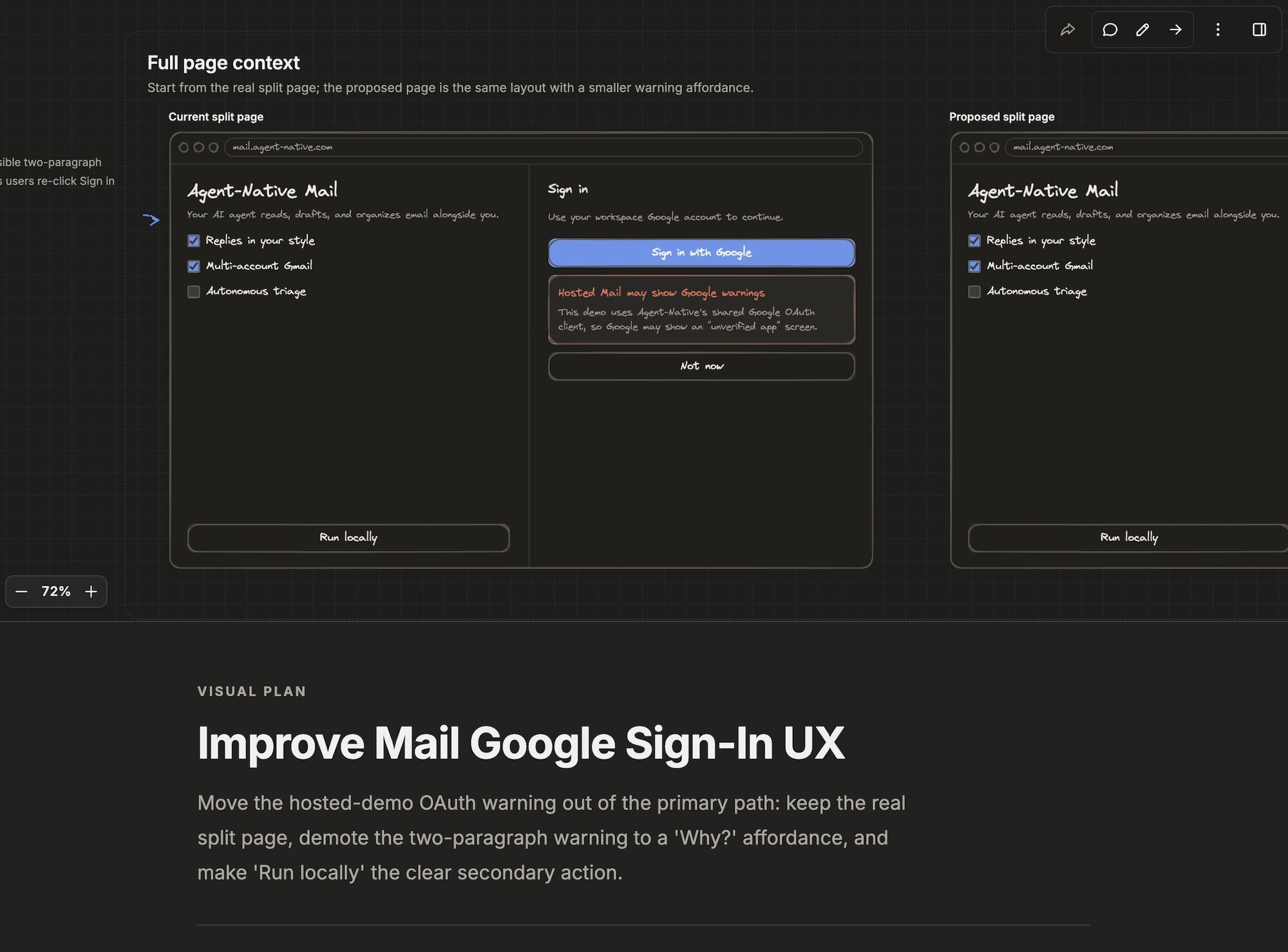
|
|
20
20
|
|
|
21
|
-
|
|
21
|
+
There are two ways into Plans:
|
|
22
|
+
|
|
23
|
+
- **From your coding agent (CLI)** — one command installs the skill, registers
|
|
24
|
+
the hosted Plans connector, and authenticates it.
|
|
25
|
+
- **In the browser** — anyone you share with can open the editor and create or
|
|
26
|
+
edit as a **guest, with no sign-up**. They sign in only when they want to save
|
|
27
|
+
or share.
|
|
28
|
+
|
|
29
|
+
## Install the skill {#install}
|
|
22
30
|
|
|
23
31
|
Use the Agent-Native CLI. This is the recommended setup because it installs the
|
|
24
|
-
Plans skill instructions, registers the hosted Plans MCP connector, and runs
|
|
25
|
-
client-specific auth/setup flow in one step
|
|
32
|
+
Plans skill instructions, registers the hosted Plans MCP connector, **and** runs
|
|
33
|
+
the client-specific auth/setup flow in one step, so your first tool call does not
|
|
34
|
+
hit an OAuth wall:
|
|
26
35
|
|
|
27
36
|
```bash
|
|
28
37
|
npx @agent-native/core@latest skills add visual-plan
|
|
@@ -36,10 +45,16 @@ agent-native skills add visual-plan
|
|
|
36
45
|
|
|
37
46
|
The command installs both commands: `/visual-plan` and `/visual-recap`.
|
|
38
47
|
|
|
39
|
-
|
|
40
|
-
|
|
41
|
-
|
|
42
|
-
|
|
48
|
+
Authentication is a one-time browser sign-in at setup — this is intended, and it
|
|
49
|
+
is what lets the agent persist and share the plans it generates. What the auth
|
|
50
|
+
step does depends on your client:
|
|
51
|
+
|
|
52
|
+
- **OAuth-capable hosts** (Claude Code) get a URL-only MCP entry plus a prompt to
|
|
53
|
+
run `/mcp` and choose **Authenticate**.
|
|
54
|
+
- **Codex / Cowork** run a short browser device-code flow: the CLI prints a code,
|
|
55
|
+
opens the verification page, and writes the connector once you approve.
|
|
56
|
+
- In a **non-interactive shell or CI**, the auth step is skipped and the exact
|
|
57
|
+
command to run later is printed for you.
|
|
43
58
|
|
|
44
59
|
By default the CLI targets Codex. Add `--client claude-code` or `--client all`
|
|
45
60
|
when you want to configure another host:
|
|
@@ -48,6 +63,22 @@ when you want to configure another host:
|
|
|
48
63
|
npx @agent-native/core@latest skills add visual-plan --client all
|
|
49
64
|
```
|
|
50
65
|
|
|
66
|
+
Pass `--no-connect` to register the connector without authenticating, then run
|
|
67
|
+
`agent-native connect https://plan.agent-native.com` whenever you are ready:
|
|
68
|
+
|
|
69
|
+
```bash
|
|
70
|
+
npx @agent-native/core@latest skills add visual-plan --no-connect
|
|
71
|
+
```
|
|
72
|
+
|
|
73
|
+
To auto-generate a recap on **every pull request**, pass `--with-github-action`.
|
|
74
|
+
This writes a GitHub Action that runs the `visual-recap` skill on each PR and
|
|
75
|
+
posts an interactive recap plan with an inline screenshot as a sticky comment —
|
|
76
|
+
see [PR Visual Recap](/docs/pr-visual-recap).
|
|
77
|
+
|
|
78
|
+
```bash
|
|
79
|
+
npx @agent-native/core@latest skills add visual-plan --with-github-action
|
|
80
|
+
```
|
|
81
|
+
|
|
51
82
|
If you only want the portable instruction file through the open Skills CLI, use:
|
|
52
83
|
|
|
53
84
|
```bash
|
|
@@ -57,6 +88,11 @@ npx skills add BuilderIO/agent-native --skill visual-plan
|
|
|
57
88
|
That installs the skill instructions only. It does not register the hosted MCP
|
|
58
89
|
connector, so use the Agent-Native CLI path when you want the one-command setup.
|
|
59
90
|
|
|
91
|
+
> **Prefer a one-install plugin?** Claude Code and Codex can add
|
|
92
|
+
> `BuilderIO/agent-native` directly as a plugin marketplace, which bundles the
|
|
93
|
+
> Plan skills _and_ the connector in one install and auto-updates as the skills
|
|
94
|
+
> improve — see [Plan plugin & marketplace](/docs/plan-plugin).
|
|
95
|
+
|
|
60
96
|
## Use it from your coding agent
|
|
61
97
|
|
|
62
98
|
After installation, ask your agent for the command that fits the work:
|
|
@@ -74,6 +110,10 @@ wrong direction would be costly. The returned Plans link opens the review UI so
|
|
|
74
110
|
you can annotate, correct, choose options, and ask for updates before code
|
|
75
111
|
changes begin.
|
|
76
112
|
|
|
113
|
+
When a Codex, Claude Code, Markdown, or pasted plan already exists, use
|
|
114
|
+
`/visual-plan`; the agent preserves that source plan and builds the richer review
|
|
115
|
+
surface from it instead of starting over.
|
|
116
|
+
|
|
77
117
|
If the first pass still has answerable decisions, the agent can place an
|
|
78
118
|
**Open Questions** form at the bottom of the same plan. Answering it and sending
|
|
79
119
|
it to the agent starts a revision turn against the existing plan.
|
|
@@ -91,14 +131,36 @@ it to the agent starts a revision turn against the existing plan.
|
|
|
91
131
|
prose block, visual comments include exact target metadata, and browser
|
|
92
132
|
handoff includes focused screenshots for a small set of visual/canvas comment
|
|
93
133
|
locations instead of one hard-to-read giant image.
|
|
94
|
-
- **Share with reviewers.** Hosted Plans can create private review links and
|
|
95
|
-
account-backed sharing. Viewing shared plans works from the browser; saving
|
|
96
|
-
and sharing require sign-in.
|
|
97
134
|
- **Export the result.** Keep an HTML, Markdown, or JSON receipt of the plan
|
|
98
135
|
when you need a source-control-friendly handoff.
|
|
99
|
-
|
|
100
|
-
|
|
101
|
-
|
|
136
|
+
|
|
137
|
+
## Editing in the browser as a guest {#guest}
|
|
138
|
+
|
|
139
|
+
People you share a plan with do not need to install anything. They open the Plans
|
|
140
|
+
editor and **create and edit with no sign-up** — they work as a guest. Signing in
|
|
141
|
+
is only required when someone wants to **save or share** their own work.
|
|
142
|
+
|
|
143
|
+
When a guest signs in, the plans they created as a guest are **claimed** into
|
|
144
|
+
their account, so nothing they built is lost.
|
|
145
|
+
|
|
146
|
+
Plan prose edits inline: click into any text section, type, format with the rich
|
|
147
|
+
editor toolbar or slash menu, and Plans autosaves the underlying markdown. Review
|
|
148
|
+
annotation mode temporarily turns text sections read-only so clicks can pin
|
|
149
|
+
feedback; leave review mode to keep editing prose.
|
|
150
|
+
|
|
151
|
+
## Sharing and commenting {#sharing}
|
|
152
|
+
|
|
153
|
+
Sharing and commenting are the workflows that need an account:
|
|
154
|
+
|
|
155
|
+
- **Viewing** a public or shared plan works for anyone with the link — no account
|
|
156
|
+
required.
|
|
157
|
+
- **Commenting** on a shared plan requires an agent-native account.
|
|
158
|
+
- **Sharing** a plan (publishing it to a link, private sharing, reviewer access,
|
|
159
|
+
cross-device or team review) requires signing in. Google sign-in appears when
|
|
160
|
+
the standard Google OAuth env vars are configured.
|
|
161
|
+
|
|
162
|
+
The hosted Plans connector lives at `https://plan.agent-native.com/_agent-native/mcp`.
|
|
163
|
+
Never put shared secrets in skill files.
|
|
102
164
|
|
|
103
165
|
## Useful prompts
|
|
104
166
|
|
|
@@ -108,6 +170,14 @@ it to the agent starts a revision turn against the existing plan.
|
|
|
108
170
|
- "Run `/visual-recap` on this PR so I can review the shape of the change first."
|
|
109
171
|
- "Use `/visual-recap` on the diff between `main` and this branch."
|
|
110
172
|
|
|
173
|
+
## Recovering from auth errors {#auth-errors}
|
|
174
|
+
|
|
175
|
+
If a Plans tool ever returns `needs auth`, `Unauthorized`, or `Session
|
|
176
|
+
terminated`, do not keep retrying it. Authenticate the connector with
|
|
177
|
+
`agent-native connect https://plan.agent-native.com` (or re-run `/mcp` →
|
|
178
|
+
**Authenticate** in an OAuth-capable host), then continue once the connector is
|
|
179
|
+
available.
|
|
180
|
+
|
|
111
181
|
## For developers
|
|
112
182
|
|
|
113
183
|
The rest of this doc is for anyone forking or self-hosting the Plans template.
|
|
@@ -130,10 +200,17 @@ The hosted app-backed skill uses:
|
|
|
130
200
|
The local template is useful when you are developing Plans itself, testing local
|
|
131
201
|
persistence, or running a fully self-hosted review surface.
|
|
132
202
|
|
|
203
|
+
### Local mode (advanced, offline)
|
|
204
|
+
|
|
205
|
+
For fully offline, no-account use, you can run the Plans app locally and sync
|
|
206
|
+
your plans to your repo as MDX. This local mode is a separate, advanced path —
|
|
207
|
+
not the default hosted flow — and is best when you need everything to stay on
|
|
208
|
+
your machine and in version control.
|
|
209
|
+
|
|
133
210
|
## What's next
|
|
134
211
|
|
|
135
|
-
- [**Visual Plans**](/docs/visual-plans) — the full skill flow and auth details
|
|
136
212
|
- [**PR Visual Recap**](/docs/pr-visual-recap) — run `/visual-recap` automatically on every pull request
|
|
213
|
+
- [**Plan plugin & marketplace**](/docs/plan-plugin) — install the Plan skills as a Claude Code or Codex plugin
|
|
137
214
|
- [**Skills**](/docs/skills-guide) — how Agent-Native installs skills
|
|
138
215
|
- [**MCP Clients**](/docs/mcp-clients) — configuring hosted MCP connectors
|
|
139
216
|
- [**Templates**](/docs/cloneable-saas) — the clone-and-own model
|
package/package.json
CHANGED
|
@@ -1,6 +1,6 @@
|
|
|
1
1
|
{
|
|
2
2
|
"name": "@agent-native/core",
|
|
3
|
-
"version": "0.
|
|
3
|
+
"version": "0.44.0",
|
|
4
4
|
"type": "module",
|
|
5
5
|
"engines": {
|
|
6
6
|
"node": ">=22"
|
|
@@ -198,6 +198,7 @@
|
|
|
198
198
|
"react-router": "^7.16.0",
|
|
199
199
|
"recharts": "3.8.1",
|
|
200
200
|
"remark-gfm": "^4.0.1",
|
|
201
|
+
"roughjs": "4.6.6",
|
|
201
202
|
"shiki": "^4.0.2",
|
|
202
203
|
"tailwind-merge": "^3.5.0",
|
|
203
204
|
"tiptap-markdown": "^0.9.0",
|
|
@@ -14,6 +14,8 @@ metadata:
|
|
|
14
14
|
|
|
15
15
|
All application data lives in **SQL** (SQLite locally, persistent database in production). The agent and UI share the same database. Do not store durable app data in the filesystem.
|
|
16
16
|
|
|
17
|
+
When you add a data model, a list, or a read path, also follow the `performance` skill: project only the columns a list renders, index the columns hot queries filter/sort on, and avoid query waterfalls — so apps stay fast as data grows.
|
|
18
|
+
|
|
17
19
|
## How It Works
|
|
18
20
|
|
|
19
21
|
Agent-native apps use Drizzle ORM over the configured SQL backend. Local development works out of the box with a SQLite file at `data/app.db`; production and shared preview deploys need a persistent `DATABASE_URL` because container/serverless filesystems can reset. The code should behave the same across backends, but the local SQLite file is not durable once deployed.
|
|
@@ -0,0 +1,141 @@
|
|
|
1
|
+
---
|
|
2
|
+
name: performance
|
|
3
|
+
description: >-
|
|
4
|
+
Keep apps and templates loading fast. Read when adding a data model, a
|
|
5
|
+
list/read action, a page or sidebar that loads data, or when something loads
|
|
6
|
+
slowly. Covers column projection, indexing hot-path queries, avoiding N+1 and
|
|
7
|
+
round-trip waterfalls, cheap polling, and not recomputing on every read.
|
|
8
|
+
metadata:
|
|
9
|
+
internal: true
|
|
10
|
+
---
|
|
11
|
+
|
|
12
|
+
# Performance — Keep Loads Fast
|
|
13
|
+
|
|
14
|
+
## Rule
|
|
15
|
+
|
|
16
|
+
Treat every list, every read, and every page load as a latency budget. Two
|
|
17
|
+
things dominate it: **how much data crosses the wire**, and **how many
|
|
18
|
+
round-trips and table scans it takes**. On a hosted/serverless SQL backend each
|
|
19
|
+
query is a network round-trip, and an unindexed filter scans the whole — often
|
|
20
|
+
shared and growing — table. So default to **projected columns**, **indexed
|
|
21
|
+
hot-path queries**, and **parallel/batched** fetches. These rules are
|
|
22
|
+
provider-agnostic: they hold on SQLite, Postgres, or any managed SQL backend.
|
|
23
|
+
|
|
24
|
+
This skill is about the data and load path. See the `storing-data` skill for the schema
|
|
25
|
+
and migration mechanics it references, and the `real-time-sync` skill for how updates
|
|
26
|
+
already reach the UI without polling.
|
|
27
|
+
|
|
28
|
+
## 1. Project columns — never `SELECT *` on a list
|
|
29
|
+
|
|
30
|
+
A list/index query should select only the columns the list actually renders.
|
|
31
|
+
|
|
32
|
+
- **Never return heavy columns in a list**: large JSON/text blobs such as
|
|
33
|
+
document bodies, rendered HTML, `config`/`layout`/`spec`/`data`/`tracks`,
|
|
34
|
+
tool results, or base64 attachments. Pulling them for every row is the single
|
|
35
|
+
most common cause of a slow list.
|
|
36
|
+
- Heavy/full columns belong on the **single-item GET/detail** path only.
|
|
37
|
+
- Need a preview from a big column? Select a **truncated substring at the DB**,
|
|
38
|
+
not the whole column — and it stays portable:
|
|
39
|
+
|
|
40
|
+
```ts
|
|
41
|
+
// Drizzle — project, and truncate the heavy column for the preview
|
|
42
|
+
const rows = await db
|
|
43
|
+
.select({
|
|
44
|
+
id: docs.id,
|
|
45
|
+
title: docs.title,
|
|
46
|
+
updatedAt: docs.updatedAt,
|
|
47
|
+
// substr/length work on both SQLite and Postgres
|
|
48
|
+
preview: sql<string>`substr(${docs.content}, 1, 400)`,
|
|
49
|
+
})
|
|
50
|
+
.from(docs)
|
|
51
|
+
.where(accessFilter(docs, docShares))
|
|
52
|
+
.orderBy(desc(docs.updatedAt));
|
|
53
|
+
```
|
|
54
|
+
|
|
55
|
+
- After narrowing the projection, update the row mapper and its return type so a
|
|
56
|
+
dropped column is provably unused on the list path. If the list genuinely
|
|
57
|
+
renders a heavy column (a thumbnail, an inline preview the UI shows), keep it —
|
|
58
|
+
don't break behavior to chase a payload win.
|
|
59
|
+
|
|
60
|
+
## 2. Index the hot paths
|
|
61
|
+
|
|
62
|
+
Indexes are added through the **versioned migration array** in
|
|
63
|
+
`server/plugins/db.ts` as `CREATE INDEX IF NOT EXISTS …` — not through a
|
|
64
|
+
schema-level `index()` helper (the framework applies indexes via migrations; see
|
|
65
|
+
the `storing-data` skill). Add an index for any column a hot query **filters or sorts**
|
|
66
|
+
on. The recurring ones:
|
|
67
|
+
|
|
68
|
+
- **Ownable tables** → `(owner_email, org_id, <the list's ORDER BY column>)`.
|
|
69
|
+
Access scoping filters by owner/org and lists sort by `updated_at`/`created_at`.
|
|
70
|
+
- **Shares tables** (`{resource}_shares`) → `(resource_id, principal_type, principal_id)`.
|
|
71
|
+
Access checks run correlated `EXISTS` subqueries against these on every list.
|
|
72
|
+
- **Child / foreign-key columns** used to load children (e.g. `responses.form_id`,
|
|
73
|
+
`comments.parent_id`, an events log's `*_id`) → index the FK, plus its sort
|
|
74
|
+
column when the children are ordered. An unindexed FK means a full scan of the
|
|
75
|
+
child table on every parent open. **A foreign-key reference does not create an
|
|
76
|
+
index automatically** — add it explicitly.
|
|
77
|
+
- **Status-filtered lists** → match the real `WHERE`, e.g. `(owner_email, status)`
|
|
78
|
+
or `(status, <sort>)`.
|
|
79
|
+
|
|
80
|
+
Keep index DDL **dialect-agnostic and idempotent**:
|
|
81
|
+
|
|
82
|
+
```sql
|
|
83
|
+
CREATE INDEX IF NOT EXISTS forms_owner_org_updated_idx ON forms (owner_email, org_id, updated_at)
|
|
84
|
+
```
|
|
85
|
+
|
|
86
|
+
No `DESC`, no partial `WHERE`, no provider-specific syntax — it then runs on
|
|
87
|
+
SQLite and Postgres alike, is safe to re-run, and applies on next startup.
|
|
88
|
+
Indexes mostly bite **as data grows** and on **unbounded child tables** (a
|
|
89
|
+
seq-scan of 10 rows is instant; of a shared, ever-growing log it is not), so
|
|
90
|
+
index the growing tables first.
|
|
91
|
+
|
|
92
|
+
## 3. Don't fan out queries — batch and parallelize
|
|
93
|
+
|
|
94
|
+
- **No N+1.** Never loop issuing one query per item. Load children for many
|
|
95
|
+
parents in one `inArray(child.parentId, ids)` query, then group in memory.
|
|
96
|
+
- **Count in SQL** (`count()`), never "select all rows then `.length`".
|
|
97
|
+
- **Parallelize independent queries** with `Promise.all` rather than sequential
|
|
98
|
+
`await`s — each `await` is another round-trip.
|
|
99
|
+
- Prefer **one composed endpoint** over several dependent calls.
|
|
100
|
+
|
|
101
|
+
## 4. Avoid client-side waterfalls
|
|
102
|
+
|
|
103
|
+
- Don't gate query B on query A's result unless B truly needs it. Fire
|
|
104
|
+
independent `useActionQuery` / `useQuery` hooks **in parallel**; never make the
|
|
105
|
+
loading skeleton wait on a serial chain.
|
|
106
|
+
- Load the visible page from one read where possible, and **lazy-load**
|
|
107
|
+
secondary / below-the-fold data after first paint.
|
|
108
|
+
|
|
109
|
+
## 5. Poll cheaply; compute once
|
|
110
|
+
|
|
111
|
+
- Updates already reach the UI through the `real-time-sync` skill (`useDbSync` / SSE).
|
|
112
|
+
Don't add an aggressive `refetchInterval` that re-runs a heavy list/read every
|
|
113
|
+
couple of seconds. If you must poll, use a **wide interval** and a **cheap**
|
|
114
|
+
endpoint.
|
|
115
|
+
- **Never do expensive per-request work on a read that runs on every load/poll**:
|
|
116
|
+
re-rendering HTML/markdown, pretty-printing, re-parsing / migrating /
|
|
117
|
+
normalizing / sanitizing stored JSON. Do that work at **write time** (store the
|
|
118
|
+
result) or compute it **lazily only for the caller that needs it**. Reads on
|
|
119
|
+
the hot path must be cheap.
|
|
120
|
+
- Data the UI doesn't display (export formats, alternate renderings) belongs in a
|
|
121
|
+
separate on-demand action, not baked into the hot read.
|
|
122
|
+
|
|
123
|
+
## 6. Big payloads and long lists
|
|
124
|
+
|
|
125
|
+
- **Paginate or window** unbounded lists (messages, responses, events, activity).
|
|
126
|
+
Don't load the entire history on open; load a recent window and fetch older on
|
|
127
|
+
demand.
|
|
128
|
+
- Don't store **unbounded blobs inline** in a row that a list/load pulls.
|
|
129
|
+
Reference large content separately so opening the parent stays cheap.
|
|
130
|
+
- **Virtualize** very long rendered lists on the client so off-screen rows aren't
|
|
131
|
+
parsed/rendered every update.
|
|
132
|
+
|
|
133
|
+
## Checklist — run before shipping a list/read or a new table
|
|
134
|
+
|
|
135
|
+
- [ ] List selects only displayed columns; heavy blobs excluded or `substr`-truncated.
|
|
136
|
+
- [ ] Every hot-path `WHERE` / `ORDER BY` column is indexed (owner/org/sort,
|
|
137
|
+
shares `resource_id`, child FKs, status filters) via a `db.ts` migration.
|
|
138
|
+
- [ ] No N+1; independent queries parallelized; counts via SQL `count()`.
|
|
139
|
+
- [ ] Client fires independent queries in parallel, not a waterfall.
|
|
140
|
+
- [ ] No heavy recompute on every read; no aggressive polling of heavy endpoints.
|
|
141
|
+
- [ ] Unbounded lists are paginated/windowed; large blobs aren't inlined on the hot path.
|
|
@@ -14,6 +14,8 @@ metadata:
|
|
|
14
14
|
|
|
15
15
|
All application data lives in **SQL** (SQLite locally, persistent database in production). The agent and UI share the same database. Do not store durable app data in the filesystem.
|
|
16
16
|
|
|
17
|
+
When you add a data model, a list, or a read path, also follow the `performance` skill: project only the columns a list renders, index the columns hot queries filter/sort on, and avoid query waterfalls — so apps stay fast as data grows.
|
|
18
|
+
|
|
17
19
|
## How It Works
|
|
18
20
|
|
|
19
21
|
Agent-native apps use Drizzle ORM over the configured SQL backend. Local development works out of the box with a SQLite file at `data/app.db`; production and shared preview deploys need a persistent `DATABASE_URL` because container/serverless filesystems can reset. The code should behave the same across backends, but the local SQLite file is not durable once deployed.
|