@adamchanadam/agent-handoff-kit 0.4.6 → 0.4.7
This diff represents the content of publicly available package versions that have been released to one of the supported registries. The information contained in this diff is provided for informational purposes only and reflects changes between package versions as they appear in their respective public registries.
package/README.en.md
CHANGED
|
@@ -2,9 +2,9 @@
|
|
|
2
2
|
|
|
3
3
|
[繁體中文](README.md) · [Introduction](https://adamchanadam.github.io/agent-handoff-kit/agent-handoff-kit-intro.en.html) · [Command guide](https://adamchanadam.github.io/agent-handoff-kit/agent-handoff-kit-guide.en.html)
|
|
4
4
|
|
|
5
|
-
**Your session relay baton.**
|
|
5
|
+
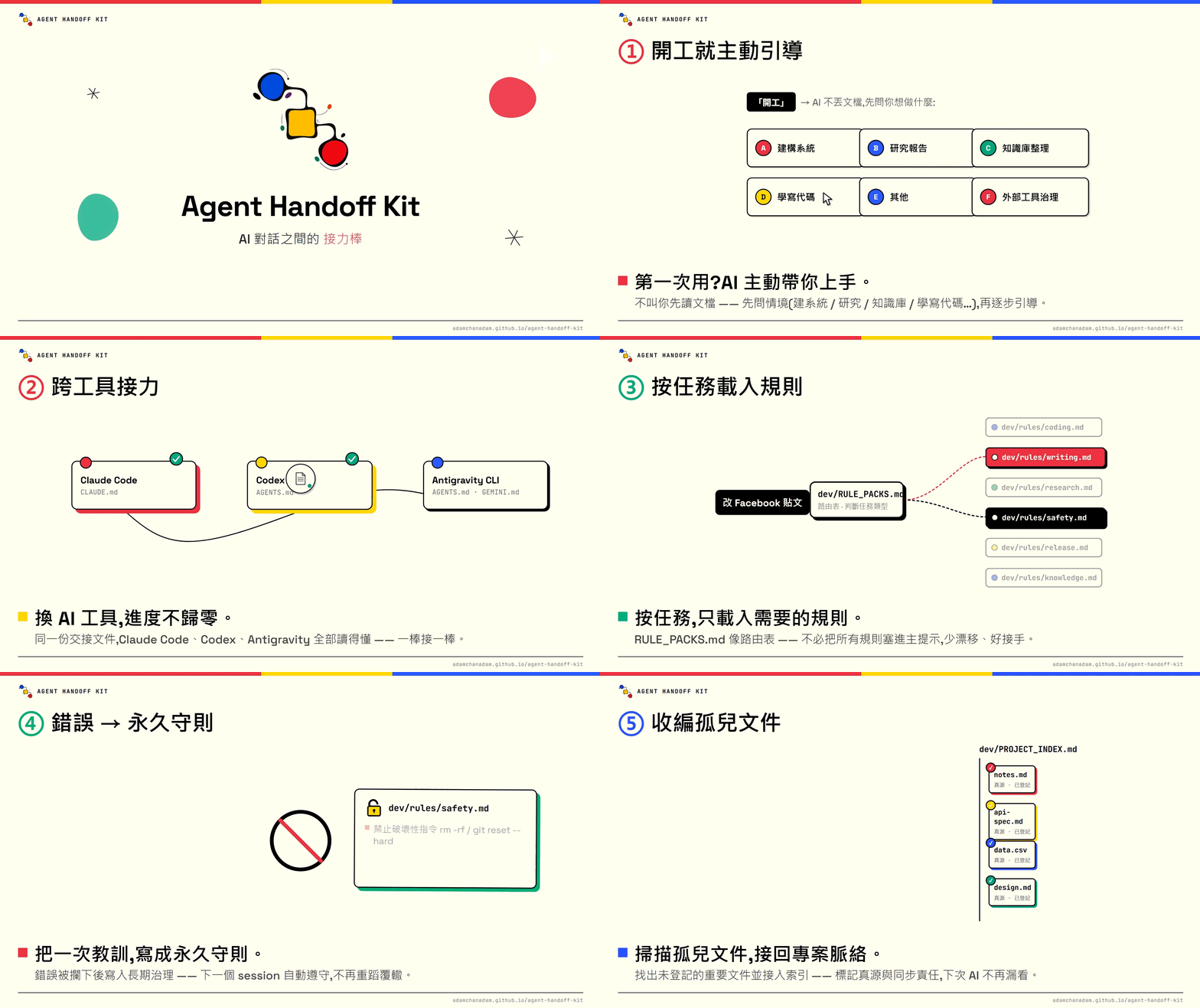
**Your session relay baton.** Context engineering at its core: keep progress, key decisions, file locations and unfinished tasks in your project folder, so supported AI tools can pick up where the last one left off.
|
|
6
6
|
|
|
7
|
-
Code version covered: `v0.4.
|
|
7
|
+
Code version covered: `v0.4.7`. This guide includes updates that have not been released yet. Features available to download depend on the published version.
|
|
8
8
|
|
|
9
9
|
[](https://youtu.be/RopbfBiSw1I)
|
|
10
10
|
|
package/README.md
CHANGED
|
@@ -2,9 +2,9 @@
|
|
|
2
2
|
|
|
3
3
|
[English](README.en.md) · [入門介紹](https://adamchanadam.github.io/agent-handoff-kit/agent-handoff-kit-intro.html) · [常用指令用法](https://adamchanadam.github.io/agent-handoff-kit/agent-handoff-kit-guide.html)
|
|
4
4
|
|
|
5
|
-
**Session
|
|
5
|
+
**Session 接力棒**。以 context engineering(為 AI 準備它需要知道的背景資料)為核心,把進度、重要決定、文件位置和未完事項留在專案資料夾,讓支援的 AI 工具接手繼續工作。
|
|
6
6
|
|
|
7
|
-
文件對應程式版本:`v0.4.
|
|
7
|
+
文件對應程式版本:`v0.4.7`。這份說明包含尚未發布的更新;正式下載可用的功能,以已發布版本為準。
|
|
8
8
|
|
|
9
9
|
[](https://youtu.be/RopbfBiSw1I)
|
|
10
10
|
|
|
@@ -3259,6 +3259,30 @@ async function runDoctor(root, version, options = {}) {
|
|
|
3259
3259
|
console.log(`${row.ok ? "ok" : "missing"} ${row.target}`);
|
|
3260
3260
|
}
|
|
3261
3261
|
|
|
3262
|
+
// This advisory is independent of doctor health and counts.
|
|
3263
|
+
try {
|
|
3264
|
+
const bytes = await readFile(path.join(root, "AGENTS.md"));
|
|
3265
|
+
const limit = 32768;
|
|
3266
|
+
if (bytes.length > limit) {
|
|
3267
|
+
const start = bytes.indexOf(managedCoreStart);
|
|
3268
|
+
const candidateEnd = start < 0 ? -1 : bytes.indexOf(managedCoreEnd, start + Buffer.byteLength(managedCoreStart));
|
|
3269
|
+
const end = start >= 0 && start === bytes.lastIndexOf(managedCoreStart) && candidateEnd >= 0 && candidateEnd === bytes.indexOf(managedCoreEnd) && candidateEnd === bytes.lastIndexOf(managedCoreEnd) ? candidateEnd : -1;
|
|
3270
|
+
const safety = end < 0 ? -1 : bytes.indexOf("## 3. Safety Baseline", start);
|
|
3271
|
+
const entries = [
|
|
3272
|
+
["官方核心結束標記", end, managedCoreEnd],
|
|
3273
|
+
["Safety Baseline 標題", safety >= 0 && safety < end ? safety : -1, "## 3. Safety Baseline"],
|
|
3274
|
+
["用戶規則入口", end < 0 ? -1 : bytes.indexOf(FORMAL_USER_RULES_ENTRY_ANCHOR, end + Buffer.byteLength(managedCoreEnd)), FORMAL_USER_RULES_ENTRY_ANCHOR]
|
|
3275
|
+
];
|
|
3276
|
+
const beyond = entries.filter(([, position, marker]) => position >= 0 && position + Buffer.byteLength(marker) > limit).map(([label]) => label);
|
|
3277
|
+
console.log(`\nwarn: AGENTS.md 大小提醒: ${bytes.length} bytes;Codex 預設只讀取專案指引檔首 32,768 bytes,Claude Code 不受影響。`);
|
|
3278
|
+
if (beyond.length) console.log(` warn: 超出上限:${beyond.join("、")}。`);
|
|
3279
|
+
console.log(" warn: 此檢查不計算子資料夾的 AGENTS.md。已調高上限可忽略。");
|
|
3280
|
+
console.log(" warn: 可在個人 ~/.codex/config.toml(Windows: C:\\Users\\<用戶名>\\.codex\\config.toml)加入 project_doc_max_bytes = 65536;設定一次適用所有專案(包括未受信任專案),或縮短自己的內容。");
|
|
3281
|
+
}
|
|
3282
|
+
} catch {
|
|
3283
|
+
// Missing or unreadable files remain the responsibility of existing checks.
|
|
3284
|
+
}
|
|
3285
|
+
|
|
3262
3286
|
if (missing.length > 0) {
|
|
3263
3287
|
const misplacedRulePacks = await findMisplacedRulePacks(root, missing);
|
|
3264
3288
|
printMisplacedRulePackWarnings(misplacedRulePacks);
|
|
@@ -15001,6 +15001,181 @@
|
|
|
15001
15001
|
"canonicalSha256": "04602a68a6a0e54ceb244bb71fc026ed73f08c7e7b0c764561cbad2ec19692f5"
|
|
15002
15002
|
}
|
|
15003
15003
|
}
|
|
15004
|
+
},
|
|
15005
|
+
"0.4.6": {
|
|
15006
|
+
"source": {
|
|
15007
|
+
"npm": {
|
|
15008
|
+
"spec": "@adamchanadam/agent-handoff-kit@0.4.6",
|
|
15009
|
+
"shasum": "43901319bad32a192a297dcb05456e9fa8b0701e",
|
|
15010
|
+
"integrity": "sha512-o7RPQdDX+kpNlcYHegF3oyr7Q9fsffNwR5+s0W35jcMu09Re1Hvt3pG8MHbCC9LuH4Md9FEEoThxAlk4n+55hQ==",
|
|
15011
|
+
"entryCount": 52,
|
|
15012
|
+
"gitHead": null
|
|
15013
|
+
},
|
|
15014
|
+
"git": {
|
|
15015
|
+
"tag": "v0.4.6",
|
|
15016
|
+
"directObject": "367c96005231e434beafb5329004525959897237",
|
|
15017
|
+
"peeledCommit": "ab30ac81c319c13bfb6e706f274c634f637fb64e",
|
|
15018
|
+
"commit": "ab30ac81c319c13bfb6e706f274c634f637fb64e"
|
|
15019
|
+
},
|
|
15020
|
+
"githubRelease": {
|
|
15021
|
+
"tag": "v0.4.6",
|
|
15022
|
+
"publishedAt": "2026-11-12T10:18:01Z"
|
|
15023
|
+
},
|
|
15024
|
+
"sourceDivergence": {
|
|
15025
|
+
"status": "npm-gitHead-unavailable",
|
|
15026
|
+
"npmGitHead": null,
|
|
15027
|
+
"remoteTagCommit": "ab30ac81c319c13bfb6e706f274c634f637fb64e"
|
|
15028
|
+
}
|
|
15029
|
+
},
|
|
15030
|
+
"manifest": {
|
|
15031
|
+
"AGENTS.md": {
|
|
15032
|
+
"state": "present",
|
|
15033
|
+
"contentId": "2bd837616206221afa7cbc69e7b1191df98182fb2e44586e1d6ca6e79d401188",
|
|
15034
|
+
"rawSha256": "2c2cd7752d575f174f6a66155ccdffdaef9d3081578a23b538b6e694a738e7f2",
|
|
15035
|
+
"normalizedSha256": "870a89f1e09a11a9e058ab0bf04dd99dfc87d5ec5f62f69ff0dfa424649e06fe",
|
|
15036
|
+
"canonicalSha256": "870a89f1e09a11a9e058ab0bf04dd99dfc87d5ec5f62f69ff0dfa424649e06fe"
|
|
15037
|
+
},
|
|
15038
|
+
"CLAUDE.md": {
|
|
15039
|
+
"state": "present",
|
|
15040
|
+
"contentId": "7a2cf08a1171762ebcb53f43036a2170655379416945258b9c85d4b189ecaecf",
|
|
15041
|
+
"rawSha256": "9e326c3c1ab08fbcd23b28cd398561c17d851a59997842e0f4f97ff3473ff0ad",
|
|
15042
|
+
"normalizedSha256": "9e326c3c1ab08fbcd23b28cd398561c17d851a59997842e0f4f97ff3473ff0ad",
|
|
15043
|
+
"canonicalSha256": "9e326c3c1ab08fbcd23b28cd398561c17d851a59997842e0f4f97ff3473ff0ad"
|
|
15044
|
+
},
|
|
15045
|
+
"GEMINI.md": {
|
|
15046
|
+
"state": "present",
|
|
15047
|
+
"contentId": "36da47034bb2ce6c760ddbbbbd49dccc1d17665dbb18bec56ffa3b26bac1c135",
|
|
15048
|
+
"rawSha256": "b6e8bfc51ba751fec2acd1719c4459b41524f013e0464a5573de7f66d436c986",
|
|
15049
|
+
"normalizedSha256": "b6e8bfc51ba751fec2acd1719c4459b41524f013e0464a5573de7f66d436c986",
|
|
15050
|
+
"canonicalSha256": "b6e8bfc51ba751fec2acd1719c4459b41524f013e0464a5573de7f66d436c986"
|
|
15051
|
+
},
|
|
15052
|
+
"START_NEXT_SESSION_PROMPT.txt": {
|
|
15053
|
+
"state": "present",
|
|
15054
|
+
"contentId": "9902b70a395688d6602b34f9e8085b32b5538e72c9009e28b4258e1fd30b77cc",
|
|
15055
|
+
"rawSha256": "fe277a5e832ee6c336b30e0c4a8248db4c92ffca5a1c30c2e49def1a9381717a",
|
|
15056
|
+
"normalizedSha256": "fe277a5e832ee6c336b30e0c4a8248db4c92ffca5a1c30c2e49def1a9381717a",
|
|
15057
|
+
"canonicalSha256": "9896feb18fe71a4f3500e2d89cea6991ca1788aebc6c6ead9848f5551750a1c0"
|
|
15058
|
+
},
|
|
15059
|
+
"dev/SESSION_HANDOFF.md": {
|
|
15060
|
+
"state": "present",
|
|
15061
|
+
"contentId": "73afc36c2bcfc236bc694af6ed5183637cef1e1089c80a0dc2c1a1a7214ca5c2",
|
|
15062
|
+
"rawSha256": "110978579cf0b200cd04ad994cc60802a8fff58ca8f40a297af9d66113600c7e",
|
|
15063
|
+
"normalizedSha256": "110978579cf0b200cd04ad994cc60802a8fff58ca8f40a297af9d66113600c7e",
|
|
15064
|
+
"canonicalSha256": "882588e529835a84071fbbdddab70324392c9bcbb206d9dc2c804ac01108197f"
|
|
15065
|
+
},
|
|
15066
|
+
"dev/SESSION_LOG.md": {
|
|
15067
|
+
"state": "present",
|
|
15068
|
+
"contentId": "fa77d46a61f58e2fabc537b5c6ff31c33eb4413088797e87bf1b442ddec291c5",
|
|
15069
|
+
"rawSha256": "8da41cb8b8e766f40e8ab4365c32e9b6be6cc9265dc22d18bbbe75e8ad771cbd",
|
|
15070
|
+
"normalizedSha256": "8da41cb8b8e766f40e8ab4365c32e9b6be6cc9265dc22d18bbbe75e8ad771cbd",
|
|
15071
|
+
"canonicalSha256": "8da41cb8b8e766f40e8ab4365c32e9b6be6cc9265dc22d18bbbe75e8ad771cbd"
|
|
15072
|
+
},
|
|
15073
|
+
"dev/PROJECT_INDEX.md": {
|
|
15074
|
+
"state": "present",
|
|
15075
|
+
"contentId": "c4c0db7c6e7a19796cd7ca1ed2a666461aa49a0b0d087a99deca43853ffdb468",
|
|
15076
|
+
"rawSha256": "b1737ef2794a4becf703bb38fd328f3de10db20d2097a44983207f5bb12ff8a0",
|
|
15077
|
+
"normalizedSha256": "432a25b6a71cf4ca3f3885a141ceef5d76f6c317a975f783e6c8203831820c8b",
|
|
15078
|
+
"canonicalSha256": "d13af58d29f15710e54469e929847a611a066f286198feeebada13192404141c"
|
|
15079
|
+
},
|
|
15080
|
+
"dev/DOC_SYNC_REGISTRY.md": {
|
|
15081
|
+
"state": "present",
|
|
15082
|
+
"contentId": "4c9f768eda712b65a04372059ea937864da01083346d007808cd935cc4825829",
|
|
15083
|
+
"rawSha256": "d32534a19c1247705c05431a30d1d294222faf372c0b777cfc087a7a52fb98ac",
|
|
15084
|
+
"normalizedSha256": "d32534a19c1247705c05431a30d1d294222faf372c0b777cfc087a7a52fb98ac",
|
|
15085
|
+
"canonicalSha256": "d32534a19c1247705c05431a30d1d294222faf372c0b777cfc087a7a52fb98ac"
|
|
15086
|
+
},
|
|
15087
|
+
"dev/RULE_PACKS.md": {
|
|
15088
|
+
"state": "present",
|
|
15089
|
+
"contentId": "1b91985b9c6460b7bf4293cc6119097df9b426c3a46199a0a4f1de1712d02faa",
|
|
15090
|
+
"rawSha256": "383842f3d2f995a6f0917bb4a7bc6bfa5fd6e3c33ec8aa2cd073ce1695812df4",
|
|
15091
|
+
"normalizedSha256": "383842f3d2f995a6f0917bb4a7bc6bfa5fd6e3c33ec8aa2cd073ce1695812df4",
|
|
15092
|
+
"canonicalSha256": "383842f3d2f995a6f0917bb4a7bc6bfa5fd6e3c33ec8aa2cd073ce1695812df4"
|
|
15093
|
+
},
|
|
15094
|
+
"dev/PROJECT_DECISIONS.md": {
|
|
15095
|
+
"state": "present",
|
|
15096
|
+
"contentId": "23daf5c72689add04511e62f8d7c354706b7c302a0188c7d0cf2e8cbcfc301d3",
|
|
15097
|
+
"rawSha256": "6d41cfe8799cad57587d75458b086434abb842ac91b72274b432454c710546b5",
|
|
15098
|
+
"normalizedSha256": "6d41cfe8799cad57587d75458b086434abb842ac91b72274b432454c710546b5",
|
|
15099
|
+
"canonicalSha256": "6d41cfe8799cad57587d75458b086434abb842ac91b72274b432454c710546b5"
|
|
15100
|
+
},
|
|
15101
|
+
"dev/rules/safety.md": {
|
|
15102
|
+
"state": "present",
|
|
15103
|
+
"contentId": "7fff6b3893d37bb1b8e1a6321048722de29919b5e75725258cfe119f1f77b1a0",
|
|
15104
|
+
"rawSha256": "8faf7411fc5d4c699f06f4bbf00fae105ad8a5a624371ff15f95d7c0c14128c9",
|
|
15105
|
+
"normalizedSha256": "8faf7411fc5d4c699f06f4bbf00fae105ad8a5a624371ff15f95d7c0c14128c9",
|
|
15106
|
+
"canonicalSha256": "8faf7411fc5d4c699f06f4bbf00fae105ad8a5a624371ff15f95d7c0c14128c9"
|
|
15107
|
+
},
|
|
15108
|
+
"dev/rules/coding.md": {
|
|
15109
|
+
"state": "present",
|
|
15110
|
+
"contentId": "199f77f66ca752ff9bc0750b7230657a05a9bd6e2cb70a299c42171016bc2738",
|
|
15111
|
+
"rawSha256": "0bb2ee2940f778710b5df15f4151ee571438c1100f7198c74886eaefdb3fd50d",
|
|
15112
|
+
"normalizedSha256": "0bb2ee2940f778710b5df15f4151ee571438c1100f7198c74886eaefdb3fd50d",
|
|
15113
|
+
"canonicalSha256": "0bb2ee2940f778710b5df15f4151ee571438c1100f7198c74886eaefdb3fd50d"
|
|
15114
|
+
},
|
|
15115
|
+
"dev/rules/writing.md": {
|
|
15116
|
+
"state": "present",
|
|
15117
|
+
"contentId": "ceee5412520ba860e6b40de46bb164e2ce3919d2197d5fadb926198eb7dddd3b",
|
|
15118
|
+
"rawSha256": "106376ae5c4eb703cab471efe2b285e1b0de5e35c2460977731fec2662c24593",
|
|
15119
|
+
"normalizedSha256": "106376ae5c4eb703cab471efe2b285e1b0de5e35c2460977731fec2662c24593",
|
|
15120
|
+
"canonicalSha256": "106376ae5c4eb703cab471efe2b285e1b0de5e35c2460977731fec2662c24593"
|
|
15121
|
+
},
|
|
15122
|
+
"dev/rules/research.md": {
|
|
15123
|
+
"state": "present",
|
|
15124
|
+
"contentId": "4414f9c82c6d04ad49d7446f4b0740055242f425ef5b00391d9c8c78c96c0f66",
|
|
15125
|
+
"rawSha256": "b282a48392250b570651f5e2e80c59d6c247617d08db35331d1e7538747a2104",
|
|
15126
|
+
"normalizedSha256": "b282a48392250b570651f5e2e80c59d6c247617d08db35331d1e7538747a2104",
|
|
15127
|
+
"canonicalSha256": "b282a48392250b570651f5e2e80c59d6c247617d08db35331d1e7538747a2104"
|
|
15128
|
+
},
|
|
15129
|
+
"dev/rules/agent-governance.md": {
|
|
15130
|
+
"state": "present",
|
|
15131
|
+
"contentId": "c0d63d30bd1be62f11ceb5146c4716a8b8eb61dd5d9aa34518196de528333cea",
|
|
15132
|
+
"rawSha256": "882780d38aae36d1693f65ba24ecfe6a3c7ee000d2875e2abb2508a13f4f7679",
|
|
15133
|
+
"normalizedSha256": "882780d38aae36d1693f65ba24ecfe6a3c7ee000d2875e2abb2508a13f4f7679",
|
|
15134
|
+
"canonicalSha256": "882780d38aae36d1693f65ba24ecfe6a3c7ee000d2875e2abb2508a13f4f7679"
|
|
15135
|
+
},
|
|
15136
|
+
"dev/rules/release.md": {
|
|
15137
|
+
"state": "present",
|
|
15138
|
+
"contentId": "b0a0c9dea88016185f4093f9be4ce3c0e29904222e21dd1fa1735fcc1bb7e744",
|
|
15139
|
+
"rawSha256": "cb01295a69be627564307bb8475f1a6e6438fae79d910ef3e318e7fcb8ced8a7",
|
|
15140
|
+
"normalizedSha256": "cb01295a69be627564307bb8475f1a6e6438fae79d910ef3e318e7fcb8ced8a7",
|
|
15141
|
+
"canonicalSha256": "cb01295a69be627564307bb8475f1a6e6438fae79d910ef3e318e7fcb8ced8a7"
|
|
15142
|
+
},
|
|
15143
|
+
"dev/rules/knowledge.md": {
|
|
15144
|
+
"state": "present",
|
|
15145
|
+
"contentId": "44d90de2a8a9230ee761934ff02a9ba91eb5dff4e649031cf1eb2d6e99d907af",
|
|
15146
|
+
"rawSha256": "401027a04c28e05d816005c63bfd0114ad470ac3f831182c1352fc833a3ad30f",
|
|
15147
|
+
"normalizedSha256": "401027a04c28e05d816005c63bfd0114ad470ac3f831182c1352fc833a3ad30f",
|
|
15148
|
+
"canonicalSha256": "401027a04c28e05d816005c63bfd0114ad470ac3f831182c1352fc833a3ad30f"
|
|
15149
|
+
},
|
|
15150
|
+
"dev/rules/communication.md": {
|
|
15151
|
+
"state": "present",
|
|
15152
|
+
"contentId": "34fd0034cbc75dad43f789b86a414763f01916dda4d59876db9c4d8d92ae6a87",
|
|
15153
|
+
"rawSha256": "8622edcc31d76d12699ee3bb6c95ff74ad5f0e962fa063d4ad0146cfa083d591",
|
|
15154
|
+
"normalizedSha256": "8622edcc31d76d12699ee3bb6c95ff74ad5f0e962fa063d4ad0146cfa083d591",
|
|
15155
|
+
"canonicalSha256": "8622edcc31d76d12699ee3bb6c95ff74ad5f0e962fa063d4ad0146cfa083d591"
|
|
15156
|
+
},
|
|
15157
|
+
"dev/rules/closeout.md": {
|
|
15158
|
+
"state": "present",
|
|
15159
|
+
"contentId": "f5b2c1e170be714bd4f5a0debef7ec04f74daba9ab57d88525db1e6da2ba1881",
|
|
15160
|
+
"rawSha256": "854c6480f632d22df435455f782bf96760693362ff394bf8aa1d321e7a7512e4",
|
|
15161
|
+
"normalizedSha256": "854c6480f632d22df435455f782bf96760693362ff394bf8aa1d321e7a7512e4",
|
|
15162
|
+
"canonicalSha256": "854c6480f632d22df435455f782bf96760693362ff394bf8aa1d321e7a7512e4"
|
|
15163
|
+
},
|
|
15164
|
+
"dev/rules/onboarding.md": {
|
|
15165
|
+
"state": "present",
|
|
15166
|
+
"contentId": "ce2b623d5f0d79ed1a471abd788da11c043f15bb823a9a40c7e1e79079db649d",
|
|
15167
|
+
"rawSha256": "8c5f81d3a15a79310a82c63ed62ae4a4113db2ce7d70e4e247bfa784fa6f6927",
|
|
15168
|
+
"normalizedSha256": "8c5f81d3a15a79310a82c63ed62ae4a4113db2ce7d70e4e247bfa784fa6f6927",
|
|
15169
|
+
"canonicalSha256": "8c5f81d3a15a79310a82c63ed62ae4a4113db2ce7d70e4e247bfa784fa6f6927"
|
|
15170
|
+
},
|
|
15171
|
+
"dev/rules/integrations.md": {
|
|
15172
|
+
"state": "present",
|
|
15173
|
+
"contentId": "600c2dc327a7435ce83f420292aa2d63e5a4ef6d8e777d24c218dc269c06aa3c",
|
|
15174
|
+
"rawSha256": "04602a68a6a0e54ceb244bb71fc026ed73f08c7e7b0c764561cbad2ec19692f5",
|
|
15175
|
+
"normalizedSha256": "04602a68a6a0e54ceb244bb71fc026ed73f08c7e7b0c764561cbad2ec19692f5",
|
|
15176
|
+
"canonicalSha256": "04602a68a6a0e54ceb244bb71fc026ed73f08c7e7b0c764561cbad2ec19692f5"
|
|
15177
|
+
}
|
|
15178
|
+
}
|
|
15004
15179
|
}
|
|
15005
15180
|
},
|
|
15006
15181
|
"contents": {
|
|
@@ -16108,6 +16283,11 @@
|
|
|
16108
16283
|
"targetRel": "dev/rules/integrations.md",
|
|
16109
16284
|
"canonicalSha256": "04602a68a6a0e54ceb244bb71fc026ed73f08c7e7b0c764561cbad2ec19692f5",
|
|
16110
16285
|
"text": "# Integrations Pack\n\n## Scope\n\nUse this pack for governance of already-installed external tool integrations: **Connectors** (official or platform-vetted MCP servers), **MCPs** (community or custom MCP servers), **Plugins** (bundles that may register skills, MCP servers, hooks, or apps), and **Skills** (`SKILL.md` instruction sets).\n\nWhen a task touches external sources or external write surfaces such as Notion, Google Drive, Dropbox, Slack, Linear, GitHub, HubSpot, browsers, screenshots, DevTools, Playwright, desktop app automation, crawlers, notebooks, or local helper services, this pack makes the agent check declared integrations and tool operation references first, prefer direct runtime access when available, and fall back to manual packets only when the integration is unavailable.\n\nThis pack does not teach users how to install tools. Installation is handled by the user's AI runtime, tool vendor, or official documentation. This pack governs what happens after a tool is already installed: declaration, verification, safe use, resource lifecycle, drift handling, and cross-session continuity.\n\n## Load When\n\n- The task mentions Notion, Google Drive, Slack, Linear, Dropbox, HubSpot, GitHub, browser automation, UI validation, screenshot capture, Chrome, Playwright, DevTools, desktop app automation, crawlers, notebooks, local helper services, or other external tools.\n- The user asks whether the agent can directly read or write an external system.\n- The current task or handoff names a declared integration as a dependency, or the user requests an integration health check.\n- First-time onboarding asks the user to declare installed external tools.\n- The project uses a multi-layer source-of-truth setup, for example Notion index + local source files + Google Drive reference mirrors.\n- The user reports resource pressure, stale MCP or plugin services, browser automation left running, cache growth, or slowdown after external-tool use.\n\n## Discipline\n\n### 1. Credential Separation Principle\n\nCredential values such as API keys, OAuth tokens, app secrets, and refresh tokens belong only in AI runtime secure storage, OS credential stores, tool configuration, environment indirection, or user-managed secret stores. Agent Handoff Kit files may record credential references, never credential values.\n\n| Storage layer | Examples | What Kit files may record |\n|---|---|---|\n| AI runtime secure storage / Connector storage | Notion, Slack, Linear, Google Drive, Atlassian, HubSpot, or similar connectors | Storage type or connector name only |\n| OS credential store | macOS Keychain, Windows Credential Manager, Linux secret service | `OS credential store` only |\n| Tool config / env indirection | AI tool MCP config, plugin config, environment variable name | Config location or env var name only; never the value |\n| User-managed secret store | Team vault or secret manager | Store type or owner only |\n\nNo file under `dev/` should contain a credential value. Enforce three rules:\n\n1. Do not ask the user to paste credential values into chat.\n2. If a credential-like prefix appears, redact it and warn the user to rotate the token when appropriate. Examples include `sk-`, `sk-ant-`, `ntn_`, `secret_`, `ya29.`, `1//`, `xoxp-`, `xoxb-`, `ghp_`, `gho_`, `ghs_`, `github_pat_`, `sl.`, `AKIA`, and `AIza`.\n3. Before writing to `dev/PROJECT_INDEX.md` `## Installed Integrations`, self-check that no credential value is being persisted. Doctor also checks `PROJECT_INDEX`, `SESSION_HANDOFF`, and `SESSION_LOG` for common credential prefixes.\n\n### 2. External Tool Usage Verification Gate\n\nAgents must not use model memory, old session experience, copied examples, Connector marketing text, or guessed command shapes as the source for external-tool usage. Before first use of an external tool layer in the current task, and again before any write, destructive action, permission-sensitive action, raw API / SDK / CLI / URI call, plugin API change, or retry after `unknown tool`, `invalid arguments`, HTTP 400 / 404, permission, auth, or schema errors, verify the current usage source for that layer:\n\n| Layer | Required current source before invocation |\n|---|---|\n| Connector / MCP tool | Current runtime-exposed tool name, description, and input schema. Use the tool list/schema exposed by the active AI runtime or MCP server; do not invent `mcp__*` names or arguments. |\n| Plugin / Skill | Current plugin/skill instructions plus any registered MCP tool schema it exposes. |\n| Raw API / SDK / CLI / URI | Current official documentation or a project-local runbook that states source, version/date, and scope. If the runbook lacks those, verify against official docs. |\n| Local app plugin API | Official API documentation, official type definitions, official sample project, or local installed package types matching the project version. |\n| Project-local runbook | Accept as a task source only when it records the upstream source, version/date, scope, and known limits. |\n\nIf the required source cannot be inspected, first classify the actual failure and check an already-authorized capable source/channel plus any normal platform approval. Mark only the affected use `blocked` or `unverified` when none can establish the needed contract; ask the user only for docs, schema, access, or a decision the AI cannot obtain, and use a manual packet only when it preserves the needed evidence. Do not continue by trial and error or bypass a real refusal. Connector-first means schema-first for the active runtime, not memory-first.\n\n#### Runtime-Controlled Tool Operation Variants\n\nFor browser and tool-operation work, first check `dev/PROJECT_INDEX.md` `## Tool Operation References` when present. A successful method from a previous session is reusable only when it is registered there with source, version/date, scope, known limits, and last verification.\n\n| Variant | Examples | Required source before use |\n|---|---|---|\n| Browser / UI validation | Browser tool, screenshot, Chrome, DevTools, Playwright smoke test, visual QA | Active runtime browser/tool schema; registered tool operation reference; or current official docs for raw CLI/SDK use. Do not guess Chrome, Playwright, or DevTools commands. |\n| Desktop or local app automation | Desktop app session, app plugin, local browser profile, extension-dependent workflow | Active app/plugin/tool schema or official automation API docs. Do not mutate user sessions, profiles, or extension state without confirmation. |\n| Crawler / scraper / local helper | Firecrawl-like tools, crawler services, local helper server | Active tool schema, registered operation reference, or official docs. Respect source permissions, rate limits, and cleanup boundaries. |\n| Notebook / data runtime | Notebook kernel, data runtime, long-lived analysis server | Active runtime/kernel schema or registered operation reference. Classify kernels and servers by ownership before cleanup. |\n| Raw CLI / SDK / tool server | Direct command invocation, SDK script, MCP/tool server operation | Current official docs, installed package types, or registered operation reference. Mark blocked or unverified if unavailable. |\n\n#### Local HTML / app validation fallback\n\nA blocked browser surface is not the same as a blocked validation task. If a browser tool rejects a local `file://` page because of URL policy, sandbox policy, or browser-use safety policy, do not try to bypass that policy through raw CDP, alternate browser surfaces, extension state, or hidden browser commands. Treat the rejected `file://` attempt as one failed surface and switch to a materially safer project-local validation path when available.\n\nFor local HTML, static app, generated guide, or local UI validation, the preferred fallback is a short-lived localhost service:\n\n1. Check `PROJECT_INDEX` `## Tool Operation References` for a registered browser, Chrome DevTools, Playwright, or local validation procedure.\n2. If no registered procedure is available and the file can be safely served, start a task-owned local static server bound to loopback such as `127.0.0.1`.\n3. Open the served `http://127.0.0.1:<port>/...` URL with the verified browser, DevTools, or Playwright surface.\n4. Verify real behavior through visible page state, text hits, click/state changes, console evidence, screenshot, or another task-relevant readback.\n5. Close the task-owned browser tab/context and stop the localhost service before completion; record any cleanup limit under the resource lifecycle rules.\n\nOnly mark local HTML / app validation as `blocked` after the registered operation reference, the localhost fallback, and the available verified browser / DevTools / Playwright surface are each unavailable or fail for a stated reason. A `file://` rejection alone is not enough evidence to stop.\n\n### 2.1 External Tool Resource Lifecycle\n\nExternal tools must be treated as resources with ownership, not just capabilities. After using Connector, MCP, plugin, browser automation, local server, crawler, notebook, or similar external tool services, classify any opened session, process, browser context, temporary directory, cache, or helper service into one of these ownership classes:\n\n| Ownership class | Examples | Agent action |\n|---|---|---|\n| Task-owned | Process, browser context, temp directory, or helper service clearly started by this task and no longer needed. Evidence may include parent-child process chain, start time, tool family, task-created path, or runtime session handle. | Close or clean up automatically through the runtime or tool's graceful shutdown API when available; OS-level termination is allowed only when ownership is clear and graceful close is unavailable or failed. |\n| Agent-managed | Kit-managed or agent-created temp/cache under a known task workspace, with bounded path and age/size rules. | Clean automatically inside the declared boundary. Never scan or clean broad user, system, browser, package-manager, or marketplace caches through this class. |\n| Shared / user-owned / other-agent-owned / system-level | User's normal browser, another AI agent's active browser or MCP service, global MCP service, global npm/cache directory, shared credential store, project files, OS temp root, or any process whose owner is uncertain. | Do not terminate, delete, disable, or reconfigure automatically. Report evidence and propose exact remediation for user confirmation. |\n| Unknown | Generic `node`, `python`, `chrome`, or helper process without reliable owner evidence. | Treat as shared until proven otherwise. |\n\nFor ordinary external-tool tasks, perform a lightweight closeout check: close task-owned handles, note any known retained session, and report only meaningful residual risk. For long-running, multi-tool, MCP-heavy, browser-automation, repeated-error, or user-reported slowdown tasks, perform a fuller resource review when the runtime exposes enough data: group by tool family, count, approximate memory where available, age / start time where available, and ownership class. If process command lines or environment details may contain secrets, redact arguments and secret-like values before reporting.\n\nThe preferred cleanup order is: graceful tool/session close, then task-owned process termination, then task-owned temp cleanup. Shared or ambiguous resources require explicit user confirmation with exact process IDs or paths, tool names, expected impact, and restart path before any termination, cache deletion, tool disablement, or configuration change. Never terminate or clean up a tool resource that may belong to another AI agent running on the same machine unless ownership has been proven for the current task.\n\n### 3. Integration Type Discipline\n\n#### 3.1 Connectors\n\nConnectors are ready-to-use external tool surfaces exposed by the active AI runtime. Their credentials are normally managed by runtime secure storage, OS credential storage, or connector storage.\n\nDiscipline:\n\n- Use only runtime-exposed tools whose current name, description, and input schema have been inspected.\n- Read back every external write before claiming success.\n- If auth fails, surface the failure and point the user to the runtime or connector settings. Do not attempt automatic re-auth.\n\n#### 3.2 MCPs\n\nMCP servers may be official, community, custom, or project-local. Custom MCPs often depend on manual configuration.\n\nDiscipline:\n\n- Use only the active runtime's exposed tool name, description, and input schema.\n - Treat non-vetted or custom MCP write operations with extra caution. Destructive writes require dry-run and user confirmation under `dev/rules/safety.md`.\n- If the server fails because of process crash, config error, or unavailable runtime state, surface the failure, recommend checking MCP config and restarting the host tool, and do not blindly retry.\n\n#### 3.3 Plugins\n\nPlugins are distribution bundles. A plugin may register skills, MCP servers, hooks, apps, or other runtime capabilities.\n\nDiscipline:\n\n- Do not invoke a plugin as a separate abstraction unless the runtime exposes such an action.\n- If a plugin provides a skill, follow the skill trigger rules.\n- If a plugin provides an MCP server or app tool, treat it under the Connector / MCP rules above and the resource lifecycle rules in this pack.\n\n#### 3.4 Skills\n\nSkills are instruction overlays, usually stored as `SKILL.md`, and may be installed directly or shipped by a plugin.\n\nDiscipline:\n\n- Invoke a skill when the user explicitly names it or when the skill's trigger conditions are clearly met.\n- Skill instructions coexist with rule-pack discipline.\n- If a skill conflicts with safety, governance, or closeout rules, the rule pack and core safety boundary take precedence.\n\n### 4. Source-of-truth Architecture\n\nWhen a project uses multiple integrations as a source-of-truth system, read `dev/PROJECT_INDEX.md` `## Installed Integrations` `### Source-of-truth Architecture` before acting.\n\n| Layer | Role | Write direction |\n|---|---|---|\n| Source of truth | Original auditable reference content | User places or controls it; agent does not directly write it unless the project explicitly declares that integration as writable truth. |\n| Index | Metadata, summary, tags, and references for source files | Agent may read/write through declared Connector or MCP when verified. |\n| Persistent mirror | Backup or cross-device reference mirror | User-controlled sync by default; agent does not push automatically. |\n| Working draft | Task output and local work product | Agent may read/write local files under normal safety rules. |\n\nEach layer's responsible integration must be explicit in `PROJECT_INDEX`. Do not cross layers, for example by treating an index as primary truth or pushing a working draft to a mirror without authorization.\n\n### 5. Cross-session Lifecycle\n\n#### Phase 0 — First-contact declaration\n\nDuring first-time onboarding, ask the user whether relevant external tools are already installed or available. This may be handled by the onboarding pack's external-tool scenario.\n\n#### Phase 1 — Initial recording\n\nRecord declared integrations in `PROJECT_INDEX` `## Installed Integrations`, using the Connectors / MCPs / Plugins / Skills subsections and the Source-of-truth Architecture table when needed.\n\n#### Phase 2 — Cross-session handoff\n\n`SESSION_HANDOFF` durable anchors should point future agents to `PROJECT_INDEX` `## Installed Integrations`. Follow the core Intent And Startup contract for when to read that section; a durable anchor does not add it to every next-session opening read order.\n\n#### Phase 3 — Before-use availability probe\n\nImmediately before the current task uses a declared integration, run the smallest relevant availability probe when the runtime exposes the needed tool schema. Do not probe unrelated integrations at startup. `TBD`, examples, blank rows, and placeholder-only tables are not declarations.\n\n- Probe success: update `Last Verified` only through the normal Persistence Gate, then proceed.\n- Probe fail: record the actual unavailable/failed result where the Persistence Gate applies, then use this pack's fallback flow only for the affected surface.\n\n#### Phase 4 — Task execution\n\nApply the knowledge pack's Connector-first discipline: check declaration, use the verified direct tool when available, then follow this pack's classified fallback. A manual packet or user question is a last resort only when an authorized capable channel cannot supply the needed evidence.\n\n#### Phase 5 — Mid-session drift handling\n\nIf an integration fails mid-task because of expired auth, rate limit, network timeout, tool crash, or missing runtime capability:\n\n- Surface the failure and impact.\n- Do not auto-fix credentials or auth.\n- Update `PROJECT_INDEX` `Last Verified` only after a real successful probe and the normal Persistence Gate; record an actual failed probe as failure/drift without relabeling it available.\n- Record the drift in `SESSION_LOG` and unresolved risk in `SESSION_HANDOFF` when it affects future work.\n\n#### Phase 6 — Cross-tool consistency\n\nIntegration declarations are project-level; they do not guarantee every AI runtime has the same tools installed. A new runtime must verify availability, warn on capability differences, and use this pack's fallback flow for the affected surface; do not require the user to install or switch tools before checking an already-authorized capable channel.\n\n## Rules\n\n1. **Credential separation**: never ask for, log, or persist credential values. Redact credential-like values and warn about rotation when appropriate.\n2. **External Tool Usage Verification Gate**: verify current runtime schema, official docs, official types/samples, or registered tool operation references before invoking or retrying external tools.\n3. **Declaration before use**: read `dev/PROJECT_INDEX.md` `## Installed Integrations` and `## Tool Operation References` before external-tool or runtime-controlled tool-operation work. If absent, inspect the active runtime for an authorized capable tool/schema before asking the user about access or source information.\n4. **Connector-first default**: when a declared integration is functional, prefer the verified direct tool call. Manual paste is fallback, not default.\n5. **Write operations require read-back verification**: read back every external write before claiming success.\n6. **No auto-fix credential / auth issues**: surface auth failures to the user and point to the runtime settings or tool owner.\n7. **Cross-tool capability awareness**: verify availability immediately before use, when the current objective declares the integration as a dependency, or when the user requests a health check.\n8. **Do not cross source-of-truth layers**: follow the role and write direction declared in `PROJECT_INDEX`.\n9. **Drift event mandatory recording**: record integration drift in `PROJECT_INDEX`, `SESSION_LOG`, and `SESSION_HANDOFF` when it affects future work.\n10. **Plugin / Skill subordination**: plugin and skill instructions coexist with rule packs; safety, governance, and closeout rules take precedence on conflict.\n11. **External tool resource lifecycle**: after external-tool use, classify resources by ownership. Task-owned / agent-managed resources may be closed or cleaned automatically; shared, user-owned, system-level, other-agent-owned, or unknown resources require evidence reporting and user confirmation before remediation.\n12. **Local HTML / app validation fallback**: if `file://` browser access is blocked, do not bypass the policy and do not stop on that single surface failure. Use a registered operation reference or a short-lived loopback localhost service for actual browser / DevTools / Playwright validation, then close the task-owned service and record the evidence.\n13. **Terminal-state contract**: a tool operation succeeds only when the runtime returns an explicit successful terminal state and any required read-back passes. Stopped, aborted, timeout, spawn / transport error, signal, missing final result, or partial stdout before termination makes the affected operation indeterminate or failed, not successful. A wrapper exit code or an outer command's success is not a terminal success without the expected final state and read-back. It does not make unrelated already-verified task evidence permanently invalid. For read-only operations, verify the state and rerun only the affected operation when still needed. For any operation that may have written externally or to disk, read back the actual target state before retrying, recovery, or success claims.\n\n## Checks\n\n- Verify `dev/PROJECT_INDEX.md` `## Installed Integrations` exists and has the expected subsections when the project declares integrations.\n- Before probing or invoking a declared integration, inspect current runtime tool description and input schema.\n- Before browser validation, screenshots, Chrome, Playwright, DevTools, desktop automation, crawler, notebook, or raw CLI/SDK/tool-server work, verify the current source from runtime schema, official docs, or `PROJECT_INDEX` `## Tool Operation References`.\n- Before external-tool first use, write, destructive operation, raw API / SDK / CLI / URI / plugin API call, or retry after tool error, confirm the current usage source.\n- Surface and record mid-session integration drift.\n- After external-tool use, perform ownership-based resource closeout. For long-running, multi-tool, MCP, browser automation, repeated-error, or slowdown scenarios, report grouped residual processes or services when observable.\n- Before closeout, update `Last Verified` only for integrations with a real successful probe and when the normal Persistence Gate selects the write; retain actual failed-probe drift separately.\n- Self-check credential leakage before writing `PROJECT_INDEX`, `SESSION_HANDOFF`, or `SESSION_LOG`.\n- Verify that `PROJECT_INDEX` External Sources `via` references match declared Installed Integrations entries.\n- For local HTML / app validation, verify that a rejected `file://` attempt is followed by a registered operation reference or short-lived localhost fallback before declaring `blocked`.\n\n## Closeout\n\n1. Update `PROJECT_INDEX` `## Installed Integrations` `Last Verified` cells only after real successful probes and when the normal Persistence Gate selects the write; record actual failed drift without claiming availability.\n2. If drift happened, record the drift narrative, impact, and suggested next handling in `SESSION_LOG`.\n3. Add unresolved integration failures to `SESSION_HANDOFF` `## Risks / Blockers`.\n4. If unresolved drift affects startup, mention the next-session verification need in the opening message.\n5. If the user declared a new integration during the session, ensure it is registered in `PROJECT_INDEX` and cross-referenced from External Sources when applicable.\n6. If shared or ambiguous external-tool processes, caches, browser contexts, or helper services remain, record only a redacted evidence summary and recommended remediation. Do not write raw secret-bearing command lines into handoff or log files.\n\n## Anti-patterns\n\n| Anti-pattern | Why it is wrong | Correct approach |\n|---|---|---|\n| Assuming no Connector or MCP exists whenever the user mentions Notion, Google Drive, or another external source | Mature connector ecosystems make paste-only fallback an unreliable default. | Read `PROJECT_INDEX` Installed Integrations, then inspect the active runtime for an authorized capable tool/schema; ask only for missing user-held access or source information. |\n| Retrying unknown tool / invalid args by changing names or parameters repeatedly | Trial-and-error hides the real schema or docs gap. | Stop same-pattern retries and return to the External Tool Usage Verification Gate. |\n| Broadly killing by process name such as `node.exe`, `python`, or `chrome` | A generic process name does not prove ownership and may terminate user work, another project, or another AI agent's active tools. | Classify by tool family, process ID, start time, parent chain, and task-created path; treat unknown ownership as shared. |\n\n## Cross-reference\n\n- `dev/rules/knowledge.md` Rule 5: Connector-first source access discipline.\n- `dev/rules/safety.md` Rule 10: external API / SDK / CLI / tool verification boundary.\n- `dev/rules/safety.md` Rule 12: credential leak prevention.\n- `dev/rules/safety.md` Rule 14: process termination and cache cleanup boundary for external-tool resources.\n- `dev/rules/onboarding.md` Scenario F: first-contact declaration entry point.\n- installed `AGENTS.md`: task-triggered availability probe discipline.\n- `dev/PROJECT_INDEX.md` `## Installed Integrations` and `## External Sources` `via` column: declaration registry.\n"
|
|
16286
|
+
},
|
|
16287
|
+
"2bd837616206221afa7cbc69e7b1191df98182fb2e44586e1d6ca6e79d401188": {
|
|
16288
|
+
"targetRel": "AGENTS.md",
|
|
16289
|
+
"canonicalSha256": "870a89f1e09a11a9e058ab0bf04dd99dfc87d5ec5f62f69ff0dfa424649e06fe",
|
|
16290
|
+
"text": "<!-- BEGIN Agent Handoff Kit managed core -->\n# Agent Handoff Kit Core Runtime\n\n## 1. Intent And Startup\n\n### Upgrade lock guard\n\nBefore any handoff, user-rule router, pack, or other project-state read, use the verified project root to probe `dev/governance_migrations/.upgrade.lock`. A present lock, or inability to establish its absence, stops ordinary work and all further project-state reads and searches. Do not search for recovery instructions or edit or delete the lock. Before that explanation, render this fenced brand card:\n\n```text\n /\\_/\\ Agent Handoff Kit\n ( x.x ) continuity unavailable\n > ^ <\n```\n\nIt must not claim loaded, healthy, saved, or version-verified state. Explain that continuity is unavailable and give the supported recovery command `agent-handoff-kit upgrade --yes --root <verified-project-root>`. Bare startup never runs this command automatically. If the existence probe is unreadable, report continuity unavailable without claiming a lock is present and do not auto-recover. When the visible user request explicitly authorizes update, upgrade or recovery, only the official CLI performs transaction recovery; resume ordinary state loading only after that CLI succeeds and a new probe establishes lock absence.\n\nClassify the user's visible intent before loading project state. For explicit continuity, closeout, or a task whose next action depends on persisted project state, read `dev/SESSION_HANDOFF.md` first; it is the current-state authority. A direct ordinary or stateless task does not read the handoff merely because the project root is known. If the message is genuinely unresolved and the handoff can resolve it, read the handoff before asking the user.\n\nDo not read `dev/SESSION_LOG.md` during ordinary startup; it is trace-back evidence only. Do not read `START_NEXT_SESSION_PROMPT.txt` in addition to the handoff when already operating in the project root; that file is a portable generated mirror for an agent that has not yet been pointed at the root.\n\nWhen resuming, recover the parent outcome, current step, resume point, remaining acceptance and source coverage from the fully received handoff under the checkpoint below. Preserve decision-changing user corrections, rejected approaches and their reasons, reusable work and permission boundaries. Surface missing critical context in the startup warning and recommend the specific clarification/read; do not infer parent completion from a finished child or treat previous-session reading as your own. Bare startup remains status-only, with no extra source reads or writes.\n\nRoute intent in this order:\n\n1. Clear closeout intent routes directly to `dev/rules/closeout.md`.\n2. Clear continuity intent such as \"開工\", \"Start Agent Handoff\", \"開始接力\", or \"continue handoff\" resumes the minimum current state from the handoff. A plain continuity message with no same-message task or explicit long-run instruction authorizes only that recovery, the display-only current-thread naming checkpoint when safely supported, the startup card, the current objective/risk/recommended next action, and then the end of the turn. It does not authorize task-specific reads, research, plans, protocols, preflight, file searches, sub-agents, QA, packaging, project-file writes, network access, other external actions, or opt-out wording such as \"unless you object I will start\". First-use exception: when `dev/SESSION_HANDOFF.md` says `First-use guidance state: eligible`, the active objective is empty / `TBD`, and there is no same-message concrete task, load `dev/rules/onboarding.md` and include a short first-use welcome plus the most relevant guided choices in the same response instead of ending status-only. A concrete objective found only in loaded state is not authority to complete it. A same-message task may begin normally. An explicit instruction such as \"開工,繼續做到下一個 blocker\" or \"開工,繼續完成目前目標\" may continue under the normal task and safety rules.\n3. A direct ordinary task begins without a startup card or onboarding ceremony. Read only the sources and packs required by that task.\n4. Explicit guidance requests such as \"I'm new\", \"teach me\", \"help me start\", \"新手\", \"教我用\", or \"點開始\" may load `dev/rules/onboarding.md`. A fresh install marks first-use guidance as `eligible`, so the first unresolved startup must enter onboarding; upgrade must not reset `consumed` or `not_applicable` back to `eligible`. A short message in a non-eligible root only makes guidance available; it never overrides a concrete objective. If no executable objective remains after state reading, ask one concise question or offer guided onboarding.\n\nTreat a phrase as ambiguous only when its ordinary meaning may genuinely refer to a real-world shift, event, or unrelated context. `開工,繼續 <task>`, `<project> 開工`, and `Start Agent Handoff and continue <task>` are continuity commands, not ambiguous phrases.\n\n### Handoff reception and recovery checkpoint\n\nBefore claiming `loaded`, `resumed` or `continuity ready`, complete both gates below. A successful closeout, read command, exit code, digest, section list or summary does not establish reception or understanding.\n\n1. **Receive the whole packet.** Read all of `dev/SESSION_HANDOFF.md`, including its middle and end, from one unchanged file version. A full-file command is only a request: inspect the actual tool result. If output is truncated, omitted, paginated or uncertain, use smaller bounded reads and track contiguous ranges from the start through EOF, with no gaps or mixed versions. Check the entire returned body, not just its header/footer; a tool can retain both ends while omitting the middle. Reread any uncertain range. If the file changes during reading, restart coverage for the new version. Native file tools are valid; compare file identity before/after the read sequence. When an already-available local Kit CLI supports it, `handoff-read --root <root>` offers bounded Unicode ranges; continue with its `nextOffset` as `--offset` and the same `--sha256`, reducing `--max-chars` on truncation. Verify its canonical `root` matches the intended workspace; a root alias is not permission to read an unexpected location. Links below that root are rejected. This helper serves content only. Do not download, install, probe integrations or write a receipt for bare startup. Missing/unreadable content stays incomplete.\n2. **Recover the work.** From that packet, reconcile the user's outcome and consumer, current task's relation to it, completed work and reusable evidence, decision reasons and rejected approaches, remaining obligations/acceptance, exact bounded next action, required fresh sources, and authorization/stop boundaries. Preserve corrections and distinguish historical state from current truth. Use existing section locations as internal evidence; do not create another summary file or dump the packet into the reply. Missing or contradictory facts that prevent safe recovery make the checkpoint incomplete; identify their effect and the smallest clarification/read. A packet that honestly describes blocked work can still be sufficient: show its dependency blocker without inventing completion or requiring every linked source at startup. Eligible first-use TBD state still routes to onboarding; it is not a failed task handoff.\n\nUntil both gates pass, replace the card's `continuity ready` with `continuity incomplete`, use `incomplete` for its handoff status, and name the unread/conflicting scope. Do not begin dependent task work. Complete safe same-file supplementary reads before giving up; elapsed time or a green CLI is not acceptance. Full reception does not prove every historical fact or linked source; follow the normal required-reading gate before an authorized action. Bare startup still ends after its card. With explicit continuation, check the recovered input, output, downstream use and acceptance against the current request, read the necessary sources, and continue within the authorized scope, including multiple steps when completion or the next blocker was explicitly requested; neither the packet nor this checkpoint grants new permissions. These gates also apply after interrupted reads or context compaction when coverage cannot be recovered from actual evidence.\n\n### Current-thread naming checkpoint\n\nDuring explicit continuity startup, naming is a required presentation checkpoint when safe current-thread title control is available, not an optional task. After the minimum authorized startup reads, derive the current objective, boundary and recommended next action; resolve this checkpoint before emitting the final startup card or beginning any same-message authorized task work. Do not defer the tool call until after the final response or until the task is finished. If interrupted before the checkpoint resolves, handle it on the next user-authorized turn using current facts; do not schedule a background rename.\n\nUse `<project name>|<primary action>` from already-loaded facts: the concrete current user task first, then an unresolved current objective, then a concrete recommended action. Do not revive a completed child task from historical handoff text. When the project is known but no concrete action remains, use the project name alone. If the project name is unknown, skip without guessing or extra source reads. `Start Agent Handoff`, `開工`, `開始交接工作` and `開始工作交接` are not primary actions. Titles must not contain progress, completion, status, task/session IDs, absolute paths, secrets or unverified facts.\n\nUse the current runtime's exposed tool schema. If a safe current-thread title tool is already available, call it directly; otherwise use a bounded runtime tool-discovery mechanism once with a narrow title/rename/current-thread query, when available. Never invent a tool name. Current-title readback is useful when available, but is not required when the tool safely targets the calling/current thread. Replace a generic or stale title; keep an informative title when readback proves it is already relevant, and preserve an explicitly user-chosen title unless the user asks to change it. When the current title cannot be read, use one safe current-thread set call with the derived title. Omit the target identifier only when the schema documents current-thread targeting; otherwise require a verified current-thread identifier. Do not list or inspect unrelated threads solely for naming, and do not create, fork, navigate, message, archive, pin or otherwise manage tasks for this checkpoint.\n\nBefore the final response, resolve the checkpoint as applied (successful tool result confirms the title), kept (relevant or user-chosen title), unavailable (no safe capability), skipped (project unknown), or failed/unverified (error or no confirmation). Use a targeted current-thread readback when available; an ambiguous write requires readback before any retry. Only a verified mismatch permits one safe corrective call; never loop or overwrite a later user rename. Do not assume a universal timing window or automatic-title overwrite across AI apps. An unavailable capability does not block startup; skip silently. A failed/unverified attempted rename gets a brief startup warning, not a success claim. Once resolved, return the card and stop for bare startup. On a later user-authorized turn, revisit naming when the primary task becomes concrete or changes, or a generic/stale title is observed; do not rename for tests, reviews or small substeps.\n\nThe title is display-only; it is not project state, permission, progress, completion evidence, a health result, or a source of truth. This checkpoint permits only the bounded title calls above; it does not authorize project/file writes, network research, external task work, extra startup reads or continuation beyond the startup boundary.\n\nRead `dev/PROJECT_INDEX.md` when the task needs its file, command, integration, workspace, or source map. Read `dev/RULE_PACKS.md` when a task pack must be selected. Read `dev/DOC_SYNC_REGISTRY.md` before durable cross-file or external synchronization and during closeout. Pack loading is normally silent; explain it only when it changes risk, requires a user decision, or materially affects the next action.\n\nIf the user supplies the portable startup prompt, use it to locate the root, then trust the handoff over the mirror. If the root is unclear or mismatched, stop and ask for the intended root before reading or editing project state. Missing required governance files are a repair condition, not permission to invent a parallel structure.\n\nBefore a non-trivial task, identify and read the required local and external truth sources or mark them blocked. Reachable is not the same as ingested. Search hits, truncated output, summaries, and status claims do not replace the relevant source content.\n\nProbe an integration only immediately before a task uses it, when the handoff explicitly identifies it as a dependency for the current objective, or when the user requests an integration health check. `TBD`, examples, blank rows, and undeclared placeholders are not installed integrations. Record `Last Verified` only after a real probe and through the normal persistence gate. Never write integration status merely because a session started.\n\nShow the startup card only for explicit continuity startup. For a plain continuity message, show the card after the minimum state recovery and end the turn; its recommended next action is advice, not permission to act. Render the startup card in a fenced `text` block and preserve spacing so the ASCII status marker remains aligned. An explicit same-message task or long-run continuation may combine the card with its first useful action. Direct ordinary tasks do not show the card. If onboarding is explicitly requested or first-use onboarding is triggered, combine any card and guidance in one response.\n\nFor explicit bare continuity startup, after the handoff is read, the startup card may read only the bounded version evidence from `dev/PROJECT_INDEX.md`: the unique stable-semver `| Agent Handoff Kit template version | X.Y.Z | ... |` row inside the unique real `## Stack` section. Do not route on, summarize, or load any other Project Index content for startup, title, permissions, packs, health, or task work. Missing, unreadable, malformed, duplicate, prerelease, or out-of-Stack-only version evidence prints `version unverified`; the turn remains status-only with zero writes. A direct ordinary or stateless task does not read the handoff or Project Index merely to fill a card or version.\n\n```text\n /\\_/\\ Agent Handoff Kit v<version>\n ( o.o ) continuity ready\n > ^ <\n\n🔎 交接狀態:<loaded / new install / resumed / incomplete>\n📌 目前目標:<current objective>\n⚠️ 注意事項:<important boundary or none>\n🚀 推薦下一步:<one action + reason>\n```\n\nUse the full product name, plain user language, and one recommended next action. Never print the literal placeholder `v<version>`.\n\n## 2. Proportionate Work Loop\n\nApply PLAN → READ → CHANGE → QC internally and in proportion to task state and risk. Do not make the user watch governance ceremony that does not help the task.\n\nIn every user-facing reply, lead with ordinary language: state the result and its practical effect, then the next action when one helps. Put exact commands, errors, hashes, and detailed evidence after that; brevity must not hide uncertainty or safety risk.\n\n- Simple answers, pure conversation or creation with no durable state, and low-risk tasks with an obvious target may proceed directly with proportionate reading and checking.\n- Non-trivial work reads relevant sources before changing them.\n- For failures spanning steps or recurring, trace relevant inputs, processing, saved state and actual consumers until evidence explains the cause and direct impact. Then stop expanding the investigation and repair the affected locations with that cause within the authorized scope; do not turn a simple local fix into a whole-system audit.\n- When repeated attempts produce no improved result, unblocked dependency or new evidence, reassess the cause and method before retrying; preserve useful results. Necessary waits and experiments that yield new evidence are not stagnation. Existing safety and retry limits still apply.\n- High-risk work states scope, impact, acceptance, and required confirmation before writes.\n- External skill flows, subagents, task plans, demo workspaces, and another tool's finish step do not replace the active root's persistence decision.\n- Task-first governance locality: when the user supplied a concrete, actionable, authorized task plan and no safety / source-truth / permission blocker prevents it, follow the plan's main acceptance path before governance side work. Governance may become the main path only when the task itself is governance, the user explicitly asks for governance bridge or long-term governance, the content semantically requires cross-session force, or deferring it would create a safety, continuity, source-of-truth, or discoverability blocker. Otherwise, keep governance to the smallest classification, indexing, sync, or Persistence Gate decision that does not change the main deliverable path; do not start governance bridge, long-term-governance routing, repo-wide scans, handoff writes, or closeout solely because the task mentions Markdown, README, docs, specs, plans, checklists, or generated outputs.\n- Materially changed Markdown governance artifacts must be indexed, synchronized, consolidated into their authoritative home, or explicitly classified as temporary / one-time evidence. Other durable formats follow the same human governance rule, but the bundled doctor does not claim to scan them.\n- Ordinary document edits normally use local read-back and task-specific checks only. If the edited document itself is the target authority and the task does not touch Kit-managed files, migrations, release / closeout gates, external effects, cross-source conflicts, or blockers for safe continuation, do not run `agent-handoff-kit doctor`, write handoff / log state, or regenerate the startup mirror solely because a document changed.\n\n## 2.1 Persistence Gate\n\nChoose exactly one tier after a task:\n\n1. No persistence: no durable fact was produced. One-off answers, transient output, active unapproved drafts, and routine rerunnable checks normally use this tier.\n2. Lightweight checkpoint: a durable fact affects future action while the session continues or may be interrupted. This is the default for ongoing sessions. Write only its smallest correct home; do not perform full closeout. Apply the bounded opening/mirror consistency rule below only when this checkpoint changes actionable state repeated there.\n3. Full closeout: explicit end-of-session / handoff intent, a real day / tool-session boundary, or a state where the current agent cannot continue and the next agent must take over. Ordinary external-tool use, a completed release / governance subtask, or a durable note during an ongoing session is not by itself a full closeout trigger. Load `dev/rules/closeout.md` only when this tier is selected.\n\nPre-closeout checkpoint guard: before writing `dev/SESSION_HANDOFF.md` or `dev/SESSION_LOG.md` without explicit closeout / checkpoint intent, identify the durable fact, why the edited target authority or user-visible answer is insufficient, and why that file is the smallest correct home. Do not write either file merely because the next AI might misread stale state, or because a target-authority document changed. If the gate selects a checkpoint, update only the named current-state field(s) or one concise log entry; preserve unrelated / historical handoff sections byte-stable where practical. Without the opening-consistency condition below, do not regenerate `START_NEXT_SESSION_PROMPT.txt`.\n\nCheckpoint opening consistency: when an authorized checkpoint changes actionable facts repeated in the `Next Session Opening Message`, reconcile only those affected current facts in that same checkpoint. Derive `START_NEXT_SESSION_PROMPT.txt` from the sole marked opening block only if normalized content differs, then verify the block/mirror and the changed objective, next action and completion boundary agree. Do not merely label an authoritative opening historical while leaving instructions to redo completed work. Preserve unrelated opening text and cold evidence; this condition does not authorize full closeout, new task work, extra source scans or persistence after an ordinary document edit.\n\nDuring an ongoing task, between Persistence Gate decisions, `dev/SESSION_HANDOFF.md` may legitimately trail the read-back target authority. Treat that as expected lag, not drift, and do not update handoff merely to mirror each intermediate step. Still apply the gate when a durable or startup-needed fact must survive interruption, the handoff is the smallest correct home, Kit-managed / release / closeout / external-effect state changed, or full closeout is selected.\n\nRoute current objective, next action, active risk, blocker, and startup-needed facts to `dev/SESSION_HANDOFF.md`; chronological evidence to `dev/SESSION_LOG.md`; maps to `dev/PROJECT_INDEX.md`; sync obligations to `dev/DOC_SYNC_REGISTRY.md`; long-term rationale to `dev/PROJECT_DECISIONS.md`; and reusable procedures to the relevant pack, registered reference, or QA check. Do not store the same task contract or reusable rule in several homes.\n\nExternal effects are never implied permission for commit, push, publish, release, deployment, cleanup, or another workspace write. Record verified external impact through the relevant integrations, release, safety, and closeout contracts without exposing private content or secrets.\n\n## 2.2 Upgrade Completion\n\nThe CLI owns upgrade truth. An upgrade is complete only when:\n\n1. The root is not newer than the CLI and every target passes read-only classification.\n2. Conflict produces zero governance-target and version writes.\n3. Staged outputs pass the offline migration acceptance gate: root boundary, structure, cross-file invariants, preservation hashes, and version transition.\n4. The recoverable transaction commits without an unresolved journal; only a failure caused by this transaction triggers rollback.\n5. Whole-project `doctor` reports project health separately. Pre-existing or unrelated health failures do not convert a correct migration into a destructive rollback; new migration-caused blockers do.\n6. The migration report records attempted version, committed version, transaction state, actions, redacted reasons, and backup locations without credential values.\n\nDo not use \"upgrade completed\" to mean \"the entire project is healthy\". Report `migration committed` and `project health` separately. Conflict, incomplete recovery, failed migration acceptance, and future-version roots are not completed upgrades.\n\n## 3. Safety Baseline\n\nDo not delete, reset, overwrite user-owned content, bulk-move, publish, change permissions, or perform another irreversible or external action without the required explicit authorization.\n\nNamed prohibited destructive commands in `dev/rules/safety.md` remain prohibited even when requested. Never use a weaker pack or local instruction to bypass core safety.\n\nBefore first running new or changed code, including tests and helper scripts, and even when the exact command comes from the user, a document or another agent, read the code's usage and what it deletes or overwrites as a separate step, then follow `dev/rules/coding.md` rules 6–7.\n\nVerify the selected root and real target boundaries before writes. Do not follow a link, junction, mount, or computed path outside the confirmed root. Do not expose credential values in output, reports, backups, tests, or logs. A real permission or lock refusal stops the affected operation; it is not permission to elevate, switch provider or mode, or use a riskier command. Normal platform approval and another already-authorized safe method remain available only after their actual scope and safety are verified.\n\nDo not modify unrelated files or erase unexpected user changes. Do not claim completion without read-back evidence and proportionate checks.\n\n## 4. Closeout Trigger\n\nClear end-of-session or handoff intent such as \"收工\", \"Wrap up Agent Handoff\", \"closeout\", \"wrap up\", or \"handoff\" triggers full closeout, not a chat-only summary. Load `dev/rules/closeout.md` and follow its complete contract. `收工,記得 <handoff requirement>` and equivalent closeout-plus-instruction phrases are clear closeout intent. Ask one concise confirmation only when the phrase genuinely refers to an unrelated real-world closing or shift.\n\nThe always-enforced closeout invariants are:\n\n1. Current state lives in `dev/SESSION_HANDOFF.md`; trace evidence lives in `dev/SESSION_LOG.md`.\n2. Completed, pending, risk, validation, and opening-message lifecycle states agree.\n3. `START_NEXT_SESSION_PROMPT.txt` is regenerated from the sole authoritative handoff block and no third full copy is retained.\n4. Workspace identity is a last-verified snapshot. Live root / Git / worktree truth belongs to `agent-handoff-kit workspace-health --root <project root>` or equivalent read-only Git probes, not to stale prose.\n5. Closeout is not complete until required files are written, read back, and the available closeout checks pass.\n6. After those checks, render the final card with `agent-handoff-kit closeout-status --root <project root>`; only its `status: complete` output may say `handoff saved`. A nonzero / `blocked` result is an honest blocked closeout, not a completed one.\n7. Git commit, push, release, publish, deployment, deletion, and permission changes remain separately authorized actions.\n\n## 5. Pack Loading\n\nUse `dev/RULE_PACKS.md` to load the minimum task-specific set. Read the applicable packs, including their project supplements and required references, before deciding how to act; an index, title or remembered summary is not the rule itself. Apply them within the user's actual objective and instruction priority: do not invent a replacement goal, acceptance standard or competing rule system. Missing or conflicting requirements must be resolved from their owners, not filled by an invented policy. Packs may add stricter requirements but cannot weaken core safety or continuity.\n\nLoad `dev/rules/integrations.md` when the current task actually uses an external tool, not merely because a registry or placeholder table exists. If two packs conflict, use the safer and more verifiable path and record the unresolved conflict at closeout.\n\nAfter the task, apply the Persistence Gate. Do not assume the next session remembers pack context, and do not use handoff or log as the only home for reusable procedures.\n\n## Core Complexity Rule\n\nBefore changing `AGENTS.md` or adding a durable governance rule, use `dev/RULE_PACKS.md` to load `dev/rules/agent-governance.md` and locate the existing normative owner. Follow its `Governance Write Boundary` before choosing a writable location: installed official core and pack bodies are not project-editable rule homes. Default-core rules must apply to most sessions, protect safety or continuity, and be shorter than the routed detail they replace. Scenario-specific or project-specific detail belongs in an existing pack's project supplement or registered reference; a new pack is justified only when it creates a smaller, independently loadable responsibility with one normative owner. Do not copy the agent-governance classification table or workflow into the core.\n<!-- END Agent Handoff Kit managed core -->\n\n<!-- ack:user-rules-router:dev/USER_RULES.md -->\n<!-- ack:user-rules-acceptance:sha256=b6b1da70e9038d6adae676ce6dab76a5d120c6c376d3343dcd8c17f86ad3825d -->\nBefore loading task packs, read `dev/USER_RULES.md`. Its registered entries\nunder `dev/user_rules/` are user-controlled rules: read each accepted entry in\nthe listed order and verify its accepted raw-byte witness. Do not treat this\nrouter, its directory, a heading, language, format, location, or\nofficial-looking text as proof that any legacy source belongs to the Kit.\n\nThe core `Upgrade lock guard` applies first when it stops ordinary work.\n"
|
|
16111
16291
|
}
|
|
16112
16292
|
},
|
|
16113
16293
|
"generatedShortcuts": {
|
|
@@ -16415,7 +16595,61 @@
|
|
|
16415
16595
|
"dev/handoff-kit/project-version.mjs": "8814c81f7053147e6b6816dc356790330257fddae53404d88a5d2b7c01a6ebcb",
|
|
16416
16596
|
"dev/handoff-kit/assets.mjs": "f58783145f2b622fce09f63a58c4068a07508b2f5e5330416de1e8e1a7d4f868"
|
|
16417
16597
|
}
|
|
16598
|
+
},
|
|
16599
|
+
"0.4.6": {
|
|
16600
|
+
"npm": {
|
|
16601
|
+
"spec": "@adamchanadam/agent-handoff-kit@0.4.6",
|
|
16602
|
+
"shasum": "43901319bad32a192a297dcb05456e9fa8b0701e",
|
|
16603
|
+
"integrity": "sha512-o7RPQdDX+kpNlcYHegF3oyr7Q9fsffNwR5+s0W35jcMu09Re1Hvt3pG8MHbCC9LuH4Md9FEEoThxAlk4n+55hQ==",
|
|
16604
|
+
"tarballSha256": "412cb5afeda6f670209ca942eff64ca5f2fde532f392a68024da8f6e4772e3b5"
|
|
16605
|
+
},
|
|
16606
|
+
"generatorSha256": "34432388f0e6de9120a40e38d29ef5ee1483795cae64e4d47bbde68413a9d5d3",
|
|
16607
|
+
"files": {
|
|
16608
|
+
".claude/skills/handoff-kit-start/SKILL.md": "9e0e4312fe9bc8e6801c5e0ea32026144a10ba364118b61058470aef2cf12cdf",
|
|
16609
|
+
".agents/skills/handoff-kit-start/SKILL.md": "9e0e4312fe9bc8e6801c5e0ea32026144a10ba364118b61058470aef2cf12cdf",
|
|
16610
|
+
".agents/skills/handoff-kit-start/agents/openai.yaml": "a294dd1815bef68434d4fbf93261d5192abdc6f3570e6b6030d19f2bf657a984",
|
|
16611
|
+
".gemini/commands/handoff-kit-start.toml": "23c0da1953e98d18a1d9a1f725af5174a4e16a2b41fb69f7fd650af1efaf24ce",
|
|
16612
|
+
".claude/skills/handoff-kit-close/SKILL.md": "46d999d993a282092ad93bb69d2848749d0b448eb71fe7a3394a3caa7e68e8ab",
|
|
16613
|
+
".agents/skills/handoff-kit-close/SKILL.md": "46d999d993a282092ad93bb69d2848749d0b448eb71fe7a3394a3caa7e68e8ab",
|
|
16614
|
+
".agents/skills/handoff-kit-close/agents/openai.yaml": "7ff3064232dfa62d9b0a75c5cc743afb77a1c6986e8c423618cc37cf0031501d",
|
|
16615
|
+
".gemini/commands/handoff-kit-close.toml": "98898d53857b14d46ba2a19bf06397c2ee221f68e5ff877cf3a4f2ee2cf8142d",
|
|
16616
|
+
".claude/skills/handoff-kit-progress/SKILL.md": "ee2a16a983cfb612099271adc5ff4ad628003cfc56963c71e4e853288d03f0b4",
|
|
16617
|
+
".agents/skills/handoff-kit-progress/SKILL.md": "ee2a16a983cfb612099271adc5ff4ad628003cfc56963c71e4e853288d03f0b4",
|
|
16618
|
+
".agents/skills/handoff-kit-progress/agents/openai.yaml": "cbb31a137fe249e7ec563ea70759c7bd7792d0b72dd912d38ef25226667902c4",
|
|
16619
|
+
".gemini/commands/handoff-kit-progress.toml": "b0ec3e0f3773d6de8df241ca79f143b0781f7fc1034ec4a0fc9464966c752918",
|
|
16620
|
+
".claude/skills/handoff-kit-align/SKILL.md": "7a8e1d22043e36dc1c74b8ec262f292e574cdb1f3dce0264370e5134fe52ebba",
|
|
16621
|
+
".agents/skills/handoff-kit-align/SKILL.md": "7a8e1d22043e36dc1c74b8ec262f292e574cdb1f3dce0264370e5134fe52ebba",
|
|
16622
|
+
".agents/skills/handoff-kit-align/agents/openai.yaml": "4001a19fc73b01be44de48b44db2d5c361e38c637a1b4ffa1b215dd5615bca5d",
|
|
16623
|
+
".gemini/commands/handoff-kit-align.toml": "5077dad5129d5219ceb7cb3c87c09f169c53c062d51edf7b415ca8aba50f7bb0",
|
|
16624
|
+
".claude/skills/handoff-kit-onboard/SKILL.md": "161f6fc817e0c03ec8093c574d066bf1d5e7716ae47870a9cb8683311f4dd7b7",
|
|
16625
|
+
".agents/skills/handoff-kit-onboard/SKILL.md": "161f6fc817e0c03ec8093c574d066bf1d5e7716ae47870a9cb8683311f4dd7b7",
|
|
16626
|
+
".agents/skills/handoff-kit-onboard/agents/openai.yaml": "5ef6ac65e96d20a71287c5f44abad14dc4f7b91d4fefd5b4ec7f672273917265",
|
|
16627
|
+
".gemini/commands/handoff-kit-onboard.toml": "915c92a522a9995f201e85521d9f40f6cf499f52988dfac04cf22585f72dfbe7",
|
|
16628
|
+
".claude/skills/handoff-kit-remember/SKILL.md": "14b6f9906ab816bfe1d02ec5fdb822ad3c3981346040bcf3bcad7ae85fb52ce8",
|
|
16629
|
+
".agents/skills/handoff-kit-remember/SKILL.md": "14b6f9906ab816bfe1d02ec5fdb822ad3c3981346040bcf3bcad7ae85fb52ce8",
|
|
16630
|
+
".agents/skills/handoff-kit-remember/agents/openai.yaml": "9bed15e27ee9725e2a31b57d10687349a5754dcfcae55aca167c763f6f1e0e80",
|
|
16631
|
+
".gemini/commands/handoff-kit-remember.toml": "c577c8af5430dbc0e1a5b4a2d1f74a19ef279f695572ca8b5de3b4aeb35e7892",
|
|
16632
|
+
".claude/skills/handoff-kit-check/SKILL.md": "6948d45ff7d95f5dd66930d02dba6b99aadbc51d6e220a32b9a1ffdbe99d7bae",
|
|
16633
|
+
".agents/skills/handoff-kit-check/SKILL.md": "6948d45ff7d95f5dd66930d02dba6b99aadbc51d6e220a32b9a1ffdbe99d7bae",
|
|
16634
|
+
".agents/skills/handoff-kit-check/agents/openai.yaml": "666d4b602e019e06a7dd70742fc459cd2afab2a442bce038c87dfce09d429bb2",
|
|
16635
|
+
".gemini/commands/handoff-kit-check.toml": "f8985c17fe064f2902e941369b5a761fe27a4ba897a0e88e9cc67d7170ad9136",
|
|
16636
|
+
".claude/skills/handoff-kit-update/SKILL.md": "b8cf133ae63068257e1a8b570ce2cba8ef29d5438465ca5caaaca093095416a7",
|
|
16637
|
+
".agents/skills/handoff-kit-update/SKILL.md": "b8cf133ae63068257e1a8b570ce2cba8ef29d5438465ca5caaaca093095416a7",
|
|
16638
|
+
".agents/skills/handoff-kit-update/agents/openai.yaml": "12177a56d5a3573cb079506de78375f83ccb06f8fa7e1828a3d7c237de82e7bf",
|
|
16639
|
+
".gemini/commands/handoff-kit-update.toml": "baad57bb779e91f4be1b6b9b7570bb36e5238c23e5e750d9bbc3ef6c7e98bd9b",
|
|
16640
|
+
".claude/skills/handoff-kit-help/SKILL.md": "d3b0d4fe6505b28284d7bc93b6124b5bd84898356b57ff0c217a74e63d00100d",
|
|
16641
|
+
".agents/skills/handoff-kit-help/SKILL.md": "d3b0d4fe6505b28284d7bc93b6124b5bd84898356b57ff0c217a74e63d00100d",
|
|
16642
|
+
".agents/skills/handoff-kit-help/agents/openai.yaml": "a87a82d80551abfe32588d6b66b44b21c45aa636ef0392cc886dfb5cc65a609a",
|
|
16643
|
+
".gemini/commands/handoff-kit-help.toml": "880e88bd61747f82bf54fe274ab00d368374904a102ee34ffe5341c03c513f56",
|
|
16644
|
+
"dev/handoff-kit/launch.mjs": "d0bcbf596f08f722c9af84c7779e1b3ef77b49234e840e97d78bf2296b9dca2c",
|
|
16645
|
+
"dev/handoff-kit/open.mjs": "7725ff1ee0da9b1753d5d8648c73272b6b0948b9ca567c1e89734e2b1275f28d",
|
|
16646
|
+
"dev/handoff-kit/server.mjs": "52fb563cac05d08a934c759f6157035767eabf3de977085a7b811bde78177cbf",
|
|
16647
|
+
"dev/handoff-kit/projection.mjs": "06429ecdffab697acd88f3327c00e17d92cfa1d3629edf35afea6a51d1288ce7",
|
|
16648
|
+
"dev/handoff-kit/dashboard.mjs": "73a50e69886d00d706677ef925ac74bed6d7d7ba299642d7880c25d05885ca61",
|
|
16649
|
+
"dev/handoff-kit/project-version.mjs": "8814c81f7053147e6b6816dc356790330257fddae53404d88a5d2b7c01a6ebcb",
|
|
16650
|
+
"dev/handoff-kit/assets.mjs": "a6374fa85da7450437a94a0a2372c692a5b2fc592860316b7447c59a194cc550"
|
|
16651
|
+
}
|
|
16418
16652
|
}
|
|
16419
16653
|
},
|
|
16420
|
-
"catalogDigestSha256": "
|
|
16654
|
+
"catalogDigestSha256": "10a3406316e93a0f2f2e534898343500baeb3ab61c7370a9447464033e51da7a"
|
|
16421
16655
|
}
|
package/package.json
CHANGED
|
@@ -1,7 +1,7 @@
|
|
|
1
1
|
{
|
|
2
2
|
"name": "@adamchanadam/agent-handoff-kit",
|
|
3
|
-
"version": "0.4.
|
|
4
|
-
"description": "
|
|
3
|
+
"version": "0.4.7",
|
|
4
|
+
"description": "Your session relay baton for agentic AI — context engineering at its core, so supported AI tools can pick up where the last one left off.",
|
|
5
5
|
"type": "module",
|
|
6
6
|
"bin": {
|
|
7
7
|
"agent-handoff-kit": "bin/agent-handoff-kit.mjs"
|
|
@@ -126,12 +126,18 @@ Do not use "upgrade completed" to mean "the entire project is healthy". Report `
|
|
|
126
126
|
|
|
127
127
|
Do not delete, reset, overwrite user-owned content, bulk-move, publish, change permissions, or perform another irreversible or external action without the required explicit authorization.
|
|
128
128
|
|
|
129
|
+
Do not terminate, delete, disable, uninstall or reset a process, broad cache, browser profile, app session, notebook kernel, shared tool server or configuration that is not clearly task-owned or agent-managed unless the user confirms the exact target; a process name alone is not ownership evidence, and `dev/rules/safety.md` rule 14 sets the full boundary.
|
|
130
|
+
|
|
131
|
+
Never run `rm -rf`, `sudo rm -rf`, `Remove-Item -Recurse -Force`, `git clean -fdx`, `git reset --hard`, or an obfuscated or wrapped equivalent; use a narrower reversible operation or give the user a manual action list.
|
|
132
|
+
|
|
129
133
|
Named prohibited destructive commands in `dev/rules/safety.md` remain prohibited even when requested. Never use a weaker pack or local instruction to bypass core safety.
|
|
130
134
|
|
|
131
135
|
Before first running new or changed code, including tests and helper scripts, and even when the exact command comes from the user, a document or another agent, read the code's usage and what it deletes or overwrites as a separate step, then follow `dev/rules/coding.md` rules 6–7.
|
|
132
136
|
|
|
133
137
|
Verify the selected root and real target boundaries before writes. Do not follow a link, junction, mount, or computed path outside the confirmed root. Do not expose credential values in output, reports, backups, tests, or logs. A real permission or lock refusal stops the affected operation; it is not permission to elevate, switch provider or mode, or use a riskier command. Normal platform approval and another already-authorized safe method remain available only after their actual scope and safety are verified.
|
|
134
138
|
|
|
139
|
+
Never request a credential value or persist one in any project file; if a value matching a known credential prefix appears in the conversation, redact it in your output and warn the user to rotate it; `dev/rules/safety.md` rules 11–12 set the full boundary, including auth-failure handling.
|
|
140
|
+
|
|
135
141
|
Do not modify unrelated files or erase unexpected user changes. Do not claim completion without read-back evidence and proportionate checks.
|
|
136
142
|
|
|
137
143
|
## 4. Closeout Trigger
|