rumblex 0.1.0__tar.gz
This diff represents the content of publicly available package versions that have been released to one of the supported registries. The information contained in this diff is provided for informational purposes only and reflects changes between package versions as they appear in their respective public registries.
- rumblex-0.1.0/.gitignore +26 -0
- rumblex-0.1.0/CHANGELOG.md +18 -0
- rumblex-0.1.0/LICENSE +202 -0
- rumblex-0.1.0/PKG-INFO +230 -0
- rumblex-0.1.0/README.md +187 -0
- rumblex-0.1.0/pyproject.toml +92 -0
- rumblex-0.1.0/src/rumblex/__init__.py +72 -0
- rumblex-0.1.0/src/rumblex/__main__.py +5 -0
- rumblex-0.1.0/src/rumblex/aligner.py +536 -0
- rumblex-0.1.0/src/rumblex/audio.py +104 -0
- rumblex-0.1.0/src/rumblex/bench.py +564 -0
- rumblex-0.1.0/src/rumblex/cli.py +274 -0
- rumblex-0.1.0/src/rumblex/diarizer.py +181 -0
- rumblex-0.1.0/src/rumblex/py.typed +0 -0
- rumblex-0.1.0/src/rumblex/transcriber.py +319 -0
- rumblex-0.1.0/src/rumblex/types.py +46 -0
- rumblex-0.1.0/src/rumblex/vad.py +261 -0
- rumblex-0.1.0/src/rumblex/vllm_backend.py +227 -0
- rumblex-0.1.0/src/rumblex/writers.py +281 -0
- rumblex-0.1.0/tests/test_aligner.py +306 -0
- rumblex-0.1.0/tests/test_api.py +42 -0
- rumblex-0.1.0/tests/test_audio.py +125 -0
- rumblex-0.1.0/tests/test_bench.py +76 -0
- rumblex-0.1.0/tests/test_benchmark.py +94 -0
- rumblex-0.1.0/tests/test_cli.py +227 -0
- rumblex-0.1.0/tests/test_diarizer_merge.py +143 -0
- rumblex-0.1.0/tests/test_transcriber.py +211 -0
- rumblex-0.1.0/tests/test_types.py +31 -0
- rumblex-0.1.0/tests/test_vad.py +129 -0
- rumblex-0.1.0/tests/test_vllm_backend.py +91 -0
- rumblex-0.1.0/tests/test_writers.py +180 -0
rumblex-0.1.0/.gitignore
ADDED
|
@@ -0,0 +1,26 @@
|
|
|
1
|
+
__pycache__/
|
|
2
|
+
*.py[cod]
|
|
3
|
+
.venv/
|
|
4
|
+
dist/
|
|
5
|
+
build/
|
|
6
|
+
*.egg-info/
|
|
7
|
+
.pytest_cache/
|
|
8
|
+
.ruff_cache/
|
|
9
|
+
.cache/
|
|
10
|
+
# local audio / model downloads
|
|
11
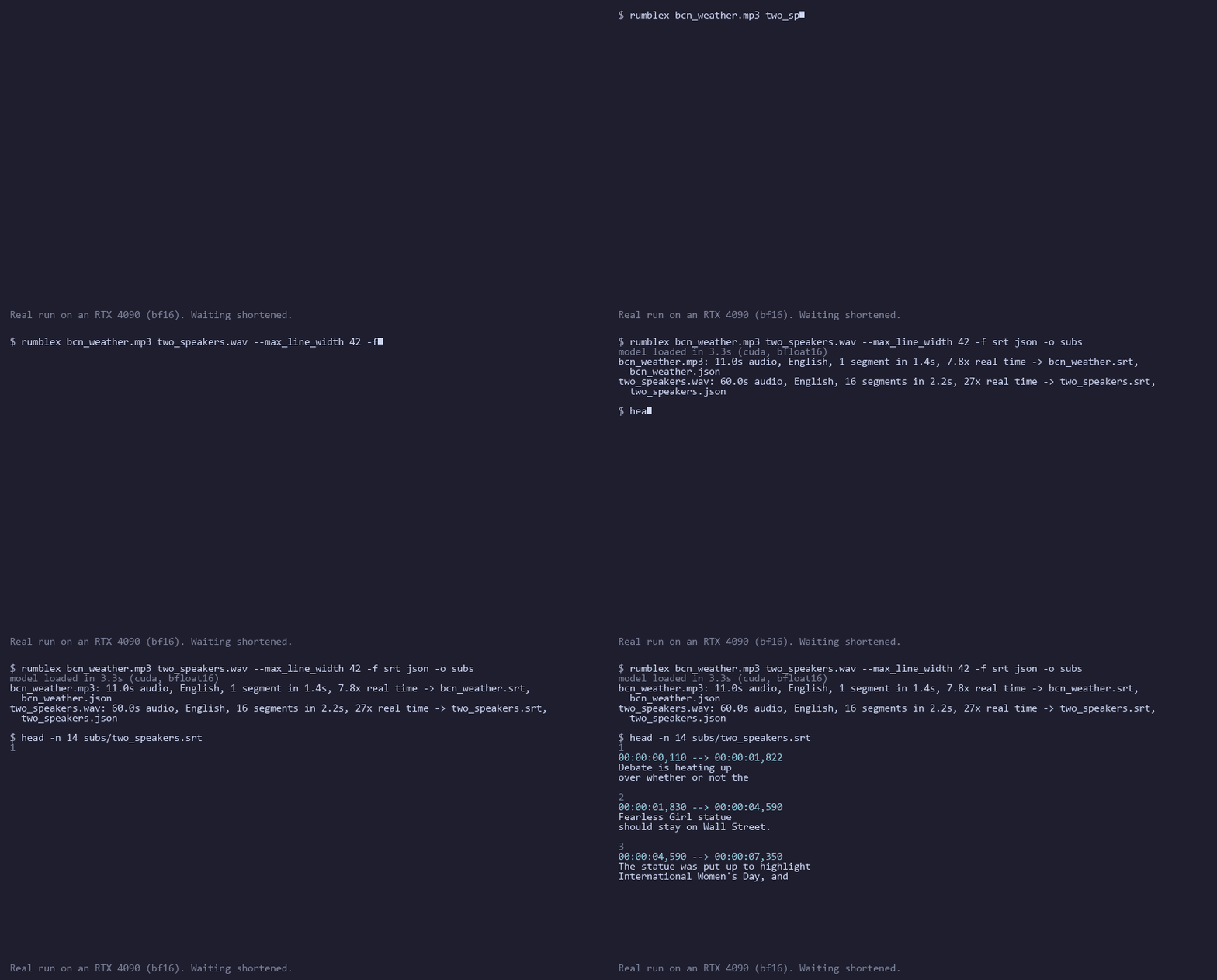
|
+
samples/
|
|
12
|
+
*.wav
|
|
13
|
+
*.mp3
|
|
14
|
+
*.mp4
|
|
15
|
+
|
|
16
|
+
# datasets and cached encoder states
|
|
17
|
+
data/
|
|
18
|
+
|
|
19
|
+
# benchmark and example output
|
|
20
|
+
results/
|
|
21
|
+
logs/
|
|
22
|
+
results.tar.gz
|
|
23
|
+
session.out
|
|
24
|
+
*.bundle
|
|
25
|
+
out/
|
|
26
|
+
subs/
|
|
@@ -0,0 +1,18 @@
|
|
|
1
|
+
# Changelog
|
|
2
|
+
|
|
3
|
+
## 0.1.0 (2026-11-21)
|
|
4
|
+
|
|
5
|
+
First release.
|
|
6
|
+
|
|
7
|
+
- Transcription with Reson8/Rumble-2-Flash: Silero VAD chunking (batched, on the GPU when there is one),
|
|
8
|
+
batched decoding whose output doesn't depend on the batch, and the model's `language`, `prompt`,
|
|
9
|
+
`digits`, `filler` and `verbatim` options.
|
|
10
|
+
- Word timestamps from the model's CTC head, reusing the decoder's encoder pass. Word ends are refined
|
|
11
|
+
on the audio's silences. A proportional fallback keeps a long job going if a chunk fails to align.
|
|
12
|
+
- Optional speaker labels with pyannote, per word.
|
|
13
|
+
- JSON, SRT, VTT (optionally with per-word karaoke tags), TSV and TXT output; subtitle cues split evenly at
|
|
14
|
+
word boundaries.
|
|
15
|
+
- Optional vLLM backend for decoding (`--vllm_url`).
|
|
16
|
+
- `rumblex` command line tool and a Python API (`load_model`, `transcribe`, `write_result`).
|
|
17
|
+
- Benchmarks against WhisperX on LibriSpeech, AMI, Earnings-22 and FLEURS Dutch, with scripts and raw
|
|
18
|
+
results in `docs/`.
|
rumblex-0.1.0/LICENSE
ADDED
|
@@ -0,0 +1,202 @@
|
|
|
1
|
+
|
|
2
|
+
Apache License
|
|
3
|
+
Version 2.0, January 2004
|
|
4
|
+
http://www.apache.org/licenses/
|
|
5
|
+
|
|
6
|
+
TERMS AND CONDITIONS FOR USE, REPRODUCTION, AND DISTRIBUTION
|
|
7
|
+
|
|
8
|
+
1. Definitions.
|
|
9
|
+
|
|
10
|
+
"License" shall mean the terms and conditions for use, reproduction,
|
|
11
|
+
and distribution as defined by Sections 1 through 9 of this document.
|
|
12
|
+
|
|
13
|
+
"Licensor" shall mean the copyright owner or entity authorized by
|
|
14
|
+
the copyright owner that is granting the License.
|
|
15
|
+
|
|
16
|
+
"Legal Entity" shall mean the union of the acting entity and all
|
|
17
|
+
other entities that control, are controlled by, or are under common
|
|
18
|
+
control with that entity. For the purposes of this definition,
|
|
19
|
+
"control" means (i) the power, direct or indirect, to cause the
|
|
20
|
+
direction or management of such entity, whether by contract or
|
|
21
|
+
otherwise, or (ii) ownership of fifty percent (50%) or more of the
|
|
22
|
+
outstanding shares, or (iii) beneficial ownership of such entity.
|
|
23
|
+
|
|
24
|
+
"You" (or "Your") shall mean an individual or Legal Entity
|
|
25
|
+
exercising permissions granted by this License.
|
|
26
|
+
|
|
27
|
+
"Source" form shall mean the preferred form for making modifications,
|
|
28
|
+
including but not limited to software source code, documentation
|
|
29
|
+
source, and configuration files.
|
|
30
|
+
|
|
31
|
+
"Object" form shall mean any form resulting from mechanical
|
|
32
|
+
transformation or translation of a Source form, including but
|
|
33
|
+
not limited to compiled object code, generated documentation,
|
|
34
|
+
and conversions to other media types.
|
|
35
|
+
|
|
36
|
+
"Work" shall mean the work of authorship, whether in Source or
|
|
37
|
+
Object form, made available under the License, as indicated by a
|
|
38
|
+
copyright notice that is included in or attached to the work
|
|
39
|
+
(an example is provided in the Appendix below).
|
|
40
|
+
|
|
41
|
+
"Derivative Works" shall mean any work, whether in Source or Object
|
|
42
|
+
form, that is based on (or derived from) the Work and for which the
|
|
43
|
+
editorial revisions, annotations, elaborations, or other modifications
|
|
44
|
+
represent, as a whole, an original work of authorship. For the purposes
|
|
45
|
+
of this License, Derivative Works shall not include works that remain
|
|
46
|
+
separable from, or merely link (or bind by name) to the interfaces of,
|
|
47
|
+
the Work and Derivative Works thereof.
|
|
48
|
+
|
|
49
|
+
"Contribution" shall mean any work of authorship, including
|
|
50
|
+
the original version of the Work and any modifications or additions
|
|
51
|
+
to that Work or Derivative Works thereof, that is intentionally
|
|
52
|
+
submitted to Licensor for inclusion in the Work by the copyright owner
|
|
53
|
+
or by an individual or Legal Entity authorized to submit on behalf of
|
|
54
|
+
the copyright owner. For the purposes of this definition, "submitted"
|
|
55
|
+
means any form of electronic, verbal, or written communication sent
|
|
56
|
+
to the Licensor or its representatives, including but not limited to
|
|
57
|
+
communication on electronic mailing lists, source code control systems,
|
|
58
|
+
and issue tracking systems that are managed by, or on behalf of, the
|
|
59
|
+
Licensor for the purpose of discussing and improving the Work, but
|
|
60
|
+
excluding communication that is conspicuously marked or otherwise
|
|
61
|
+
designated in writing by the copyright owner as "Not a Contribution."
|
|
62
|
+
|
|
63
|
+
"Contributor" shall mean Licensor and any individual or Legal Entity
|
|
64
|
+
on behalf of whom a Contribution has been received by Licensor and
|
|
65
|
+
subsequently incorporated within the Work.
|
|
66
|
+
|
|
67
|
+
2. Grant of Copyright License. Subject to the terms and conditions of
|
|
68
|
+
this License, each Contributor hereby grants to You a perpetual,
|
|
69
|
+
worldwide, non-exclusive, no-charge, royalty-free, irrevocable
|
|
70
|
+
copyright license to reproduce, prepare Derivative Works of,
|
|
71
|
+
publicly display, publicly perform, sublicense, and distribute the
|
|
72
|
+
Work and such Derivative Works in Source or Object form.
|
|
73
|
+
|
|
74
|
+
3. Grant of Patent License. Subject to the terms and conditions of
|
|
75
|
+
this License, each Contributor hereby grants to You a perpetual,
|
|
76
|
+
worldwide, non-exclusive, no-charge, royalty-free, irrevocable
|
|
77
|
+
(except as stated in this section) patent license to make, have made,
|
|
78
|
+
use, offer to sell, sell, import, and otherwise transfer the Work,
|
|
79
|
+
where such license applies only to those patent claims licensable
|
|
80
|
+
by such Contributor that are necessarily infringed by their
|
|
81
|
+
Contribution(s) alone or by combination of their Contribution(s)
|
|
82
|
+
with the Work to which such Contribution(s) was submitted. If You
|
|
83
|
+
institute patent litigation against any entity (including a
|
|
84
|
+
cross-claim or counterclaim in a lawsuit) alleging that the Work
|
|
85
|
+
or a Contribution incorporated within the Work constitutes direct
|
|
86
|
+
or contributory patent infringement, then any patent licenses
|
|
87
|
+
granted to You under this License for that Work shall terminate
|
|
88
|
+
as of the date such litigation is filed.
|
|
89
|
+
|
|
90
|
+
4. Redistribution. You may reproduce and distribute copies of the
|
|
91
|
+
Work or Derivative Works thereof in any medium, with or without
|
|
92
|
+
modifications, and in Source or Object form, provided that You
|
|
93
|
+
meet the following conditions:
|
|
94
|
+
|
|
95
|
+
(a) You must give any other recipients of the Work or
|
|
96
|
+
Derivative Works a copy of this License; and
|
|
97
|
+
|
|
98
|
+
(b) You must cause any modified files to carry prominent notices
|
|
99
|
+
stating that You changed the files; and
|
|
100
|
+
|
|
101
|
+
(c) You must retain, in the Source form of any Derivative Works
|
|
102
|
+
that You distribute, all copyright, patent, trademark, and
|
|
103
|
+
attribution notices from the Source form of the Work,
|
|
104
|
+
excluding those notices that do not pertain to any part of
|
|
105
|
+
the Derivative Works; and
|
|
106
|
+
|
|
107
|
+
(d) If the Work includes a "NOTICE" text file as part of its
|
|
108
|
+
distribution, then any Derivative Works that You distribute must
|
|
109
|
+
include a readable copy of the attribution notices contained
|
|
110
|
+
within such NOTICE file, excluding those notices that do not
|
|
111
|
+
pertain to any part of the Derivative Works, in at least one
|
|
112
|
+
of the following places: within a NOTICE text file distributed
|
|
113
|
+
as part of the Derivative Works; within the Source form or
|
|
114
|
+
documentation, if provided along with the Derivative Works; or,
|
|
115
|
+
within a display generated by the Derivative Works, if and
|
|
116
|
+
wherever such third-party notices normally appear. The contents
|
|
117
|
+
of the NOTICE file are for informational purposes only and
|
|
118
|
+
do not modify the License. You may add Your own attribution
|
|
119
|
+
notices within Derivative Works that You distribute, alongside
|
|
120
|
+
or as an addendum to the NOTICE text from the Work, provided
|
|
121
|
+
that such additional attribution notices cannot be construed
|
|
122
|
+
as modifying the License.
|
|
123
|
+
|
|
124
|
+
You may add Your own copyright statement to Your modifications and
|
|
125
|
+
may provide additional or different license terms and conditions
|
|
126
|
+
for use, reproduction, or distribution of Your modifications, or
|
|
127
|
+
for any such Derivative Works as a whole, provided Your use,
|
|
128
|
+
reproduction, and distribution of the Work otherwise complies with
|
|
129
|
+
the conditions stated in this License.
|
|
130
|
+
|
|
131
|
+
5. Submission of Contributions. Unless You explicitly state otherwise,
|
|
132
|
+
any Contribution intentionally submitted for inclusion in the Work
|
|
133
|
+
by You to the Licensor shall be under the terms and conditions of
|
|
134
|
+
this License, without any additional terms or conditions.
|
|
135
|
+
Notwithstanding the above, nothing herein shall supersede or modify
|
|
136
|
+
the terms of any separate license agreement you may have executed
|
|
137
|
+
with Licensor regarding such Contributions.
|
|
138
|
+
|
|
139
|
+
6. Trademarks. This License does not grant permission to use the trade
|
|
140
|
+
names, trademarks, service marks, or product names of the Licensor,
|
|
141
|
+
except as required for reasonable and customary use in describing the
|
|
142
|
+
origin of the Work and reproducing the content of the NOTICE file.
|
|
143
|
+
|
|
144
|
+
7. Disclaimer of Warranty. Unless required by applicable law or
|
|
145
|
+
agreed to in writing, Licensor provides the Work (and each
|
|
146
|
+
Contributor provides its Contributions) on an "AS IS" BASIS,
|
|
147
|
+
WITHOUT WARRANTIES OR CONDITIONS OF ANY KIND, either express or
|
|
148
|
+
implied, including, without limitation, any warranties or conditions
|
|
149
|
+
of TITLE, NON-INFRINGEMENT, MERCHANTABILITY, or FITNESS FOR A
|
|
150
|
+
PARTICULAR PURPOSE. You are solely responsible for determining the
|
|
151
|
+
appropriateness of using or redistributing the Work and assume any
|
|
152
|
+
risks associated with Your exercise of permissions under this License.
|
|
153
|
+
|
|
154
|
+
8. Limitation of Liability. In no event and under no legal theory,
|
|
155
|
+
whether in tort (including negligence), contract, or otherwise,
|
|
156
|
+
unless required by applicable law (such as deliberate and grossly
|
|
157
|
+
negligent acts) or agreed to in writing, shall any Contributor be
|
|
158
|
+
liable to You for damages, including any direct, indirect, special,
|
|
159
|
+
incidental, or consequential damages of any character arising as a
|
|
160
|
+
result of this License or out of the use or inability to use the
|
|
161
|
+
Work (including but not limited to damages for loss of goodwill,
|
|
162
|
+
work stoppage, computer failure or malfunction, or any and all
|
|
163
|
+
other commercial damages or losses), even if such Contributor
|
|
164
|
+
has been advised of the possibility of such damages.
|
|
165
|
+
|
|
166
|
+
9. Accepting Warranty or Additional Liability. While redistributing
|
|
167
|
+
the Work or Derivative Works thereof, You may choose to offer,
|
|
168
|
+
and charge a fee for, acceptance of support, warranty, indemnity,
|
|
169
|
+
or other liability obligations and/or rights consistent with this
|
|
170
|
+
License. However, in accepting such obligations, You may act only
|
|
171
|
+
on Your own behalf and on Your sole responsibility, not on behalf
|
|
172
|
+
of any other Contributor, and only if You agree to indemnify,
|
|
173
|
+
defend, and hold each Contributor harmless for any liability
|
|
174
|
+
incurred by, or claims asserted against, such Contributor by reason
|
|
175
|
+
of your accepting any such warranty or additional liability.
|
|
176
|
+
|
|
177
|
+
END OF TERMS AND CONDITIONS
|
|
178
|
+
|
|
179
|
+
APPENDIX: How to apply the Apache License to your work.
|
|
180
|
+
|
|
181
|
+
To apply the Apache License to your work, attach the following
|
|
182
|
+
boilerplate notice, with the fields enclosed by brackets "[]"
|
|
183
|
+
replaced with your own identifying information. (Don't include
|
|
184
|
+
the brackets!) The text should be enclosed in the appropriate
|
|
185
|
+
comment syntax for the file format. We also recommend that a
|
|
186
|
+
file or class name and description of purpose be included on the
|
|
187
|
+
same "printed page" as the copyright notice for easier
|
|
188
|
+
identification within third-party archives.
|
|
189
|
+
|
|
190
|
+
Copyright [yyyy] [name of copyright owner]
|
|
191
|
+
|
|
192
|
+
Licensed under the Apache License, Version 2.0 (the "License");
|
|
193
|
+
you may not use this file except in compliance with the License.
|
|
194
|
+
You may obtain a copy of the License at
|
|
195
|
+
|
|
196
|
+
http://www.apache.org/licenses/LICENSE-2.0
|
|
197
|
+
|
|
198
|
+
Unless required by applicable law or agreed to in writing, software
|
|
199
|
+
distributed under the License is distributed on an "AS IS" BASIS,
|
|
200
|
+
WITHOUT WARRANTIES OR CONDITIONS OF ANY KIND, either express or implied.
|
|
201
|
+
See the License for the specific language governing permissions and
|
|
202
|
+
limitations under the License.
|
rumblex-0.1.0/PKG-INFO
ADDED
|
@@ -0,0 +1,230 @@
|
|
|
1
|
+
Metadata-Version: 2.5
|
|
2
|
+
Name: rumblex
|
|
3
|
+
Version: 0.1.0
|
|
4
|
+
Summary: Transcription with word timestamps, speaker labels and subtitles on Reson8/Rumble-2-Flash
|
|
5
|
+
Project-URL: Homepage, https://github.com/EdwardGlockner/rumblex
|
|
6
|
+
Project-URL: Source, https://github.com/EdwardGlockner/rumblex
|
|
7
|
+
Project-URL: Issues, https://github.com/EdwardGlockner/rumblex/issues
|
|
8
|
+
Project-URL: Changelog, https://github.com/EdwardGlockner/rumblex/blob/main/CHANGELOG.md
|
|
9
|
+
Author: Edward Glockner
|
|
10
|
+
License-Expression: Apache-2.0
|
|
11
|
+
License-File: LICENSE
|
|
12
|
+
Keywords: asr,ctc,diarization,forced alignment,rumble-2-flash,speech recognition,srt,subtitles,transcription,vtt,whisperx,word timestamps
|
|
13
|
+
Classifier: Development Status :: 3 - Alpha
|
|
14
|
+
Classifier: Intended Audience :: Developers
|
|
15
|
+
Classifier: Intended Audience :: Science/Research
|
|
16
|
+
Classifier: Operating System :: OS Independent
|
|
17
|
+
Classifier: Programming Language :: Python :: 3
|
|
18
|
+
Classifier: Programming Language :: Python :: 3.11
|
|
19
|
+
Classifier: Programming Language :: Python :: 3.12
|
|
20
|
+
Classifier: Topic :: Multimedia :: Sound/Audio :: Speech
|
|
21
|
+
Classifier: Topic :: Scientific/Engineering :: Artificial Intelligence
|
|
22
|
+
Requires-Python: >=3.11
|
|
23
|
+
Requires-Dist: huggingface-hub
|
|
24
|
+
Requires-Dist: numpy
|
|
25
|
+
Requires-Dist: rich
|
|
26
|
+
Requires-Dist: safetensors
|
|
27
|
+
Requires-Dist: silero-vad>=6.2.3
|
|
28
|
+
Requires-Dist: soundfile
|
|
29
|
+
Requires-Dist: torch>=2.6
|
|
30
|
+
Requires-Dist: torchaudio>=2.6
|
|
31
|
+
Requires-Dist: transformers>=5.21
|
|
32
|
+
Provides-Extra: dev
|
|
33
|
+
Requires-Dist: jiwer; extra == 'dev'
|
|
34
|
+
Requires-Dist: pyarrow; extra == 'dev'
|
|
35
|
+
Requires-Dist: pytest; extra == 'dev'
|
|
36
|
+
Requires-Dist: ruff==0.17.6; extra == 'dev'
|
|
37
|
+
Requires-Dist: whisper-normalizer; extra == 'dev'
|
|
38
|
+
Provides-Extra: diarize
|
|
39
|
+
Requires-Dist: pyannote-audio<5,>=4.1; extra == 'diarize'
|
|
40
|
+
Provides-Extra: vllm
|
|
41
|
+
Requires-Dist: openai; extra == 'vllm'
|
|
42
|
+
Description-Content-Type: text/markdown
|
|
43
|
+
|
|
44
|
+
# rumblex
|
|
45
|
+
|
|
46
|
+
Transcription with word-level timestamps, speaker labels and subtitles, built on
|
|
47
|
+
[Reson8/Rumble-2-Flash](https://huggingface.co/Reson8/Rumble-2-Flash).
|
|
48
|
+
|
|
49
|
+
Rumble-2-Flash ships an auxiliary CTC head next to its decoder. rumblex uses it for word timestamps:
|
|
50
|
+
the decoder writes the text, and the CTC head force-aligns that text to the audio. It reuses the
|
|
51
|
+
encoder pass the decoder already ran, so alignment costs one linear layer plus a Viterbi search, not
|
|
52
|
+
a second model.
|
|
53
|
+
|
|
54
|
+
Rumble-2-Flash is a 0.5B-parameter speech recognition model fine-tuned from Qwen3-ASR-0.6B. Its
|
|
55
|
+
[model card](https://huggingface.co/Reson8/Rumble-2-Flash) lists 45 languages; the benchmarks here cover
|
|
56
|
+
English and Dutch.
|
|
57
|
+
|
|
58
|
+
|
|
59
|
+
|
|
60
|
+
> rumblex is an independent project and is not affiliated with Reson8.
|
|
61
|
+
|
|
62
|
+
## Features
|
|
63
|
+
|
|
64
|
+
- Reads anything ffmpeg can (wav, mp3, m4a, mp4, mkv, ...). Long recordings are split into speech
|
|
65
|
+
chunks with Silero VAD.
|
|
66
|
+
- Batched transcription. A chunk's output doesn't depend on what it is batched with. The model's
|
|
67
|
+
`language`, `prompt` (context / hotwords), `digits`, `filler` and `verbatim` options are exposed.
|
|
68
|
+
- Word timestamps from the CTC head. If alignment fails on a chunk, its words get proportional times
|
|
69
|
+
instead, so a long job doesn't stop.
|
|
70
|
+
- Optional speaker labels via pyannote, per word. Segments are split where the speaker changes.
|
|
71
|
+
- Writes JSON, SRT, VTT (optionally with per-word karaoke tags), TSV and TXT.
|
|
72
|
+
|
|
73
|
+
## Install
|
|
74
|
+
|
|
75
|
+
```bash
|
|
76
|
+
pip install rumblex
|
|
77
|
+
pip install "rumblex[diarize]" # with speaker labels (pyannote)
|
|
78
|
+
```
|
|
79
|
+
|
|
80
|
+
You also need Python 3.11 or 3.12 and ffmpeg on `PATH`. pip takes PyTorch from PyPI, which is a CPU-only build
|
|
81
|
+
on Windows. For a GPU on Windows, or for an older GPU, install torch and torchaudio for your CUDA version
|
|
82
|
+
from [pytorch.org](https://pytorch.org/get-started/locally/) first. GPUs from Ampere on run in bf16,
|
|
83
|
+
older ones (e.g. Pascal) in float32. A GPU is strongly recommended; the model runs on a 6 GB GTX 1060 in
|
|
84
|
+
float32 at the default batch size of 8. CPU works but is slow.
|
|
85
|
+
|
|
86
|
+
From source:
|
|
87
|
+
|
|
88
|
+
```bash
|
|
89
|
+
git clone https://github.com/EdwardGlockner/rumblex && cd rumblex
|
|
90
|
+
uv sync # PyTorch's CUDA 12.6 builds, which still support Pascal
|
|
91
|
+
uv sync --extra diarize
|
|
92
|
+
```
|
|
93
|
+
|
|
94
|
+
The lock file pins PyTorch's CUDA 12.6 wheels on Linux and Windows and PyPI's build on macOS. For RTX
|
|
95
|
+
50-series GPUs (which need CUDA 12.8+), install torch yourself and use `pip install -e .` instead.
|
|
96
|
+
|
|
97
|
+
## Use
|
|
98
|
+
|
|
99
|
+
```bash
|
|
100
|
+
rumblex meeting.mp4 # all formats into the current folder
|
|
101
|
+
rumblex talk.wav -f srt vtt --max_line_width 42 # subtitles with cues split at 42 chars
|
|
102
|
+
rumblex interview.m4a --language Dutch --diarize -f srt txt
|
|
103
|
+
rumblex call.wav --prompt "Kubernetes, metoprolol" # context / hotwords for the model
|
|
104
|
+
```
|
|
105
|
+
|
|
106
|
+
```python
|
|
107
|
+
import rumblex
|
|
108
|
+
|
|
109
|
+
model = rumblex.load_model() # Reson8/Rumble-2-Flash, GPU if available
|
|
110
|
+
result = rumblex.transcribe("meeting.mp4", model) # segments with word timestamps
|
|
111
|
+
for seg in result.segments:
|
|
112
|
+
print(seg.start, seg.end, seg.text)
|
|
113
|
+
rumblex.write_result(result, "meeting.mp4", "out/", ["srt", "json"])
|
|
114
|
+
```
|
|
115
|
+
|
|
116
|
+
More in [examples/quickstart.py](https://github.com/EdwardGlockner/rumblex/blob/main/examples/quickstart.py) and
|
|
117
|
+
[examples/batch_subtitles.py](https://github.com/EdwardGlockner/rumblex/blob/main/examples/batch_subtitles.py), which writes subtitles for a folder of files.
|
|
118
|
+
|
|
119
|
+
### Faster decoding with vLLM
|
|
120
|
+
|
|
121
|
+
On Linux with a recent NVIDIA GPU, decoding can run on a [vLLM](https://github.com/vllm-project/vllm)
|
|
122
|
+
server. `pip install "rumblex[vllm]"` adds the client; vLLM itself goes wherever the server runs:
|
|
123
|
+
|
|
124
|
+
```bash
|
|
125
|
+
vllm serve Reson8/Rumble-2-Flash --max-model-len 4096 --gpu-memory-utilization 0.5
|
|
126
|
+
rumblex meeting.mp4 --vllm_url http://localhost:8000/v1
|
|
127
|
+
```
|
|
128
|
+
|
|
129
|
+
Word timestamps still come from a local pass of the audio encoder, so leave GPU memory for it. On our
|
|
130
|
+
LibriSpeech run this was 601× real time against 467× without vLLM, with the same WER and timing error
|
|
131
|
+
([docs/bench_2026-11-20_rtx4090_release](https://github.com/EdwardGlockner/rumblex/blob/main/docs/bench_2026-11-20_rtx4090_release/README.md)).
|
|
132
|
+
|
|
133
|
+
### Speaker labels
|
|
134
|
+
|
|
135
|
+
The pyannote models are gated. Accept the conditions on
|
|
136
|
+
[pyannote/speaker-diarization-community-1](https://huggingface.co/pyannote/speaker-diarization-community-1),
|
|
137
|
+
then run `hf auth login`. pyannote.audio 4 sends usage telemetry by default. rumblex turns it off
|
|
138
|
+
unless you set `PYANNOTE_METRICS_ENABLED=true` yourself.
|
|
139
|
+
|
|
140
|
+
## Compared with WhisperX
|
|
141
|
+
|
|
142
|
+
Both systems ran on the same audio on one rented RTX 4090, in one session, with the code released as
|
|
143
|
+
0.1.0: rumblex in bf16 at batch 32 (the default is 8), and WhisperX 3.8.6 with `large-v3` in float16 at
|
|
144
|
+
batch 16 with its default wav2vec2 aligners (large-v3-turbo was not measured). The language was given to
|
|
145
|
+
both. For the English sets rumblex ran with `--no_digits`, since their references spell numbers out.
|
|
146
|
+
WER uses Whisper's normalizers. Speed is one long file per dataset (20–60 min) made from that dataset's
|
|
147
|
+
audio, timed from decoded audio to aligned words with the models already loaded. Raw results, settings
|
|
148
|
+
and caveats:
|
|
149
|
+
[docs/bench_2026-11-20_rtx4090_release](https://github.com/EdwardGlockner/rumblex/blob/main/docs/bench_2026-11-20_rtx4090_release/README.md).
|
|
150
|
+
|
|
151
|
+
| dataset | rumblex WER | WhisperX WER | rumblex speed | WhisperX speed |
|
|
152
|
+
|---|---|---|---|---|
|
|
153
|
+
| AMI meetings (500 utt.) | 10.9% | 17.2% | 329× real time | 104× |
|
|
154
|
+
| Earnings-22 calls (500 utt.) | 9.3% | 10.6% | 430× | 102× |
|
|
155
|
+
| LibriSpeech test-clean (200 utt.) | 2.2% | 1.6% | 467× (601× with vLLM) | 92× |
|
|
156
|
+
| FLEURS Dutch (364 utt.) | 9.2% | 7.0% | 380× | 79× |
|
|
157
|
+
|
|
158
|
+
rumblex was 3–5× faster on every set. Over 40% of WhisperX's time goes to its alignment step (7–17 s
|
|
159
|
+
per file); rumblex's alignment reuses the encoder pass and took 0.3–0.9 s. rumblex had the lower WER on
|
|
160
|
+
meetings and earnings calls, WhisperX on clean read speech and on Dutch. Most of rumblex's lead on AMI
|
|
161
|
+
and Earnings-22 is fewer deleted words (177 vs 353 and 231 vs 427). rumblex passes clips of up to 20 s
|
|
162
|
+
to the model whole, while WhisperX runs its VAD on every clip, so on long recordings, where both use a
|
|
163
|
+
VAD, the gap may be smaller. These are samples of a few hundred utterances per set, and speeds also
|
|
164
|
+
depend on the host CPU.
|
|
165
|
+
|
|
166
|
+
The [model card](https://huggingface.co/Reson8/Rumble-2-Flash) reports 6.05% on FLEURS Dutch under the
|
|
167
|
+
Open ASR Leaderboard's scoring, which we did not reproduce. An earlier diagnostic run (vLLM vs
|
|
168
|
+
transformers, bf16 vs float32, with and without VAD) gave 9.2–9.6% every time, so none of those pipeline
|
|
169
|
+
choices explains the gap. Part of it is that FLEURS mixes digits and spelled-out numbers in its
|
|
170
|
+
references ([docs/bench_2026-11-20_rtx4090_diagnose](https://github.com/EdwardGlockner/rumblex/blob/main/docs/bench_2026-11-20_rtx4090_diagnose/README.md)).
|
|
171
|
+
|
|
172
|
+
### Timestamp accuracy
|
|
173
|
+
|
|
174
|
+
Measured on the 200 LibriSpeech utterances in the same run, against Montreal Forced Aligner reference
|
|
175
|
+
alignments. The settings were chosen on `dev_clean` ([docs/alignment_eval.md](https://github.com/EdwardGlockner/rumblex/blob/main/docs/alignment_eval.md)).
|
|
176
|
+
|
|
177
|
+
| mean absolute error | rumblex | WhisperX |
|
|
178
|
+
|---|---|---|
|
|
179
|
+
| word start | 58 ms | 75 ms |
|
|
180
|
+
| word end | 57 ms | 34 ms |
|
|
181
|
+
|
|
182
|
+
The Rumble encoder produces 13 frames per second (80 ms apart within each second), while WhisperX's
|
|
183
|
+
aligner works at 20 ms, and that shows in the word ends. rumblex moves a word's end back to where the
|
|
184
|
+
audio goes quiet, which brought its end error down from 75 to 57 ms in development. The reference is
|
|
185
|
+
another forced aligner, not human labels.
|
|
186
|
+
|
|
187
|
+
## How it works
|
|
188
|
+
|
|
189
|
+
1. ffmpeg decodes the audio to 16 kHz mono.
|
|
190
|
+
2. Silero VAD finds the speech, running over many stretches of the file at once (on the GPU if there
|
|
191
|
+
is one). Speech is packed into chunks of up to 20 s. Pauses under 0.5 s don't split speech unless a
|
|
192
|
+
chunk would run past 20 s, and pauses over 2 s never end up inside a chunk. Audio of 20 s or less
|
|
193
|
+
skips VAD and goes in whole.
|
|
194
|
+
3. Rumble-2-Flash transcribes the chunks in batches. A hook keeps the encoder's `ln_post` states
|
|
195
|
+
(13 frames/s).
|
|
196
|
+
4. The CTC head and a Viterbi search align the decoder's own tokens to those states. Tokens are grouped
|
|
197
|
+
into words at the leading-space marker. A word ends where the next one starts, or earlier if the
|
|
198
|
+
audio goes quiet before that.
|
|
199
|
+
5. Optionally, pyannote labels speakers and each word takes the speaker it overlaps most.
|
|
200
|
+
6. The writers produce JSON, SRT, VTT, TSV and TXT.
|
|
201
|
+
|
|
202
|
+
Model details measured for this project: [docs/model_inspection.md](https://github.com/EdwardGlockner/rumblex/blob/main/docs/model_inspection.md).
|
|
203
|
+
|
|
204
|
+
## Limitations
|
|
205
|
+
|
|
206
|
+
- Word timing resolution is limited by the encoder's frame rate (13 per second). Word ends in particular
|
|
207
|
+
are less precise than WhisperX's 20 ms aligner (57 vs 34 ms mean error on LibriSpeech).
|
|
208
|
+
- Each chunk is decoded on its own, so a sentence that runs across a chunk boundary in long audio can be
|
|
209
|
+
broken there, sometimes with a capital letter mid-sentence.
|
|
210
|
+
- Words are split at spaces, so languages written without spaces (Chinese, Japanese) get one "word" per
|
|
211
|
+
chunk.
|
|
212
|
+
- On clean read English and on FLEURS Dutch, WhisperX large-v3 had the lower WER in our runs. Only
|
|
213
|
+
English and Dutch have been measured.
|
|
214
|
+
- Speaker labels need the `[diarize]` extra and access to pyannote's gated models.
|
|
215
|
+
- The vLLM backend needs Linux and a GPU vLLM supports.
|
|
216
|
+
|
|
217
|
+
## Development
|
|
218
|
+
|
|
219
|
+
```bash
|
|
220
|
+
uv sync --extra dev
|
|
221
|
+
uv run pytest
|
|
222
|
+
uv run ruff check . && uv run ruff format --check .
|
|
223
|
+
```
|
|
224
|
+
|
|
225
|
+
Benchmarks and research scripts: [scripts/README.md](https://github.com/EdwardGlockner/rumblex/blob/main/scripts/README.md). Every measured number in this
|
|
226
|
+
README links to its raw results; the full list is in [docs/README.md](https://github.com/EdwardGlockner/rumblex/blob/main/docs/README.md).
|
|
227
|
+
|
|
228
|
+
## License
|
|
229
|
+
|
|
230
|
+
Apache-2.0. Rumble-2-Flash is Apache-2.0 as well. The pyannote models have their own terms.
|
rumblex-0.1.0/README.md
ADDED
|
@@ -0,0 +1,187 @@
|
|
|
1
|
+
# rumblex
|
|
2
|
+
|
|
3
|
+
Transcription with word-level timestamps, speaker labels and subtitles, built on
|
|
4
|
+
[Reson8/Rumble-2-Flash](https://huggingface.co/Reson8/Rumble-2-Flash).
|
|
5
|
+
|
|
6
|
+
Rumble-2-Flash ships an auxiliary CTC head next to its decoder. rumblex uses it for word timestamps:
|
|
7
|
+
the decoder writes the text, and the CTC head force-aligns that text to the audio. It reuses the
|
|
8
|
+
encoder pass the decoder already ran, so alignment costs one linear layer plus a Viterbi search, not
|
|
9
|
+
a second model.
|
|
10
|
+
|
|
11
|
+
Rumble-2-Flash is a 0.5B-parameter speech recognition model fine-tuned from Qwen3-ASR-0.6B. Its
|
|
12
|
+
[model card](https://huggingface.co/Reson8/Rumble-2-Flash) lists 45 languages; the benchmarks here cover
|
|
13
|
+
English and Dutch.
|
|
14
|
+
|
|
15
|
+

|
|
16
|
+
|
|
17
|
+
> rumblex is an independent project and is not affiliated with Reson8.
|
|
18
|
+
|
|
19
|
+
## Features
|
|
20
|
+
|
|
21
|
+
- Reads anything ffmpeg can (wav, mp3, m4a, mp4, mkv, ...). Long recordings are split into speech
|
|
22
|
+
chunks with Silero VAD.
|
|
23
|
+
- Batched transcription. A chunk's output doesn't depend on what it is batched with. The model's
|
|
24
|
+
`language`, `prompt` (context / hotwords), `digits`, `filler` and `verbatim` options are exposed.
|
|
25
|
+
- Word timestamps from the CTC head. If alignment fails on a chunk, its words get proportional times
|
|
26
|
+
instead, so a long job doesn't stop.
|
|
27
|
+
- Optional speaker labels via pyannote, per word. Segments are split where the speaker changes.
|
|
28
|
+
- Writes JSON, SRT, VTT (optionally with per-word karaoke tags), TSV and TXT.
|
|
29
|
+
|
|
30
|
+
## Install
|
|
31
|
+
|
|
32
|
+
```bash
|
|
33
|
+
pip install rumblex
|
|
34
|
+
pip install "rumblex[diarize]" # with speaker labels (pyannote)
|
|
35
|
+
```
|
|
36
|
+
|
|
37
|
+
You also need Python 3.11 or 3.12 and ffmpeg on `PATH`. pip takes PyTorch from PyPI, which is a CPU-only build
|
|
38
|
+
on Windows. For a GPU on Windows, or for an older GPU, install torch and torchaudio for your CUDA version
|
|
39
|
+
from [pytorch.org](https://pytorch.org/get-started/locally/) first. GPUs from Ampere on run in bf16,
|
|
40
|
+
older ones (e.g. Pascal) in float32. A GPU is strongly recommended; the model runs on a 6 GB GTX 1060 in
|
|
41
|
+
float32 at the default batch size of 8. CPU works but is slow.
|
|
42
|
+
|
|
43
|
+
From source:
|
|
44
|
+
|
|
45
|
+
```bash
|
|
46
|
+
git clone https://github.com/EdwardGlockner/rumblex && cd rumblex
|
|
47
|
+
uv sync # PyTorch's CUDA 12.6 builds, which still support Pascal
|
|
48
|
+
uv sync --extra diarize
|
|
49
|
+
```
|
|
50
|
+
|
|
51
|
+
The lock file pins PyTorch's CUDA 12.6 wheels on Linux and Windows and PyPI's build on macOS. For RTX
|
|
52
|
+
50-series GPUs (which need CUDA 12.8+), install torch yourself and use `pip install -e .` instead.
|
|
53
|
+
|
|
54
|
+
## Use
|
|
55
|
+
|
|
56
|
+
```bash
|
|
57
|
+
rumblex meeting.mp4 # all formats into the current folder
|
|
58
|
+
rumblex talk.wav -f srt vtt --max_line_width 42 # subtitles with cues split at 42 chars
|
|
59
|
+
rumblex interview.m4a --language Dutch --diarize -f srt txt
|
|
60
|
+
rumblex call.wav --prompt "Kubernetes, metoprolol" # context / hotwords for the model
|
|
61
|
+
```
|
|
62
|
+
|
|
63
|
+
```python
|
|
64
|
+
import rumblex
|
|
65
|
+
|
|
66
|
+
model = rumblex.load_model() # Reson8/Rumble-2-Flash, GPU if available
|
|
67
|
+
result = rumblex.transcribe("meeting.mp4", model) # segments with word timestamps
|
|
68
|
+
for seg in result.segments:
|
|
69
|
+
print(seg.start, seg.end, seg.text)
|
|
70
|
+
rumblex.write_result(result, "meeting.mp4", "out/", ["srt", "json"])
|
|
71
|
+
```
|
|
72
|
+
|
|
73
|
+
More in [examples/quickstart.py](examples/quickstart.py) and
|
|
74
|
+
[examples/batch_subtitles.py](examples/batch_subtitles.py), which writes subtitles for a folder of files.
|
|
75
|
+
|
|
76
|
+
### Faster decoding with vLLM
|
|
77
|
+
|
|
78
|
+
On Linux with a recent NVIDIA GPU, decoding can run on a [vLLM](https://github.com/vllm-project/vllm)
|
|
79
|
+
server. `pip install "rumblex[vllm]"` adds the client; vLLM itself goes wherever the server runs:
|
|
80
|
+
|
|
81
|
+
```bash
|
|
82
|
+
vllm serve Reson8/Rumble-2-Flash --max-model-len 4096 --gpu-memory-utilization 0.5
|
|
83
|
+
rumblex meeting.mp4 --vllm_url http://localhost:8000/v1
|
|
84
|
+
```
|
|
85
|
+
|
|
86
|
+
Word timestamps still come from a local pass of the audio encoder, so leave GPU memory for it. On our
|
|
87
|
+
LibriSpeech run this was 601× real time against 467× without vLLM, with the same WER and timing error
|
|
88
|
+
([docs/bench_2026-11-20_rtx4090_release](docs/bench_2026-11-20_rtx4090_release/README.md)).
|
|
89
|
+
|
|
90
|
+
### Speaker labels
|
|
91
|
+
|
|
92
|
+
The pyannote models are gated. Accept the conditions on
|
|
93
|
+
[pyannote/speaker-diarization-community-1](https://huggingface.co/pyannote/speaker-diarization-community-1),
|
|
94
|
+
then run `hf auth login`. pyannote.audio 4 sends usage telemetry by default. rumblex turns it off
|
|
95
|
+
unless you set `PYANNOTE_METRICS_ENABLED=true` yourself.
|
|
96
|
+
|
|
97
|
+
## Compared with WhisperX
|
|
98
|
+
|
|
99
|
+
Both systems ran on the same audio on one rented RTX 4090, in one session, with the code released as
|
|
100
|
+
0.1.0: rumblex in bf16 at batch 32 (the default is 8), and WhisperX 3.8.6 with `large-v3` in float16 at
|
|
101
|
+
batch 16 with its default wav2vec2 aligners (large-v3-turbo was not measured). The language was given to
|
|
102
|
+
both. For the English sets rumblex ran with `--no_digits`, since their references spell numbers out.
|
|
103
|
+
WER uses Whisper's normalizers. Speed is one long file per dataset (20–60 min) made from that dataset's
|
|
104
|
+
audio, timed from decoded audio to aligned words with the models already loaded. Raw results, settings
|
|
105
|
+
and caveats:
|
|
106
|
+
[docs/bench_2026-11-20_rtx4090_release](docs/bench_2026-11-20_rtx4090_release/README.md).
|
|
107
|
+
|
|
108
|
+
| dataset | rumblex WER | WhisperX WER | rumblex speed | WhisperX speed |
|
|
109
|
+
|---|---|---|---|---|
|
|
110
|
+
| AMI meetings (500 utt.) | 10.9% | 17.2% | 329× real time | 104× |
|
|
111
|
+
| Earnings-22 calls (500 utt.) | 9.3% | 10.6% | 430× | 102× |
|
|
112
|
+
| LibriSpeech test-clean (200 utt.) | 2.2% | 1.6% | 467× (601× with vLLM) | 92× |
|
|
113
|
+
| FLEURS Dutch (364 utt.) | 9.2% | 7.0% | 380× | 79× |
|
|
114
|
+
|
|
115
|
+
rumblex was 3–5× faster on every set. Over 40% of WhisperX's time goes to its alignment step (7–17 s
|
|
116
|
+
per file); rumblex's alignment reuses the encoder pass and took 0.3–0.9 s. rumblex had the lower WER on
|
|
117
|
+
meetings and earnings calls, WhisperX on clean read speech and on Dutch. Most of rumblex's lead on AMI
|
|
118
|
+
and Earnings-22 is fewer deleted words (177 vs 353 and 231 vs 427). rumblex passes clips of up to 20 s
|
|
119
|
+
to the model whole, while WhisperX runs its VAD on every clip, so on long recordings, where both use a
|
|
120
|
+
VAD, the gap may be smaller. These are samples of a few hundred utterances per set, and speeds also
|
|
121
|
+
depend on the host CPU.
|
|
122
|
+
|
|
123
|
+
The [model card](https://huggingface.co/Reson8/Rumble-2-Flash) reports 6.05% on FLEURS Dutch under the
|
|
124
|
+
Open ASR Leaderboard's scoring, which we did not reproduce. An earlier diagnostic run (vLLM vs
|
|
125
|
+
transformers, bf16 vs float32, with and without VAD) gave 9.2–9.6% every time, so none of those pipeline
|
|
126
|
+
choices explains the gap. Part of it is that FLEURS mixes digits and spelled-out numbers in its
|
|
127
|
+
references ([docs/bench_2026-11-20_rtx4090_diagnose](docs/bench_2026-11-20_rtx4090_diagnose/README.md)).
|
|
128
|
+
|
|
129
|
+
### Timestamp accuracy
|
|
130
|
+
|
|
131
|
+
Measured on the 200 LibriSpeech utterances in the same run, against Montreal Forced Aligner reference
|
|
132
|
+
alignments. The settings were chosen on `dev_clean` ([docs/alignment_eval.md](docs/alignment_eval.md)).
|
|
133
|
+
|
|
134
|
+
| mean absolute error | rumblex | WhisperX |
|
|
135
|
+
|---|---|---|
|
|
136
|
+
| word start | 58 ms | 75 ms |
|
|
137
|
+
| word end | 57 ms | 34 ms |
|
|
138
|
+
|
|
139
|
+
The Rumble encoder produces 13 frames per second (80 ms apart within each second), while WhisperX's
|
|
140
|
+
aligner works at 20 ms, and that shows in the word ends. rumblex moves a word's end back to where the
|
|
141
|
+
audio goes quiet, which brought its end error down from 75 to 57 ms in development. The reference is
|
|
142
|
+
another forced aligner, not human labels.
|
|
143
|
+
|
|
144
|
+
## How it works
|
|
145
|
+
|
|
146
|
+
1. ffmpeg decodes the audio to 16 kHz mono.
|
|
147
|
+
2. Silero VAD finds the speech, running over many stretches of the file at once (on the GPU if there
|
|
148
|
+
is one). Speech is packed into chunks of up to 20 s. Pauses under 0.5 s don't split speech unless a
|
|
149
|
+
chunk would run past 20 s, and pauses over 2 s never end up inside a chunk. Audio of 20 s or less
|
|
150
|
+
skips VAD and goes in whole.
|
|
151
|
+
3. Rumble-2-Flash transcribes the chunks in batches. A hook keeps the encoder's `ln_post` states
|
|
152
|
+
(13 frames/s).
|
|
153
|
+
4. The CTC head and a Viterbi search align the decoder's own tokens to those states. Tokens are grouped
|
|
154
|
+
into words at the leading-space marker. A word ends where the next one starts, or earlier if the
|
|
155
|
+
audio goes quiet before that.
|
|
156
|
+
5. Optionally, pyannote labels speakers and each word takes the speaker it overlaps most.
|
|
157
|
+
6. The writers produce JSON, SRT, VTT, TSV and TXT.
|
|
158
|
+
|
|
159
|
+
Model details measured for this project: [docs/model_inspection.md](docs/model_inspection.md).
|
|
160
|
+
|
|
161
|
+
## Limitations
|
|
162
|
+
|
|
163
|
+
- Word timing resolution is limited by the encoder's frame rate (13 per second). Word ends in particular
|
|
164
|
+
are less precise than WhisperX's 20 ms aligner (57 vs 34 ms mean error on LibriSpeech).
|
|
165
|
+
- Each chunk is decoded on its own, so a sentence that runs across a chunk boundary in long audio can be
|
|
166
|
+
broken there, sometimes with a capital letter mid-sentence.
|
|
167
|
+
- Words are split at spaces, so languages written without spaces (Chinese, Japanese) get one "word" per
|
|
168
|
+
chunk.
|
|
169
|
+
- On clean read English and on FLEURS Dutch, WhisperX large-v3 had the lower WER in our runs. Only
|
|
170
|
+
English and Dutch have been measured.
|
|
171
|
+
- Speaker labels need the `[diarize]` extra and access to pyannote's gated models.
|
|
172
|
+
- The vLLM backend needs Linux and a GPU vLLM supports.
|
|
173
|
+
|
|
174
|
+
## Development
|
|
175
|
+
|
|
176
|
+
```bash
|
|
177
|
+
uv sync --extra dev
|
|
178
|
+
uv run pytest
|
|
179
|
+
uv run ruff check . && uv run ruff format --check .
|
|
180
|
+
```
|
|
181
|
+
|
|
182
|
+
Benchmarks and research scripts: [scripts/README.md](scripts/README.md). Every measured number in this
|
|
183
|
+
README links to its raw results; the full list is in [docs/README.md](docs/README.md).
|
|
184
|
+
|
|
185
|
+
## License
|
|
186
|
+
|
|
187
|
+
Apache-2.0. Rumble-2-Flash is Apache-2.0 as well. The pyannote models have their own terms.
|