readthrough 0.4.0__tar.gz → 0.5.0__tar.gz
This diff represents the content of publicly available package versions that have been released to one of the supported registries. The information contained in this diff is provided for informational purposes only and reflects changes between package versions as they appear in their respective public registries.
- {readthrough-0.4.0 → readthrough-0.5.0}/AGENTS.md +18 -8
- {readthrough-0.4.0 → readthrough-0.5.0}/CHANGELOG.md +59 -0
- readthrough-0.5.0/CONTRIBUTING.md +39 -0
- {readthrough-0.4.0 → readthrough-0.5.0}/PKG-INFO +8 -4
- {readthrough-0.4.0 → readthrough-0.5.0}/README.md +7 -3
- {readthrough-0.4.0 → readthrough-0.5.0}/docs/guide.md +17 -4
- {readthrough-0.4.0 → readthrough-0.5.0}/docs/maintaining.md +12 -9
- {readthrough-0.4.0 → readthrough-0.5.0}/pyproject.toml +10 -4
- {readthrough-0.4.0 → readthrough-0.5.0}/src/readthrough/agents.py +6 -0
- {readthrough-0.4.0 → readthrough-0.5.0}/src/readthrough/assets/SKILL.md +2 -0
- readthrough-0.5.0/src/readthrough/assets/extension/extension.mjs +96 -0
- readthrough-0.5.0/src/readthrough/assets/extension/readthrough.mjs +185 -0
- {readthrough-0.4.0 → readthrough-0.5.0}/src/readthrough/assets/web/dashboard.css +3 -1
- {readthrough-0.4.0 → readthrough-0.5.0}/src/readthrough/assets/web/dashboard.js +53 -7
- {readthrough-0.4.0 → readthrough-0.5.0}/src/readthrough/assets/web/setup.css +1 -0
- {readthrough-0.4.0 → readthrough-0.5.0}/src/readthrough/assets/web/setup.js +10 -1
- {readthrough-0.4.0 → readthrough-0.5.0}/src/readthrough/assets/web/theme.css +2 -0
- {readthrough-0.4.0 → readthrough-0.5.0}/src/readthrough/cli.py +198 -43
- {readthrough-0.4.0 → readthrough-0.5.0}/src/readthrough/contract.py +19 -1
- {readthrough-0.4.0 → readthrough-0.5.0}/src/readthrough/serve.py +78 -17
- {readthrough-0.4.0 → readthrough-0.5.0}/src/readthrough/system.py +140 -1
- {readthrough-0.4.0 → readthrough-0.5.0}/src/readthrough/web_setup.py +11 -1
- {readthrough-0.4.0 → readthrough-0.5.0}/tests/conftest.py +10 -0
- {readthrough-0.4.0 → readthrough-0.5.0}/tests/test_browser.py +165 -6
- {readthrough-0.4.0 → readthrough-0.5.0}/tests/test_cli.py +175 -3
- readthrough-0.5.0/tests/test_commit_messages.py +77 -0
- readthrough-0.5.0/tests/test_extension.py +76 -0
- {readthrough-0.4.0 → readthrough-0.5.0}/tests/test_serve.py +53 -0
- {readthrough-0.4.0 → readthrough-0.5.0}/tests/test_web_setup.py +11 -1
- {readthrough-0.4.0 → readthrough-0.5.0}/.gitignore +0 -0
- {readthrough-0.4.0 → readthrough-0.5.0}/LICENSE +0 -0
- {readthrough-0.4.0 → readthrough-0.5.0}/docs/profiles.md +0 -0
- {readthrough-0.4.0 → readthrough-0.5.0}/examples/README.md +0 -0
- {readthrough-0.4.0 → readthrough-0.5.0}/examples/custom_profile_source.py +0 -0
- {readthrough-0.4.0 → readthrough-0.5.0}/examples/offline_analysis.py +0 -0
- {readthrough-0.4.0 → readthrough-0.5.0}/src/readthrough/__init__.py +0 -0
- {readthrough-0.4.0 → readthrough-0.5.0}/src/readthrough/__main__.py +0 -0
- {readthrough-0.4.0 → readthrough-0.5.0}/src/readthrough/analyze.py +0 -0
- {readthrough-0.4.0 → readthrough-0.5.0}/src/readthrough/assets/defaults.toml +0 -0
- {readthrough-0.4.0 → readthrough-0.5.0}/src/readthrough/assets/profile-reference.md +0 -0
- {readthrough-0.4.0 → readthrough-0.5.0}/src/readthrough/assets/vendor/README.md +0 -0
- {readthrough-0.4.0 → readthrough-0.5.0}/src/readthrough/assets/vendor/cose-base.js +0 -0
- {readthrough-0.4.0 → readthrough-0.5.0}/src/readthrough/assets/vendor/cytoscape-fcose.js +0 -0
- {readthrough-0.4.0 → readthrough-0.5.0}/src/readthrough/assets/vendor/cytoscape.min.js +0 -0
- {readthrough-0.4.0 → readthrough-0.5.0}/src/readthrough/assets/vendor/layout-base.js +0 -0
- {readthrough-0.4.0 → readthrough-0.5.0}/src/readthrough/assets/vendor/licenses/cose-base-LICENSE +0 -0
- {readthrough-0.4.0 → readthrough-0.5.0}/src/readthrough/assets/vendor/licenses/cytoscape-LICENSE +0 -0
- {readthrough-0.4.0 → readthrough-0.5.0}/src/readthrough/assets/vendor/licenses/cytoscape-fcose-LICENSE +0 -0
- {readthrough-0.4.0 → readthrough-0.5.0}/src/readthrough/assets/vendor/licenses/dompurify-LICENSE +0 -0
- {readthrough-0.4.0 → readthrough-0.5.0}/src/readthrough/assets/vendor/licenses/layout-base-LICENSE +0 -0
- {readthrough-0.4.0 → readthrough-0.5.0}/src/readthrough/assets/vendor/licenses/lucide-LICENSE +0 -0
- {readthrough-0.4.0 → readthrough-0.5.0}/src/readthrough/assets/vendor/licenses/marked-LICENSE +0 -0
- {readthrough-0.4.0 → readthrough-0.5.0}/src/readthrough/assets/vendor/lucide-icons.js +0 -0
- {readthrough-0.4.0 → readthrough-0.5.0}/src/readthrough/assets/vendor/marked.umd.js +0 -0
- {readthrough-0.4.0 → readthrough-0.5.0}/src/readthrough/assets/vendor/purify.min.js +0 -0
- {readthrough-0.4.0 → readthrough-0.5.0}/src/readthrough/assets/web/dashboard.html +0 -0
- {readthrough-0.4.0 → readthrough-0.5.0}/src/readthrough/assets/web/setup.html +0 -0
- {readthrough-0.4.0 → readthrough-0.5.0}/src/readthrough/assistants.py +0 -0
- {readthrough-0.4.0 → readthrough-0.5.0}/src/readthrough/brief.py +0 -0
- {readthrough-0.4.0 → readthrough-0.5.0}/src/readthrough/build.py +0 -0
- {readthrough-0.4.0 → readthrough-0.5.0}/src/readthrough/ci.py +0 -0
- {readthrough-0.4.0 → readthrough-0.5.0}/src/readthrough/config.py +0 -0
- {readthrough-0.4.0 → readthrough-0.5.0}/src/readthrough/engine.py +0 -0
- {readthrough-0.4.0 → readthrough-0.5.0}/src/readthrough/faults.py +0 -0
- {readthrough-0.4.0 → readthrough-0.5.0}/src/readthrough/files.py +0 -0
- {readthrough-0.4.0 → readthrough-0.5.0}/src/readthrough/forges/__init__.py +0 -0
- {readthrough-0.4.0 → readthrough-0.5.0}/src/readthrough/forges/azure_devops.py +0 -0
- {readthrough-0.4.0 → readthrough-0.5.0}/src/readthrough/forges/forgejo.py +0 -0
- {readthrough-0.4.0 → readthrough-0.5.0}/src/readthrough/forges/github.py +0 -0
- {readthrough-0.4.0 → readthrough-0.5.0}/src/readthrough/forges/gitlab.py +0 -0
- {readthrough-0.4.0 → readthrough-0.5.0}/src/readthrough/ledger.py +0 -0
- {readthrough-0.4.0 → readthrough-0.5.0}/src/readthrough/limits.py +0 -0
- {readthrough-0.4.0 → readthrough-0.5.0}/src/readthrough/logs.py +0 -0
- {readthrough-0.4.0 → readthrough-0.5.0}/src/readthrough/membership.py +0 -0
- {readthrough-0.4.0 → readthrough-0.5.0}/src/readthrough/model.py +0 -0
- {readthrough-0.4.0 → readthrough-0.5.0}/src/readthrough/onboard.py +0 -0
- {readthrough-0.4.0 → readthrough-0.5.0}/src/readthrough/onboard_model.py +0 -0
- {readthrough-0.4.0 → readthrough-0.5.0}/src/readthrough/process.py +0 -0
- {readthrough-0.4.0 → readthrough-0.5.0}/src/readthrough/profile.py +0 -0
- {readthrough-0.4.0 → readthrough-0.5.0}/src/readthrough/py.typed +0 -0
- {readthrough-0.4.0 → readthrough-0.5.0}/src/readthrough/registry.py +0 -0
- {readthrough-0.4.0 → readthrough-0.5.0}/src/readthrough/review.py +0 -0
- {readthrough-0.4.0 → readthrough-0.5.0}/src/readthrough/rules.py +0 -0
- {readthrough-0.4.0 → readthrough-0.5.0}/src/readthrough/runtimes/__init__.py +0 -0
- {readthrough-0.4.0 → readthrough-0.5.0}/src/readthrough/runtimes/anthropic.py +0 -0
- {readthrough-0.4.0 → readthrough-0.5.0}/src/readthrough/runtimes/copilot.py +0 -0
- {readthrough-0.4.0 → readthrough-0.5.0}/src/readthrough/runtimes/openai.py +0 -0
- {readthrough-0.4.0 → readthrough-0.5.0}/src/readthrough/study.py +0 -0
- {readthrough-0.4.0 → readthrough-0.5.0}/src/readthrough/terminals.py +0 -0
- {readthrough-0.4.0 → readthrough-0.5.0}/src/readthrough/tuning.py +0 -0
- {readthrough-0.4.0 → readthrough-0.5.0}/src/readthrough/usage.py +0 -0
- {readthrough-0.4.0 → readthrough-0.5.0}/tests/fake_gh.py +0 -0
- {readthrough-0.4.0 → readthrough-0.5.0}/tests/fakes.py +0 -0
- {readthrough-0.4.0 → readthrough-0.5.0}/tests/fixtures/courier.toml +0 -0
- {readthrough-0.4.0 → readthrough-0.5.0}/tests/fixtures/forges/README.md +0 -0
- {readthrough-0.4.0 → readthrough-0.5.0}/tests/fixtures/forges/ado/03be324e4f9e.json +0 -0
- {readthrough-0.4.0 → readthrough-0.5.0}/tests/fixtures/forges/ado/090629072c7e.json +0 -0
- {readthrough-0.4.0 → readthrough-0.5.0}/tests/fixtures/forges/ado/0e1fe07a4beb.json +0 -0
- {readthrough-0.4.0 → readthrough-0.5.0}/tests/fixtures/forges/ado/21609ce43570.json +0 -0
- {readthrough-0.4.0 → readthrough-0.5.0}/tests/fixtures/forges/ado/23c144c8cae2.json +0 -0
- {readthrough-0.4.0 → readthrough-0.5.0}/tests/fixtures/forges/ado/2f67f0784d3f.json +0 -0
- {readthrough-0.4.0 → readthrough-0.5.0}/tests/fixtures/forges/ado/4b737519e721.json +0 -0
- {readthrough-0.4.0 → readthrough-0.5.0}/tests/fixtures/forges/ado/7f26382a26ef.json +0 -0
- {readthrough-0.4.0 → readthrough-0.5.0}/tests/fixtures/forges/ado/9221b6d0840a.json +0 -0
- {readthrough-0.4.0 → readthrough-0.5.0}/tests/fixtures/forges/ado/92c5290eaff1.json +0 -0
- {readthrough-0.4.0 → readthrough-0.5.0}/tests/fixtures/forges/ado/e71b9e3fc4c0.json +0 -0
- {readthrough-0.4.0 → readthrough-0.5.0}/tests/fixtures/forges/ado/f3509478d4d7.json +0 -0
- {readthrough-0.4.0 → readthrough-0.5.0}/tests/fixtures/forges/ado/fc6b5e815e82.json +0 -0
- {readthrough-0.4.0 → readthrough-0.5.0}/tests/fixtures/forges/ado/index.json +0 -0
- {readthrough-0.4.0 → readthrough-0.5.0}/tests/fixtures/forges/forgejo/0cebf0b65aa5.json +0 -0
- {readthrough-0.4.0 → readthrough-0.5.0}/tests/fixtures/forges/forgejo/165113c4eabe.json +0 -0
- {readthrough-0.4.0 → readthrough-0.5.0}/tests/fixtures/forges/forgejo/26c499a0bd6b.json +0 -0
- {readthrough-0.4.0 → readthrough-0.5.0}/tests/fixtures/forges/forgejo/274a37d8bb25.json +0 -0
- {readthrough-0.4.0 → readthrough-0.5.0}/tests/fixtures/forges/forgejo/2e89d19be1f1.json +0 -0
- {readthrough-0.4.0 → readthrough-0.5.0}/tests/fixtures/forges/forgejo/39bdce47eea5.json +0 -0
- {readthrough-0.4.0 → readthrough-0.5.0}/tests/fixtures/forges/forgejo/4101cf99b3ab.json +0 -0
- {readthrough-0.4.0 → readthrough-0.5.0}/tests/fixtures/forges/forgejo/4b5a777cdf98.json +0 -0
- {readthrough-0.4.0 → readthrough-0.5.0}/tests/fixtures/forges/forgejo/59c71da3f041.json +0 -0
- {readthrough-0.4.0 → readthrough-0.5.0}/tests/fixtures/forges/forgejo/5a273c90feeb.json +0 -0
- {readthrough-0.4.0 → readthrough-0.5.0}/tests/fixtures/forges/forgejo/5c250e7135fc.json +0 -0
- {readthrough-0.4.0 → readthrough-0.5.0}/tests/fixtures/forges/forgejo/5dd2f033485b.json +0 -0
- {readthrough-0.4.0 → readthrough-0.5.0}/tests/fixtures/forges/forgejo/649b79bcdb19.json +0 -0
- {readthrough-0.4.0 → readthrough-0.5.0}/tests/fixtures/forges/forgejo/6a44ccb778e2.json +0 -0
- {readthrough-0.4.0 → readthrough-0.5.0}/tests/fixtures/forges/forgejo/9389f28310ef.json +0 -0
- {readthrough-0.4.0 → readthrough-0.5.0}/tests/fixtures/forges/forgejo/963f7a37840f.json +0 -0
- {readthrough-0.4.0 → readthrough-0.5.0}/tests/fixtures/forges/forgejo/a1dcb3f2df5a.json +0 -0
- {readthrough-0.4.0 → readthrough-0.5.0}/tests/fixtures/forges/forgejo/a467e70e374c.json +0 -0
- {readthrough-0.4.0 → readthrough-0.5.0}/tests/fixtures/forges/forgejo/aad3937bc2be.json +0 -0
- {readthrough-0.4.0 → readthrough-0.5.0}/tests/fixtures/forges/forgejo/abf7a246a063.json +0 -0
- {readthrough-0.4.0 → readthrough-0.5.0}/tests/fixtures/forges/forgejo/ae2091aa681b.json +0 -0
- {readthrough-0.4.0 → readthrough-0.5.0}/tests/fixtures/forges/forgejo/b3bcdf26f5f2.json +0 -0
- {readthrough-0.4.0 → readthrough-0.5.0}/tests/fixtures/forges/forgejo/c5f794f6d12a.json +0 -0
- {readthrough-0.4.0 → readthrough-0.5.0}/tests/fixtures/forges/forgejo/e97f70ce7e2e.json +0 -0
- {readthrough-0.4.0 → readthrough-0.5.0}/tests/fixtures/forges/forgejo/ee76ff2b2aa7.json +0 -0
- {readthrough-0.4.0 → readthrough-0.5.0}/tests/fixtures/forges/forgejo/fcd900fc02ac.json +0 -0
- {readthrough-0.4.0 → readthrough-0.5.0}/tests/fixtures/forges/forgejo/index.json +0 -0
- {readthrough-0.4.0 → readthrough-0.5.0}/tests/fixtures/forges/gitlab/03addf8039b3.json +0 -0
- {readthrough-0.4.0 → readthrough-0.5.0}/tests/fixtures/forges/gitlab/054a7bf76049.json +0 -0
- {readthrough-0.4.0 → readthrough-0.5.0}/tests/fixtures/forges/gitlab/05a1a7170d04.json +0 -0
- {readthrough-0.4.0 → readthrough-0.5.0}/tests/fixtures/forges/gitlab/0603a56f5c6e.json +0 -0
- {readthrough-0.4.0 → readthrough-0.5.0}/tests/fixtures/forges/gitlab/1faa33d3d89d.json +0 -0
- {readthrough-0.4.0 → readthrough-0.5.0}/tests/fixtures/forges/gitlab/2214b16b333f.json +0 -0
- {readthrough-0.4.0 → readthrough-0.5.0}/tests/fixtures/forges/gitlab/229ccc31e324.json +0 -0
- {readthrough-0.4.0 → readthrough-0.5.0}/tests/fixtures/forges/gitlab/235e10ac50b2.json +0 -0
- {readthrough-0.4.0 → readthrough-0.5.0}/tests/fixtures/forges/gitlab/26c82541d833.json +0 -0
- {readthrough-0.4.0 → readthrough-0.5.0}/tests/fixtures/forges/gitlab/293c168adbb5.json +0 -0
- {readthrough-0.4.0 → readthrough-0.5.0}/tests/fixtures/forges/gitlab/3a0f3d9a23f8.json +0 -0
- {readthrough-0.4.0 → readthrough-0.5.0}/tests/fixtures/forges/gitlab/4f32035198bb.json +0 -0
- {readthrough-0.4.0 → readthrough-0.5.0}/tests/fixtures/forges/gitlab/5a7f9f9571ba.json +0 -0
- {readthrough-0.4.0 → readthrough-0.5.0}/tests/fixtures/forges/gitlab/5d53ec48c954.json +0 -0
- {readthrough-0.4.0 → readthrough-0.5.0}/tests/fixtures/forges/gitlab/6c9d9aaf4865.json +0 -0
- {readthrough-0.4.0 → readthrough-0.5.0}/tests/fixtures/forges/gitlab/6d0b7f56058c.json +0 -0
- {readthrough-0.4.0 → readthrough-0.5.0}/tests/fixtures/forges/gitlab/6e76cb3a29c6.json +0 -0
- {readthrough-0.4.0 → readthrough-0.5.0}/tests/fixtures/forges/gitlab/6f7a226c9418.json +0 -0
- {readthrough-0.4.0 → readthrough-0.5.0}/tests/fixtures/forges/gitlab/788d7a59a435.json +0 -0
- {readthrough-0.4.0 → readthrough-0.5.0}/tests/fixtures/forges/gitlab/87847cd77255.json +0 -0
- {readthrough-0.4.0 → readthrough-0.5.0}/tests/fixtures/forges/gitlab/9159d1034171.json +0 -0
- {readthrough-0.4.0 → readthrough-0.5.0}/tests/fixtures/forges/gitlab/93514ae445cf.json +0 -0
- {readthrough-0.4.0 → readthrough-0.5.0}/tests/fixtures/forges/gitlab/995df583d679.json +0 -0
- {readthrough-0.4.0 → readthrough-0.5.0}/tests/fixtures/forges/gitlab/a103f9259efe.json +0 -0
- {readthrough-0.4.0 → readthrough-0.5.0}/tests/fixtures/forges/gitlab/ba7bbd8d7f4d.json +0 -0
- {readthrough-0.4.0 → readthrough-0.5.0}/tests/fixtures/forges/gitlab/c0d36d9d5385.json +0 -0
- {readthrough-0.4.0 → readthrough-0.5.0}/tests/fixtures/forges/gitlab/cb31d203bf57.json +0 -0
- {readthrough-0.4.0 → readthrough-0.5.0}/tests/fixtures/forges/gitlab/d9cf27bbda67.json +0 -0
- {readthrough-0.4.0 → readthrough-0.5.0}/tests/fixtures/forges/gitlab/e56b428bb2c2.json +0 -0
- {readthrough-0.4.0 → readthrough-0.5.0}/tests/fixtures/forges/gitlab/fe1e852021c5.json +0 -0
- {readthrough-0.4.0 → readthrough-0.5.0}/tests/fixtures/forges/gitlab/index.json +0 -0
- {readthrough-0.4.0 → readthrough-0.5.0}/tests/test_agents.py +0 -0
- {readthrough-0.4.0 → readthrough-0.5.0}/tests/test_analyze.py +0 -0
- {readthrough-0.4.0 → readthrough-0.5.0}/tests/test_assistants.py +0 -0
- {readthrough-0.4.0 → readthrough-0.5.0}/tests/test_ci.py +0 -0
- {readthrough-0.4.0 → readthrough-0.5.0}/tests/test_contract.py +0 -0
- {readthrough-0.4.0 → readthrough-0.5.0}/tests/test_e2e.py +0 -0
- {readthrough-0.4.0 → readthrough-0.5.0}/tests/test_engine.py +0 -0
- {readthrough-0.4.0 → readthrough-0.5.0}/tests/test_examples.py +0 -0
- {readthrough-0.4.0 → readthrough-0.5.0}/tests/test_forges.py +0 -0
- {readthrough-0.4.0 → readthrough-0.5.0}/tests/test_github_faults.py +0 -0
- {readthrough-0.4.0 → readthrough-0.5.0}/tests/test_jitter.py +0 -0
- {readthrough-0.4.0 → readthrough-0.5.0}/tests/test_ledger_config.py +0 -0
- {readthrough-0.4.0 → readthrough-0.5.0}/tests/test_onboard.py +0 -0
- {readthrough-0.4.0 → readthrough-0.5.0}/tests/test_onboard_model.py +0 -0
- {readthrough-0.4.0 → readthrough-0.5.0}/tests/test_profile.py +0 -0
- {readthrough-0.4.0 → readthrough-0.5.0}/tests/test_registry.py +0 -0
- {readthrough-0.4.0 → readthrough-0.5.0}/tests/test_review.py +0 -0
- {readthrough-0.4.0 → readthrough-0.5.0}/tests/test_rules.py +0 -0
- {readthrough-0.4.0 → readthrough-0.5.0}/tests/test_runtimes.py +0 -0
- {readthrough-0.4.0 → readthrough-0.5.0}/tests/test_study.py +0 -0
- {readthrough-0.4.0 → readthrough-0.5.0}/tests/test_system.py +0 -0
- {readthrough-0.4.0 → readthrough-0.5.0}/tests/test_tuning.py +0 -0
- {readthrough-0.4.0 → readthrough-0.5.0}/tests/test_vendor.py +0 -0
|
@@ -14,16 +14,17 @@ uv run pytest tests/test_engine.py -q # one file; -k NAME for one test; -m e2
|
|
|
14
14
|
uv run readthrough --help # the CLI from the checkout
|
|
15
15
|
uv build # sdist and wheel into dist/
|
|
16
16
|
uvx zizmor .github/workflows # lint the workflows; a required check, so keep it clean
|
|
17
|
-
git config core.hooksPath .githooks # once per clone: --quick before every commit
|
|
17
|
+
git config core.hooksPath .githooks # once per clone: runs --quick before every commit
|
|
18
18
|
uv run python scripts/screenshots.py --repo microsoft/vscode --pr N # redraw docs/img/*.webp from a built repo
|
|
19
|
+
uv run python scripts/screenshot_canvas.py --repo microsoft/PyRIT --pr N # the VS Code canvas shot (Windows; a real session)
|
|
19
20
|
```
|
|
20
21
|
|
|
21
22
|
CI (`ci.yml`) runs the same gate through the reusable `test.yml` on Linux, macOS, and Windows for every Python
|
|
22
|
-
in its matrix, and sums it up in `gate`; `gate
|
|
23
|
-
ruleset requires. The local gate is one cell of that matrix: CI adds the other platforms and Pythons, refuses a
|
|
23
|
+
in its matrix, and sums it up in `gate`; `gate`, `zizmor` (the workflow linter), and `commits` (Conventional Commits on the PR title and each commit) are the checks the branch
|
|
24
|
+
ruleset requires, and a change reaches `main` through a pull request the maintainer (the code owner) has approved, up to date with `main` and rebased or squashed so the history stays linear. Work in progress lives on `dev/<your login>/<topic>` branches, the one namespace a collaborator can create on the repository; they take no checks and may be rewritten freely. The local gate is one cell of that matrix: CI adds the other platforms and Pythons, refuses a
|
|
24
25
|
stale `uv.lock` (`UV_LOCKED`), and lints the workflows, so run `uv lock` after changing dependencies and
|
|
25
|
-
`uvx zizmor` after touching `.github/`. The browser tests
|
|
26
|
-
installed
|
|
26
|
+
`uvx zizmor` after touching `.github/`. The browser tests run on Playwright's own Chromium (`uv run playwright install chromium`, once), the same
|
|
27
|
+
engine CI uses, else an installed Edge or Chrome; they skip when there is none, and on CI they fail instead. A release is a `vX.Y.Z` tag on `main`:
|
|
27
28
|
`release.yml` runs the gate again and, after the maintainer approves, publishes to PyPI and GitHub
|
|
28
29
|
(`docs/maintaining.md`, "Releasing").
|
|
29
30
|
|
|
@@ -92,8 +93,15 @@ installed; on CI they fail instead, since the hosted runners have one. A release
|
|
|
92
93
|
- **What crosses between page and server is declared in `contract.py`** (the payload, the SSE events, the
|
|
93
94
|
study API) and `test_contract.py` checks both sides: a build has exactly those shapes, the page reads nothing
|
|
94
95
|
else. Events are notifications; a GET is the truth, and after any gap (`hello` with a new instance, `resync`,
|
|
95
|
-
a reconnect) the page re-fetches what it holds.
|
|
96
|
-
|
|
96
|
+
a reconnect) the page re-fetches what it holds. The one exception is `focus`, a request to show a PR that a
|
|
97
|
+
missed delivery rightly loses. Shared files (study logs, the ledger) are read and written under
|
|
98
|
+
`files.locked`, which also holds against another process.
|
|
99
|
+
- **Programs drive the server through the CLI, never the page's API.** `serve.json` in the home records the
|
|
100
|
+
running server (port, instance, token) for programs of the same user; `readthrough show` reads it to steer
|
|
101
|
+
open pages, and `repos --json` reports it. The Copilot canvas (`assets/extension/`, two ES modules the Copilot
|
|
102
|
+
runtime loads, installed by `install canvas`) is a client of the CLI alone: it runs the interpreter that
|
|
103
|
+
installed it with an argument list from a fixed directory, reads, steers, and writes nothing to the log or the
|
|
104
|
+
ledger; `test_extension.py` keeps its constants and flags in step with `contract.py` and `cli.py`.
|
|
97
105
|
- **Lint is `ruff` with `select = ["ALL"]`** and an ignore list that states each reason in `pyproject.toml`.
|
|
98
106
|
Suppress per file (with a reason) rather than per line where a whole file legitimately differs. Types are
|
|
99
107
|
checked by `ty`, pinned exactly; bump it deliberately.
|
|
@@ -109,4 +117,6 @@ installed; on CI they fail instead, since the hosted runners have one. A release
|
|
|
109
117
|
builds what gets published uses no package cache (the test jobs may: a coverage report isn't shipped);
|
|
110
118
|
in-repo workflows are called as `$/.github/workflows/<file>` so they count as pinned. `.github/zizmor.yml`
|
|
111
119
|
holds the policy and the `zizmor` job fails on any finding.
|
|
112
|
-
- **Commits** are one logical change each
|
|
120
|
+
- **Commits** are one logical change each. The subject is Conventional Commits, `type(scope): description`
|
|
121
|
+
(`CONTRIBUTING.md` lists the types; `scripts/commit_messages.py --range origin/main..HEAD` checks what you're
|
|
122
|
+
about to propose); the body is prose a person would write, and there are no trailers.
|
|
@@ -1,5 +1,64 @@
|
|
|
1
1
|
# Changelog
|
|
2
2
|
|
|
3
|
+
0.4.0 is the first published version; the entries before it are the project's history from before it was public.
|
|
4
|
+
|
|
5
|
+
## 0.5.0 (2026-11-04)
|
|
6
|
+
|
|
7
|
+
### Added
|
|
8
|
+
|
|
9
|
+
- The dashboard beside an agent session, as a Copilot canvas (experimental): `readthrough install canvas` adds
|
|
10
|
+
a small Copilot extension that shows the live dashboard next to the chat in VS Code's Agents window and lets
|
|
11
|
+
the agent point it at a PR: on the architecture map alone before the reviewer has predicted, then its brief,
|
|
12
|
+
overview, or study log. Beside a session the page hides the buttons that would start another review and shows
|
|
13
|
+
the study log without a second composer. The extension only runs the `readthrough` CLI, with the interpreter
|
|
14
|
+
that installed it; `doctor` reports a stale copy; `uninstall canvas` removes what was installed, and
|
|
15
|
+
`readthrough install` offers it wherever the Copilot CLI is.
|
|
16
|
+
- `readthrough show N [--panel none|overview|study|brief]` points every open dashboard page (browser tabs and
|
|
17
|
+
canvases) at a PR, through a `focus` event the live server sends; `--client` addresses one page by the name it
|
|
18
|
+
gave on its event stream. The server records where it is in `serve.json` (port, instance, token) for programs
|
|
19
|
+
of the same user, and `/api/health` names its instance.
|
|
20
|
+
- `#map?pr=N` is a deep link to a PR's panel, `panel=` picks its tab, and opening or closing the panel keeps the
|
|
21
|
+
URL current, so any panel can be bookmarked or handed on.
|
|
22
|
+
- `readthrough repos --json`: the live server, the default repo, and each repo's slug and URL, for programs.
|
|
23
|
+
- `CONTRIBUTING.md`, and a check on every pull request that its title and each of its commits follow
|
|
24
|
+
Conventional Commits (`type(scope): description`). The grammar is `scripts/commit_messages.py`, which also
|
|
25
|
+
checks a range locally; Dependabot's pull requests carry `build(deps)` and `ci(deps)` prefixes so they pass.
|
|
26
|
+
The history before this isn't rewritten.
|
|
27
|
+
- `readthrough install` with nothing named sets up the machine in one go: it lists every piece that isn't set up
|
|
28
|
+
(each agent's review skill, the live server at logon, one-click links, the morning nudge), says what each does,
|
|
29
|
+
and asks; `--all` says yes to the recommended ones without asking, and outside a terminal it only reports. The
|
|
30
|
+
same table drives `doctor`, which now points at the one command when two or more pieces are missing, and the
|
|
31
|
+
setup page's side bar, which lists what is left to set up; onboarding ends with the same pointer.
|
|
32
|
+
|
|
33
|
+
### Fixed
|
|
34
|
+
|
|
35
|
+
- Switching views no longer shifts the page sideways: the views differ in height, so the scrollbar came and went
|
|
36
|
+
with the tab and the layout moved by its width each time. The gutter is reserved now, on the page and in the
|
|
37
|
+
PR panel.
|
|
38
|
+
|
|
39
|
+
### Changed
|
|
40
|
+
|
|
41
|
+
- Work in progress goes on `dev/<login>/<topic>` branches: the one place a collaborator can create a branch on the
|
|
42
|
+
repository, with no checks required and rewriting allowed. The repository's rulesets are the whole policy now;
|
|
43
|
+
the pre-push hook that kept other branches off the remote is gone.
|
|
44
|
+
- `doctor` reports a missing morning nudge and, on platforms without the automation, the link handler and the
|
|
45
|
+
logon task as optional rather than as problems: they are choices, and nothing is wrong without them.
|
|
46
|
+
- `repo_url` percent-encodes the slug, so a repo whose name has spaces (an Azure DevOps project) gets a URL a
|
|
47
|
+
program can use.
|
|
48
|
+
- The release pipeline marks a release as latest only when its version is the highest released, so a patch to
|
|
49
|
+
an older line doesn't take the badge from a newer one; and when a GitHub release already exists for the tag, it
|
|
50
|
+
is left alone only if it is in every respect (files, title, notes, flags) the one the run would have made, and
|
|
51
|
+
otherwise fails the run instead of lending its approval to someone else's release.
|
|
52
|
+
- The toolchain that builds a release is pinned: `uv` is the version the pinned `setup-uv` action ships a
|
|
53
|
+
checksum for, and the build backend is an exact build constraint in `pyproject.toml`.
|
|
54
|
+
- The documented provenance check names the signing workflow and the tag, not just the owner, so an attestation
|
|
55
|
+
from another workflow or branch no longer passes it.
|
|
56
|
+
- The page picks its view with a switch on the tab's name, so a name from the URL never selects a function by
|
|
57
|
+
lookup.
|
|
58
|
+
- The browser tests prefer Playwright's own Chromium, which CI now installs, so a developer's run and every CI
|
|
59
|
+
cell drive the same engine; an installed Edge or Chrome remains the fallback, and the test report names which
|
|
60
|
+
one ran.
|
|
61
|
+
|
|
3
62
|
## 0.4.0 (2026-10-30)
|
|
4
63
|
|
|
5
64
|
### Added
|
|
@@ -0,0 +1,39 @@
|
|
|
1
|
+
# Contributing
|
|
2
|
+
|
|
3
|
+
Thanks for looking. The short version: work on a `dev/<your login>/<topic>` branch, open a pull request against
|
|
4
|
+
`main`, and give the pull request a Conventional Commits title. [AGENTS.md](AGENTS.md) has the exact commands,
|
|
5
|
+
including the gate to run before you push, and the conventions that aren't obvious; the maintainers' guide
|
|
6
|
+
(`docs/maintaining.md`) has the rest, and [SECURITY.md](SECURITY.md) says how to report a vulnerability.
|
|
7
|
+
|
|
8
|
+
## Branches
|
|
9
|
+
|
|
10
|
+
`main` is what ships; `release/X.Y` carries a patch to an older line; `dev/<login>/<topic>` is where work in
|
|
11
|
+
progress lives, under your own GitHub login. Those are the only branch names the repository accepts (a ruleset
|
|
12
|
+
refuses others), and `dev/*` is yours to rebase or rewrite as you like. A change reaches `main` through a pull
|
|
13
|
+
request the maintainer has approved, rebased or squashed so the history stays linear.
|
|
14
|
+
|
|
15
|
+
## Commit messages
|
|
16
|
+
|
|
17
|
+
Subjects follow [Conventional Commits](https://www.conventionalcommits.org/en/v1.0.0/): `type(scope)!: description`.
|
|
18
|
+
A check on every pull request reads the title (a squash makes it the commit) and each commit's subject (a rebase
|
|
19
|
+
lands them as they are); `uv run python scripts/commit_messages.py --range origin/main..HEAD` runs the same check
|
|
20
|
+
locally.
|
|
21
|
+
|
|
22
|
+
- The **type** says what kind of change it is: `feat` (something new for users), `fix` (a bug), `docs`,
|
|
23
|
+
`refactor` (no change in behaviour), `test`, `build` (packaging and dependencies), `ci` (workflows and
|
|
24
|
+
checks), `chore` (nothing else fits; a formatting-only change is one, since ruff owns formatting), `perf`,
|
|
25
|
+
`revert`.
|
|
26
|
+
- The **scope** is optional, lowercase, and names the part touched: `canvas`, `serve`, `page`, `forges`,
|
|
27
|
+
`study`, `cli`, `release`, `deps`, or whatever reads best. Don't agonize over it.
|
|
28
|
+
- A **breaking change** carries `!` after the type or scope, and says what breaks in the body.
|
|
29
|
+
- The **description** says what the change does. Lowercase reads best after the colon, but it isn't checked:
|
|
30
|
+
Dependabot capitalizes, and the specification doesn't mind.
|
|
31
|
+
- The **body** is prose a person would write: what changed and why, the reasoning behind a choice, what was
|
|
32
|
+
considered and rejected. Wrap it at about 110 columns. No trailers.
|
|
33
|
+
|
|
34
|
+
```text
|
|
35
|
+
fix(serve): refuse a focus for a PR that isn't open
|
|
36
|
+
|
|
37
|
+
The page would have shown a toast and moved on, but the caller had no way to tell the request was pointless.
|
|
38
|
+
The server now answers 404 for a number that isn't in the current payload, and `readthrough show` says so.
|
|
39
|
+
```
|
|
@@ -1,6 +1,6 @@
|
|
|
1
1
|
Metadata-Version: 2.5
|
|
2
2
|
Name: readthrough
|
|
3
|
-
Version: 0.
|
|
3
|
+
Version: 0.5.0
|
|
4
4
|
Summary: Lay a repo's open pull requests out on its architecture, then study each one before you review it.
|
|
5
5
|
Project-URL: Homepage, https://github.com/spencrr/readthrough
|
|
6
6
|
Project-URL: Documentation, https://github.com/spencrr/readthrough/blob/main/docs/guide.md
|
|
@@ -37,7 +37,7 @@ Busy repos have fifty-plus open pull requests. I wanted two things from a queue
|
|
|
37
37
|
|
|
38
38
|
readthrough does both, for repos on GitHub, GitLab, Forgejo (Codeberg), or Azure DevOps. It pulls the open PRs (the hundred most recently active by default; `limit` raises it) and places each on the repo's architecture (its layers and components), marking which ones come from outside contributors and which have CI trouble. It packs the reviewable ones into hour-long sessions grouped by component, then gives each PR a study brief.
|
|
39
39
|
|
|
40
|
-
From there you can go two ways. A button on each PR starts a deep-review session in a terminal, in the GitHub Copilot CLI or Claude Code, where you predict what the PR does, answer questions about it, explain it back, and list your concerns before the agent shows you its own. Or you study it right in the dashboard: an assistant quizzes you on the change one question at a time and keeps everything you got right and wrong in an append-only study log that becomes part of the brief. Given a model (GitHub Copilot through the Copilot SDK, or Claude or GPT through their own APIs, including Azure OpenAI), the assistant reads the code and grades your answers; without one, a rules-based assistant asks the questions the repo's profile already carries and never pretends to grade.
|
|
40
|
+
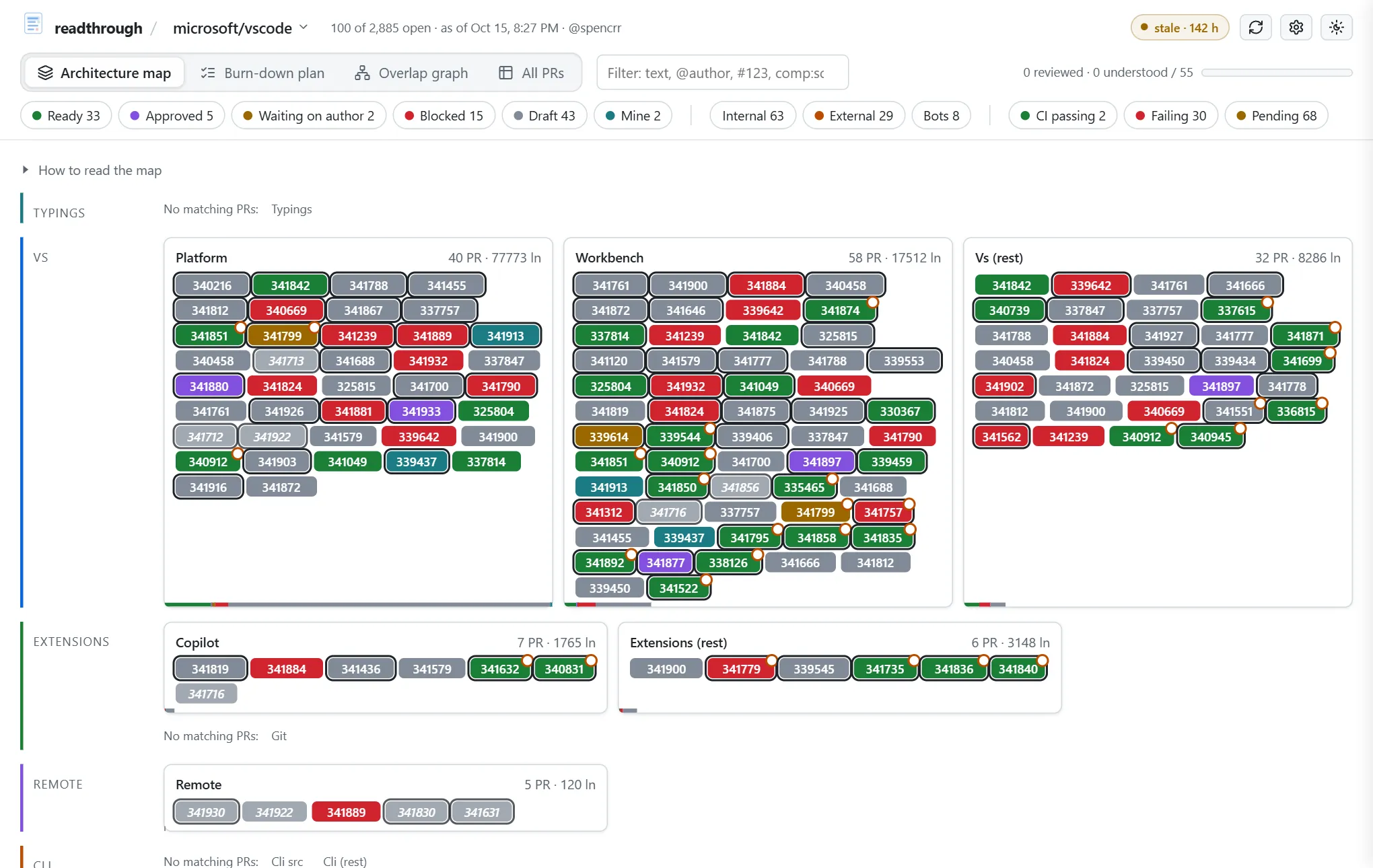
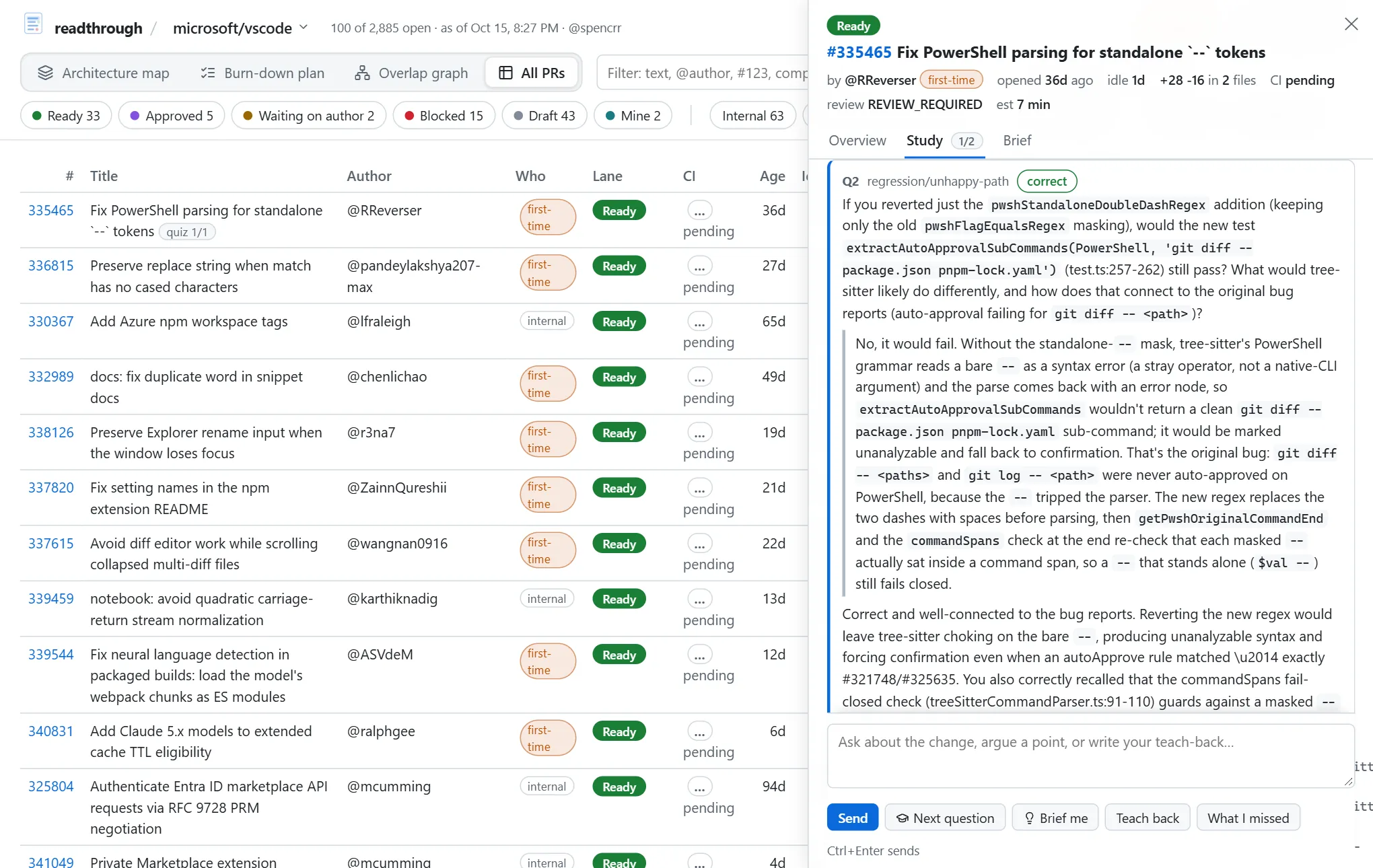
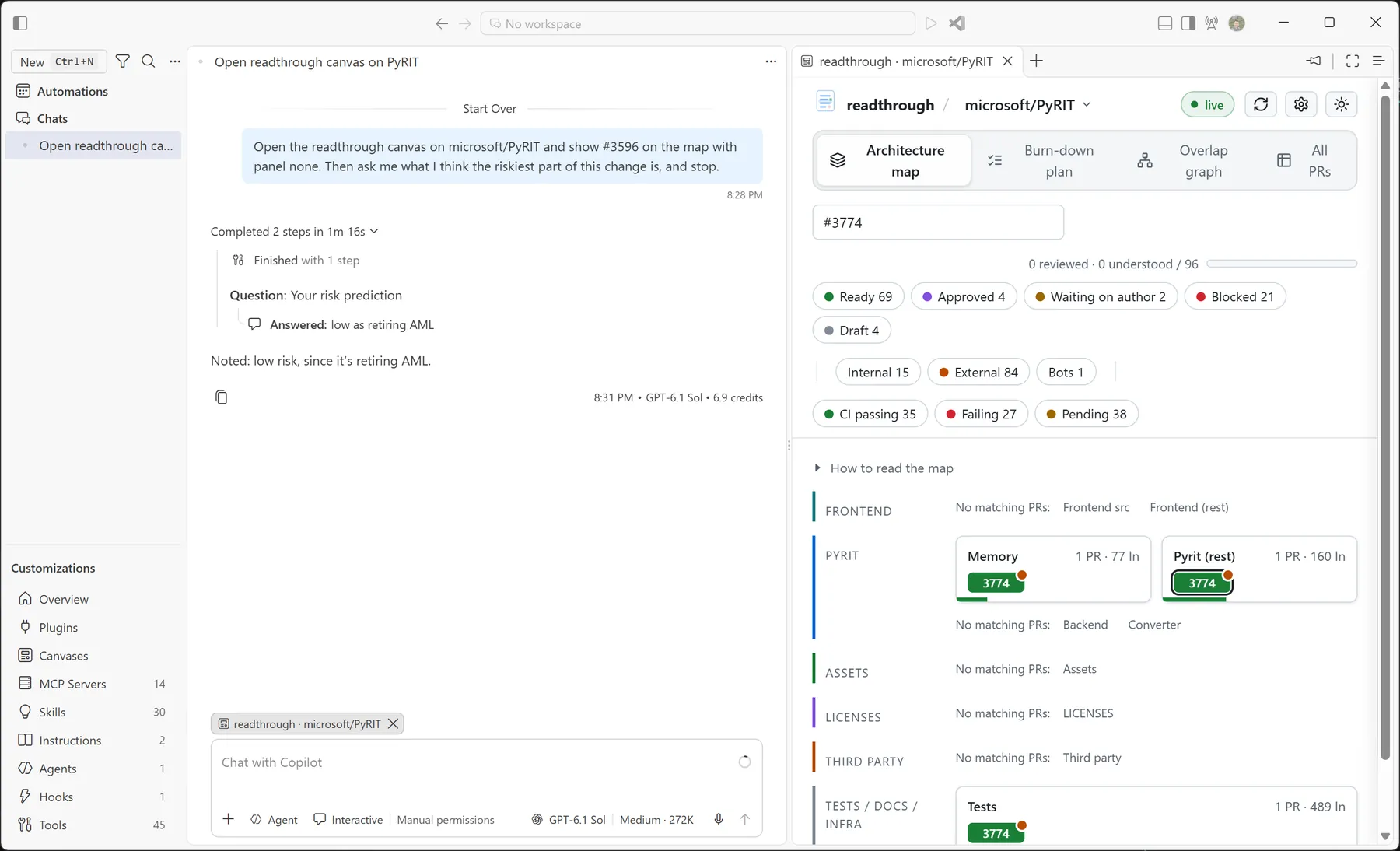
From there you can go two ways. A button on each PR starts a deep-review session in a terminal, in the GitHub Copilot CLI or Claude Code, where you predict what the PR does, answer questions about it, explain it back, and list your concerns before the agent shows you its own. Or you study it right in the dashboard: an assistant quizzes you on the change one question at a time and keeps everything you got right and wrong in an append-only study log that becomes part of the brief. Given a model (GitHub Copilot through the Copilot SDK, or Claude or GPT through their own APIs, including Azure OpenAI), the assistant reads the code and grades your answers; without one, a rules-based assistant asks the questions the repo's profile already carries and never pretends to grade. In VS Code the two meet: the dashboard sits beside the deep-review session, steered by the agent, which puts the PR on the map before you predict and opens its brief after.
|
|
41
41
|
|
|
42
42
|
|
|
43
43
|
|
|
@@ -54,19 +54,23 @@ uv tool install "readthrough[study]" # from PyPI; drop [study] to skip
|
|
|
54
54
|
|
|
55
55
|
readthrough onboard microsoft/vscode --accept # map the repo's architecture (edit the draft first if you like)
|
|
56
56
|
readthrough build --open # fetch the PRs and open the dashboard
|
|
57
|
+
readthrough install # the rest, one question each: the agents' review skill, the VS Code canvas, the live server
|
|
57
58
|
```
|
|
58
59
|
|
|
59
60
|
Repos elsewhere take a `--forge`: `readthrough onboard --forge forgejo forgejo/forgejo`, `--forge gitlab gitlab-org/cli`, or `--forge ado organization/project/repository`. Those are read through the platform's REST API, with a token from its own CLI (`glab`, `az`) or an environment variable when there is one, and anonymously otherwise, which is enough for public repos.
|
|
60
61
|
|
|
61
|
-
That gives you a static dashboard you rebuild when you want. For one that stays fresh, run the live server (`readthrough serve`, or `readthrough install
|
|
62
|
+
That gives you a static dashboard you rebuild when you want. For one that stays fresh, run the live server (`readthrough serve`, or let `readthrough install` start it at logon on Windows) and open <http://127.0.0.1:8765/>; with nothing onboarded yet it walks you through onboarding, with a model drafting the profile if you like. `readthrough install` offers everything else readthrough can set up on your machine and asks about each (`--all` skips the questions); `readthrough doctor` tells you what's missing afterwards.
|
|
62
63
|
|
|
63
64
|
|
|
64
65
|
|
|
66
|
+
|
|
67
|
+
|
|
65
68
|
## Docs
|
|
66
69
|
|
|
67
70
|
- [Using readthrough](https://github.com/spencrr/readthrough/blob/main/docs/guide.md): onboarding, the dashboard, deep reviews, studying, keeping it fresh, configuration, and troubleshooting.
|
|
68
71
|
- [Writing a profile](https://github.com/spencrr/readthrough/blob/main/docs/profiles.md): how to describe a repo's architecture well, and how to share it.
|
|
69
72
|
- [Maintaining readthrough](https://github.com/spencrr/readthrough/blob/main/docs/maintaining.md): the checks, error handling, logging, settings, plugins, and the pages' structure.
|
|
73
|
+
- [Contributing](CONTRIBUTING.md): branches, commit messages, and the checks a change goes through.
|
|
70
74
|
- [Working on readthrough](AGENTS.md): the exact commands and the conventions that aren't obvious.
|
|
71
75
|
- [Examples](examples/): runnable scripts, including one that needs nothing but the standard library.
|
|
72
76
|
- [Changelog](CHANGELOG.md).
|
|
@@ -120,4 +124,4 @@ git config core.hooksPath .githooks # once: run the checks before every com
|
|
|
120
124
|
uv run python scripts/check.py # lint, format, types, and tests with the coverage floor
|
|
121
125
|
```
|
|
122
126
|
|
|
123
|
-
The same gate runs in CI on Linux, macOS, and Windows for every supported Python. The browser tests
|
|
127
|
+
The same gate runs in CI on Linux, macOS, and Windows for every supported Python. The browser tests run on Playwright's Chromium (`uv run playwright install chromium`), or an installed Edge or Chrome; locally they skip without one, on CI they fail. See [SECURITY.md](https://github.com/spencrr/readthrough/blob/main/SECURITY.md) for what the tool trusts and how to report a vulnerability.
|
|
@@ -4,7 +4,7 @@ Busy repos have fifty-plus open pull requests. I wanted two things from a queue
|
|
|
4
4
|
|
|
5
5
|
readthrough does both, for repos on GitHub, GitLab, Forgejo (Codeberg), or Azure DevOps. It pulls the open PRs (the hundred most recently active by default; `limit` raises it) and places each on the repo's architecture (its layers and components), marking which ones come from outside contributors and which have CI trouble. It packs the reviewable ones into hour-long sessions grouped by component, then gives each PR a study brief.
|
|
6
6
|
|
|
7
|
-
From there you can go two ways. A button on each PR starts a deep-review session in a terminal, in the GitHub Copilot CLI or Claude Code, where you predict what the PR does, answer questions about it, explain it back, and list your concerns before the agent shows you its own. Or you study it right in the dashboard: an assistant quizzes you on the change one question at a time and keeps everything you got right and wrong in an append-only study log that becomes part of the brief. Given a model (GitHub Copilot through the Copilot SDK, or Claude or GPT through their own APIs, including Azure OpenAI), the assistant reads the code and grades your answers; without one, a rules-based assistant asks the questions the repo's profile already carries and never pretends to grade.
|
|
7
|
+
From there you can go two ways. A button on each PR starts a deep-review session in a terminal, in the GitHub Copilot CLI or Claude Code, where you predict what the PR does, answer questions about it, explain it back, and list your concerns before the agent shows you its own. Or you study it right in the dashboard: an assistant quizzes you on the change one question at a time and keeps everything you got right and wrong in an append-only study log that becomes part of the brief. Given a model (GitHub Copilot through the Copilot SDK, or Claude or GPT through their own APIs, including Azure OpenAI), the assistant reads the code and grades your answers; without one, a rules-based assistant asks the questions the repo's profile already carries and never pretends to grade. In VS Code the two meet: the dashboard sits beside the deep-review session, steered by the agent, which puts the PR on the map before you predict and opens its brief after.
|
|
8
8
|
|
|
9
9
|

|
|
10
10
|
|
|
@@ -21,19 +21,23 @@ uv tool install "readthrough[study]" # from PyPI; drop [study] to skip
|
|
|
21
21
|
|
|
22
22
|
readthrough onboard microsoft/vscode --accept # map the repo's architecture (edit the draft first if you like)
|
|
23
23
|
readthrough build --open # fetch the PRs and open the dashboard
|
|
24
|
+
readthrough install # the rest, one question each: the agents' review skill, the VS Code canvas, the live server
|
|
24
25
|
```
|
|
25
26
|
|
|
26
27
|
Repos elsewhere take a `--forge`: `readthrough onboard --forge forgejo forgejo/forgejo`, `--forge gitlab gitlab-org/cli`, or `--forge ado organization/project/repository`. Those are read through the platform's REST API, with a token from its own CLI (`glab`, `az`) or an environment variable when there is one, and anonymously otherwise, which is enough for public repos.
|
|
27
28
|
|
|
28
|
-
That gives you a static dashboard you rebuild when you want. For one that stays fresh, run the live server (`readthrough serve`, or `readthrough install
|
|
29
|
+
That gives you a static dashboard you rebuild when you want. For one that stays fresh, run the live server (`readthrough serve`, or let `readthrough install` start it at logon on Windows) and open <http://127.0.0.1:8765/>; with nothing onboarded yet it walks you through onboarding, with a model drafting the profile if you like. `readthrough install` offers everything else readthrough can set up on your machine and asks about each (`--all` skips the questions); `readthrough doctor` tells you what's missing afterwards.
|
|
29
30
|
|
|
30
31
|

|
|
31
32
|
|
|
33
|
+

|
|
34
|
+
|
|
32
35
|
## Docs
|
|
33
36
|
|
|
34
37
|
- [Using readthrough](https://github.com/spencrr/readthrough/blob/main/docs/guide.md): onboarding, the dashboard, deep reviews, studying, keeping it fresh, configuration, and troubleshooting.
|
|
35
38
|
- [Writing a profile](https://github.com/spencrr/readthrough/blob/main/docs/profiles.md): how to describe a repo's architecture well, and how to share it.
|
|
36
39
|
- [Maintaining readthrough](https://github.com/spencrr/readthrough/blob/main/docs/maintaining.md): the checks, error handling, logging, settings, plugins, and the pages' structure.
|
|
40
|
+
- [Contributing](CONTRIBUTING.md): branches, commit messages, and the checks a change goes through.
|
|
37
41
|
- [Working on readthrough](AGENTS.md): the exact commands and the conventions that aren't obvious.
|
|
38
42
|
- [Examples](examples/): runnable scripts, including one that needs nothing but the standard library.
|
|
39
43
|
- [Changelog](CHANGELOG.md).
|
|
@@ -87,4 +91,4 @@ git config core.hooksPath .githooks # once: run the checks before every com
|
|
|
87
91
|
uv run python scripts/check.py # lint, format, types, and tests with the coverage floor
|
|
88
92
|
```
|
|
89
93
|
|
|
90
|
-
The same gate runs in CI on Linux, macOS, and Windows for every supported Python. The browser tests
|
|
94
|
+
The same gate runs in CI on Linux, macOS, and Windows for every supported Python. The browser tests run on Playwright's Chromium (`uv run playwright install chromium`), or an installed Edge or Chrome; locally they skip without one, on CI they fail. See [SECURITY.md](https://github.com/spencrr/readthrough/blob/main/SECURITY.md) for what the tool trusts and how to report a vulnerability.
|
|
@@ -12,7 +12,7 @@ Install it as a uv tool so `readthrough` is on your PATH. `[study]` adds the Cop
|
|
|
12
12
|
uv tool install "readthrough[study]"
|
|
13
13
|
```
|
|
14
14
|
|
|
15
|
-
Releases on PyPI are built by the repository's release workflow from a tagged commit, with signed provenance; `gh attestation verify <downloaded file> --
|
|
15
|
+
Releases on PyPI are built by the repository's release workflow from a tagged commit, with signed provenance; `gh attestation verify <downloaded file> -R spencrr/readthrough --signer-workflow spencrr/readthrough/.github/workflows/release.yml --source-ref refs/tags/vX.Y.Z` checks one. For the latest `main` instead, install from the repository: `uv tool install "readthrough[study] @ git+https://github.com/spencrr/readthrough"`.
|
|
16
16
|
|
|
17
17
|
To work on the tool itself, clone it and install it editable, so edits take effect right away:
|
|
18
18
|
|
|
@@ -23,12 +23,13 @@ uv tool install -e "~/src/readthrough[study]"
|
|
|
23
23
|
|
|
24
24
|
If the live server is running, stop it before reinstalling (`readthrough uninstall server`, then `install server` again afterwards). Windows won't let uv replace files the server has open.
|
|
25
25
|
|
|
26
|
-
Then run the
|
|
26
|
+
Then run `readthrough install`. With nothing named it goes through everything readthrough can set up on this machine that isn't set up yet, says what each piece does, and asks; `--all` says yes to every recommended piece without asking (the morning nudge isn't one: it opens a browser on a timer, so it stays a question, or `readthrough install schedule`). In a script, or anywhere that isn't a terminal, `readthrough install` without `--all` only lists what it would do. Each piece can also be installed on its own, and undone with `readthrough uninstall <same thing>`:
|
|
27
27
|
|
|
28
28
|
- `readthrough install skill` copies the deep-review instructions into each installed agent's skill directory: `~/.agents/skills/readthrough` for the Copilot CLI and VS Code's agent sessions, `~/.claude/skills/readthrough` for Claude Code (`--agent claude` for just one). Re-run it after pulling changes; `doctor` warns you when an installed copy is out of date.
|
|
29
29
|
- `readthrough install server` starts the live dashboard now and again every time you log in. Open it with `readthrough open`, or bookmark <http://127.0.0.1:8765/>.
|
|
30
30
|
- `readthrough install schedule` creates a Task Scheduler entry that refreshes every repo in the morning and opens the dashboard when something needs you. More on this below.
|
|
31
31
|
- `readthrough install protocol` registers a `readthrough://` link handler for your Windows user, so the buttons in the snapshot version can start a review. The live dashboard doesn't need it. No admin rights are needed; it writes a single key under `HKCU\Software\Classes`.
|
|
32
|
+
- `readthrough install canvas` puts the dashboard beside agent sessions in VS Code's Agents window (see [The dashboard beside the session](#the-dashboard-beside-the-session-experimental)). Offered wherever the Copilot CLI is.
|
|
32
33
|
|
|
33
34
|
None of this does anything until you onboard a repo. With the server running, its front page takes you to onboarding.
|
|
34
35
|
|
|
@@ -252,6 +253,16 @@ Sessions are linked to their PR wherever they started. Every prompt readthrough
|
|
|
252
253
|
|
|
253
254
|
To burn down a whole session, ask Copilot for "burn down session 2 of OWNER/NAME". It gives you a quick overview of how the PRs in that session relate, then runs the routine for each one.
|
|
254
255
|
|
|
256
|
+
### The dashboard beside the session (experimental)
|
|
257
|
+
|
|
258
|
+
In VS Code's Agents window a session can have *canvases*: pages shown beside the chat that the agent can open and steer. `readthrough install canvas` adds one that shows the live dashboard, so the map, a PR's panel, and its study log sit next to the deep review instead of in a browser tab you keep switching to. It needs the live dashboard running (`readthrough serve`, or `readthrough install server` to keep it running), and it appears after the Agents window reloads its extensions.
|
|
259
|
+
|
|
260
|
+
The agent opens the canvas on a repo and points it: in the predict phase it places the PR on the architecture map without opening anything (the map narrows to that one PR, so you see which components it touches and nothing more), and once you've committed it opens the brief, the overview, or the study log. The same page, a browser tab included, answers to `readthrough show 2897` (`--panel none|overview|study|brief`), which is all the agent does. Beside a session the page knows that the session is the deep review: the buttons that would start another one are hidden, and the Study tab shows the log the session writes to rather than a second composer.
|
|
261
|
+
|
|
262
|
+

|
|
263
|
+
|
|
264
|
+
The canvas is a small Copilot extension (two JavaScript files the Copilot runtime loads, under `~/.copilot/extensions/readthrough/`) that only runs the `readthrough` CLI; it records which interpreter installed it, so it keeps working when the editor's PATH doesn't have `readthrough`. `readthrough doctor` says whether the installed copy matches the version you have; `readthrough uninstall canvas` removes exactly what was installed. The canvas API is experimental in the Copilot SDK, so this part of readthrough is too.
|
|
265
|
+
|
|
255
266
|
## Studying a PR
|
|
256
267
|
|
|
257
268
|
The deep review is a long, guided conversation in a terminal. The **Study** tab in the PR panel is the lighter version, right in the dashboard, for building understanding a question at a time. It needs the live dashboard.
|
|
@@ -486,7 +497,7 @@ Every command except `onboard`, `repos`, `default`, `remove`, `install`, `uninst
|
|
|
486
497
|
| Command | What it does |
|
|
487
498
|
| --- | --- |
|
|
488
499
|
| `onboard OWNER/NAME [--forge F] [--clone P] [--account A] [--assisted] [--update] [--preview] [--accept] [--force]` | Draft, check, preview, and accept a repo's profile |
|
|
489
|
-
| `repos` | List the repos you've onboarded |
|
|
500
|
+
| `repos [--json]` | List the repos you've onboarded (`--json` for programs: the live server, each repo's URL) |
|
|
490
501
|
| `default OWNER/NAME` | Set the default repo |
|
|
491
502
|
| `remove OWNER/NAME [--purge]` | Stop tracking a repo |
|
|
492
503
|
| `profile [show\|check\|sources\|path\|export] [--file F]` | Look at, check, or export the repo's profile |
|
|
@@ -494,12 +505,14 @@ Every command except `onboard`, `repos`, `default`, `remove`, `install`, `uninst
|
|
|
494
505
|
| `build [--all] [--open [auto\|always\|never]] [--no-diffs]` | Fetch, analyze, and write the snapshot and briefs |
|
|
495
506
|
| `open` | Open the dashboard (live if the server is up) |
|
|
496
507
|
| `brief N [--path]` | Print a PR's study brief |
|
|
508
|
+
| `show N [--panel none\|overview\|study\|brief] [--client ID] [--wait S]` | Point every open dashboard page at a PR |
|
|
497
509
|
| `review N [--fresh] [--here] [--vscode] [--print]` | Start or resume the deep-review session |
|
|
498
510
|
| `worktree N [--remove]` | Check out a PR in its own worktree and print the diff command |
|
|
499
511
|
| `ledger N [--status S] [--note T] [--clear]` | Record, show, or clear what you did with a PR |
|
|
500
512
|
| `study N [--prediction T] [--teachback T] [--note T] [--finding S:T --at P:L]` | Show or add to a PR's study log |
|
|
501
513
|
| (browser) `/setup` | Onboard a repo, or change a repo's settings |
|
|
502
|
-
| `install
|
|
514
|
+
| `install [skill\|server\|schedule\|protocol\|canvas] [--all]` | Set up the integrations: all that are missing, asking about each, or one |
|
|
515
|
+
| `uninstall skill\|server\|schedule\|protocol\|canvas` | Undo one |
|
|
503
516
|
| `config [--edit] [--defaults] [--check]` | Show, open, explain, or validate the configuration |
|
|
504
517
|
| `doctor [--bundle]` | Check the setup, or write a debug bundle for a bug report |
|
|
505
518
|
|
|
@@ -4,7 +4,7 @@ How the code handles failure, where settings live, and how to check a change bef
|
|
|
4
4
|
|
|
5
5
|
## Checking a change
|
|
6
6
|
|
|
7
|
-
The same gate runs on your machine and in CI. `.github/workflows/test.yml` is the gate as a reusable workflow (lint and types on Linux, tests on Linux, macOS, and Windows for every supported Python, then a build that installs the wheel into a clean environment and uploads it as the `dist` artifact); `ci.yml` calls it on every push and PR and adds `gate`, which is green only when everything in it was. `zizmor.yml` lints the workflows themselves and fails on any finding. `
|
|
7
|
+
The same gate runs on your machine and in CI. `.github/workflows/test.yml` is the gate as a reusable workflow (lint and types on Linux, tests on Linux, macOS, and Windows for every supported Python, then a build that installs the wheel into a clean environment and uploads it as the `dist` artifact); `ci.yml` calls it on every push and PR and adds `gate`, which is green only when everything in it was. `zizmor.yml` lints the workflows themselves and fails on any finding. `commits.yml` checks that a pull request's title and every commit in it follow Conventional Commits (`CONTRIBUTING.md`; the grammar is `scripts/commit_messages.py`, which the tests cover). `gate`, `zizmor`, and `commits` are the checks the branch ruleset requires. The browser tests fail on CI if the runner has no Chrome or Edge, where locally they would skip:
|
|
8
8
|
|
|
9
9
|
```sh
|
|
10
10
|
uv run python scripts/check.py # lint, format, types, tests with the coverage floor
|
|
@@ -29,7 +29,7 @@ The gates:
|
|
|
29
29
|
| types | ty | Pinned to an exact version in the dev group, because it's pre-1.0 and its diagnostics change between releases. Bump it on purpose, with the fixes in the same commit. Covers `src`, `tests`, and `scripts`. Production code is written against `forges.Forge` and the `Protocol`s (`membership.Membership`, `assistants.Assistant`, `assistants.Harness`) rather than a concrete adapter, which is what lets the tests' fakes type-check. |
|
|
30
30
|
| tests | pytest with pytest-cov | Fails below the floor in `[tool.coverage.report] fail_under`. Raise the floor when coverage goes up; don't lower it to get a change in. |
|
|
31
31
|
|
|
32
|
-
The browser tests (`tests/test_browser.py`, marked `browser`) drive the real dashboard and setup page in headless
|
|
32
|
+
The browser tests (`tests/test_browser.py`, marked `browser`) drive the real dashboard and setup page in a headless Chromium through Playwright: Playwright's own build first (`uv run playwright install chromium` fetches it), so a run on your machine and a run on CI use the same engine, else an installed Edge or Chrome; they are skipped if there is none. The branded builds are more lenient in places, which is how a test can pass locally and fail on CI; the test report's last line names the engine that ran. They catch script errors and broken interactions that Python tests can't see. The first time they ran, they found a chart that drew negative-size shapes.
|
|
33
33
|
|
|
34
34
|
The end-to-end tests (`tests/test_e2e.py`, marked `e2e`) run the real `readthrough` executable as a subprocess, with `tests/fake_gh.py` standing in for `gh` through `READTHROUGH_GH`. That's the one place the whole program is exercised the way a user runs it: onboarding, a build, studying from the terminal, a second build that must hit the diff cache, `doctor`. The first time it ran, it found that a legitimately empty diff was never cached, so docs-only PRs were re-fetched on every refresh.
|
|
35
35
|
|
|
@@ -37,7 +37,7 @@ Tests never touch the network, `gh`, git, Copilot, the registry, or the schedule
|
|
|
37
37
|
|
|
38
38
|
The recordings come from `scripts/probe_forge.py --record`, which runs an adapter against a real public repo (codeberg.org/forgejo/forgejo, gitlab.com/gitlab-org/cli, dev.azure.com/powershell) and writes every response, including the refusals, keyed by request. Re-record when an adapter asks for something new; the tests then need their expectations refreshed, since the data is whatever the forge said that day. Only a few response headers are kept and known identity fields are scrubbed, so a recording holds nothing about whoever made it.
|
|
39
39
|
|
|
40
|
-
The screenshots in `docs/img/` come from `scripts/screenshots.py`, which serves a repo you've built through the live server, drives headless Edge or Chrome through Playwright at a fixed size in the light theme, and writes WebP (Pillow converts; Playwright writes only PNG and JPEG). They show microsoft/vscode, onboarded into a scratch home: `READTHROUGH_HOME=~/.readthrough-docs readthrough onboard microsoft/vscode --accept`, a build, a real study exchange on one PR, then `scripts/screenshots.py --repo microsoft/vscode --pr <n>`. Re-take them after a visible change to the pages.
|
|
40
|
+
The screenshots in `docs/img/` come from `scripts/screenshots.py`, which serves a repo you've built through the live server, drives headless Edge or Chrome through Playwright at a fixed size in the light theme, and writes WebP (Pillow converts; Playwright writes only PNG and JPEG). They show microsoft/vscode, onboarded into a scratch home: `READTHROUGH_HOME=~/.readthrough-docs readthrough onboard microsoft/vscode --accept`, a build, a real study exchange on one PR, then `scripts/screenshots.py --repo microsoft/vscode --pr <n>`. Re-take them after a visible change to the pages. The one a headless browser can't take, the dashboard beside an agent session (`canvas.webp`), comes from `scripts/screenshot_canvas.py`, Windows only: it starts a second VS Code on a throwaway profile, opens an agent session with a prompt that has the agent open the canvas, and captures the window once you've sent the prompt and the agent has asked its question; the profile is signed in to GitHub once and remembers it.
|
|
41
41
|
|
|
42
42
|
## Failures
|
|
43
43
|
|
|
@@ -120,7 +120,7 @@ The UI lives in `assets/web/`. Each page has its own `.html`, `.css`, and `.js`,
|
|
|
120
120
|
- Every script carries a per-render nonce, and the content security policy runs nothing else. Don't add inline event handlers (`onclick=`); use the delegated listeners.
|
|
121
121
|
- PR descriptions and comments are third-party HTML. They go through DOMPurify, and `test_browser.py` checks that an `onerror` attribute doesn't survive.
|
|
122
122
|
- Escape everything else you interpolate with `esc()`.
|
|
123
|
-
- Third-party JavaScript is vendored under `assets/vendor/` with its license, and listed in `build.VENDOR_SCRIPTS`. The page makes no requests to other sites.
|
|
123
|
+
- Third-party JavaScript is vendored under `assets/vendor/` with its license, and listed in `build.VENDOR_SCRIPTS`. The page itself makes no requests to other sites; the images in a PR's description are the one exception, and `SECURITY.md` says what that means.
|
|
124
124
|
- Check both themes. New colors go in `theme.css` as tokens if both pages use them, otherwise at the top of the page's CSS.
|
|
125
125
|
|
|
126
126
|
### The contract with the server
|
|
@@ -146,21 +146,24 @@ A terminal launcher is a pure function from a `Command` to a `Spawn`; only the W
|
|
|
146
146
|
|
|
147
147
|
## Releasing
|
|
148
148
|
|
|
149
|
-
A release is a `vX.Y.Z` tag on `main` (or on a `release/*` branch, for a patch to an older line). The tag starts `.github/workflows/release.yml`, which checks that the tagged commit is on one of those branches, that the tag is the version in `pyproject.toml`, and that `CHANGELOG.md` has a section for it; runs the whole gate again through `test.yml`; and then waits. Approving the `pypi` environment (Actions → the run → *Review deployments*) lets the last job run: it takes the wheel and sdist the gate built, attests their provenance, uploads them to PyPI through trusted publishing (no token anywhere), and creates the GitHub release with the changelog section as its notes. Nothing in that last job builds anything, and nothing starts it but a tag plus a click, so a
|
|
149
|
+
A release is a `vX.Y.Z` tag on `main` (or on a `release/*` branch, for a patch to an older line). The tag starts `.github/workflows/release.yml`, which checks that the tagged commit is on one of those branches, that the tag is the version in `pyproject.toml`, and that `CHANGELOG.md` has a section for it; runs the whole gate again through `test.yml`; and then waits. Approving the `pypi` environment (Actions → the run → *Review deployments*) lets the last job run: it takes the wheel and sdist the gate built, attests their provenance, uploads them to PyPI through trusted publishing (no token anywhere), and creates the GitHub release with the changelog section as its notes. Nothing in that last job builds anything, and nothing starts it but a tag plus a click. Who can do what is set by the repository's rulesets: only an admin creates tags or `release/*` branches (or any branch outside `dev/*`, which is where everyone's work in progress goes, under their own login), and anyone else lands a commit on `main` only through a pull request that the code owner (`.github/CODEOWNERS`: the maintainer) has approved, with the branch brought up to date first so the commit that lands is the one the checks ran on; so a collaborator's credential can't start a release, and a branch run can't enter the `pypi` environment, whose policy admits only `v*` tags. The admin's own credential is the root of trust: a token with the `repo` scope can push the tag and approve the deployment, so there is no gate against it beyond keeping it safe (push with an SSH key, and treat the `gh` login as the credential it is). A GitHub release someone else created for the tag ahead of the pipeline makes the publish job fail rather than pass, since it only leaves an existing release alone when it carries exactly the files it built.
|
|
150
150
|
|
|
151
151
|
1. Bump `version` in `pyproject.toml` and run `uv lock`, so the lockfile names the new version (`UV_LOCKED` in CI refuses a stale one). `readthrough.__version__` reads it from the installed package.
|
|
152
152
|
2. Add a `## X.Y.Z (YYYY-MM-DD)` section to `CHANGELOG.md`; the release notes are that section, up to the next heading.
|
|
153
|
-
3. Run `uv run python scripts/check.py`, commit, and
|
|
154
|
-
4. `git tag vX.Y.Z && git push origin vX.Y.Z`. Only a repository admin can create a
|
|
153
|
+
3. Run `uv run python scripts/check.py`, commit on a `dev/<login>/*` branch, and land it on `main` through a pull request (nothing reaches `main` any other way). Wait for CI.
|
|
154
|
+
4. `git tag vX.Y.Z && git push origin vX.Y.Z`. Only a repository admin can create a tag, and once a `v*` tag exists it can't be moved or deleted. The release is marked latest only when its version is the highest released, so a patch to an older line doesn't take the badge from a newer one.
|
|
155
155
|
5. Approve the deployment when the run reaches `publish`. Then check it from the outside, on a downloaded file rather than a local build:
|
|
156
156
|
|
|
157
157
|
```sh
|
|
158
158
|
gh release verify vX.Y.Z # the release is immutable and attested
|
|
159
159
|
gh release verify-asset vX.Y.Z readthrough-X.Y.Z-py3-none-any.whl # this file is the published asset
|
|
160
|
-
gh attestation verify readthrough-X.Y.Z-py3-none-any.whl
|
|
160
|
+
gh attestation verify readthrough-X.Y.Z-py3-none-any.whl -R spencrr/readthrough \
|
|
161
|
+
--signer-workflow spencrr/readthrough/.github/workflows/release.yml --source-ref refs/tags/vX.Y.Z # built by release.yml from this tag
|
|
161
162
|
uv tool install readthrough==X.Y.Z && readthrough --version
|
|
162
163
|
```
|
|
163
164
|
|
|
164
165
|
If the run fails after PyPI accepted the files, fix what failed and re-run the failed job: the upload skips files PyPI already has, and the release step leaves an existing release alone. The tag can't be moved, so a mistake in the release itself means a new patch version.
|
|
165
166
|
|
|
166
|
-
For a patch to an older line when `main` has unfinished work: `git switch -c release/X.Y vX.Y.0`, cherry-pick with `-x`, release from there, and add the changelog section to `main` by hand.
|
|
167
|
+
For a patch to an older line when `main` has unfinished work: `git switch -c release/X.Y vX.Y.0`, cherry-pick with `-x`, release from there, and add the changelog section to `main` by hand.
|
|
168
|
+
|
|
169
|
+
The toolchain that builds a release is pinned, in two places: `uv` is whatever version the pinned `setup-uv` action ships a checksum for (`version: latest-known`, so Dependabot's bump of the action, after its cooldown, is what moves `uv`), and the build backend is an exact `build-constraint-dependencies` entry in `pyproject.toml`, bumped by hand like `ty`.
|
|
@@ -4,7 +4,7 @@ build-backend = "hatchling.build"
|
|
|
4
4
|
|
|
5
5
|
[project]
|
|
6
6
|
name = "readthrough"
|
|
7
|
-
version = "0.
|
|
7
|
+
version = "0.5.0"
|
|
8
8
|
description = "Lay a repo's open pull requests out on its architecture, then study each one before you review it."
|
|
9
9
|
readme = "README.md"
|
|
10
10
|
license = "MIT"
|
|
@@ -58,11 +58,16 @@ dev = [
|
|
|
58
58
|
"pillow>=10",
|
|
59
59
|
]
|
|
60
60
|
|
|
61
|
+
[tool.uv]
|
|
62
|
+
# The build backend is resolved at build time, outside uv.lock; pinned exactly so a release is built by a known
|
|
63
|
+
# version (1.33.0 built 0.4.0). Bump it deliberately, like ty.
|
|
64
|
+
build-constraint-dependencies = ["hatchling==1.33.0"]
|
|
65
|
+
|
|
61
66
|
[tool.uv.sources]
|
|
62
67
|
readthrough = { workspace = true }
|
|
63
68
|
|
|
64
69
|
[tool.hatch.build.targets.sdist]
|
|
65
|
-
include = ["src/readthrough", "tests", "docs", "examples", "CHANGELOG.md", "LICENSE", "README.md", "AGENTS.md"]
|
|
70
|
+
include = ["src/readthrough", "tests", "docs", "examples", "CHANGELOG.md", "CONTRIBUTING.md", "LICENSE", "README.md", "AGENTS.md"]
|
|
66
71
|
exclude = ["docs/img"]
|
|
67
72
|
|
|
68
73
|
[tool.hatch.build.targets.wheel]
|
|
@@ -154,8 +159,9 @@ skip_covered = true
|
|
|
154
159
|
|
|
155
160
|
[tool.ty.environment]
|
|
156
161
|
python-version = "3.11"
|
|
157
|
-
# tests/ is a root too, so `from conftest import ...` resolves the way pytest's rootdir import does
|
|
158
|
-
|
|
162
|
+
# tests/ is a root too, so `from conftest import ...` resolves the way pytest's rootdir import does; scripts/ so a
|
|
163
|
+
# test can import the script it checks.
|
|
164
|
+
root = ["src", "tests", "scripts"]
|
|
159
165
|
|
|
160
166
|
[tool.ty.src]
|
|
161
167
|
include = ["src", "tests", "scripts"]
|
|
@@ -23,6 +23,7 @@ import re
|
|
|
23
23
|
import sys
|
|
24
24
|
from collections.abc import Iterator
|
|
25
25
|
from dataclasses import dataclass, field
|
|
26
|
+
from importlib.resources import files
|
|
26
27
|
from pathlib import Path
|
|
27
28
|
from typing import Any, ClassVar
|
|
28
29
|
|
|
@@ -35,6 +36,11 @@ AUTO_ORDER = ("copilot", "claude") # the first installed wins when agent = "aut
|
|
|
35
36
|
SKILL_NAME = "readthrough"
|
|
36
37
|
|
|
37
38
|
|
|
39
|
+
def bundled_skill() -> str:
|
|
40
|
+
"""The deep-review skill as shipped, which ``install skill`` writes and ``doctor`` compares against."""
|
|
41
|
+
return files("readthrough").joinpath("assets/SKILL.md").read_text(encoding="utf-8")
|
|
42
|
+
|
|
43
|
+
|
|
38
44
|
@dataclass(frozen=True)
|
|
39
45
|
class SessionRecord:
|
|
40
46
|
"""A session as found on disk, before anything is read from it."""
|
|
@@ -36,6 +36,8 @@ You may have been launched by the dashboard's review button. If so, this session
|
|
|
36
36
|
|
|
37
37
|
In the commands below, `R` stands for `--repo OWNER/NAME`.
|
|
38
38
|
|
|
39
|
+
**If your host renders canvases** (you have `open_canvas` and `invoke_canvas_action` tools and a `readthrough` canvas is listed), show the dashboard beside this session instead of describing it. In Phase 0, `open_canvas` with a stable `instanceId` and `{"repo": "OWNER/NAME"}`; if it says the live dashboard isn't running, tell the user to run `readthrough serve` and carry on without it. Then steer it with the `show` action, one PR at a time: in Phase 1 `{"pr": N, "panel": "none"}`, which places the PR on the architecture map and reveals nothing else; from Phase 2 `"panel": "brief"` for the reading order and contracts; in Phase 4 `"panel": "study"` so the user sees the evidence you both built. The canvas reads; everything you record still goes through the CLI commands below, which the user can see. If your host has canvas tools but lists no `readthrough` canvas, say once, in one line, that `readthrough install canvas` would put the dashboard beside this session from the next session on, then carry on. Without canvas tools, skip this paragraph: nothing else changes.
|
|
40
|
+
|
|
39
41
|
### Phase 0: Prepare (silent)
|
|
40
42
|
|
|
41
43
|
1. `readthrough R profile show`. This is the repo's architecture profile: its layers and components, where its component contracts live, its review guidance, and its test command. Follow the review guidance throughout.
|
|
@@ -0,0 +1,96 @@
|
|
|
1
|
+
// The readthrough canvas: the live dashboard beside an agent session, in any Copilot host that renders canvases.
|
|
2
|
+
//
|
|
3
|
+
// `readthrough install canvas` puts this directory under the Copilot home's `extensions/`; the Copilot runtime
|
|
4
|
+
// loads it into each session, with its own copy of the SDK. It declares one canvas whose page is the dashboard
|
|
5
|
+
// the user already runs (`readthrough serve`), so the view is the same page a browser shows, told through
|
|
6
|
+
// `canvas=<instance>` in its URL that an agent session sits beside it. The agent steers it with the `show`
|
|
7
|
+
// action, and reads a PR's brief or study log, all through the readthrough CLI; nothing is written here.
|
|
8
|
+
//
|
|
9
|
+
// Experimental: the canvas API is marked so in the SDK, and may change under this file.
|
|
10
|
+
|
|
11
|
+
import { CanvasError, createCanvas, joinSession } from "@github/copilot-sdk/extension";
|
|
12
|
+
|
|
13
|
+
import { ACTIONS, CliError, OPEN_SCHEMA, Readthrough, text } from "./readthrough.mjs";
|
|
14
|
+
|
|
15
|
+
const canvasId = "readthrough";
|
|
16
|
+
let session;
|
|
17
|
+
const log = (message, level = "info") => {
|
|
18
|
+
if (session) session.log(message, { level }).catch(() => {});
|
|
19
|
+
};
|
|
20
|
+
const readthrough = new Readthrough({ log });
|
|
21
|
+
// The repo each open instance shows, so an action on that instance means that repo and not the CLI's default.
|
|
22
|
+
// Filled by open(), which the host calls again for every instance it restores after a reload.
|
|
23
|
+
const showing = new Map();
|
|
24
|
+
|
|
25
|
+
const toCanvasError = error =>
|
|
26
|
+
error instanceof CliError ? new CanvasError(error.code, error.message) : new CanvasError("readthrough_error", String(error?.message ?? error));
|
|
27
|
+
|
|
28
|
+
/** A stable instance id is also the page's name on its event stream, so steering reaches this view alone. */
|
|
29
|
+
const clientId = instanceId => {
|
|
30
|
+
const id = `canvas-${String(instanceId).replace(/[^A-Za-z0-9._:-]/g, "-")}`.slice(0, 64);
|
|
31
|
+
return text(id, "instance", { max: 64, pattern: /^[A-Za-z0-9][A-Za-z0-9._:-]{0,63}$/ });
|
|
32
|
+
};
|
|
33
|
+
|
|
34
|
+
const canvas = createCanvas({
|
|
35
|
+
id: canvasId,
|
|
36
|
+
displayName: "readthrough",
|
|
37
|
+
description: "The live readthrough dashboard: a repo's open pull requests laid out on its architecture, with each one's brief and study log, beside the deep-review session.",
|
|
38
|
+
inputSchema: OPEN_SCHEMA,
|
|
39
|
+
actions: ACTIONS.map(action => ({
|
|
40
|
+
name: action.name,
|
|
41
|
+
description: action.description,
|
|
42
|
+
inputSchema: action.inputSchema,
|
|
43
|
+
handler: async ctx => {
|
|
44
|
+
try {
|
|
45
|
+
const input = { repo: showing.get(ctx.instanceId), ...(ctx.input ?? {}) };
|
|
46
|
+
if (input.repo === undefined && !showing.has(ctx.instanceId)) {
|
|
47
|
+
throw new CliError("readthrough_not_open", "This canvas isn't open yet; open it first, or name the repo.");
|
|
48
|
+
}
|
|
49
|
+
return await action.run(readthrough, input, { ...ctx, instanceId: clientId(ctx.instanceId) });
|
|
50
|
+
} catch (error) {
|
|
51
|
+
throw toCanvasError(error);
|
|
52
|
+
}
|
|
53
|
+
},
|
|
54
|
+
})),
|
|
55
|
+
|
|
56
|
+
async open(ctx) {
|
|
57
|
+
const input = ctx.input ?? {};
|
|
58
|
+
let repo;
|
|
59
|
+
try {
|
|
60
|
+
repo = readthrough.pick(await readthrough.repos(), input.repo);
|
|
61
|
+
} catch (error) {
|
|
62
|
+
throw toCanvasError(error);
|
|
63
|
+
}
|
|
64
|
+
const client = clientId(ctx.instanceId);
|
|
65
|
+
showing.set(ctx.instanceId, repo.slug);
|
|
66
|
+
// The URL is the same every time this instance opens, so re-opening focuses the view instead of reloading
|
|
67
|
+
// it; where the page should look is said separately, once it is up.
|
|
68
|
+
const url = `${repo.url}#map?canvas=${encodeURIComponent(client)}`;
|
|
69
|
+
if (input.pr !== undefined && input.pr !== null) {
|
|
70
|
+
readthrough
|
|
71
|
+
.show({ repo: repo.slug, pr: input.pr, panel: input.panel, client })
|
|
72
|
+
.then(result => log(`${repo.name}: ${result}`))
|
|
73
|
+
.catch(error => log(`${repo.name}: couldn't point the page at #${input.pr}: ${error.message}`, "warning"));
|
|
74
|
+
}
|
|
75
|
+
const built = repo.built ? `built ${new Date(repo.built).toLocaleString()}` : "not built yet";
|
|
76
|
+
const renders = ctx.host?.capabilities?.canvases !== false;
|
|
77
|
+
return {
|
|
78
|
+
url,
|
|
79
|
+
title: `readthrough · ${repo.name}`,
|
|
80
|
+
status: renders ? built : `${built} · this host doesn't render canvases; open ${repo.url} in a browser`,
|
|
81
|
+
};
|
|
82
|
+
},
|
|
83
|
+
|
|
84
|
+
onClose(ctx) {
|
|
85
|
+
// The dashboard is the user's, served for every page that shows it; closing a view stops nothing.
|
|
86
|
+
showing.delete(ctx.instanceId);
|
|
87
|
+
log(`canvas ${ctx.instanceId} closed`);
|
|
88
|
+
},
|
|
89
|
+
});
|
|
90
|
+
|
|
91
|
+
try {
|
|
92
|
+
session = await joinSession({ canvases: [canvas] });
|
|
93
|
+
} catch (error) {
|
|
94
|
+
// An older runtime without canvases: there is nothing for this extension to do, and nothing to break.
|
|
95
|
+
process.stderr.write(`readthrough canvas: not loaded (${error?.message ?? error})\n`);
|
|
96
|
+
}
|