readthrough 0.4.0__tar.gz
This diff represents the content of publicly available package versions that have been released to one of the supported registries. The information contained in this diff is provided for informational purposes only and reflects changes between package versions as they appear in their respective public registries.
- readthrough-0.4.0/.gitignore +35 -0
- readthrough-0.4.0/AGENTS.md +112 -0
- readthrough-0.4.0/CHANGELOG.md +320 -0
- readthrough-0.4.0/LICENSE +21 -0
- readthrough-0.4.0/PKG-INFO +123 -0
- readthrough-0.4.0/README.md +90 -0
- readthrough-0.4.0/docs/guide.md +540 -0
- readthrough-0.4.0/docs/maintaining.md +166 -0
- readthrough-0.4.0/docs/profiles.md +102 -0
- readthrough-0.4.0/examples/README.md +12 -0
- readthrough-0.4.0/examples/custom_profile_source.py +83 -0
- readthrough-0.4.0/examples/offline_analysis.py +144 -0
- readthrough-0.4.0/pyproject.toml +161 -0
- readthrough-0.4.0/src/readthrough/__init__.py +8 -0
- readthrough-0.4.0/src/readthrough/__main__.py +3 -0
- readthrough-0.4.0/src/readthrough/agents.py +344 -0
- readthrough-0.4.0/src/readthrough/analyze.py +537 -0
- readthrough-0.4.0/src/readthrough/assets/SKILL.md +86 -0
- readthrough-0.4.0/src/readthrough/assets/defaults.toml +143 -0
- readthrough-0.4.0/src/readthrough/assets/profile-reference.md +133 -0
- readthrough-0.4.0/src/readthrough/assets/vendor/README.md +22 -0
- readthrough-0.4.0/src/readthrough/assets/vendor/cose-base.js +3214 -0
- readthrough-0.4.0/src/readthrough/assets/vendor/cytoscape-fcose.js +1549 -0
- readthrough-0.4.0/src/readthrough/assets/vendor/cytoscape.min.js +31 -0
- readthrough-0.4.0/src/readthrough/assets/vendor/layout-base.js +5230 -0
- readthrough-0.4.0/src/readthrough/assets/vendor/licenses/cose-base-LICENSE +21 -0
- readthrough-0.4.0/src/readthrough/assets/vendor/licenses/cytoscape-LICENSE +19 -0
- readthrough-0.4.0/src/readthrough/assets/vendor/licenses/cytoscape-fcose-LICENSE +19 -0
- readthrough-0.4.0/src/readthrough/assets/vendor/licenses/dompurify-LICENSE +202 -0
- readthrough-0.4.0/src/readthrough/assets/vendor/licenses/layout-base-LICENSE +21 -0
- readthrough-0.4.0/src/readthrough/assets/vendor/licenses/lucide-LICENSE +15 -0
- readthrough-0.4.0/src/readthrough/assets/vendor/licenses/marked-LICENSE +44 -0
- readthrough-0.4.0/src/readthrough/assets/vendor/lucide-icons.js +36 -0
- readthrough-0.4.0/src/readthrough/assets/vendor/marked.umd.js +82 -0
- readthrough-0.4.0/src/readthrough/assets/vendor/purify.min.js +7 -0
- readthrough-0.4.0/src/readthrough/assets/web/dashboard.css +202 -0
- readthrough-0.4.0/src/readthrough/assets/web/dashboard.html +48 -0
- readthrough-0.4.0/src/readthrough/assets/web/dashboard.js +937 -0
- readthrough-0.4.0/src/readthrough/assets/web/setup.css +57 -0
- readthrough-0.4.0/src/readthrough/assets/web/setup.html +28 -0
- readthrough-0.4.0/src/readthrough/assets/web/setup.js +342 -0
- readthrough-0.4.0/src/readthrough/assets/web/theme.css +36 -0
- readthrough-0.4.0/src/readthrough/assistants.py +699 -0
- readthrough-0.4.0/src/readthrough/brief.py +145 -0
- readthrough-0.4.0/src/readthrough/build.py +616 -0
- readthrough-0.4.0/src/readthrough/ci.py +107 -0
- readthrough-0.4.0/src/readthrough/cli.py +958 -0
- readthrough-0.4.0/src/readthrough/config.py +533 -0
- readthrough-0.4.0/src/readthrough/contract.py +394 -0
- readthrough-0.4.0/src/readthrough/engine.py +230 -0
- readthrough-0.4.0/src/readthrough/faults.py +92 -0
- readthrough-0.4.0/src/readthrough/files.py +110 -0
- readthrough-0.4.0/src/readthrough/forges/__init__.py +614 -0
- readthrough-0.4.0/src/readthrough/forges/azure_devops.py +658 -0
- readthrough-0.4.0/src/readthrough/forges/forgejo.py +300 -0
- readthrough-0.4.0/src/readthrough/forges/github.py +487 -0
- readthrough-0.4.0/src/readthrough/forges/gitlab.py +335 -0
- readthrough-0.4.0/src/readthrough/ledger.py +61 -0
- readthrough-0.4.0/src/readthrough/limits.py +26 -0
- readthrough-0.4.0/src/readthrough/logs.py +169 -0
- readthrough-0.4.0/src/readthrough/membership.py +76 -0
- readthrough-0.4.0/src/readthrough/model.py +177 -0
- readthrough-0.4.0/src/readthrough/onboard.py +551 -0
- readthrough-0.4.0/src/readthrough/onboard_model.py +319 -0
- readthrough-0.4.0/src/readthrough/process.py +169 -0
- readthrough-0.4.0/src/readthrough/profile.py +699 -0
- readthrough-0.4.0/src/readthrough/py.typed +0 -0
- readthrough-0.4.0/src/readthrough/registry.py +157 -0
- readthrough-0.4.0/src/readthrough/review.py +394 -0
- readthrough-0.4.0/src/readthrough/rules.py +111 -0
- readthrough-0.4.0/src/readthrough/runtimes/__init__.py +297 -0
- readthrough-0.4.0/src/readthrough/runtimes/anthropic.py +278 -0
- readthrough-0.4.0/src/readthrough/runtimes/copilot.py +313 -0
- readthrough-0.4.0/src/readthrough/runtimes/openai.py +307 -0
- readthrough-0.4.0/src/readthrough/serve.py +817 -0
- readthrough-0.4.0/src/readthrough/study.py +327 -0
- readthrough-0.4.0/src/readthrough/system.py +205 -0
- readthrough-0.4.0/src/readthrough/terminals.py +168 -0
- readthrough-0.4.0/src/readthrough/tuning.py +266 -0
- readthrough-0.4.0/src/readthrough/usage.py +169 -0
- readthrough-0.4.0/src/readthrough/web_setup.py +635 -0
- readthrough-0.4.0/tests/conftest.py +121 -0
- readthrough-0.4.0/tests/fake_gh.py +282 -0
- readthrough-0.4.0/tests/fakes.py +149 -0
- readthrough-0.4.0/tests/fixtures/courier.toml +303 -0
- readthrough-0.4.0/tests/fixtures/forges/README.md +18 -0
- readthrough-0.4.0/tests/fixtures/forges/ado/03be324e4f9e.json +9 -0
- readthrough-0.4.0/tests/fixtures/forges/ado/090629072c7e.json +9 -0
- readthrough-0.4.0/tests/fixtures/forges/ado/0e1fe07a4beb.json +9 -0
- readthrough-0.4.0/tests/fixtures/forges/ado/21609ce43570.json +9 -0
- readthrough-0.4.0/tests/fixtures/forges/ado/23c144c8cae2.json +9 -0
- readthrough-0.4.0/tests/fixtures/forges/ado/2f67f0784d3f.json +9 -0
- readthrough-0.4.0/tests/fixtures/forges/ado/4b737519e721.json +9 -0
- readthrough-0.4.0/tests/fixtures/forges/ado/7f26382a26ef.json +9 -0
- readthrough-0.4.0/tests/fixtures/forges/ado/9221b6d0840a.json +9 -0
- readthrough-0.4.0/tests/fixtures/forges/ado/92c5290eaff1.json +9 -0
- readthrough-0.4.0/tests/fixtures/forges/ado/e71b9e3fc4c0.json +10 -0
- readthrough-0.4.0/tests/fixtures/forges/ado/f3509478d4d7.json +9 -0
- readthrough-0.4.0/tests/fixtures/forges/ado/fc6b5e815e82.json +9 -0
- readthrough-0.4.0/tests/fixtures/forges/ado/index.json +105 -0
- readthrough-0.4.0/tests/fixtures/forges/forgejo/0cebf0b65aa5.json +11 -0
- readthrough-0.4.0/tests/fixtures/forges/forgejo/165113c4eabe.json +9 -0
- readthrough-0.4.0/tests/fixtures/forges/forgejo/26c499a0bd6b.json +10 -0
- readthrough-0.4.0/tests/fixtures/forges/forgejo/274a37d8bb25.json +11 -0
- readthrough-0.4.0/tests/fixtures/forges/forgejo/2e89d19be1f1.json +10 -0
- readthrough-0.4.0/tests/fixtures/forges/forgejo/39bdce47eea5.json +9 -0
- readthrough-0.4.0/tests/fixtures/forges/forgejo/4101cf99b3ab.json +10 -0
- readthrough-0.4.0/tests/fixtures/forges/forgejo/4b5a777cdf98.json +10 -0
- readthrough-0.4.0/tests/fixtures/forges/forgejo/59c71da3f041.json +10 -0
- readthrough-0.4.0/tests/fixtures/forges/forgejo/5a273c90feeb.json +9 -0
- readthrough-0.4.0/tests/fixtures/forges/forgejo/5c250e7135fc.json +10 -0
- readthrough-0.4.0/tests/fixtures/forges/forgejo/5dd2f033485b.json +9 -0
- readthrough-0.4.0/tests/fixtures/forges/forgejo/649b79bcdb19.json +10 -0
- readthrough-0.4.0/tests/fixtures/forges/forgejo/6a44ccb778e2.json +11 -0
- readthrough-0.4.0/tests/fixtures/forges/forgejo/9389f28310ef.json +11 -0
- readthrough-0.4.0/tests/fixtures/forges/forgejo/963f7a37840f.json +11 -0
- readthrough-0.4.0/tests/fixtures/forges/forgejo/a1dcb3f2df5a.json +11 -0
- readthrough-0.4.0/tests/fixtures/forges/forgejo/a467e70e374c.json +9 -0
- readthrough-0.4.0/tests/fixtures/forges/forgejo/aad3937bc2be.json +10 -0
- readthrough-0.4.0/tests/fixtures/forges/forgejo/abf7a246a063.json +11 -0
- readthrough-0.4.0/tests/fixtures/forges/forgejo/ae2091aa681b.json +9 -0
- readthrough-0.4.0/tests/fixtures/forges/forgejo/b3bcdf26f5f2.json +9 -0
- readthrough-0.4.0/tests/fixtures/forges/forgejo/c5f794f6d12a.json +9 -0
- readthrough-0.4.0/tests/fixtures/forges/forgejo/e97f70ce7e2e.json +9 -0
- readthrough-0.4.0/tests/fixtures/forges/forgejo/ee76ff2b2aa7.json +9 -0
- readthrough-0.4.0/tests/fixtures/forges/forgejo/fcd900fc02ac.json +10 -0
- readthrough-0.4.0/tests/fixtures/forges/forgejo/index.json +162 -0
- readthrough-0.4.0/tests/fixtures/forges/gitlab/03addf8039b3.json +12 -0
- readthrough-0.4.0/tests/fixtures/forges/gitlab/054a7bf76049.json +10 -0
- readthrough-0.4.0/tests/fixtures/forges/gitlab/05a1a7170d04.json +12 -0
- readthrough-0.4.0/tests/fixtures/forges/gitlab/0603a56f5c6e.json +10 -0
- readthrough-0.4.0/tests/fixtures/forges/gitlab/1faa33d3d89d.json +12 -0
- readthrough-0.4.0/tests/fixtures/forges/gitlab/2214b16b333f.json +10 -0
- readthrough-0.4.0/tests/fixtures/forges/gitlab/229ccc31e324.json +12 -0
- readthrough-0.4.0/tests/fixtures/forges/gitlab/235e10ac50b2.json +12 -0
- readthrough-0.4.0/tests/fixtures/forges/gitlab/26c82541d833.json +12 -0
- readthrough-0.4.0/tests/fixtures/forges/gitlab/293c168adbb5.json +10 -0
- readthrough-0.4.0/tests/fixtures/forges/gitlab/3a0f3d9a23f8.json +10 -0
- readthrough-0.4.0/tests/fixtures/forges/gitlab/4f32035198bb.json +12 -0
- readthrough-0.4.0/tests/fixtures/forges/gitlab/5a7f9f9571ba.json +12 -0
- readthrough-0.4.0/tests/fixtures/forges/gitlab/5d53ec48c954.json +12 -0
- readthrough-0.4.0/tests/fixtures/forges/gitlab/6c9d9aaf4865.json +12 -0
- readthrough-0.4.0/tests/fixtures/forges/gitlab/6d0b7f56058c.json +10 -0
- readthrough-0.4.0/tests/fixtures/forges/gitlab/6e76cb3a29c6.json +12 -0
- readthrough-0.4.0/tests/fixtures/forges/gitlab/6f7a226c9418.json +12 -0
- readthrough-0.4.0/tests/fixtures/forges/gitlab/788d7a59a435.json +10 -0
- readthrough-0.4.0/tests/fixtures/forges/gitlab/87847cd77255.json +12 -0
- readthrough-0.4.0/tests/fixtures/forges/gitlab/9159d1034171.json +12 -0
- readthrough-0.4.0/tests/fixtures/forges/gitlab/93514ae445cf.json +12 -0
- readthrough-0.4.0/tests/fixtures/forges/gitlab/995df583d679.json +12 -0
- readthrough-0.4.0/tests/fixtures/forges/gitlab/a103f9259efe.json +10 -0
- readthrough-0.4.0/tests/fixtures/forges/gitlab/ba7bbd8d7f4d.json +12 -0
- readthrough-0.4.0/tests/fixtures/forges/gitlab/c0d36d9d5385.json +12 -0
- readthrough-0.4.0/tests/fixtures/forges/gitlab/cb31d203bf57.json +12 -0
- readthrough-0.4.0/tests/fixtures/forges/gitlab/d9cf27bbda67.json +12 -0
- readthrough-0.4.0/tests/fixtures/forges/gitlab/e56b428bb2c2.json +12 -0
- readthrough-0.4.0/tests/fixtures/forges/gitlab/fe1e852021c5.json +12 -0
- readthrough-0.4.0/tests/fixtures/forges/gitlab/index.json +247 -0
- readthrough-0.4.0/tests/test_agents.py +104 -0
- readthrough-0.4.0/tests/test_analyze.py +201 -0
- readthrough-0.4.0/tests/test_assistants.py +501 -0
- readthrough-0.4.0/tests/test_browser.py +667 -0
- readthrough-0.4.0/tests/test_ci.py +109 -0
- readthrough-0.4.0/tests/test_cli.py +377 -0
- readthrough-0.4.0/tests/test_contract.py +163 -0
- readthrough-0.4.0/tests/test_e2e.py +119 -0
- readthrough-0.4.0/tests/test_engine.py +257 -0
- readthrough-0.4.0/tests/test_examples.py +24 -0
- readthrough-0.4.0/tests/test_forges.py +609 -0
- readthrough-0.4.0/tests/test_github_faults.py +528 -0
- readthrough-0.4.0/tests/test_jitter.py +63 -0
- readthrough-0.4.0/tests/test_ledger_config.py +155 -0
- readthrough-0.4.0/tests/test_onboard.py +289 -0
- readthrough-0.4.0/tests/test_onboard_model.py +309 -0
- readthrough-0.4.0/tests/test_profile.py +116 -0
- readthrough-0.4.0/tests/test_registry.py +267 -0
- readthrough-0.4.0/tests/test_review.py +291 -0
- readthrough-0.4.0/tests/test_rules.py +57 -0
- readthrough-0.4.0/tests/test_runtimes.py +701 -0
- readthrough-0.4.0/tests/test_serve.py +546 -0
- readthrough-0.4.0/tests/test_study.py +282 -0
- readthrough-0.4.0/tests/test_system.py +157 -0
- readthrough-0.4.0/tests/test_tuning.py +186 -0
- readthrough-0.4.0/tests/test_vendor.py +23 -0
- readthrough-0.4.0/tests/test_web_setup.py +283 -0
|
@@ -0,0 +1,35 @@
|
|
|
1
|
+
# Python
|
|
2
|
+
__pycache__/
|
|
3
|
+
*.py[cod]
|
|
4
|
+
.venv/
|
|
5
|
+
*.egg-info/
|
|
6
|
+
build/
|
|
7
|
+
dist/
|
|
8
|
+
|
|
9
|
+
# Tool caches and reports
|
|
10
|
+
.pytest_cache/
|
|
11
|
+
.ruff_cache/
|
|
12
|
+
.ty_cache/
|
|
13
|
+
.coverage
|
|
14
|
+
.coverage.*
|
|
15
|
+
coverage.xml
|
|
16
|
+
htmlcov/
|
|
17
|
+
|
|
18
|
+
# Anything the tool writes when run from a checkout: data, caches, logs, debug bundles
|
|
19
|
+
.readthrough/
|
|
20
|
+
readthrough.log*
|
|
21
|
+
logfile-*.txt
|
|
22
|
+
*.log
|
|
23
|
+
*.zip
|
|
24
|
+
|
|
25
|
+
# Editors and OS
|
|
26
|
+
.idea/
|
|
27
|
+
.vscode/
|
|
28
|
+
.DS_Store
|
|
29
|
+
Thumbs.db
|
|
30
|
+
|
|
31
|
+
# Secrets: never commit tokens or local environment files
|
|
32
|
+
.env
|
|
33
|
+
.env.*
|
|
34
|
+
*.pem
|
|
35
|
+
*.key
|
|
@@ -0,0 +1,112 @@
|
|
|
1
|
+
# Working on readthrough
|
|
2
|
+
|
|
3
|
+
One package, `src/readthrough`, standard library only at runtime (plus the `gh` CLI); the `[study]` extra adds the
|
|
4
|
+
GitHub Copilot SDK. Python 3.11 is the floor and what `.python-version` pins for development.
|
|
5
|
+
|
|
6
|
+
## Commands
|
|
7
|
+
|
|
8
|
+
```sh
|
|
9
|
+
uv sync # environment with the dev group (tests, ruff, ty, playwright) and [study]
|
|
10
|
+
uv run python scripts/check.py # the gate: ruff check, ruff format --check, ty check, pytest with coverage
|
|
11
|
+
uv run python scripts/check.py --fix # same, letting ruff fix and format first
|
|
12
|
+
uv run python scripts/check.py --quick # skip the browser tests (what the pre-commit hook runs)
|
|
13
|
+
uv run pytest tests/test_engine.py -q # one file; -k NAME for one test; -m e2e / -m browser for those groups
|
|
14
|
+
uv run readthrough --help # the CLI from the checkout
|
|
15
|
+
uv build # sdist and wheel into dist/
|
|
16
|
+
uvx zizmor .github/workflows # lint the workflows; a required check, so keep it clean
|
|
17
|
+
git config core.hooksPath .githooks # once per clone: --quick before every commit; push only main, release/*, v* tags
|
|
18
|
+
uv run python scripts/screenshots.py --repo microsoft/vscode --pr N # redraw docs/img/*.webp from a built repo
|
|
19
|
+
```
|
|
20
|
+
|
|
21
|
+
CI (`ci.yml`) runs the same gate through the reusable `test.yml` on Linux, macOS, and Windows for every Python
|
|
22
|
+
in its matrix, and sums it up in `gate`; `gate` and `zizmor` (the workflow linter) are the two checks the branch
|
|
23
|
+
ruleset requires. The local gate is one cell of that matrix: CI adds the other platforms and Pythons, refuses a
|
|
24
|
+
stale `uv.lock` (`UV_LOCKED`), and lints the workflows, so run `uv lock` after changing dependencies and
|
|
25
|
+
`uvx zizmor` after touching `.github/`. The browser tests skip locally when no Chromium-family browser is
|
|
26
|
+
installed; on CI they fail instead, since the hosted runners have one. A release is a `vX.Y.Z` tag on `main`:
|
|
27
|
+
`release.yml` runs the gate again and, after the maintainer approves, publishes to PyPI and GitHub
|
|
28
|
+
(`docs/maintaining.md`, "Releasing").
|
|
29
|
+
|
|
30
|
+
## Conventions that aren't obvious
|
|
31
|
+
|
|
32
|
+
- **A failure is never mistaken for an answer.** "Couldn't check" must not become "no", "absent", or "nothing
|
|
33
|
+
to see". A value a forge may not supply is a `model.Capability` (`known` / `unsupported` / `unavailable`);
|
|
34
|
+
the build turns the last two into a `Warnings` entry and a per-PR `gap` signal, and `ci.classify` has an
|
|
35
|
+
`unknown` state. Only `read_file` / `api_or_none` / `Rest.call(absent=...)` return `None`, and only for a 404.
|
|
36
|
+
- **Every forge is an adapter in `forges/`** producing `model.PullRequest` records; nothing outside reads a
|
|
37
|
+
platform's API. GitHub goes through the `gh` CLI; the others speak REST over `urllib` (`forges.Rest`) with a
|
|
38
|
+
token from the platform's CLI or an environment variable, else anonymously. A repo's identity is its slug,
|
|
39
|
+
`<forge>/<path>` (data under `repos/<forge>/...`, pages under `/r/<forge>/...`); `forge` defaults to `github`.
|
|
40
|
+
Verify an adapter against a real public repo with `scripts/probe_forge.py`, which also records the responses
|
|
41
|
+
the replay tests in `test_forges.py` run on (identities and all but a few headers are scrubbed).
|
|
42
|
+
- **Every program whose output we read runs through `process.run`** with an argument list, never a shell
|
|
43
|
+
string. It resolves the program with `shutil.which` (so `.cmd` shims and wrappers work on Windows), decodes
|
|
44
|
+
as UTF-8, applies a timeout, and classifies failures (`faults.classify_stderr`). `READTHROUGH_GH` /
|
|
45
|
+
`READTHROUGH_GIT` / `READTHROUGH_GLAB` / `READTHROUGH_AZ` substitute a program: the tests use that to stand
|
|
46
|
+
in for `gh` at the process boundary. The OS integrations (`terminals.py` opening a window, `system.py`
|
|
47
|
+
registering the scheduled task and the protocol handler) are the exception: they hand a fixed command with
|
|
48
|
+
quoted values to the platform's launcher and don't wait for it.
|
|
49
|
+
- **UTF-8 everywhere.** Every `open`, `read_text`, `write_text`, and `subprocess` call names `encoding="utf-8"`.
|
|
50
|
+
A file another process may be reading while we write it (config, data, the ledger, the session index) goes
|
|
51
|
+
through `files.write_atomic`; the study log and the usage ledger are append-only; briefs and diff caches are
|
|
52
|
+
plain writes of files only this process reads. A model's file reads are held under the clone by
|
|
53
|
+
`files.inside`, symlinks followed.
|
|
54
|
+
- **Secrets never reach a log, an error, or a bundle.** Tokens are `process.Secret`s whose repr is
|
|
55
|
+
`Secret(***)`, registered with `process.remember` so `process.redact` strips every seen one from captured
|
|
56
|
+
output. `Rest` sends `Authorization` only to its own host. `config.toml` holds no credentials (the
|
|
57
|
+
`[forges.*]` tables name hosts and environment variables), and `doctor --bundle` says so.
|
|
58
|
+
- **Stochastic steps take a seed.** Retry backoff (`forges.jitter`) and refresh jitter (`Dashboard(seed=...)`)
|
|
59
|
+
each have their own `random.Random`; tests assert their distributions with a fixed seed and a stated margin.
|
|
60
|
+
- **Cache keys cover everything that changes the result.** Diffs are cached by PR number and head SHA, with
|
|
61
|
+
separate markers for "too large" and "legitimately empty" so neither is re-asked until the head changes.
|
|
62
|
+
Failures are never cached.
|
|
63
|
+
- **Pluggable things go through a registry** (`registry.Registry`): forges, profile sources, terminal
|
|
64
|
+
launchers, study assistants, model runtimes, review agents. A plugin has a name, a one-line summary, an
|
|
65
|
+
implementation, and a dataclass of options that the config loader validates with did-you-mean errors. Never
|
|
66
|
+
add a name-based `if/elif` for one of these; what a forge can't do is a missing entry in its `capabilities`,
|
|
67
|
+
which the build reads.
|
|
68
|
+
- **The model behind studying is a `runtimes.Runtime`, never a forge's credential.** The assistant and the
|
|
69
|
+
onboarding drafter describe their tools once as `ToolSpec`s and consume `Event`s; a runtime (`copilot` for
|
|
70
|
+
the SDK, `anthropic`, `openai` incl. Azure) owns the wire format, the tool loop, and the session store, and
|
|
71
|
+
reports `Usage` in its provider's own units with nothing unreported written as zero. New providers are new
|
|
72
|
+
modules under `runtimes/`; nothing in `assistants.py` names one.
|
|
73
|
+
- **Settings have one home each.** Per-machine or per-repo choices live in `config.toml` (`config.py`);
|
|
74
|
+
operational numbers are `[tuning.*]` with defaults and documentation in `assets/defaults.toml` (a test keeps
|
|
75
|
+
the two in step); safety limits are constants in `limits.py` and change only by a deliberate commit.
|
|
76
|
+
- **The study log is append-only and truthful about authorship.** Every entry's `by` is who wrote it (`you`,
|
|
77
|
+
`model`, `rules`; `readthrough` only for a `failure`, the record that a turn ended in an error). Only an
|
|
78
|
+
assistant that read the code writes verdicts; the rules assistant never grades. What the model assistant
|
|
79
|
+
writes carries the `model` the runtime reported and the `runtime` that carried it, since the same assistant
|
|
80
|
+
may be talking to GitHub Copilot, Claude, or a deployment of yours; labels (the page, the brief) come from
|
|
81
|
+
the entry, never from the current config. No brand names in `by` or in the UI: the engine is named by what
|
|
82
|
+
it is. Older logs say `by: copilot`, the assistant's former name; `study.load` reads it as `model` and claims
|
|
83
|
+
no runtime for it, and the file is never rewritten. Answers are tagged with the aids that preceded them
|
|
84
|
+
(`hint`, `brief`) from the log itself, never asserted.
|
|
85
|
+
- **Model usage goes to the ledger (`usage.py`), in the provider's units.** One line per call, idempotent
|
|
86
|
+
by call id; tokens, Copilot's multiplier, and AI credits stay separate, a dollar figure must name its price
|
|
87
|
+
table, and nothing unreported is written as zero. `billed_to` says whose account paid.
|
|
88
|
+
- **The pages are one served file.** `assets/web/` holds separate `.html`, `.css`, `.js` for editing;
|
|
89
|
+
`build.page_source` inlines them, every script carries a per-render nonce, and the CSP runs nothing else.
|
|
90
|
+
No inline `onclick=`; third-party HTML goes through DOMPurify. Vendored JS lives in `assets/vendor/` with
|
|
91
|
+
its license and is listed in `build.VENDOR_SCRIPTS`.
|
|
92
|
+
- **What crosses between page and server is declared in `contract.py`** (the payload, the SSE events, the
|
|
93
|
+
study API) and `test_contract.py` checks both sides: a build has exactly those shapes, the page reads nothing
|
|
94
|
+
else. Events are notifications; a GET is the truth, and after any gap (`hello` with a new instance, `resync`,
|
|
95
|
+
a reconnect) the page re-fetches what it holds. Shared files (study logs, the ledger) are read and written
|
|
96
|
+
under `files.locked`, which also holds against another process.
|
|
97
|
+
- **Lint is `ruff` with `select = ["ALL"]`** and an ignore list that states each reason in `pyproject.toml`.
|
|
98
|
+
Suppress per file (with a reason) rather than per line where a whole file legitimately differs. Types are
|
|
99
|
+
checked by `ty`, pinned exactly; bump it deliberately.
|
|
100
|
+
- **Tests never touch the network, `gh`, git, Copilot, the registry, or the scheduler.** Reuse the fakes:
|
|
101
|
+
`FakeForge` (`tests/fakes.py`, installed by the `fake_forge` fixture in place of `forges.make`), `Script`
|
|
102
|
+
(`test_github_faults.py`), `tests/fake_gh.py` for the real executable, the recorded forge responses under
|
|
103
|
+
`tests/fixtures/forges/` (`test_forges.py`), `RecordingAssistant` (`test_engine.py`), the fake Copilot SDK in
|
|
104
|
+
`test_assistants.py`. PRs are described GraphQL-shaped by `make_pr` and normalized by `make_pull`.
|
|
105
|
+
- **Coverage is a ratchet.** `fail_under` in `pyproject.toml` only goes up.
|
|
106
|
+
- **Workflows are hardened the same way everywhere.** Every action is pinned to a full commit SHA with its
|
|
107
|
+
version in a comment (Dependabot bumps both); every checkout has `persist-credentials: false`; a workflow
|
|
108
|
+
starts from `permissions: {}` and each job grants what it needs with a comment saying why; the job that
|
|
109
|
+
builds what gets published uses no package cache (the test jobs may: a coverage report isn't shipped);
|
|
110
|
+
in-repo workflows are called as `$/.github/workflows/<file>` so they count as pinned. `.github/zizmor.yml`
|
|
111
|
+
holds the policy and the `zizmor` job fails on any finding.
|
|
112
|
+
- **Commits** are one logical change each, with a message a person would write, and no trailers.
|
|
@@ -0,0 +1,320 @@
|
|
|
1
|
+
# Changelog
|
|
2
|
+
|
|
3
|
+
## 0.4.0 (2026-10-30)
|
|
4
|
+
|
|
5
|
+
### Added
|
|
6
|
+
|
|
7
|
+
- Repos on GitLab, Forgejo (Codeberg and other Forgejo or Gitea servers), and Azure DevOps, next to GitHub. A
|
|
8
|
+
repo's config entry says where it lives (`forge = "gitlab"`; GitHub is the default), and `readthrough onboard
|
|
9
|
+
--forge gitlab group/project` writes it. GitHub keeps going through `gh`; the others are read through their
|
|
10
|
+
REST API with a token from the platform's CLI (`glab`, `az`) or an environment variable (`GITLAB_TOKEN`,
|
|
11
|
+
`FORGEJO_TOKEN`, `AZURE_DEVOPS_EXT_PAT`), else anonymously, which is enough for public repos. Hosts and
|
|
12
|
+
variable names go under `[forges.<name>]`; tokens never go in the config. Each adapter was checked against a
|
|
13
|
+
real public repo, and the tests replay those recorded responses.
|
|
14
|
+
- What a forge can't tell us is said, not assumed: a warning on the dashboard and a *gap* signal on each affected
|
|
15
|
+
PR when a platform has no review decision, no merge state, no diffs, no per-file line counts (Azure DevOps),
|
|
16
|
+
no named required checks (GitLab), or when author associations need a token (Forgejo). CI that couldn't be read
|
|
17
|
+
is its own state, "couldn't be read", never "passing" or "no CI".
|
|
18
|
+
- A repo can carry its profile as `readthrough.toml` in its forge's dot-directory (`.github/`, `.gitlab/`,
|
|
19
|
+
`.forgejo/`, `.azuredevops/`) or at the root as `.readthrough.toml` or `readthrough.toml`. The dot-directory's
|
|
20
|
+
wins when a repo has several, with a warning. Shared profile directories take `forge/owner/name.toml`.
|
|
21
|
+
- Rate-limit replies that name a `Retry-After` are waited for that long (capped by `rate_limit_wait_seconds`)
|
|
22
|
+
instead of a fixed minute. gitlab.com throttles anonymous callers per IP address; the guide says so.
|
|
23
|
+
- `[tuning.forge] max_tree_files` caps how much of a repo's tree onboarding lists through an API that pages a
|
|
24
|
+
hundred files at a time. A partial tree is reported as partial, and path patterns aren't judged against it.
|
|
25
|
+
- `scripts/probe_forge.py` exercises an adapter against a real repo and can record its responses for the tests.
|
|
26
|
+
- Deep reviews can run in Claude Code as well as the Copilot CLI. `agent = "auto" | "copilot" | "claude"` in
|
|
27
|
+
`config.toml` chooses (`auto` takes the first one installed), with per-agent options under `[agents.<name>]`
|
|
28
|
+
and per-repo flags in `agent_args` (which replaces `copilot_args`). Sessions started in either agent are
|
|
29
|
+
linked to their PR by the marker in their first message and resumed in the agent that owns them; the PR
|
|
30
|
+
panel says which agent each one ran in. `readthrough install skill` installs the skill for every agent
|
|
31
|
+
found (`--agent` for one). Claude Code leaves no trace of an open session, so for its sessions the panel
|
|
32
|
+
shows when they were last written rather than claiming they're closed.
|
|
33
|
+
- Azure DevOps pull requests get a diff and line counts. The platform serves neither, so the adapter assembles
|
|
34
|
+
a unified diff from both versions of each changed file (two blob requests per file, cached by head commit
|
|
35
|
+
like every diff, capped by `[tuning.forge] max_assembled_diff_files`), and the build counts added and deleted
|
|
36
|
+
lines from it for any forge that reports none. Line heuristics now run on Azure DevOps, and the "no line
|
|
37
|
+
counts" and "no API for whole-change diffs" warnings are gone; a PR over the cap, or a build with `--no-diffs`,
|
|
38
|
+
keeps the line-counts gap and says so.
|
|
39
|
+
- Azure DevOps authors get an association and membership checks. The platform has no association, so one is
|
|
40
|
+
derived: an author with a completed PR in the repo is `COLLABORATOR` (everyone who can open a PR there holds
|
|
41
|
+
contribute rights, GitHub's collaborator), one on their first PR here is `FIRST_TIME_CONTRIBUTOR`; nobody is
|
|
42
|
+
`MEMBER`. The profile's `internal_orgs` (the organization's users) and `internal_teams`
|
|
43
|
+
(`organization/team`, through any nesting of groups, via the identities API) now work with a sign-in, so
|
|
44
|
+
the "can't tell us the association" warning is gone and authors are classified the way they are on GitHub.
|
|
45
|
+
- A token a CLI prints is used only if it looks like one (a line of printable characters). A stand-in that
|
|
46
|
+
printed a banner used to end up in an `Authorization` header, which `urllib` rejects by crashing the call.
|
|
47
|
+
- The study assistant and the onboarding drafter run on a **model runtime**, chosen machine-wide with
|
|
48
|
+
`runtime = "auto" | "copilot" | "anthropic" | "openai"` and configured in `[runtimes.NAME]`. `copilot` is the
|
|
49
|
+
Copilot SDK: GitHub Copilot through its sign-in, or with `provider = "openai" | "azure" | "anthropic"` a
|
|
50
|
+
provider of your own, where the runtime never touches the CLI's GitHub login. `anthropic` speaks Claude's
|
|
51
|
+
Messages API and `openai` the Responses API (OpenAI, or Azure OpenAI and Foundry with a key or `entra = true`
|
|
52
|
+
for an Entra token from `az`), both over the standard library with nothing to install but a key. The
|
|
53
|
+
Socratic behaviour, the tools, and what reaches the study log are the same on every runtime (`runtimes/`
|
|
54
|
+
holds the engines; `assistants.py` the behaviour), so the GitHub forge and the AI behind studying are no
|
|
55
|
+
longer one credential: a repo on Azure DevOps can be studied with no GitHub account at all. `auto` takes
|
|
56
|
+
the Copilot SDK when installed, else the first runtime whose key is set; `doctor` names the one in use.
|
|
57
|
+
Checked live on the same PR with all of GitHub Copilot (Claude Sonnet 5 through the SDK) and Azure OpenAI
|
|
58
|
+
`gpt-4.1` through both the SDK's provider mode and the Responses API with an Entra token.
|
|
59
|
+
- Every model call is recorded in the repo's usage ledger (`usage.jsonl`), one line per call keyed by the
|
|
60
|
+
provider's call id: the model, tokens in the provider's own units, Copilot's premium-request multiplier and
|
|
61
|
+
AI-credit consumption when it was Copilot, who was billed (`copilot:<login>` or `<provider>:<host>`), and
|
|
62
|
+
what for (`study` on a PR, or the onboarding `draft`). Units are never converted into one another and an
|
|
63
|
+
unreported quantity is absent, not zero. `doctor` sums the last thirty days per repo.
|
|
64
|
+
- Study-log entries an assistant writes carry the model that reached them, and the brief says "assessed by
|
|
65
|
+
gpt-4.1 (through Copilot)" rather than just "by Copilot", since a verdict's weight depends on who gave it.
|
|
66
|
+
- A study turn that ends in an error is written to the study log as a `failure` entry (by `readthrough`, naming
|
|
67
|
+
the assistant and the error), so a "Quiz me" with no reply is never read as one you abandoned. The Study tab
|
|
68
|
+
shows it as a line in the transcript.
|
|
69
|
+
- The Study tab shows your "what I missed" reflections and offers a **What I missed** button after a verdict
|
|
70
|
+
that wasn't *correct*; before, reflections could be written only through the API and appeared only in the
|
|
71
|
+
brief. The transcript opens at its end, where the latest exchange and the composer are, and follows new
|
|
72
|
+
entries while you're there.
|
|
73
|
+
- `scripts/screenshots.py` takes the documentation screenshots from a repo you've built, through the live
|
|
74
|
+
server and a headless browser, as WebP. The ones in `docs/` are of microsoft/vscode.
|
|
75
|
+
- `SECURITY.md` says what the tool trusts and doesn't (the forge's text, a repo's own profile, the local
|
|
76
|
+
server, credentials, model runtimes, `readthrough://` links) and how to report a vulnerability privately.
|
|
77
|
+
- The workflows are hardened: every action is pinned to a commit SHA, checkouts keep no credentials, each job
|
|
78
|
+
grants only the permissions it names, the build job uses no package cache, and `zizmor` lints the workflows
|
|
79
|
+
on every push. The gate is a reusable workflow (`test.yml`) that `ci.yml` calls and sums up in one `gate`
|
|
80
|
+
check; the browser tests fail on CI instead of skipping when the runner has no browser. Dependabot keeps the
|
|
81
|
+
Python dependencies and the action pins fresh, a week after each release. A pre-push hook in `.githooks`
|
|
82
|
+
lets only `main`, `release/*`, and `v*` tags leave a clone. Python 3.15 is in the matrix and the classifiers.
|
|
83
|
+
- A release pipeline (`release.yml`). A `vX.Y.Z` tag on `main` or a `release/*` branch is checked (the commit is
|
|
84
|
+
on one of those branches, the tag is the version in `pyproject.toml`, the changelog has its section), put
|
|
85
|
+
through the whole gate again, and then held until the maintainer approves the `pypi` environment. The last
|
|
86
|
+
job builds nothing: it attests the provenance of the wheel and sdist the gate built, uploads them to PyPI
|
|
87
|
+
through trusted publishing, and creates the GitHub release with the changelog section as its notes. There is
|
|
88
|
+
no manual trigger; `gh release verify`, `gh release verify-asset`, and `gh attestation verify` check a
|
|
89
|
+
published file from the outside.
|
|
90
|
+
|
|
91
|
+
### Changed
|
|
92
|
+
|
|
93
|
+
- The PR panel keeps the primary review actions on one row and moves **Copy prompt** and **Copy worktree
|
|
94
|
+
cmd** under a keyboard-reachable **⋯** disclosure. **Your status** is a group of pills with every existing
|
|
95
|
+
ledger status; repeated clicks can't overlap saves for a PR, failures keep the last confirmed status, and
|
|
96
|
+
**To do** still keeps notes and linked sessions. Numeric table headings now align with their right-aligned,
|
|
97
|
+
tabular-figure values. Components with no matching PRs share a thin row per layer rather than empty
|
|
98
|
+
boxes, and remain visible and filterable even when nothing matches.
|
|
99
|
+
- The live chip has space beside Refresh and carries stale-data ages, including alongside offline or
|
|
100
|
+
refresh-failed states, instead of another standing banner. Actual refresh errors and snapshot age
|
|
101
|
+
warnings stay prominent. Its styling no longer spills onto a PR's active-session dot. Onboarding's
|
|
102
|
+
read-only connection line expands to show the CLI or API and the ordered credential sources; the
|
|
103
|
+
credential actually used is still shown after checking access.
|
|
104
|
+
- The header puts the product first, the repo second, and the small print third: **readthrough / microsoft/vscode ·
|
|
105
|
+
100 of 2,885 open · as of 8:27 PM · @you**. The repo is a quiet pill that opens the switcher (the native select,
|
|
106
|
+
still keyboard-reachable, laid invisibly over it); the connection is a status chip that reads live, refreshing,
|
|
107
|
+
offline, or refresh failed, with the next check on hover, and the refresh button spins while a refresh runs
|
|
108
|
+
instead of growing a label. The tabs no longer breathe while the indicator slides (a selected tab is bolder, so
|
|
109
|
+
each label now reserves its bold width). The progress bar moved up beside the search box, and three banners
|
|
110
|
+
stopped appearing on every visit: "nothing new since you last opened this" (only news is announced now), the
|
|
111
|
+
standing "showing the N most recently active of M" (that's the header's count now, with the explanation on
|
|
112
|
+
hover), and the three-line explanation under each view, which is a fold ("How to read the map", "How sessions
|
|
113
|
+
are packed") that stays open or closed as you last left it. Content starts about 200 px higher on a big repo.
|
|
114
|
+
- The setup page shares the dashboard's header (brand, then where you are: Welcome, Set up a repo, or the
|
|
115
|
+
repo's name) and its theme button. On a first run it opens with a welcome card saying what readthrough does
|
|
116
|
+
and what the three steps ask for, the repo field focused, and no settings card for repos that don't exist yet;
|
|
117
|
+
finished steps show a check.
|
|
118
|
+
- What crosses between the page and the server is written down in one place, `contract.py`: the payload's
|
|
119
|
+
shape (every record in `data.json`), the Server-Sent Events and what each carries, and the study API, with
|
|
120
|
+
the rules they cross under (events are notifications and a GET is the truth; after any gap the page
|
|
121
|
+
re-fetches what it holds; study entry ids only grow; one turn per PR). `test_contract.py` checks both sides:
|
|
122
|
+
a build with every optional part populated has exactly the declared shapes, and the page's scripts read only
|
|
123
|
+
declared fields, listen only for declared events, handle every study event, and call only served routes.
|
|
124
|
+
The server refuses to broadcast an event the contract doesn't name.
|
|
125
|
+
- The study assistant that reads the code is named for what it is, a **model**, not for GitHub Copilot, which
|
|
126
|
+
is now one of three runtimes it can run on. `assistant = "model"` in `config.toml` (the old `"copilot"` is
|
|
127
|
+
refused with the list of names); the log's `by` is `model`, and every entry the model writes also records
|
|
128
|
+
the `runtime` that carried it next to the `model` the runtime reported, so the brief says "assessed by
|
|
129
|
+
gpt-4.1 via openai" from the entry itself and switching runtimes never relabels an old grade. Logs written
|
|
130
|
+
before this say `by: copilot`, the assistant's former name; they're read as `model` without touching the
|
|
131
|
+
file, and with no runtime claimed, since they never recorded one. The Study tab labels each reply with the
|
|
132
|
+
model that wrote it, says what will answer next (the configured model, or the runtime when GitHub Copilot
|
|
133
|
+
picks per call),
|
|
134
|
+
and names a failed turn by its runtime rather than a model that never answered; "Study with Copilot" is
|
|
135
|
+
"Study". Model-assisted onboarding is `readthrough onboard --assisted` (was `--copilot`) and the setup page's
|
|
136
|
+
**Draft with a model**, which names the runtime it would use or says why none can run; a draft's
|
|
137
|
+
`drafted_by` is `model` (profiles saying `copilot` still load) and its first line names the model and
|
|
138
|
+
runtime. `readthrough study --by model` records a review agent's finding. A registry name that resembles
|
|
139
|
+
nothing (a renamed plugin, say) now gets the list of valid names in the error instead of no hint.
|
|
140
|
+
- The config file is schema 2. Each repo's data lives under `repos/<forge>/<owner>/<name>/` (so
|
|
141
|
+
`repos/github/microsoft/vscode/`), dashboard pages under `/r/<forge>/<owner>/<name>/`, and
|
|
142
|
+
`readthrough://` links and the marker in Copilot prompts name repos the same way. There is no migration: move
|
|
143
|
+
`repos/owner/name` to `repos/github/owner/name`, rename `[tuning.github]` to `[tuning.forge]`, and set
|
|
144
|
+
`schema = 2`; the error message for an old file says the same. Sessions linked by the old `owner/name` marker
|
|
145
|
+
are still found.
|
|
146
|
+
- `data.json` is schema 2: the raw GitHub rollup state (`ci`) is gone, `ci_state` has the new `unknown` value,
|
|
147
|
+
and the payload carries the repo's `slug` and `forge`.
|
|
148
|
+
- Saving `config.toml` from the browser keeps `terminal`, `assistant`, and the plugin option tables; before, a
|
|
149
|
+
save from the settings page dropped them.
|
|
150
|
+
- The onboarding drafter ranks source roots by recent churn rather than file count, and names a generic
|
|
151
|
+
directory (`src`, `lib`, `core`) after its parent. Onboarding microsoft/vscode went from 76% coverage, refused,
|
|
152
|
+
to 100%.
|
|
153
|
+
- On GitHub the whole tree is read in one call, so `max_tree_files` no longer applies there and a repo the size
|
|
154
|
+
of vscode is judged against all of its files.
|
|
155
|
+
- A profile found in the repo's data directory, or named by `profile = ...`, is labelled with a `~`-relative path
|
|
156
|
+
on the map and in `doctor`, not an absolute one.
|
|
157
|
+
- A PR's worktree whose clone or data directory has moved since it was made (its `.git` file points at a gitdir
|
|
158
|
+
that is gone) is set aside as `pr-<n>.detached-<time>` and made afresh, instead of every deep review and
|
|
159
|
+
study turn failing with "not a git repository".
|
|
160
|
+
- The documentation images are WebP at 1.5× instead of PNG, a third of the size, and the logo is an SVG.
|
|
161
|
+
|
|
162
|
+
### Fixed
|
|
163
|
+
|
|
164
|
+
- Text a forge supplies (check names, PR and check URLs, the repo's instruction-file URLs) and text a repo's
|
|
165
|
+
profile supplies (author badges, layer colors, ids) is escaped wherever the page puts it in an attribute, and
|
|
166
|
+
links are only ever web URLs. A profile's ids must be slugs and a layer's `color` a CSS color, checked when
|
|
167
|
+
it loads, so a `readthrough.toml` written by someone else can't shape the page's markup.
|
|
168
|
+
- What a model sends back is held to the same standard as what a stranger sends. On the Anthropic and OpenAI
|
|
169
|
+
runtimes a tool call's arguments are now checked against the tool's schema before a handler sees them
|
|
170
|
+
(unknown properties dropped, types coerced or refused, required ones present), as the Copilot SDK already
|
|
171
|
+
did; the study log refuses a writer that names its own `id`, `ts`, `kind`, or `by`, and holds every value to
|
|
172
|
+
a string, a number, a boolean, or a list of strings (`line` is a number); and the Study tab escapes an
|
|
173
|
+
entry's id, author, verdict, and line. Without those, a PR description that steered the model could have
|
|
174
|
+
planted markup in every reader's Study tab. The onboarding drafter's `read_file` now follows symlinks and
|
|
175
|
+
refuses anything that resolves outside the clone, as the study assistant's tools always did; a repository
|
|
176
|
+
can commit a symlink, and the name being in its tree says nothing about where it points.
|
|
177
|
+
- A repository locator is held to the slug grammar in every forge adapter (no `.`, `..`, or backslash
|
|
178
|
+
segments), since it becomes directory names under `repos/` and a self-hosted forge chooses the name it
|
|
179
|
+
answers with; removing a repo with its data checks the directory is under `repos/` before deleting it.
|
|
180
|
+
- A PR description containing `<!--<script` broke the whole page: the inlined data escaped `</` but not `<`,
|
|
181
|
+
and that sequence puts the HTML parser into a state where the real `</script>` no longer closes the script.
|
|
182
|
+
Every `<` in inlined JSON is now `\u003c`.
|
|
183
|
+
- A required-checks lookup that could read one of its two GitHub sources (classic protection, rulesets) but
|
|
184
|
+
was refused the other reported the union as known. It's now `unavailable`, naming the refusal, since a
|
|
185
|
+
partial answer is not an answer.
|
|
186
|
+
- Secrets are blanked out of every log record on its way to a handler (`logs.ContextFilter`), so no call site
|
|
187
|
+
has to remember to redact.
|
|
188
|
+
- The brief quotes the author's description and the unresolved threads as what they are: text written by the
|
|
189
|
+
PR's author, to be assessed. The review skill says the same of the profile's guidance and test command and
|
|
190
|
+
asks the agent to show you any command before running it; the study assistant gets the profile's guidance
|
|
191
|
+
labelled as the maintainers' advice rather than as part of its own instructions. `SECURITY.md` was corrected
|
|
192
|
+
where it claimed more than the code does (an `Origin` header is checked when the browser sends one; images in
|
|
193
|
+
a description may load from any `https` host; the profile's guidance does reach the models).
|
|
194
|
+
- Text a model wrote is rendered without images in the Study tab and the brief. A model that read a hostile PR
|
|
195
|
+
could have been steered into writing an image whose URL carried what it had read; a PR's own description
|
|
196
|
+
keeps its screenshots.
|
|
197
|
+
- A page that fell behind the server's events (a long streamed reply, a throttled background tab) was quietly
|
|
198
|
+
unsubscribed and kept showing a stale page over a connection that looked healthy. It's now sent one `resync`
|
|
199
|
+
and fetches everything it holds again; the same happens after a reconnect, which used to refresh the PR list
|
|
200
|
+
but not the open study log, so a `done` missed during the gap left the Study tab's composer disabled until
|
|
201
|
+
a reload.
|
|
202
|
+
- Two writers could corrupt the shared files: a review agent's terminal recording a finding while the server's
|
|
203
|
+
assistant wrote to the same study log produced duplicate entry ids and dropped lines (measured: 5 of 80
|
|
204
|
+
entries lost), and two tabs or the server and `readthrough ledger` could each load the ledger and the slower
|
|
205
|
+
one's write undo the other's. Both are now read and written under a file lock that holds across processes.
|
|
206
|
+
The config watcher and the setup page could also both start a dashboard for a freshly onboarded repo, one of
|
|
207
|
+
them an orphan that kept building; syncs are serialized. The watcher that picks up study-log appends made
|
|
208
|
+
from a terminal compares the file's size as well as its timestamp, so two appends within one clock tick
|
|
209
|
+
aren't missed.
|
|
210
|
+
- The live dashboard took two to four seconds to answer a page request on a repo with a hundred PRs. The
|
|
211
|
+
watcher thread recomputed every PR's agent sessions every three seconds while holding the payload lock, and
|
|
212
|
+
for each PR it searched PATH for the agents again (several milliseconds per lookup on Windows), so every page
|
|
213
|
+
load waited for a pass to finish. The agents are now resolved once per pass, and the scan runs without the
|
|
214
|
+
lock and applies its findings under it: 5.5 s to 0.1 s per pass on microsoft/vscode, and the page in about
|
|
215
|
+
100 ms (the browser's own parse and render of the 2.6 MB page is about 200 ms).
|
|
216
|
+
- A clone (or a model, or a runtime) set in config.toml or on the setup page now reaches a running study
|
|
217
|
+
session. The server reloaded the repo's settings but the study engine and its assistant kept the Config they
|
|
218
|
+
were built with, so a repo onboarded without a clone kept failing "No local clone configured" after one was
|
|
219
|
+
added, until a restart; and a PR's checkout was made once per process, so a push to the PR between turns was
|
|
220
|
+
invisible to the assistant's tools. The engine now takes the new Config in place, the assistant reads it on
|
|
221
|
+
every turn, and the checkout follows the PR's head. Two further races closed on the way: two browser tabs (or
|
|
222
|
+
a double-click) could start two turns on one PR, since the busy check wasn't atomic across handler threads;
|
|
223
|
+
and the study assistant and a deep review launched from the page could `git worktree add` the same path at
|
|
224
|
+
once, now serialized per worktree.
|
|
225
|
+
- The `anthropic` and `openai` runtimes retry what the provider calls temporary (429, 529 overloaded, 5xx, a
|
|
226
|
+
dropped connection), waiting what `Retry-After` asks for or an exponential backoff with jitter, four attempts
|
|
227
|
+
at most; a bad key or a bad request still fails at once with the provider's message.
|
|
228
|
+
- A profile's `repo` is the repo's path on its forge, however many segments that has. The parser demanded
|
|
229
|
+
exactly `owner/name`, so onboarding an Azure DevOps repo (`organization/project/repository`) or a GitLab
|
|
230
|
+
project in a subgroup drafted a profile and then refused to load it. The default title, and the directory
|
|
231
|
+
`onboard` looks in for an existing clone, are the repo's own name (the last segment), not the project's.
|
|
232
|
+
- Azure DevOps projects called things like `Delivery Team` can be onboarded: a repo path's segments may have
|
|
233
|
+
spaces between words. The slug keeps the literal name (so does the data directory); dashboard and
|
|
234
|
+
`readthrough://` URLs carry it percent-encoded, and the marker in agent prompts carries it as written.
|
|
235
|
+
- A clone's remote is matched the way its forge writes URLs, so an Azure DevOps clone
|
|
236
|
+
(`https://…/org/Delivery%20Team/_git/repo`, or `v3/org/project/repo` over SSH) is recognised by `onboard`,
|
|
237
|
+
the setup page, and `doctor`; before, only the GitHub-shaped `…/owner/name(.git)` ending was.
|
|
238
|
+
- Login lists edited in the browser accept the email addresses Azure DevOps and GitLab use as logins.
|
|
239
|
+
- Pull requests with eight-digit numbers work in the dashboard. Azure DevOps numbers PRs per organization, and
|
|
240
|
+
a big one is past 17 million, but every PR route in the live server, the `readthrough://` URL, and the marker
|
|
241
|
+
that links agent sessions to PRs stopped at seven digits, so the Study and Brief tabs answered "not found".
|
|
242
|
+
The bound is now nine digits, in one place.
|
|
243
|
+
- A PR's brief says "Open on Azure DevOps" (or GitLab, or Forgejo) rather than "Open on GitHub" for every
|
|
244
|
+
forge, and its Files link, like the ones under each signal, opens the files tab the way that forge spells it.
|
|
245
|
+
- Azure DevOps sign-in no longer depends on which tenant `az` happens to default to. readthrough asks the
|
|
246
|
+
organization for its tenant (an anonymous call it refuses, naming it; the request carries
|
|
247
|
+
`X-TFS-FedAuthRedirect: Suppress`, so refusals are 401s rather than a sign-in page) and asks `az` for a
|
|
248
|
+
token in that tenant, so an account signed in to several tenants is no longer refused by an organization
|
|
249
|
+
outside its default one. When `az` has no sign-in there, `doctor` repeats what `az` said and its fix is a
|
|
250
|
+
single-tenant login (`az login --tenant … --allow-no-subscriptions --scope …`), which prompts once; a plain
|
|
251
|
+
`az login` with many accounts in Windows opens a window per tenant and most fail. A failed token lookup is
|
|
252
|
+
retried after ten minutes, so a sign-in made after `doctor`'s advice is picked up by a running server.
|
|
253
|
+
- The setup page says how a repo is read before anything runs: for the forge picked, which CLI or API
|
|
254
|
+
(the `gh` CLI for GitHub; the REST API, with the identities host, for Azure DevOps; the REST API for
|
|
255
|
+
GitLab and Forgejo) and where the credential comes from, in the order tried, as each adapter declares
|
|
256
|
+
(`Forge.access`, `Forge.credentials`). After **Check access**, and on an onboarded repo's settings, it
|
|
257
|
+
says which credential is in use right now (`az (tenant …)`, `gh as <account>`, `anonymous`).
|
|
258
|
+
- An organization that refuses both the `az` identity and anonymous access now fails with an error that
|
|
259
|
+
says how to sign in, instead of a bare refusal after a log line claiming anonymous access was fine. The
|
|
260
|
+
live server answers a forge refusal during setup with that message (HTTP 502) rather than a traceback on
|
|
261
|
+
stderr and a dropped connection, and anything else unexpected in a request with a 500 that names its
|
|
262
|
+
error id.
|
|
263
|
+
|
|
264
|
+
### Removed
|
|
265
|
+
|
|
266
|
+
- `github.py`. Its pieces are `forges/github.py` (the adapter), `process.py` (running programs, secrets), and
|
|
267
|
+
`faults.py` (the error hierarchy, now shared with the REST adapters).
|
|
268
|
+
|
|
269
|
+
## 0.3.0 (2026-10-14)
|
|
270
|
+
|
|
271
|
+
The first release under the name readthrough, and the first with a public baseline. Earlier versions were a
|
|
272
|
+
private tool for one repository; this one is for any repository, and the history starts here.
|
|
273
|
+
|
|
274
|
+
### Added
|
|
275
|
+
|
|
276
|
+
- A rules-based study assistant that needs nothing installed. It asks the questions the repo's profile already
|
|
277
|
+
carries (the shared ones, each touched component's, the author kind's, and one per signal), hints by pointing
|
|
278
|
+
at files, and assembles a briefing from the PR's metadata. It never grades: after the last question about a
|
|
279
|
+
component it shows that component's contract once, so you can check yourself, and the Study tab offers a
|
|
280
|
+
"what I missed" note. `assistant = "auto" | "copilot" | "rules"` in `config.toml` chooses; `auto` takes Copilot
|
|
281
|
+
when the `[study]` extra is installed.
|
|
282
|
+
- Every answer in the study log is tagged with the aids that came before it (a hint for that question, a
|
|
283
|
+
briefing), computed from the log itself. The brief's summary says how many answers were unaided, and never
|
|
284
|
+
shows a score unless Copilot graded.
|
|
285
|
+
- Terminal launchers for deep-review sessions are chosen by name: `terminal = "auto" | "wt" | "console" |
|
|
286
|
+
"terminal-app" | "x-terminal-emulator" | "gnome-terminal"`, with per-launcher options under `[terminals.<name>]`
|
|
287
|
+
(Windows Terminal takes a `profile`, a `window`, and `extra_args`).
|
|
288
|
+
- Shared profile directories: `[profile_sources.shared] dirs = [...]` lists directories holding
|
|
289
|
+
`owner/name.toml` files, so a team can keep maps for repos that can't carry `.github/readthrough.toml`.
|
|
290
|
+
- Plugin names and options in `config.toml` are validated when the file is read, with a suggestion for a typo.
|
|
291
|
+
Relative paths in options are taken from the config file's directory.
|
|
292
|
+
- `READTHROUGH_GH` and `READTHROUGH_GIT` name the program to run instead of the one on PATH (a path, or a JSON
|
|
293
|
+
list for a command with arguments). The end-to-end tests use it; so can a wrapper script.
|
|
294
|
+
- CI on Linux, macOS, and Windows for Python 3.11 through 3.14, with a build job that installs the wheel into a
|
|
295
|
+
clean environment and uploads the artifacts.
|
|
296
|
+
- Runnable examples under `examples/`, including one that uses only the standard library.
|
|
297
|
+
|
|
298
|
+
### Changed
|
|
299
|
+
|
|
300
|
+
- One package, `readthrough`, installed from the repository root. The PyRIT add-on package is gone, and with it
|
|
301
|
+
the `readthrough.profiles` entry point: a repo's profile comes from an explicit path, your local draft, the
|
|
302
|
+
repo's own `.github/readthrough.toml`, or a shared directory, in that order. An explicit `profile` path that
|
|
303
|
+
doesn't exist is an error rather than a silent fall-through.
|
|
304
|
+
- Tokens from `gh auth token` are held as `Secret` values whose repr is `Secret(***)`, and any token this process
|
|
305
|
+
has seen is blanked out of captured `gh` error output.
|
|
306
|
+
- Programs are resolved with `shutil.which` before they're run, so `.cmd` shims and wrappers are found on Windows.
|
|
307
|
+
- `gh` and `git` output is decoded as UTF-8 everywhere, including the PowerShell calls behind the Windows
|
|
308
|
+
installers.
|
|
309
|
+
- Retry backoff and refresh jitter use their own seeded random generators, so neither can perturb the other and
|
|
310
|
+
tests can pin them.
|
|
311
|
+
- The type checker is `ty`, pinned exactly; lint is ruff with every rule enabled and a reasoned ignore list.
|
|
312
|
+
- The logo is a page being read rather than a radar sweep. The URL scheme is `readthrough://`, the data directory
|
|
313
|
+
`~/.readthrough`, the environment variables `READTHROUGH_HOME` and `READTHROUGH_CONFIG`, and the in-repo profile
|
|
314
|
+
`.github/readthrough.toml`.
|
|
315
|
+
|
|
316
|
+
### Fixed
|
|
317
|
+
|
|
318
|
+
- A legitimately empty diff (a PR GitHub serves no diff text for) was never cached, so it was fetched again on
|
|
319
|
+
every refresh. It's now remembered until the PR's head changes, like the "too large" answer.
|
|
320
|
+
- `drift()` took a profile it never read.
|
|
@@ -0,0 +1,21 @@
|
|
|
1
|
+
MIT License
|
|
2
|
+
|
|
3
|
+
Copyright (c) 2026 Spencer Schoenberg
|
|
4
|
+
|
|
5
|
+
Permission is hereby granted, free of charge, to any person obtaining a copy
|
|
6
|
+
of this software and associated documentation files (the "Software"), to deal
|
|
7
|
+
in the Software without restriction, including without limitation the rights
|
|
8
|
+
to use, copy, modify, merge, publish, distribute, sublicense, and/or sell
|
|
9
|
+
copies of the Software, and to permit persons to whom the Software is
|
|
10
|
+
furnished to do so, subject to the following conditions:
|
|
11
|
+
|
|
12
|
+
The above copyright notice and this permission notice shall be included in all
|
|
13
|
+
copies or substantial portions of the Software.
|
|
14
|
+
|
|
15
|
+
THE SOFTWARE IS PROVIDED "AS IS", WITHOUT WARRANTY OF ANY KIND, EXPRESS OR
|
|
16
|
+
IMPLIED, INCLUDING BUT NOT LIMITED TO THE WARRANTIES OF MERCHANTABILITY,
|
|
17
|
+
FITNESS FOR A PARTICULAR PURPOSE AND NONINFRINGEMENT. IN NO EVENT SHALL THE
|
|
18
|
+
AUTHORS OR COPYRIGHT HOLDERS BE LIABLE FOR ANY CLAIM, DAMAGES OR OTHER
|
|
19
|
+
LIABILITY, WHETHER IN AN ACTION OF CONTRACT, TORT OR OTHERWISE, ARISING FROM,
|
|
20
|
+
OUT OF OR IN CONNECTION WITH THE SOFTWARE OR THE USE OR OTHER DEALINGS IN THE
|
|
21
|
+
SOFTWARE.
|
|
@@ -0,0 +1,123 @@
|
|
|
1
|
+
Metadata-Version: 2.5
|
|
2
|
+
Name: readthrough
|
|
3
|
+
Version: 0.4.0
|
|
4
|
+
Summary: Lay a repo's open pull requests out on its architecture, then study each one before you review it.
|
|
5
|
+
Project-URL: Homepage, https://github.com/spencrr/readthrough
|
|
6
|
+
Project-URL: Documentation, https://github.com/spencrr/readthrough/blob/main/docs/guide.md
|
|
7
|
+
Project-URL: Changelog, https://github.com/spencrr/readthrough/blob/main/CHANGELOG.md
|
|
8
|
+
Project-URL: Issues, https://github.com/spencrr/readthrough/issues
|
|
9
|
+
Project-URL: Security, https://github.com/spencrr/readthrough/blob/main/SECURITY.md
|
|
10
|
+
Author: Spencer Schoenberg
|
|
11
|
+
License-Expression: MIT
|
|
12
|
+
License-File: LICENSE
|
|
13
|
+
Keywords: azure-devops,code-review,dashboard,github,gitlab,learning,pull-requests
|
|
14
|
+
Classifier: Development Status :: 4 - Beta
|
|
15
|
+
Classifier: Environment :: Console
|
|
16
|
+
Classifier: Environment :: Web Environment
|
|
17
|
+
Classifier: Intended Audience :: Developers
|
|
18
|
+
Classifier: Operating System :: OS Independent
|
|
19
|
+
Classifier: Programming Language :: Python :: 3
|
|
20
|
+
Classifier: Programming Language :: Python :: 3 :: Only
|
|
21
|
+
Classifier: Programming Language :: Python :: 3.11
|
|
22
|
+
Classifier: Programming Language :: Python :: 3.12
|
|
23
|
+
Classifier: Programming Language :: Python :: 3.13
|
|
24
|
+
Classifier: Programming Language :: Python :: 3.14
|
|
25
|
+
Classifier: Programming Language :: Python :: 3.15
|
|
26
|
+
Classifier: Topic :: Software Development :: Quality Assurance
|
|
27
|
+
Classifier: Topic :: Software Development :: Version Control :: Git
|
|
28
|
+
Classifier: Typing :: Typed
|
|
29
|
+
Requires-Python: >=3.11
|
|
30
|
+
Provides-Extra: study
|
|
31
|
+
Requires-Dist: github-copilot-sdk<2,>=1.0.11; extra == 'study'
|
|
32
|
+
Description-Content-Type: text/markdown
|
|
33
|
+
|
|
34
|
+
# <img src="docs/img/logo.svg" alt="" width="36" height="36" align="top"> readthrough
|
|
35
|
+
|
|
36
|
+
Busy repos have fifty-plus open pull requests. I wanted two things from a queue like that: a picture of where the work is landing in the architecture, and a way to review PRs that leaves me actually understanding them, instead of skimming a diff and clicking approve.
|
|
37
|
+
|
|
38
|
+
readthrough does both, for repos on GitHub, GitLab, Forgejo (Codeberg), or Azure DevOps. It pulls the open PRs (the hundred most recently active by default; `limit` raises it) and places each on the repo's architecture (its layers and components), marking which ones come from outside contributors and which have CI trouble. It packs the reviewable ones into hour-long sessions grouped by component, then gives each PR a study brief.
|
|
39
|
+
|
|
40
|
+
From there you can go two ways. A button on each PR starts a deep-review session in a terminal, in the GitHub Copilot CLI or Claude Code, where you predict what the PR does, answer questions about it, explain it back, and list your concerns before the agent shows you its own. Or you study it right in the dashboard: an assistant quizzes you on the change one question at a time and keeps everything you got right and wrong in an append-only study log that becomes part of the brief. Given a model (GitHub Copilot through the Copilot SDK, or Claude or GPT through their own APIs, including Azure OpenAI), the assistant reads the code and grades your answers; without one, a rules-based assistant asks the questions the repo's profile already carries and never pretends to grade.
|
|
41
|
+
|
|
42
|
+
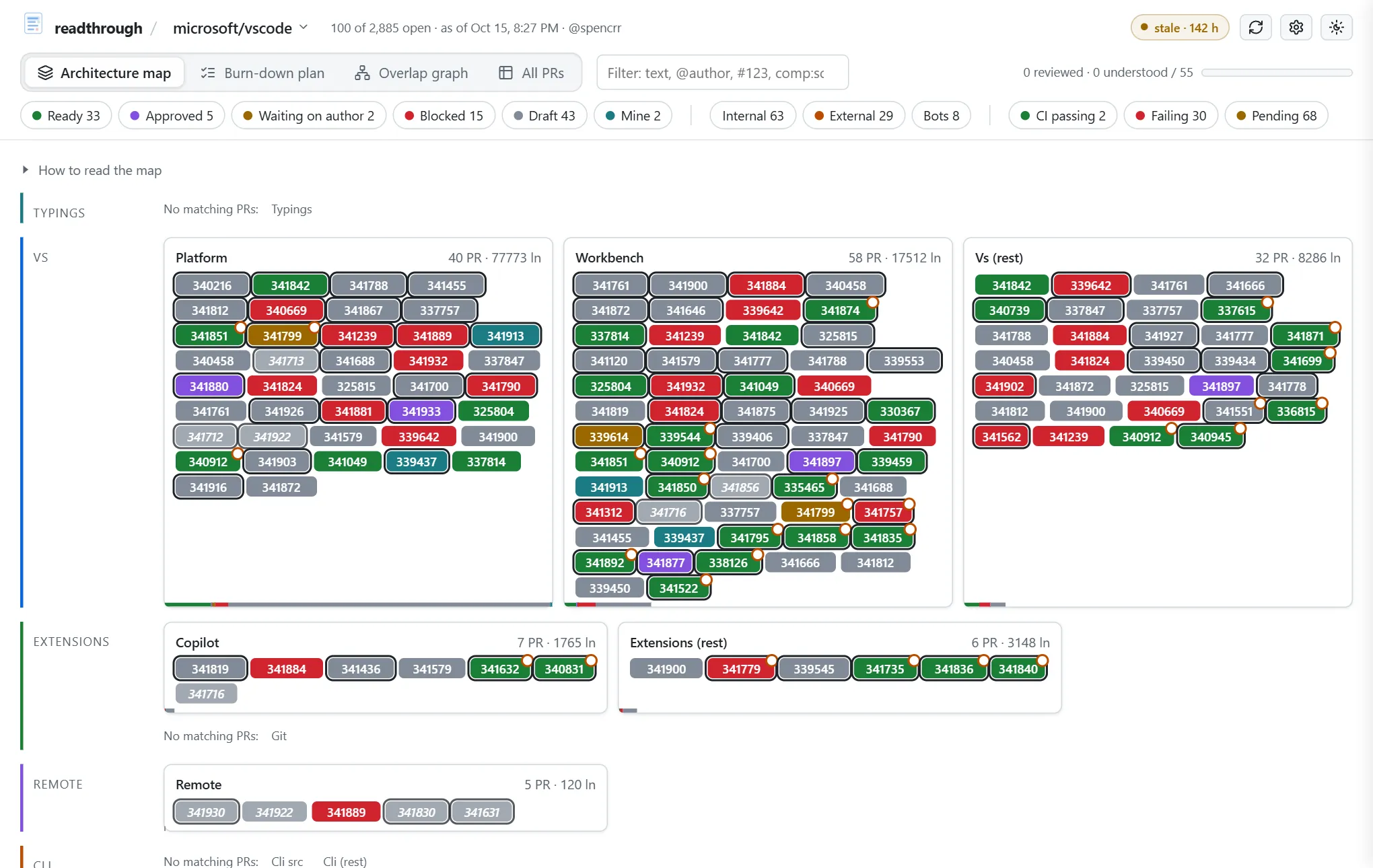
|
|
43
|
+
|
|
44
|
+
## A repo has to be onboarded first
|
|
45
|
+
|
|
46
|
+
The map is only as good as readthrough's idea of the architecture, so before it lays out a repo you check that idea with it. Onboarding (in the browser at `/setup`, or `readthrough onboard`) drafts an architecture profile from the code, CODEOWNERS, the docs, and where recent PRs actually changed things, measures it against those PRs, and won't accept it until it covers them. A model can write the draft for you by reading the repo. Repos can ship their own profile as `readthrough.toml` (in `.github/`, `.gitlab/`, or the root), and a team can keep a directory of profiles for repos that can't.
|
|
47
|
+
|
|
48
|
+
## Quick start
|
|
49
|
+
|
|
50
|
+
You need Python 3.11 or newer, [uv](https://docs.astral.sh/uv/), and, for GitHub repos, the GitHub CLI signed in (`gh auth login`). For deep reviews, the [Copilot CLI](https://github.com/github/copilot-cli) or [Claude Code](https://docs.anthropic.com/en/docs/claude-code) signed in; for the Study tab's model assistant, the `[study]` extra (GitHub Copilot) or an API key for Claude or OpenAI.
|
|
51
|
+
|
|
52
|
+
```sh
|
|
53
|
+
uv tool install "readthrough[study]" # from PyPI; drop [study] to skip the Copilot SDK
|
|
54
|
+
|
|
55
|
+
readthrough onboard microsoft/vscode --accept # map the repo's architecture (edit the draft first if you like)
|
|
56
|
+
readthrough build --open # fetch the PRs and open the dashboard
|
|
57
|
+
```
|
|
58
|
+
|
|
59
|
+
Repos elsewhere take a `--forge`: `readthrough onboard --forge forgejo forgejo/forgejo`, `--forge gitlab gitlab-org/cli`, or `--forge ado organization/project/repository`. Those are read through the platform's REST API, with a token from its own CLI (`glab`, `az`) or an environment variable when there is one, and anonymously otherwise, which is enough for public repos.
|
|
60
|
+
|
|
61
|
+
That gives you a static dashboard you rebuild when you want. For one that stays fresh, run the live server (`readthrough serve`, or `readthrough install server` to start it at logon on Windows) and open <http://127.0.0.1:8765/>; with nothing onboarded yet it walks you through onboarding, with a model drafting the profile if you like. `readthrough install skill` teaches the review agents the deep-review routine, and `readthrough doctor` tells you what's missing.
|
|
62
|
+
|
|
63
|
+
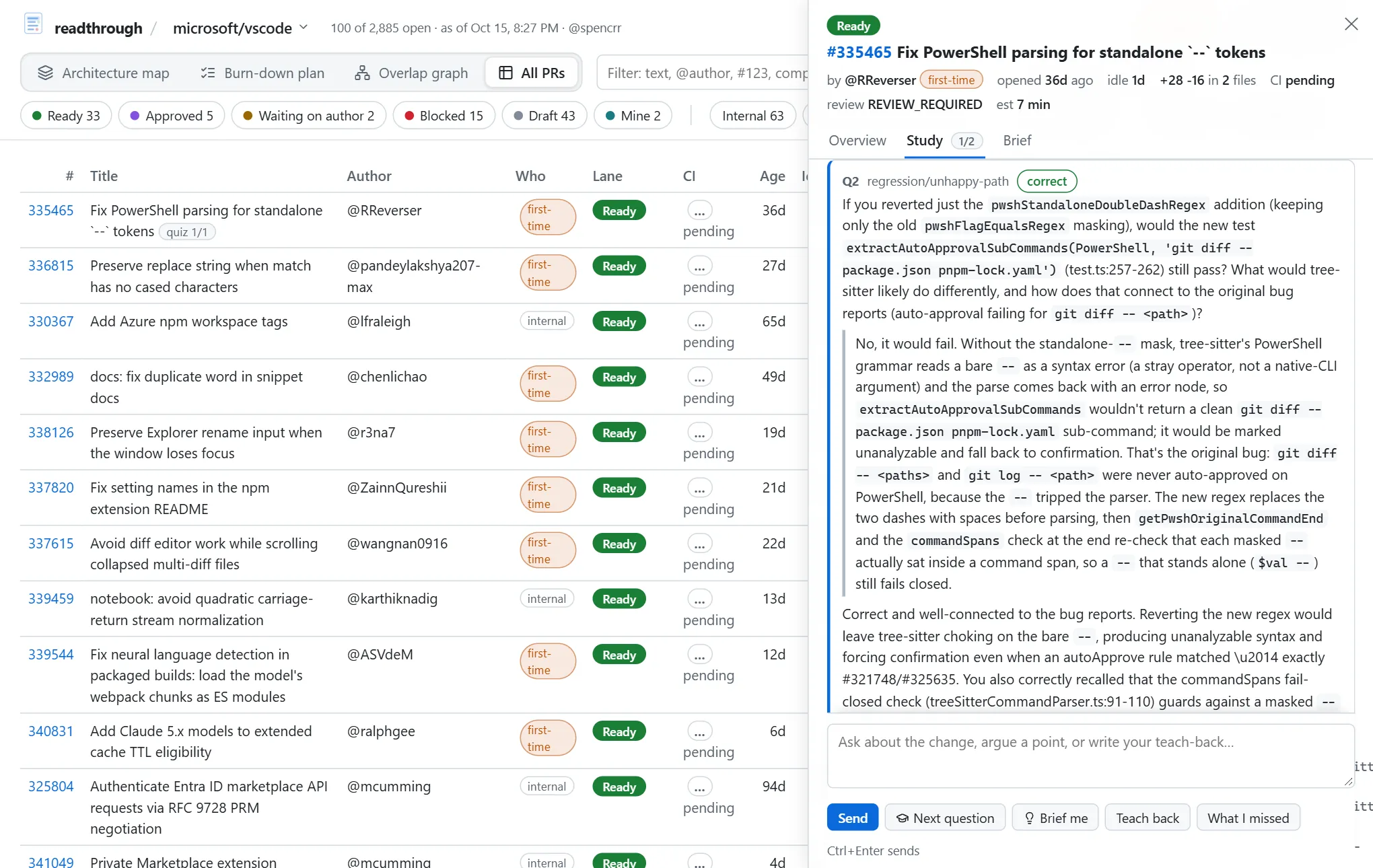
|
|
64
|
+
|
|
65
|
+
## Docs
|
|
66
|
+
|
|
67
|
+
- [Using readthrough](https://github.com/spencrr/readthrough/blob/main/docs/guide.md): onboarding, the dashboard, deep reviews, studying, keeping it fresh, configuration, and troubleshooting.
|
|
68
|
+
- [Writing a profile](https://github.com/spencrr/readthrough/blob/main/docs/profiles.md): how to describe a repo's architecture well, and how to share it.
|
|
69
|
+
- [Maintaining readthrough](https://github.com/spencrr/readthrough/blob/main/docs/maintaining.md): the checks, error handling, logging, settings, plugins, and the pages' structure.
|
|
70
|
+
- [Working on readthrough](AGENTS.md): the exact commands and the conventions that aren't obvious.
|
|
71
|
+
- [Examples](examples/): runnable scripts, including one that needs nothing but the standard library.
|
|
72
|
+
- [Changelog](CHANGELOG.md).
|
|
73
|
+
|
|
74
|
+
## How it's put together
|
|
75
|
+
|
|
76
|
+
One package, `src/readthrough`, with no runtime dependencies beyond the standard library (and the `gh` CLI for GitHub repos); the `[study]` extra adds the GitHub Copilot SDK (one of the model runtimes the study assistant can run on; the Anthropic and OpenAI ones need only a key).
|
|
77
|
+
|
|
78
|
+
```
|
|
79
|
+
cli.py the commands; every failure ends in one line or an error id
|
|
80
|
+
config.py config.toml: repos, machine-wide choices, validated with did-you-mean errors
|
|
81
|
+
tuning.py operational numbers, typed and ranged; defaults.toml documents them
|
|
82
|
+
limits.py safety limits that only change by a deliberate commit
|
|
83
|
+
profile.py architecture profiles, and where a repo's comes from (a registry of sources)
|
|
84
|
+
onboard.py drafting a profile from the repo and measuring it against recent PRs
|
|
85
|
+
onboard_model.py the same, with a model reading the repo (on the configured runtime)
|
|
86
|
+
model.py the pull request as the analysis sees it, whichever forge it came from
|
|
87
|
+
forges/ a registry of forge adapters: github (gh), gitlab, forgejo, azure_devops (REST); the diff cache
|
|
88
|
+
faults.py how outside calls fail, classified from a CLI's stderr or an HTTP status
|
|
89
|
+
process.py running programs: UTF-8, timeouts, secrets that never reach a log
|
|
90
|
+
build.py one build: fetch, analyze, write data.json, the dashboard, and the briefs
|
|
91
|
+
analyze.py lanes, signals, line heuristics, overlaps, and the burn-down plan
|
|
92
|
+
ci.py which checks are required, failing, or also failing on main
|
|
93
|
+
brief.py the Markdown brief a reviewer reads before the diff
|
|
94
|
+
review.py deep-review sessions, worktrees, and the index linking agent sessions to PRs
|
|
95
|
+
agents.py a registry of review agents: copilot (the Copilot CLI) and claude (Claude Code)
|
|
96
|
+
study.py the append-only study log and its rendering into the brief
|
|
97
|
+
engine.py the Study tab's loop: records the learner's side, runs the assistant
|
|
98
|
+
assistants.py a registry of study assistants: the model one (reads code, grades) and rules (no model)
|
|
99
|
+
runtimes/ a registry of model runtimes the assistant runs on: copilot (the SDK), anthropic, openai
|
|
100
|
+
usage.py the usage ledger: every model call, in the provider's own units, and who paid
|
|
101
|
+
terminals.py a registry of terminal launchers for review sessions
|
|
102
|
+
registry.py the generic plugin registry with validated per-plugin options
|
|
103
|
+
serve.py the live server: refreshes, pushes changes to open pages, watches the config
|
|
104
|
+
web_setup.py the API behind the browser's onboarding and settings page
|
|
105
|
+
system.py the readthrough:// URL handler and the Windows scheduled tasks
|
|
106
|
+
logs.py the logger: build context on every line, error ids, JSON format
|
|
107
|
+
assets/web/ the pages as separate HTML, CSS, and JS, inlined into one served file
|
|
108
|
+
assets/vendor/ Cytoscape, marked, DOMPurify, and Lucide icons, with their licenses
|
|
109
|
+
```
|
|
110
|
+
|
|
111
|
+
To extend it: a new forge, a new place profiles can come from, a new review agent, a new terminal, or a new study assistant is a registry entry with an options dataclass, described in [Maintaining readthrough](https://github.com/spencrr/readthrough/blob/main/docs/maintaining.md#plugins). Everything repo-specific is data in a profile, described in [Writing a profile](https://github.com/spencrr/readthrough/blob/main/docs/profiles.md).
|
|
112
|
+
|
|
113
|
+
## Development
|
|
114
|
+
|
|
115
|
+
```sh
|
|
116
|
+
git clone https://github.com/spencrr/readthrough.git
|
|
117
|
+
cd readthrough
|
|
118
|
+
uv sync
|
|
119
|
+
git config core.hooksPath .githooks # once: run the checks before every commit
|
|
120
|
+
uv run python scripts/check.py # lint, format, types, and tests with the coverage floor
|
|
121
|
+
```
|
|
122
|
+
|
|
123
|
+
The same gate runs in CI on Linux, macOS, and Windows for every supported Python. The browser tests use an installed Edge or Chrome; locally they skip without one, on CI they fail. See [SECURITY.md](https://github.com/spencrr/readthrough/blob/main/SECURITY.md) for what the tool trusts and how to report a vulnerability.
|