pyworkforce 0.5.3__tar.gz → 0.6.0__tar.gz
This diff represents the content of publicly available package versions that have been released to one of the supported registries. The information contained in this diff is provided for informational purposes only and reflects changes between package versions as they appear in their respective public registries.
- pyworkforce-0.6.0/PKG-INFO +221 -0
- pyworkforce-0.6.0/README.md +183 -0
- {pyworkforce-0.5.3 → pyworkforce-0.6.0}/pyproject.toml +16 -3
- pyworkforce-0.6.0/pyworkforce/_version.py +1 -0
- pyworkforce-0.6.0/pyworkforce/plotting.py +73 -0
- {pyworkforce-0.5.3 → pyworkforce-0.6.0}/pyworkforce/queuing/erlang.py +39 -3
- {pyworkforce-0.5.3 → pyworkforce-0.6.0}/pyworkforce/queuing/tests/test_erlang.py +28 -0
- pyworkforce-0.6.0/pyworkforce/scheduling/base.py +213 -0
- {pyworkforce-0.5.3 → pyworkforce-0.6.0}/pyworkforce/scheduling/shifts_selection.py +33 -59
- {pyworkforce-0.5.3 → pyworkforce-0.6.0}/pyworkforce/scheduling/tests/test_shifts.py +121 -9
- pyworkforce-0.6.0/pyworkforce/tests/test_plotting.py +53 -0
- pyworkforce-0.6.0/pyworkforce.egg-info/PKG-INFO +221 -0
- {pyworkforce-0.5.3 → pyworkforce-0.6.0}/pyworkforce.egg-info/SOURCES.txt +2 -0
- {pyworkforce-0.5.3 → pyworkforce-0.6.0}/pyworkforce.egg-info/requires.txt +3 -0
- pyworkforce-0.5.3/PKG-INFO +0 -319
- pyworkforce-0.5.3/README.md +0 -285
- pyworkforce-0.5.3/pyworkforce/_version.py +0 -1
- pyworkforce-0.5.3/pyworkforce/scheduling/base.py +0 -97
- pyworkforce-0.5.3/pyworkforce.egg-info/PKG-INFO +0 -319
- {pyworkforce-0.5.3 → pyworkforce-0.6.0}/LICENSE +0 -0
- {pyworkforce-0.5.3 → pyworkforce-0.6.0}/pyworkforce/__init__.py +0 -0
- {pyworkforce-0.5.3 → pyworkforce-0.6.0}/pyworkforce/base.py +0 -0
- {pyworkforce-0.5.3 → pyworkforce-0.6.0}/pyworkforce/breaks/__init__.py +0 -0
- {pyworkforce-0.5.3 → pyworkforce-0.6.0}/pyworkforce/breaks/break_scheduler.py +0 -0
- {pyworkforce-0.5.3 → pyworkforce-0.6.0}/pyworkforce/breaks/tests/__init__.py +0 -0
- {pyworkforce-0.5.3 → pyworkforce-0.6.0}/pyworkforce/breaks/tests/test_break_scheduler.py +0 -0
- {pyworkforce-0.5.3 → pyworkforce-0.6.0}/pyworkforce/queuing/__init__.py +0 -0
- {pyworkforce-0.5.3 → pyworkforce-0.6.0}/pyworkforce/queuing/abandonment.py +0 -0
- {pyworkforce-0.5.3 → pyworkforce-0.6.0}/pyworkforce/queuing/erlang_b.py +0 -0
- {pyworkforce-0.5.3 → pyworkforce-0.6.0}/pyworkforce/queuing/tests/__init__.py +0 -0
- {pyworkforce-0.5.3 → pyworkforce-0.6.0}/pyworkforce/queuing/tests/test_abandonment.py +0 -0
- {pyworkforce-0.5.3 → pyworkforce-0.6.0}/pyworkforce/queuing/tests/test_erlang_b.py +0 -0
- {pyworkforce-0.5.3 → pyworkforce-0.6.0}/pyworkforce/queuing/tests/test_multi_abandonment.py +0 -0
- {pyworkforce-0.5.3 → pyworkforce-0.6.0}/pyworkforce/queuing/tests/test_multi_erlang.py +0 -0
- {pyworkforce-0.5.3 → pyworkforce-0.6.0}/pyworkforce/rostering/__init__.py +0 -0
- {pyworkforce-0.5.3 → pyworkforce-0.6.0}/pyworkforce/rostering/binary_programming.py +0 -0
- {pyworkforce-0.5.3 → pyworkforce-0.6.0}/pyworkforce/rostering/tests/__init__.py +0 -0
- {pyworkforce-0.5.3 → pyworkforce-0.6.0}/pyworkforce/rostering/tests/rostering_data.json +0 -0
- {pyworkforce-0.5.3 → pyworkforce-0.6.0}/pyworkforce/rostering/tests/test_rostering.py +0 -0
- {pyworkforce-0.5.3 → pyworkforce-0.6.0}/pyworkforce/rostering/tests/test_validation.py +0 -0
- {pyworkforce-0.5.3 → pyworkforce-0.6.0}/pyworkforce/scheduling/__init__.py +0 -0
- {pyworkforce-0.5.3 → pyworkforce-0.6.0}/pyworkforce/scheduling/tests/__init__.py +0 -0
- {pyworkforce-0.5.3 → pyworkforce-0.6.0}/pyworkforce/scheduling/tests/test_utils.py +0 -0
- {pyworkforce-0.5.3 → pyworkforce-0.6.0}/pyworkforce/scheduling/tests/test_validation.py +0 -0
- {pyworkforce-0.5.3 → pyworkforce-0.6.0}/pyworkforce/scheduling/utils.py +0 -0
- {pyworkforce-0.5.3 → pyworkforce-0.6.0}/pyworkforce/shifts/__init__.py +0 -0
- {pyworkforce-0.5.3 → pyworkforce-0.6.0}/pyworkforce/shifts/coverage.py +0 -0
- {pyworkforce-0.5.3 → pyworkforce-0.6.0}/pyworkforce/shifts/tests/__init__.py +0 -0
- {pyworkforce-0.5.3 → pyworkforce-0.6.0}/pyworkforce/shifts/tests/test_coverage.py +0 -0
- {pyworkforce-0.5.3 → pyworkforce-0.6.0}/pyworkforce/staffing/__init__.py +0 -0
- {pyworkforce-0.5.3 → pyworkforce-0.6.0}/pyworkforce/staffing/multi_skill.py +0 -0
- {pyworkforce-0.5.3 → pyworkforce-0.6.0}/pyworkforce/staffing/tests/__init__.py +0 -0
- {pyworkforce-0.5.3 → pyworkforce-0.6.0}/pyworkforce/staffing/tests/test_multi_skill.py +0 -0
- {pyworkforce-0.5.3 → pyworkforce-0.6.0}/pyworkforce/tests/__init__.py +0 -0
- {pyworkforce-0.5.3 → pyworkforce-0.6.0}/pyworkforce/tests/test_base.py +0 -0
- {pyworkforce-0.5.3 → pyworkforce-0.6.0}/pyworkforce/utils/__init__.py +0 -0
- {pyworkforce-0.5.3 → pyworkforce-0.6.0}/pyworkforce/utils/frames.py +0 -0
- {pyworkforce-0.5.3 → pyworkforce-0.6.0}/pyworkforce/utils/grid.py +0 -0
- {pyworkforce-0.5.3 → pyworkforce-0.6.0}/pyworkforce/utils/tests/__init__.py +0 -0
- {pyworkforce-0.5.3 → pyworkforce-0.6.0}/pyworkforce/utils/tests/test_frames.py +0 -0
- {pyworkforce-0.5.3 → pyworkforce-0.6.0}/pyworkforce/utils/tests/test_parameter_grid.py +0 -0
- {pyworkforce-0.5.3 → pyworkforce-0.6.0}/pyworkforce/utils/tests/test_validation.py +0 -0
- {pyworkforce-0.5.3 → pyworkforce-0.6.0}/pyworkforce/utils/validation.py +0 -0
- {pyworkforce-0.5.3 → pyworkforce-0.6.0}/pyworkforce.egg-info/dependency_links.txt +0 -0
- {pyworkforce-0.5.3 → pyworkforce-0.6.0}/pyworkforce.egg-info/top_level.txt +0 -0
- {pyworkforce-0.5.3 → pyworkforce-0.6.0}/setup.cfg +0 -0
|
@@ -0,0 +1,221 @@
|
|
|
1
|
+
Metadata-Version: 2.4
|
|
2
|
+
Name: pyworkforce
|
|
3
|
+
Version: 0.6.0
|
|
4
|
+
Summary: Practical workforce planning tools for queue staffing, shift scheduling, rostering, breaks, and operations research in Python
|
|
5
|
+
Author-email: Rodrigo Arenas <rodrigo.arenas456@gmail.com>
|
|
6
|
+
License-Expression: MIT
|
|
7
|
+
Project-URL: Documentation, https://pyworkforce.rodrigo-arenas.com/
|
|
8
|
+
Project-URL: Source Code, https://github.com/rodrigo-arenas/pyworkforce
|
|
9
|
+
Project-URL: Bug Tracker, https://github.com/rodrigo-arenas/pyworkforce/issues
|
|
10
|
+
Project-URL: Changelog, https://pyworkforce.rodrigo-arenas.com/stable/release-notes
|
|
11
|
+
Keywords: workforce management,workforce planning,call center,contact center,call center staffing,contact center staffing,erlang,erlang c,erlang a,erlang b,scheduling,shift scheduling,rostering,employee rostering,operations research,or-tools,optimization
|
|
12
|
+
Classifier: Development Status :: 4 - Beta
|
|
13
|
+
Classifier: Intended Audience :: Science/Research
|
|
14
|
+
Classifier: Intended Audience :: Developers
|
|
15
|
+
Classifier: Topic :: Scientific/Engineering
|
|
16
|
+
Classifier: Topic :: Scientific/Engineering :: Mathematics
|
|
17
|
+
Classifier: Topic :: Office/Business :: Scheduling
|
|
18
|
+
Classifier: Operating System :: OS Independent
|
|
19
|
+
Classifier: Programming Language :: Python :: 3
|
|
20
|
+
Classifier: Programming Language :: Python :: 3.12
|
|
21
|
+
Classifier: Programming Language :: Python :: 3.13
|
|
22
|
+
Classifier: Programming Language :: Python :: 3.14
|
|
23
|
+
Requires-Python: <3.15,>=3.12
|
|
24
|
+
Description-Content-Type: text/markdown
|
|
25
|
+
License-File: LICENSE
|
|
26
|
+
Requires-Dist: numpy>=1.23
|
|
27
|
+
Requires-Dist: pandas>=2.2.0
|
|
28
|
+
Requires-Dist: ortools>=9.6
|
|
29
|
+
Requires-Dist: joblib>=1.4.2
|
|
30
|
+
Provides-Extra: plot
|
|
31
|
+
Requires-Dist: matplotlib>=3.8; extra == "plot"
|
|
32
|
+
Provides-Extra: dev
|
|
33
|
+
Requires-Dist: pytest>=9.1.1; extra == "dev"
|
|
34
|
+
Requires-Dist: pytest-cov>=7.1.0; extra == "dev"
|
|
35
|
+
Requires-Dist: ruff>=0.15.20; extra == "dev"
|
|
36
|
+
Requires-Dist: twine>=6.2.0; extra == "dev"
|
|
37
|
+
Dynamic: license-file
|
|
38
|
+
|
|
39
|
+
[](https://github.com/rodrigo-arenas/pyworkforce/actions/workflows/ci-tests.yml)
|
|
40
|
+
[](https://codecov.io/github/rodrigo-arenas/pyworkforce?branch=main)
|
|
41
|
+
[](https://pypi.org/project/pyworkforce/)
|
|
42
|
+
[](https://www.python.org/downloads/)
|
|
43
|
+
[](https://pyworkforce.rodrigo-arenas.com/stable/)
|
|
44
|
+
|
|
45
|
+
# pyworkforce
|
|
46
|
+
|
|
47
|
+
**Practical workforce planning in Python: queue staffing, shift scheduling, rostering, and breaks.**
|
|
48
|
+
|
|
49
|
+
pyworkforce helps teams turn variable demand into staffing decisions with a friendly,
|
|
50
|
+
scikit-learn-like API. It combines Erlang queueing models and OR-Tools
|
|
51
|
+
constraint programming so workforce analysts, data scientists, operations
|
|
52
|
+
researchers, and Python developers can move from forecast volumes to workable
|
|
53
|
+
staffing plans without building every solver from scratch.
|
|
54
|
+
|
|
55
|
+
It is useful for contact centers and call centers, but the same patterns apply
|
|
56
|
+
to healthcare staffing, retail operations, logistics, support teams, service
|
|
57
|
+
desks, and field operations.
|
|
58
|
+
|
|
59
|
+
**Docs:** [pyworkforce.rodrigo-arenas.com](https://pyworkforce.rodrigo-arenas.com/stable/)
|
|
60
|
+
**Package:** [PyPI](https://pypi.org/project/pyworkforce/)
|
|
61
|
+
**Examples:** [examples/](examples/)
|
|
62
|
+
|
|
63
|
+
## Why pyworkforce?
|
|
64
|
+
|
|
65
|
+
- **More practical than spreadsheets:** reusable models, scenario sweeps, tested
|
|
66
|
+
calculations, and outputs that fit naturally into pandas workflows.
|
|
67
|
+
- **Faster than custom scripts:** common workforce planning steps are packaged
|
|
68
|
+
behind consistent constructors, `solve()` methods, validation, and clear
|
|
69
|
+
result dictionaries.
|
|
70
|
+
- **Lighter than enterprise WFM tools:** use it inside notebooks, pipelines,
|
|
71
|
+
internal apps, simulations, or decision-support workflows without adopting a
|
|
72
|
+
full platform.
|
|
73
|
+
- **Built on proven methods:** Erlang C, Erlang A, and Erlang B for queue
|
|
74
|
+
staffing; OR-Tools CP-SAT for scheduling, rostering, and break placement.
|
|
75
|
+
- **Designed for adoption:** small examples, copy-paste tutorials, and APIs that
|
|
76
|
+
feel familiar to Python users.
|
|
77
|
+
|
|
78
|
+
## Installation
|
|
79
|
+
|
|
80
|
+
```bash
|
|
81
|
+
pip install pyworkforce
|
|
82
|
+
```
|
|
83
|
+
|
|
84
|
+
pyworkforce supports Python 3.12, 3.13, and 3.14.
|
|
85
|
+
|
|
86
|
+
Install the plotting extra to explore coverage and Erlang C staffing curves
|
|
87
|
+
with Matplotlib:
|
|
88
|
+
|
|
89
|
+
```bash
|
|
90
|
+
pip install "pyworkforce[plot]"
|
|
91
|
+
```
|
|
92
|
+
|
|
93
|
+
The [schedule stress-test tutorial](https://pyworkforce.rodrigo-arenas.com/stable/guide/coverage-scenarios)
|
|
94
|
+
shows how to set staffing limits by shift and compare a solved plan against
|
|
95
|
+
multiple demand forecasts. The [Erlang C staffing curve tutorial](https://pyworkforce.rodrigo-arenas.com/stable/guide/staffing-curve)
|
|
96
|
+
shows how to choose a headcount against service and occupancy targets.
|
|
97
|
+
|
|
98
|
+
## Planning pipeline
|
|
99
|
+
|
|
100
|
+
```text
|
|
101
|
+
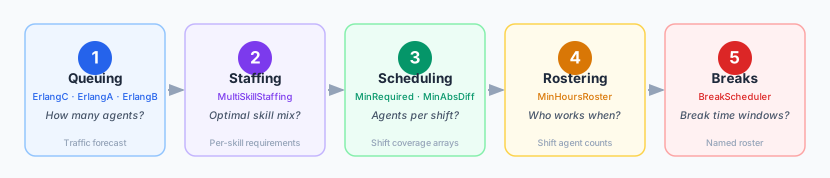
Forecast demand -> Queue staffing -> Multi-skill staffing -> Shift scheduling -> Rostering -> Break scheduling
|
|
102
|
+
```
|
|
103
|
+
|
|
104
|
+
|
|
105
|
+
|
|
106
|
+
| Step | Module | Typical question |
|
|
107
|
+
| --- | --- | --- |
|
|
108
|
+
| Queue staffing | `pyworkforce.queuing` | How many agents or channels do we need for a service target? |
|
|
109
|
+
| Multi-skill staffing | `pyworkforce.staffing` | What skill-profile mix covers all queues at minimum cost? |
|
|
110
|
+
| Shift scheduling | `pyworkforce.scheduling` | How many people should work each shift? |
|
|
111
|
+
| Rostering | `pyworkforce.rostering` | Which named people work on which days and shifts? |
|
|
112
|
+
| Break scheduling | `pyworkforce.breaks` | When can breaks happen without dropping below coverage? |
|
|
113
|
+
|
|
114
|
+
## What can I do in 5 minutes?
|
|
115
|
+
|
|
116
|
+
### Size a contact-center queue with Erlang C
|
|
117
|
+
|
|
118
|
+
```python
|
|
119
|
+
from pyworkforce.queuing import ErlangC
|
|
120
|
+
|
|
121
|
+
erlang = ErlangC(
|
|
122
|
+
transactions=100, # calls in the interval
|
|
123
|
+
aht=3, # average handle time, minutes
|
|
124
|
+
asa=20 / 60, # answer-time target, minutes
|
|
125
|
+
interval=30, # interval length, minutes
|
|
126
|
+
shrinkage=0.30,
|
|
127
|
+
)
|
|
128
|
+
|
|
129
|
+
print(erlang.required_positions(service_level=0.80, max_occupancy=0.85))
|
|
130
|
+
```
|
|
131
|
+
|
|
132
|
+
```text
|
|
133
|
+
{'raw_positions': 14,
|
|
134
|
+
'positions': 20,
|
|
135
|
+
'service_level': 0.8883500191794669,
|
|
136
|
+
'occupancy': 0.7142857142857143,
|
|
137
|
+
'waiting_probability': 0.1741319335950498}
|
|
138
|
+
```
|
|
139
|
+
|
|
140
|
+
`raw_positions` is productive staffing. `positions` adds shrinkage for breaks,
|
|
141
|
+
training, meetings, and other unavailable time.
|
|
142
|
+
|
|
143
|
+
### Compare staffing scenarios
|
|
144
|
+
|
|
145
|
+
```python
|
|
146
|
+
from pyworkforce.queuing import MultiErlangC
|
|
147
|
+
from pyworkforce.utils import results_to_dataframe
|
|
148
|
+
|
|
149
|
+
param_grid = {
|
|
150
|
+
"transactions": [80, 100, 120],
|
|
151
|
+
"aht": [3],
|
|
152
|
+
"asa": [20 / 60],
|
|
153
|
+
"interval": [30],
|
|
154
|
+
"shrinkage": [0.20, 0.30],
|
|
155
|
+
}
|
|
156
|
+
|
|
157
|
+
multi = MultiErlangC(param_grid=param_grid, n_jobs=-1)
|
|
158
|
+
results = multi.required_positions({"service_level": [0.80], "max_occupancy": [0.85]})
|
|
159
|
+
df = results_to_dataframe(results, multi.required_positions_params)
|
|
160
|
+
print(df[["transactions", "shrinkage", "positions", "service_level"]])
|
|
161
|
+
```
|
|
162
|
+
|
|
163
|
+
Use this pattern to compare service levels, shrinkage assumptions, average
|
|
164
|
+
handle time, patience, or arrival forecasts.
|
|
165
|
+
|
|
166
|
+
### Build shift coverage from clock hours
|
|
167
|
+
|
|
168
|
+
```python
|
|
169
|
+
from pyworkforce.shifts import shift_coverage_from_hours
|
|
170
|
+
|
|
171
|
+
shifts_coverage = shift_coverage_from_hours(
|
|
172
|
+
{
|
|
173
|
+
"Morning": (6, 14),
|
|
174
|
+
"Afternoon": (14, 22),
|
|
175
|
+
"Night": (22, 6), # wraps past midnight
|
|
176
|
+
},
|
|
177
|
+
num_periods=24,
|
|
178
|
+
)
|
|
179
|
+
```
|
|
180
|
+
|
|
181
|
+
The result feeds the scheduling solvers directly, avoiding hand-written 0/1
|
|
182
|
+
coverage arrays.
|
|
183
|
+
|
|
184
|
+
## Main capabilities
|
|
185
|
+
|
|
186
|
+
| Capability | Use it when | Start here |
|
|
187
|
+
| --- | --- | --- |
|
|
188
|
+
| Erlang C staffing | Callers wait and abandonment is ignored or negligible | [Erlang C guide](https://pyworkforce.rodrigo-arenas.com/stable/guide/erlangc) |
|
|
189
|
+
| Erlang A staffing | Callers may abandon before being answered | [Erlang A guide](https://pyworkforce.rodrigo-arenas.com/stable/guide/erlanga) |
|
|
190
|
+
| Erlang B channel sizing | Blocked calls are lost because there is no queue | [Erlang B guide](https://pyworkforce.rodrigo-arenas.com/stable/guide/erlangb) |
|
|
191
|
+
| Multi-skill staffing | Agents can cover different skill combinations | [Staffing guide](https://pyworkforce.rodrigo-arenas.com/stable/guide/staffing) |
|
|
192
|
+
| Shift scheduling | You need shift counts from hourly demand | [Scheduling guide](https://pyworkforce.rodrigo-arenas.com/stable/guide/scheduling) |
|
|
193
|
+
| Employee rostering | You need named assignments with rules and preferences | [Rostering guide](https://pyworkforce.rodrigo-arenas.com/stable/guide/rostering) |
|
|
194
|
+
| Break scheduling | You need meal/rest breaks while maintaining coverage | [Break guide](https://pyworkforce.rodrigo-arenas.com/stable/guide/breaks) |
|
|
195
|
+
|
|
196
|
+
## Project status
|
|
197
|
+
|
|
198
|
+
pyworkforce is beta-stage open source software. The core models are tested and
|
|
199
|
+
usable for real planning experiments, but workforce policies vary by operation,
|
|
200
|
+
country, and labor agreement. Validate assumptions, units, and constraints
|
|
201
|
+
against your own environment before using results operationally.
|
|
202
|
+
|
|
203
|
+
## Documentation
|
|
204
|
+
|
|
205
|
+
- [Get Started](https://pyworkforce.rodrigo-arenas.com/stable/guide/introduction)
|
|
206
|
+
- [Quick Start](https://pyworkforce.rodrigo-arenas.com/stable/guide/quickstart)
|
|
207
|
+
- [End-to-end planning tutorial](https://pyworkforce.rodrigo-arenas.com/stable/guide/end-to-end)
|
|
208
|
+
- [Recipes](https://pyworkforce.rodrigo-arenas.com/stable/recipes/)
|
|
209
|
+
- [API Reference](https://pyworkforce.rodrigo-arenas.com/stable/api/queuing)
|
|
210
|
+
- [Release Notes](https://pyworkforce.rodrigo-arenas.com/stable/release-notes)
|
|
211
|
+
|
|
212
|
+
## Contributing
|
|
213
|
+
|
|
214
|
+
Contributions are welcome: examples, documentation, validation improvements,
|
|
215
|
+
benchmarks, visualization helpers, additional workforce constraints, and bug
|
|
216
|
+
reports all help. See [CONTRIBUTING.md](CONTRIBUTING.md) for local setup,
|
|
217
|
+
tests, docs, and roadmap ideas.
|
|
218
|
+
|
|
219
|
+
## License
|
|
220
|
+
|
|
221
|
+
pyworkforce is released under the [MIT License](LICENSE).
|
|
@@ -0,0 +1,183 @@
|
|
|
1
|
+
[](https://github.com/rodrigo-arenas/pyworkforce/actions/workflows/ci-tests.yml)
|
|
2
|
+
[](https://codecov.io/github/rodrigo-arenas/pyworkforce?branch=main)
|
|
3
|
+
[](https://pypi.org/project/pyworkforce/)
|
|
4
|
+
[](https://www.python.org/downloads/)
|
|
5
|
+
[](https://pyworkforce.rodrigo-arenas.com/stable/)
|
|
6
|
+
|
|
7
|
+
# pyworkforce
|
|
8
|
+
|
|
9
|
+
**Practical workforce planning in Python: queue staffing, shift scheduling, rostering, and breaks.**
|
|
10
|
+
|
|
11
|
+
pyworkforce helps teams turn variable demand into staffing decisions with a friendly,
|
|
12
|
+
scikit-learn-like API. It combines Erlang queueing models and OR-Tools
|
|
13
|
+
constraint programming so workforce analysts, data scientists, operations
|
|
14
|
+
researchers, and Python developers can move from forecast volumes to workable
|
|
15
|
+
staffing plans without building every solver from scratch.
|
|
16
|
+
|
|
17
|
+
It is useful for contact centers and call centers, but the same patterns apply
|
|
18
|
+
to healthcare staffing, retail operations, logistics, support teams, service
|
|
19
|
+
desks, and field operations.
|
|
20
|
+
|
|
21
|
+
**Docs:** [pyworkforce.rodrigo-arenas.com](https://pyworkforce.rodrigo-arenas.com/stable/)
|
|
22
|
+
**Package:** [PyPI](https://pypi.org/project/pyworkforce/)
|
|
23
|
+
**Examples:** [examples/](examples/)
|
|
24
|
+
|
|
25
|
+
## Why pyworkforce?
|
|
26
|
+
|
|
27
|
+
- **More practical than spreadsheets:** reusable models, scenario sweeps, tested
|
|
28
|
+
calculations, and outputs that fit naturally into pandas workflows.
|
|
29
|
+
- **Faster than custom scripts:** common workforce planning steps are packaged
|
|
30
|
+
behind consistent constructors, `solve()` methods, validation, and clear
|
|
31
|
+
result dictionaries.
|
|
32
|
+
- **Lighter than enterprise WFM tools:** use it inside notebooks, pipelines,
|
|
33
|
+
internal apps, simulations, or decision-support workflows without adopting a
|
|
34
|
+
full platform.
|
|
35
|
+
- **Built on proven methods:** Erlang C, Erlang A, and Erlang B for queue
|
|
36
|
+
staffing; OR-Tools CP-SAT for scheduling, rostering, and break placement.
|
|
37
|
+
- **Designed for adoption:** small examples, copy-paste tutorials, and APIs that
|
|
38
|
+
feel familiar to Python users.
|
|
39
|
+
|
|
40
|
+
## Installation
|
|
41
|
+
|
|
42
|
+
```bash
|
|
43
|
+
pip install pyworkforce
|
|
44
|
+
```
|
|
45
|
+
|
|
46
|
+
pyworkforce supports Python 3.12, 3.13, and 3.14.
|
|
47
|
+
|
|
48
|
+
Install the plotting extra to explore coverage and Erlang C staffing curves
|
|
49
|
+
with Matplotlib:
|
|
50
|
+
|
|
51
|
+
```bash
|
|
52
|
+
pip install "pyworkforce[plot]"
|
|
53
|
+
```
|
|
54
|
+
|
|
55
|
+
The [schedule stress-test tutorial](https://pyworkforce.rodrigo-arenas.com/stable/guide/coverage-scenarios)
|
|
56
|
+
shows how to set staffing limits by shift and compare a solved plan against
|
|
57
|
+
multiple demand forecasts. The [Erlang C staffing curve tutorial](https://pyworkforce.rodrigo-arenas.com/stable/guide/staffing-curve)
|
|
58
|
+
shows how to choose a headcount against service and occupancy targets.
|
|
59
|
+
|
|
60
|
+
## Planning pipeline
|
|
61
|
+
|
|
62
|
+
```text
|
|
63
|
+
Forecast demand -> Queue staffing -> Multi-skill staffing -> Shift scheduling -> Rostering -> Break scheduling
|
|
64
|
+
```
|
|
65
|
+
|
|
66
|
+

|
|
67
|
+
|
|
68
|
+
| Step | Module | Typical question |
|
|
69
|
+
| --- | --- | --- |
|
|
70
|
+
| Queue staffing | `pyworkforce.queuing` | How many agents or channels do we need for a service target? |
|
|
71
|
+
| Multi-skill staffing | `pyworkforce.staffing` | What skill-profile mix covers all queues at minimum cost? |
|
|
72
|
+
| Shift scheduling | `pyworkforce.scheduling` | How many people should work each shift? |
|
|
73
|
+
| Rostering | `pyworkforce.rostering` | Which named people work on which days and shifts? |
|
|
74
|
+
| Break scheduling | `pyworkforce.breaks` | When can breaks happen without dropping below coverage? |
|
|
75
|
+
|
|
76
|
+
## What can I do in 5 minutes?
|
|
77
|
+
|
|
78
|
+
### Size a contact-center queue with Erlang C
|
|
79
|
+
|
|
80
|
+
```python
|
|
81
|
+
from pyworkforce.queuing import ErlangC
|
|
82
|
+
|
|
83
|
+
erlang = ErlangC(
|
|
84
|
+
transactions=100, # calls in the interval
|
|
85
|
+
aht=3, # average handle time, minutes
|
|
86
|
+
asa=20 / 60, # answer-time target, minutes
|
|
87
|
+
interval=30, # interval length, minutes
|
|
88
|
+
shrinkage=0.30,
|
|
89
|
+
)
|
|
90
|
+
|
|
91
|
+
print(erlang.required_positions(service_level=0.80, max_occupancy=0.85))
|
|
92
|
+
```
|
|
93
|
+
|
|
94
|
+
```text
|
|
95
|
+
{'raw_positions': 14,
|
|
96
|
+
'positions': 20,
|
|
97
|
+
'service_level': 0.8883500191794669,
|
|
98
|
+
'occupancy': 0.7142857142857143,
|
|
99
|
+
'waiting_probability': 0.1741319335950498}
|
|
100
|
+
```
|
|
101
|
+
|
|
102
|
+
`raw_positions` is productive staffing. `positions` adds shrinkage for breaks,
|
|
103
|
+
training, meetings, and other unavailable time.
|
|
104
|
+
|
|
105
|
+
### Compare staffing scenarios
|
|
106
|
+
|
|
107
|
+
```python
|
|
108
|
+
from pyworkforce.queuing import MultiErlangC
|
|
109
|
+
from pyworkforce.utils import results_to_dataframe
|
|
110
|
+
|
|
111
|
+
param_grid = {
|
|
112
|
+
"transactions": [80, 100, 120],
|
|
113
|
+
"aht": [3],
|
|
114
|
+
"asa": [20 / 60],
|
|
115
|
+
"interval": [30],
|
|
116
|
+
"shrinkage": [0.20, 0.30],
|
|
117
|
+
}
|
|
118
|
+
|
|
119
|
+
multi = MultiErlangC(param_grid=param_grid, n_jobs=-1)
|
|
120
|
+
results = multi.required_positions({"service_level": [0.80], "max_occupancy": [0.85]})
|
|
121
|
+
df = results_to_dataframe(results, multi.required_positions_params)
|
|
122
|
+
print(df[["transactions", "shrinkage", "positions", "service_level"]])
|
|
123
|
+
```
|
|
124
|
+
|
|
125
|
+
Use this pattern to compare service levels, shrinkage assumptions, average
|
|
126
|
+
handle time, patience, or arrival forecasts.
|
|
127
|
+
|
|
128
|
+
### Build shift coverage from clock hours
|
|
129
|
+
|
|
130
|
+
```python
|
|
131
|
+
from pyworkforce.shifts import shift_coverage_from_hours
|
|
132
|
+
|
|
133
|
+
shifts_coverage = shift_coverage_from_hours(
|
|
134
|
+
{
|
|
135
|
+
"Morning": (6, 14),
|
|
136
|
+
"Afternoon": (14, 22),
|
|
137
|
+
"Night": (22, 6), # wraps past midnight
|
|
138
|
+
},
|
|
139
|
+
num_periods=24,
|
|
140
|
+
)
|
|
141
|
+
```
|
|
142
|
+
|
|
143
|
+
The result feeds the scheduling solvers directly, avoiding hand-written 0/1
|
|
144
|
+
coverage arrays.
|
|
145
|
+
|
|
146
|
+
## Main capabilities
|
|
147
|
+
|
|
148
|
+
| Capability | Use it when | Start here |
|
|
149
|
+
| --- | --- | --- |
|
|
150
|
+
| Erlang C staffing | Callers wait and abandonment is ignored or negligible | [Erlang C guide](https://pyworkforce.rodrigo-arenas.com/stable/guide/erlangc) |
|
|
151
|
+
| Erlang A staffing | Callers may abandon before being answered | [Erlang A guide](https://pyworkforce.rodrigo-arenas.com/stable/guide/erlanga) |
|
|
152
|
+
| Erlang B channel sizing | Blocked calls are lost because there is no queue | [Erlang B guide](https://pyworkforce.rodrigo-arenas.com/stable/guide/erlangb) |
|
|
153
|
+
| Multi-skill staffing | Agents can cover different skill combinations | [Staffing guide](https://pyworkforce.rodrigo-arenas.com/stable/guide/staffing) |
|
|
154
|
+
| Shift scheduling | You need shift counts from hourly demand | [Scheduling guide](https://pyworkforce.rodrigo-arenas.com/stable/guide/scheduling) |
|
|
155
|
+
| Employee rostering | You need named assignments with rules and preferences | [Rostering guide](https://pyworkforce.rodrigo-arenas.com/stable/guide/rostering) |
|
|
156
|
+
| Break scheduling | You need meal/rest breaks while maintaining coverage | [Break guide](https://pyworkforce.rodrigo-arenas.com/stable/guide/breaks) |
|
|
157
|
+
|
|
158
|
+
## Project status
|
|
159
|
+
|
|
160
|
+
pyworkforce is beta-stage open source software. The core models are tested and
|
|
161
|
+
usable for real planning experiments, but workforce policies vary by operation,
|
|
162
|
+
country, and labor agreement. Validate assumptions, units, and constraints
|
|
163
|
+
against your own environment before using results operationally.
|
|
164
|
+
|
|
165
|
+
## Documentation
|
|
166
|
+
|
|
167
|
+
- [Get Started](https://pyworkforce.rodrigo-arenas.com/stable/guide/introduction)
|
|
168
|
+
- [Quick Start](https://pyworkforce.rodrigo-arenas.com/stable/guide/quickstart)
|
|
169
|
+
- [End-to-end planning tutorial](https://pyworkforce.rodrigo-arenas.com/stable/guide/end-to-end)
|
|
170
|
+
- [Recipes](https://pyworkforce.rodrigo-arenas.com/stable/recipes/)
|
|
171
|
+
- [API Reference](https://pyworkforce.rodrigo-arenas.com/stable/api/queuing)
|
|
172
|
+
- [Release Notes](https://pyworkforce.rodrigo-arenas.com/stable/release-notes)
|
|
173
|
+
|
|
174
|
+
## Contributing
|
|
175
|
+
|
|
176
|
+
Contributions are welcome: examples, documentation, validation improvements,
|
|
177
|
+
benchmarks, visualization helpers, additional workforce constraints, and bug
|
|
178
|
+
reports all help. See [CONTRIBUTING.md](CONTRIBUTING.md) for local setup,
|
|
179
|
+
tests, docs, and roadmap ideas.
|
|
180
|
+
|
|
181
|
+
## License
|
|
182
|
+
|
|
183
|
+
pyworkforce is released under the [MIT License](LICENSE).
|
|
@@ -5,7 +5,7 @@ build-backend = "setuptools.build_meta"
|
|
|
5
5
|
[project]
|
|
6
6
|
name = "pyworkforce"
|
|
7
7
|
dynamic = ["version"]
|
|
8
|
-
description = "
|
|
8
|
+
description = "Practical workforce planning tools for queue staffing, shift scheduling, rostering, breaks, and operations research in Python"
|
|
9
9
|
readme = "README.md"
|
|
10
10
|
requires-python = ">=3.12,<3.15"
|
|
11
11
|
license = "MIT"
|
|
@@ -15,11 +15,21 @@ authors = [
|
|
|
15
15
|
]
|
|
16
16
|
keywords = [
|
|
17
17
|
"workforce management",
|
|
18
|
+
"workforce planning",
|
|
18
19
|
"call center",
|
|
20
|
+
"contact center",
|
|
21
|
+
"call center staffing",
|
|
22
|
+
"contact center staffing",
|
|
19
23
|
"erlang",
|
|
24
|
+
"erlang c",
|
|
25
|
+
"erlang a",
|
|
26
|
+
"erlang b",
|
|
20
27
|
"scheduling",
|
|
28
|
+
"shift scheduling",
|
|
21
29
|
"rostering",
|
|
30
|
+
"employee rostering",
|
|
22
31
|
"operations research",
|
|
32
|
+
"or-tools",
|
|
23
33
|
"optimization",
|
|
24
34
|
]
|
|
25
35
|
classifiers = [
|
|
@@ -27,6 +37,8 @@ classifiers = [
|
|
|
27
37
|
"Intended Audience :: Science/Research",
|
|
28
38
|
"Intended Audience :: Developers",
|
|
29
39
|
"Topic :: Scientific/Engineering",
|
|
40
|
+
"Topic :: Scientific/Engineering :: Mathematics",
|
|
41
|
+
"Topic :: Office/Business :: Scheduling",
|
|
30
42
|
"Operating System :: OS Independent",
|
|
31
43
|
"Programming Language :: Python :: 3",
|
|
32
44
|
"Programming Language :: Python :: 3.12",
|
|
@@ -41,6 +53,7 @@ dependencies = [
|
|
|
41
53
|
]
|
|
42
54
|
|
|
43
55
|
[project.optional-dependencies]
|
|
56
|
+
plot = ["matplotlib>=3.8"]
|
|
44
57
|
dev = [
|
|
45
58
|
"pytest>=9.1.1",
|
|
46
59
|
"pytest-cov>=7.1.0",
|
|
@@ -49,10 +62,10 @@ dev = [
|
|
|
49
62
|
]
|
|
50
63
|
|
|
51
64
|
[project.urls]
|
|
52
|
-
Documentation = "https://rodrigo-arenas.
|
|
65
|
+
Documentation = "https://pyworkforce.rodrigo-arenas.com/"
|
|
53
66
|
"Source Code" = "https://github.com/rodrigo-arenas/pyworkforce"
|
|
54
67
|
"Bug Tracker" = "https://github.com/rodrigo-arenas/pyworkforce/issues"
|
|
55
|
-
Changelog = "https://rodrigo-arenas.
|
|
68
|
+
Changelog = "https://pyworkforce.rodrigo-arenas.com/stable/release-notes"
|
|
56
69
|
|
|
57
70
|
[tool.setuptools]
|
|
58
71
|
include-package-data = true
|
|
@@ -0,0 +1 @@
|
|
|
1
|
+
__version__ = "0.6.0"
|
|
@@ -0,0 +1,73 @@
|
|
|
1
|
+
"""Optional Matplotlib charts for inspecting workforce plans and queue staffing."""
|
|
2
|
+
|
|
3
|
+
import numpy as np
|
|
4
|
+
|
|
5
|
+
__all__ = ["plot_coverage", "plot_staffing_curve"]
|
|
6
|
+
|
|
7
|
+
|
|
8
|
+
def _axes(ax):
|
|
9
|
+
if ax is not None:
|
|
10
|
+
return ax
|
|
11
|
+
try:
|
|
12
|
+
from matplotlib import pyplot as plt
|
|
13
|
+
except ModuleNotFoundError as exc:
|
|
14
|
+
if exc.name != "matplotlib":
|
|
15
|
+
raise
|
|
16
|
+
raise ImportError("Plotting requires Matplotlib. Install pyworkforce[plot].") from exc
|
|
17
|
+
return plt.subplots(layout="constrained")[1]
|
|
18
|
+
|
|
19
|
+
|
|
20
|
+
def plot_coverage(coverage, *, day=0, ax=None):
|
|
21
|
+
"""Plot one day from a scheduler's ``coverage()`` DataFrame.
|
|
22
|
+
|
|
23
|
+
Demand and scheduled staffing are drawn as steps. Shading marks shortfalls
|
|
24
|
+
over the full period, including the final interval. Supply a Matplotlib
|
|
25
|
+
Axes to compose charts. Returns the Axes and leaves display to the caller.
|
|
26
|
+
"""
|
|
27
|
+
intervals = coverage.loc[coverage["day"] == day].sort_values("period")
|
|
28
|
+
if intervals.empty:
|
|
29
|
+
raise ValueError(f"coverage has no rows for day {day}")
|
|
30
|
+
periods = intervals["period"].to_numpy()
|
|
31
|
+
edges = np.append(periods, periods[-1] + 1)
|
|
32
|
+
required = intervals["required"].to_numpy()
|
|
33
|
+
scheduled = intervals["scheduled"].to_numpy()
|
|
34
|
+
ax = _axes(ax)
|
|
35
|
+
from matplotlib.ticker import MaxNLocator
|
|
36
|
+
|
|
37
|
+
ax.stairs(required, edges, baseline=None, label="Required", color="#25304b", linestyle="--", linewidth=1.8)
|
|
38
|
+
ax.stairs(scheduled, edges, baseline=None, label="Scheduled", color="#3451b2", linewidth=2.2)
|
|
39
|
+
if (scheduled < required).any():
|
|
40
|
+
shortfall_top = np.maximum(required, scheduled)
|
|
41
|
+
ax.fill_between(
|
|
42
|
+
edges, np.append(scheduled, scheduled[-1]), np.append(shortfall_top, shortfall_top[-1]),
|
|
43
|
+
step="post", color="#d0673d", alpha=0.25, label="Shortfall",
|
|
44
|
+
)
|
|
45
|
+
ax.set(title=f"Coverage · day {day}", xlabel="Period boundary", ylabel="People", xlim=(edges[0], edges[-1]))
|
|
46
|
+
ax.xaxis.set_major_locator(MaxNLocator(integer=True))
|
|
47
|
+
ax.yaxis.set_major_locator(MaxNLocator(integer=True))
|
|
48
|
+
ax.set_ylim(bottom=0)
|
|
49
|
+
ax.grid(axis="y", alpha=0.2)
|
|
50
|
+
ax.legend()
|
|
51
|
+
return ax
|
|
52
|
+
|
|
53
|
+
|
|
54
|
+
def plot_staffing_curve(curve, *, ax=None):
|
|
55
|
+
"""Plot achieved service level and occupancy from ``ErlangC.staffing_curve()``.
|
|
56
|
+
|
|
57
|
+
Headcounts are drawn in ascending order. Supply a Matplotlib Axes to compose
|
|
58
|
+
charts. Returns the Axes and leaves display to the caller.
|
|
59
|
+
"""
|
|
60
|
+
if curve.empty:
|
|
61
|
+
raise ValueError("staffing curve must contain at least one candidate")
|
|
62
|
+
ordered = curve.sort_values("positions")
|
|
63
|
+
ax = _axes(ax)
|
|
64
|
+
from matplotlib.ticker import MaxNLocator, PercentFormatter
|
|
65
|
+
|
|
66
|
+
ax.plot(ordered["positions"], ordered["service_level"], label="Service level", color="#3451b2", marker="o")
|
|
67
|
+
ax.plot(ordered["positions"], ordered["occupancy"], label="Occupancy", color="#a24d32", marker="s", linestyle="--")
|
|
68
|
+
ax.set(title="Erlang C staffing trade-off", xlabel="Positions", ylabel="Rate", ylim=(0, 1.05))
|
|
69
|
+
ax.xaxis.set_major_locator(MaxNLocator(integer=True))
|
|
70
|
+
ax.yaxis.set_major_formatter(PercentFormatter(xmax=1))
|
|
71
|
+
ax.grid(axis="y", alpha=0.2)
|
|
72
|
+
ax.legend()
|
|
73
|
+
return ax
|
|
@@ -1,10 +1,11 @@
|
|
|
1
|
+
from fractions import Fraction
|
|
1
2
|
from math import ceil, exp, floor
|
|
2
3
|
|
|
3
4
|
from joblib import Parallel, delayed
|
|
4
5
|
|
|
5
6
|
from pyworkforce.base import BaseWorkforce
|
|
6
7
|
from pyworkforce.utils import ParameterGrid
|
|
7
|
-
from pyworkforce.utils.validation import check_in_range, check_positive_float
|
|
8
|
+
from pyworkforce.utils.validation import check_in_range, check_positive_float, check_positive_integer
|
|
8
9
|
|
|
9
10
|
|
|
10
11
|
class ErlangC(BaseWorkforce):
|
|
@@ -65,9 +66,13 @@ class ErlangC(BaseWorkforce):
|
|
|
65
66
|
def n_transactions(self):
|
|
66
67
|
return self.transactions
|
|
67
68
|
|
|
69
|
+
def _available_fraction(self):
|
|
70
|
+
# Keep decimal shrinkage exact at whole-headcount boundaries.
|
|
71
|
+
return 1 - Fraction(str(self.shrinkage))
|
|
72
|
+
|
|
68
73
|
def _productive_positions(self, positions: int, scale_positions: bool = False):
|
|
69
74
|
if scale_positions:
|
|
70
|
-
productive_positions = floor(
|
|
75
|
+
productive_positions = floor(self._available_fraction() * Fraction(str(positions)))
|
|
71
76
|
else:
|
|
72
77
|
productive_positions = positions
|
|
73
78
|
|
|
@@ -119,6 +124,9 @@ class ErlangC(BaseWorkforce):
|
|
|
119
124
|
productive_positions = self._productive_positions(positions, scale_positions)
|
|
120
125
|
|
|
121
126
|
probability_wait = self.waiting_probability(productive_positions, scale_positions=False)
|
|
127
|
+
return self._service_level_from_wait(productive_positions, probability_wait)
|
|
128
|
+
|
|
129
|
+
def _service_level_from_wait(self, productive_positions, probability_wait):
|
|
122
130
|
exponential = exp(-(productive_positions - self.intensity) * (self.asa / self.aht))
|
|
123
131
|
return max(0, 1 - (probability_wait * exponential))
|
|
124
132
|
|
|
@@ -140,6 +148,34 @@ class ErlangC(BaseWorkforce):
|
|
|
140
148
|
|
|
141
149
|
return self.intensity / productive_positions
|
|
142
150
|
|
|
151
|
+
def staffing_curve(self, positions, *, scale_positions=False):
|
|
152
|
+
"""Return a DataFrame of service and occupancy metrics by candidate headcount.
|
|
153
|
+
|
|
154
|
+
``positions`` is a non-empty iterable of positive integers in the order
|
|
155
|
+
to report. Set ``scale_positions=True`` to evaluate scheduled headcounts
|
|
156
|
+
after subtracting shrinkage. The frame includes both the input count
|
|
157
|
+
(``positions``) and the productive count (``raw_positions``).
|
|
158
|
+
Candidates whose productive count cannot support the offered load raise
|
|
159
|
+
``ValueError``. Probabilities and occupancy are fractions in [0, 1].
|
|
160
|
+
"""
|
|
161
|
+
import pandas as pd
|
|
162
|
+
|
|
163
|
+
rows = []
|
|
164
|
+
for headcount in positions:
|
|
165
|
+
check_positive_integer("positions", headcount)
|
|
166
|
+
raw = self._productive_positions(headcount, scale_positions)
|
|
167
|
+
waiting = self.waiting_probability(raw)
|
|
168
|
+
rows.append({
|
|
169
|
+
"positions": headcount,
|
|
170
|
+
"raw_positions": raw,
|
|
171
|
+
"service_level": self._service_level_from_wait(raw, waiting),
|
|
172
|
+
"occupancy": self.intensity / raw,
|
|
173
|
+
"waiting_probability": waiting,
|
|
174
|
+
})
|
|
175
|
+
if not rows:
|
|
176
|
+
raise ValueError("positions must contain at least one headcount")
|
|
177
|
+
return pd.DataFrame(rows)
|
|
178
|
+
|
|
143
179
|
def required_positions(self, service_level: float, max_occupancy: float = 1.0):
|
|
144
180
|
"""
|
|
145
181
|
Computes the required positions for a target service level.
|
|
@@ -187,7 +223,7 @@ class ErlangC(BaseWorkforce):
|
|
|
187
223
|
achieved_service_level = self.service_level(raw_positions)
|
|
188
224
|
|
|
189
225
|
waiting_probability = self.waiting_probability(positions=raw_positions)
|
|
190
|
-
positions = ceil(raw_positions /
|
|
226
|
+
positions = ceil(raw_positions / self._available_fraction())
|
|
191
227
|
|
|
192
228
|
return {"raw_positions": raw_positions,
|
|
193
229
|
"positions": positions,
|
|
@@ -3,6 +3,34 @@ import pytest
|
|
|
3
3
|
from pyworkforce.queuing import ErlangC
|
|
4
4
|
|
|
5
5
|
|
|
6
|
+
def test_staffing_curve_reports_metrics_at_each_scheduled_headcount():
|
|
7
|
+
erlang = ErlangC(transactions=100, asa=20 / 60, aht=3, interval=30, shrinkage=0.3)
|
|
8
|
+
curve = erlang.staffing_curve([19, 20], scale_positions=True)
|
|
9
|
+
assert list(curve.columns) == ['positions', 'raw_positions', 'service_level', 'occupancy', 'waiting_probability']
|
|
10
|
+
assert curve['positions'].tolist() == [19, 20]
|
|
11
|
+
assert curve['raw_positions'].tolist() == [13, 14]
|
|
12
|
+
assert curve['service_level'].tolist() == pytest.approx([0.7956, 0.8884], abs=0.0001)
|
|
13
|
+
assert curve['occupancy'].tolist() == pytest.approx([10 / 13, 10 / 14])
|
|
14
|
+
assert curve['waiting_probability'].tolist() == pytest.approx([0.28526988, 0.17413193], abs=0.0001)
|
|
15
|
+
assert erlang.staffing_curve([14]).iloc[0]['raw_positions'] == 14
|
|
16
|
+
|
|
17
|
+
|
|
18
|
+
@pytest.mark.parametrize(('positions', 'message'), [([], 'at least one'), ([True], 'positive integer'), ([10], 'traffic intensity')])
|
|
19
|
+
def test_staffing_curve_rejects_missing_invalid_or_unstable_headcount(positions, message):
|
|
20
|
+
erlang = ErlangC(transactions=100, asa=20 / 60, aht=3, interval=30)
|
|
21
|
+
with pytest.raises(ValueError, match=message):
|
|
22
|
+
erlang.staffing_curve(positions)
|
|
23
|
+
|
|
24
|
+
|
|
25
|
+
def test_shrinkage_preserves_exact_headcount_boundaries():
|
|
26
|
+
erlang = ErlangC(transactions=25, aht=1, asa=0.5, interval=20, shrinkage=0.8)
|
|
27
|
+
target = erlang.service_level(2)
|
|
28
|
+
row = erlang.staffing_curve([10], scale_positions=True).iloc[0]
|
|
29
|
+
assert row['raw_positions'] == 2
|
|
30
|
+
assert row['service_level'] == pytest.approx(target)
|
|
31
|
+
assert erlang.required_positions(service_level=target)['positions'] == 10
|
|
32
|
+
|
|
33
|
+
|
|
6
34
|
def test_expected_erlangc_results():
|
|
7
35
|
erlang = ErlangC(transactions=100, asa=0.33, aht=3, interval=30, shrinkage=0.3)
|
|
8
36
|
results = erlang.required_positions(service_level=0.8, max_occupancy=0.85)
|