physmap 0.2.4__tar.gz → 0.2.5__tar.gz
This diff represents the content of publicly available package versions that have been released to one of the supported registries. The information contained in this diff is provided for informational purposes only and reflects changes between package versions as they appear in their respective public registries.
- {physmap-0.2.4/src/physmap.egg-info → physmap-0.2.5}/PKG-INFO +154 -109
- {physmap-0.2.4 → physmap-0.2.5}/README.md +151 -108
- {physmap-0.2.4 → physmap-0.2.5}/pyproject.toml +2 -1
- {physmap-0.2.4 → physmap-0.2.5}/src/physmap/__init__.py +1 -1
- {physmap-0.2.4 → physmap-0.2.5}/src/physmap/_paths.py +11 -1
- physmap-0.2.5/src/physmap/benchmarks/architecture_axis.py +475 -0
- {physmap-0.2.4 → physmap-0.2.5}/src/physmap/benchmarks/benchmark_v0_4.py +10 -1
- physmap-0.2.5/src/physmap/benchmarks/home_baseline.py +372 -0
- {physmap-0.2.4 → physmap-0.2.5}/src/physmap/benchmarks/registry.py +1 -1
- {physmap-0.2.4 → physmap-0.2.5}/src/physmap/benchmarks/report.py +43 -2
- {physmap-0.2.4 → physmap-0.2.5}/src/physmap/cli.py +60 -4
- {physmap-0.2.4 → physmap-0.2.5}/src/physmap/stress_tests/lewis_reuse.py +3 -0
- {physmap-0.2.4 → physmap-0.2.5}/src/physmap/substrate/loaders.py +47 -23
- {physmap-0.2.4 → physmap-0.2.5/src/physmap.egg-info}/PKG-INFO +154 -109
- {physmap-0.2.4 → physmap-0.2.5}/src/physmap.egg-info/SOURCES.txt +22 -1
- {physmap-0.2.4 → physmap-0.2.5}/src/physmap.egg-info/requires.txt +3 -0
- physmap-0.2.5/tests/test_architecture_axis.py +105 -0
- {physmap-0.2.4 → physmap-0.2.5}/tests/test_benchmark_reproduces.py +2 -1
- physmap-0.2.5/tests/test_calibration_corpus.py +295 -0
- physmap-0.2.5/tests/test_casper_vehicle.py +61 -0
- physmap-0.2.5/tests/test_closure_index.py +80 -0
- physmap-0.2.5/tests/test_closures_registry.py +185 -0
- physmap-0.2.5/tests/test_corpus_real.py +102 -0
- physmap-0.2.5/tests/test_corpus_resolver.py +53 -0
- physmap-0.2.5/tests/test_d3_pipeline.py +462 -0
- physmap-0.2.5/tests/test_dirker_water_middle.py +111 -0
- physmap-0.2.5/tests/test_evidence_corpus_validators.py +551 -0
- physmap-0.2.5/tests/test_home_baseline.py +154 -0
- physmap-0.2.5/tests/test_marineau_vehicle.py +63 -0
- physmap-0.2.5/tests/test_observability.py +158 -0
- physmap-0.2.5/tests/test_regime_observability_mapping.py +284 -0
- physmap-0.2.5/tests/test_resolution_semantics.py +111 -0
- physmap-0.2.5/tests/test_split_corpus.py +122 -0
- {physmap-0.2.4 → physmap-0.2.5}/tests/test_talk_package.py +2 -2
- physmap-0.2.5/tests/test_vehicle_config.py +182 -0
- physmap-0.2.5/tests/test_velazquez_sco2_middle.py +87 -0
- physmap-0.2.5/tests/test_weighting_heuristic.py +284 -0
- {physmap-0.2.4 → physmap-0.2.5}/LICENSE +0 -0
- {physmap-0.2.4 → physmap-0.2.5}/LICENSE-CORPUS +0 -0
- {physmap-0.2.4 → physmap-0.2.5}/NOTICE +0 -0
- {physmap-0.2.4 → physmap-0.2.5}/setup.cfg +0 -0
- {physmap-0.2.4 → physmap-0.2.5}/src/physmap/applicability/__init__.py +0 -0
- {physmap-0.2.4 → physmap-0.2.5}/src/physmap/applicability/fixtures.py +0 -0
- {physmap-0.2.4 → physmap-0.2.5}/src/physmap/applicability/screen.py +0 -0
- {physmap-0.2.4 → physmap-0.2.5}/src/physmap/baselines/__init__.py +0 -0
- {physmap-0.2.4 → physmap-0.2.5}/src/physmap/benchmarks/__init__.py +0 -0
- {physmap-0.2.4 → physmap-0.2.5}/src/physmap/benchmarks/benchmark_report.py +0 -0
- {physmap-0.2.4 → physmap-0.2.5}/src/physmap/benchmarks/compare.py +0 -0
- {physmap-0.2.4 → physmap-0.2.5}/src/physmap/closures/__init__.py +0 -0
- {physmap-0.2.4 → physmap-0.2.5}/src/physmap/closures/data/__init__.py +0 -0
- {physmap-0.2.4 → physmap-0.2.5}/src/physmap/closures/data/closure_index.json +0 -0
- {physmap-0.2.4 → physmap-0.2.5}/src/physmap/closures/formulas.py +0 -0
- {physmap-0.2.4 → physmap-0.2.5}/src/physmap/closures/geometry_classes.py +0 -0
- {physmap-0.2.4 → physmap-0.2.5}/src/physmap/closures/index.py +0 -0
- {physmap-0.2.4 → physmap-0.2.5}/src/physmap/closures/registry.py +0 -0
- {physmap-0.2.4 → physmap-0.2.5}/src/physmap/compat/__init__.py +0 -0
- {physmap-0.2.4 → physmap-0.2.5}/src/physmap/core/__init__.py +0 -0
- {physmap-0.2.4 → physmap-0.2.5}/src/physmap/core/mechanism.py +0 -0
- {physmap-0.2.4 → physmap-0.2.5}/src/physmap/core/signals.py +0 -0
- {physmap-0.2.4 → physmap-0.2.5}/src/physmap/corpus/__init__.py +0 -0
- {physmap-0.2.4 → physmap-0.2.5}/src/physmap/corpus/calibration.py +0 -0
- {physmap-0.2.4 → physmap-0.2.5}/src/physmap/corpus/data/__init__.py +0 -0
- {physmap-0.2.4 → physmap-0.2.5}/src/physmap/corpus/data/corpus_seed.jsonl +0 -0
- {physmap-0.2.4 → physmap-0.2.5}/src/physmap/corpus/data/evidence_claims_seed.jsonl +0 -0
- {physmap-0.2.4 → physmap-0.2.5}/src/physmap/corpus/data/evidence_sources_seed.jsonl +0 -0
- {physmap-0.2.4 → physmap-0.2.5}/src/physmap/corpus/data/premium_coverage.json +0 -0
- {physmap-0.2.4 → physmap-0.2.5}/src/physmap/corpus/evidence.py +0 -0
- {physmap-0.2.4 → physmap-0.2.5}/src/physmap/explain/__init__.py +0 -0
- {physmap-0.2.4 → physmap-0.2.5}/src/physmap/explain/benchmark.py +0 -0
- {physmap-0.2.4 → physmap-0.2.5}/src/physmap/explain/causal.py +0 -0
- {physmap-0.2.4 → physmap-0.2.5}/src/physmap/guardrail/__init__.py +0 -0
- {physmap-0.2.4 → physmap-0.2.5}/src/physmap/guardrail/aggregator_observability.py +0 -0
- {physmap-0.2.4 → physmap-0.2.5}/src/physmap/guardrail/classify.py +0 -0
- {physmap-0.2.4 → physmap-0.2.5}/src/physmap/guardrail/configs.py +0 -0
- {physmap-0.2.4 → physmap-0.2.5}/src/physmap/guardrail/corpus_regimes.py +0 -0
- {physmap-0.2.4 → physmap-0.2.5}/src/physmap/guardrail/detector_conformal.py +0 -0
- {physmap-0.2.4 → physmap-0.2.5}/src/physmap/guardrail/detector_density.py +0 -0
- {physmap-0.2.4 → physmap-0.2.5}/src/physmap/guardrail/enums.py +0 -0
- {physmap-0.2.4 → physmap-0.2.5}/src/physmap/guardrail/graph.py +0 -0
- {physmap-0.2.4 → physmap-0.2.5}/src/physmap/guardrail/guardrail.py +0 -0
- {physmap-0.2.4 → physmap-0.2.5}/src/physmap/guardrail/io.py +0 -0
- {physmap-0.2.4 → physmap-0.2.5}/src/physmap/guardrail/regime_observability.py +0 -0
- {physmap-0.2.4 → physmap-0.2.5}/src/physmap/guardrail/render.py +0 -0
- {physmap-0.2.4 → physmap-0.2.5}/src/physmap/guardrail/weighting_heuristic.py +0 -0
- {physmap-0.2.4 → physmap-0.2.5}/src/physmap/infra/__init__.py +0 -0
- {physmap-0.2.4 → physmap-0.2.5}/src/physmap/infra/blindspot_oracle.py +0 -0
- {physmap-0.2.4 → physmap-0.2.5}/src/physmap/infra/corpus_runtime.py +0 -0
- {physmap-0.2.4 → physmap-0.2.5}/src/physmap/integrations/__init__.py +0 -0
- {physmap-0.2.4 → physmap-0.2.5}/src/physmap/materiality/__init__.py +0 -0
- {physmap-0.2.4 → physmap-0.2.5}/src/physmap/materiality/estimator.py +0 -0
- {physmap-0.2.4 → physmap-0.2.5}/src/physmap/materiality/independence.py +0 -0
- {physmap-0.2.4 → physmap-0.2.5}/src/physmap/materiality/surrogate_fit.py +0 -0
- {physmap-0.2.4 → physmap-0.2.5}/src/physmap/observability/__init__.py +0 -0
- {physmap-0.2.4 → physmap-0.2.5}/src/physmap/pipeline/__init__.py +0 -0
- {physmap-0.2.4 → physmap-0.2.5}/src/physmap/pipeline/aggregators.py +0 -0
- {physmap-0.2.4 → physmap-0.2.5}/src/physmap/pipeline/assessment_v06.py +0 -0
- {physmap-0.2.4 → physmap-0.2.5}/src/physmap/pipeline/core.py +0 -0
- {physmap-0.2.4 → physmap-0.2.5}/src/physmap/pipeline/defeasible_aggregator.py +0 -0
- {physmap-0.2.4 → physmap-0.2.5}/src/physmap/pipeline/detectors.py +0 -0
- {physmap-0.2.4 → physmap-0.2.5}/src/physmap/pipeline/observability.py +0 -0
- {physmap-0.2.4 → physmap-0.2.5}/src/physmap/pipeline/surrogate.py +0 -0
- {physmap-0.2.4 → physmap-0.2.5}/src/physmap/pipeline/validity_signal.py +0 -0
- {physmap-0.2.4 → physmap-0.2.5}/src/physmap/pipeline/vehicle_spec.py +0 -0
- {physmap-0.2.4 → physmap-0.2.5}/src/physmap/release.py +0 -0
- {physmap-0.2.4 → physmap-0.2.5}/src/physmap/stress_tests/__init__.py +0 -0
- {physmap-0.2.4 → physmap-0.2.5}/src/physmap/substrate/__init__.py +0 -0
- {physmap-0.2.4 → physmap-0.2.5}/src/physmap/substrate/corpus_real.py +0 -0
- {physmap-0.2.4 → physmap-0.2.5}/src/physmap/substrate/engine.py +0 -0
- {physmap-0.2.4 → physmap-0.2.5}/src/physmap/substrate/forrest.py +0 -0
- {physmap-0.2.4 → physmap-0.2.5}/src/physmap/substrate/naca_tn1451.py +0 -0
- {physmap-0.2.4 → physmap-0.2.5}/src/physmap/substrate/naca_wpd_loader.py +0 -0
- {physmap-0.2.4 → physmap-0.2.5}/src/physmap/substrate/stage1_ingest.py +0 -0
- {physmap-0.2.4 → physmap-0.2.5}/src/physmap/substrate/vehicle_config.py +0 -0
- {physmap-0.2.4 → physmap-0.2.5}/src/physmap.egg-info/dependency_links.txt +0 -0
- {physmap-0.2.4 → physmap-0.2.5}/src/physmap.egg-info/entry_points.txt +0 -0
- {physmap-0.2.4 → physmap-0.2.5}/src/physmap.egg-info/top_level.txt +0 -0
- {physmap-0.2.4 → physmap-0.2.5}/tests/test_applicability_screen.py +0 -0
- {physmap-0.2.4 → physmap-0.2.5}/tests/test_benchmark_boundaries.py +0 -0
- {physmap-0.2.4 → physmap-0.2.5}/tests/test_causal_materiality.py +0 -0
- {physmap-0.2.4 → physmap-0.2.5}/tests/test_cli_without_checkout.py +0 -0
- {physmap-0.2.4 → physmap-0.2.5}/tests/test_guardrail_public_api.py +0 -0
- {physmap-0.2.4 → physmap-0.2.5}/tests/test_no_conflation.py +0 -0
- {physmap-0.2.4 → physmap-0.2.5}/tests/test_no_heavy_imports.py +0 -0
- {physmap-0.2.4 → physmap-0.2.5}/tests/test_render_ood_wording.py +0 -0
- {physmap-0.2.4 → physmap-0.2.5}/tests/test_stress_test_lewis_reuse.py +0 -0
- {physmap-0.2.4 → physmap-0.2.5}/tests/test_surrogate_fit.py +0 -0
- {physmap-0.2.4 → physmap-0.2.5}/tests/test_version.py +0 -0
|
@@ -1,6 +1,6 @@
|
|
|
1
1
|
Metadata-Version: 2.4
|
|
2
2
|
Name: physmap
|
|
3
|
-
Version: 0.2.
|
|
3
|
+
Version: 0.2.5
|
|
4
4
|
Summary: Physics-aware credibility checks for AI surrogates in multiphysics simulation: closure validity, surrogate observability, and causal materiality.
|
|
5
5
|
Author: Vishnu Vettrivel
|
|
6
6
|
License-Expression: MIT
|
|
@@ -28,6 +28,8 @@ Requires-Dist: matplotlib>=3.5; extra == "experiment"
|
|
|
28
28
|
Provides-Extra: dev
|
|
29
29
|
Requires-Dist: pytest>=7.4; extra == "dev"
|
|
30
30
|
Requires-Dist: pytest-xdist>=3.5; extra == "dev"
|
|
31
|
+
Provides-Extra: architectures
|
|
32
|
+
Requires-Dist: torch>=2.2; extra == "architectures"
|
|
31
33
|
Dynamic: license-file
|
|
32
34
|
|
|
33
35
|
# PhysMAP
|
|
@@ -36,18 +38,41 @@ Dynamic: license-file
|
|
|
36
38
|
|
|
37
39
|
Physics-aware credibility checks for AI surrogates in multiphysics simulation.
|
|
38
40
|
|
|
39
|
-
|
|
40
|
-
|
|
41
|
-
|
|
42
|
-
|
|
43
|
-
|
|
41
|
+
An input-based OOD detector asks whether a prediction's inputs look familiar. PhysMAP asks two
|
|
42
|
+
other questions: **does the physics the model relies on still apply here**, and **does a
|
|
43
|
+
mechanism the model left out materially change the quantity of interest?** It keeps the OOD
|
|
44
|
+
detectors, and adds the checks they cannot make — because what breaks a surrogate is often not
|
|
45
|
+
one of its inputs.
|
|
44
46
|
|
|
45
|
-
|
|
46
|
-
|
|
47
|
-
|
|
47
|
+
- **Applicability assurance** — shown on the entrance region of a heated pipe (NACA TN-1451).
|
|
48
|
+
- **Causal materiality** — shown in a controlled model-reuse stress test on Lewis (1992)
|
|
49
|
+
Test 35A, the main controlled demonstration.
|
|
50
|
+
- **Supporting evidence** across seven published datasets, led by a hypersonic transition case
|
|
51
|
+
(Casper) where three different surrogate architectures give the same result.
|
|
48
52
|
|
|
49
|
-
|
|
50
|
-
|
|
53
|
+
No LLM is in any path. Every explanation is a deterministic rendered template.
|
|
54
|
+
|
|
55
|
+
## Applicability assurance: the NACA x/D entrance region
|
|
56
|
+
|
|
57
|
+
|
|
58
|
+
|
|
59
|
+
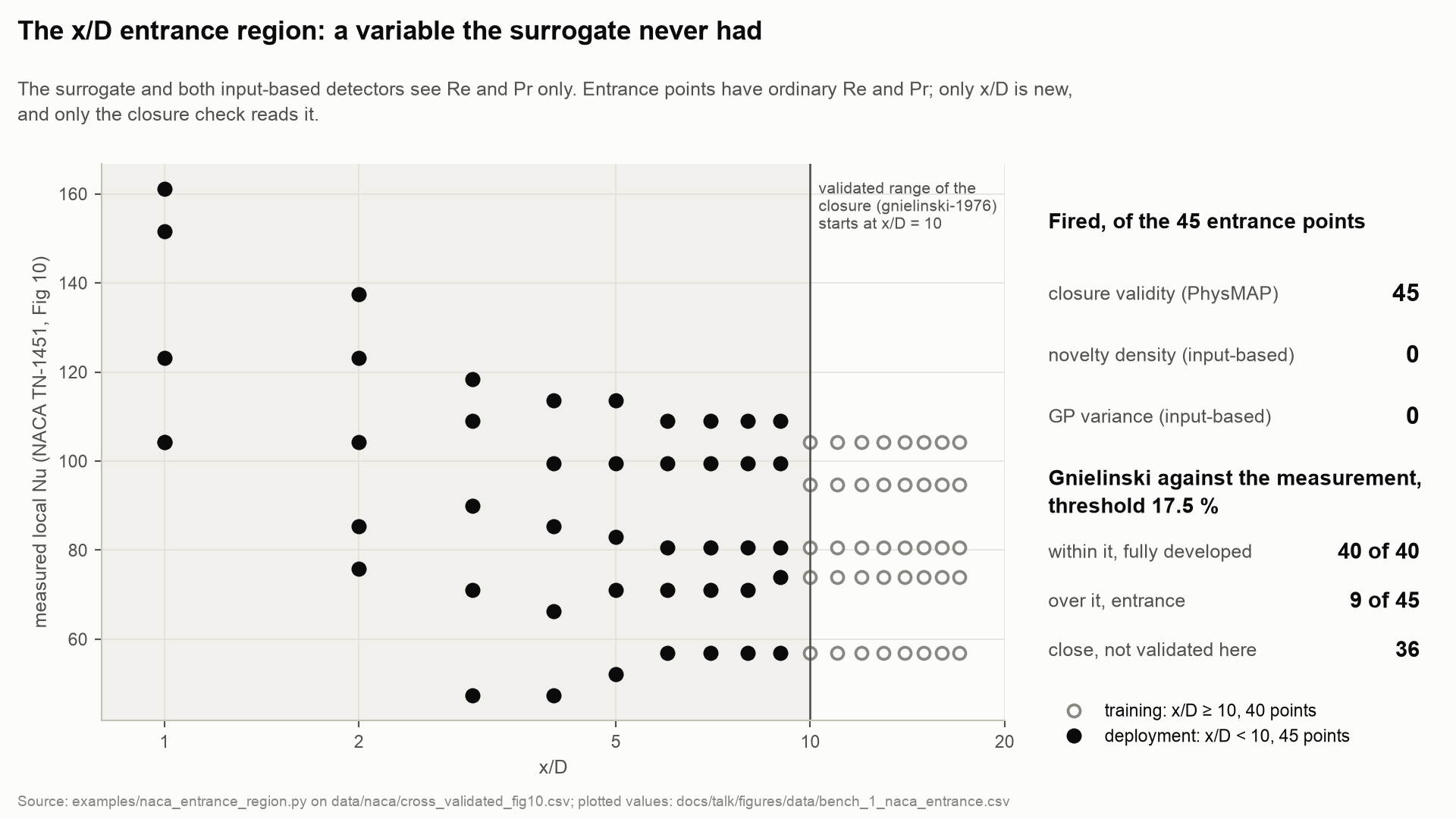
A heat-transfer surrogate that takes only `(Re, Pr)` relies on a closure — here the Gnielinski
|
|
60
|
+
correlation — validated for fully developed flow, from x/D = 10 on. Near a pipe's inlet, `x/D`
|
|
61
|
+
governs the heat transfer, and neither the surrogate nor an input-based OOD detector sees it:
|
|
62
|
+
in `(Re, Pr)` the entrance points look perfectly ordinary. On NACA TN-1451's Fig 10 (two-reader
|
|
63
|
+
digitisation), against the measurement, at the numerical-error threshold (17.5 %):
|
|
64
|
+
|
|
65
|
+
- Gnielinski is **within the threshold on 40 of 40** fully developed points.
|
|
66
|
+
- It **exceeds the threshold on 9 of 45** entrance points — all at x/D ≤ 5, the largest 38 % at
|
|
67
|
+
the inlet.
|
|
68
|
+
- PhysMAP identifies **all 45 entrance predictions as outside the closure's supported
|
|
69
|
+
applicability region**. The input-based OOD detectors fire on none.
|
|
70
|
+
- **The other 36 are numerically acceptable, but not physically supported by that closure.**
|
|
71
|
+
|
|
72
|
+
Numerical agreement does not by itself establish that a prediction is credibly supported.
|
|
73
|
+
PhysMAP reads the bound variable from the test coordinates rather than from the surrogate's
|
|
74
|
+
inputs, checks it against the closure's validated range, and knows at setup that `x/D` is
|
|
75
|
+
structurally invisible to this surrogate:
|
|
51
76
|
|
|
52
77
|
```
|
|
53
78
|
verdicts: {'REJECT': 45}
|
|
@@ -58,58 +83,132 @@ rationale: Prediction relies on gnielinski-1976 beyond its validated x_over_D bo
|
|
|
58
83
|
because they cannot observe x_over_D.
|
|
59
84
|
```
|
|
60
85
|
|
|
61
|
-
|
|
86
|
+
The −63% is the literature's figure; on this data the largest entrance error is 38%. Run it:
|
|
87
|
+
[`examples/naca_entrance_region.py`](https://github.com/cloudronin/physmap/blob/main/examples/naca_entrance_region.py).
|
|
88
|
+
|
|
89
|
+
## Causal materiality: a controlled model-reuse stress test (Lewis 35A)
|
|
90
|
+
|
|
91
|
+
Applicability asks whether the physics a prediction relies on still applies. This asks
|
|
92
|
+
something else: when a mechanism the surrogate never saw becomes active, does it change the
|
|
93
|
+
answer — and where?
|
|
62
94
|
|
|
63
|
-
|
|
95
|
+
```bash
|
|
96
|
+
physmap stress-test lewis-reuse
|
|
97
|
+
```
|
|
64
98
|
|
|
65
|
-
|
|
99
|
+
**The setup.** The surrogate was trained for forced convection, where gravity did not vary
|
|
100
|
+
and was not an input. It was then reused in vertical heated flow, where buoyancy became
|
|
101
|
+
material. A mixed-convection surrogate designed for this regime should include Richardson
|
|
102
|
+
number, Grashof number, or equivalent physical information — this test reuses one without
|
|
103
|
+
it, on purpose.
|
|
66
104
|
|
|
67
|
-
|
|
105
|
+
**The claim.** PhysMAP detects when model reuse activates a physically relevant mechanism
|
|
106
|
+
outside the surrogate's observable input space. An input-only OOD detector cannot identify a
|
|
107
|
+
change absent from its input contract.
|
|
68
108
|
|
|
69
|
-
|
|
70
|
-
|
|
71
|
-
|
|
72
|
-
|
|
73
|
-
setup which of those variables the detectors can see. It keeps the OOD detectors, and
|
|
74
|
-
overrides them only where they are structurally blind.
|
|
109
|
+
**The input contract.** Both the surrogate and the input-based OOD detector — the
|
|
110
|
+
seven-vehicle benchmark's own, unchanged — receive `Re`, `Pr` and `x_over_D`. Neither
|
|
111
|
+
receives gravity, `Ri`, `Gr` or heat flux. **Every visible deployment input exactly matches a
|
|
112
|
+
training input.**
|
|
75
113
|
|
|
76
|
-
The
|
|
77
|
-
|
|
114
|
+
**The result**, same visible inputs, two physical states, on Lewis's (1992) vertical-tube
|
|
115
|
+
experiment:
|
|
78
116
|
|
|
79
|
-
|
|
|
117
|
+
| | surrogate error | input-based OOD scores | PhysMAP materiality |
|
|
80
118
|
|---|---|---|---|
|
|
81
|
-
|
|
|
82
|
-
|
|
|
83
|
-
|
|
84
|
-
|
|
85
|
-
|
|
86
|
-
|
|
87
|
-
|
|
88
|
-
|
|
89
|
-
|
|
90
|
-
|
|
91
|
-
|
|
92
|
-
|
|
93
|
-
|
|
94
|
-
|
|
95
|
-
|
|
96
|
-
|
|
97
|
-
|
|
98
|
-
|
|
99
|
-
|
|
100
|
-
|
|
101
|
-
|
|
102
|
-
|
|
103
|
-
|
|
104
|
-
|
|
105
|
-
|
|
119
|
+
| gravity off — the accurate control | within 0.06 % | quiet at the default setting; identical in both rows | 0 |
|
|
120
|
+
| gravity on — Lewis's measurement | 17–18 % downstream | quiet at the default setting; identical in both rows | up to 0.195 |
|
|
121
|
+
|
|
122
|
+
Identical OOD scores and zero-versus-0.195 materiality need no threshold. The flag threshold θ
|
|
123
|
+
is not yet locked, so materiality is reported as numbers, and θ = 0.10 appears only as an
|
|
124
|
+
illustration.
|
|
125
|
+
|
|
126
|
+
A secondary result shows specificity: when the visible operating point falls *between*
|
|
127
|
+
training runs, the OOD detector warns in both the accurate and the inaccurate case —
|
|
128
|
+
identically — while PhysMAP changes with the physical mechanism.
|
|
129
|
+
|
|
130
|
+
**What it is not.** Not a claim that OOD detectors fail in general — this one does exactly its
|
|
131
|
+
job. Not a suggestion to leave gravity out. Not a claim about NVIDIA PhysicsNeMo, whose OOD
|
|
132
|
+
and physics checks are distinct and were not run. **One run, a development demonstration:** its
|
|
133
|
+
stations are not independent cases, and no precision, recall or F1 is computed.
|
|
134
|
+
|
|
135
|
+
The command recomputes everything from this checkout in a few minutes, asserts the exact
|
|
136
|
+
input overlap and the unchanged OOD scores, and diffs itself against a committed bank — the
|
|
137
|
+
same contract as `physmap benchmark run`, deliberately kept a separate command because this is
|
|
138
|
+
a causal-materiality result. It recomputes from committed CFD-derived profiles and does not rerun
|
|
139
|
+
OpenFOAM. Full record:
|
|
140
|
+
[docs/findings/lewis-ood-head-to-head.md](https://github.com/cloudronin/physmap/blob/main/docs/findings/lewis-ood-head-to-head.md). The NAFEMS
|
|
141
|
+
talk package — figures, facts sheet, claims ledger, and a clean-clone reproduction record — is
|
|
142
|
+
in [docs/talk/](https://github.com/cloudronin/physmap/blob/main/docs/talk/README.md).
|
|
143
|
+
|
|
144
|
+
|
|
145
|
+
## Supporting evidence: seven published datasets
|
|
146
|
+
|
|
147
|
+
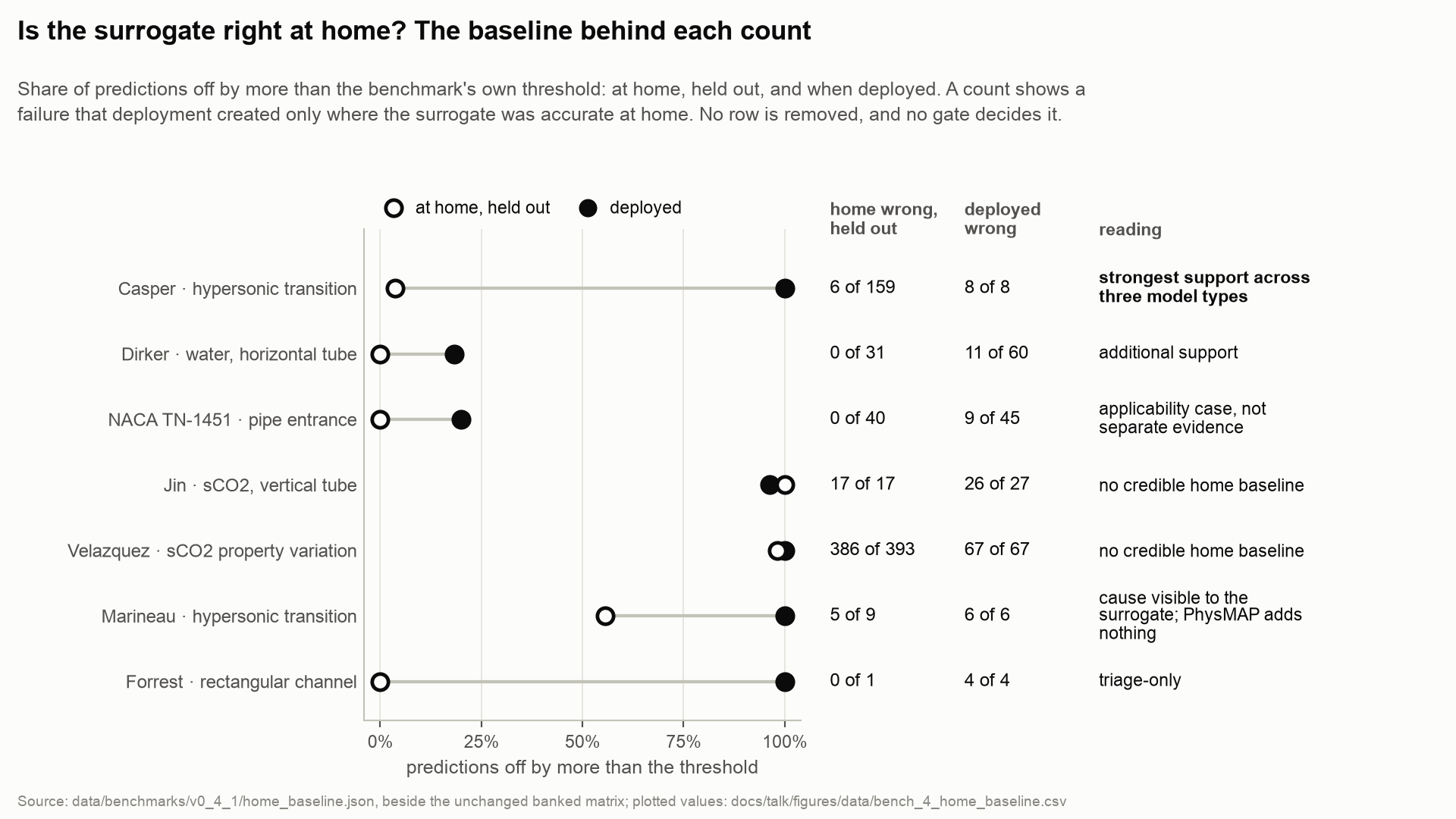
The seven-vehicle benchmark asks, per dataset: which wrong predictions does PhysMAP flag that
|
|
148
|
+
the input-based detectors (distance-to-training and GP variance) miss — and was the surrogate
|
|
149
|
+
accurate at home, so that deployment is what created the failure?
|
|
150
|
+
|
|
151
|
+
**Casper leads.** Hypersonic transition; the cause, tunnel freestream noise, is not a surrogate
|
|
152
|
+
input. The surrogate is wrong on 6 of 159 home rows held out (4%), and on 8 of 8 deployed. A
|
|
153
|
+
Gaussian process, a DeepONet and gradient-boosted trees each pass the same home-accuracy check,
|
|
154
|
+
and **each leaves 4 of 8 deployment errors that only PhysMAP flags**.
|
|
155
|
+
|
|
156
|
+
**Dirker supports it.** Water in a horizontal tube; the cause, buoyancy, is partly visible to
|
|
157
|
+
the inputs. Wrong on 0 of 31 home rows held out, and on 11 of 60 deployed; PhysMAP flags 2 of
|
|
158
|
+
those 11 that the detectors miss.
|
|
159
|
+
|
|
160
|
+
|
|
161
|
+
|
|
162
|
+
**The full matrix** — every dataset, at the default setting (the 99th percentile), with how its
|
|
163
|
+
home error was obtained, its error rates and its limitation:
|
|
164
|
+
|
|
165
|
+
| Dataset | Detectors see the cause? | Home error: how obtained | Home wrong | Deployed wrong | Wrong, flagged only by PhysMAP | Accurate, flagged anyway | Limitation |
|
|
166
|
+
|---|---|---|---|---|---|---|---|
|
|
167
|
+
| `casper_hypersonic_transition` — hypersonic transition | no | fitted; held out by refit (in-sample 2 of 159) | 6 of 159 (4%) | 8 of 8 (100%) | 4 of 8 | 0 | — |
|
|
168
|
+
| `dirker_water` — water, horizontal tube | partly | fitted; held out by refit (in-sample 0 of 31) | 0 of 31 (0%) | 11 of 60 (18%) | 2 of 11 | 16 | the cause is partly visible |
|
|
169
|
+
| `naca_tn1451` — heated pipe, entrance region | no | published correlation; 40 of 40 inside its range | 0 of 40 (0%) | 9 of 45 (20%) | 9 of 9 | 19 | the applicability case above, same data — not separate evidence |
|
|
170
|
+
| `jin_sco2_buoyancy` — supercritical CO2, vertical tube | no | published correlation; 11 of 17 inside its range | 17 of 17 (100%) | 26 of 27 (96%) | 15 of 26 | 0 | wrong almost everywhere: no home baseline |
|
|
171
|
+
| `velazquez_sco2` — supercritical CO2, property variation | partly | published correlation; 197 of 393 inside its range | 386 of 393 (98%) | 67 of 67 (100%) | 18 of 67 | 0 | wrong almost everywhere: no home baseline |
|
|
172
|
+
| `marineau_hypersonic_transition` — hypersonic transition | yes | fitted; held out by refit (in-sample 0 of 9) | 5 of 9 (56%) | 6 of 6 (100%) | 0 of 6 | 0 | the control; nine home rows are too few |
|
|
173
|
+
| `forrest` — rectangular channel | yes | published correlation | 0 of 1 | 4 of 4 (100%) | not tested | — | one training row; triage-grade values |
|
|
174
|
+
|
|
175
|
+
"Wrong" is each dataset's own threshold, set from measurement noise; "accurate" is a tighter
|
|
176
|
+
one, with a dead band between them. Home error is labelled by how it was obtained: where the
|
|
177
|
+
surrogate was fitted to the home rows, it is also refitted without each row in turn; a
|
|
178
|
+
published correlation was never fitted to them.
|
|
179
|
+
|
|
180
|
+
- **Where the evidence holds:** Casper and Dirker have a home baseline from which deployment
|
|
181
|
+
fails — and NACA, which is the applicability case above.
|
|
182
|
+
- **Where the reading stops:** Jin and Velazquez keep their counts, but their correlations are
|
|
183
|
+
wrong almost everywhere, at home too, so the counts cannot show that deployment created the
|
|
184
|
+
failure.
|
|
185
|
+
- **Where PhysMAP adds nothing:** Marineau, where the cause is a surrogate input and the
|
|
186
|
+
detectors already see it.
|
|
187
|
+
- **Accurate predictions flagged anyway:** PhysMAP flags every prediction outside a closure's
|
|
188
|
+
supported region, accurate or not — 19 for NACA, 16 for Dirker. As detection those are false
|
|
189
|
+
alarms; as applicability assurance, they are predictions the closure does not support.
|
|
190
|
+
- **The kind of model:** on Casper, three model types pass the home check and each leaves 4 of
|
|
191
|
+
8 errors only PhysMAP flags. On NACA all three pass too, but its home reads repeat — 40 rows,
|
|
192
|
+
5 distinct values — so leave-one-out says little there. On Jin and Velazquez none passes.
|
|
193
|
+
|
|
194
|
+
No gate decides a dataset's reading: the counts and rates are the evidence, and
|
|
195
|
+
`physmap benchmark report` prints each dataset's interpretation as prose. Counts are rows of
|
|
196
|
+
each dataset, not independent cases, never pooled into a rate, and digitised from publications.
|
|
197
|
+
A one-sided Fisher exact test was run after the counts were seen; it is reported as exploratory
|
|
198
|
+
and decides nothing.
|
|
199
|
+
|
|
200
|
+
**Bank v0.4.1.** It corrects the NACA source data: the original bank's NACA row came from an
|
|
201
|
+
automated read of the figure later found invalid — wrong axis calibration, points on gridline
|
|
202
|
+
crossings — and its "20 of 20" is withdrawn. The original bank is kept unchanged for audit, not
|
|
203
|
+
as evidence. See [`data/naca/CORRECTION_v0_4_1.md`](https://github.com/cloudronin/physmap/blob/main/data/naca/CORRECTION_v0_4_1.md).
|
|
106
204
|
|
|
107
205
|
## The benchmark: seven vehicles, all rerunnable
|
|
108
206
|
|
|
109
207
|
```bash
|
|
110
|
-
physmap benchmark report # all seven outcomes
|
|
208
|
+
physmap benchmark report # all seven outcomes, the counts above and the home baseline
|
|
111
209
|
physmap benchmark run # recomputes all seven from this checkout, diffs against the bank
|
|
112
210
|
physmap benchmark coverage # what that subset does and does not cover
|
|
211
|
+
physmap benchmark architectures --banked # three model types per vehicle; drop --banked to retrain (PyTorch)
|
|
113
212
|
```
|
|
114
213
|
|
|
115
214
|
All seven vehicles ran, all seven outcomes are reported, and **all seven now ship their
|
|
@@ -162,9 +261,9 @@ one to another.
|
|
|
162
261
|
|
|
163
262
|
| Check | Question | Status | Evidence |
|
|
164
263
|
|---|---|---|---|
|
|
165
|
-
| **Closure validity** | Is this closure relation being applied outside the range it was calibrated on? | Shipping | the seven-vehicle benchmark
|
|
166
|
-
| **Surrogate observability** | Can the surrogate's inputs even represent the variable that governs the failure? | Shipping | the
|
|
167
|
-
| **Causal materiality** | Is the out-of-range mechanism large enough to matter for the quantity of interest? | Preview — method, plus one controlled stress test | Lewis 35A,
|
|
264
|
+
| **Closure validity** | Is this closure relation being applied outside the range it was calibrated on? | Shipping | applicability assurance (NACA x/D); the seven-vehicle benchmark |
|
|
265
|
+
| **Surrogate observability** | Can the surrogate's inputs even represent the variable that governs the failure? | Shipping | the same |
|
|
266
|
+
| **Causal materiality** | Is the out-of-range mechanism large enough to matter for the quantity of interest? | Preview — method, plus one controlled stress test | Lewis 35A, the main controlled demonstration |
|
|
168
267
|
|
|
169
268
|
## What this release claims
|
|
170
269
|
|
|
@@ -192,61 +291,6 @@ not reproduction of the published numbers. The protocol defines `REPRODUCED` and
|
|
|
192
291
|
unreachable, so the word cannot drift onto a weaker result. See
|
|
193
292
|
[`protocols/`](https://github.com/cloudronin/physmap/tree/main/protocols).
|
|
194
293
|
|
|
195
|
-
## A separate question: causal materiality, in a controlled stress test (Lewis 35A)
|
|
196
|
-
|
|
197
|
-
The benchmark asks whether PhysMAP catches failures the OOD detectors cannot see. This asks
|
|
198
|
-
something else: when a mechanism the surrogate never saw becomes active, does it matter for the
|
|
199
|
-
answer — and where?
|
|
200
|
-
|
|
201
|
-
```bash
|
|
202
|
-
physmap stress-test lewis-reuse
|
|
203
|
-
```
|
|
204
|
-
|
|
205
|
-
**The setup.** The surrogate was trained for forced convection, where gravity did not vary
|
|
206
|
-
and was not an input. It was then reused in vertical heated flow, where buoyancy became
|
|
207
|
-
material. A mixed-convection surrogate designed for this regime should include Richardson
|
|
208
|
-
number, Grashof number, or equivalent physical information — this test reuses one without
|
|
209
|
-
it, on purpose.
|
|
210
|
-
|
|
211
|
-
**The claim.** PhysMAP detects when model reuse activates a physically relevant mechanism
|
|
212
|
-
outside the surrogate's observable input space. An input-only OOD detector cannot identify a
|
|
213
|
-
change absent from its input contract.
|
|
214
|
-
|
|
215
|
-
**The input contract.** Both the surrogate and the input-based OOD detector — the
|
|
216
|
-
seven-vehicle benchmark's own, unchanged — receive `Re`, `Pr` and `x_over_D`. Neither
|
|
217
|
-
receives gravity, `Ri`, `Gr` or heat flux. **Every visible deployment input exactly matches a
|
|
218
|
-
training input.**
|
|
219
|
-
|
|
220
|
-
**The result**, same visible inputs, two physical states, on Lewis's (1992) vertical-tube
|
|
221
|
-
experiment:
|
|
222
|
-
|
|
223
|
-
| | surrogate error | input-based OOD scores | PhysMAP materiality |
|
|
224
|
-
|---|---|---|---|
|
|
225
|
-
| gravity off — the accurate control | within 0.06 % | identical in both rows | 0 |
|
|
226
|
-
| gravity on — Lewis's measurement | 17–18 % downstream | identical in both rows | up to 0.195 |
|
|
227
|
-
|
|
228
|
-
Identical OOD scores and zero-versus-0.195 materiality need no threshold. The flag threshold θ
|
|
229
|
-
is not yet locked, so materiality is reported as numbers, and θ = 0.10 appears only as an
|
|
230
|
-
illustration.
|
|
231
|
-
|
|
232
|
-
A secondary result shows specificity: when the visible operating point falls *between*
|
|
233
|
-
training runs, the OOD detector warns in both the accurate and the inaccurate case —
|
|
234
|
-
identically — while PhysMAP changes with the physical mechanism.
|
|
235
|
-
|
|
236
|
-
**What it is not.** Not a claim that OOD detectors fail in general — this one does exactly its
|
|
237
|
-
job. Not a suggestion to leave gravity out. Not a claim about NVIDIA PhysicsNeMo, whose OOD
|
|
238
|
-
and physics checks are distinct and were not run. **One run, a development demonstration:** its
|
|
239
|
-
stations are not independent cases, and no precision, recall or F1 is computed.
|
|
240
|
-
|
|
241
|
-
The command recomputes everything from this checkout in a few minutes, asserts the exact
|
|
242
|
-
input overlap and the unchanged OOD scores, and diffs itself against a committed bank — the
|
|
243
|
-
same contract as `physmap benchmark run`, deliberately kept a separate command because this is
|
|
244
|
-
a causal-materiality result. It recomputes from committed CFD-derived profiles and does not rerun
|
|
245
|
-
OpenFOAM. Full record:
|
|
246
|
-
[docs/findings/lewis-ood-head-to-head.md](https://github.com/cloudronin/physmap/blob/main/docs/findings/lewis-ood-head-to-head.md). The NAFEMS
|
|
247
|
-
talk package — figures, facts sheet, claims ledger, and a clean-clone reproduction record — is
|
|
248
|
-
in [docs/talk/](https://github.com/cloudronin/physmap/blob/main/docs/talk/README.md).
|
|
249
|
-
|
|
250
294
|
## Install
|
|
251
295
|
|
|
252
296
|
```bash
|
|
@@ -268,7 +312,8 @@ redistribution terms and partly because it is not runtime data. From a plain
|
|
|
268
312
|
`pip install physmap`, those commands say so in one sentence and stop.
|
|
269
313
|
|
|
270
314
|
Optional extras: `[jsonld]` adds evidence export via `uofa`, `[experiment]` adds
|
|
271
|
-
`matplotlib` for benchmark figures, `[
|
|
315
|
+
`matplotlib` for benchmark figures, `[architectures]` adds PyTorch for the DeepONet in
|
|
316
|
+
`physmap benchmark architectures`, `[dev]` adds the test tooling.
|
|
272
317
|
|
|
273
318
|
## Using the guardrail
|
|
274
319
|
|