openreflex 0.1.3__tar.gz → 0.3.0__tar.gz
This diff represents the content of publicly available package versions that have been released to one of the supported registries. The information contained in this diff is provided for informational purposes only and reflects changes between package versions as they appear in their respective public registries.
- {openreflex-0.1.3/src/openreflex.egg-info → openreflex-0.3.0}/PKG-INFO +43 -10
- {openreflex-0.1.3 → openreflex-0.3.0}/README.md +42 -9
- {openreflex-0.1.3 → openreflex-0.3.0}/pyproject.toml +2 -2
- {openreflex-0.1.3 → openreflex-0.3.0}/src/openreflex/__init__.py +1 -1
- {openreflex-0.1.3 → openreflex-0.3.0}/src/openreflex/cli.py +122 -21
- openreflex-0.3.0/src/openreflex/control.py +108 -0
- openreflex-0.3.0/src/openreflex/decision.py +221 -0
- openreflex-0.3.0/src/openreflex/detect.py +91 -0
- {openreflex-0.1.3 → openreflex-0.3.0}/src/openreflex/engine.py +252 -87
- {openreflex-0.1.3 → openreflex-0.3.0}/src/openreflex/hooks.py +20 -24
- {openreflex-0.1.3 → openreflex-0.3.0}/src/openreflex/install.py +65 -1
- openreflex-0.3.0/src/openreflex/mcp_server.py +280 -0
- {openreflex-0.1.3 → openreflex-0.3.0}/src/openreflex/metrics.py +9 -0
- {openreflex-0.1.3 → openreflex-0.3.0}/src/openreflex/models.py +12 -0
- openreflex-0.3.0/src/openreflex/policies/default.toml +165 -0
- openreflex-0.3.0/src/openreflex/policy.py +144 -0
- openreflex-0.3.0/src/openreflex/project.py +154 -0
- openreflex-0.3.0/src/openreflex/routing.py +190 -0
- {openreflex-0.1.3 → openreflex-0.3.0/src/openreflex.egg-info}/PKG-INFO +43 -10
- {openreflex-0.1.3 → openreflex-0.3.0}/src/openreflex.egg-info/SOURCES.txt +7 -0
- {openreflex-0.1.3 → openreflex-0.3.0}/tests/test_engine.py +1 -1
- {openreflex-0.1.3 → openreflex-0.3.0}/tests/test_mcp_metrics_benchmark.py +20 -3
- openreflex-0.3.0/tests/test_policy_recap.py +149 -0
- openreflex-0.3.0/tests/test_reliability_lifecycle.py +108 -0
- openreflex-0.3.0/tests/test_routing_control.py +160 -0
- openreflex-0.1.3/src/openreflex/detect.py +0 -82
- openreflex-0.1.3/src/openreflex/mcp_server.py +0 -112
- openreflex-0.1.3/src/openreflex/project.py +0 -103
- openreflex-0.1.3/src/openreflex/routing.py +0 -66
- {openreflex-0.1.3 → openreflex-0.3.0}/LICENSE +0 -0
- {openreflex-0.1.3 → openreflex-0.3.0}/setup.cfg +0 -0
- {openreflex-0.1.3 → openreflex-0.3.0}/src/openreflex/__main__.py +0 -0
- {openreflex-0.1.3 → openreflex-0.3.0}/src/openreflex/benchmark.py +0 -0
- {openreflex-0.1.3 → openreflex-0.3.0}/src/openreflex/integrations/opencode.ts +0 -0
- {openreflex-0.1.3 → openreflex-0.3.0}/src/openreflex/learning.py +0 -0
- {openreflex-0.1.3 → openreflex-0.3.0}/src/openreflex/privacy.py +0 -0
- {openreflex-0.1.3 → openreflex-0.3.0}/src/openreflex/store.py +0 -0
- {openreflex-0.1.3 → openreflex-0.3.0}/src/openreflex.egg-info/dependency_links.txt +0 -0
- {openreflex-0.1.3 → openreflex-0.3.0}/src/openreflex.egg-info/entry_points.txt +0 -0
- {openreflex-0.1.3 → openreflex-0.3.0}/src/openreflex.egg-info/requires.txt +0 -0
- {openreflex-0.1.3 → openreflex-0.3.0}/src/openreflex.egg-info/top_level.txt +0 -0
- {openreflex-0.1.3 → openreflex-0.3.0}/tests/test_hooks.py +0 -0
- {openreflex-0.1.3 → openreflex-0.3.0}/tests/test_install_cli.py +0 -0
- {openreflex-0.1.3 → openreflex-0.3.0}/tests/test_stress.py +0 -0
|
@@ -1,6 +1,6 @@
|
|
|
1
1
|
Metadata-Version: 2.4
|
|
2
2
|
Name: openreflex
|
|
3
|
-
Version: 0.
|
|
3
|
+
Version: 0.3.0
|
|
4
4
|
Summary: Muscle memory for AI coding agents: learns from every task, advises the next one, and flags failure loops live
|
|
5
5
|
Author: vishnu-77
|
|
6
6
|
License-Expression: MIT
|
|
@@ -128,6 +128,17 @@ OpenReflex installs per project with `openreflex install <agent>`, or as a plugi
|
|
|
128
128
|
With a plugin install, enable each project with `openreflex approve`. Claude Code and Codex are verified in live
|
|
129
129
|
sessions; the Cursor and OpenCode integrations follow each agent's documented hook protocol.
|
|
130
130
|
|
|
131
|
+
## See it work
|
|
132
|
+
|
|
133
|
+
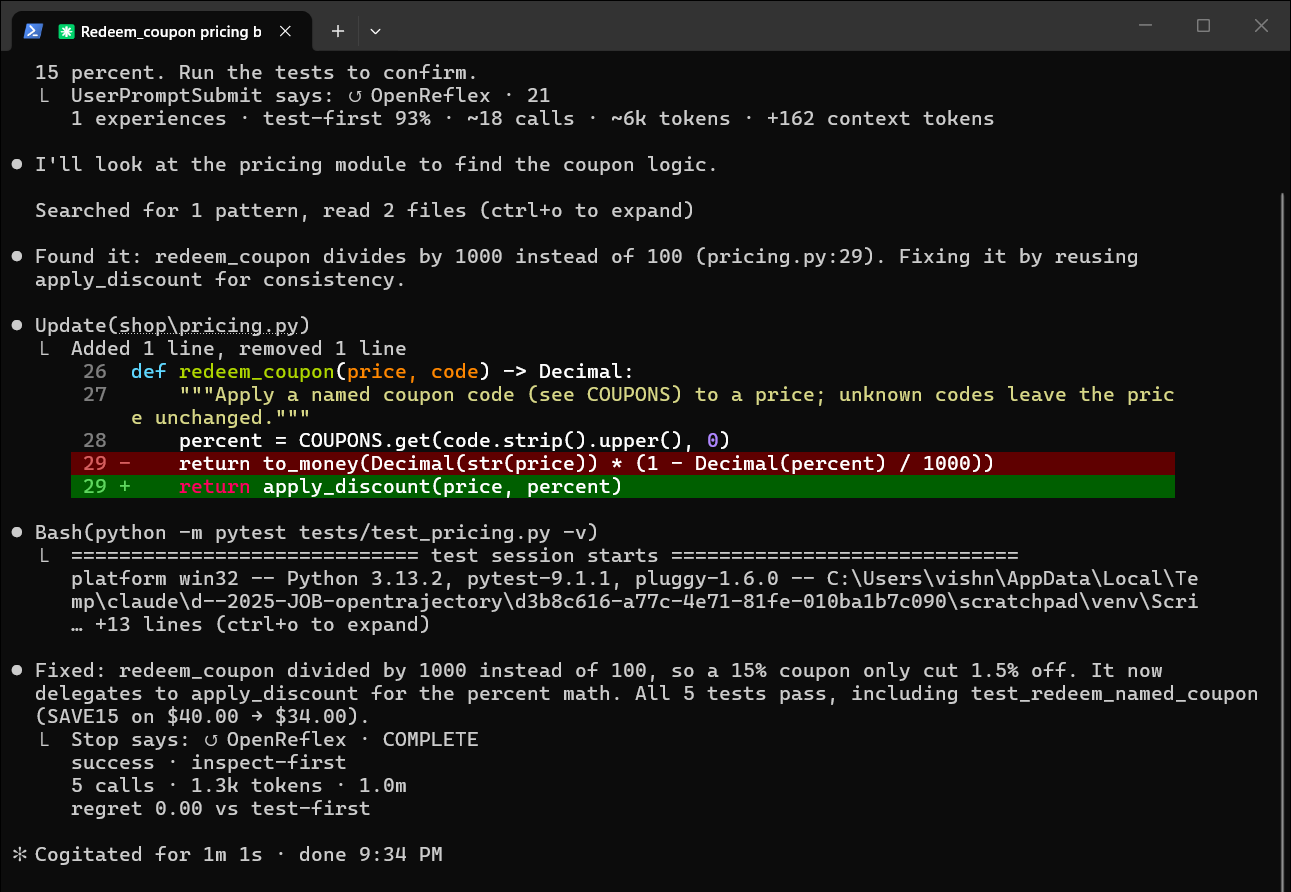
A real Claude Code session in a repository where OpenReflex has seen one similar task before. The
|
|
134
|
+
`UserPromptSubmit` line shows the past experience found and the context added; the `Stop` line shows the verified
|
|
135
|
+
outcome, the path taken and the cost.
|
|
136
|
+
|
|
137
|
+
|
|
138
|
+
|
|
139
|
+
The full walkthrough, with both sessions, the exact context the model received and the CLI output, is in
|
|
140
|
+
[docs/walkthrough.md](docs/walkthrough.md).
|
|
141
|
+
|
|
131
142
|
## How it works
|
|
132
143
|
|
|
133
144
|
Hooks send lifecycle events (prompt, tool start, tool end, compaction, stop) to the OpenReflex engine, which
|
|
@@ -140,26 +151,48 @@ Execution -failed_with-> ToolCall -resolved_by-> ToolCall
|
|
|
140
151
|
Execution -caused-> Outcome -caused-> Experience -caused-> Lesson
|
|
141
152
|
```
|
|
142
153
|
|
|
143
|
-
- **Before a task:** similar experiences are retrieved
|
|
144
|
-
`incremental`) are
|
|
145
|
-
reversibility, and
|
|
146
|
-
|
|
147
|
-
|
|
154
|
+
- **Before a task:** similar experiences are retrieved and three strategies (`inspect-first`, `test-first`,
|
|
155
|
+
`incremental`) are estimated on success probability, time, tool calls, context cost, risk, uncertainty,
|
|
156
|
+
reversibility, and expected regret. Strategies that another one beats on every measure are dropped as
|
|
157
|
+
dominated (Pareto efficiency), the rest are ranked by utility within any limits you set, and the chosen path
|
|
158
|
+
gets an execution budget for time, tool calls, and context. A context of at most 1,400 characters is
|
|
159
|
+
injected; nothing is injected without relevant experience.
|
|
160
|
+
- **During a task:** when a detector finds a failure loop, repeated calls, stalled progress, context growth,
|
|
161
|
+
or work past the budget, OpenReflex estimates the marginal value of more work. The current path's success
|
|
162
|
+
estimate is updated with each call that makes no progress or fails, and compared with the cost of the work
|
|
163
|
+
left and with the best untried alternative. The alert ends with a recommendation to **continue**, **pivot**
|
|
164
|
+
to another strategy, or **stop** and ask the user. Each problem, pivot, or stop is raised once, with a cooldown
|
|
165
|
+
between messages.
|
|
148
166
|
- **After a task:** outcome and chosen path come from the agent's `record_outcome` / `choose_path` MCP calls when
|
|
149
|
-
available, and are otherwise inferred from tool activity. Execution Regret
|
|
167
|
+
available, and are otherwise inferred from tool activity. Execution Regret compares the path taken with the
|
|
168
|
+
best plausible alternative; it is withheld when the outcome is unknown, and feeds back into how strategies
|
|
169
|
+
are ranked next time, along with success, cost, and how often a strategy ran into trouble.
|
|
170
|
+
|
|
171
|
+
Every recommendation is stored as a decision snapshot with a **Reflex Score** (0-100): how strong the
|
|
172
|
+
recommendation is, which is separate from the estimated chance that the task succeeds. `openreflex why` explains
|
|
173
|
+
the latest decision and `openreflex trace` shows the timeline. In Claude Code, a short recap appears when a task
|
|
174
|
+
starts, when OpenReflex recommends a pivot or stop or detects trouble, and when the task completes.
|
|
175
|
+
|
|
176
|
+
Set optional limits for every task with `OPENREFLEX_BUDGET`, for example `calls=40,minutes=20,tokens=60000`.
|
|
177
|
+
Routing, scoring, budget and recap settings come from a versioned policy: the packaged defaults, overridden by
|
|
178
|
+
`~/.openreflex/config.toml` and then by `.openreflex.toml` in the project.
|
|
150
179
|
|
|
151
|
-
Agents can also query OpenReflex directly through its MCP server: `get_execution_context
|
|
152
|
-
`
|
|
180
|
+
Agents can also query OpenReflex directly through its MCP server: `get_execution_context` (optionally with
|
|
181
|
+
`max_tool_calls`, `max_minutes`, `max_context_tokens`), `choose_path`, `check_progress`, `explain_decision`,
|
|
182
|
+
`get_execution_trace`, `get_reflex_score`, `record_outcome`, `search_experience`, `explain_node`,
|
|
183
|
+
`project_insights`, and `approve_project`.
|
|
153
184
|
|
|
154
185
|
## CLI
|
|
155
186
|
|
|
156
187
|
| Command | Purpose |
|
|
157
188
|
|---|---|
|
|
158
189
|
| `install <agent> [--dry-run]` | Write project hooks and MCP config, and enable the project |
|
|
190
|
+
| `uninstall <agent> [--dry-run]` | Remove OpenReflex's project hooks and MCP config; captured memory is kept |
|
|
159
191
|
| `approve` / `revoke` | Enable or disable capture for the current project |
|
|
160
192
|
| `context "<task>"` | Preview the Execution Context a task would receive |
|
|
161
193
|
| `status [--json]` | What has been captured, reused, and learned |
|
|
162
|
-
| `
|
|
194
|
+
| `why` / `trace` | Explain the latest recommendation, or show the decision timeline |
|
|
195
|
+
| `doctor` | Installation, project resolution, and recent hook activity checks |
|
|
163
196
|
| `forget --yes` | Delete the project's data |
|
|
164
197
|
| `benchmark` | Run the simulated benchmark |
|
|
165
198
|
| `hook <agent> <event>` / `mcp` | Used by agent configs |
|
|
@@ -96,6 +96,17 @@ OpenReflex installs per project with `openreflex install <agent>`, or as a plugi
|
|
|
96
96
|
With a plugin install, enable each project with `openreflex approve`. Claude Code and Codex are verified in live
|
|
97
97
|
sessions; the Cursor and OpenCode integrations follow each agent's documented hook protocol.
|
|
98
98
|
|
|
99
|
+
## See it work
|
|
100
|
+
|
|
101
|
+
A real Claude Code session in a repository where OpenReflex has seen one similar task before. The
|
|
102
|
+
`UserPromptSubmit` line shows the past experience found and the context added; the `Stop` line shows the verified
|
|
103
|
+
outcome, the path taken and the cost.
|
|
104
|
+
|
|
105
|
+

|
|
106
|
+
|
|
107
|
+
The full walkthrough, with both sessions, the exact context the model received and the CLI output, is in
|
|
108
|
+
[docs/walkthrough.md](docs/walkthrough.md).
|
|
109
|
+
|
|
99
110
|
## How it works
|
|
100
111
|
|
|
101
112
|
Hooks send lifecycle events (prompt, tool start, tool end, compaction, stop) to the OpenReflex engine, which
|
|
@@ -108,26 +119,48 @@ Execution -failed_with-> ToolCall -resolved_by-> ToolCall
|
|
|
108
119
|
Execution -caused-> Outcome -caused-> Experience -caused-> Lesson
|
|
109
120
|
```
|
|
110
121
|
|
|
111
|
-
- **Before a task:** similar experiences are retrieved
|
|
112
|
-
`incremental`) are
|
|
113
|
-
reversibility, and
|
|
114
|
-
|
|
115
|
-
|
|
122
|
+
- **Before a task:** similar experiences are retrieved and three strategies (`inspect-first`, `test-first`,
|
|
123
|
+
`incremental`) are estimated on success probability, time, tool calls, context cost, risk, uncertainty,
|
|
124
|
+
reversibility, and expected regret. Strategies that another one beats on every measure are dropped as
|
|
125
|
+
dominated (Pareto efficiency), the rest are ranked by utility within any limits you set, and the chosen path
|
|
126
|
+
gets an execution budget for time, tool calls, and context. A context of at most 1,400 characters is
|
|
127
|
+
injected; nothing is injected without relevant experience.
|
|
128
|
+
- **During a task:** when a detector finds a failure loop, repeated calls, stalled progress, context growth,
|
|
129
|
+
or work past the budget, OpenReflex estimates the marginal value of more work. The current path's success
|
|
130
|
+
estimate is updated with each call that makes no progress or fails, and compared with the cost of the work
|
|
131
|
+
left and with the best untried alternative. The alert ends with a recommendation to **continue**, **pivot**
|
|
132
|
+
to another strategy, or **stop** and ask the user. Each problem, pivot, or stop is raised once, with a cooldown
|
|
133
|
+
between messages.
|
|
116
134
|
- **After a task:** outcome and chosen path come from the agent's `record_outcome` / `choose_path` MCP calls when
|
|
117
|
-
available, and are otherwise inferred from tool activity. Execution Regret
|
|
135
|
+
available, and are otherwise inferred from tool activity. Execution Regret compares the path taken with the
|
|
136
|
+
best plausible alternative; it is withheld when the outcome is unknown, and feeds back into how strategies
|
|
137
|
+
are ranked next time, along with success, cost, and how often a strategy ran into trouble.
|
|
138
|
+
|
|
139
|
+
Every recommendation is stored as a decision snapshot with a **Reflex Score** (0-100): how strong the
|
|
140
|
+
recommendation is, which is separate from the estimated chance that the task succeeds. `openreflex why` explains
|
|
141
|
+
the latest decision and `openreflex trace` shows the timeline. In Claude Code, a short recap appears when a task
|
|
142
|
+
starts, when OpenReflex recommends a pivot or stop or detects trouble, and when the task completes.
|
|
143
|
+
|
|
144
|
+
Set optional limits for every task with `OPENREFLEX_BUDGET`, for example `calls=40,minutes=20,tokens=60000`.
|
|
145
|
+
Routing, scoring, budget and recap settings come from a versioned policy: the packaged defaults, overridden by
|
|
146
|
+
`~/.openreflex/config.toml` and then by `.openreflex.toml` in the project.
|
|
118
147
|
|
|
119
|
-
Agents can also query OpenReflex directly through its MCP server: `get_execution_context
|
|
120
|
-
`
|
|
148
|
+
Agents can also query OpenReflex directly through its MCP server: `get_execution_context` (optionally with
|
|
149
|
+
`max_tool_calls`, `max_minutes`, `max_context_tokens`), `choose_path`, `check_progress`, `explain_decision`,
|
|
150
|
+
`get_execution_trace`, `get_reflex_score`, `record_outcome`, `search_experience`, `explain_node`,
|
|
151
|
+
`project_insights`, and `approve_project`.
|
|
121
152
|
|
|
122
153
|
## CLI
|
|
123
154
|
|
|
124
155
|
| Command | Purpose |
|
|
125
156
|
|---|---|
|
|
126
157
|
| `install <agent> [--dry-run]` | Write project hooks and MCP config, and enable the project |
|
|
158
|
+
| `uninstall <agent> [--dry-run]` | Remove OpenReflex's project hooks and MCP config; captured memory is kept |
|
|
127
159
|
| `approve` / `revoke` | Enable or disable capture for the current project |
|
|
128
160
|
| `context "<task>"` | Preview the Execution Context a task would receive |
|
|
129
161
|
| `status [--json]` | What has been captured, reused, and learned |
|
|
130
|
-
| `
|
|
162
|
+
| `why` / `trace` | Explain the latest recommendation, or show the decision timeline |
|
|
163
|
+
| `doctor` | Installation, project resolution, and recent hook activity checks |
|
|
131
164
|
| `forget --yes` | Delete the project's data |
|
|
132
165
|
| `benchmark` | Run the simulated benchmark |
|
|
133
166
|
| `hook <agent> <event>` / `mcp` | Used by agent configs |
|
|
@@ -4,7 +4,7 @@ build-backend = "setuptools.build_meta"
|
|
|
4
4
|
|
|
5
5
|
[project]
|
|
6
6
|
name = "openreflex"
|
|
7
|
-
version = "0.
|
|
7
|
+
version = "0.3.0"
|
|
8
8
|
description = "Muscle memory for AI coding agents: learns from every task, advises the next one, and flags failure loops live"
|
|
9
9
|
readme = "README.md"
|
|
10
10
|
license = "MIT"
|
|
@@ -41,7 +41,7 @@ openreflex = "openreflex.cli:main"
|
|
|
41
41
|
where = ["src"]
|
|
42
42
|
|
|
43
43
|
[tool.setuptools.package-data]
|
|
44
|
-
openreflex = ["integrations/*.ts"]
|
|
44
|
+
openreflex = ["integrations/*.ts", "policies/*.toml"]
|
|
45
45
|
|
|
46
46
|
[tool.pytest.ini_options]
|
|
47
47
|
testpaths = ["tests"]
|
|
@@ -6,13 +6,12 @@ import time
|
|
|
6
6
|
from pathlib import Path
|
|
7
7
|
|
|
8
8
|
from . import __version__
|
|
9
|
-
from .project import approval, approve, home, project_root, revoke
|
|
9
|
+
from .project import approval, approve, home, project_resolution, project_root, revoke
|
|
10
10
|
|
|
11
11
|
AGENT_CHOICES = ["claude-code", "codex", "cursor", "opencode"]
|
|
12
12
|
|
|
13
13
|
|
|
14
14
|
def _project(value: str | None) -> Path:
|
|
15
|
-
# An unexpanded ${VAR} placeholder from an agent config means "not provided".
|
|
16
15
|
return project_root(None if not value or "${" in value else value)
|
|
17
16
|
|
|
18
17
|
|
|
@@ -32,7 +31,7 @@ def cmd_hook(args) -> int:
|
|
|
32
31
|
if output:
|
|
33
32
|
sys.stdout.write(output)
|
|
34
33
|
sys.stdout.flush()
|
|
35
|
-
return 0
|
|
34
|
+
return 0
|
|
36
35
|
|
|
37
36
|
|
|
38
37
|
def cmd_mcp(args) -> int:
|
|
@@ -60,17 +59,46 @@ def cmd_install(args) -> int:
|
|
|
60
59
|
|
|
61
60
|
project = _project(args.project)
|
|
62
61
|
changes = install(args.agent, project, dry_run=args.dry_run)
|
|
63
|
-
verb = "
|
|
64
|
-
|
|
65
|
-
|
|
66
|
-
|
|
67
|
-
|
|
62
|
+
verb = "would update" if args.dry_run else "updated"
|
|
63
|
+
print("OPENREFLEX / CONNECT")
|
|
64
|
+
print(f" agent {args.agent}")
|
|
65
|
+
print(f" project {project}")
|
|
66
|
+
if changes:
|
|
67
|
+
print(f" config {verb} {len(changes)} file{'s' if len(changes) != 1 else ''}")
|
|
68
|
+
for change in changes:
|
|
69
|
+
print(f" {change}")
|
|
70
|
+
else:
|
|
71
|
+
print(" config already connected")
|
|
68
72
|
if not args.dry_run:
|
|
69
|
-
print(
|
|
73
|
+
print(" memory enabled")
|
|
74
|
+
print(" storage local")
|
|
75
|
+
print("\n [ok] reflex active")
|
|
70
76
|
if args.agent == "codex":
|
|
71
|
-
print("
|
|
77
|
+
print("\nCodex requires one trust step: open /hooks and approve the OpenReflex entries.")
|
|
72
78
|
if shutil.which("openreflex") is None:
|
|
73
|
-
print("
|
|
79
|
+
print("\nWarning: `openreflex` is not on PATH; hooks will not run. Install with `uv tool install .` or `pipx install .`.")
|
|
80
|
+
return 0
|
|
81
|
+
|
|
82
|
+
|
|
83
|
+
def cmd_uninstall(args) -> int:
|
|
84
|
+
from .install import uninstall
|
|
85
|
+
|
|
86
|
+
project = _project(args.project)
|
|
87
|
+
changes = uninstall(args.agent, project, dry_run=args.dry_run)
|
|
88
|
+
verb = "would remove" if args.dry_run else "removed"
|
|
89
|
+
print("OPENREFLEX / DISCONNECT")
|
|
90
|
+
print(f" agent {args.agent}")
|
|
91
|
+
print(f" project {project}")
|
|
92
|
+
if changes:
|
|
93
|
+
print(f" config {verb} OpenReflex entries from {len(changes)} file{'s' if len(changes) != 1 else ''}")
|
|
94
|
+
for change in changes:
|
|
95
|
+
print(f" {change}")
|
|
96
|
+
else:
|
|
97
|
+
print(" config no project integration found")
|
|
98
|
+
print(" memory preserved")
|
|
99
|
+
if not args.dry_run:
|
|
100
|
+
print("\n [ok] disconnected")
|
|
101
|
+
print("\nRun `openreflex forget --yes` separately if you also want to delete local experience data.")
|
|
74
102
|
return 0
|
|
75
103
|
|
|
76
104
|
|
|
@@ -102,6 +130,8 @@ def cmd_status(args) -> int:
|
|
|
102
130
|
f"{eff['without_prior_experience']['tool_calls']} (observational)")
|
|
103
131
|
print(f" mean execution regret: {regret['mean']} routing agreement: {routing['agreement']}")
|
|
104
132
|
print(f" live alerts: {data['live_alerts'] or '-'}")
|
|
133
|
+
control = data["execution_control"]
|
|
134
|
+
print(f" verdicts: {control['verdicts'] or '-'} tasks within tool-call budget: {control['tasks_within_tool_call_budget']}")
|
|
105
135
|
return 0
|
|
106
136
|
|
|
107
137
|
|
|
@@ -116,22 +146,91 @@ def cmd_context(args) -> int:
|
|
|
116
146
|
return 0
|
|
117
147
|
|
|
118
148
|
|
|
149
|
+
def cmd_why(args) -> int:
|
|
150
|
+
from .engine import Engine
|
|
151
|
+
|
|
152
|
+
engine = Engine(_project(args.project))
|
|
153
|
+
try:
|
|
154
|
+
print(engine.why())
|
|
155
|
+
finally:
|
|
156
|
+
engine.close()
|
|
157
|
+
return 0
|
|
158
|
+
|
|
159
|
+
|
|
160
|
+
def cmd_trace(args) -> int:
|
|
161
|
+
from .engine import Engine
|
|
162
|
+
|
|
163
|
+
engine = Engine(_project(args.project))
|
|
164
|
+
try:
|
|
165
|
+
print(engine.trace())
|
|
166
|
+
finally:
|
|
167
|
+
engine.close()
|
|
168
|
+
return 0
|
|
169
|
+
|
|
170
|
+
|
|
171
|
+
def _json(path: Path) -> dict:
|
|
172
|
+
try:
|
|
173
|
+
value = json.loads(path.read_text(encoding="utf-8"))
|
|
174
|
+
return value if isinstance(value, dict) else {}
|
|
175
|
+
except (OSError, ValueError):
|
|
176
|
+
return {}
|
|
177
|
+
|
|
178
|
+
|
|
179
|
+
def _claude_plugin_enabled() -> bool:
|
|
180
|
+
settings = _json(Path.home() / ".claude" / "settings.json")
|
|
181
|
+
enabled = settings.get("enabledPlugins")
|
|
182
|
+
if isinstance(enabled, dict):
|
|
183
|
+
return any("openreflex" in str(name).lower() and value is not False for name, value in enabled.items())
|
|
184
|
+
if isinstance(enabled, list):
|
|
185
|
+
return any("openreflex" in str(name).lower() for name in enabled)
|
|
186
|
+
return False
|
|
187
|
+
|
|
188
|
+
|
|
189
|
+
def _recent_hook_trace(project: Path) -> str | None:
|
|
190
|
+
path = home() / "logs" / "hooks.log"
|
|
191
|
+
try:
|
|
192
|
+
lines = path.read_text(encoding="utf-8", errors="replace").splitlines()[-100:]
|
|
193
|
+
except OSError:
|
|
194
|
+
return None
|
|
195
|
+
target = str(project)
|
|
196
|
+
for line in reversed(lines):
|
|
197
|
+
if target in line:
|
|
198
|
+
return line
|
|
199
|
+
return lines[-1] if lines else None
|
|
200
|
+
|
|
201
|
+
|
|
119
202
|
def cmd_doctor(args) -> int:
|
|
120
203
|
from .store import database_path
|
|
121
204
|
|
|
122
205
|
project = _project(args.project)
|
|
206
|
+
resolution = project_resolution(args.project)
|
|
207
|
+
claude_project = "openreflex hook" in _read(project / ".claude" / "settings.json")
|
|
208
|
+
claude_plugin = _claude_plugin_enabled()
|
|
209
|
+
trace = _recent_hook_trace(project)
|
|
123
210
|
checks = [
|
|
124
211
|
("openreflex on PATH", shutil.which("openreflex") is not None),
|
|
125
212
|
("project enabled", approval(project) is not None),
|
|
126
213
|
("database exists", database_path(project).exists()),
|
|
127
|
-
("Claude Code
|
|
214
|
+
("Claude Code integration", claude_project or claude_plugin),
|
|
128
215
|
("Codex hooks (project)", "openreflex hook" in _read(project / ".codex" / "hooks.json")),
|
|
129
216
|
("Cursor hooks (project)", "openreflex hook" in _read(project / ".cursor" / "hooks.json")),
|
|
130
217
|
("OpenCode plugin (project)", (project / ".opencode" / "plugins" / "openreflex.ts").exists()),
|
|
218
|
+
("hook activity observed", trace is not None),
|
|
131
219
|
]
|
|
132
|
-
print(
|
|
220
|
+
print("OPENREFLEX / DOCTOR")
|
|
221
|
+
print(f" project {project}")
|
|
222
|
+
print(f" resolution {resolution['source']}")
|
|
223
|
+
if resolution.get("cwd"):
|
|
224
|
+
print(f" hook cwd {resolution['cwd']}")
|
|
225
|
+
if resolution.get("agent_hint"):
|
|
226
|
+
print(f" agent hint {resolution['agent_hint']}")
|
|
227
|
+
print(f" data {database_path(project)}")
|
|
228
|
+
if claude_plugin and not claude_project:
|
|
229
|
+
print(" Claude plugin/global install detected")
|
|
133
230
|
for name, ok in checks:
|
|
134
231
|
print(f" [{'ok' if ok else '--'}] {name}")
|
|
232
|
+
if trace:
|
|
233
|
+
print(f"Last hook trace:\n {trace}")
|
|
135
234
|
log = home() / "logs" / "errors.log"
|
|
136
235
|
if log.exists():
|
|
137
236
|
tail = log.read_text(encoding="utf-8", errors="replace").splitlines()[-5:]
|
|
@@ -176,7 +275,6 @@ def build_parser() -> argparse.ArgumentParser:
|
|
|
176
275
|
sub = parser.add_subparsers(dest="command", required=True)
|
|
177
276
|
|
|
178
277
|
hook = sub.add_parser("hook", help="Handle a lifecycle hook (JSON on stdin); used by agent configs")
|
|
179
|
-
# No `choices`: argparse exits 2 on bad input, and exit code 2 means "block" to Claude Code and Codex.
|
|
180
278
|
hook.add_argument("agent", help=", ".join(AGENT_CHOICES))
|
|
181
279
|
hook.add_argument("event", nargs="?")
|
|
182
280
|
hook.set_defaults(func=cmd_hook)
|
|
@@ -187,16 +285,20 @@ def build_parser() -> argparse.ArgumentParser:
|
|
|
187
285
|
|
|
188
286
|
for name, func, text in (("approve", cmd_approve, "Enable capture for a project"),
|
|
189
287
|
("revoke", cmd_revoke, "Disable capture for a project"),
|
|
190
|
-
("doctor", cmd_doctor, "Check installation and recent hook
|
|
288
|
+
("doctor", cmd_doctor, "Check installation, project resolution, and recent hook activity"),
|
|
289
|
+
("why", cmd_why, "Explain the latest OpenReflex execution decision"),
|
|
290
|
+
("trace", cmd_trace, "Show the latest execution decision timeline")):
|
|
191
291
|
command = sub.add_parser(name, help=text)
|
|
192
292
|
command.add_argument("--project")
|
|
193
293
|
command.set_defaults(func=func)
|
|
194
294
|
|
|
195
|
-
|
|
196
|
-
|
|
197
|
-
|
|
198
|
-
|
|
199
|
-
|
|
295
|
+
for name, func, text in (("install", cmd_install, "Connect OpenReflex hooks + MCP for an agent"),
|
|
296
|
+
("uninstall", cmd_uninstall, "Disconnect OpenReflex hooks + MCP while preserving memory")):
|
|
297
|
+
command = sub.add_parser(name, help=text)
|
|
298
|
+
command.add_argument("agent", choices=AGENT_CHOICES)
|
|
299
|
+
command.add_argument("--project")
|
|
300
|
+
command.add_argument("--dry-run", action="store_true")
|
|
301
|
+
command.set_defaults(func=func)
|
|
200
302
|
|
|
201
303
|
status = sub.add_parser("status", help="Show capture, reuse, regret, and routing metrics")
|
|
202
304
|
status.add_argument("--project")
|
|
@@ -225,7 +327,6 @@ def main(argv: list[str] | None = None) -> int:
|
|
|
225
327
|
_utf8_stdio()
|
|
226
328
|
argv = sys.argv[1:] if argv is None else argv
|
|
227
329
|
if argv[:1] == ["hook"]:
|
|
228
|
-
# Hook invocations must never fail loudly or return a blocking exit code, whatever the arguments.
|
|
229
330
|
try:
|
|
230
331
|
return cmd_hook(argparse.Namespace(agent=argv[1] if len(argv) > 1 else "", event=argv[2] if len(argv) > 2 else ""))
|
|
231
332
|
except BaseException: # noqa: BLE001
|
|
@@ -0,0 +1,108 @@
|
|
|
1
|
+
"""Budget-aware execution control driven by the versioned OpenReflex policy."""
|
|
2
|
+
|
|
3
|
+
import math
|
|
4
|
+
from dataclasses import dataclass
|
|
5
|
+
|
|
6
|
+
from .models import CandidatePath, Execution, ToolCall
|
|
7
|
+
from .policy import Policy, load_policy
|
|
8
|
+
from .privacy import PROGRESS
|
|
9
|
+
from .routing import Budget, dominates, marginal_cost
|
|
10
|
+
|
|
11
|
+
|
|
12
|
+
@dataclass(frozen=True)
|
|
13
|
+
class Verdict:
|
|
14
|
+
action: str
|
|
15
|
+
current: str | None
|
|
16
|
+
success_estimate: float
|
|
17
|
+
value_continue: float
|
|
18
|
+
alternative: CandidatePath | None
|
|
19
|
+
alternative_estimate: float | None
|
|
20
|
+
value_pivot: float | None
|
|
21
|
+
budget_used: float
|
|
22
|
+
|
|
23
|
+
def summary(self) -> str:
|
|
24
|
+
parts = [f"success estimate ~{self.success_estimate:.0%} on {self.current or 'the current path'}"]
|
|
25
|
+
if self.alternative is not None and self.alternative_estimate is not None:
|
|
26
|
+
parts.append(f"~{self.alternative_estimate:.0%} for {self.alternative.strategy}")
|
|
27
|
+
parts.append(f"budget {self.budget_used:.0%} used")
|
|
28
|
+
return ", ".join(parts)
|
|
29
|
+
|
|
30
|
+
|
|
31
|
+
def _update(probability: float, likelihood_ratio: float, epsilon: float) -> float:
|
|
32
|
+
probability = min(max(probability, epsilon), 1 - epsilon)
|
|
33
|
+
odds = probability / (1 - probability) * likelihood_ratio
|
|
34
|
+
return odds / (1 + odds)
|
|
35
|
+
|
|
36
|
+
|
|
37
|
+
def assess(execution: Execution, calls: list[ToolCall], current: CandidatePath | None,
|
|
38
|
+
alternatives: list[CandidatePath], budget: Budget, active_seconds: float, since: float,
|
|
39
|
+
tried: set[str] = frozenset(), policy: Policy | None = None) -> Verdict:
|
|
40
|
+
cfg = policy or load_policy()
|
|
41
|
+
values = cfg.table("control")
|
|
42
|
+
success_value = float(values["success_value"])
|
|
43
|
+
idle_likelihood = float(values["idle_likelihood_ratio"])
|
|
44
|
+
failure_likelihood = float(values["failure_likelihood_ratio"])
|
|
45
|
+
shared_failure_likelihood = float(values["shared_failure_likelihood_ratio"])
|
|
46
|
+
pivot_reuse = float(values["pivot_reuse"])
|
|
47
|
+
pivot_margin = float(values["pivot_margin"])
|
|
48
|
+
minimum_remaining = float(values["minimum_remaining"])
|
|
49
|
+
epsilon = float(values["probability_epsilon"])
|
|
50
|
+
|
|
51
|
+
finished = [c for c in calls if c.status != "running"]
|
|
52
|
+
recent = [c for c in finished if c.started_at > since]
|
|
53
|
+
failures = sum(c.status == "failure" for c in recent)
|
|
54
|
+
idle = sum(c.status == "success" and c.category not in PROGRESS for c in recent)
|
|
55
|
+
used = budget.usage(active_seconds, len(calls), execution.output_tokens_estimate)
|
|
56
|
+
overrun = max(1.0, used)
|
|
57
|
+
|
|
58
|
+
prior = current.success_probability if current else float(values["fallback_success_probability"])
|
|
59
|
+
estimate = _update(prior, idle_likelihood ** idle * failure_likelihood ** failures, epsilon)
|
|
60
|
+
expected_calls = current.tool_calls if current else cfg.number("routing.budget.minimum_tool_calls")
|
|
61
|
+
remaining = max(expected_calls - len(calls), minimum_remaining * expected_calls) / max(expected_calls, 1.0)
|
|
62
|
+
value_continue = success_value * estimate - overrun * marginal_cost(
|
|
63
|
+
(current.time_seconds if current else cfg.number("routing.budget.minimum_seconds")) * remaining,
|
|
64
|
+
expected_calls * remaining,
|
|
65
|
+
(current.context_tokens if current else cfg.number("routing.budget.minimum_context_tokens")) * remaining,
|
|
66
|
+
cfg,
|
|
67
|
+
)
|
|
68
|
+
|
|
69
|
+
total_failures = sum(c.status == "failure" for c in finished)
|
|
70
|
+
pool = [p for p in alternatives if p.within_limits and p.strategy not in tried
|
|
71
|
+
and not (current and p.strategy == current.strategy)]
|
|
72
|
+
best, best_estimate, best_value = None, None, None
|
|
73
|
+
for path in pool:
|
|
74
|
+
if any(dominates(other, path, cfg) for other in pool if other is not path):
|
|
75
|
+
continue
|
|
76
|
+
path_estimate = _update(path.success_probability, shared_failure_likelihood ** total_failures, epsilon)
|
|
77
|
+
repeat = 1 - min(pivot_reuse, len(calls) / max(path.tool_calls, 1.0))
|
|
78
|
+
value = success_value * path_estimate - overrun * marginal_cost(
|
|
79
|
+
path.time_seconds * repeat, path.tool_calls * repeat, path.context_tokens * repeat, cfg)
|
|
80
|
+
if best_value is None or value > best_value:
|
|
81
|
+
best, best_estimate, best_value = path, path_estimate, value
|
|
82
|
+
|
|
83
|
+
if best_value is not None and best_value > value_continue + pivot_margin and best_value > 0:
|
|
84
|
+
action = "pivot"
|
|
85
|
+
elif value_continue <= 0 and (best_value is None or best_value <= 0) and used >= 1:
|
|
86
|
+
action = "stop"
|
|
87
|
+
else:
|
|
88
|
+
action = "continue"
|
|
89
|
+
return Verdict(action, current.strategy if current else None, round(estimate, 4), round(value_continue, 4),
|
|
90
|
+
best, None if best_estimate is None else round(best_estimate, 4),
|
|
91
|
+
None if best_value is None else round(best_value, 4), round(used, 3))
|
|
92
|
+
|
|
93
|
+
|
|
94
|
+
def pivots(execution: Execution) -> list[tuple[str, str, int]]:
|
|
95
|
+
found = []
|
|
96
|
+
for verdict in execution.verdicts:
|
|
97
|
+
head, _, count = verdict.rpartition("@")
|
|
98
|
+
if head.startswith("pivot:") and ">" in head and count.isdigit():
|
|
99
|
+
source, _, target = head[len("pivot:"):].partition(">")
|
|
100
|
+
found.append((source, target, int(count)))
|
|
101
|
+
return found
|
|
102
|
+
|
|
103
|
+
|
|
104
|
+
def switch_time(execution: Execution, calls: list[ToolCall]) -> float:
|
|
105
|
+
history = pivots(execution)
|
|
106
|
+
if not history or not calls:
|
|
107
|
+
return -math.inf
|
|
108
|
+
return calls[max(1, min(history[-1][2], len(calls))) - 1].started_at
|