neurolume 0.1.0__tar.gz
This diff represents the content of publicly available package versions that have been released to one of the supported registries. The information contained in this diff is provided for informational purposes only and reflects changes between package versions as they appear in their respective public registries.
- neurolume-0.1.0/LICENSE +21 -0
- neurolume-0.1.0/PKG-INFO +330 -0
- neurolume-0.1.0/README.md +289 -0
- neurolume-0.1.0/pyproject.toml +71 -0
- neurolume-0.1.0/python/neurolume/__init__.py +20 -0
- neurolume-0.1.0/python/neurolume/adapters/__init__.py +5 -0
- neurolume-0.1.0/python/neurolume/adapters/base.py +111 -0
- neurolume-0.1.0/python/neurolume/adapters/keras_adapter.py +389 -0
- neurolume-0.1.0/python/neurolume/adapters/torch_adapter.py +581 -0
- neurolume-0.1.0/python/neurolume/demo.py +74 -0
- neurolume-0.1.0/python/neurolume/export.py +60 -0
- neurolume-0.1.0/python/neurolume/feature_maps.py +64 -0
- neurolume-0.1.0/python/neurolume/keras.py +69 -0
- neurolume-0.1.0/python/neurolume/live.py +454 -0
- neurolume-0.1.0/python/neurolume/py.typed +0 -0
- neurolume-0.1.0/python/neurolume/qt.py +79 -0
- neurolume-0.1.0/python/neurolume/schema.py +289 -0
- neurolume-0.1.0/python/neurolume/server.py +266 -0
- neurolume-0.1.0/python/neurolume/static/assets/KaTeX_AMS-Regular-BQhdFMY1.woff2 +0 -0
- neurolume-0.1.0/python/neurolume/static/assets/KaTeX_AMS-Regular-DMm9YOAa.woff +0 -0
- neurolume-0.1.0/python/neurolume/static/assets/KaTeX_AMS-Regular-DRggAlZN.ttf +0 -0
- neurolume-0.1.0/python/neurolume/static/assets/KaTeX_Caligraphic-Bold-ATXxdsX0.ttf +0 -0
- neurolume-0.1.0/python/neurolume/static/assets/KaTeX_Caligraphic-Bold-BEiXGLvX.woff +0 -0
- neurolume-0.1.0/python/neurolume/static/assets/KaTeX_Caligraphic-Bold-Dq_IR9rO.woff2 +0 -0
- neurolume-0.1.0/python/neurolume/static/assets/KaTeX_Caligraphic-Regular-CTRA-rTL.woff +0 -0
- neurolume-0.1.0/python/neurolume/static/assets/KaTeX_Caligraphic-Regular-Di6jR-x-.woff2 +0 -0
- neurolume-0.1.0/python/neurolume/static/assets/KaTeX_Caligraphic-Regular-wX97UBjC.ttf +0 -0
- neurolume-0.1.0/python/neurolume/static/assets/KaTeX_Fraktur-Bold-BdnERNNW.ttf +0 -0
- neurolume-0.1.0/python/neurolume/static/assets/KaTeX_Fraktur-Bold-BsDP51OF.woff +0 -0
- neurolume-0.1.0/python/neurolume/static/assets/KaTeX_Fraktur-Bold-CL6g_b3V.woff2 +0 -0
- neurolume-0.1.0/python/neurolume/static/assets/KaTeX_Fraktur-Regular-CB_wures.ttf +0 -0
- neurolume-0.1.0/python/neurolume/static/assets/KaTeX_Fraktur-Regular-CTYiF6lA.woff2 +0 -0
- neurolume-0.1.0/python/neurolume/static/assets/KaTeX_Fraktur-Regular-Dxdc4cR9.woff +0 -0
- neurolume-0.1.0/python/neurolume/static/assets/KaTeX_Main-Bold-Cx986IdX.woff2 +0 -0
- neurolume-0.1.0/python/neurolume/static/assets/KaTeX_Main-Bold-Jm3AIy58.woff +0 -0
- neurolume-0.1.0/python/neurolume/static/assets/KaTeX_Main-Bold-waoOVXN0.ttf +0 -0
- neurolume-0.1.0/python/neurolume/static/assets/KaTeX_Main-BoldItalic-DxDJ3AOS.woff2 +0 -0
- neurolume-0.1.0/python/neurolume/static/assets/KaTeX_Main-BoldItalic-DzxPMmG6.ttf +0 -0
- neurolume-0.1.0/python/neurolume/static/assets/KaTeX_Main-BoldItalic-SpSLRI95.woff +0 -0
- neurolume-0.1.0/python/neurolume/static/assets/KaTeX_Main-Italic-3WenGoN9.ttf +0 -0
- neurolume-0.1.0/python/neurolume/static/assets/KaTeX_Main-Italic-BMLOBm91.woff +0 -0
- neurolume-0.1.0/python/neurolume/static/assets/KaTeX_Main-Italic-NWA7e6Wa.woff2 +0 -0
- neurolume-0.1.0/python/neurolume/static/assets/KaTeX_Main-Regular-B22Nviop.woff2 +0 -0
- neurolume-0.1.0/python/neurolume/static/assets/KaTeX_Main-Regular-Dr94JaBh.woff +0 -0
- neurolume-0.1.0/python/neurolume/static/assets/KaTeX_Main-Regular-ypZvNtVU.ttf +0 -0
- neurolume-0.1.0/python/neurolume/static/assets/KaTeX_Math-BoldItalic-B3XSjfu4.ttf +0 -0
- neurolume-0.1.0/python/neurolume/static/assets/KaTeX_Math-BoldItalic-CZnvNsCZ.woff2 +0 -0
- neurolume-0.1.0/python/neurolume/static/assets/KaTeX_Math-BoldItalic-iY-2wyZ7.woff +0 -0
- neurolume-0.1.0/python/neurolume/static/assets/KaTeX_Math-Italic-DA0__PXp.woff +0 -0
- neurolume-0.1.0/python/neurolume/static/assets/KaTeX_Math-Italic-flOr_0UB.ttf +0 -0
- neurolume-0.1.0/python/neurolume/static/assets/KaTeX_Math-Italic-t53AETM-.woff2 +0 -0
- neurolume-0.1.0/python/neurolume/static/assets/KaTeX_SansSerif-Bold-CFMepnvq.ttf +0 -0
- neurolume-0.1.0/python/neurolume/static/assets/KaTeX_SansSerif-Bold-D1sUS0GD.woff2 +0 -0
- neurolume-0.1.0/python/neurolume/static/assets/KaTeX_SansSerif-Bold-DbIhKOiC.woff +0 -0
- neurolume-0.1.0/python/neurolume/static/assets/KaTeX_SansSerif-Italic-C3H0VqGB.woff2 +0 -0
- neurolume-0.1.0/python/neurolume/static/assets/KaTeX_SansSerif-Italic-DN2j7dab.woff +0 -0
- neurolume-0.1.0/python/neurolume/static/assets/KaTeX_SansSerif-Italic-YYjJ1zSn.ttf +0 -0
- neurolume-0.1.0/python/neurolume/static/assets/KaTeX_SansSerif-Regular-BNo7hRIc.ttf +0 -0
- neurolume-0.1.0/python/neurolume/static/assets/KaTeX_SansSerif-Regular-CS6fqUqJ.woff +0 -0
- neurolume-0.1.0/python/neurolume/static/assets/KaTeX_SansSerif-Regular-DDBCnlJ7.woff2 +0 -0
- neurolume-0.1.0/python/neurolume/static/assets/KaTeX_Script-Regular-C5JkGWo-.ttf +0 -0
- neurolume-0.1.0/python/neurolume/static/assets/KaTeX_Script-Regular-D3wIWfF6.woff2 +0 -0
- neurolume-0.1.0/python/neurolume/static/assets/KaTeX_Script-Regular-D5yQViql.woff +0 -0
- neurolume-0.1.0/python/neurolume/static/assets/KaTeX_Size1-Regular-C195tn64.woff +0 -0
- neurolume-0.1.0/python/neurolume/static/assets/KaTeX_Size1-Regular-Dbsnue_I.ttf +0 -0
- neurolume-0.1.0/python/neurolume/static/assets/KaTeX_Size1-Regular-mCD8mA8B.woff2 +0 -0
- neurolume-0.1.0/python/neurolume/static/assets/KaTeX_Size2-Regular-B7gKUWhC.ttf +0 -0
- neurolume-0.1.0/python/neurolume/static/assets/KaTeX_Size2-Regular-Dy4dx90m.woff2 +0 -0
- neurolume-0.1.0/python/neurolume/static/assets/KaTeX_Size2-Regular-oD1tc_U0.woff +0 -0
- neurolume-0.1.0/python/neurolume/static/assets/KaTeX_Size3-Regular-CTq5MqoE.woff +0 -0
- neurolume-0.1.0/python/neurolume/static/assets/KaTeX_Size3-Regular-DgpXs0kz.ttf +0 -0
- neurolume-0.1.0/python/neurolume/static/assets/KaTeX_Size4-Regular-BF-4gkZK.woff +0 -0
- neurolume-0.1.0/python/neurolume/static/assets/KaTeX_Size4-Regular-DWFBv043.ttf +0 -0
- neurolume-0.1.0/python/neurolume/static/assets/KaTeX_Size4-Regular-Dl5lxZxV.woff2 +0 -0
- neurolume-0.1.0/python/neurolume/static/assets/KaTeX_Typewriter-Regular-C0xS9mPB.woff +0 -0
- neurolume-0.1.0/python/neurolume/static/assets/KaTeX_Typewriter-Regular-CO6r4hn1.woff2 +0 -0
- neurolume-0.1.0/python/neurolume/static/assets/KaTeX_Typewriter-Regular-D3Ib7_Hf.ttf +0 -0
- neurolume-0.1.0/python/neurolume/static/assets/ibm-plex-mono-cyrillic-400-normal-BSMlKf0J.woff2 +0 -0
- neurolume-0.1.0/python/neurolume/static/assets/ibm-plex-mono-cyrillic-400-normal-CEL4l2ZJ.woff +0 -0
- neurolume-0.1.0/python/neurolume/static/assets/ibm-plex-mono-cyrillic-500-normal-Ael50iVv.woff +0 -0
- neurolume-0.1.0/python/neurolume/static/assets/ibm-plex-mono-cyrillic-500-normal-Bq9vWWag.woff2 +0 -0
- neurolume-0.1.0/python/neurolume/static/assets/ibm-plex-mono-cyrillic-ext-400-normal-DMdlQ8Kv.woff +0 -0
- neurolume-0.1.0/python/neurolume/static/assets/ibm-plex-mono-cyrillic-ext-400-normal-xuaO2J-f.woff2 +0 -0
- neurolume-0.1.0/python/neurolume/static/assets/ibm-plex-mono-cyrillic-ext-500-normal-BIfNGwUT.woff +0 -0
- neurolume-0.1.0/python/neurolume/static/assets/ibm-plex-mono-cyrillic-ext-500-normal-BqneJy0T.woff2 +0 -0
- neurolume-0.1.0/python/neurolume/static/assets/ibm-plex-mono-latin-400-normal-CvHOgSBP.woff +0 -0
- neurolume-0.1.0/python/neurolume/static/assets/ibm-plex-mono-latin-400-normal-DMJ8VG8y.woff2 +0 -0
- neurolume-0.1.0/python/neurolume/static/assets/ibm-plex-mono-latin-500-normal-CB9ihrfo.woff +0 -0
- neurolume-0.1.0/python/neurolume/static/assets/ibm-plex-mono-latin-500-normal-DSY6xOcd.woff2 +0 -0
- neurolume-0.1.0/python/neurolume/static/assets/ibm-plex-mono-latin-ext-400-normal-BmRBH3aV.woff2 +0 -0
- neurolume-0.1.0/python/neurolume/static/assets/ibm-plex-mono-latin-ext-400-normal-D3D2R8hC.woff +0 -0
- neurolume-0.1.0/python/neurolume/static/assets/ibm-plex-mono-latin-ext-500-normal-CAhNIIs5.woff2 +0 -0
- neurolume-0.1.0/python/neurolume/static/assets/ibm-plex-mono-latin-ext-500-normal-CZ70TYgx.woff +0 -0
- neurolume-0.1.0/python/neurolume/static/assets/ibm-plex-mono-vietnamese-400-normal-BulugwFq.woff2 +0 -0
- neurolume-0.1.0/python/neurolume/static/assets/ibm-plex-mono-vietnamese-400-normal-DDuiU_S-.woff +0 -0
- neurolume-0.1.0/python/neurolume/static/assets/ibm-plex-mono-vietnamese-500-normal-C8zxqsMH.woff +0 -0
- neurolume-0.1.0/python/neurolume/static/assets/ibm-plex-mono-vietnamese-500-normal-DZ4AoWbu.woff2 +0 -0
- neurolume-0.1.0/python/neurolume/static/assets/ibm-plex-sans-cyrillic-ext-wght-normal-d45eAU9y.woff2 +0 -0
- neurolume-0.1.0/python/neurolume/static/assets/ibm-plex-sans-cyrillic-wght-normal-BAAhND-U.woff2 +0 -0
- neurolume-0.1.0/python/neurolume/static/assets/ibm-plex-sans-greek-wght-normal-CmyJS8uq.woff2 +0 -0
- neurolume-0.1.0/python/neurolume/static/assets/ibm-plex-sans-latin-ext-wght-normal-CIII54If.woff2 +0 -0
- neurolume-0.1.0/python/neurolume/static/assets/ibm-plex-sans-latin-wght-normal-IvpUvPa2.woff2 +0 -0
- neurolume-0.1.0/python/neurolume/static/assets/ibm-plex-sans-vietnamese-wght-normal-Dg1JeJN0.woff2 +0 -0
- neurolume-0.1.0/python/neurolume/static/assets/index-BXnWQi2p.css +1 -0
- neurolume-0.1.0/python/neurolume/static/assets/index-D-Lwaa28.js +4062 -0
- neurolume-0.1.0/python/neurolume/static/assets/live-B-d7TNM4.js +92 -0
- neurolume-0.1.0/python/neurolume/static/assets/notes-BJmosK-V.css +1 -0
- neurolume-0.1.0/python/neurolume/static/assets/notes-BKaGThLj.js +328 -0
- neurolume-0.1.0/python/neurolume/static/export/index.html +7 -0
- neurolume-0.1.0/python/neurolume/static/export/viewer.css +1 -0
- neurolume-0.1.0/python/neurolume/static/export/viewer.js +4479 -0
- neurolume-0.1.0/python/neurolume/static/index.html +7 -0
- neurolume-0.1.0/python/neurolume/system.py +231 -0
- neurolume-0.1.0/python/neurolume/weights.py +57 -0
- neurolume-0.1.0/python/neurolume.egg-info/PKG-INFO +330 -0
- neurolume-0.1.0/python/neurolume.egg-info/SOURCES.txt +130 -0
- neurolume-0.1.0/python/neurolume.egg-info/dependency_links.txt +1 -0
- neurolume-0.1.0/python/neurolume.egg-info/entry_points.txt +2 -0
- neurolume-0.1.0/python/neurolume.egg-info/requires.txt +23 -0
- neurolume-0.1.0/python/neurolume.egg-info/top_level.txt +1 -0
- neurolume-0.1.0/setup.cfg +4 -0
- neurolume-0.1.0/tests/test_demo.py +25 -0
- neurolume-0.1.0/tests/test_export.py +18 -0
- neurolume-0.1.0/tests/test_feature_maps.py +40 -0
- neurolume-0.1.0/tests/test_imports.py +22 -0
- neurolume-0.1.0/tests/test_keras_adapter.py +159 -0
- neurolume-0.1.0/tests/test_live.py +252 -0
- neurolume-0.1.0/tests/test_qt.py +44 -0
- neurolume-0.1.0/tests/test_schema.py +87 -0
- neurolume-0.1.0/tests/test_system.py +170 -0
- neurolume-0.1.0/tests/test_torch_adapter.py +280 -0
- neurolume-0.1.0/tests/test_weights.py +33 -0
neurolume-0.1.0/LICENSE
ADDED
|
@@ -0,0 +1,21 @@
|
|
|
1
|
+
MIT License
|
|
2
|
+
|
|
3
|
+
Copyright (c) 2026 Freddie Ellis
|
|
4
|
+
|
|
5
|
+
Permission is hereby granted, free of charge, to any person obtaining a copy
|
|
6
|
+
of this software and associated documentation files (the "Software"), to deal
|
|
7
|
+
in the Software without restriction, including without limitation the rights
|
|
8
|
+
to use, copy, modify, merge, publish, distribute, sublicense, and/or sell
|
|
9
|
+
copies of the Software, and to permit persons to whom the Software is
|
|
10
|
+
furnished to do so, subject to the following conditions:
|
|
11
|
+
|
|
12
|
+
The above copyright notice and this permission notice shall be included in all
|
|
13
|
+
copies or substantial portions of the Software.
|
|
14
|
+
|
|
15
|
+
THE SOFTWARE IS PROVIDED "AS IS", WITHOUT WARRANTY OF ANY KIND, EXPRESS OR
|
|
16
|
+
IMPLIED, INCLUDING BUT NOT LIMITED TO THE WARRANTIES OF MERCHANTABILITY,
|
|
17
|
+
FITNESS FOR A PARTICULAR PURPOSE AND NONINFRINGEMENT. IN NO EVENT SHALL THE
|
|
18
|
+
AUTHORS OR COPYRIGHT HOLDERS BE LIABLE FOR ANY CLAIM, DAMAGES OR OTHER
|
|
19
|
+
LIABILITY, WHETHER IN AN ACTION OF CONTRACT, TORT OR OTHERWISE, ARISING FROM,
|
|
20
|
+
OUT OF OR IN CONNECTION WITH THE SOFTWARE OR THE USE OR OTHER DEALINGS IN THE
|
|
21
|
+
SOFTWARE.
|
neurolume-0.1.0/PKG-INFO
ADDED
|
@@ -0,0 +1,330 @@
|
|
|
1
|
+
Metadata-Version: 2.4
|
|
2
|
+
Name: neurolume
|
|
3
|
+
Version: 0.1.0
|
|
4
|
+
Summary: See your PyTorch and Keras models as interactive diagrams, and watch them train.
|
|
5
|
+
Author: Freddie Ellis
|
|
6
|
+
License-Expression: MIT
|
|
7
|
+
Project-URL: Homepage, https://github.com/Freddie-Ellis/neurolume
|
|
8
|
+
Project-URL: Source, https://github.com/Freddie-Ellis/neurolume
|
|
9
|
+
Project-URL: Issues, https://github.com/Freddie-Ellis/neurolume/issues
|
|
10
|
+
Keywords: neural network,visualisation,pytorch,keras,deep learning,training,architecture
|
|
11
|
+
Classifier: Development Status :: 3 - Alpha
|
|
12
|
+
Classifier: Intended Audience :: Developers
|
|
13
|
+
Classifier: Intended Audience :: Education
|
|
14
|
+
Classifier: Intended Audience :: Science/Research
|
|
15
|
+
Classifier: Operating System :: OS Independent
|
|
16
|
+
Classifier: Programming Language :: Python :: 3
|
|
17
|
+
Classifier: Topic :: Scientific/Engineering :: Artificial Intelligence
|
|
18
|
+
Classifier: Topic :: Scientific/Engineering :: Visualization
|
|
19
|
+
Classifier: Typing :: Typed
|
|
20
|
+
Requires-Python: >=3.10
|
|
21
|
+
Description-Content-Type: text/markdown
|
|
22
|
+
License-File: LICENSE
|
|
23
|
+
Requires-Dist: numpy>=1.24
|
|
24
|
+
Requires-Dist: pydantic>=2.5
|
|
25
|
+
Requires-Dist: tornado>=6.4
|
|
26
|
+
Provides-Extra: torch
|
|
27
|
+
Requires-Dist: torch>=2.0; extra == "torch"
|
|
28
|
+
Provides-Extra: tensorflow
|
|
29
|
+
Requires-Dist: tensorflow>=2.15; extra == "tensorflow"
|
|
30
|
+
Provides-Extra: keras
|
|
31
|
+
Requires-Dist: keras>=3.0; extra == "keras"
|
|
32
|
+
Provides-Extra: qt
|
|
33
|
+
Requires-Dist: qtpy>=2.4; extra == "qt"
|
|
34
|
+
Provides-Extra: dev
|
|
35
|
+
Requires-Dist: pytest>=8.0; extra == "dev"
|
|
36
|
+
Requires-Dist: ruff>=0.6; extra == "dev"
|
|
37
|
+
Requires-Dist: build>=1.2; extra == "dev"
|
|
38
|
+
Provides-Extra: examples
|
|
39
|
+
Requires-Dist: torchvision>=0.17; extra == "examples"
|
|
40
|
+
Dynamic: license-file
|
|
41
|
+
|
|
42
|
+
# Neurolume
|
|
43
|
+
|
|
44
|
+
**See your PyTorch and Keras models as interactive diagrams, and watch them train... (If it's working)**
|
|
45
|
+
|
|
46
|
+
Neurolume runs your model once to learn its shape, then opens an interactive
|
|
47
|
+
viewer in the browser: every layer as a panel, every dense connection as a
|
|
48
|
+
line, feature maps painted with what the model actually sees. Several models
|
|
49
|
+
wired together become one schematic you can open level by level. While you
|
|
50
|
+
train, the same viewer shows the loss, whether the model is overfitting, its
|
|
51
|
+
predictions against the truth, and how its parameters change, and lets you
|
|
52
|
+
scrub back through the run.
|
|
53
|
+
|
|
54
|
+
|
|
55
|
+
|
|
56
|
+
- One call: `neurolume.show(model, sample)`. No account, no log files, nothing to set up.
|
|
57
|
+
- PyTorch and Keras 3, CNNs (with real feature maps), residual and branching models.
|
|
58
|
+
- Systems: several networks plus plain blocks (sensors, losses, outputs) in one diagram, nested as deep as you like.
|
|
59
|
+
- Live training: a calmer, more readable alternative to TensorBoard, in the browser or embedded in a Qt app.
|
|
60
|
+
- Export to one standalone HTML file that opens anywhere, offline.
|
|
61
|
+
|
|
62
|
+
## Install
|
|
63
|
+
|
|
64
|
+
```bash
|
|
65
|
+
pip install "neurolume[torch]" # with PyTorch
|
|
66
|
+
pip install "neurolume[keras]" # with Keras 3, plus a backend: TensorFlow, JAX or PyTorch
|
|
67
|
+
```
|
|
68
|
+
|
|
69
|
+
Neurolume needs Python 3.10 or later. The viewer runs in any modern browser;
|
|
70
|
+
nothing else needs installing. (Keras with PyTorch underneath: install `torch`
|
|
71
|
+
too and set `KERAS_BACKEND=torch`.)
|
|
72
|
+
|
|
73
|
+
## Example 1: a model
|
|
74
|
+
|
|
75
|
+
```python
|
|
76
|
+
import neurolume
|
|
77
|
+
import torch
|
|
78
|
+
from torch import nn
|
|
79
|
+
|
|
80
|
+
|
|
81
|
+
class MLP(nn.Module):
|
|
82
|
+
def __init__(self) -> None:
|
|
83
|
+
super().__init__()
|
|
84
|
+
self.flatten = nn.Flatten()
|
|
85
|
+
self.fc1 = nn.Linear(784, 512)
|
|
86
|
+
self.relu1 = nn.ReLU()
|
|
87
|
+
self.dropout = nn.Dropout(0.2)
|
|
88
|
+
self.fc2 = nn.Linear(512, 256)
|
|
89
|
+
self.relu2 = nn.ReLU()
|
|
90
|
+
self.fc3 = nn.Linear(256, 10)
|
|
91
|
+
|
|
92
|
+
def forward(self, x: torch.Tensor) -> torch.Tensor:
|
|
93
|
+
x = self.flatten(x)
|
|
94
|
+
x = self.dropout(self.relu1(self.fc1(x)))
|
|
95
|
+
x = self.relu2(self.fc2(x))
|
|
96
|
+
return self.fc3(x)
|
|
97
|
+
|
|
98
|
+
|
|
99
|
+
neurolume.show(MLP(), (1, 28, 28)) # the shape of one input: 1 channel, 28 x 28 pixels
|
|
100
|
+
```
|
|
101
|
+
|
|
102
|
+
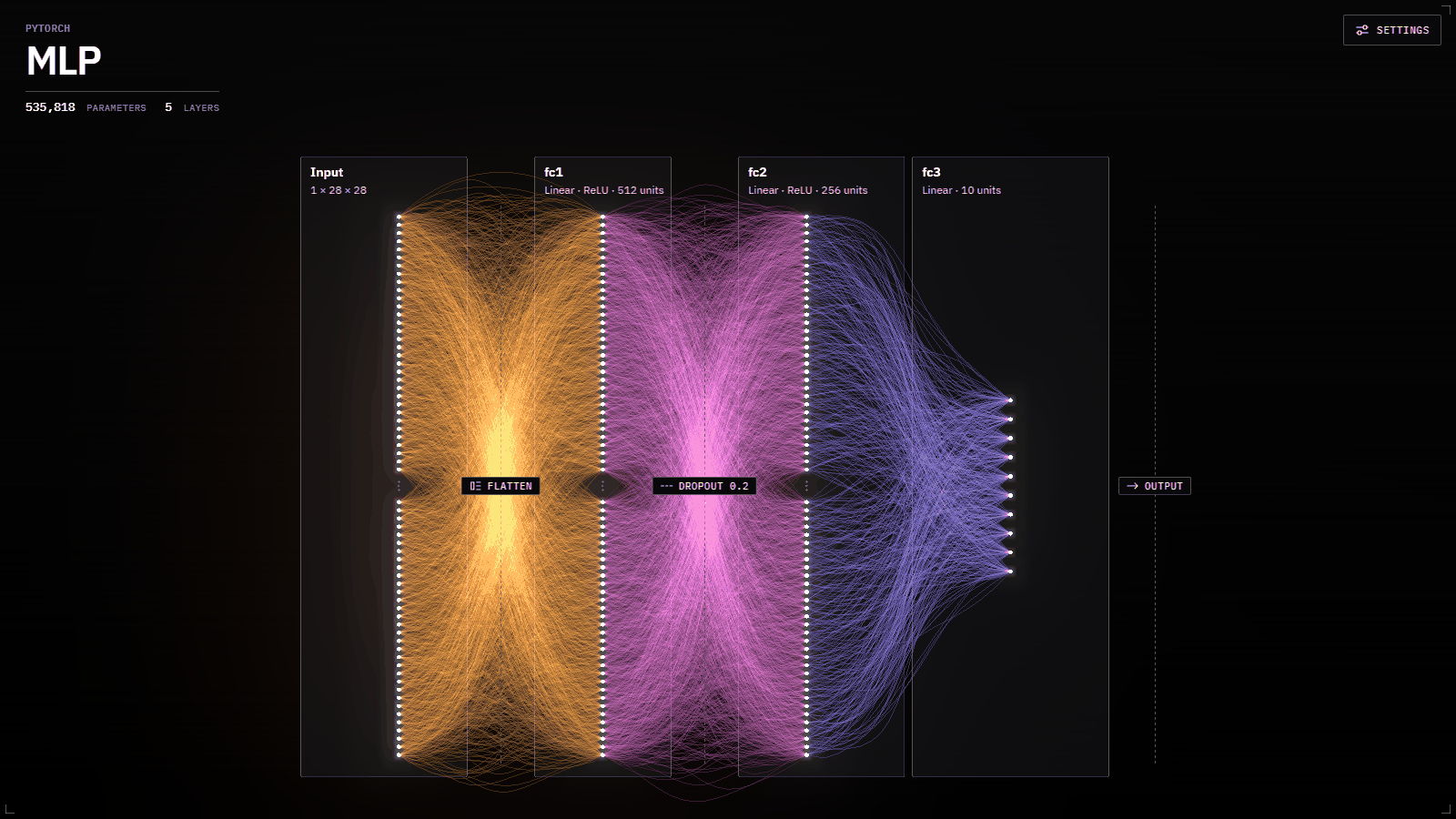
This opens the viewer shown at the top of this page. Each layer is a panel;
|
|
103
|
+
the lines between them are the strongest weights, brighter where the weight is
|
|
104
|
+
larger. Click a layer for its details, scroll to zoom, drag to pan.
|
|
105
|
+
|
|
106
|
+
The second argument, `sample`, tells Neurolume what goes into the model:
|
|
107
|
+
|
|
108
|
+
- the **shape** of one input, without the batch dimension, like `(1, 28, 28)`.
|
|
109
|
+
Enough to draw the architecture.
|
|
110
|
+
- **real data**, such as a batch of images. Convolution layers then show their
|
|
111
|
+
actual feature maps for that input.
|
|
112
|
+
|
|
113
|
+
Neurolume follows the data through your model's `forward` method to find the
|
|
114
|
+
layers and how they connect, so a PyTorch model needs a `forward` (or must be
|
|
115
|
+
an `nn.Sequential`). Keras models that start with `keras.Input` don't need a
|
|
116
|
+
sample at all.
|
|
117
|
+
|
|
118
|
+
Run it: [`examples/mlp.py`](examples/mlp.py).
|
|
119
|
+
|
|
120
|
+
## Example 2: a system of networks
|
|
121
|
+
|
|
122
|
+
Real projects are often several networks wired together. Add each one, plus
|
|
123
|
+
any plain blocks such as data sources or losses, and connect them:
|
|
124
|
+
|
|
125
|
+
```python
|
|
126
|
+
import neurolume
|
|
127
|
+
from torch import nn
|
|
128
|
+
|
|
129
|
+
|
|
130
|
+
def mlp(*sizes):
|
|
131
|
+
layers = []
|
|
132
|
+
for i, (inputs, outputs) in enumerate(zip(sizes, sizes[1:])):
|
|
133
|
+
layers.append(nn.Linear(inputs, outputs))
|
|
134
|
+
if i < len(sizes) - 2:
|
|
135
|
+
layers.append(nn.ReLU())
|
|
136
|
+
return nn.Sequential(*layers)
|
|
137
|
+
|
|
138
|
+
|
|
139
|
+
system = neurolume.System("Sensor autoencoder")
|
|
140
|
+
sensor = system.block("sensor", label="Sensor", description="32 readings per sample", output_shape=[32])
|
|
141
|
+
encoder = system.add("encoder", mlp(32, 64, 64, 16), (32,), label="Encoder")
|
|
142
|
+
decoder = system.add("decoder", mlp(16, 64, 64, 32), (16,), label="Decoder")
|
|
143
|
+
classifier = system.add("classifier", mlp(16, 12, 3), (16,), label="Classifier")
|
|
144
|
+
loss = system.block("loss", label="Reconstruction loss", description="Mean squared error", input_shape=[32])
|
|
145
|
+
prediction = system.block("prediction", label="Fault type", input_shape=[3])
|
|
146
|
+
|
|
147
|
+
system.connect(sensor, encoder, label="readings")
|
|
148
|
+
system.connect(encoder, decoder, label="latent")
|
|
149
|
+
system.connect(encoder, classifier, label="latent")
|
|
150
|
+
system.connect(decoder, loss)
|
|
151
|
+
system.connect(classifier, prediction, label="logits")
|
|
152
|
+
|
|
153
|
+
neurolume.show(system)
|
|
154
|
+
```
|
|
155
|
+
|
|
156
|
+
|
|
157
|
+
|
|
158
|
+
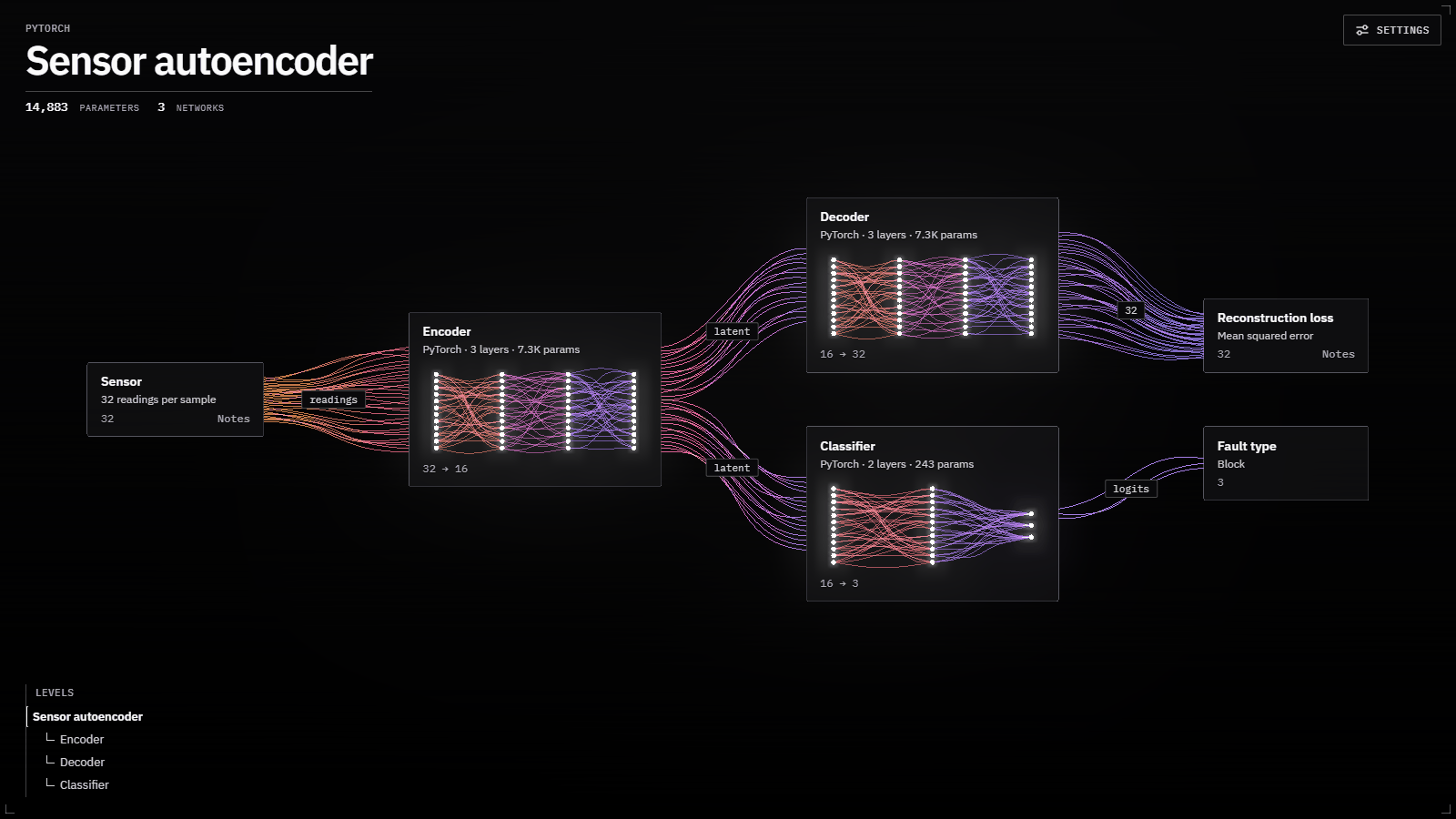
The viewer opens on an overview: one card per network or block, with labelled
|
|
159
|
+
links between them. Click a card (or zoom into it) to open its layers; press
|
|
160
|
+
`Esc` or zoom out to go back. Blocks can carry Markdown notes with LaTeX maths
|
|
161
|
+
(`notes=...`), shown when you click them.
|
|
162
|
+
|
|
163
|
+
Run it: [`examples/system.py`](examples/system.py).
|
|
164
|
+
|
|
165
|
+
## Example 3: systems inside systems
|
|
166
|
+
|
|
167
|
+
A component can itself be a System, or a model with parts of its own. Each one
|
|
168
|
+
opens to its own overview, as many levels deep as you need:
|
|
169
|
+
|
|
170
|
+
```python
|
|
171
|
+
import neurolume
|
|
172
|
+
from autoencoder import Autoencoder # a model with self.encoder and self.decoder
|
|
173
|
+
from system import build_system # the System from example 2
|
|
174
|
+
|
|
175
|
+
plant = neurolume.System("Plant monitor")
|
|
176
|
+
camera = plant.block("camera", label="Camera", description="Noisy 28 x 28 frames", output_shape=[1, 28, 28])
|
|
177
|
+
denoiser = plant.add("denoiser", Autoencoder(), (1, 28, 28), label="Denoiser")
|
|
178
|
+
sensors = plant.block("sensors", label="Sensor bus", description="32 readings per tick", output_shape=[32])
|
|
179
|
+
detector = plant.add("detector", build_system(), label="Fault detector") # a whole System as one component
|
|
180
|
+
alarm = plant.block("alarm", label="Alarm", description="Raise a ticket on a fault", input_shape=[3])
|
|
181
|
+
display = plant.block("display", label="Operator screen", input_shape=[784])
|
|
182
|
+
|
|
183
|
+
plant.connect(camera, denoiser, label="frames")
|
|
184
|
+
plant.connect(denoiser, display, label="clean frames")
|
|
185
|
+
plant.connect(sensors, detector, label="readings")
|
|
186
|
+
plant.connect(detector, alarm, label="fault type", from_="prediction") # the detector has two outputs
|
|
187
|
+
|
|
188
|
+
neurolume.show(plant)
|
|
189
|
+
```
|
|
190
|
+
|
|
191
|
+
|
|
192
|
+
|
|
193
|
+
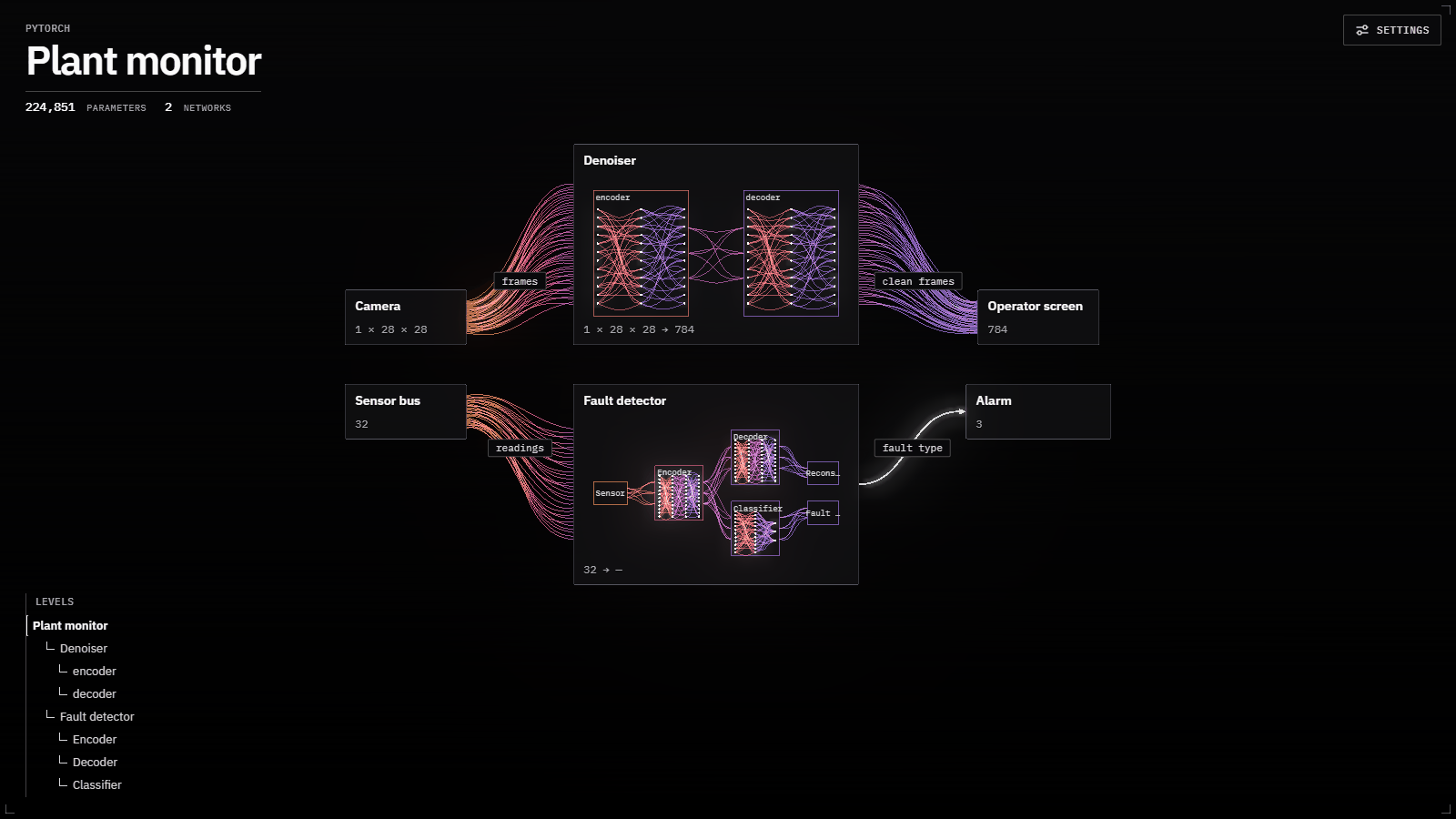
The "Denoiser" card opens to its encoder and decoder; the "Fault detector"
|
|
194
|
+
card opens to the whole system from example 2. Links from outside attach to
|
|
195
|
+
its ends: the readings reach its sensor block, and the fault type leaves from
|
|
196
|
+
its prediction block. The tree at the bottom left shows every level.
|
|
197
|
+
|
|
198
|
+
A single PyTorch module that keeps its parts in attributes (`self.encoder`,
|
|
199
|
+
`self.decoder`) is split into networks like this automatically. Pass
|
|
200
|
+
`group_submodules=False` to `show` to keep it as one network.
|
|
201
|
+
|
|
202
|
+
Run it: [`examples/nested_system.py`](examples/nested_system.py).
|
|
203
|
+
|
|
204
|
+
## Watching a model train (beta)
|
|
205
|
+
|
|
206
|
+
Swap `show` for `watch` and log as you go:
|
|
207
|
+
|
|
208
|
+
```python
|
|
209
|
+
live = neurolume.watch(model, (8,))
|
|
210
|
+
for step in range(steps):
|
|
211
|
+
loss = train_step() # forward, backward, optimiser step
|
|
212
|
+
live.log(step, loss=loss) # after backward(); tensors are fine
|
|
213
|
+
if step % 100 == 0:
|
|
214
|
+
live.log(step, split="val", loss=val_loss)
|
|
215
|
+
live.predictions(step, predicted, target) # e.g. on a validation batch
|
|
216
|
+
live.finish() # the viewer stays open until Ctrl+C
|
|
217
|
+
```
|
|
218
|
+
|
|
219
|
+
|
|
220
|
+
|
|
221
|
+
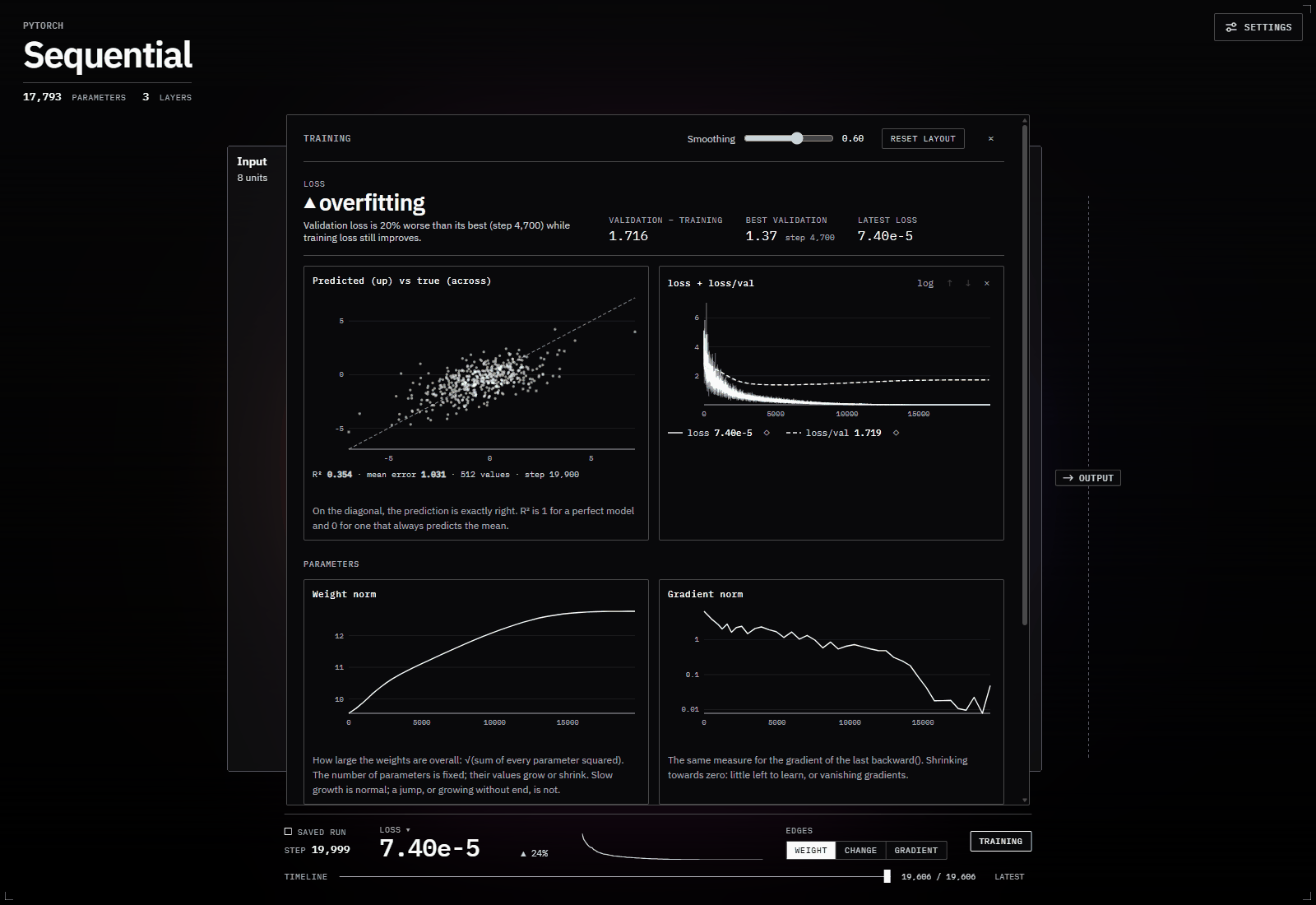
The viewer gains a run strip (step, the main metric, its trend) and a
|
|
222
|
+
**Training** panel:
|
|
223
|
+
|
|
224
|
+
- **Summary:** whether the run is `improving`, `levelling off`, `converged`,
|
|
225
|
+
`getting worse` or `overfitting` (validation getting worse while training
|
|
226
|
+
still improves), the gap between validation and training, and the best
|
|
227
|
+
validation point.
|
|
228
|
+
- **Predictions vs truth:** a predicted-against-true scatter with R² and mean
|
|
229
|
+
error, or a confusion matrix when the targets are class labels.
|
|
230
|
+
- **Metrics:** a chart for each metric you log, with training and validation
|
|
231
|
+
together. Smooth, log-scale, reorder, hide, combine or pin them; the layout is
|
|
232
|
+
remembered per model.
|
|
233
|
+
- **Parameters:** the weight norm (how large the weights are overall), the
|
|
234
|
+
gradient norm, how fast the parameters move, and how their values are spread
|
|
235
|
+
over time.
|
|
236
|
+
|
|
237
|
+
The network itself updates too: lines brighten and fade as the weights change
|
|
238
|
+
(or show the change since the start, or the gradient), and CNN feature maps
|
|
239
|
+
repaint as the filters learn. Drag the **timeline** to scrub back through the
|
|
240
|
+
run. `live.save("run.nlrun")` keeps it; `neurolume.open_run("run.nlrun")` opens
|
|
241
|
+
it again later.
|
|
242
|
+
|
|
243
|
+
`log()` costs microseconds; the model is read at most every half second
|
|
244
|
+
(`every_seconds=0.5`): about 1% of training time for an MLP, and live feature
|
|
245
|
+
maps are kept under 2%.
|
|
246
|
+
|
|
247
|
+
- **Keras:** `model.fit(x, y, callbacks=[neurolume.keras.Live(x[:64], validation=(x_val, y_val))])`.
|
|
248
|
+
- **Systems:** `neurolume.watch(system)` follows every network, nested ones
|
|
249
|
+
included; `live.log(step, network="critic", loss=...)` logs per network.
|
|
250
|
+
|
|
251
|
+
Run it: [`examples/live_training.py`](examples/live_training.py) (a small
|
|
252
|
+
model that overfits on purpose), [`examples/live_resnet.py`](examples/live_resnet.py)
|
|
253
|
+
(ResNet-18 with live feature maps), [`examples/live_nested_system.py`](examples/live_nested_system.py)
|
|
254
|
+
(example 3's plant monitor, every network training at once),
|
|
255
|
+
[`examples/keras_live.py`](examples/keras_live.py).
|
|
256
|
+
|
|
257
|
+
## Sharing: a standalone HTML file
|
|
258
|
+
|
|
259
|
+
```python
|
|
260
|
+
neurolume.export_html(model, (1, 28, 28), "model.html")
|
|
261
|
+
neurolume.export_html(live, path="run.html") # a training run, with its charts and timeline
|
|
262
|
+
```
|
|
263
|
+
|
|
264
|
+
One file with the viewer and your model inside. It opens from disk or an email
|
|
265
|
+
attachment, offline, with no Python. The **Export** button in the viewer's
|
|
266
|
+
Settings does the same.
|
|
267
|
+
|
|
268
|
+
## Embedding in a Qt app
|
|
269
|
+
|
|
270
|
+
```python
|
|
271
|
+
from neurolume.qt import NeurolumeWidget # import before creating the QApplication
|
|
272
|
+
|
|
273
|
+
widget = NeurolumeWidget(model, (1, 28, 28))
|
|
274
|
+
layout.addWidget(widget)
|
|
275
|
+
session = widget.watch(model, sample) # or show a live run, and log() to it
|
|
276
|
+
```
|
|
277
|
+
|
|
278
|
+
A `QWebEngineView` with the same viewer, for your own tools and training
|
|
279
|
+
loggers. Needs `pip install "neurolume[qt]" PySide6`. See
|
|
280
|
+
[`examples/qt_widget.py`](examples/qt_widget.py) and
|
|
281
|
+
[`examples/qt_live.py`](examples/qt_live.py) (a logger with Start/Stop, training
|
|
282
|
+
on a background thread).
|
|
283
|
+
|
|
284
|
+
## Viewer controls
|
|
285
|
+
|
|
286
|
+
| Action | Control |
|
|
287
|
+
| --- | --- |
|
|
288
|
+
| Zoom | Scroll |
|
|
289
|
+
| Pan | Drag |
|
|
290
|
+
| Layer or block details | Click |
|
|
291
|
+
| Open a network | Click, or zoom in |
|
|
292
|
+
| Back to the overview | Zoom out, or `Esc` |
|
|
293
|
+
| Fit to screen | Double-click, or `F` |
|
|
294
|
+
| Light or dark | `T` |
|
|
295
|
+
|
|
296
|
+
Settings (top right) has the colour map, the theme, how many neurons and
|
|
297
|
+
connections to draw, and Export.
|
|
298
|
+
|
|
299
|
+
## How it works
|
|
300
|
+
|
|
301
|
+
Python runs your model once on the sample (with `torch.fx`, or Keras's own
|
|
302
|
+
layer graph) and describes it as a JSON graph: layers, shapes, connections,
|
|
303
|
+
the strongest weights, feature maps. A small local server
|
|
304
|
+
([Tornado](https://www.tornadoweb.org)) hands that graph to a TypeScript and
|
|
305
|
+
three.js viewer in your browser. During training, the same server streams
|
|
306
|
+
metrics and weights over a WebSocket. Nothing leaves your machine.
|
|
307
|
+
|
|
308
|
+
## Development
|
|
309
|
+
|
|
310
|
+
```bash
|
|
311
|
+
git clone https://github.com/Freddie-Ellis/neurolume
|
|
312
|
+
cd neurolume
|
|
313
|
+
pip install -e ".[dev,torch]"
|
|
314
|
+
pytest
|
|
315
|
+
```
|
|
316
|
+
|
|
317
|
+
The viewer lives in `frontend/` (TypeScript, Vite, three.js; Node 18+). After
|
|
318
|
+
changing it, rebuild it into the Python package with
|
|
319
|
+
`scripts/build_frontend.ps1` (PowerShell), and run its tests with `npm test` in
|
|
320
|
+
`frontend/`. For live reloading, run `neurolume.show(model, x, port=8000)` and
|
|
321
|
+
`npm run dev` in `frontend/`.
|
|
322
|
+
|
|
323
|
+
The JSON schema in `python/neurolume/schema.py` is the contract between
|
|
324
|
+
Python and the viewer: after changing it, bump `SCHEMA_VERSION` and run
|
|
325
|
+
`python scripts/generate_schema_ts.py`. The roadmap is
|
|
326
|
+
[`docs/project-plan.md`](docs/project-plan.md).
|
|
327
|
+
|
|
328
|
+
## Licence
|
|
329
|
+
|
|
330
|
+
MIT. See [LICENSE](LICENSE).
|
|
@@ -0,0 +1,289 @@
|
|
|
1
|
+
# Neurolume
|
|
2
|
+
|
|
3
|
+
**See your PyTorch and Keras models as interactive diagrams, and watch them train... (If it's working)**
|
|
4
|
+
|
|
5
|
+
Neurolume runs your model once to learn its shape, then opens an interactive
|
|
6
|
+
viewer in the browser: every layer as a panel, every dense connection as a
|
|
7
|
+
line, feature maps painted with what the model actually sees. Several models
|
|
8
|
+
wired together become one schematic you can open level by level. While you
|
|
9
|
+
train, the same viewer shows the loss, whether the model is overfitting, its
|
|
10
|
+
predictions against the truth, and how its parameters change, and lets you
|
|
11
|
+
scrub back through the run.
|
|
12
|
+
|
|
13
|
+

|
|
14
|
+
|
|
15
|
+
- One call: `neurolume.show(model, sample)`. No account, no log files, nothing to set up.
|
|
16
|
+
- PyTorch and Keras 3, CNNs (with real feature maps), residual and branching models.
|
|
17
|
+
- Systems: several networks plus plain blocks (sensors, losses, outputs) in one diagram, nested as deep as you like.
|
|
18
|
+
- Live training: a calmer, more readable alternative to TensorBoard, in the browser or embedded in a Qt app.
|
|
19
|
+
- Export to one standalone HTML file that opens anywhere, offline.
|
|
20
|
+
|
|
21
|
+
## Install
|
|
22
|
+
|
|
23
|
+
```bash
|
|
24
|
+
pip install "neurolume[torch]" # with PyTorch
|
|
25
|
+
pip install "neurolume[keras]" # with Keras 3, plus a backend: TensorFlow, JAX or PyTorch
|
|
26
|
+
```
|
|
27
|
+
|
|
28
|
+
Neurolume needs Python 3.10 or later. The viewer runs in any modern browser;
|
|
29
|
+
nothing else needs installing. (Keras with PyTorch underneath: install `torch`
|
|
30
|
+
too and set `KERAS_BACKEND=torch`.)
|
|
31
|
+
|
|
32
|
+
## Example 1: a model
|
|
33
|
+
|
|
34
|
+
```python
|
|
35
|
+
import neurolume
|
|
36
|
+
import torch
|
|
37
|
+
from torch import nn
|
|
38
|
+
|
|
39
|
+
|
|
40
|
+
class MLP(nn.Module):
|
|
41
|
+
def __init__(self) -> None:
|
|
42
|
+
super().__init__()
|
|
43
|
+
self.flatten = nn.Flatten()
|
|
44
|
+
self.fc1 = nn.Linear(784, 512)
|
|
45
|
+
self.relu1 = nn.ReLU()
|
|
46
|
+
self.dropout = nn.Dropout(0.2)
|
|
47
|
+
self.fc2 = nn.Linear(512, 256)
|
|
48
|
+
self.relu2 = nn.ReLU()
|
|
49
|
+
self.fc3 = nn.Linear(256, 10)
|
|
50
|
+
|
|
51
|
+
def forward(self, x: torch.Tensor) -> torch.Tensor:
|
|
52
|
+
x = self.flatten(x)
|
|
53
|
+
x = self.dropout(self.relu1(self.fc1(x)))
|
|
54
|
+
x = self.relu2(self.fc2(x))
|
|
55
|
+
return self.fc3(x)
|
|
56
|
+
|
|
57
|
+
|
|
58
|
+
neurolume.show(MLP(), (1, 28, 28)) # the shape of one input: 1 channel, 28 x 28 pixels
|
|
59
|
+
```
|
|
60
|
+
|
|
61
|
+
This opens the viewer shown at the top of this page. Each layer is a panel;
|
|
62
|
+
the lines between them are the strongest weights, brighter where the weight is
|
|
63
|
+
larger. Click a layer for its details, scroll to zoom, drag to pan.
|
|
64
|
+
|
|
65
|
+
The second argument, `sample`, tells Neurolume what goes into the model:
|
|
66
|
+
|
|
67
|
+
- the **shape** of one input, without the batch dimension, like `(1, 28, 28)`.
|
|
68
|
+
Enough to draw the architecture.
|
|
69
|
+
- **real data**, such as a batch of images. Convolution layers then show their
|
|
70
|
+
actual feature maps for that input.
|
|
71
|
+
|
|
72
|
+
Neurolume follows the data through your model's `forward` method to find the
|
|
73
|
+
layers and how they connect, so a PyTorch model needs a `forward` (or must be
|
|
74
|
+
an `nn.Sequential`). Keras models that start with `keras.Input` don't need a
|
|
75
|
+
sample at all.
|
|
76
|
+
|
|
77
|
+
Run it: [`examples/mlp.py`](examples/mlp.py).
|
|
78
|
+
|
|
79
|
+
## Example 2: a system of networks
|
|
80
|
+
|
|
81
|
+
Real projects are often several networks wired together. Add each one, plus
|
|
82
|
+
any plain blocks such as data sources or losses, and connect them:
|
|
83
|
+
|
|
84
|
+
```python
|
|
85
|
+
import neurolume
|
|
86
|
+
from torch import nn
|
|
87
|
+
|
|
88
|
+
|
|
89
|
+
def mlp(*sizes):
|
|
90
|
+
layers = []
|
|
91
|
+
for i, (inputs, outputs) in enumerate(zip(sizes, sizes[1:])):
|
|
92
|
+
layers.append(nn.Linear(inputs, outputs))
|
|
93
|
+
if i < len(sizes) - 2:
|
|
94
|
+
layers.append(nn.ReLU())
|
|
95
|
+
return nn.Sequential(*layers)
|
|
96
|
+
|
|
97
|
+
|
|
98
|
+
system = neurolume.System("Sensor autoencoder")
|
|
99
|
+
sensor = system.block("sensor", label="Sensor", description="32 readings per sample", output_shape=[32])
|
|
100
|
+
encoder = system.add("encoder", mlp(32, 64, 64, 16), (32,), label="Encoder")
|
|
101
|
+
decoder = system.add("decoder", mlp(16, 64, 64, 32), (16,), label="Decoder")
|
|
102
|
+
classifier = system.add("classifier", mlp(16, 12, 3), (16,), label="Classifier")
|
|
103
|
+
loss = system.block("loss", label="Reconstruction loss", description="Mean squared error", input_shape=[32])
|
|
104
|
+
prediction = system.block("prediction", label="Fault type", input_shape=[3])
|
|
105
|
+
|
|
106
|
+
system.connect(sensor, encoder, label="readings")
|
|
107
|
+
system.connect(encoder, decoder, label="latent")
|
|
108
|
+
system.connect(encoder, classifier, label="latent")
|
|
109
|
+
system.connect(decoder, loss)
|
|
110
|
+
system.connect(classifier, prediction, label="logits")
|
|
111
|
+
|
|
112
|
+
neurolume.show(system)
|
|
113
|
+
```
|
|
114
|
+
|
|
115
|
+

|
|
116
|
+
|
|
117
|
+
The viewer opens on an overview: one card per network or block, with labelled
|
|
118
|
+
links between them. Click a card (or zoom into it) to open its layers; press
|
|
119
|
+
`Esc` or zoom out to go back. Blocks can carry Markdown notes with LaTeX maths
|
|
120
|
+
(`notes=...`), shown when you click them.
|
|
121
|
+
|
|
122
|
+
Run it: [`examples/system.py`](examples/system.py).
|
|
123
|
+
|
|
124
|
+
## Example 3: systems inside systems
|
|
125
|
+
|
|
126
|
+
A component can itself be a System, or a model with parts of its own. Each one
|
|
127
|
+
opens to its own overview, as many levels deep as you need:
|
|
128
|
+
|
|
129
|
+
```python
|
|
130
|
+
import neurolume
|
|
131
|
+
from autoencoder import Autoencoder # a model with self.encoder and self.decoder
|
|
132
|
+
from system import build_system # the System from example 2
|
|
133
|
+
|
|
134
|
+
plant = neurolume.System("Plant monitor")
|
|
135
|
+
camera = plant.block("camera", label="Camera", description="Noisy 28 x 28 frames", output_shape=[1, 28, 28])
|
|
136
|
+
denoiser = plant.add("denoiser", Autoencoder(), (1, 28, 28), label="Denoiser")
|
|
137
|
+
sensors = plant.block("sensors", label="Sensor bus", description="32 readings per tick", output_shape=[32])
|
|
138
|
+
detector = plant.add("detector", build_system(), label="Fault detector") # a whole System as one component
|
|
139
|
+
alarm = plant.block("alarm", label="Alarm", description="Raise a ticket on a fault", input_shape=[3])
|
|
140
|
+
display = plant.block("display", label="Operator screen", input_shape=[784])
|
|
141
|
+
|
|
142
|
+
plant.connect(camera, denoiser, label="frames")
|
|
143
|
+
plant.connect(denoiser, display, label="clean frames")
|
|
144
|
+
plant.connect(sensors, detector, label="readings")
|
|
145
|
+
plant.connect(detector, alarm, label="fault type", from_="prediction") # the detector has two outputs
|
|
146
|
+
|
|
147
|
+
neurolume.show(plant)
|
|
148
|
+
```
|
|
149
|
+
|
|
150
|
+

|
|
151
|
+
|
|
152
|
+
The "Denoiser" card opens to its encoder and decoder; the "Fault detector"
|
|
153
|
+
card opens to the whole system from example 2. Links from outside attach to
|
|
154
|
+
its ends: the readings reach its sensor block, and the fault type leaves from
|
|
155
|
+
its prediction block. The tree at the bottom left shows every level.
|
|
156
|
+
|
|
157
|
+
A single PyTorch module that keeps its parts in attributes (`self.encoder`,
|
|
158
|
+
`self.decoder`) is split into networks like this automatically. Pass
|
|
159
|
+
`group_submodules=False` to `show` to keep it as one network.
|
|
160
|
+
|
|
161
|
+
Run it: [`examples/nested_system.py`](examples/nested_system.py).
|
|
162
|
+
|
|
163
|
+
## Watching a model train (beta)
|
|
164
|
+
|
|
165
|
+
Swap `show` for `watch` and log as you go:
|
|
166
|
+
|
|
167
|
+
```python
|
|
168
|
+
live = neurolume.watch(model, (8,))
|
|
169
|
+
for step in range(steps):
|
|
170
|
+
loss = train_step() # forward, backward, optimiser step
|
|
171
|
+
live.log(step, loss=loss) # after backward(); tensors are fine
|
|
172
|
+
if step % 100 == 0:
|
|
173
|
+
live.log(step, split="val", loss=val_loss)
|
|
174
|
+
live.predictions(step, predicted, target) # e.g. on a validation batch
|
|
175
|
+
live.finish() # the viewer stays open until Ctrl+C
|
|
176
|
+
```
|
|
177
|
+
|
|
178
|
+

|
|
179
|
+
|
|
180
|
+
The viewer gains a run strip (step, the main metric, its trend) and a
|
|
181
|
+
**Training** panel:
|
|
182
|
+
|
|
183
|
+
- **Summary:** whether the run is `improving`, `levelling off`, `converged`,
|
|
184
|
+
`getting worse` or `overfitting` (validation getting worse while training
|
|
185
|
+
still improves), the gap between validation and training, and the best
|
|
186
|
+
validation point.
|
|
187
|
+
- **Predictions vs truth:** a predicted-against-true scatter with R² and mean
|
|
188
|
+
error, or a confusion matrix when the targets are class labels.
|
|
189
|
+
- **Metrics:** a chart for each metric you log, with training and validation
|
|
190
|
+
together. Smooth, log-scale, reorder, hide, combine or pin them; the layout is
|
|
191
|
+
remembered per model.
|
|
192
|
+
- **Parameters:** the weight norm (how large the weights are overall), the
|
|
193
|
+
gradient norm, how fast the parameters move, and how their values are spread
|
|
194
|
+
over time.
|
|
195
|
+
|
|
196
|
+
The network itself updates too: lines brighten and fade as the weights change
|
|
197
|
+
(or show the change since the start, or the gradient), and CNN feature maps
|
|
198
|
+
repaint as the filters learn. Drag the **timeline** to scrub back through the
|
|
199
|
+
run. `live.save("run.nlrun")` keeps it; `neurolume.open_run("run.nlrun")` opens
|
|
200
|
+
it again later.
|
|
201
|
+
|
|
202
|
+
`log()` costs microseconds; the model is read at most every half second
|
|
203
|
+
(`every_seconds=0.5`): about 1% of training time for an MLP, and live feature
|
|
204
|
+
maps are kept under 2%.
|
|
205
|
+
|
|
206
|
+
- **Keras:** `model.fit(x, y, callbacks=[neurolume.keras.Live(x[:64], validation=(x_val, y_val))])`.
|
|
207
|
+
- **Systems:** `neurolume.watch(system)` follows every network, nested ones
|
|
208
|
+
included; `live.log(step, network="critic", loss=...)` logs per network.
|
|
209
|
+
|
|
210
|
+
Run it: [`examples/live_training.py`](examples/live_training.py) (a small
|
|
211
|
+
model that overfits on purpose), [`examples/live_resnet.py`](examples/live_resnet.py)
|
|
212
|
+
(ResNet-18 with live feature maps), [`examples/live_nested_system.py`](examples/live_nested_system.py)
|
|
213
|
+
(example 3's plant monitor, every network training at once),
|
|
214
|
+
[`examples/keras_live.py`](examples/keras_live.py).
|
|
215
|
+
|
|
216
|
+
## Sharing: a standalone HTML file
|
|
217
|
+
|
|
218
|
+
```python
|
|
219
|
+
neurolume.export_html(model, (1, 28, 28), "model.html")
|
|
220
|
+
neurolume.export_html(live, path="run.html") # a training run, with its charts and timeline
|
|
221
|
+
```
|
|
222
|
+
|
|
223
|
+
One file with the viewer and your model inside. It opens from disk or an email
|
|
224
|
+
attachment, offline, with no Python. The **Export** button in the viewer's
|
|
225
|
+
Settings does the same.
|
|
226
|
+
|
|
227
|
+
## Embedding in a Qt app
|
|
228
|
+
|
|
229
|
+
```python
|
|
230
|
+
from neurolume.qt import NeurolumeWidget # import before creating the QApplication
|
|
231
|
+
|
|
232
|
+
widget = NeurolumeWidget(model, (1, 28, 28))
|
|
233
|
+
layout.addWidget(widget)
|
|
234
|
+
session = widget.watch(model, sample) # or show a live run, and log() to it
|
|
235
|
+
```
|
|
236
|
+
|
|
237
|
+
A `QWebEngineView` with the same viewer, for your own tools and training
|
|
238
|
+
loggers. Needs `pip install "neurolume[qt]" PySide6`. See
|
|
239
|
+
[`examples/qt_widget.py`](examples/qt_widget.py) and
|
|
240
|
+
[`examples/qt_live.py`](examples/qt_live.py) (a logger with Start/Stop, training
|
|
241
|
+
on a background thread).
|
|
242
|
+
|
|
243
|
+
## Viewer controls
|
|
244
|
+
|
|
245
|
+
| Action | Control |
|
|
246
|
+
| --- | --- |
|
|
247
|
+
| Zoom | Scroll |
|
|
248
|
+
| Pan | Drag |
|
|
249
|
+
| Layer or block details | Click |
|
|
250
|
+
| Open a network | Click, or zoom in |
|
|
251
|
+
| Back to the overview | Zoom out, or `Esc` |
|
|
252
|
+
| Fit to screen | Double-click, or `F` |
|
|
253
|
+
| Light or dark | `T` |
|
|
254
|
+
|
|
255
|
+
Settings (top right) has the colour map, the theme, how many neurons and
|
|
256
|
+
connections to draw, and Export.
|
|
257
|
+
|
|
258
|
+
## How it works
|
|
259
|
+
|
|
260
|
+
Python runs your model once on the sample (with `torch.fx`, or Keras's own
|
|
261
|
+
layer graph) and describes it as a JSON graph: layers, shapes, connections,
|
|
262
|
+
the strongest weights, feature maps. A small local server
|
|
263
|
+
([Tornado](https://www.tornadoweb.org)) hands that graph to a TypeScript and
|
|
264
|
+
three.js viewer in your browser. During training, the same server streams
|
|
265
|
+
metrics and weights over a WebSocket. Nothing leaves your machine.
|
|
266
|
+
|
|
267
|
+
## Development
|
|
268
|
+
|
|
269
|
+
```bash
|
|
270
|
+
git clone https://github.com/Freddie-Ellis/neurolume
|
|
271
|
+
cd neurolume
|
|
272
|
+
pip install -e ".[dev,torch]"
|
|
273
|
+
pytest
|
|
274
|
+
```
|
|
275
|
+
|
|
276
|
+
The viewer lives in `frontend/` (TypeScript, Vite, three.js; Node 18+). After
|
|
277
|
+
changing it, rebuild it into the Python package with
|
|
278
|
+
`scripts/build_frontend.ps1` (PowerShell), and run its tests with `npm test` in
|
|
279
|
+
`frontend/`. For live reloading, run `neurolume.show(model, x, port=8000)` and
|
|
280
|
+
`npm run dev` in `frontend/`.
|
|
281
|
+
|
|
282
|
+
The JSON schema in `python/neurolume/schema.py` is the contract between
|
|
283
|
+
Python and the viewer: after changing it, bump `SCHEMA_VERSION` and run
|
|
284
|
+
`python scripts/generate_schema_ts.py`. The roadmap is
|
|
285
|
+
[`docs/project-plan.md`](docs/project-plan.md).
|
|
286
|
+
|
|
287
|
+
## Licence
|
|
288
|
+
|
|
289
|
+
MIT. See [LICENSE](LICENSE).
|