granulaire 0.2.0b3__tar.gz
This diff represents the content of publicly available package versions that have been released to one of the supported registries. The information contained in this diff is provided for informational purposes only and reflects changes between package versions as they appear in their respective public registries.
- granulaire-0.2.0b3/LICENSE +21 -0
- granulaire-0.2.0b3/PKG-INFO +541 -0
- granulaire-0.2.0b3/README.md +509 -0
- granulaire-0.2.0b3/pyproject.toml +59 -0
- granulaire-0.2.0b3/setup.cfg +4 -0
- granulaire-0.2.0b3/src/granulaire/__init__.py +21 -0
- granulaire-0.2.0b3/src/granulaire/__main__.py +3 -0
- granulaire-0.2.0b3/src/granulaire/cli.py +167 -0
- granulaire-0.2.0b3/src/granulaire/generator.py +378 -0
- granulaire-0.2.0b3/src/granulaire/measure.py +49 -0
- granulaire-0.2.0b3/src/granulaire/moisture.py +95 -0
- granulaire-0.2.0b3/src/granulaire/presets.py +744 -0
- granulaire-0.2.0b3/src/granulaire/render.py +422 -0
- granulaire-0.2.0b3/src/granulaire/shape.py +329 -0
- granulaire-0.2.0b3/src/granulaire/usd_export.py +303 -0
- granulaire-0.2.0b3/src/granulaire.egg-info/PKG-INFO +541 -0
- granulaire-0.2.0b3/src/granulaire.egg-info/SOURCES.txt +24 -0
- granulaire-0.2.0b3/src/granulaire.egg-info/dependency_links.txt +1 -0
- granulaire-0.2.0b3/src/granulaire.egg-info/entry_points.txt +2 -0
- granulaire-0.2.0b3/src/granulaire.egg-info/requires.txt +13 -0
- granulaire-0.2.0b3/src/granulaire.egg-info/top_level.txt +1 -0
- granulaire-0.2.0b3/tests/test_cli.py +88 -0
- granulaire-0.2.0b3/tests/test_generator.py +178 -0
- granulaire-0.2.0b3/tests/test_moisture.py +51 -0
- granulaire-0.2.0b3/tests/test_presets.py +88 -0
- granulaire-0.2.0b3/tests/test_shape.py +88 -0
|
@@ -0,0 +1,21 @@
|
|
|
1
|
+
MIT License
|
|
2
|
+
|
|
3
|
+
Copyright (c) 2026 Daniel Régis Sarmento Caon
|
|
4
|
+
|
|
5
|
+
Permission is hereby granted, free of charge, to any person obtaining a copy
|
|
6
|
+
of this software and associated documentation files (the "Software"), to deal
|
|
7
|
+
in the Software without restriction, including without limitation the rights
|
|
8
|
+
to use, copy, modify, merge, publish, distribute, sublicense, and/or sell
|
|
9
|
+
copies of the Software, and to permit persons to whom the Software is
|
|
10
|
+
furnished to do so, subject to the following conditions:
|
|
11
|
+
|
|
12
|
+
The above copyright notice and this permission notice shall be included in all
|
|
13
|
+
copies or substantial portions of the Software.
|
|
14
|
+
|
|
15
|
+
THE SOFTWARE IS PROVIDED "AS IS", WITHOUT WARRANTY OF ANY KIND, EXPRESS OR
|
|
16
|
+
IMPLIED, INCLUDING BUT NOT LIMITED TO THE WARRANTIES OF MERCHANTABILITY,
|
|
17
|
+
FITNESS FOR A PARTICULAR PURPOSE AND NONINFRINGEMENT. IN NO EVENT SHALL THE
|
|
18
|
+
AUTHORS OR COPYRIGHT HOLDERS BE LIABLE FOR ANY CLAIM, DAMAGES OR OTHER
|
|
19
|
+
LIABILITY, WHETHER IN AN ACTION OF CONTRACT, TORT OR OTHERWISE, ARISING FROM,
|
|
20
|
+
OUT OF OR IN CONNECTION WITH THE SOFTWARE OR THE USE OR OTHER DEALINGS IN THE
|
|
21
|
+
SOFTWARE.
|
|
@@ -0,0 +1,541 @@
|
|
|
1
|
+
Metadata-Version: 2.4
|
|
2
|
+
Name: granulaire
|
|
3
|
+
Version: 0.2.0b3
|
|
4
|
+
Summary: Realistic granular assets generator for Physical AI: procedural grains with measured shape, mass and moisture, exported to OpenUSD for robot simulation and synthetic perception data.
|
|
5
|
+
Author: Daniel Régis Sarmento Caon
|
|
6
|
+
License-Expression: MIT
|
|
7
|
+
Project-URL: Homepage, https://github.com/drscaon/granulaire
|
|
8
|
+
Project-URL: Issues, https://github.com/drscaon/granulaire/issues
|
|
9
|
+
Project-URL: Changelog, https://github.com/drscaon/granulaire/blob/main/CHANGELOG.md
|
|
10
|
+
Project-URL: Suite, https://github.com/drscaon/primvaria
|
|
11
|
+
Keywords: granular,simulation,openusd,procedural,robotics,physical-ai,synthetic-data,robot-learning,primvaria
|
|
12
|
+
Classifier: Development Status :: 4 - Beta
|
|
13
|
+
Classifier: Intended Audience :: Science/Research
|
|
14
|
+
Classifier: Programming Language :: Python :: 3
|
|
15
|
+
Classifier: Topic :: Scientific/Engineering :: Artificial Intelligence
|
|
16
|
+
Classifier: Topic :: Multimedia :: Graphics :: 3D Modeling
|
|
17
|
+
Requires-Python: >=3.10
|
|
18
|
+
Description-Content-Type: text/markdown
|
|
19
|
+
License-File: LICENSE
|
|
20
|
+
Requires-Dist: numpy>=1.24
|
|
21
|
+
Requires-Dist: scipy>=1.10
|
|
22
|
+
Requires-Dist: scikit-image>=0.21
|
|
23
|
+
Requires-Dist: trimesh>=4.0
|
|
24
|
+
Requires-Dist: usd-core>=24.0
|
|
25
|
+
Provides-Extra: render
|
|
26
|
+
Requires-Dist: matplotlib>=3.7; extra == "render"
|
|
27
|
+
Provides-Extra: dev
|
|
28
|
+
Requires-Dist: pytest>=7; extra == "dev"
|
|
29
|
+
Requires-Dist: ruff>=0.5; extra == "dev"
|
|
30
|
+
Requires-Dist: matplotlib>=3.7; extra == "dev"
|
|
31
|
+
Dynamic: license-file
|
|
32
|
+
|
|
33
|
+
<h1 align="center">
|
|
34
|
+
<picture>
|
|
35
|
+
<source media="(prefers-color-scheme: dark)" srcset="https://raw.githubusercontent.com/drscaon/granulaire/main/docs/images/logo-dark.svg">
|
|
36
|
+
<img alt="Granulaire" src="https://raw.githubusercontent.com/drscaon/granulaire/main/docs/images/logo.svg" width="420">
|
|
37
|
+
</picture>
|
|
38
|
+
</h1>
|
|
39
|
+
|
|
40
|
+
<p align="center"><strong>Realistic granular assets generator for Physical AI.</strong></p>
|
|
41
|
+
|
|
42
|
+
<p align="center">
|
|
43
|
+
<a href="https://github.com/drscaon/granulaire/actions/workflows/ci.yml"><img alt="CI" src="https://github.com/drscaon/granulaire/actions/workflows/ci.yml/badge.svg"></a>
|
|
44
|
+
<img alt="Python 3.10+" src="https://img.shields.io/badge/python-3.10%2B-3776AB">
|
|
45
|
+
<img alt="License: MIT" src="https://img.shields.io/badge/license-MIT-green">
|
|
46
|
+
</p>
|
|
47
|
+
|
|
48
|
+
Granulaire generates sand, gravel, pebbles, seeds, fruit, pellets, rubber mulch and packing peanuts
|
|
49
|
+
with realistic, measured shapes, sizes, masses and moisture, and exports them
|
|
50
|
+
to **OpenUSD**. It is built for **Physical AI**: robots trained and tested in
|
|
51
|
+
simulation (reinforcement learning, virtual test campaigns, sim-to-real) need
|
|
52
|
+
ground that looks and behaves like the real thing, not perfect spheres, and
|
|
53
|
+
perception models need synthetic images with exact ground truth. Everything
|
|
54
|
+
can run on CPU; see [Physics limits by grain size](#physics-limits-by-grain-size)
|
|
55
|
+
for what current engines can simulate.
|
|
56
|
+
|
|
57
|
+
|
|
58
|
+
|
|
59
|
+
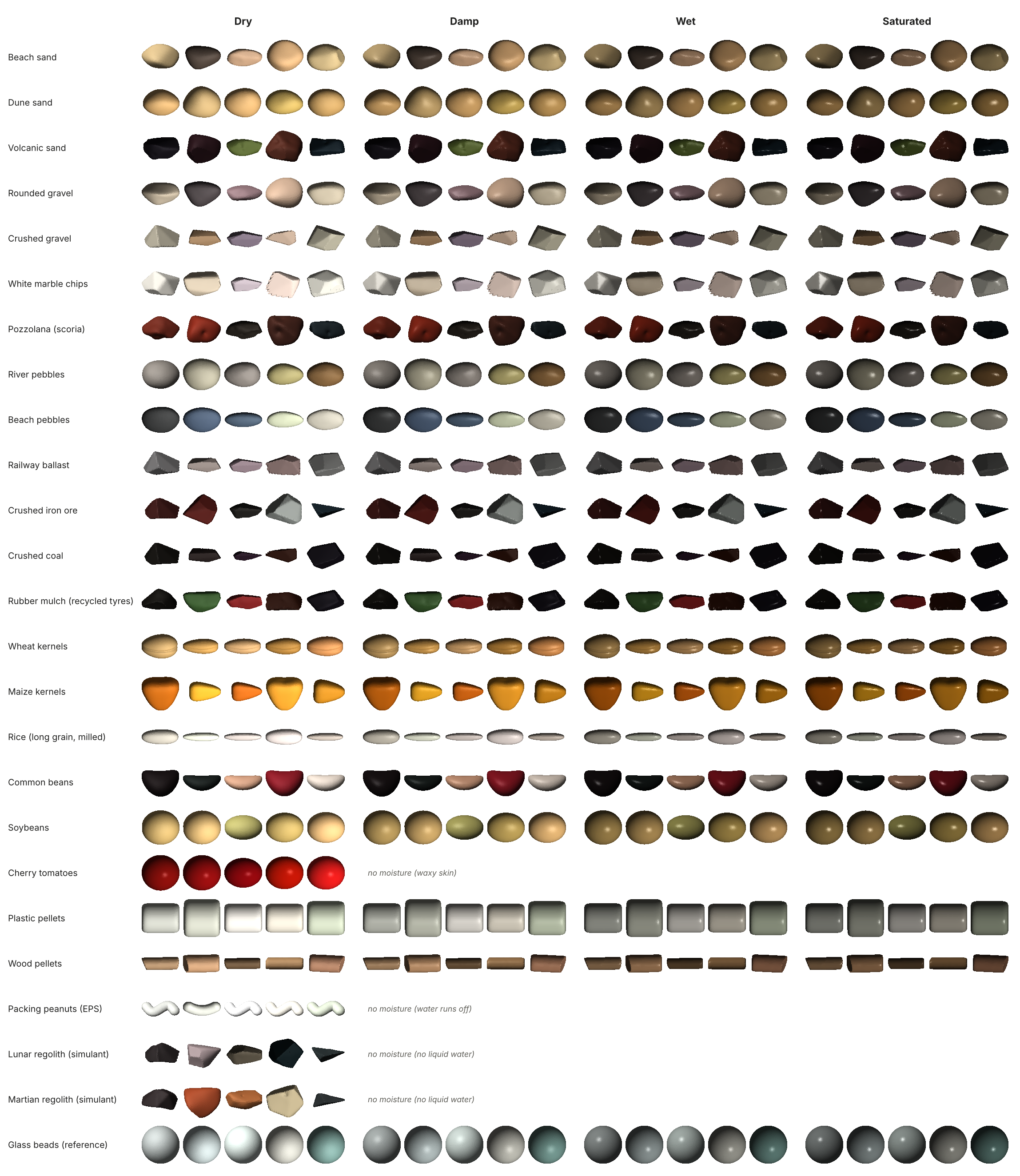
*Five different grains of each of the 25 presets, dry, damp, wet and
|
|
60
|
+
saturated, rendered from the generated meshes. Each grain is drawn at its own
|
|
61
|
+
scale: sizes range from 0.07 mm (lunar regolith) to ~5 cm (river pebbles).
|
|
62
|
+
Regenerate with `granulaire render-gallery` (see Usage).*
|
|
63
|
+
|
|
64
|
+
## What it does
|
|
65
|
+
|
|
66
|
+
- Generates *N* distinct grain shapes (100 by default) from distributions
|
|
67
|
+
borrowed from sedimentology: size on the phi scale (Wentworth), Zingg ratios
|
|
68
|
+
(elongation I/L, flatness S/I), angularity, irregularity (fracture faces,
|
|
69
|
+
lumps, pits) and mineralogy. Kernels, seeds and pellets use their own shape
|
|
70
|
+
families (superellipsoids, cylinders).
|
|
71
|
+
- Places each shape several times in shuffled order with random orientations:
|
|
72
|
+
by default 100 shapes × 5 copies = 500 grains per scene (see
|
|
73
|
+
[Scene size and mixing](#scene-size-and-mixing)).
|
|
74
|
+
- **Measures** every generated grain (nominal diameter, Zingg ratios, Wadell
|
|
75
|
+
sphericity, convexity, angularity proxy) instead of trusting the inputs.
|
|
76
|
+
- Exports an OpenUSD scene: prototypes, grains by reference, UsdPreviewSurface
|
|
77
|
+
materials, `UsdPhysics` rigid bodies (mass from volume and density,
|
|
78
|
+
convex-hull collision, friction, restitution) and a collision ground.
|
|
79
|
+
- Optionally gives every grain a moisture state through an OpenUSD variant set.
|
|
80
|
+
- Exports packing peanuts and cherry tomatoes as deformable bodies.
|
|
81
|
+
**Deformable simulation works only with NVIDIA OmniPhysics** (Omniverse,
|
|
82
|
+
Isaac Sim 5+) and is **not tested yet**; see
|
|
83
|
+
[Deformable grains](#deformable-grains-packing-peanuts-cherry-tomatoes).
|
|
84
|
+
|
|
85
|
+
## Installation
|
|
86
|
+
|
|
87
|
+
From PyPI:
|
|
88
|
+
|
|
89
|
+
```bash
|
|
90
|
+
pip install "granulaire[render]"
|
|
91
|
+
```
|
|
92
|
+
|
|
93
|
+
From a clone, for development:
|
|
94
|
+
|
|
95
|
+
```bash
|
|
96
|
+
python -m venv .venv && source .venv/bin/activate
|
|
97
|
+
pip install -e ".[render]" # add ",dev" for tests and linting
|
|
98
|
+
```
|
|
99
|
+
|
|
100
|
+
Requires Python 3.10+.
|
|
101
|
+
|
|
102
|
+
## Usage
|
|
103
|
+
|
|
104
|
+
```bash
|
|
105
|
+
granulaire list
|
|
106
|
+
granulaire generate --preset beach_sand # 100 shapes × 5 copies, shuffled
|
|
107
|
+
granulaire generate --preset beach_sand --shapes 20 --copies 10 --no-shuffle --seed 3
|
|
108
|
+
granulaire generate --preset beach_pebbles --moisture --moisture-weights 0,20,50,30
|
|
109
|
+
granulaire generate --preset rounded_gravel --no-size --no-orientation
|
|
110
|
+
granulaire render output/beach_sand output/crushed_gravel
|
|
111
|
+
granulaire render-moisture output/beach_pebbles output/crushed_gravel output/beach_sand
|
|
112
|
+
granulaire render-gallery output/beach_sand output/crushed_gravel --grains 5
|
|
113
|
+
```
|
|
114
|
+
|
|
115
|
+
The README gallery comes from generating every preset with `--moisture`, then
|
|
116
|
+
`granulaire render-gallery` on all 25 output folders in category order, with
|
|
117
|
+
`--output docs/images/moisture_gallery.png`.
|
|
118
|
+
|
|
119
|
+
`python -m granulaire ...` works too. From Python:
|
|
120
|
+
|
|
121
|
+
```python
|
|
122
|
+
from granulaire import Variations, generate_scene, write_outputs
|
|
123
|
+
|
|
124
|
+
# defaults: 100 shapes × 5 copies, shuffled, seed 1; moisture turned on
|
|
125
|
+
sand = generate_scene("beach_sand", variations=Variations(moisture=True))
|
|
126
|
+
write_outputs(sand, "output") # -> output/beach_sand/
|
|
127
|
+
|
|
128
|
+
# 20 shapes × 10 copies, copies side by side, another random draw
|
|
129
|
+
gravel = generate_scene("crushed_gravel", shapes=20, copies=10, shuffle=False, seed=3)
|
|
130
|
+
write_outputs(gravel, "output") # -> output/crushed_gravel/
|
|
131
|
+
```
|
|
132
|
+
|
|
133
|
+
### Scene size and mixing
|
|
134
|
+
|
|
135
|
+
| Option (CLI / Python) | Default | Effect |
|
|
136
|
+
|---|---|---|
|
|
137
|
+
| `--shapes N` / `shapes=N` | 100 | number of distinct grain shapes |
|
|
138
|
+
| `--copies K` / `copies=K` | 5 | how many times each shape is placed; the scene has N × K grains |
|
|
139
|
+
| `--no-shuffle` / `shuffle=False` | shuffled | place the copies of each shape side by side, shape after shape, instead of mixing them, e.g. to compare shapes |
|
|
140
|
+
| `--seed S` / `seed=S` | 1 | random seed; the same options and seed give the same scene |
|
|
141
|
+
|
|
142
|
+
`--shapes` and `--copies` must be at least 1. Turning shuffling off changes
|
|
143
|
+
only which shape goes in which slot: shapes, positions and orientations stay
|
|
144
|
+
the same.
|
|
145
|
+
|
|
146
|
+
### Presets
|
|
147
|
+
|
|
148
|
+
| Category | Presets |
|
|
149
|
+
|---|---|
|
|
150
|
+
| Sand | `beach_sand`, `dune_sand`, `volcanic_sand` |
|
|
151
|
+
| Gravel | `rounded_gravel`, `crushed_gravel`, `marble_chips`, `pozzolana` |
|
|
152
|
+
| Pebbles | `river_pebbles` (rounded, equant, earthy mixed minerals), `beach_pebbles` (flat discs and ovals, polished basalt and marble) |
|
|
153
|
+
| Industrial | `railway_ballast`, `iron_ore`, `coal`, `rubber_mulch` (shredded recycled tyres: torn, grippy, bouncy nuggets) |
|
|
154
|
+
| Agricultural | `wheat` (kernels with a ventral crease), `maize` (wedge-shaped dent kernels), `rice` (long grain, milled), `beans` (kidney-shaped, mixed varieties), `soybean`, `cherry_tomatoes` (glossy skin, stem scar): **deformable, NVIDIA OmniPhysics only** (rigid elsewhere with `--no-deformable`), **no moisture** (waxy skin) |
|
|
155
|
+
| Pellets | `plastic_pellets` (PE/PP, ~3.4 mm), `wood_pellets` (6 mm diameter, 10–30 mm long, broken ends) |
|
|
156
|
+
| Packaging | `packing_peanuts` (expanded polystyrene, S or C shaped): **deformable, NVIDIA OmniPhysics only** (rigid elsewhere with `--no-deformable`), and **no moisture**: EPS never gets wet, water runs off |
|
|
157
|
+
| Space | `lunar_regolith`, `martian_regolith` (no moisture) |
|
|
158
|
+
| Reference | `glass_beads`: exact spheres, the baseline to compare real grains against |
|
|
159
|
+
|
|
160
|
+
Values are realistic orders of magnitude, not measurements of a specific deposit.
|
|
161
|
+
|
|
162
|
+
### Variations (checkboxes)
|
|
163
|
+
|
|
164
|
+
| Option | On | Off |
|
|
165
|
+
|---|---|---|
|
|
166
|
+
| `--size` | diameter drawn from the grading curve | all at d50 |
|
|
167
|
+
| `--shape` | elongation, flatness and irregularity drawn | mean values |
|
|
168
|
+
| `--roundness` | facets and edge rounding drawn | median values |
|
|
169
|
+
| `--mineralogy` | mineral and tint drawn | dominant mineral |
|
|
170
|
+
| `--orientation` | random orientation | all aligned |
|
|
171
|
+
| `--moisture` (off by default) | variant set + state drawn per grain | no moisture |
|
|
172
|
+
|
|
173
|
+
Turning one variation off does not change the other random draws: with the
|
|
174
|
+
same seed you compare the same scene with a single difference.
|
|
175
|
+
|
|
176
|
+
### Moisture (OpenUSD variant set)
|
|
177
|
+
|
|
178
|
+
Every prototype carries a `moisture` variant set (`dry`, `damp`, `wet`,
|
|
179
|
+
`saturated`) and every grain selects its own. A state changes:
|
|
180
|
+
|
|
181
|
+
- **mass**: a wetter grain is **heavier**. Each state stores its own mass
|
|
182
|
+
(dry mass + water) in `physics:mass`, plus the water alone in
|
|
183
|
+
`granulaire:waterMass`; switching the variant switches the mass;
|
|
184
|
+
- **appearance**: darker colour, lower roughness, clearcoat (UsdPreviewSurface);
|
|
185
|
+
- **contact**: friction and restitution (one UsdPhysics material per state),
|
|
186
|
+
plus capillary cohesion in the custom attribute `granulaire:capillaryCohesion`,
|
|
187
|
+
since UsdPhysics has no standard schema for it.
|
|
188
|
+
|
|
189
|
+
The water comes from two sources: a **surface film**, which weighs a lot on
|
|
190
|
+
small grains (much surface for little mass) and little on pebbles, capped by
|
|
191
|
+
the water the pores of a heap can hold; and **absorbed water**, which
|
|
192
|
+
dominates for porous stone (pozzolana) and for anything that soaks
|
|
193
|
+
(seeds, beans, wood). Median weight gain of one grain, % of its dry mass:
|
|
194
|
+
|
|
195
|
+
| Material | Damp | Wet | Saturated |
|
|
196
|
+
|---|---|---|---|
|
|
197
|
+
| Beach sand | +3.6 % | +14 % | +24 % |
|
|
198
|
+
| Pozzolana (porous) | +6.2 % | +17 % | +22 % |
|
|
199
|
+
| Crushed gravel | +0.5 % | +1.5 % | +2.2 % |
|
|
200
|
+
| River pebbles | +0.2 % | +0.6 % | +0.8 % |
|
|
201
|
+
| Beach pebbles (dense basalt, marble) | +0.1 % | +0.3 % | +0.5 % |
|
|
202
|
+
| Plastic pellets | +1.0 % | +4.0 % | +7.0 % |
|
|
203
|
+
| Wheat | +9.6 % | +26 % | +34 % |
|
|
204
|
+
| Soybeans | +12 % | +34 % | +43 % |
|
|
205
|
+
| Wood pellets | +15 % | +41 % | +52 % |
|
|
206
|
+
| Common beans | +27 % | +73 % | +92 % |
|
|
207
|
+
|
|
208
|
+
Every preset's values are in `summary.json` (`median_water_content_pct`) and
|
|
209
|
+
per grain in `prototype_metrics.csv` (`mass_<state>_kg`).
|
|
210
|
+
|
|
211
|
+
- **No swelling.** A wet grain gets heavier but keeps its shape and size. In
|
|
212
|
+
reality beans, seeds and wood pellets swell when soaked, so their wet
|
|
213
|
+
density is overstated.
|
|
214
|
+
- **Indicative values.** Water contents, contact and cohesion coefficients
|
|
215
|
+
are model orders of magnitude, not measurements, and still need
|
|
216
|
+
calibrating.
|
|
217
|
+
|
|
218
|
+
In usdview or Omniverse, change a grain's state by changing its variant
|
|
219
|
+
selection. Blender's USD importer takes the state selected at import time.
|
|
220
|
+
|
|
221
|
+
Presets with no moisture states, even with `--moisture`: the regoliths (no
|
|
222
|
+
liquid water), the polystyrene packing peanuts (EPS never gets wet: water
|
|
223
|
+
runs off) and the cherry tomatoes (water beads on the waxy skin).
|
|
224
|
+
|
|
225
|
+
### Deformable grains (packing peanuts, cherry tomatoes)
|
|
226
|
+
|
|
227
|
+
> **Works only with NVIDIA OmniPhysics, and not tested yet.** Deformable
|
|
228
|
+
> simulation of `packing_peanuts` and `cherry_tomatoes` requires an engine that
|
|
229
|
+
> reads NVIDIA's OmniPhysics deformable schema: Omniverse Kit and Isaac Sim 5 or
|
|
230
|
+
> later, where PhysX runs it on the GPU. Other tools (Blender, usdview, MuJoCo,
|
|
231
|
+
> Bullet, engines reading only standard UsdPhysics) open the file but see these
|
|
232
|
+
> grains as **static meshes with no physics**. For those, export with
|
|
233
|
+
> `--no-deformable` to get ordinary rigid bodies.
|
|
234
|
+
>
|
|
235
|
+
> Granulaire is developed without an NVIDIA GPU: the files are checked to be
|
|
236
|
+
> valid OpenUSD with the documented schemas and attributes, but they have
|
|
237
|
+
> **never been simulated in Isaac Sim**. In some releases the schema is a beta
|
|
238
|
+
> feature that must be enabled. Feedback from anyone who runs them is very
|
|
239
|
+
> welcome.
|
|
240
|
+
|
|
241
|
+
Why: core OpenUSD has no deformable-body schema yet. UsdPhysics covers rigid
|
|
242
|
+
bodies only ([UsdPhysics overview](https://openusd.org/dev/api/usd_physics_page_front.html));
|
|
243
|
+
the AOUSD Physics Working Group lists deformable and soft bodies only as a
|
|
244
|
+
possible future extension
|
|
245
|
+
([charter](https://project.linuxfoundation.org/hubfs/AOUSD/Charters/24.12.16%20AOUSD%20Physics%20Working%20Group%20Charter%20-%20Approved.pdf)).
|
|
246
|
+
Deformable presets therefore follow NVIDIA's **OmniPhysics deformable
|
|
247
|
+
schema** ([reference](https://docs.omniverse.nvidia.com/kit/docs/omni_physics/latest/dev_guide/deformables/deformable_bodies.html)),
|
|
248
|
+
built on the core `UsdGeom.TetMesh`:
|
|
249
|
+
|
|
250
|
+
```
|
|
251
|
+
/World/Prototypes/Grain_000 Xform + OmniPhysicsDeformableBodyAPI (omniphysics:mass)
|
|
252
|
+
geom Mesh + OmniPhysicsDeformablePoseAPI:custom (bind pose)
|
|
253
|
+
sim TetMesh + OmniPhysicsVolumeDeformableSimAPI
|
|
254
|
+
+ OmniPhysicsDeformablePoseAPI:custom
|
|
255
|
+
+ PhysicsCollisionAPI
|
|
256
|
+
/World/Looks/Phys Material + OmniPhysicsBaseMaterialAPI (density, friction)
|
|
257
|
+
+ OmniPhysicsDeformableMaterialAPI
|
|
258
|
+
(Young's modulus, Poisson's ratio)
|
|
259
|
+
+ PhysxDeformableMaterialAPI
|
|
260
|
+
(elasticity damping)
|
|
261
|
+
```
|
|
262
|
+
|
|
263
|
+
- The simulation mesh fills the grain's volume with tetrahedra (voxels split
|
|
264
|
+
into 6 tetrahedra each, ~1,300–1,400 per grain); the render mesh follows it
|
|
265
|
+
through the bind pose. The tetrahedral volume matches the surface within a
|
|
266
|
+
few percent.
|
|
267
|
+
- The schemas are applied by name, so the file stays valid OpenUSD in any
|
|
268
|
+
tool, but only OmniPhysics acts on them. `usd-core` does not list
|
|
269
|
+
unregistered schemas in `GetAppliedSchemas()`, but they are in the file
|
|
270
|
+
(`apiSchemas` metadata).
|
|
271
|
+
- NVIDIA's schema is still evolving (it replaced an earlier PhysX deformable
|
|
272
|
+
API); if a newer Omniverse release renames attributes, re-export with an
|
|
273
|
+
updated Granulaire. If OpenUSD standardises deformables, the export will move
|
|
274
|
+
to that schema.
|
|
275
|
+
- `--no-deformable` exports the same presets as rigid bodies.
|
|
276
|
+
- **Bounce.** Deformable materials have no restitution: a grain bounces
|
|
277
|
+
through its own elasticity, and `physxDeformableMaterial:elasticityDamping`
|
|
278
|
+
(1/s) sets how much energy each deformation loses. The values below are
|
|
279
|
+
uncalibrated starting points, to tune in Isaac Sim.
|
|
280
|
+
- Material values are indicative:
|
|
281
|
+
|
|
282
|
+
| Preset | Young's modulus E | Poisson's ratio ν | Elasticity damping |
|
|
283
|
+
|---|---|---|---|
|
|
284
|
+
| `packing_peanuts` (EPS foam) | ≈ 1 MPa | ≈ 0.1 | 0.02 /s |
|
|
285
|
+
| `cherry_tomatoes` (soft fruit, keeps its volume when squeezed) | ≈ 0.5 MPa | ≈ 0.45 | 0.01 /s |
|
|
286
|
+
|
|
287
|
+
## Outputs (per preset, under `output/<preset>/`)
|
|
288
|
+
|
|
289
|
+
| File | Content |
|
|
290
|
+
|---|---|
|
|
291
|
+
| `granulaire_<preset>.usdc` | OpenUSD scene (Blender: File > Import > USD) |
|
|
292
|
+
| `prototype_metrics.csv` | measured descriptors, mass (per moisture state), parameters |
|
|
293
|
+
| `instances.csv` | grain → shape, position, moisture state |
|
|
294
|
+
| `summary.json` | global statistics (d50, mean sphericity, masses, water) |
|
|
295
|
+
| `prototypes.npz` | meshes, used by the renderer |
|
|
296
|
+
| `shape_sheet.png`, `mix_preview.png` | previews (`granulaire render`) |
|
|
297
|
+
|
|
298
|
+
### In Blender
|
|
299
|
+
|
|
300
|
+
The `.usdc` scene opens directly in Blender (File > Import > USD).
|
|
301
|
+
|
|
302
|
+
<table>
|
|
303
|
+
<tr>
|
|
304
|
+
<td width="50%"><img src="https://raw.githubusercontent.com/drscaon/granulaire/main/docs/images/blender_gravel.jpg" alt="Crushed gravel grains imported into Blender, falling onto the floor under rigid-body physics"></td>
|
|
305
|
+
<td width="50%"><img src="https://raw.githubusercontent.com/drscaon/granulaire/main/docs/images/blender_sand.jpg" alt="Beach sand grains imported into Blender, small rounded grains in varied mineral colours"></td>
|
|
306
|
+
</tr>
|
|
307
|
+
<tr>
|
|
308
|
+
<td align="center"><sub>Crushed gravel falling onto the floor (Blender rigid-body physics)</sub></td>
|
|
309
|
+
<td align="center"><sub>Beach sand, rounded grains in mineral colours</sub></td>
|
|
310
|
+
</tr>
|
|
311
|
+
</table>
|
|
312
|
+
|
|
313
|
+
<sub>Screenshots from the first version (0.1.0); grain shapes have become more
|
|
314
|
+
varied since then.</sub>
|
|
315
|
+
|
|
316
|
+
## Method in brief
|
|
317
|
+
|
|
318
|
+
Each grain is an implicit volume, meshed with marching cubes:
|
|
319
|
+
|
|
320
|
+
1. **Base body.** Rocks: a random convex polyhedron (the hull of points drawn
|
|
321
|
+
on an ellipsoid with Zingg proportions; few facets give an angular grain),
|
|
322
|
+
with edges rounded by replacing the *max* in its gauge with a p-norm (low p
|
|
323
|
+
gives a rounded grain, high p sharp edges). Kernels and seeds: a
|
|
324
|
+
superellipsoid. Pellets: a cylinder with rounded end edges.
|
|
325
|
+
2. **Fracture chips.** Random planes cut the body, leaving flat broken faces
|
|
326
|
+
with sharp edges (crushed stone, broken pebbles, broken pellet ends).
|
|
327
|
+
3. **Taper and irregularity.** An egg or wedge taper along the long axis, then
|
|
328
|
+
low-frequency lumps, pits (scoria vesicles, flint dents), a crease (wheat),
|
|
329
|
+
a crown dent (maize), a kidney bend with its hilum (beans) and light
|
|
330
|
+
roughness.
|
|
331
|
+
4. **Mesh and scale.** Marching cubes on the zero level set, recentring on the
|
|
332
|
+
centre of mass, scaling to the target nominal diameter.
|
|
333
|
+
|
|
334
|
+
## Friction and restitution
|
|
335
|
+
|
|
336
|
+
Every grain gets a standard OpenUSD physics material (`UsdPhysicsMaterialAPI`:
|
|
337
|
+
static friction, dynamic friction, restitution), bound to its collision mesh
|
|
338
|
+
with the `physics` purpose. With moisture enabled there is one material per
|
|
339
|
+
state, and each grain's `moisture` variant selects it. The ground has its own
|
|
340
|
+
material (static friction 0.60, restitution 0.10).
|
|
341
|
+
|
|
342
|
+
### Values
|
|
343
|
+
|
|
344
|
+
Dynamic friction is 90 % of static friction. In wet states, friction is
|
|
345
|
+
multiplied by 1.10 (damp: a little water makes grains grip), 1.00 (wet) and
|
|
346
|
+
0.80 (saturated: grains slide on the water); restitution by 0.60, 0.40
|
|
347
|
+
and 0.30. The values are realistic orders of magnitude, ranked sensibly
|
|
348
|
+
(angular crushed rock grips more than round, polished or waxy grains), not
|
|
349
|
+
measurements of a specific deposit.
|
|
350
|
+
|
|
351
|
+
| Preset | Static μ (dry) | Dynamic μ (dry) | Restitution (dry) | Static μ damp | Static μ wet | Static μ saturated |
|
|
352
|
+
|---|---|---|---|---|---|---|
|
|
353
|
+
| `beach_sand` | 0.55 | 0.50 | 0.10 | 0.61 | 0.55 | 0.44 |
|
|
354
|
+
| `dune_sand` | 0.50 | 0.45 | 0.10 | 0.55 | 0.50 | 0.40 |
|
|
355
|
+
| `volcanic_sand` | 0.60 | 0.54 | 0.10 | 0.66 | 0.60 | 0.48 |
|
|
356
|
+
| `rounded_gravel` | 0.55 | 0.50 | 0.15 | 0.61 | 0.55 | 0.44 |
|
|
357
|
+
| `crushed_gravel` | 0.65 | 0.59 | 0.15 | 0.72 | 0.65 | 0.52 |
|
|
358
|
+
| `marble_chips` | 0.60 | 0.54 | 0.15 | 0.66 | 0.60 | 0.48 |
|
|
359
|
+
| `pozzolana` | 0.75 | 0.68 | 0.10 | 0.83 | 0.75 | 0.60 |
|
|
360
|
+
| `river_pebbles` | 0.50 | 0.45 | 0.20 | 0.55 | 0.50 | 0.40 |
|
|
361
|
+
| `beach_pebbles` | 0.40 | 0.36 | 0.25 | 0.44 | 0.40 | 0.32 |
|
|
362
|
+
| `railway_ballast` | 0.70 | 0.63 | 0.15 | 0.77 | 0.70 | 0.56 |
|
|
363
|
+
| `iron_ore` | 0.70 | 0.63 | 0.12 | 0.77 | 0.70 | 0.56 |
|
|
364
|
+
| `coal` | 0.55 | 0.50 | 0.10 | 0.61 | 0.55 | 0.44 |
|
|
365
|
+
| `rubber_mulch` | 0.85 | 0.77 | 0.55 | 0.94 | 0.85 | 0.68 |
|
|
366
|
+
| `wheat` | 0.40 | 0.36 | 0.40 | 0.44 | 0.40 | 0.32 |
|
|
367
|
+
| `maize` | 0.45 | 0.41 | 0.35 | 0.50 | 0.45 | 0.36 |
|
|
368
|
+
| `rice` | 0.40 | 0.36 | 0.30 | 0.44 | 0.40 | 0.32 |
|
|
369
|
+
| `beans` | 0.35 | 0.32 | 0.40 | 0.39 | 0.35 | 0.28 |
|
|
370
|
+
| `soybean` | 0.35 | 0.32 | 0.45 | 0.39 | 0.35 | 0.28 |
|
|
371
|
+
| `cherry_tomatoes` | 0.45 | 0.41 | 0.20 | — | — | — |
|
|
372
|
+
| `plastic_pellets` | 0.30 | 0.27 | 0.50 | 0.33 | 0.30 | 0.24 |
|
|
373
|
+
| `wood_pellets` | 0.50 | 0.45 | 0.20 | 0.55 | 0.50 | 0.40 |
|
|
374
|
+
| `packing_peanuts` | 0.50 | 0.45 | 0.30 | — | — | — |
|
|
375
|
+
| `lunar_regolith` | 0.75 | 0.68 | 0.05 | — | — | — |
|
|
376
|
+
| `martian_regolith` | 0.70 | 0.63 | 0.05 | — | — | — |
|
|
377
|
+
| `glass_beads` | 0.35 | 0.32 | 0.85 | 0.39 | 0.35 | 0.28 |
|
|
378
|
+
|
|
379
|
+
— : no moisture states for this preset. Packing peanuts and cherry tomatoes
|
|
380
|
+
are deformable: NVIDIA OmniPhysics ignores static friction for deformables, so
|
|
381
|
+
their single value is written as both static and dynamic friction, and
|
|
382
|
+
restitution does not apply (their bounce comes from elasticity and damping, see
|
|
383
|
+
[Deformable grains](#deformable-grains-packing-peanuts-cherry-tomatoes)); the
|
|
384
|
+
restitution shown is used when they are exported as rigid bodies
|
|
385
|
+
(`--no-deformable`).
|
|
386
|
+
|
|
387
|
+
### Which engines use it
|
|
388
|
+
|
|
389
|
+
| Tool | Friction and restitution from the USD file |
|
|
390
|
+
|---|---|
|
|
391
|
+
| NVIDIA Isaac Sim / Omniverse (PhysX) | **Used**, including the material selected by each grain's moisture variant. PhysX averages the two materials in contact by default (`physxMaterial:frictionCombineMode` to change it). |
|
|
392
|
+
| Other engines importing `UsdPhysics` (e.g. Newton) | Should be read, as it is the standard schema; not tested here. |
|
|
393
|
+
| Blender | **Not used**: Blender's USD importer does not import physics data. Set friction in the rigid-body panel or with an import script. |
|
|
394
|
+
| MuJoCo, Gazebo, PyBullet | Not native; depends on the converter. MuJoCo combines friction differently (it takes the larger of the two). |
|
|
395
|
+
|
|
396
|
+
### Limits
|
|
397
|
+
|
|
398
|
+
- **Friction is per pair of surfaces.** What a robot foot feels also depends on
|
|
399
|
+
the foot's own material and the engine's combine mode.
|
|
400
|
+
- **No capillary cohesion in simulation.** Wet-grain cohesion is stored in
|
|
401
|
+
`granulaire:capillaryCohesion`, but OpenUSD has no standard schema for it and
|
|
402
|
+
no rigid-body engine reads it: in simulation, wet grains differ only by
|
|
403
|
+
friction, restitution and mass.
|
|
404
|
+
- **No rolling resistance.** Neither `UsdPhysics` nor PhysX rigid bodies model
|
|
405
|
+
it, which is why piles of spheres flow far too easily. Here the irregular
|
|
406
|
+
shapes play that role: an angular grain cannot roll.
|
|
407
|
+
- **Calibrate for quantitative work.** For training with domain
|
|
408
|
+
randomisation, these values are a sensible centre to randomise around; for a
|
|
409
|
+
quantitative study, calibrate them against the real material, for example
|
|
410
|
+
with its angle of repose.
|
|
411
|
+
|
|
412
|
+
## Physics limits by grain size
|
|
413
|
+
|
|
414
|
+
Grains are generated at their **real size**. That is right for rendering and
|
|
415
|
+
perception, but many of them are too small or too light for today's
|
|
416
|
+
rigid-body engines with default settings. Rules of thumb behind the table:
|
|
417
|
+
|
|
418
|
+
- **Bullet** (PyBullet, Blender) works best with objects larger than ~0.1 m,
|
|
419
|
+
and Blender's default collision margin is 0.04 m.
|
|
420
|
+
- **PhysX** (Isaac Sim, Omniverse) uses a default `contactOffset` of 0.02 m
|
|
421
|
+
per shape at metric scale, so two shapes are treated as touching from ~4 cm.
|
|
422
|
+
- **Tunnelling**: at 60 Hz, a grain falling at 1–2 m/s travels 1.7–3.3 cm per
|
|
423
|
+
step and can pass through surfaces smaller than that without CCD or substeps.
|
|
424
|
+
- **Mass ratio**: iterative solvers become unstable when very light grains
|
|
425
|
+
touch a much heavier body, such as a robot foot weighing a few kilograms.
|
|
426
|
+
|
|
427
|
+
| Physics risk | Presets (median nominal size · mean grain mass) | What to do |
|
|
428
|
+
|---|---|---|
|
|
429
|
+
| **Not usable as individual rigid bodies** | `lunar_regolith` (0.07 mm · ~13 µg), `martian_regolith` (0.12 mm · ~0.1 mg), `dune_sand` (0.22 mm · ~18 µg), `beach_sand` (0.36 mm · ~0.1 mg), `volcanic_sand` (0.49 mm · ~0.4 mg), `glass_beads` (1 mm · ~1.4 mg) | Use for rendering and perception; for physics, use a continuum model (MPM), a deformable heightfield, or scaled-up grains |
|
|
430
|
+
| **Unstable without tuning** | `rice` (2.8 mm, 1.6 mm thick · ~18 mg), `plastic_pellets` (3.4 mm · ~20 mg), `wheat` (4.1 mm · ~53 mg), `rounded_gravel` (5.8 mm · ~0.4 g), `soybean` (6.6 mm · ~0.19 g), `beans` (9.1 mm, 5.8 mm thick · ~0.53 g), `maize` (7.4 mm, 4.7 mm thick · ~0.29 g), `crushed_gravel` (8.2 mm · ~1 g) | Reduce contact offsets / margins to ~1 mm, enable CCD, use substeps or a smaller time step |
|
|
431
|
+
| **Workable with tuning** | `packing_peanuts` (20 mm, ~9 mm thick · ~50 mg, extremely light), `wood_pellets` (9.8 mm, 6 mm thick · ~0.6 g), `pozzolana` (11 mm · ~1.5 g, very light), `marble_chips` (11.5 mm · ~2.5 g), `iron_ore` (16 mm · ~17 g), `rubber_mulch` (20 mm, 12 mm thick · ~6 g), `cherry_tomatoes` (25 mm · ~8 g, deformable) | Same settings as above; check stability against the heaviest body in contact |
|
|
432
|
+
| **Generally fine** | `coal` (23 mm · ~15 g), `beach_pebbles` (38 mm, 18 mm thick · ~140 g), `railway_ballast` (40 mm · ~100 g), `river_pebbles` (46 mm · ~230 g) | Keep CCD on for impacts; in Blender, lower the default 0.04 m margin |
|
|
433
|
+
|
|
434
|
+
For elongated or flat grains (rice, maize, beans, pellets), the **thickness** is what
|
|
435
|
+
matters for tunnelling, not the nominal size. Packing peanuts are large but
|
|
436
|
+
weigh almost nothing: the mass ratio with anything they touch is the main risk,
|
|
437
|
+
and as deformable bodies they are simulated only by NVIDIA OmniPhysics (see
|
|
438
|
+
above).
|
|
439
|
+
|
|
440
|
+
These are orders of magnitude, not hard limits: the actual threshold depends
|
|
441
|
+
on the engine, time step, solver iterations, contact settings and the bodies
|
|
442
|
+
in contact. Scaling grains up changes the physics (mass, inertia, contact
|
|
443
|
+
forces scale differently), so treat it as an approximation of the material.
|
|
444
|
+
|
|
445
|
+
**Perception is not affected.** Cameras and renderers have no minimum size:
|
|
446
|
+
every preset, including sand and regoliths, can be used at real scale for
|
|
447
|
+
synthetic images, ground-truth masks, grading-from-image benchmarks or
|
|
448
|
+
appearance studies (moisture darkening and gloss). Only dynamics need the
|
|
449
|
+
precautions above. A thin layer of a few hundred grains on a hard surface
|
|
450
|
+
(the "sand on the ramp" case) is also within reach of rigid-body engines for
|
|
451
|
+
the gravel and pebble presets.
|
|
452
|
+
|
|
453
|
+
## Known limits
|
|
454
|
+
|
|
455
|
+
- **Real units.** See *Physics limits by grain size* above.
|
|
456
|
+
- **No grain-by-grain physics at large scale.** CPU physics targets a few
|
|
457
|
+
hundred grains; instancing is for rendering surfaces.
|
|
458
|
+
- **Angularity is a proxy**, not Wadell roundness, and is only comparable
|
|
459
|
+
between grains of the same mesh resolution.
|
|
460
|
+
- **Collision uses the convex hull** for rigid grains. Pits, creases and dents
|
|
461
|
+
are visible but not part of the collision shape; hollow shells (whole
|
|
462
|
+
seashells) are not generated. Deformable grains collide with their
|
|
463
|
+
tetrahedral mesh.
|
|
464
|
+
- **Deformables work only with NVIDIA OmniPhysics, untested.** Until OpenUSD
|
|
465
|
+
standardises deformable bodies, packing peanuts and cherry tomatoes are
|
|
466
|
+
simulated as deformables only in Omniverse / Isaac Sim (GPU); elsewhere they
|
|
467
|
+
are static meshes unless exported with `--no-deformable`. They have not been
|
|
468
|
+
run in Isaac Sim yet.
|
|
469
|
+
- **Mesh resolution.** Marching cubes runs on a 48-cell grid along the longest
|
|
470
|
+
axis; the sharpest edges can show slight stair-stepping.
|
|
471
|
+
|
|
472
|
+
## Development
|
|
473
|
+
|
|
474
|
+
```bash
|
|
475
|
+
pip install -e ".[dev]"
|
|
476
|
+
pytest # test suite
|
|
477
|
+
ruff check . # lint
|
|
478
|
+
ruff format . # format
|
|
479
|
+
```
|
|
480
|
+
|
|
481
|
+
### Commits and versions
|
|
482
|
+
|
|
483
|
+
- Commit messages follow [Conventional Commits](https://www.conventionalcommits.org/)
|
|
484
|
+
(`feat:`, `fix:`, `docs:`, `test:`, `refactor:`, `build:`, `chore:`).
|
|
485
|
+
- Versions follow [Semantic Versioning](https://semver.org/). The version
|
|
486
|
+
lives in one place, `pyproject.toml`; `granulaire.__version__` reads it from
|
|
487
|
+
the installed package metadata.
|
|
488
|
+
- To release: update `version` in `pyproject.toml`, move the `Unreleased`
|
|
489
|
+
entries of `CHANGELOG.md` under the new version with its date, commit as
|
|
490
|
+
`chore(release): X.Y.Z`, then tag `vX.Y.Z` (annotated). Pre-releases use
|
|
491
|
+
PEP 440 suffixes (`0.2.0b1` for a beta, tag `v0.2.0b1`).
|
|
492
|
+
|
|
493
|
+
### Branches (GitHub Flow)
|
|
494
|
+
|
|
495
|
+
The repository follows [GitHub Flow](https://docs.github.com/en/get-started/using-github/github-flow):
|
|
496
|
+
|
|
497
|
+
1. `main` is the only long-lived branch and is always releasable. Nobody
|
|
498
|
+
pushes to it directly.
|
|
499
|
+
2. Every change starts on a short-lived branch from `main`, named after its
|
|
500
|
+
type: `feat/<name>`, `fix/<name>`, `docs/<name>`, `ci/<name>`, …
|
|
501
|
+
3. Push the branch and open a pull request into `main`; CI runs on it.
|
|
502
|
+
4. Merge when CI is green, then delete the branch.
|
|
503
|
+
|
|
504
|
+
Releasing is a change like any other: on a `chore/release-X.Y.Z` branch, bump
|
|
505
|
+
`version` in `pyproject.toml` and move the `Unreleased` entries of
|
|
506
|
+
`CHANGELOG.md` under the new version; merge the pull request, then tag
|
|
507
|
+
`vX.Y.Z` on `main` (or create the release on the GitHub web page with that new
|
|
508
|
+
tag). The release workflow builds the packages and attaches them.
|
|
509
|
+
|
|
510
|
+
A versioned `pre-push` hook refuses direct pushes to `main`. Enable it once per
|
|
511
|
+
clone with `git config core.hooksPath .githooks` (emergency override:
|
|
512
|
+
`ALLOW_MAIN_PUSH=1 git push`).
|
|
513
|
+
|
|
514
|
+
On a private repository, GitHub enforces branch protection rules only with
|
|
515
|
+
GitHub Pro (or on a public repository). With either, add a rule on `main`:
|
|
516
|
+
require a pull request and the CI checks to pass, block force pushes and
|
|
517
|
+
deletion.
|
|
518
|
+
|
|
519
|
+
### Continuous integration
|
|
520
|
+
|
|
521
|
+
GitHub Actions runs these workflows (`.github/workflows/`):
|
|
522
|
+
|
|
523
|
+
| Workflow | When | What |
|
|
524
|
+
|---|---|---|
|
|
525
|
+
| `ci.yml` | every push to `main`, every pull request | `ruff check` and `ruff format --check`; `pytest` on Python 3.10–3.13 (Linux) and 3.12 (macOS, Windows); a command-line smoke test; build the wheel and sdist, `twine check`, install the wheel in a clean environment. The packages are kept as a run artifact for 14 days. |
|
|
526
|
+
| `release.yml` | a pushed tag `v*` | checks the tag matches the version in `pyproject.toml`, tests, builds, then creates the GitHub release with the packages attached and the notes taken from `CHANGELOG.md`. Versions with `a`, `b` or `rc` are marked as pre-releases. If the release already exists (created on the web page), the packages are added to it. |
|
|
527
|
+
| Dependabot | monthly | pull requests to update the GitHub Actions and the Python dependencies. |
|
|
528
|
+
|
|
529
|
+
Ruff is pinned in CI so that a new ruff release cannot fail the build on
|
|
530
|
+
unchanged code; update the pin and run `ruff format .` together.
|
|
531
|
+
|
|
532
|
+
## License
|
|
533
|
+
|
|
534
|
+
[MIT](https://github.com/drscaon/granulaire/blob/main/LICENSE) © 2026 Daniel Régis Sarmento Caon
|
|
535
|
+
|
|
536
|
+
The logo is set in IBM Plex Sans (SIL Open Font License 1.1), outlined into
|
|
537
|
+
paths, so it displays without the font installed.
|
|
538
|
+
|
|
539
|
+
---
|
|
540
|
+
|
|
541
|
+
Granulaire is part of [**Primvaria**](https://github.com/drscaon/primvaria), physics-ready variability for Physical AI, in OpenUSD: `pip install primvaria` installs the whole suite.
|