filaire 0.2.0b1__tar.gz
This diff represents the content of publicly available package versions that have been released to one of the supported registries. The information contained in this diff is provided for informational purposes only and reflects changes between package versions as they appear in their respective public registries.
- filaire-0.2.0b1/LICENSE +21 -0
- filaire-0.2.0b1/PKG-INFO +580 -0
- filaire-0.2.0b1/README.md +544 -0
- filaire-0.2.0b1/pyproject.toml +57 -0
- filaire-0.2.0b1/setup.cfg +4 -0
- filaire-0.2.0b1/src/filaire/__init__.py +24 -0
- filaire-0.2.0b1/src/filaire/__main__.py +3 -0
- filaire-0.2.0b1/src/filaire/blender/__init__.py +38 -0
- filaire-0.2.0b1/src/filaire/blender/checks.py +177 -0
- filaire-0.2.0b1/src/filaire/blender/physics.py +445 -0
- filaire-0.2.0b1/src/filaire/blender/run.py +125 -0
- filaire-0.2.0b1/src/filaire/cable.py +486 -0
- filaire-0.2.0b1/src/filaire/catalog.py +280 -0
- filaire-0.2.0b1/src/filaire/centerline.py +110 -0
- filaire-0.2.0b1/src/filaire/cli.py +275 -0
- filaire-0.2.0b1/src/filaire/connectors.py +554 -0
- filaire-0.2.0b1/src/filaire/generator.py +301 -0
- filaire-0.2.0b1/src/filaire/geometry2d.py +172 -0
- filaire-0.2.0b1/src/filaire/mesh3d.py +196 -0
- filaire-0.2.0b1/src/filaire/render.py +147 -0
- filaire-0.2.0b1/src/filaire/sim/__init__.py +0 -0
- filaire-0.2.0b1/src/filaire/sim/checks.py +295 -0
- filaire-0.2.0b1/src/filaire/sim/mujoco_model.py +342 -0
- filaire-0.2.0b1/src/filaire/sim/usd_reader.py +151 -0
- filaire-0.2.0b1/src/filaire/usd_export.py +546 -0
- filaire-0.2.0b1/src/filaire/validate.py +58 -0
- filaire-0.2.0b1/src/filaire.egg-info/PKG-INFO +580 -0
- filaire-0.2.0b1/src/filaire.egg-info/SOURCES.txt +37 -0
- filaire-0.2.0b1/src/filaire.egg-info/dependency_links.txt +1 -0
- filaire-0.2.0b1/src/filaire.egg-info/entry_points.txt +2 -0
- filaire-0.2.0b1/src/filaire.egg-info/requires.txt +21 -0
- filaire-0.2.0b1/src/filaire.egg-info/top_level.txt +1 -0
- filaire-0.2.0b1/tests/test_blender.py +28 -0
- filaire-0.2.0b1/tests/test_cli.py +78 -0
- filaire-0.2.0b1/tests/test_connectors.py +64 -0
- filaire-0.2.0b1/tests/test_generator.py +69 -0
- filaire-0.2.0b1/tests/test_geometry.py +59 -0
- filaire-0.2.0b1/tests/test_sim.py +87 -0
- filaire-0.2.0b1/tests/test_usd.py +144 -0
filaire-0.2.0b1/LICENSE
ADDED
|
@@ -0,0 +1,21 @@
|
|
|
1
|
+
MIT License
|
|
2
|
+
|
|
3
|
+
Copyright (c) 2026 Daniel Régis Sarmento Caon
|
|
4
|
+
|
|
5
|
+
Permission is hereby granted, free of charge, to any person obtaining a copy
|
|
6
|
+
of this software and associated documentation files (the "Software"), to deal
|
|
7
|
+
in the Software without restriction, including without limitation the rights
|
|
8
|
+
to use, copy, modify, merge, publish, distribute, sublicense, and/or sell
|
|
9
|
+
copies of the Software, and to permit persons to whom the Software is
|
|
10
|
+
furnished to do so, subject to the following conditions:
|
|
11
|
+
|
|
12
|
+
The above copyright notice and this permission notice shall be included in all
|
|
13
|
+
copies or substantial portions of the Software.
|
|
14
|
+
|
|
15
|
+
THE SOFTWARE IS PROVIDED "AS IS", WITHOUT WARRANTY OF ANY KIND, EXPRESS OR
|
|
16
|
+
IMPLIED, INCLUDING BUT NOT LIMITED TO THE WARRANTIES OF MERCHANTABILITY,
|
|
17
|
+
FITNESS FOR A PARTICULAR PURPOSE AND NONINFRINGEMENT. IN NO EVENT SHALL THE
|
|
18
|
+
AUTHORS OR COPYRIGHT HOLDERS BE LIABLE FOR ANY CLAIM, DAMAGES OR OTHER
|
|
19
|
+
LIABILITY, WHETHER IN AN ACTION OF CONTRACT, TORT OR OTHERWISE, ARISING FROM,
|
|
20
|
+
OUT OF OR IN CONNECTION WITH THE SOFTWARE OR THE USE OR OTHER DEALINGS IN THE
|
|
21
|
+
SOFTWARE.
|
filaire-0.2.0b1/PKG-INFO
ADDED
|
@@ -0,0 +1,580 @@
|
|
|
1
|
+
Metadata-Version: 2.4
|
|
2
|
+
Name: filaire
|
|
3
|
+
Version: 0.2.0b1
|
|
4
|
+
Summary: Standard cable assets generator for Physical AI: cables of standard types (power, USB, Ethernet, HDMI, audio, industrial, ribbon, coiled) with male and female connectors, cut or stripped ends, exported to OpenUSD as UsdPhysics rigid-segment chains and checked in MuJoCo.
|
|
5
|
+
Author: Daniel Régis Sarmento Caon
|
|
6
|
+
License-Expression: MIT
|
|
7
|
+
Project-URL: Homepage, https://github.com/drscaon/filaire
|
|
8
|
+
Project-URL: Issues, https://github.com/drscaon/filaire/issues
|
|
9
|
+
Project-URL: Changelog, https://github.com/drscaon/filaire/blob/main/CHANGELOG.md
|
|
10
|
+
Project-URL: Suite, https://github.com/drscaon/primvaria
|
|
11
|
+
Keywords: cable,connector,simulation,openusd,mujoco,procedural,robotics,physical-ai,synthetic-data,robot-learning,primvaria
|
|
12
|
+
Classifier: Development Status :: 4 - Beta
|
|
13
|
+
Classifier: Intended Audience :: Science/Research
|
|
14
|
+
Classifier: Programming Language :: Python :: 3
|
|
15
|
+
Classifier: Topic :: Scientific/Engineering :: Artificial Intelligence
|
|
16
|
+
Classifier: Topic :: Multimedia :: Graphics :: 3D Modeling
|
|
17
|
+
Requires-Python: >=3.10
|
|
18
|
+
Description-Content-Type: text/markdown
|
|
19
|
+
License-File: LICENSE
|
|
20
|
+
Requires-Dist: numpy>=1.24
|
|
21
|
+
Requires-Dist: scipy>=1.10
|
|
22
|
+
Requires-Dist: shapely>=2.1
|
|
23
|
+
Requires-Dist: usd-core>=24.0
|
|
24
|
+
Provides-Extra: render
|
|
25
|
+
Requires-Dist: matplotlib>=3.7; extra == "render"
|
|
26
|
+
Provides-Extra: sim
|
|
27
|
+
Requires-Dist: mujoco>=3.2; extra == "sim"
|
|
28
|
+
Provides-Extra: blender
|
|
29
|
+
Requires-Dist: bpy>=5.1; python_version == "3.13" and extra == "blender"
|
|
30
|
+
Provides-Extra: dev
|
|
31
|
+
Requires-Dist: pytest>=7; extra == "dev"
|
|
32
|
+
Requires-Dist: ruff>=0.5; extra == "dev"
|
|
33
|
+
Requires-Dist: matplotlib>=3.7; extra == "dev"
|
|
34
|
+
Requires-Dist: mujoco>=3.2; extra == "dev"
|
|
35
|
+
Dynamic: license-file
|
|
36
|
+
|
|
37
|
+
<h1 align="center">
|
|
38
|
+
<picture>
|
|
39
|
+
<source media="(prefers-color-scheme: dark)" srcset="https://raw.githubusercontent.com/drscaon/filaire/main/docs/images/logo-dark.svg">
|
|
40
|
+
<img alt="Filaire" src="https://raw.githubusercontent.com/drscaon/filaire/main/docs/images/logo.svg" width="360">
|
|
41
|
+
</picture>
|
|
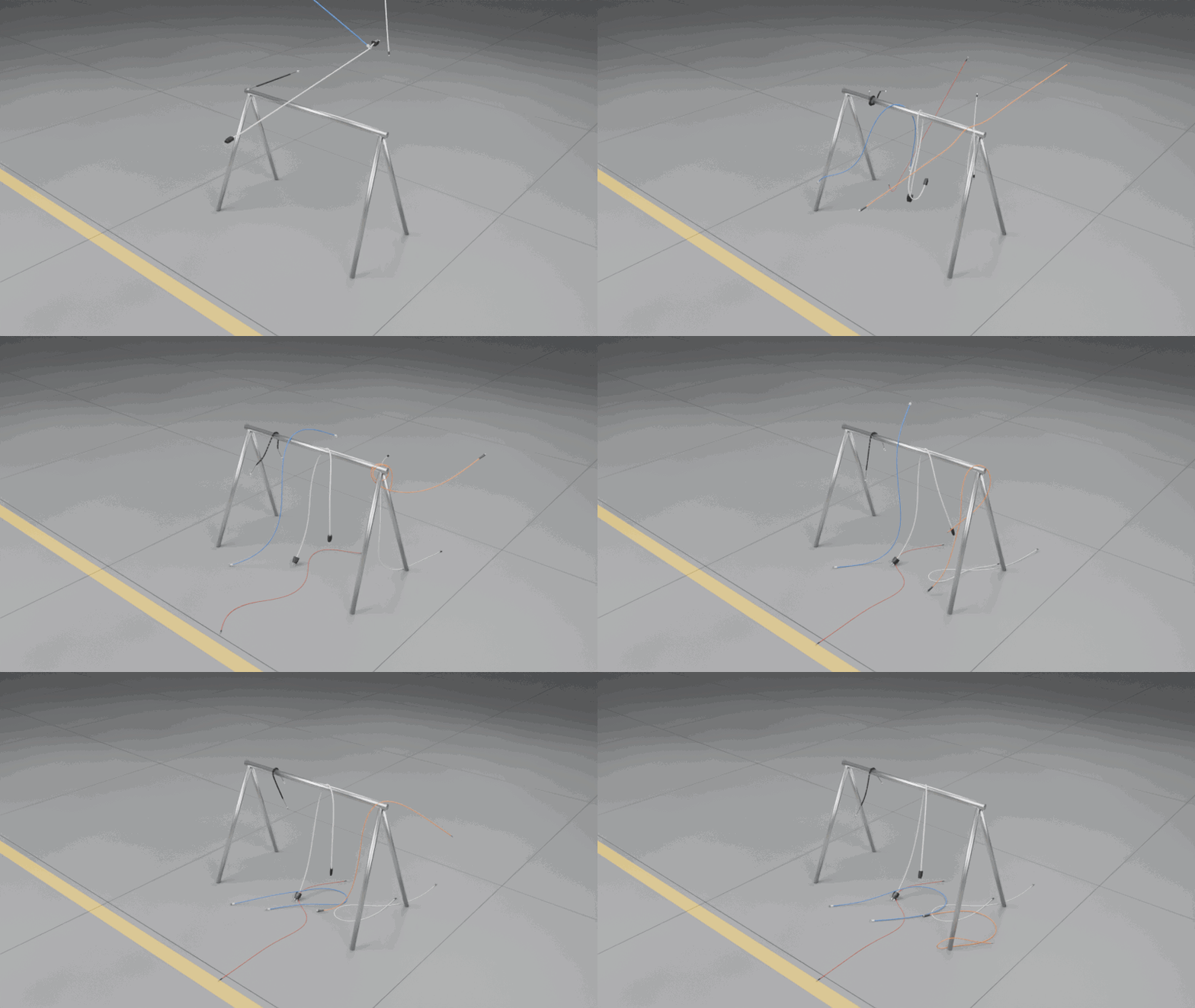
42
|
+
</h1>
|
|
43
|
+
|
|
44
|
+
<p align="center"><strong>Standard cable assets generator for Physical AI.</strong></p>
|
|
45
|
+
|
|
46
|
+
<p align="center">
|
|
47
|
+
<a href="https://github.com/drscaon/filaire/actions/workflows/ci.yml"><img alt="CI" src="https://github.com/drscaon/filaire/actions/workflows/ci.yml/badge.svg"></a>
|
|
48
|
+
<img alt="Python 3.10+" src="https://img.shields.io/badge/python-3.10%2B-3776AB">
|
|
49
|
+
<img alt="License: MIT" src="https://img.shields.io/badge/license-MIT-green">
|
|
50
|
+
</p>
|
|
51
|
+
|
|
52
|
+
Filaire generates cables of standard types (power cords, USB, Ethernet,
|
|
53
|
+
HDMI, audio, microphone, speaker wire, sensor, ribbon and coiled handset
|
|
54
|
+
cords, DC barrel and Micro-USB) with their real connectors, **male and female**, or with cut or
|
|
55
|
+
stripped ends, and exports them to **OpenUSD** as physics-ready assets: a
|
|
56
|
+
chain of rigid segments with `UsdPhysics` joints whose springs come from
|
|
57
|
+
the cable's bending and torsional stiffness. Every connector comes with the
|
|
58
|
+
receptacle it plugs into (device port, inlet, wall socket, panel connector,
|
|
59
|
+
or the female end of an extension), derived from the plug so that the two
|
|
60
|
+
always mate. The assets are checked in **MuJoCo** (dropped on the ground,
|
|
61
|
+
sagging like a beam, plugged in at the right and wrong angles) and in
|
|
62
|
+
**Blender**, where an add-on sets the rigid bodies and joints up by itself
|
|
63
|
+
when a file is imported. Every file passes OpenUSD's own validators.
|
|
64
|
+
|
|
65
|
+
It is built for **Physical AI**: robots that route, plug and unplug cables
|
|
66
|
+
are trained and tested in simulation, and they need many different cables
|
|
67
|
+
with exact ground truth, not one capsule chain. Everything can run on CPU.
|
|
68
|
+
Filaire belongs to a series with
|
|
69
|
+
[Granulaire](https://github.com/drscaon/granulaire) (granular assets),
|
|
70
|
+
[Maillage](https://github.com/drscaon/maillage) (textiles) and
|
|
71
|
+
[Quincaillerie](https://github.com/drscaon/quincaillerie) (fasteners, cells
|
|
72
|
+
and holders), and follows the same approach: distributions instead of one
|
|
73
|
+
shape, measured outputs, honest limits.
|
|
74
|
+
|
|
75
|
+
|
|
76
|
+
|
|
77
|
+
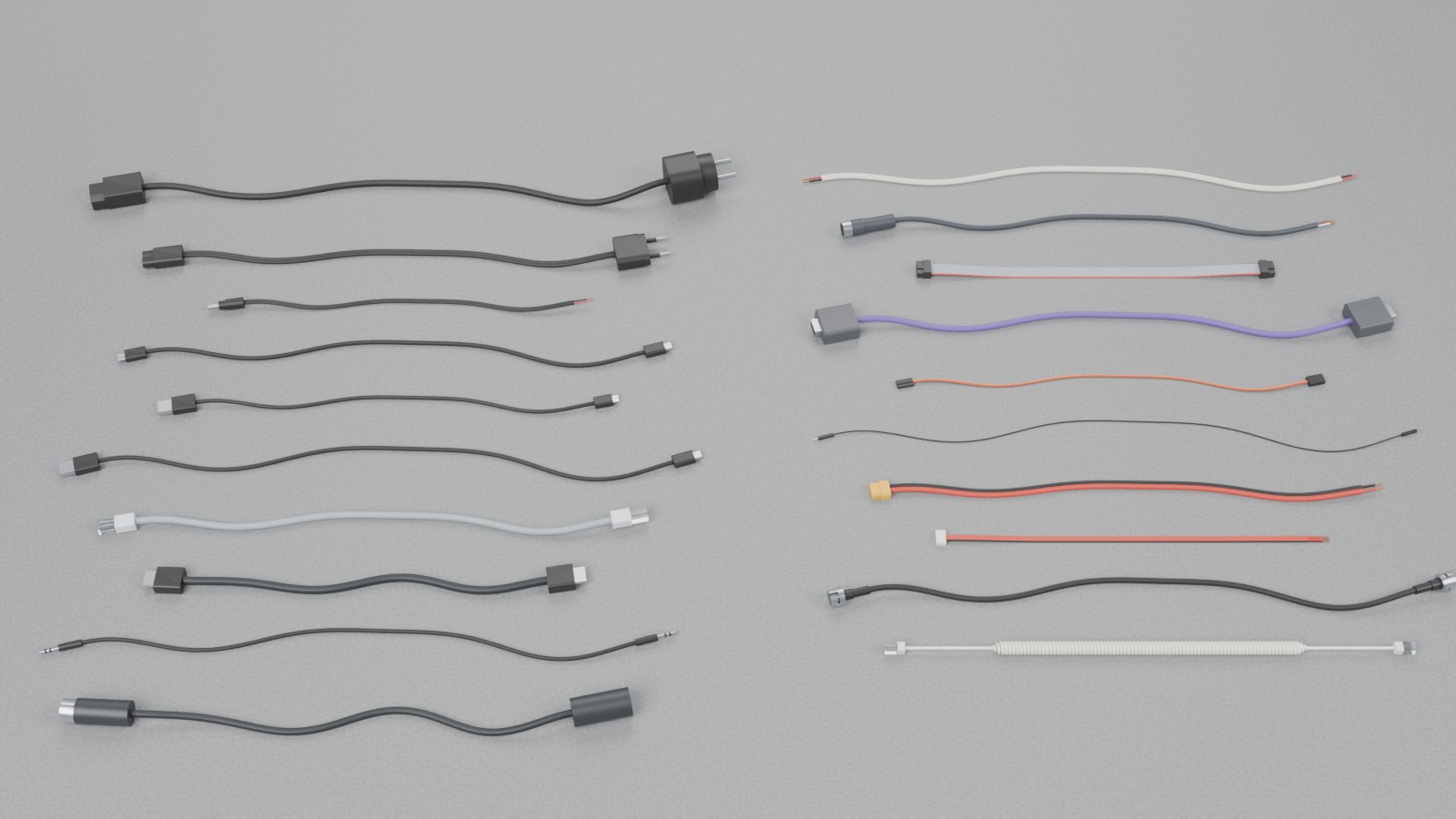
*One cable of each of the 14 presets, with its usual ends (left: power cords
|
|
78
|
+
C13 and C7, DC barrel, USB-C, USB-A to C, USB-A to Micro-B, Ethernet; right:
|
|
79
|
+
HDMI, 3.5 mm jack, XLR microphone cable, speaker wire, M12 sensor cable, IDC
|
|
80
|
+
ribbon, coiled handset cord), imported from the OpenUSD files into Blender
|
|
81
|
+
and rendered with Cycles.*
|
|
82
|
+
|
|
83
|
+
## What it does
|
|
84
|
+
|
|
85
|
+
- Generates *N* cables of a preset, **1 m long by default** (`--length` for
|
|
86
|
+
another length, or the preset's retail lengths), lying straight, as a
|
|
87
|
+
slack random curve or coiled on the floor.
|
|
88
|
+
- Puts on **each end, independently**, a connector plug, a receptacle on a
|
|
89
|
+
cable (the female end of an extension or a coupler), a clean cut or a
|
|
90
|
+
stripped end with the cores out: 17 connector families, 28 end variants,
|
|
91
|
+
any of them on any cable.
|
|
92
|
+
- Models the cable as a **Kirchhoff rod**: rigid segments of 1.5 cable
|
|
93
|
+
widths, joints with twist and bending springs `G·J / L` and `E·I / L`
|
|
94
|
+
computed from the cross-section (round, figure-8 zip cord, flat ribbon;
|
|
95
|
+
coiled cords as a helical spring), real masses.
|
|
96
|
+
- Derives every **receptacle from its plug**, layer by layer, with a
|
|
97
|
+
clearance; the keying (any angle, reversible, one orientation) is found
|
|
98
|
+
from the geometry and checked against the standard.
|
|
99
|
+
- Exports **OpenUSD**: one rigid body per segment and per connector, each
|
|
100
|
+
with *one* visual mesh (so every DCC imports one object per body), mass,
|
|
101
|
+
centre of mass and inertia, convex collision parts, joints with drives,
|
|
102
|
+
PhysX attributes for Isaac Sim, a variant set per end (all the end
|
|
103
|
+
variants of a cable in one asset), a `MateFrame` on each connector with
|
|
104
|
+
its insertion axis, depth, clearance, keying and contact gender; and a
|
|
105
|
+
`sockets.usdc` file with the fixed receptacles. `--no-physics` writes
|
|
106
|
+
visual assets only. Every file passes the OpenUSD validators
|
|
107
|
+
(`UsdValidation`).
|
|
108
|
+
- **Checks the assets in MuJoCo** (`filaire sim-test`), read back from the
|
|
109
|
+
files: drop on the ground, cantilever sag against beam theory, coil
|
|
110
|
+
extension against spring theory, insertion at 0°, 90° and 180°.
|
|
111
|
+
- **A Blender add-on** (`filaire blender-addon`): rigid bodies and
|
|
112
|
+
constraints set up on every USD import, and the same drop check in
|
|
113
|
+
Blender (`filaire blender-test`).
|
|
114
|
+
|
|
115
|
+
## Installation
|
|
116
|
+
|
|
117
|
+
From PyPI:
|
|
118
|
+
|
|
119
|
+
```bash
|
|
120
|
+
pip install "filaire[render,sim]"
|
|
121
|
+
```
|
|
122
|
+
|
|
123
|
+
From a clone, for development:
|
|
124
|
+
|
|
125
|
+
```bash
|
|
126
|
+
python -m venv .venv && source .venv/bin/activate
|
|
127
|
+
pip install -e ".[render,sim]" # add ",dev" for tests and linting
|
|
128
|
+
```
|
|
129
|
+
|
|
130
|
+
Requires Python 3.10+. Dependencies: NumPy, SciPy, Shapely 2.1+ and the
|
|
131
|
+
OpenUSD bindings (`usd-core`); matplotlib for the previews, MuJoCo for the
|
|
132
|
+
checks. The Blender checks need Blender as a Python module
|
|
133
|
+
(`pip install -e ".[blender]"`, Python 3.13 only) or a Blender executable.
|
|
134
|
+
|
|
135
|
+
## Usage
|
|
136
|
+
|
|
137
|
+
```bash
|
|
138
|
+
filaire list # presets
|
|
139
|
+
filaire ends # every end variant
|
|
140
|
+
filaire generate --preset usb_c # 6 cables, 1 m each
|
|
141
|
+
filaire generate --preset ethernet --length 3 --layout coil
|
|
142
|
+
filaire generate --preset power_c13 --end-a c13_plug --end-b stripped
|
|
143
|
+
filaire generate --preset usb_c --end-a usb_c_plug --end-b usb_c_inline # an extension cord
|
|
144
|
+
filaire generate --preset hdmi --length preset --count 12 --seed 4 # retail lengths
|
|
145
|
+
filaire generate --preset audio_jack --color "#c0392b" --modulus 45
|
|
146
|
+
filaire preview output/usb_c # top view (matplotlib)
|
|
147
|
+
filaire connectors --out connectors.png # plug faces and receptacles
|
|
148
|
+
filaire generate --preset hdmi --no-physics # visual assets only
|
|
149
|
+
filaire sim-test output/usb_c # MuJoCo checks
|
|
150
|
+
filaire blender-test output/usb_c # the drop check in Blender (add-on)
|
|
151
|
+
filaire blender-addon # filaire_physics.zip, for Blender 4.4+
|
|
152
|
+
```
|
|
153
|
+
|
|
154
|
+
`python -m filaire ...` works too. From Python:
|
|
155
|
+
|
|
156
|
+
```python
|
|
157
|
+
from filaire import generate_scene, write_outputs
|
|
158
|
+
|
|
159
|
+
cables = generate_scene("usb_c", count=6, seed=1) # 1 m, ends drawn from the preset
|
|
160
|
+
write_outputs(cables, "output") # -> output/usb_c/
|
|
161
|
+
|
|
162
|
+
# 2.5 m power cords coiled on the floor, C13 on one end and a stripped end on the other
|
|
163
|
+
cords = generate_scene(
|
|
164
|
+
"power_c13", count=4, length=2.5, layout="coil", ends={"a": "c13_plug", "b": "stripped"}
|
|
165
|
+
)
|
|
166
|
+
write_outputs(cords, "output")
|
|
167
|
+
```
|
|
168
|
+
|
|
169
|
+
### Options of `filaire generate`
|
|
170
|
+
|
|
171
|
+
| Option | Default | Effect |
|
|
172
|
+
|---|---|---|
|
|
173
|
+
| `--preset` | `usb_c` | cable type (table below) |
|
|
174
|
+
| `--count N`, `--seed S` | 6, 1 | number of cables, random seed; same options and seed give the same cables |
|
|
175
|
+
| `--length L` | `1` | length in m of every cable; `preset` draws the preset's retail lengths (± tolerance) |
|
|
176
|
+
| `--end-a V`, `--end-b V` | preset's draw | end variant of each end, independently: any `filaire ends` entry, on any cable |
|
|
177
|
+
| `--layout` | preset's draw | `straight`, `slack` (random smooth curve) or `coil` (flat spiral on the floor) |
|
|
178
|
+
| `--color "#rrggbb"` | preset's draw | jacket colour of every cable |
|
|
179
|
+
| `--modulus E` | preset's draw | effective Young's modulus of the cable in MPa (sets the stiffness) |
|
|
180
|
+
| `--max-segments N` | 400 | upper bound on the rigid segments per cable (longer segments beyond it) |
|
|
181
|
+
| `--no-physics` | | visual assets only: no rigid bodies, colliders, joints, physics scene or ground |
|
|
182
|
+
| `--no-vary-…` | | turn one random aspect off, the others unchanged: `layout`, `ends`, `color`, `stiffness`, `density`, `length` |
|
|
183
|
+
|
|
184
|
+
Each random aspect has its own stream: turning one off or forcing it leaves
|
|
185
|
+
the others as they were (same layouts with plain colours, same colours with
|
|
186
|
+
other ends…).
|
|
187
|
+
|
|
188
|
+
### Presets
|
|
189
|
+
|
|
190
|
+
| Category | Preset | Cross-section | End A | End B (default draw) |
|
|
191
|
+
|---|---|---|---|---|
|
|
192
|
+
| Power | `power_c13` | round Ø6.4 mm, 3 cores | C13 | CEE 7/7 plug, C14 (extension), stripped |
|
|
193
|
+
| | `power_c7` | figure-8, 2 × Ø3.4 mm | C7 | Europlug, stripped |
|
|
194
|
+
| | `dc_barrel` | figure-8, 2 × Ø2.4 mm | DC plug 5.5 × 2.1, 5.5 × 2.5 or 4.0 × 1.7 | stripped, cut, DC jack (extension) |
|
|
195
|
+
| Data | `usb_c` | round Ø4.0 mm | USB-C plug | USB-C plug, USB-C receptacle (extension) |
|
|
196
|
+
| | `usb_a_to_c` | round Ø3.8 mm | USB-A plug | USB-C plug |
|
|
197
|
+
| | `usb_micro` | round Ø3.5 mm | USB-A plug | Micro-B plug |
|
|
198
|
+
| | `ethernet` | round Ø6.0 mm, 4 pairs | RJ45 plug | RJ45 plug, RJ45 coupler |
|
|
199
|
+
| | `hdmi` | round Ø7.0 mm | HDMI plug | HDMI plug, HDMI receptacle (extension) |
|
|
200
|
+
| Audio | `audio_jack` | round Ø3.5 mm | 3.5 mm plug | 3.5 mm plug, 3.5 mm socket (extension) |
|
|
201
|
+
| | `xlr_mic` | round Ø6.0 mm | XLR3 female | XLR3 male |
|
|
202
|
+
| | `speaker_wire` | figure-8, 2 × Ø3.2 mm | stripped, cut | stripped, cut |
|
|
203
|
+
| Industrial | `m12_sensor` | round Ø5.0 mm, PUR | M12 female | stripped, cut |
|
|
204
|
+
| | `ribbon_idc` | flat, 10 × 1.27 mm | IDC socket 2 × 5 | IDC socket, cut |
|
|
205
|
+
| Telephone | `coiled_handset` | coil Ø8.5 mm of Ø2.8 mm wire | RJ9 plug | RJ9 plug |
|
|
206
|
+
|
|
207
|
+
Every cable also carries `cut` and `stripped` variants on both ends, and any
|
|
208
|
+
other variant forced with `--end-a` / `--end-b`. Diameters, densities
|
|
209
|
+
(8–90 g/m) and moduli (20–300 MPa, drawn per cable) are realistic orders of
|
|
210
|
+
magnitude, not measurements of a specific product.
|
|
211
|
+
|
|
212
|
+
|
|
213
|
+
|
|
214
|
+
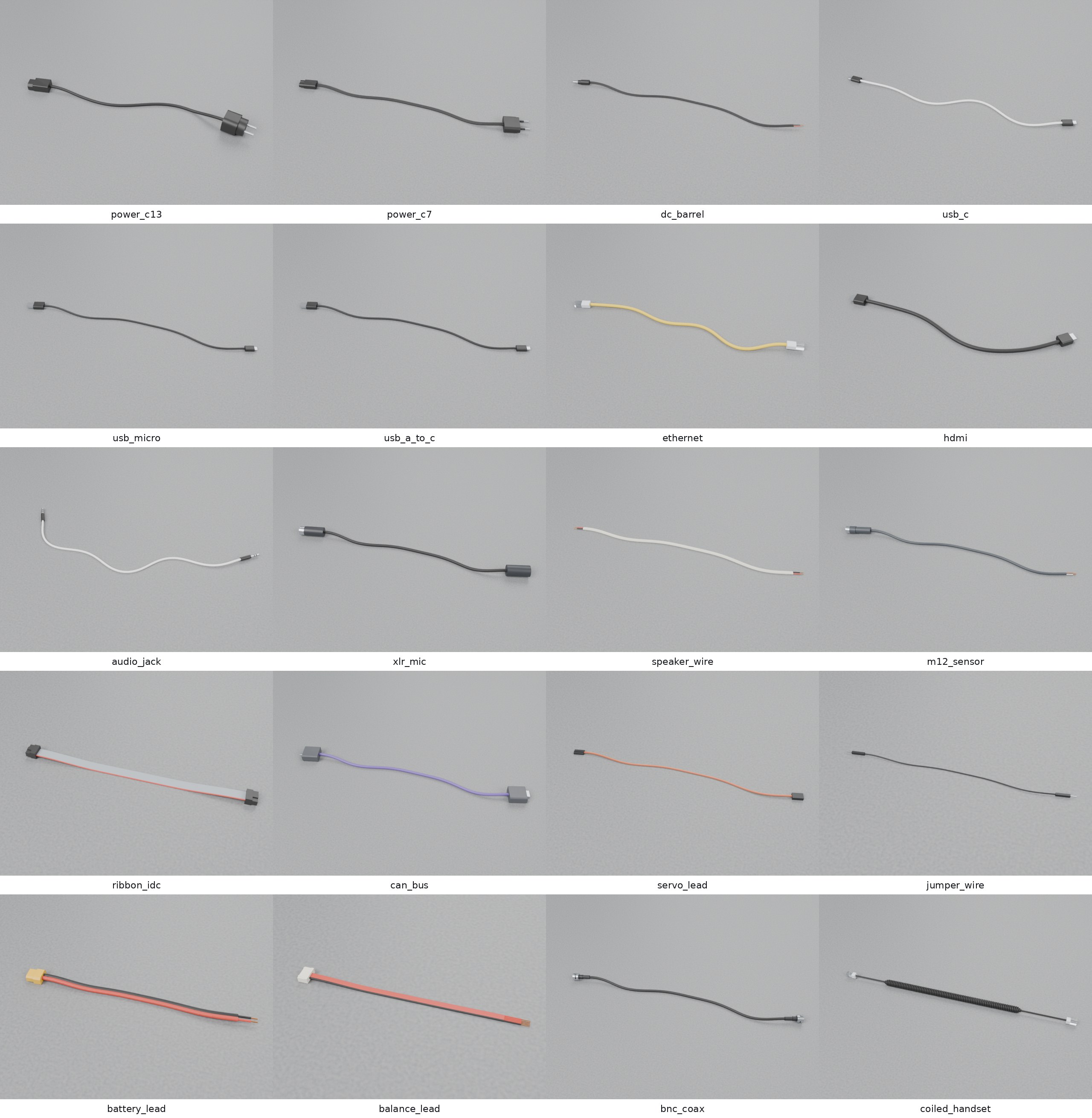
*Each preset with its usual ends (the first variant of each end), 40 cm
|
|
215
|
+
long (25 cm for the ribbon and the coiled cord), rendered in Blender.*
|
|
216
|
+
|
|
217
|
+
## Connectors
|
|
218
|
+
|
|
219
|
+
|
|
220
|
+
|
|
221
|
+
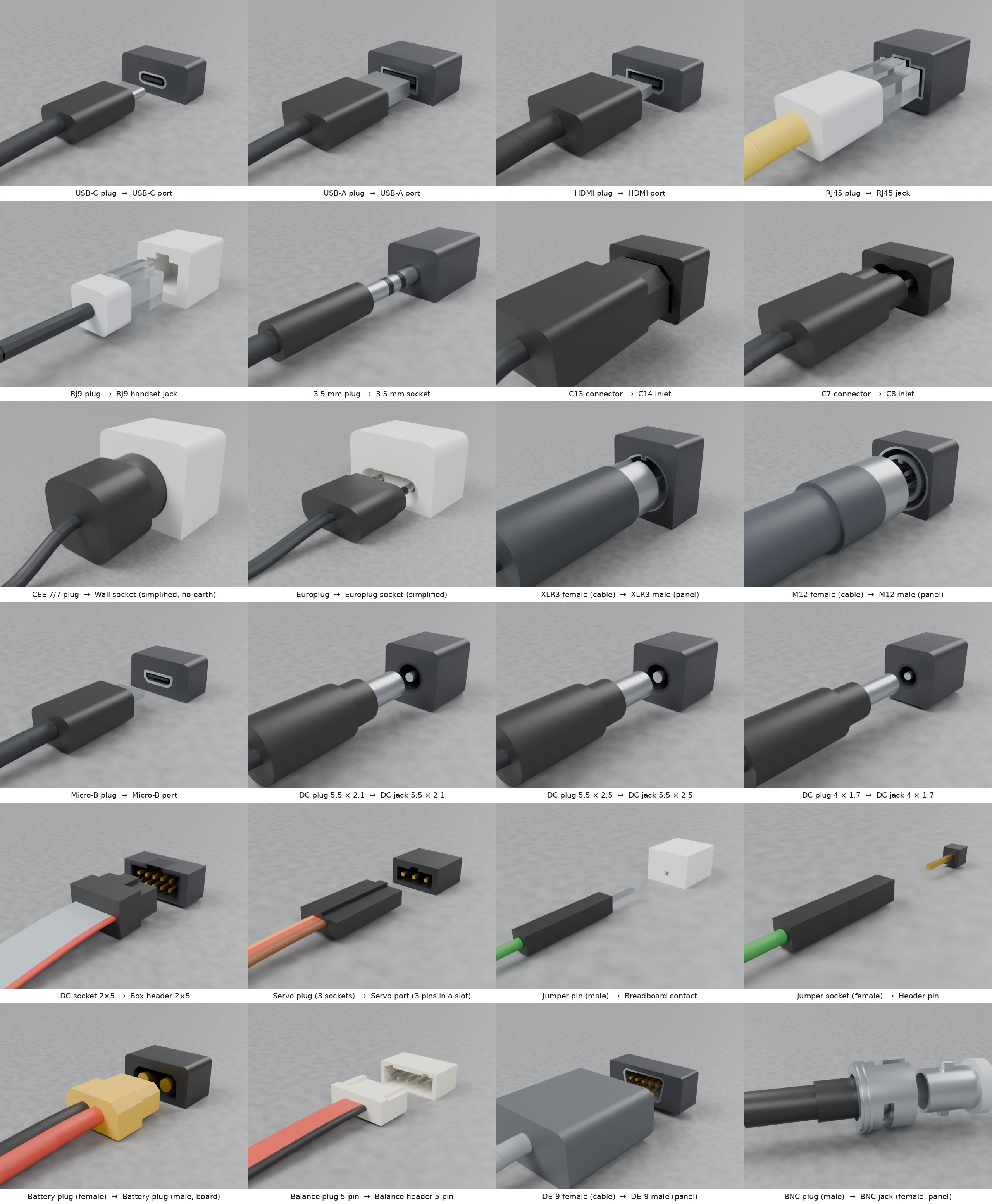
*The 17 connector families: each plug on a short piece of its cable, 15 mm
|
|
222
|
+
in front of the fixed receptacle derived from it (`sockets.usdc`), rendered
|
|
223
|
+
in Blender.*
|
|
224
|
+
|
|
225
|
+
| Family | Cable side (plug) | Contacts | Receptacle on a cable | Fixed receptacle | Keying | Depth |
|
|
226
|
+
|---|---|---|---|---|---|---|
|
|
227
|
+
| `usb_c` | USB-C plug | male | USB-C receptacle | USB-C port | reversible | 6.65 mm |
|
|
228
|
+
| `usb_a` | USB-A plug | male | | USB-A port | keyed | 12 mm |
|
|
229
|
+
| `usb_micro` | Micro-B plug | male | | Micro-B port | keyed | 5.6 mm |
|
|
230
|
+
| `hdmi_a` | HDMI plug | male | HDMI receptacle | HDMI port | keyed | 9.5 mm |
|
|
231
|
+
| `rj45` | RJ45 plug | male | RJ45 coupler | RJ45 jack | keyed | 14 mm |
|
|
232
|
+
| `rj9` | RJ9 plug | male | | RJ9 handset jack | keyed | 10 mm |
|
|
233
|
+
| `jack35` | 3.5 mm plug | male | 3.5 mm socket | 3.5 mm socket | none | 15 mm |
|
|
234
|
+
| `c13` | C13 connector | **female** | C14 plug | C14 inlet | keyed | 13 mm |
|
|
235
|
+
| `c7` | C7 connector | **female** | | C8 inlet | reversible | 10 mm |
|
|
236
|
+
| `cee77` | CEE 7/7 plug | male | | wall socket (simplified) | reversible | 34 mm |
|
|
237
|
+
| `cee716` | Europlug | male | | Europlug socket (simplified) | reversible | 25 mm |
|
|
238
|
+
| `xlr3` | XLR3 female | **female** | XLR3 male | XLR3 male (panel) | keyed | 11 mm |
|
|
239
|
+
| `m12a` | M12 A-coded female | **female** | | M12 male (panel) | keyed | 8 mm |
|
|
240
|
+
| `idc10` | IDC socket 2 × 5 | **female** | | box header 2 × 5 | keyed | 6 mm |
|
|
241
|
+
| `dc5521`, `dc5525`, `dc4017` | DC plug 5.5 × 2.1, 5.5 × 2.5, 4.0 × 1.7 mm | male | DC jack | DC jack | none | 9.5 mm |
|
|
242
|
+
|
|
243
|
+
**Gender and role are kept apart.** *Gender* is the contact gender of the
|
|
244
|
+
standard; *role* is geometric: the plug enters, the receptacle receives. An
|
|
245
|
+
IEC C13 has female contacts but enters the C14 inlet; an XLR3 female enters
|
|
246
|
+
the shell of the male. `filaire:contactGender` and `filaire:role` say both.
|
|
247
|
+
|
|
248
|
+
**The receptacle is derived from the plug.** Each plug is described by its
|
|
249
|
+
cross-sections, layer by layer from the tip (a CEE 7/7 plug: two pins, then
|
|
250
|
+
the round face that enters the socket's recess). In each layer, the
|
|
251
|
+
receptacle's solid is its outline minus the plug's cross-section grown by
|
|
252
|
+
the clearance (0.05–0.3 mm). The plug's holes become the receptacle's pins
|
|
253
|
+
or tongue, the plug's key becomes the keyway, and the two always mate. The
|
|
254
|
+
keying is then *found* by turning the plug in 15° steps and testing for
|
|
255
|
+
overlap, and a test checks it against the standard's.
|
|
256
|
+
|
|
257
|
+
The same test answers which plug goes into which receptacle across families
|
|
258
|
+
(`fits(plug, angle, socket=other)`). For the DC barrels it gives the real
|
|
259
|
+
behaviour: the derived jacks get a centre pin from the plug's bore, so a
|
|
260
|
+
5.5 × 2.5 mm plug goes loosely onto a 5.5 × 2.1 mm jack, while a 5.5 × 2.1 mm
|
|
261
|
+
plug is stopped by the thicker pin of a 5.5 × 2.5 mm jack.
|
|
262
|
+
|
|
263
|
+
|
|
264
|
+
|
|
265
|
+
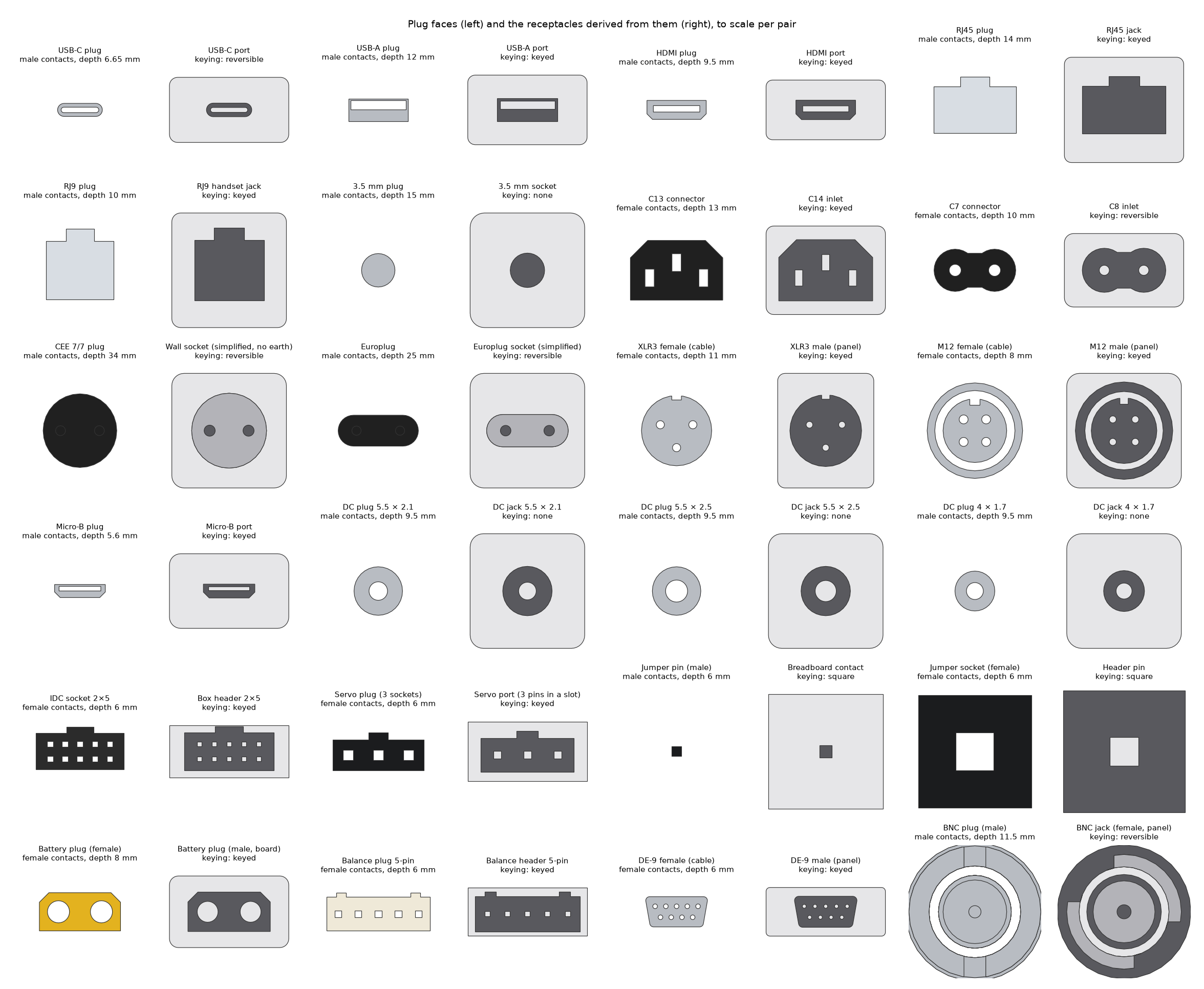
*`filaire connectors`: the plug seen from its tip (left) and the fixed
|
|
266
|
+
receptacle seen from the front (right): opening in dark, pins and tongues in
|
|
267
|
+
light grey.*
|
|
268
|
+
|
|
269
|
+
Dimensions come from published figures where they could be found (USB-C
|
|
270
|
+
receptacle opening and insertion length, HDMI plug and receptacle, RJ45 and
|
|
271
|
+
RJ9 widths and heights, 3.5 mm diameter and length, CEE 7 pins and recess
|
|
272
|
+
depth, IEC 60320 pin spacing, Micro-B receptacle opening, DC barrel diameters
|
|
273
|
+
and the 4.0 × 1.7 mm barrel length); the others (XLR, M12, IDC, C13 face,
|
|
274
|
+
Micro-B chamfers, 5.5 mm barrel length, inner cavities, overmolds) are **approximate** and marked so in
|
|
275
|
+
[`connectors.py`](https://github.com/drscaon/filaire/blob/main/src/filaire/connectors.py), each with its sources. The
|
|
276
|
+
standards themselves were not consulted. Connectors are simplified: no
|
|
277
|
+
latches that move, no threads, no contacts inside the holes, no logos.
|
|
278
|
+
|
|
279
|
+
## Outputs (per preset, under `output/<preset>/`)
|
|
280
|
+
|
|
281
|
+
| File | Content |
|
|
282
|
+
|---|---|
|
|
283
|
+
| `filaire_<preset>.usdc` | the cables (OpenUSD, Blender: File > Import > USD) |
|
|
284
|
+
| `sockets.usdc` | one fixed receptacle per connector family used by the cables |
|
|
285
|
+
| `cables.csv` | per cable: layout, length, ends, colour, modulus, densities, stiffness, segments, masses |
|
|
286
|
+
| `summary.json` | counts by layout, end and colour; length, mass, stiffness and segment ranges |
|
|
287
|
+
| `sheet.png` | top view (`filaire preview`) |
|
|
288
|
+
| `sim_test/sim_test.json` | MuJoCo report (`filaire sim-test`) |
|
|
289
|
+
| `sim_test/blender_setup.json`, `sim_test/blender_naive.json` | Blender reports and their scenes (`filaire blender-test`) |
|
|
290
|
+
|
|
291
|
+
### OpenUSD layout
|
|
292
|
+
|
|
293
|
+
Z up, metres, kilograms, `/World` the default prim.
|
|
294
|
+
|
|
295
|
+
```
|
|
296
|
+
/World
|
|
297
|
+
/PhysicsScene gravity
|
|
298
|
+
/Looks, /PhysicsMaterials UsdPreviewSurface materials; friction and restitution
|
|
299
|
+
/Cables/<cable> Xform, PhysicsArticulationRootAPI, filaire:* attributes,
|
|
300
|
+
variant sets "end_a" and "end_b"
|
|
301
|
+
/Segments/seg_000 … rigid bodies (RigidBodyAPI, MassAPI, PhysxRigidBodyAPI), x along the cable
|
|
302
|
+
/Visual ONE mesh: the piece of tube this segment carries
|
|
303
|
+
/Collision Capsule along x (round, coiled) or Cube (flat, figure-8), purpose guide
|
|
304
|
+
/Joints/joint_000 … PhysicsJoint: translations locked (coiled: transX free),
|
|
305
|
+
drives rotX (twist), rotY, rotZ (bending) [, transX (coil)]
|
|
306
|
+
/End_A, /End_B filled by the selected variant:
|
|
307
|
+
/Body rigid body of the connector or stripped end
|
|
308
|
+
/Visual ONE mesh, a GeomSubset per material (shell, body, cores, copper)
|
|
309
|
+
/Collision/hull_00 … convex parts (MeshCollisionAPI convexHull, purpose guide)
|
|
310
|
+
/MateFrame origin on the mating plane, +Z = insertion direction
|
|
311
|
+
/Attach PhysicsFixedJoint to the end segment
|
|
312
|
+
/Ground collision box, its top face at z = 0
|
|
313
|
+
```
|
|
314
|
+
|
|
315
|
+
Each rigid body has exactly one visual mesh, as in Quincaillerie: Blender
|
|
316
|
+
and other DCCs import one object per body, so a rigid body set on it moves
|
|
317
|
+
the whole part. Each segment spans the chord between its two joints, so
|
|
318
|
+
neighbouring segments meet exactly at their joint even on a tight curve.
|
|
319
|
+
Every collider carries `PhysxCollisionAPI` offsets and every body
|
|
320
|
+
`PhysxRigidBodyAPI` iterations, read by Isaac Sim and ignored elsewhere.
|
|
321
|
+
|
|
322
|
+
**Without physics** (`--no-physics`, `write_outputs(…, physics=False)`):
|
|
323
|
+
each cable is one mesh, `/World/Cables/<cable>/Visual`, each end a `Body`
|
|
324
|
+
with its `Visual` and `MateFrame`; no rigid bodies, colliders, joints,
|
|
325
|
+
physics materials, physics scene or ground. The `filaire:*` attributes stay.
|
|
326
|
+
|
|
327
|
+
**OpenUSD compliance.** `filaire.validate.validate(file)` runs every
|
|
328
|
+
validator of OpenUSD's `UsdValidation` registry (composition, stage
|
|
329
|
+
metadata, geometry and subsets, material bindings, shaders, UsdPhysics
|
|
330
|
+
bodies, colliders, joints and articulations) on each end variant of each
|
|
331
|
+
cable; the tests and CI require no error and no warning, with and without
|
|
332
|
+
physics.
|
|
333
|
+
|
|
334
|
+
Selecting a variant (`end_b = "usb_c_inline"`, `"cut"`…) swaps the end, its
|
|
335
|
+
collision parts and its joint. Angular drives use UsdPhysics units
|
|
336
|
+
(stiffness per degree); the same values per radian and the rod's stiffness
|
|
337
|
+
are kept as engine-neutral attributes:
|
|
338
|
+
|
|
339
|
+
| Attribute (on the cable) | Content |
|
|
340
|
+
|---|---|
|
|
341
|
+
| `filaire:bendingStiffness` | E·I about the width axis and about the height axis (N·m²) |
|
|
342
|
+
| `filaire:torsionalStiffness` | G·J (N·m²) |
|
|
343
|
+
| `filaire:jointStiffness` | per joint: twist, bend y, bend z (N·m/rad) |
|
|
344
|
+
| `filaire:youngsModulus`, `filaire:shearModulus`, `filaire:linearDensity` | material (Pa, kg/m) |
|
|
345
|
+
| `filaire:segmentLength`, `filaire:segmentCount`, `filaire:restShape` | discretisation; rest shape is straight |
|
|
346
|
+
| `filaire:dampingTime` | joint damping = stiffness × 0.01 s |
|
|
347
|
+
| `filaire:coil:*`, `filaire:axialStiffness` | coiled cords: coil diameter, pitch, turns, wire length; spring k (N/m) |
|
|
348
|
+
| `filaire:length`, `filaire:layout`, `filaire:profile`, `filaire:jacket`, … | what the cable is |
|
|
349
|
+
|
|
350
|
+
| Attribute (on a `MateFrame`) | Content |
|
|
351
|
+
|---|---|
|
|
352
|
+
| `filaire:connector`, `filaire:name`, `filaire:standard` | family and name (`usb_c`, "USB-C plug") |
|
|
353
|
+
| `filaire:role`, `filaire:mount`, `filaire:contactGender` | plug / receptacle, cable / panel, male / female |
|
|
354
|
+
| `filaire:insertionDepth`, `filaire:clearance`, `filaire:keying` | for insertion tasks (m) |
|
|
355
|
+
|
|
356
|
+
## Physics model
|
|
357
|
+
|
|
358
|
+
- **Rod.** The cable is a chain of N rigid segments (length ≈ 1.5 cable
|
|
359
|
+
widths, at most 400 per cable). Consecutive segments share a joint at
|
|
360
|
+
their common end point with three rotational springs: twist `G·J / L`,
|
|
361
|
+
bending `E·I_y / L` and `E·I_z / L`, the discrete Kirchhoff rod. `E·I` and
|
|
362
|
+
`G·J` come from the cross-section (polygon second moments, so a flat
|
|
363
|
+
ribbon is a hundred times softer across its thickness than across its
|
|
364
|
+
width) and an effective modulus drawn per cable; `G = E / (2 (1 + ν))`,
|
|
365
|
+
ν = 0.45. The rest shape is straight; the authored pose (slack, coiled) is
|
|
366
|
+
a deformed state.
|
|
367
|
+
- **Coiled cords** are modelled along their axis, as a helical spring seen
|
|
368
|
+
as a rod (Wahl's close-coiled formulas): bending `2 E I p / (π D (2 + ν))`,
|
|
369
|
+
twist `E I p / (π D)`, and an axial spring `4 G J / (π D³ n)` shared by
|
|
370
|
+
free `transX` joints. The coil itself is in the visual mesh.
|
|
371
|
+
- **Masses** from the linear density; connectors from the volume of their
|
|
372
|
+
parts and an effective density; inertia tensors from the meshes.
|
|
373
|
+
|
|
374
|
+
## Blender
|
|
375
|
+
|
|
376
|
+
Blender's USD importer reads geometry and materials but ignores UsdPhysics:
|
|
377
|
+
imported as is, a cable is a heap of loose tube pieces and its connectors
|
|
378
|
+
fall off (see the comparison below). The add-on, adapted from
|
|
379
|
+
Quincaillerie's, sets the physics up once and for all:
|
|
380
|
+
|
|
381
|
+
1. `filaire blender-addon` writes `filaire_physics.zip`.
|
|
382
|
+
2. In Blender (4.4 or later): Edit > Preferences > Get Extensions > Install
|
|
383
|
+
from Disk, pick the zip.
|
|
384
|
+
3. File > Import > Universal Scene Description, as usual: every segment and
|
|
385
|
+
connector gets its rigid body, every joint its constraint. Press Play.
|
|
386
|
+
|
|
387
|
+
On import it moves each body's origin to its centre of mass (Blender uses
|
|
388
|
+
the origin as centre of mass), makes its collision shape a compound of the
|
|
389
|
+
USD shapes (capsules, boxes and convex hulls rebuilt from the file), sets
|
|
390
|
+
mass, friction and small collision margins, turns the cable joints into
|
|
391
|
+
Generic Spring constraints with the USD drives' stiffness and damping
|
|
392
|
+
(translations locked; a coiled cord's axial spring kept) and the connectors'
|
|
393
|
+
fixed joints into Fixed constraints, and runs the rigid body world at 4000
|
|
394
|
+
substeps per second for the light segments. The same file runs as a script
|
|
395
|
+
(`blender -b -P filaire_physics.py -- file.usdc`) without installing.
|
|
396
|
+
|
|
397
|
+
Bullet takes a spring's rest position from the first frame, so in Blender a
|
|
398
|
+
cable keeps the shape it was generated in (coiled, slack) as its rest shape,
|
|
399
|
+
where the file and MuJoCo say straight: a coiled cable stays coiled.
|
|
400
|
+
|
|
401
|
+
## MuJoCo checks
|
|
402
|
+
|
|
403
|
+
`filaire sim-test output/<preset>` reads the OpenUSD files back (not the
|
|
404
|
+
generator's objects) and runs, on CPU:
|
|
405
|
+
|
|
406
|
+
| Check | What | Pass when |
|
|
407
|
+
|---|---|---|
|
|
408
|
+
| drop | the first cables, with their selected ends, lifted 1 cm and dropped for 3 s in their authored layout | finite, ground penetration below half the cable radius after the impact, all bodies slower than 5 cm/s at the end |
|
|
409
|
+
| sag | a sample of the cable clamped at one end, sagging ≈ 10 % of its length under its own weight; `E·I` read back from the joint drives | tip deflection within 5 % of `w L⁴ / (8 E I)` |
|
|
410
|
+
| coil | coiled cords: the coil hanging from its top | extension within 5 % of `W / (2 k)` |
|
|
411
|
+
| insertion | each plug pushed along its axis (5 N max) into the fixed receptacle and the receptacle on a cable, at 0°, 90° and 180° | goes fully in at the angles its keying allows, stopped before 60 % of the depth at the others |
|
|
412
|
+
|
|
413
|
+
For speed, the drop test simulates the cable with at most 60 links (groups
|
|
414
|
+
of segments merged, springs in series, same `E·I`) and without the twist
|
|
415
|
+
hinge: in generalised coordinates a chain's mass matrix is dense and a step
|
|
416
|
+
costs the cube of its joints. Each joint gets an armature (added inertia)
|
|
417
|
+
and critical damping so that stiff, light links stay stable with a 1 ms
|
|
418
|
+
step; neither changes a static equilibrium, which is what the sag and coil
|
|
419
|
+
checks compare.
|
|
420
|
+
|
|
421
|
+
|
|
422
|
+
|
|
423
|
+
*Power cord, Cat 6, USB-C, 3.5 mm jack and M12 sensor cable (70 cm),
|
|
424
|
+
steeply tilted and dropped together onto a bar: one end hits first, the
|
|
425
|
+
cables fold over the bar and over each other, connectors attached, and come
|
|
426
|
+
to rest. Simulated in MuJoCo from the OpenUSD files (rest shape straight,
|
|
427
|
+
60 links per cable, 0.5 ms step), rendered in Blender:
|
|
428
|
+
[`scripts/drop_gif.py`](https://github.com/drscaon/filaire/blob/main/scripts/drop_gif.py).*
|
|
429
|
+
|
|
430
|
+
### Results
|
|
431
|
+
|
|
432
|
+
`filaire generate --preset <p> --count 3` (1 m cables, seed 1) then
|
|
433
|
+
`filaire sim-test output/<p> --cables 3`, MuJoCo 3.17, one CPU core:
|
|
434
|
+
|
|
435
|
+
| Preset | Segments | `E·I` (N·m²) | Mass with ends (g) | Drop (max speed, penetration) | Stiffness check | Insertion |
|
|
436
|
+
|---|---|---|---|---|---|---|
|
|
437
|
+
| `power_c13` | 104 | 0.0049–0.0073 | 119–187 | 3/3 (0.004 m/s, 0.10 mm) | sag −0.8 % | C13 panel + inline, CEE 7/7 ✓ |
|
|
438
|
+
| `power_c7` | 98 | 0.00066–0.00098 | 49–67 | 3/3 (0.002 m/s, 0.06 mm) | sag −0.8 % | C7, Europlug ✓ |
|
|
439
|
+
| `dc_barrel` | 139 | 0.00016–0.00026 | 30–33 | 3/3 (0.012 m/s, 0.09 mm) | sag −0.8 % | three DC jacks ✓ |
|
|
440
|
+
| `usb_c` | 167 | 0.00050–0.00080 | 46–50 | 3/3 (0.013 m/s, 0.18 mm) | sag −0.8 % | USB-C panel + inline ✓ |
|
|
441
|
+
| `usb_a_to_c` | 175 | 0.00041–0.00065 | 43–46 | 3/3 (0.004 m/s, 0.18 mm) | sag −0.8 % | USB-A, USB-C ✓ |
|
|
442
|
+
| `usb_micro` | 190 | 0.00029–0.00051 | 38–40 | 3/3 (0.004 m/s, 0.10 mm) | sag −0.8 % | USB-A, Micro-B ✓ |
|
|
443
|
+
| `ethernet` | 111 | 0.0050–0.0072 | 61–70 | 3/3 (0.005 m/s, 0.07 mm) | sag −0.8 % | RJ45 panel + inline ✓ |
|
|
444
|
+
| `hdmi` | 95 | 0.0094–0.0139 | 99–107 | 3/3 (0.005 m/s, 0.09 mm) | sag −0.8 % | HDMI panel + inline ✓ |
|
|
445
|
+
| `audio_jack` | 190 | 0.00022–0.00036 | 20–22 | 3/3 (0.003 m/s, 0.13 mm) | sag −0.8 % | 3.5 mm panel + inline ✓ |
|
|
446
|
+
| `xlr_mic` | 111 | 0.0013–0.0022 | 147–151 | 3/3 (0.007 m/s, 0.06 mm) | sag −0.8 % | XLR3 panel + inline ✓ |
|
|
447
|
+
| `speaker_wire` | 104 | 0.00042–0.00067 | 52–55 | 3/3 (0.024 m/s, 0.07 mm) | sag −0.8 % | (stripped / cut ends) |
|
|
448
|
+
| `m12_sensor` | 133 | 0.0015–0.0023 | 65–68 | 3/3 (0.004 m/s, 0.03 mm) | sag −0.8 % | M12 ✓ |
|
|
449
|
+
| `ribbon_idc` | 52 | 0.00011–0.00017 | 14–16 | 3/3 (0.007 m/s, 0.06 mm) | sag −0.8 % | IDC ✓ |
|
|
450
|
+
| `coiled_handset` | 59 | (coil) | 130–139 | 3/3 (0.004 m/s, 0.07 mm) | coil −0.0 % | RJ9 ✓ |
|
|
451
|
+
|
|
452
|
+
Every keyed connector was stopped at 90° and 180° (at most 12 % of its
|
|
453
|
+
depth, the IDC socket's flat face entering a little before its key meets the
|
|
454
|
+
header), every reversible one went in at 180°, the 3.5 mm jack at every
|
|
455
|
+
angle, like the DC barrels. The sag is 0.8 % under the linear beam formula for every cable: the
|
|
456
|
+
geometric nonlinearity of a 10 % deflection, the same for all since the
|
|
457
|
+
sample length is scaled to the stiffness. Generation takes 1–4 s per
|
|
458
|
+
preset (3 cables), the checks 15–30 s (a minute for the coiled cords).
|
|
459
|
+
|
|
460
|
+
### Blender checks
|
|
461
|
+
|
|
462
|
+
`filaire blender-test output/<preset>` builds, for each tested cable, a scene
|
|
463
|
+
that references the cable file, keeps that cable (with its selected ends),
|
|
464
|
+
lifts it 2 cm and drops it on the ground, then simulates it in Blender
|
|
465
|
+
(Bullet) through the add-on, in its own process:
|
|
466
|
+
|
|
467
|
+
| Check | Pass when |
|
|
468
|
+
|---|---|
|
|
469
|
+
| joints hold | the two bodies of every joint meet within 0.5 mm at its anchor, the connectors' fixed joints included |
|
|
470
|
+
| at rest on the ground | no point more than 0.5 mm under the ground, every body slower than 5 cm/s after 1.5 s |
|
|
471
|
+
|
|
472
|
+
`--mode naive` imports the same scene the way one would by hand (File >
|
|
473
|
+
Import > USD, every mesh an active rigid body, the ground passive) and
|
|
474
|
+
reports how far neighbouring pieces drift apart.
|
|
475
|
+
|
|
476
|
+
`filaire generate --preset <p> --count 2` (1 m cables, seed 1), then
|
|
477
|
+
`filaire blender-test output/<p> --cables 2` and `--mode naive` on the
|
|
478
|
+
first cable, Blender 5.2 (`bpy`), one CPU core:
|
|
479
|
+
|
|
480
|
+
| Preset | Through the add-on | Bodies | Widest joint gap (mm) | Lowest point (mm) | Rigid bodies by hand: pieces drifted apart (mm) | Time per cable (s) |
|
|
481
|
+
|---|---|---|---|---|---|---|
|
|
482
|
+
| `power_c13` | 2/2 | 106 | 0.005 | −0.09 | 145 | 18 |
|
|
483
|
+
| `power_c7` | 2/2 | 100 | 0.006 | +0.02 | 180 | 17 |
|
|
484
|
+
| `dc_barrel` | 2/2 | 141 | 0.009 | +0.05 | 174 | 30 |
|
|
485
|
+
| `usb_c` | 2/2 | 169 | 0.005 | +0.04 | 58 | 42 |
|
|
486
|
+
| `usb_a_to_c` | 2/2 | 177 | 0.005 | +0.04 | 32 | 44 |
|
|
487
|
+
| `usb_micro` | 2/2 | 192 | 0.006 | +0.04 | 35 | 47 |
|
|
488
|
+
| `ethernet` | 2/2 | 113 | 0.005 | +0.01 | 40 | 21 |
|
|
489
|
+
| `hdmi` | 2/2 | 97 | 0.002 | +0.03 | 40 | 16 |
|
|
490
|
+
| `audio_jack` | 2/2 | 192 | 0.006 | +0.04 | 162 | 48 |
|
|
491
|
+
| `xlr_mic` | 2/2 | 113 | 0.008 | −0.03 | 1634 | 21 |
|
|
492
|
+
| `speaker_wire` | 2/2 | 105 | < 0.001 | +0.05 | 10 | 18 |
|
|
493
|
+
| `m12_sensor` | 2/2 | 135 | 0.007 | +0.02 | 818 | 25 |
|
|
494
|
+
| `ribbon_idc` | 2/2 | 54 | < 0.001 | −0.05 | 1240 | 7 |
|
|
495
|
+
| `coiled_handset` | 2/2 | 61 | 0.104 (axial spring) | −0.10 | 2193 | 10 |
|
|
496
|
+
|
|
497
|
+
Through the add-on every cable holds together and comes to rest (a coiled
|
|
498
|
+
cord's joints stretch along its axial spring, by design). Set up by hand,
|
|
499
|
+
the pieces are independent: they spread over the floor, and where a heavy
|
|
500
|
+
connector or a coil's overlapping pieces push on them, they are thrown
|
|
501
|
+
metres away. The checks found a real defect of the first beta: on tight
|
|
502
|
+
curves the rigid segments, as long as the arc they stand for, overlapped
|
|
503
|
+
their neighbours by up to 0.4 mm at the joints; each segment now spans the
|
|
504
|
+
chord between its joints.
|
|
505
|
+
|
|
506
|
+
## Limits
|
|
507
|
+
|
|
508
|
+
- **Not calibrated.** Moduli and densities are orders of magnitude; no
|
|
509
|
+
cable's `E·I` was measured. The sag check proves the export is consistent
|
|
510
|
+
with the model, not that the model matches a real cable.
|
|
511
|
+
- **Approximate connectors.** See [Connectors](#connectors): simplified
|
|
512
|
+
outlines, no moving latches, threads or contacts; several dimensions not
|
|
513
|
+
from a source.
|
|
514
|
+
- **Elastic, straight rest shape.** No plastic set (a real cable keeps its
|
|
515
|
+
coils), no initial tension in coiled cords, no knots.
|
|
516
|
+
- **Isaac Sim not tested here.** The files follow the standard `UsdPhysics`
|
|
517
|
+
schemas (rigid bodies, D6 joints with drives, articulation root, convex
|
|
518
|
+
hulls) and carry PhysX attributes; they are checked in MuJoCo and Blender
|
|
519
|
+
but have not been loaded in Isaac Sim / PhysX (no NVIDIA GPU), where
|
|
520
|
+
drive units and articulation behaviour may need adjusting.
|
|
521
|
+
- **Rest shape differs in Blender.** See [Blender](#blender): Bullet's
|
|
522
|
+
springs rest in the first frame's pose, the generated one.
|
|
523
|
+
- **Visual per segment.** Each segment carries its piece of tube, so a
|
|
524
|
+
simulated cable shows small creases at the joints when it bends.
|
|
525
|
+
|
|
526
|
+
## Roadmap
|
|
527
|
+
|
|
528
|
+
1. Calibration against measured bending stiffness (three-point bending or
|
|
529
|
+
cantilever tests) for a few real cables per preset.
|
|
530
|
+
2. Plastic set and pre-coiled rest shapes; tied bundles and hanks.
|
|
531
|
+
3. A PhysX test in Isaac Sim, and MJCF export with MuJoCo's cable plugin.
|
|
532
|
+
4. More connectors (Schuko and French sockets with their earth contacts,
|
|
533
|
+
D-sub with its screws, DisplayPort, M8) and snap-fit latches.
|
|
534
|
+
5. Insertion tasks: forces, misalignment tolerances, success labels.
|
|
535
|
+
|
|
536
|
+
## Development
|
|
537
|
+
|
|
538
|
+
The project follows **GitHub Flow**:
|
|
539
|
+
|
|
540
|
+
1. `main` is always releasable and protected: changes reach it only through
|
|
541
|
+
pull requests, nobody pushes to it directly.
|
|
542
|
+
2. Every change starts on a short-lived branch from `main`, named after its
|
|
543
|
+
type: `feat/<name>`, `fix/<name>`, `docs/<name>`, `ci/<name>`, …
|
|
544
|
+
3. Push the branch and open a pull request into `main`; CI runs on it.
|
|
545
|
+
4. Merge when CI is green, then delete the branch.
|
|
546
|
+
|
|
547
|
+
Releasing is a change like any other: on a `chore/release-X.Y.Z` branch, bump
|
|
548
|
+
`version` in `pyproject.toml` and move the `Unreleased` entries of
|
|
549
|
+
`CHANGELOG.md` under the new version; merge the pull request, then tag
|
|
550
|
+
`vX.Y.Z` on `main`. The release workflow builds the packages and attaches
|
|
551
|
+
them to the GitHub release.
|
|
552
|
+
|
|
553
|
+
A versioned `pre-push` hook refuses direct pushes to `main`. Enable it once per
|
|
554
|
+
clone with `git config core.hooksPath .githooks` (emergency override:
|
|
555
|
+
`ALLOW_MAIN_PUSH=1 git push`).
|
|
556
|
+
|
|
557
|
+
The README images are made by [`scripts/`](https://github.com/drscaon/filaire/blob/main/scripts/): `make_logo.py` (logo),
|
|
558
|
+
`readme_images.py` (Blender renders through `bpy` of every preset and every
|
|
559
|
+
connector family, connector sheet, GitHub social preview
|
|
560
|
+
`docs/images/social_preview.png`, to upload in the repository's Settings >
|
|
561
|
+
General > Social preview), `drop_gif.py` (the MuJoCo drop animation).
|
|
562
|
+
|
|
563
|
+
### Continuous integration
|
|
564
|
+
|
|
565
|
+
| Workflow | When | What |
|
|
566
|
+
|---|---|---|
|
|
567
|
+
| `ci.yml` | every push to `main`, every pull request | `ruff check` and `ruff format --check`; `pytest` on Python 3.10–3.13 (Linux) and 3.12 (macOS, Windows); a command-line smoke test with the OpenUSD validators; **the MuJoCo checks of every preset**; **the Blender checks of every preset** through the add-on (with the `bpy` module, Python 3.13), and for comparison the same with rigid bodies set by hand; reports kept as run artifacts; build the wheel and sdist, `twine check`, install the wheel in a clean environment. |
|
|
568
|
+
| `release.yml` | a pushed tag `v*` | checks the tag matches the version in `pyproject.toml`, tests, builds, then creates the GitHub release with the packages and the Blender add-on attached and the notes taken from `CHANGELOG.md`. Versions with `a`, `b` or `rc` are marked as pre-releases. |
|
|
569
|
+
| Dependabot | monthly | pull requests to update the GitHub Actions and the Python dependencies. |
|
|
570
|
+
|
|
571
|
+
## License
|
|
572
|
+
|
|
573
|
+
[MIT](https://github.com/drscaon/filaire/blob/main/LICENSE) © 2026 Daniel Régis Sarmento Caon
|
|
574
|
+
|
|
575
|
+
The logo is drawn from DejaVu Sans Bold outlines (Bitstream Vera license),
|
|
576
|
+
converted to paths, so it displays without the font installed.
|
|
577
|
+
|
|
578
|
+
---
|
|
579
|
+
|
|
580
|
+
Filaire is part of [**Primvaria**](https://github.com/drscaon/primvaria), physics-ready variability for Physical AI, in OpenUSD: `pip install primvaria` installs the whole suite.
|