elicitor 0.1.0__tar.gz
This diff represents the content of publicly available package versions that have been released to one of the supported registries. The information contained in this diff is provided for informational purposes only and reflects changes between package versions as they appear in their respective public registries.
- elicitor-0.1.0/LICENSE +21 -0
- elicitor-0.1.0/PKG-INFO +283 -0
- elicitor-0.1.0/README.md +254 -0
- elicitor-0.1.0/data/travel/backstories.jsonl +60 -0
- elicitor-0.1.0/data/travel/catalog.jsonl +200 -0
- elicitor-0.1.0/data/travel/personas.jsonl +60 -0
- elicitor-0.1.0/data/travel/prompts/backstory.txt +15 -0
- elicitor-0.1.0/data/travel/prompts/imagine.txt +14 -0
- elicitor-0.1.0/data/travel/prompts/judge.txt +17 -0
- elicitor-0.1.0/data/travel/prompts/pair.txt +21 -0
- elicitor-0.1.0/data/travel/prompts/phrase.txt +13 -0
- elicitor-0.1.0/data/travel/prompts/plan.txt +12 -0
- elicitor-0.1.0/data/travel/prompts/simulate.txt +19 -0
- elicitor-0.1.0/data/travel/prompts/styles.toml +9 -0
- elicitor-0.1.0/data/travel/prompts/update.txt +19 -0
- elicitor-0.1.0/data/travel/schema.toml +129 -0
- elicitor-0.1.0/experiments/demo.toml +35 -0
- elicitor-0.1.0/pyproject.toml +82 -0
- elicitor-0.1.0/setup.cfg +4 -0
- elicitor-0.1.0/src/elicitor/__init__.py +22 -0
- elicitor-0.1.0/src/elicitor/__main__.py +3 -0
- elicitor-0.1.0/src/elicitor/analysis/__init__.py +1 -0
- elicitor-0.1.0/src/elicitor/analysis/descriptive.py +176 -0
- elicitor-0.1.0/src/elicitor/analysis/figures.py +101 -0
- elicitor-0.1.0/src/elicitor/analysis/judge_report.py +647 -0
- elicitor-0.1.0/src/elicitor/analysis/report.py +382 -0
- elicitor-0.1.0/src/elicitor/analysis/stats.py +107 -0
- elicitor-0.1.0/src/elicitor/answer_model.py +79 -0
- elicitor-0.1.0/src/elicitor/backstories.py +87 -0
- elicitor-0.1.0/src/elicitor/belief.py +81 -0
- elicitor-0.1.0/src/elicitor/calibration.py +203 -0
- elicitor-0.1.0/src/elicitor/catalog.py +42 -0
- elicitor-0.1.0/src/elicitor/cli.py +319 -0
- elicitor-0.1.0/src/elicitor/datagen.py +40 -0
- elicitor-0.1.0/src/elicitor/demo.py +115 -0
- elicitor-0.1.0/src/elicitor/episode.py +152 -0
- elicitor-0.1.0/src/elicitor/experiments/__init__.py +1 -0
- elicitor-0.1.0/src/elicitor/experiments/config.py +159 -0
- elicitor-0.1.0/src/elicitor/experiments/health.py +144 -0
- elicitor-0.1.0/src/elicitor/experiments/runner.py +308 -0
- elicitor-0.1.0/src/elicitor/experiments/store.py +210 -0
- elicitor-0.1.0/src/elicitor/jsonl.py +20 -0
- elicitor-0.1.0/src/elicitor/judge.py +476 -0
- elicitor-0.1.0/src/elicitor/llm/__init__.py +10 -0
- elicitor-0.1.0/src/elicitor/llm/cache.py +73 -0
- elicitor-0.1.0/src/elicitor/llm/client.py +389 -0
- elicitor-0.1.0/src/elicitor/llm/mock.py +117 -0
- elicitor-0.1.0/src/elicitor/llm/providers.py +218 -0
- elicitor-0.1.0/src/elicitor/llm/roles.py +240 -0
- elicitor-0.1.0/src/elicitor/metrics.py +70 -0
- elicitor-0.1.0/src/elicitor/personas.py +96 -0
- elicitor-0.1.0/src/elicitor/phrasing.py +101 -0
- elicitor-0.1.0/src/elicitor/questions.py +83 -0
- elicitor-0.1.0/src/elicitor/recommender.py +91 -0
- elicitor-0.1.0/src/elicitor/resources.py +33 -0
- elicitor-0.1.0/src/elicitor/rng.py +17 -0
- elicitor-0.1.0/src/elicitor/schema.py +142 -0
- elicitor-0.1.0/src/elicitor/selectors/__init__.py +64 -0
- elicitor-0.1.0/src/elicitor/selectors/eig.py +90 -0
- elicitor-0.1.0/src/elicitor/selectors/eig_mc.py +97 -0
- elicitor-0.1.0/src/elicitor/selectors/entropy.py +27 -0
- elicitor-0.1.0/src/elicitor/selectors/fixed.py +24 -0
- elicitor-0.1.0/src/elicitor/selectors/random.py +24 -0
- elicitor-0.1.0/src/elicitor/session.py +214 -0
- elicitor-0.1.0/src/elicitor/simulator/__init__.py +42 -0
- elicitor-0.1.0/src/elicitor/simulator/llm.py +57 -0
- elicitor-0.1.0/src/elicitor/simulator/oracle.py +52 -0
- elicitor-0.1.0/src/elicitor/updaters/__init__.py +37 -0
- elicitor-0.1.0/src/elicitor/updaters/llm.py +65 -0
- elicitor-0.1.0/src/elicitor/updaters/rule.py +173 -0
- elicitor-0.1.0/src/elicitor.egg-info/PKG-INFO +283 -0
- elicitor-0.1.0/src/elicitor.egg-info/SOURCES.txt +90 -0
- elicitor-0.1.0/src/elicitor.egg-info/dependency_links.txt +1 -0
- elicitor-0.1.0/src/elicitor.egg-info/entry_points.txt +2 -0
- elicitor-0.1.0/src/elicitor.egg-info/requires.txt +9 -0
- elicitor-0.1.0/src/elicitor.egg-info/top_level.txt +1 -0
- elicitor-0.1.0/tests/test_belief.py +113 -0
- elicitor-0.1.0/tests/test_cli.py +34 -0
- elicitor-0.1.0/tests/test_eig.py +204 -0
- elicitor-0.1.0/tests/test_episode_and_runner.py +167 -0
- elicitor-0.1.0/tests/test_llm_components.py +211 -0
- elicitor-0.1.0/tests/test_llm_layer.py +387 -0
- elicitor-0.1.0/tests/test_m5.py +284 -0
- elicitor-0.1.0/tests/test_m6.py +209 -0
- elicitor-0.1.0/tests/test_m7.py +309 -0
- elicitor-0.1.0/tests/test_question_types.py +201 -0
- elicitor-0.1.0/tests/test_recommender.py +86 -0
- elicitor-0.1.0/tests/test_rule_and_oracle.py +104 -0
- elicitor-0.1.0/tests/test_runner_resume_and_analysis.py +286 -0
- elicitor-0.1.0/tests/test_schema_and_data.py +65 -0
- elicitor-0.1.0/tests/test_selectors.py +70 -0
- elicitor-0.1.0/tests/test_session.py +215 -0
elicitor-0.1.0/LICENSE
ADDED
|
@@ -0,0 +1,21 @@
|
|
|
1
|
+
MIT License
|
|
2
|
+
|
|
3
|
+
Copyright (c) 2026 Jason Liu
|
|
4
|
+
|
|
5
|
+
Permission is hereby granted, free of charge, to any person obtaining a copy
|
|
6
|
+
of this software and associated documentation files (the "Software"), to deal
|
|
7
|
+
in the Software without restriction, including without limitation the rights
|
|
8
|
+
to use, copy, modify, merge, publish, distribute, sublicense, and/or sell
|
|
9
|
+
copies of the Software, and to permit persons to whom the Software is
|
|
10
|
+
furnished to do so, subject to the following conditions:
|
|
11
|
+
|
|
12
|
+
The above copyright notice and this permission notice shall be included in all
|
|
13
|
+
copies or substantial portions of the Software.
|
|
14
|
+
|
|
15
|
+
THE SOFTWARE IS PROVIDED "AS IS", WITHOUT WARRANTY OF ANY KIND, EXPRESS OR
|
|
16
|
+
IMPLIED, INCLUDING BUT NOT LIMITED TO THE WARRANTIES OF MERCHANTABILITY,
|
|
17
|
+
FITNESS FOR A PARTICULAR PURPOSE AND NONINFRINGEMENT. IN NO EVENT SHALL THE
|
|
18
|
+
AUTHORS OR COPYRIGHT HOLDERS BE LIABLE FOR ANY CLAIM, DAMAGES OR OTHER
|
|
19
|
+
LIABILITY, WHETHER IN AN ACTION OF CONTRACT, TORT OR OTHERWISE, ARISING FROM,
|
|
20
|
+
OUT OF OR IN CONNECTION WITH THE SOFTWARE OR THE USE OR OTHER DEALINGS IN THE
|
|
21
|
+
SOFTWARE.
|
elicitor-0.1.0/PKG-INFO
ADDED
|
@@ -0,0 +1,283 @@
|
|
|
1
|
+
Metadata-Version: 2.4
|
|
2
|
+
Name: elicitor
|
|
3
|
+
Version: 0.1.0
|
|
4
|
+
Summary: An LLM agent that chooses clarifying questions by expected information gain.
|
|
5
|
+
License-Expression: MIT
|
|
6
|
+
Project-URL: Repository, https://github.com/LhyJason/elicitor
|
|
7
|
+
Project-URL: Documentation, https://github.com/LhyJason/elicitor/blob/main/docs/SPEC.md
|
|
8
|
+
Project-URL: Issues, https://github.com/LhyJason/elicitor/issues
|
|
9
|
+
Keywords: llm,agent,preference elicitation,clarifying questions,information gain,bayesian,recommender
|
|
10
|
+
Classifier: Development Status :: 3 - Alpha
|
|
11
|
+
Classifier: Intended Audience :: Science/Research
|
|
12
|
+
Classifier: Intended Audience :: Developers
|
|
13
|
+
Classifier: Operating System :: OS Independent
|
|
14
|
+
Classifier: Programming Language :: Python :: 3
|
|
15
|
+
Classifier: Programming Language :: Python :: 3.12
|
|
16
|
+
Classifier: Topic :: Scientific/Engineering :: Artificial Intelligence
|
|
17
|
+
Requires-Python: >=3.12
|
|
18
|
+
Description-Content-Type: text/markdown
|
|
19
|
+
License-File: LICENSE
|
|
20
|
+
Requires-Dist: httpx>=0.27
|
|
21
|
+
Requires-Dist: matplotlib>=3.8
|
|
22
|
+
Requires-Dist: numpy>=1.26
|
|
23
|
+
Requires-Dist: pydantic>=2.7
|
|
24
|
+
Requires-Dist: scipy>=1.11
|
|
25
|
+
Provides-Extra: dev
|
|
26
|
+
Requires-Dist: pytest>=8; extra == "dev"
|
|
27
|
+
Requires-Dist: ruff>=0.6; extra == "dev"
|
|
28
|
+
Dynamic: license-file
|
|
29
|
+
|
|
30
|
+
# Elicitor
|
|
31
|
+
|
|
32
|
+
An LLM agent that learns what a user wants by asking a few well-chosen questions. It keeps a
|
|
33
|
+
probability distribution over the user's preferences, picks each question by expected information
|
|
34
|
+
gain, updates the distribution from the free-text answer, and then recommends. Everything runs on
|
|
35
|
+
open models served locally or on a GPU cluster; no paid API is needed.
|
|
36
|
+
|
|
37
|
+
Inspired by an EECS 545 team project.
|
|
38
|
+
|
|
39
|
+
```bash
|
|
40
|
+
pip install elicitor
|
|
41
|
+
elicitor demo # answer the agent's questions yourself; no LLM needed
|
|
42
|
+
```
|
|
43
|
+
|
|
44
|
+
To use it from your own code, see [Use it in your own code](https://github.com/LhyJason/elicitor#use-it-in-your-own-code).
|
|
45
|
+
[Elicitor-Distill](https://github.com/LhyJason/elicitor-distill) replaces the agent's 32B updater
|
|
46
|
+
and the 70B judge with fine-tuned 0.6B to 4B models, so the LLM updater runs on a laptop GPU.
|
|
47
|
+
|
|
48
|
+
## How it works
|
|
49
|
+
|
|
50
|
+
The domain is trip planning: 9 slots (climate, setting, pace, lodging, food, activity, transport,
|
|
51
|
+
plus budget and trip length as binned constraints), a 200-item synthetic catalog and 60 synthetic
|
|
52
|
+
users (12 for development, 48 for evaluation) with known ground truth and one of four answer
|
|
53
|
+
styles: direct, vague, rambling or indifferent.
|
|
54
|
+
|
|
55
|
+
One episode is a dialogue of at most K questions:
|
|
56
|
+
|
|
57
|
+
1. **Belief.** One categorical distribution per slot, starting from the prior.
|
|
58
|
+
2. **Question selection.** `fixed` (schema order), `random`, `max_entropy` (the slot with the
|
|
59
|
+
most uncertainty), `entropy_choice` (the same slot, asked as a choice between its likeliest
|
|
60
|
+
values), `eig` (the open, choice or yes/no question with the largest expected information gain
|
|
61
|
+
under an answer-noise model, computed exactly) and `eig_mc` (expected gain estimated by
|
|
62
|
+
sampling simulated answers from the LLM and running the updater on them).
|
|
63
|
+
3. **Simulated user.** llama3.3 70B role-plays the persona in its answer style and is told to
|
|
64
|
+
answer only what was asked; how often it volunteers other slots is measured.
|
|
65
|
+
4. **Belief update.** Either a keyword matcher (`rule`) or the LLM (`llm`, qwen3 32B), which
|
|
66
|
+
scores how well the answer fits each value; Bayes' rule is applied in code in both cases.
|
|
67
|
+
5. **Recommendation.** The catalog is ranked by expected utility under the belief and scored
|
|
68
|
+
against the true preferences: regret, hit@k and constraint violations.
|
|
69
|
+
|
|
70
|
+
Question wording is a template by default; LLM rewording is one ablation. The full design and
|
|
71
|
+
every decision taken along the way are in [docs/SPEC.md](https://github.com/LhyJason/elicitor/blob/main/docs/SPEC.md).
|
|
72
|
+
|
|
73
|
+
## Results
|
|
74
|
+
|
|
75
|
+
Full run: 12 arms × 48 evaluation personas × 5 replicates at K = 3, 5 and 8 (8,160 episodes),
|
|
76
|
+
4.3 hours on 4 A40 GPUs, about 230,000 LLM calls (most served from the reply cache) with no failed
|
|
77
|
+
calls and no parse failures. Each metric is averaged over a persona's replicates first; arms are
|
|
78
|
+
compared with paired Wilcoxon tests over the 48 personas with Holm correction. The hypotheses
|
|
79
|
+
were frozen before the run (SPEC Q13). Complete tables:
|
|
80
|
+
[results_summary/m5_full/results.md](https://github.com/LhyJason/elicitor/blob/main/results_summary/m5_full/results.md).
|
|
81
|
+
|
|
82
|
+
At K = 5 (95 % bootstrap CIs in the full table):
|
|
83
|
+
|
|
84
|
+
| selector | updater | mass on truth | MAP accuracy | regret | violations |
|
|
85
|
+
|---|---|---|---|---|---|
|
|
86
|
+
| `fixed` | `llm` | 0.488 | 0.647 | 0.089 | 1.08 |
|
|
87
|
+
| `random` | `llm` | 0.511 | 0.654 | 0.101 | 0.73 |
|
|
88
|
+
| `max_entropy` | `llm` | 0.513 | 0.656 | 0.112 | 1.24 |
|
|
89
|
+
| `entropy_choice` | `llm` | 0.490 | 0.654 | 0.110 | 1.21 |
|
|
90
|
+
| `eig` | `llm` | 0.513 | 0.656 | 0.112 | 1.24 |
|
|
91
|
+
| `eig_mc` | `llm` | **0.541** | **0.668** | 0.110 | **0.34** |
|
|
92
|
+
| `eig` | `rule` | 0.507 | 0.569 | 0.119 | 1.20 |
|
|
93
|
+
|
|
94
|
+
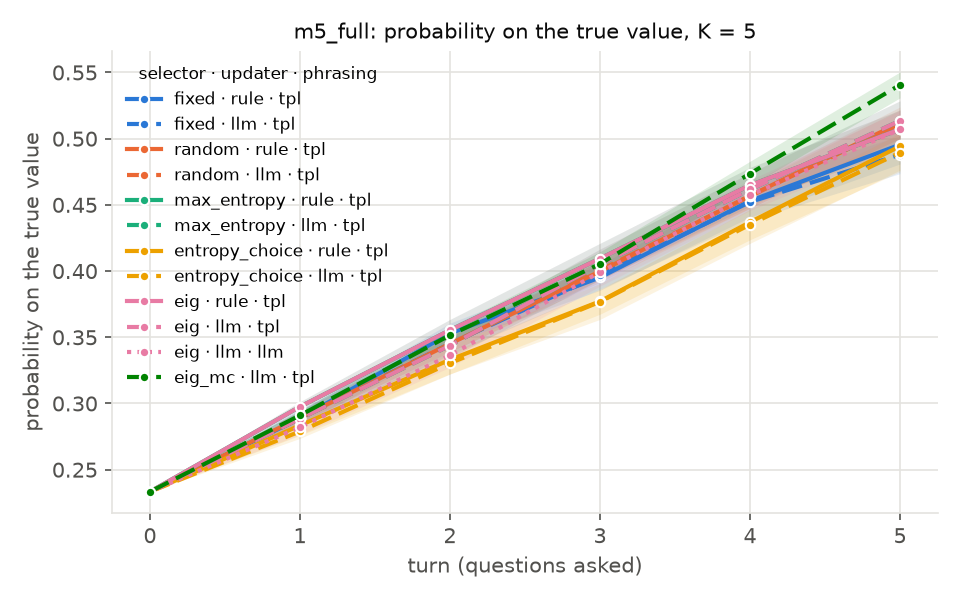
Mass on truth is the mean probability the belief puts on the true value of each slot (the
|
|
95
|
+
primary metric); MAP accuracy is the share of slots whose most probable value is the true one;
|
|
96
|
+
violations count the constraint slots the top recommendation breaks (0 to 2).
|
|
97
|
+
|
|
98
|
+
|
|
99
|
+
|
|
100
|
+
What held and what did not:
|
|
101
|
+
|
|
102
|
+
- **H1, principled selection beats fixed and random order: not supported.** `eig` beats `fixed`
|
|
103
|
+
only at K = 5 with the LLM updater (+0.026 mass on truth, Holm p < 0.001). At K = 8 the two are
|
|
104
|
+
identical, because both end up asking the same 8 of the 9 slots, and `random` is slightly ahead
|
|
105
|
+
of `eig` with either updater (+0.010). With nine slots of 3 to 5 values each, question order
|
|
106
|
+
has little room to matter.
|
|
107
|
+
- **H2, `eig` equals `max_entropy` under the measured answer noise: holds exactly.** The noise
|
|
108
|
+
per question type was measured on the development personas before the run: the LLM updater
|
|
109
|
+
reads the right value from 99 % of open answers, 97 % of choice answers and 85 % of yes/no
|
|
110
|
+
answers. With open questions the most reliable, the question with the largest expected gain is
|
|
111
|
+
always the open question on the most uncertain slot, so `eig` asked `max_entropy`'s questions in
|
|
112
|
+
every episode and every metric is identical. (In an earlier run with a rule-based user and the
|
|
113
|
+
opposite noise, 0.7 / 0.8 / 0.9, `eig` beat `max_entropy` by 0.057 at K = 5: its edge comes
|
|
114
|
+
entirely from the noise model.) Listing the options (`entropy_choice`) is worse at K = 3
|
|
115
|
+
(−0.03 with either updater) and at K = 5 with the LLM updater (−0.024).
|
|
116
|
+
- **`eig_mc` is the one selector that helps**, against the frozen prediction that it would not:
|
|
117
|
+
+0.027 mass on truth over `eig` at K = 5 and 0.90 fewer constraint violations (both Holm
|
|
118
|
+
p < 0.001). Regret and hit@1 do not change. It needs several LLM calls per candidate question,
|
|
119
|
+
so it was run at K = 5 only; why its questions do better has not been analysed.
|
|
120
|
+
- **H3, the LLM updater beats the keyword updater: not supported on the primary metric.** Mass
|
|
121
|
+
on truth does not differ for any selector. MAP accuracy does, for every selector: +0.04 to +0.08
|
|
122
|
+
at K = 3, +0.06 to +0.10 at K = 5, +0.11 to +0.13 at K = 8 (all Holm p < 0.01). The LLM updater
|
|
123
|
+
picks the right value more often without putting more probability on it. Split by answer
|
|
124
|
+
style (descriptive, 12 personas per style), the null on mass on truth is an average of
|
|
125
|
+
opposite effects: the LLM updater puts more mass on the truth for direct (+0.01 to +0.04) and
|
|
126
|
+
rambling answers (+0.01 to +0.06), about the same for vague ones, and less for indifferent ones
|
|
127
|
+
(−0.03 to −0.09, every CI below zero). So the predicted pattern, a gap that grows from direct to
|
|
128
|
+
vague answers, does not appear on mass on truth. It does appear on MAP accuracy: at K = 8 the
|
|
129
|
+
gain is +0.15 to +0.20 for vague and rambling answers, +0.08 to +0.14 for direct ones and about
|
|
130
|
+
+0.01 for indifferent ones. Tables:
|
|
131
|
+
[styles.csv](https://github.com/LhyJason/elicitor/blob/main/results_summary/m5_full/styles.csv).
|
|
132
|
+
- **H4, a better final belief goes with lower regret: holds, weakly, for mass on truth.** Across
|
|
133
|
+
the 240 episodes of each arm and budget, the Spearman correlation between final mass on truth
|
|
134
|
+
and regret is negative in 33 of 34 cases (−0.05 to −0.35; the exception is +0.10). MAP accuracy
|
|
135
|
+
is not related to regret (−0.19 to +0.25), which fits the LLM updater raising MAP accuracy
|
|
136
|
+
without lowering regret. Tables:
|
|
137
|
+
[correlations.csv](https://github.com/LhyJason/elicitor/blob/main/results_summary/m5_full/correlations.csv).
|
|
138
|
+
- **Phrasing:** LLM rewording of the questions changes nothing measurable (largest difference
|
|
139
|
+
−0.006 mass on truth, not significant).
|
|
140
|
+
|
|
141
|
+
Limits: the users are simulated by an LLM that knows its whole profile, there is one domain, the
|
|
142
|
+
belief treats slots as independent, and regret is measured on a synthetic catalog.
|
|
143
|
+
|
|
144
|
+
### An LLM judge checked against the true utility
|
|
145
|
+
|
|
146
|
+
Because the catalog's utility is known, it can test what is usually used when it is not: an LLM
|
|
147
|
+
judge. The judge study runs no new dialogues. For each of the 48 evaluation personas (replicate 0
|
|
148
|
+
of the full run) it takes the items the agent recommended, the best catalog item and one random
|
|
149
|
+
item, 256 distinct (persona, item) units. Each unit is scored 0 to 10 by two judges, llama3.3 70B
|
|
150
|
+
(the simulator's model, the main judge) and qwen3 32B (the agent's model), in three presentations:
|
|
151
|
+
the item's attribute list, and a short trip plan written by either model. Two pairs of arms are
|
|
152
|
+
also compared head to head, in both orders. That is about 2,000 LLM calls, 42 minutes on 4 A40
|
|
153
|
+
GPUs, with no failed calls and no parse failures. The hypotheses were frozen before any judge
|
|
154
|
+
call (SPEC Q13); the tests are as above. Complete tables:
|
|
155
|
+
[results_summary/m7_judge/results.md](https://github.com/LhyJason/elicitor/blob/main/results_summary/m7_judge/results.md).
|
|
156
|
+
|
|
157
|
+
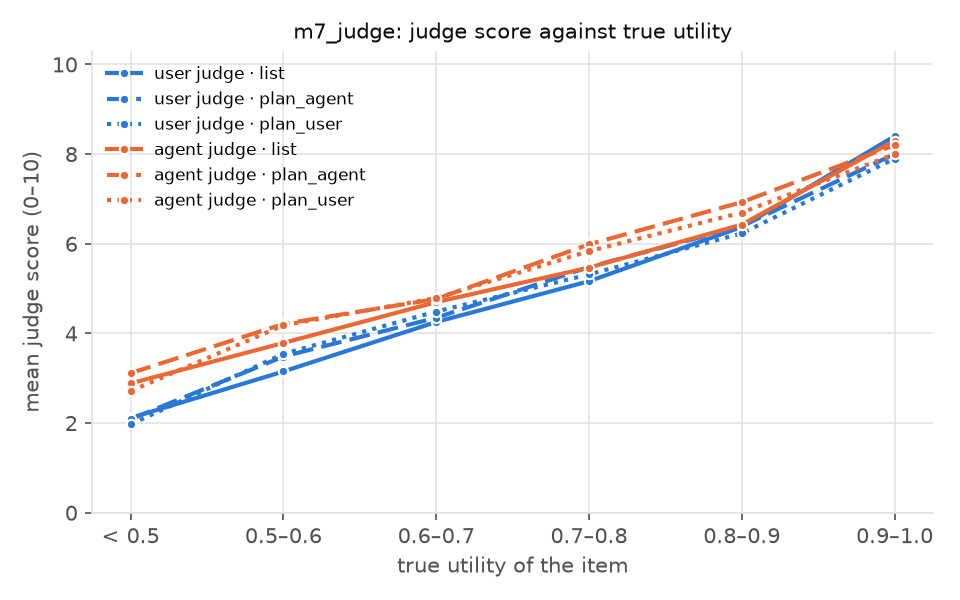
- **J1, the judge tracks utility: holds.** Spearman correlation 0.87 [0.83, 0.91] for the main
|
|
158
|
+
judge on the list, and 0.74 to 0.82 for the other judge and presentation combinations.
|
|
159
|
+
- **J2, the judge keeps the utility order: holds for two of three steps.** An item recommended at
|
|
160
|
+
K = 8 scores 2.1 points above one recommended at K = 3, which scores 2.0 above a random item
|
|
161
|
+
(both Holm p < 0.001). The best catalog item scores only 0.22 above the K = 8 recommendation
|
|
162
|
+
(Holm p = 0.15).
|
|
163
|
+
- **J3, the judge prefers `eig_mc`'s items for their constraints: not supported.** `eig_mc` + llm
|
|
164
|
+
scores 0.44 above `eig` + llm at K = 5 (CI −0.10 to +0.98, Holm p = 0.22). Head to head, judges
|
|
165
|
+
that gave the same verdict in both orders picked `eig_mc`'s item 21 times to 8. The judges do
|
|
166
|
+
weigh the slots unevenly although the rubric says every preference counts the same: a
|
|
167
|
+
least-squares fit gives budget a weight of 2.0 to 2.8 and food 0.4 to 0.7, against 1.11 for each
|
|
168
|
+
slot in the utility.
|
|
169
|
+
- **J4, a written plan scores higher than the list: not supported** (+0.12, Holm p = 0.22). Plans
|
|
170
|
+
make the main judge slightly less accurate: Spearman 0.79 and 0.82 against 0.87 for the list.
|
|
171
|
+
- **J5, each judge favours its own model's plans: not supported** (+0.09, p = 0.23).
|
|
172
|
+
- **J6, verdicts depend on the order: half holds.** The verdict changed when the two items were
|
|
173
|
+
swapped in 28 % of pairs (the frozen bar was 10 %), but the share of decisive verdicts for the
|
|
174
|
+
item shown first, 0.42, does not differ from 1/2 after Holm (p = 0.055 before, 0.22 after), so
|
|
175
|
+
J6 as frozen fails. When the verdict did not change with the order, it picked the item of higher
|
|
176
|
+
utility in 93 % and 94 % of pairs.
|
|
177
|
+
- **Leniency:** the main judge is strict: a random item averages 2.4 and the best item 6.8 out of
|
|
178
|
+
10. On the list, the agent's model gives items of utility below 0.6 and the random items 0.6 to
|
|
179
|
+
0.8 points more.
|
|
180
|
+
|
|
181
|
+
|
|
182
|
+
|
|
183
|
+
## Quick start
|
|
184
|
+
|
|
185
|
+
From a clone of the repo:
|
|
186
|
+
|
|
187
|
+
```bash
|
|
188
|
+
pip install -e .
|
|
189
|
+
elicitor demo # you answer the questions; no LLM needed
|
|
190
|
+
elicitor run experiments/m1_no_llm.toml # no LLM needed; writes results/m1_no_llm/
|
|
191
|
+
elicitor run experiments/m2_mock.toml # every LLM code path on the mock backend
|
|
192
|
+
elicitor run experiments/m3_eig.toml # EIG vs the baselines, rule-based user, no LLM
|
|
193
|
+
```
|
|
194
|
+
|
|
195
|
+
Run the experiments from the repo root; the demo runs from any folder. It asks up to five
|
|
196
|
+
questions chosen by `eig`, shows the belief after each answer and ends with the three best
|
|
197
|
+
catalog items.
|
|
198
|
+
`elicitor demo --selector max_entropy --budget 8` changes the agent; with
|
|
199
|
+
[Ollama](https://ollama.com) running locally and `ollama pull qwen3:4b`,
|
|
200
|
+
`elicitor demo --updater llm` uses the LLM updater.
|
|
201
|
+
|
|
202
|
+
Then, for any run folder:
|
|
203
|
+
|
|
204
|
+
```bash
|
|
205
|
+
elicitor health results/m2_mock # progress and per-role LLM failure rates (also mid-run)
|
|
206
|
+
elicitor analyze results/m3_eig # tables, paired tests and curves in results/m3_eig/analysis/
|
|
207
|
+
```
|
|
208
|
+
|
|
209
|
+
A run into an existing folder resumes; `--fresh` starts over (the LLM reply cache is kept).
|
|
210
|
+
`analyze --publish` writes the committed tables in `results_summary/` and figures in
|
|
211
|
+
`docs/figures/`, and refuses runs that are incomplete, cut short or made with the mock backend.
|
|
212
|
+
|
|
213
|
+
## Use it in your own code
|
|
214
|
+
|
|
215
|
+
A `Session` is one dialogue that your code drives: it hands you the next question, you bring
|
|
216
|
+
back the user's answer.
|
|
217
|
+
|
|
218
|
+
```python
|
|
219
|
+
from elicitor import Session
|
|
220
|
+
|
|
221
|
+
session = Session.from_config() # travel domain, `eig` + rule updater, no LLM
|
|
222
|
+
while (question := session.next_question()) is not None:
|
|
223
|
+
session.observe(input(question + "\n> "))
|
|
224
|
+
for rec in session.recommend(3):
|
|
225
|
+
print(rec.item.id, round(rec.expected_utility, 2), rec.item.attrs)
|
|
226
|
+
```
|
|
227
|
+
|
|
228
|
+
`session.belief` is the current distribution per slot, `session.turns` the dialogue so far and
|
|
229
|
+
`session.stop_reason` why it ended (budget, confident or exhausted). `Session.from_config(path)`
|
|
230
|
+
takes any experiment file; `selector=`, `updater=`, `phraser=` and `budget=` override it. For
|
|
231
|
+
your own domain, pass a schema and a catalog:
|
|
232
|
+
|
|
233
|
+
```python
|
|
234
|
+
from elicitor import Session, load_catalog, load_schema
|
|
235
|
+
|
|
236
|
+
session = Session(
|
|
237
|
+
load_schema("my_domain/schema.toml"),
|
|
238
|
+
catalog=load_catalog("my_domain/catalog.jsonl"),
|
|
239
|
+
selector="max_entropy",
|
|
240
|
+
budget=8,
|
|
241
|
+
)
|
|
242
|
+
```
|
|
243
|
+
|
|
244
|
+
The LLM updater needs a client built from an `[llm]` table and the domain's prompt files:
|
|
245
|
+
|
|
246
|
+
```python
|
|
247
|
+
from elicitor import Session
|
|
248
|
+
from elicitor.experiments.config import load_config
|
|
249
|
+
from elicitor.llm import build_client
|
|
250
|
+
|
|
251
|
+
config = load_config("experiments/demo.toml")
|
|
252
|
+
client = build_client(config.llm, config.prompts_dir, "llm_cache.sqlite")
|
|
253
|
+
session = Session.from_config(config, updater="llm", client=client)
|
|
254
|
+
```
|
|
255
|
+
|
|
256
|
+
The travel domain's schema, catalog and prompts ship with the package. The prompts are written
|
|
257
|
+
for travel; a new domain needs its own `schema.toml` and prompt files (see `data/travel/`).
|
|
258
|
+
|
|
259
|
+
## Running the full experiment
|
|
260
|
+
|
|
261
|
+
`experiments/m5_full.toml` is the run above. `cluster/` holds the Slurm scripts: copy
|
|
262
|
+
`cluster/local.env.example` to `cluster/local.env`, fill in your account and partition, then run
|
|
263
|
+
`cluster/submit.sh cluster/full.sbatch`. The job starts Ollama servers on the GPUs (qwen3:32b for
|
|
264
|
+
the agent, llama3.3 70B for the simulated user), runs the grid with resume, checks run health and
|
|
265
|
+
publishes the analysis. `elicitor calibrate` measures the answer noise per question type and
|
|
266
|
+
`elicitor make-backstories` writes the persona backstories; both results are frozen in the repo.
|
|
267
|
+
`cluster/submit.sh cluster/judge.sbatch experiments/m7_judge.toml` runs the judge study on the
|
|
268
|
+
finished run and publishes its tables.
|
|
269
|
+
|
|
270
|
+
## Development
|
|
271
|
+
|
|
272
|
+
```bash
|
|
273
|
+
python -m venv .venv
|
|
274
|
+
source .venv/bin/activate # Windows: .venv\Scripts\activate
|
|
275
|
+
pip install -e ".[dev]"
|
|
276
|
+
ruff check . && ruff format --check . && pytest
|
|
277
|
+
```
|
|
278
|
+
|
|
279
|
+
CI runs the tests and the no-LLM and mock suites on Linux and Windows.
|
|
280
|
+
|
|
281
|
+
## License
|
|
282
|
+
|
|
283
|
+
MIT, see [LICENSE](https://github.com/LhyJason/elicitor/blob/main/LICENSE).
|
elicitor-0.1.0/README.md
ADDED
|
@@ -0,0 +1,254 @@
|
|
|
1
|
+
# Elicitor
|
|
2
|
+
|
|
3
|
+
An LLM agent that learns what a user wants by asking a few well-chosen questions. It keeps a
|
|
4
|
+
probability distribution over the user's preferences, picks each question by expected information
|
|
5
|
+
gain, updates the distribution from the free-text answer, and then recommends. Everything runs on
|
|
6
|
+
open models served locally or on a GPU cluster; no paid API is needed.
|
|
7
|
+
|
|
8
|
+
Inspired by an EECS 545 team project.
|
|
9
|
+
|
|
10
|
+
```bash
|
|
11
|
+
pip install elicitor
|
|
12
|
+
elicitor demo # answer the agent's questions yourself; no LLM needed
|
|
13
|
+
```
|
|
14
|
+
|
|
15
|
+
To use it from your own code, see [Use it in your own code](https://github.com/LhyJason/elicitor#use-it-in-your-own-code).
|
|
16
|
+
[Elicitor-Distill](https://github.com/LhyJason/elicitor-distill) replaces the agent's 32B updater
|
|
17
|
+
and the 70B judge with fine-tuned 0.6B to 4B models, so the LLM updater runs on a laptop GPU.
|
|
18
|
+
|
|
19
|
+
## How it works
|
|
20
|
+
|
|
21
|
+
The domain is trip planning: 9 slots (climate, setting, pace, lodging, food, activity, transport,
|
|
22
|
+
plus budget and trip length as binned constraints), a 200-item synthetic catalog and 60 synthetic
|
|
23
|
+
users (12 for development, 48 for evaluation) with known ground truth and one of four answer
|
|
24
|
+
styles: direct, vague, rambling or indifferent.
|
|
25
|
+
|
|
26
|
+
One episode is a dialogue of at most K questions:
|
|
27
|
+
|
|
28
|
+
1. **Belief.** One categorical distribution per slot, starting from the prior.
|
|
29
|
+
2. **Question selection.** `fixed` (schema order), `random`, `max_entropy` (the slot with the
|
|
30
|
+
most uncertainty), `entropy_choice` (the same slot, asked as a choice between its likeliest
|
|
31
|
+
values), `eig` (the open, choice or yes/no question with the largest expected information gain
|
|
32
|
+
under an answer-noise model, computed exactly) and `eig_mc` (expected gain estimated by
|
|
33
|
+
sampling simulated answers from the LLM and running the updater on them).
|
|
34
|
+
3. **Simulated user.** llama3.3 70B role-plays the persona in its answer style and is told to
|
|
35
|
+
answer only what was asked; how often it volunteers other slots is measured.
|
|
36
|
+
4. **Belief update.** Either a keyword matcher (`rule`) or the LLM (`llm`, qwen3 32B), which
|
|
37
|
+
scores how well the answer fits each value; Bayes' rule is applied in code in both cases.
|
|
38
|
+
5. **Recommendation.** The catalog is ranked by expected utility under the belief and scored
|
|
39
|
+
against the true preferences: regret, hit@k and constraint violations.
|
|
40
|
+
|
|
41
|
+
Question wording is a template by default; LLM rewording is one ablation. The full design and
|
|
42
|
+
every decision taken along the way are in [docs/SPEC.md](https://github.com/LhyJason/elicitor/blob/main/docs/SPEC.md).
|
|
43
|
+
|
|
44
|
+
## Results
|
|
45
|
+
|
|
46
|
+
Full run: 12 arms × 48 evaluation personas × 5 replicates at K = 3, 5 and 8 (8,160 episodes),
|
|
47
|
+
4.3 hours on 4 A40 GPUs, about 230,000 LLM calls (most served from the reply cache) with no failed
|
|
48
|
+
calls and no parse failures. Each metric is averaged over a persona's replicates first; arms are
|
|
49
|
+
compared with paired Wilcoxon tests over the 48 personas with Holm correction. The hypotheses
|
|
50
|
+
were frozen before the run (SPEC Q13). Complete tables:
|
|
51
|
+
[results_summary/m5_full/results.md](https://github.com/LhyJason/elicitor/blob/main/results_summary/m5_full/results.md).
|
|
52
|
+
|
|
53
|
+
At K = 5 (95 % bootstrap CIs in the full table):
|
|
54
|
+
|
|
55
|
+
| selector | updater | mass on truth | MAP accuracy | regret | violations |
|
|
56
|
+
|---|---|---|---|---|---|
|
|
57
|
+
| `fixed` | `llm` | 0.488 | 0.647 | 0.089 | 1.08 |
|
|
58
|
+
| `random` | `llm` | 0.511 | 0.654 | 0.101 | 0.73 |
|
|
59
|
+
| `max_entropy` | `llm` | 0.513 | 0.656 | 0.112 | 1.24 |
|
|
60
|
+
| `entropy_choice` | `llm` | 0.490 | 0.654 | 0.110 | 1.21 |
|
|
61
|
+
| `eig` | `llm` | 0.513 | 0.656 | 0.112 | 1.24 |
|
|
62
|
+
| `eig_mc` | `llm` | **0.541** | **0.668** | 0.110 | **0.34** |
|
|
63
|
+
| `eig` | `rule` | 0.507 | 0.569 | 0.119 | 1.20 |
|
|
64
|
+
|
|
65
|
+
Mass on truth is the mean probability the belief puts on the true value of each slot (the
|
|
66
|
+
primary metric); MAP accuracy is the share of slots whose most probable value is the true one;
|
|
67
|
+
violations count the constraint slots the top recommendation breaks (0 to 2).
|
|
68
|
+
|
|
69
|
+

|
|
70
|
+
|
|
71
|
+
What held and what did not:
|
|
72
|
+
|
|
73
|
+
- **H1, principled selection beats fixed and random order: not supported.** `eig` beats `fixed`
|
|
74
|
+
only at K = 5 with the LLM updater (+0.026 mass on truth, Holm p < 0.001). At K = 8 the two are
|
|
75
|
+
identical, because both end up asking the same 8 of the 9 slots, and `random` is slightly ahead
|
|
76
|
+
of `eig` with either updater (+0.010). With nine slots of 3 to 5 values each, question order
|
|
77
|
+
has little room to matter.
|
|
78
|
+
- **H2, `eig` equals `max_entropy` under the measured answer noise: holds exactly.** The noise
|
|
79
|
+
per question type was measured on the development personas before the run: the LLM updater
|
|
80
|
+
reads the right value from 99 % of open answers, 97 % of choice answers and 85 % of yes/no
|
|
81
|
+
answers. With open questions the most reliable, the question with the largest expected gain is
|
|
82
|
+
always the open question on the most uncertain slot, so `eig` asked `max_entropy`'s questions in
|
|
83
|
+
every episode and every metric is identical. (In an earlier run with a rule-based user and the
|
|
84
|
+
opposite noise, 0.7 / 0.8 / 0.9, `eig` beat `max_entropy` by 0.057 at K = 5: its edge comes
|
|
85
|
+
entirely from the noise model.) Listing the options (`entropy_choice`) is worse at K = 3
|
|
86
|
+
(−0.03 with either updater) and at K = 5 with the LLM updater (−0.024).
|
|
87
|
+
- **`eig_mc` is the one selector that helps**, against the frozen prediction that it would not:
|
|
88
|
+
+0.027 mass on truth over `eig` at K = 5 and 0.90 fewer constraint violations (both Holm
|
|
89
|
+
p < 0.001). Regret and hit@1 do not change. It needs several LLM calls per candidate question,
|
|
90
|
+
so it was run at K = 5 only; why its questions do better has not been analysed.
|
|
91
|
+
- **H3, the LLM updater beats the keyword updater: not supported on the primary metric.** Mass
|
|
92
|
+
on truth does not differ for any selector. MAP accuracy does, for every selector: +0.04 to +0.08
|
|
93
|
+
at K = 3, +0.06 to +0.10 at K = 5, +0.11 to +0.13 at K = 8 (all Holm p < 0.01). The LLM updater
|
|
94
|
+
picks the right value more often without putting more probability on it. Split by answer
|
|
95
|
+
style (descriptive, 12 personas per style), the null on mass on truth is an average of
|
|
96
|
+
opposite effects: the LLM updater puts more mass on the truth for direct (+0.01 to +0.04) and
|
|
97
|
+
rambling answers (+0.01 to +0.06), about the same for vague ones, and less for indifferent ones
|
|
98
|
+
(−0.03 to −0.09, every CI below zero). So the predicted pattern, a gap that grows from direct to
|
|
99
|
+
vague answers, does not appear on mass on truth. It does appear on MAP accuracy: at K = 8 the
|
|
100
|
+
gain is +0.15 to +0.20 for vague and rambling answers, +0.08 to +0.14 for direct ones and about
|
|
101
|
+
+0.01 for indifferent ones. Tables:
|
|
102
|
+
[styles.csv](https://github.com/LhyJason/elicitor/blob/main/results_summary/m5_full/styles.csv).
|
|
103
|
+
- **H4, a better final belief goes with lower regret: holds, weakly, for mass on truth.** Across
|
|
104
|
+
the 240 episodes of each arm and budget, the Spearman correlation between final mass on truth
|
|
105
|
+
and regret is negative in 33 of 34 cases (−0.05 to −0.35; the exception is +0.10). MAP accuracy
|
|
106
|
+
is not related to regret (−0.19 to +0.25), which fits the LLM updater raising MAP accuracy
|
|
107
|
+
without lowering regret. Tables:
|
|
108
|
+
[correlations.csv](https://github.com/LhyJason/elicitor/blob/main/results_summary/m5_full/correlations.csv).
|
|
109
|
+
- **Phrasing:** LLM rewording of the questions changes nothing measurable (largest difference
|
|
110
|
+
−0.006 mass on truth, not significant).
|
|
111
|
+
|
|
112
|
+
Limits: the users are simulated by an LLM that knows its whole profile, there is one domain, the
|
|
113
|
+
belief treats slots as independent, and regret is measured on a synthetic catalog.
|
|
114
|
+
|
|
115
|
+
### An LLM judge checked against the true utility
|
|
116
|
+
|
|
117
|
+
Because the catalog's utility is known, it can test what is usually used when it is not: an LLM
|
|
118
|
+
judge. The judge study runs no new dialogues. For each of the 48 evaluation personas (replicate 0
|
|
119
|
+
of the full run) it takes the items the agent recommended, the best catalog item and one random
|
|
120
|
+
item, 256 distinct (persona, item) units. Each unit is scored 0 to 10 by two judges, llama3.3 70B
|
|
121
|
+
(the simulator's model, the main judge) and qwen3 32B (the agent's model), in three presentations:
|
|
122
|
+
the item's attribute list, and a short trip plan written by either model. Two pairs of arms are
|
|
123
|
+
also compared head to head, in both orders. That is about 2,000 LLM calls, 42 minutes on 4 A40
|
|
124
|
+
GPUs, with no failed calls and no parse failures. The hypotheses were frozen before any judge
|
|
125
|
+
call (SPEC Q13); the tests are as above. Complete tables:
|
|
126
|
+
[results_summary/m7_judge/results.md](https://github.com/LhyJason/elicitor/blob/main/results_summary/m7_judge/results.md).
|
|
127
|
+
|
|
128
|
+
- **J1, the judge tracks utility: holds.** Spearman correlation 0.87 [0.83, 0.91] for the main
|
|
129
|
+
judge on the list, and 0.74 to 0.82 for the other judge and presentation combinations.
|
|
130
|
+
- **J2, the judge keeps the utility order: holds for two of three steps.** An item recommended at
|
|
131
|
+
K = 8 scores 2.1 points above one recommended at K = 3, which scores 2.0 above a random item
|
|
132
|
+
(both Holm p < 0.001). The best catalog item scores only 0.22 above the K = 8 recommendation
|
|
133
|
+
(Holm p = 0.15).
|
|
134
|
+
- **J3, the judge prefers `eig_mc`'s items for their constraints: not supported.** `eig_mc` + llm
|
|
135
|
+
scores 0.44 above `eig` + llm at K = 5 (CI −0.10 to +0.98, Holm p = 0.22). Head to head, judges
|
|
136
|
+
that gave the same verdict in both orders picked `eig_mc`'s item 21 times to 8. The judges do
|
|
137
|
+
weigh the slots unevenly although the rubric says every preference counts the same: a
|
|
138
|
+
least-squares fit gives budget a weight of 2.0 to 2.8 and food 0.4 to 0.7, against 1.11 for each
|
|
139
|
+
slot in the utility.
|
|
140
|
+
- **J4, a written plan scores higher than the list: not supported** (+0.12, Holm p = 0.22). Plans
|
|
141
|
+
make the main judge slightly less accurate: Spearman 0.79 and 0.82 against 0.87 for the list.
|
|
142
|
+
- **J5, each judge favours its own model's plans: not supported** (+0.09, p = 0.23).
|
|
143
|
+
- **J6, verdicts depend on the order: half holds.** The verdict changed when the two items were
|
|
144
|
+
swapped in 28 % of pairs (the frozen bar was 10 %), but the share of decisive verdicts for the
|
|
145
|
+
item shown first, 0.42, does not differ from 1/2 after Holm (p = 0.055 before, 0.22 after), so
|
|
146
|
+
J6 as frozen fails. When the verdict did not change with the order, it picked the item of higher
|
|
147
|
+
utility in 93 % and 94 % of pairs.
|
|
148
|
+
- **Leniency:** the main judge is strict: a random item averages 2.4 and the best item 6.8 out of
|
|
149
|
+
10. On the list, the agent's model gives items of utility below 0.6 and the random items 0.6 to
|
|
150
|
+
0.8 points more.
|
|
151
|
+
|
|
152
|
+

|
|
153
|
+
|
|
154
|
+
## Quick start
|
|
155
|
+
|
|
156
|
+
From a clone of the repo:
|
|
157
|
+
|
|
158
|
+
```bash
|
|
159
|
+
pip install -e .
|
|
160
|
+
elicitor demo # you answer the questions; no LLM needed
|
|
161
|
+
elicitor run experiments/m1_no_llm.toml # no LLM needed; writes results/m1_no_llm/
|
|
162
|
+
elicitor run experiments/m2_mock.toml # every LLM code path on the mock backend
|
|
163
|
+
elicitor run experiments/m3_eig.toml # EIG vs the baselines, rule-based user, no LLM
|
|
164
|
+
```
|
|
165
|
+
|
|
166
|
+
Run the experiments from the repo root; the demo runs from any folder. It asks up to five
|
|
167
|
+
questions chosen by `eig`, shows the belief after each answer and ends with the three best
|
|
168
|
+
catalog items.
|
|
169
|
+
`elicitor demo --selector max_entropy --budget 8` changes the agent; with
|
|
170
|
+
[Ollama](https://ollama.com) running locally and `ollama pull qwen3:4b`,
|
|
171
|
+
`elicitor demo --updater llm` uses the LLM updater.
|
|
172
|
+
|
|
173
|
+
Then, for any run folder:
|
|
174
|
+
|
|
175
|
+
```bash
|
|
176
|
+
elicitor health results/m2_mock # progress and per-role LLM failure rates (also mid-run)
|
|
177
|
+
elicitor analyze results/m3_eig # tables, paired tests and curves in results/m3_eig/analysis/
|
|
178
|
+
```
|
|
179
|
+
|
|
180
|
+
A run into an existing folder resumes; `--fresh` starts over (the LLM reply cache is kept).
|
|
181
|
+
`analyze --publish` writes the committed tables in `results_summary/` and figures in
|
|
182
|
+
`docs/figures/`, and refuses runs that are incomplete, cut short or made with the mock backend.
|
|
183
|
+
|
|
184
|
+
## Use it in your own code
|
|
185
|
+
|
|
186
|
+
A `Session` is one dialogue that your code drives: it hands you the next question, you bring
|
|
187
|
+
back the user's answer.
|
|
188
|
+
|
|
189
|
+
```python
|
|
190
|
+
from elicitor import Session
|
|
191
|
+
|
|
192
|
+
session = Session.from_config() # travel domain, `eig` + rule updater, no LLM
|
|
193
|
+
while (question := session.next_question()) is not None:
|
|
194
|
+
session.observe(input(question + "\n> "))
|
|
195
|
+
for rec in session.recommend(3):
|
|
196
|
+
print(rec.item.id, round(rec.expected_utility, 2), rec.item.attrs)
|
|
197
|
+
```
|
|
198
|
+
|
|
199
|
+
`session.belief` is the current distribution per slot, `session.turns` the dialogue so far and
|
|
200
|
+
`session.stop_reason` why it ended (budget, confident or exhausted). `Session.from_config(path)`
|
|
201
|
+
takes any experiment file; `selector=`, `updater=`, `phraser=` and `budget=` override it. For
|
|
202
|
+
your own domain, pass a schema and a catalog:
|
|
203
|
+
|
|
204
|
+
```python
|
|
205
|
+
from elicitor import Session, load_catalog, load_schema
|
|
206
|
+
|
|
207
|
+
session = Session(
|
|
208
|
+
load_schema("my_domain/schema.toml"),
|
|
209
|
+
catalog=load_catalog("my_domain/catalog.jsonl"),
|
|
210
|
+
selector="max_entropy",
|
|
211
|
+
budget=8,
|
|
212
|
+
)
|
|
213
|
+
```
|
|
214
|
+
|
|
215
|
+
The LLM updater needs a client built from an `[llm]` table and the domain's prompt files:
|
|
216
|
+
|
|
217
|
+
```python
|
|
218
|
+
from elicitor import Session
|
|
219
|
+
from elicitor.experiments.config import load_config
|
|
220
|
+
from elicitor.llm import build_client
|
|
221
|
+
|
|
222
|
+
config = load_config("experiments/demo.toml")
|
|
223
|
+
client = build_client(config.llm, config.prompts_dir, "llm_cache.sqlite")
|
|
224
|
+
session = Session.from_config(config, updater="llm", client=client)
|
|
225
|
+
```
|
|
226
|
+
|
|
227
|
+
The travel domain's schema, catalog and prompts ship with the package. The prompts are written
|
|
228
|
+
for travel; a new domain needs its own `schema.toml` and prompt files (see `data/travel/`).
|
|
229
|
+
|
|
230
|
+
## Running the full experiment
|
|
231
|
+
|
|
232
|
+
`experiments/m5_full.toml` is the run above. `cluster/` holds the Slurm scripts: copy
|
|
233
|
+
`cluster/local.env.example` to `cluster/local.env`, fill in your account and partition, then run
|
|
234
|
+
`cluster/submit.sh cluster/full.sbatch`. The job starts Ollama servers on the GPUs (qwen3:32b for
|
|
235
|
+
the agent, llama3.3 70B for the simulated user), runs the grid with resume, checks run health and
|
|
236
|
+
publishes the analysis. `elicitor calibrate` measures the answer noise per question type and
|
|
237
|
+
`elicitor make-backstories` writes the persona backstories; both results are frozen in the repo.
|
|
238
|
+
`cluster/submit.sh cluster/judge.sbatch experiments/m7_judge.toml` runs the judge study on the
|
|
239
|
+
finished run and publishes its tables.
|
|
240
|
+
|
|
241
|
+
## Development
|
|
242
|
+
|
|
243
|
+
```bash
|
|
244
|
+
python -m venv .venv
|
|
245
|
+
source .venv/bin/activate # Windows: .venv\Scripts\activate
|
|
246
|
+
pip install -e ".[dev]"
|
|
247
|
+
ruff check . && ruff format --check . && pytest
|
|
248
|
+
```
|
|
249
|
+
|
|
250
|
+
CI runs the tests and the no-LLM and mock suites on Linux and Windows.
|
|
251
|
+
|
|
252
|
+
## License
|
|
253
|
+
|
|
254
|
+
MIT, see [LICENSE](https://github.com/LhyJason/elicitor/blob/main/LICENSE).
|