django-observatory 0.1.0__tar.gz
This diff represents the content of publicly available package versions that have been released to one of the supported registries. The information contained in this diff is provided for informational purposes only and reflects changes between package versions as they appear in their respective public registries.
- django_observatory-0.1.0/CHANGELOG.md +36 -0
- django_observatory-0.1.0/CONTRIBUTING.md +69 -0
- django_observatory-0.1.0/LICENSE +21 -0
- django_observatory-0.1.0/MANIFEST.in +5 -0
- django_observatory-0.1.0/PKG-INFO +237 -0
- django_observatory-0.1.0/README.md +194 -0
- django_observatory-0.1.0/SECURITY.md +26 -0
- django_observatory-0.1.0/benchmarks/overhead.py +79 -0
- django_observatory-0.1.0/django_observatory/__init__.py +35 -0
- django_observatory-0.1.0/django_observatory/admin.py +69 -0
- django_observatory-0.1.0/django_observatory/alerts.py +212 -0
- django_observatory-0.1.0/django_observatory/apps.py +32 -0
- django_observatory-0.1.0/django_observatory/audit.py +47 -0
- django_observatory-0.1.0/django_observatory/checks.py +82 -0
- django_observatory-0.1.0/django_observatory/conf.py +197 -0
- django_observatory-0.1.0/django_observatory/context.py +156 -0
- django_observatory-0.1.0/django_observatory/correlation/__init__.py +0 -0
- django_observatory-0.1.0/django_observatory/correlation/causal.py +117 -0
- django_observatory-0.1.0/django_observatory/correlation/engine.py +345 -0
- django_observatory-0.1.0/django_observatory/correlation/graph.py +97 -0
- django_observatory-0.1.0/django_observatory/correlation/rules.py +220 -0
- django_observatory-0.1.0/django_observatory/exporters.py +73 -0
- django_observatory-0.1.0/django_observatory/fingerprints.py +74 -0
- django_observatory-0.1.0/django_observatory/health.py +165 -0
- django_observatory-0.1.0/django_observatory/instrumentation/__init__.py +32 -0
- django_observatory-0.1.0/django_observatory/instrumentation/database.py +71 -0
- django_observatory-0.1.0/django_observatory/instrumentation/exceptions.py +75 -0
- django_observatory-0.1.0/django_observatory/instrumentation/http.py +173 -0
- django_observatory-0.1.0/django_observatory/instrumentation/otel.py +115 -0
- django_observatory-0.1.0/django_observatory/internal.py +50 -0
- django_observatory-0.1.0/django_observatory/logging.py +127 -0
- django_observatory-0.1.0/django_observatory/maintenance.py +77 -0
- django_observatory-0.1.0/django_observatory/management/__init__.py +0 -0
- django_observatory-0.1.0/django_observatory/management/commands/__init__.py +0 -0
- django_observatory-0.1.0/django_observatory/management/commands/observability_cleanup.py +21 -0
- django_observatory-0.1.0/django_observatory/management/commands/observability_export.py +33 -0
- django_observatory-0.1.0/django_observatory/management/commands/observability_health.py +19 -0
- django_observatory-0.1.0/django_observatory/management/commands/observability_rebuild_fingerprints.py +37 -0
- django_observatory-0.1.0/django_observatory/management/commands/observability_stats.py +15 -0
- django_observatory-0.1.0/django_observatory/management/commands/observability_test.py +145 -0
- django_observatory-0.1.0/django_observatory/metrics.py +257 -0
- django_observatory-0.1.0/django_observatory/middleware.py +262 -0
- django_observatory-0.1.0/django_observatory/migrations/0001_initial.py +509 -0
- django_observatory-0.1.0/django_observatory/migrations/__init__.py +0 -0
- django_observatory-0.1.0/django_observatory/models.py +562 -0
- django_observatory-0.1.0/django_observatory/observe.py +42 -0
- django_observatory-0.1.0/django_observatory/permissions.py +55 -0
- django_observatory-0.1.0/django_observatory/pipeline.py +176 -0
- django_observatory-0.1.0/django_observatory/redaction.py +119 -0
- django_observatory-0.1.0/django_observatory/routers.py +35 -0
- django_observatory-0.1.0/django_observatory/scheduler.py +77 -0
- django_observatory-0.1.0/django_observatory/search.py +200 -0
- django_observatory-0.1.0/django_observatory/security.py +47 -0
- django_observatory-0.1.0/django_observatory/signals.py +53 -0
- django_observatory-0.1.0/django_observatory/static/django_observatory/app.css +195 -0
- django_observatory-0.1.0/django_observatory/static/django_observatory/app.js +372 -0
- django_observatory-0.1.0/django_observatory/storage/__init__.py +24 -0
- django_observatory-0.1.0/django_observatory/storage/base.py +30 -0
- django_observatory-0.1.0/django_observatory/storage/django.py +175 -0
- django_observatory-0.1.0/django_observatory/system.py +207 -0
- django_observatory-0.1.0/django_observatory/tables.py +182 -0
- django_observatory-0.1.0/django_observatory/templates/django_observatory/_cells.html +1 -0
- django_observatory-0.1.0/django_observatory/templates/django_observatory/_chart.html +1 -0
- django_observatory-0.1.0/django_observatory/templates/django_observatory/_hbars.html +3 -0
- django_observatory-0.1.0/django_observatory/templates/django_observatory/_range.html +4 -0
- django_observatory-0.1.0/django_observatory/templates/django_observatory/_waterfall.html +12 -0
- django_observatory-0.1.0/django_observatory/templates/django_observatory/alerts.html +29 -0
- django_observatory-0.1.0/django_observatory/templates/django_observatory/base.html +55 -0
- django_observatory-0.1.0/django_observatory/templates/django_observatory/dashboard.html +26 -0
- django_observatory-0.1.0/django_observatory/templates/django_observatory/database.html +18 -0
- django_observatory-0.1.0/django_observatory/templates/django_observatory/exception_detail.html +21 -0
- django_observatory-0.1.0/django_observatory/templates/django_observatory/external.html +19 -0
- django_observatory-0.1.0/django_observatory/templates/django_observatory/health.html +12 -0
- django_observatory-0.1.0/django_observatory/templates/django_observatory/incident_detail.html +36 -0
- django_observatory-0.1.0/django_observatory/templates/django_observatory/issue_detail.html +32 -0
- django_observatory-0.1.0/django_observatory/templates/django_observatory/list.html +27 -0
- django_observatory-0.1.0/django_observatory/templates/django_observatory/log_detail.html +26 -0
- django_observatory-0.1.0/django_observatory/templates/django_observatory/metrics.html +15 -0
- django_observatory-0.1.0/django_observatory/templates/django_observatory/performance.html +29 -0
- django_observatory-0.1.0/django_observatory/templates/django_observatory/request_detail.html +46 -0
- django_observatory-0.1.0/django_observatory/templates/django_observatory/search.html +13 -0
- django_observatory-0.1.0/django_observatory/templates/django_observatory/settings.html +17 -0
- django_observatory-0.1.0/django_observatory/templates/django_observatory/system.html +11 -0
- django_observatory-0.1.0/django_observatory/templates/django_observatory/trace_detail.html +17 -0
- django_observatory-0.1.0/django_observatory/templatetags/__init__.py +0 -0
- django_observatory-0.1.0/django_observatory/templatetags/observatory.py +41 -0
- django_observatory-0.1.0/django_observatory/tracing.py +214 -0
- django_observatory-0.1.0/django_observatory/urls.py +33 -0
- django_observatory-0.1.0/django_observatory/views.py +898 -0
- django_observatory-0.1.0/django_observatory.egg-info/PKG-INFO +237 -0
- django_observatory-0.1.0/django_observatory.egg-info/SOURCES.txt +121 -0
- django_observatory-0.1.0/django_observatory.egg-info/dependency_links.txt +1 -0
- django_observatory-0.1.0/django_observatory.egg-info/requires.txt +11 -0
- django_observatory-0.1.0/django_observatory.egg-info/top_level.txt +1 -0
- django_observatory-0.1.0/docs/alerts.md +138 -0
- django_observatory-0.1.0/docs/api.md +146 -0
- django_observatory-0.1.0/docs/architecture.md +74 -0
- django_observatory-0.1.0/docs/commands.md +99 -0
- django_observatory-0.1.0/docs/configuration.md +289 -0
- django_observatory-0.1.0/docs/data-model.md +145 -0
- django_observatory-0.1.0/docs/deployment.md +67 -0
- django_observatory-0.1.0/docs/development.md +154 -0
- django_observatory-0.1.0/docs/faq.md +128 -0
- django_observatory-0.1.0/docs/getting-started.md +167 -0
- django_observatory-0.1.0/docs/incident-correlation.md +89 -0
- django_observatory-0.1.0/docs/index.md +36 -0
- django_observatory-0.1.0/docs/instrumentation.md +284 -0
- django_observatory-0.1.0/docs/opentelemetry.md +34 -0
- django_observatory-0.1.0/docs/privacy.md +47 -0
- django_observatory-0.1.0/docs/query-language.md +290 -0
- django_observatory-0.1.0/docs/security.md +46 -0
- django_observatory-0.1.0/docs/server-monitoring.md +93 -0
- django_observatory-0.1.0/docs/troubleshooting.md +29 -0
- django_observatory-0.1.0/docs/user-guide.md +222 -0
- django_observatory-0.1.0/pyproject.toml +61 -0
- django_observatory-0.1.0/setup.cfg +4 -0
- django_observatory-0.1.0/tests/__init__.py +0 -0
- django_observatory-0.1.0/tests/settings.py +29 -0
- django_observatory-0.1.0/tests/test_capture.py +573 -0
- django_observatory-0.1.0/tests/test_core.py +167 -0
- django_observatory-0.1.0/tests/test_intelligence.py +488 -0
- django_observatory-0.1.0/tests/test_ui.py +245 -0
- django_observatory-0.1.0/tests/urls.py +49 -0
|
@@ -0,0 +1,36 @@
|
|
|
1
|
+
# Changelog
|
|
2
|
+
|
|
3
|
+
All notable changes are documented here. The format follows [Keep a Changelog](https://keepachangelog.com/),
|
|
4
|
+
and the project uses [Semantic Versioning](https://semver.org/).
|
|
5
|
+
|
|
6
|
+
## Unreleased
|
|
7
|
+
|
|
8
|
+
## 0.1.0 - 2026-10-05
|
|
9
|
+
|
|
10
|
+
First public release.
|
|
11
|
+
|
|
12
|
+
### Capture
|
|
13
|
+
- Logging handler with automatic attachment; structured `observe` API
|
|
14
|
+
- Request middleware for WSGI and ASGI; request and trace ids; W3C Trace Context in and out
|
|
15
|
+
- Traces and spans (`span`, `task`); SQL monitoring with normalisation, fingerprints and slow-query detection
|
|
16
|
+
- Outbound HTTP monitoring for `urllib`, `requests` and `httpx`
|
|
17
|
+
- Exception capture, issue grouping and lifecycle (open, acknowledged, resolved, ignored, regressed), breadcrumbs
|
|
18
|
+
- Metrics: counters, gauges, histograms, timers; one-minute buckets rolled up to hourly and daily
|
|
19
|
+
- Server resources: CPU, memory and disk per host (psutil optional)
|
|
20
|
+
- Security events (logins, failures, permission denied, CSRF, password changes)
|
|
21
|
+
- Append-only, hash-chained audit trail; Django admin changes audited automatically
|
|
22
|
+
|
|
23
|
+
### Intelligence
|
|
24
|
+
- Alert rules with deduplication, cooldown, email and webhook channels; eight default rules
|
|
25
|
+
- Incident detection with rule-based correlation: external service, database, server resources, deployment,
|
|
26
|
+
exception spike, security spike; facts and inference kept separate
|
|
27
|
+
- Per-request causal analysis ("Why is this slow?" / "Why did this fail?")
|
|
28
|
+
- Application Observability Graph
|
|
29
|
+
|
|
30
|
+
### Interface and operations
|
|
31
|
+
- Built-in UI (Django templates and vanilla JavaScript, light and dark, no external assets) and JSON API
|
|
32
|
+
- Query language, global search, CSV / JSON / NDJSON export
|
|
33
|
+
- Central redaction engine, sampling, per-kind retention, health page, system checks
|
|
34
|
+
- OTLP/HTTP trace export without the OpenTelemetry SDK
|
|
35
|
+
- Management commands: `observability_test`, `_health`, `_stats`, `_cleanup`, `_export`, `_rebuild_fingerprints`
|
|
36
|
+
- Optional separate telemetry database through `ObservabilityRouter`
|
|
@@ -0,0 +1,69 @@
|
|
|
1
|
+
# Contributing
|
|
2
|
+
|
|
3
|
+
Thank you for helping. Bug reports, documentation fixes and code are all welcome.
|
|
4
|
+
|
|
5
|
+
## Ground rules
|
|
6
|
+
|
|
7
|
+
These are what make the project what it is. Changes that break them are not merged.
|
|
8
|
+
|
|
9
|
+
1. **Zero infrastructure.** Nothing may require Redis, Celery, Docker, a message broker, a search engine,
|
|
10
|
+
a SaaS or a CDN. Django is the only mandatory dependency; prefer the standard library.
|
|
11
|
+
2. **Offline.** No runtime network access except what the operator configures (webhook, OTLP endpoint).
|
|
12
|
+
The UI ships all of its assets.
|
|
13
|
+
3. **Failure isolation.** A bug or outage in observability must never fail, block or slow the host
|
|
14
|
+
application's request. New capture code is wrapped and gets a test that breaks it on purpose.
|
|
15
|
+
4. **Privacy by default.** Everything stored, exported or displayed goes through `redaction`. New capture of
|
|
16
|
+
potentially sensitive data is opt-in.
|
|
17
|
+
5. **Portable.** Windows Server and Linux; SQLite, PostgreSQL and SQL Server. No database-specific SQL, no
|
|
18
|
+
Unix-only APIs without a fallback.
|
|
19
|
+
6. **Explainable.** Incident rules state the evidence behind every inference. No opaque scoring, no LLM in
|
|
20
|
+
the core.
|
|
21
|
+
|
|
22
|
+
## Development setup
|
|
23
|
+
|
|
24
|
+
```bash
|
|
25
|
+
git clone https://github.com/AzeemQidwai/django-observatory.git
|
|
26
|
+
cd django-observatory
|
|
27
|
+
python -m venv .venv && . .venv/bin/activate # Windows: .venv\Scripts\activate
|
|
28
|
+
pip install -e ".[all]"
|
|
29
|
+
python -m django test tests --settings=tests.settings
|
|
30
|
+
```
|
|
31
|
+
|
|
32
|
+
Run the demo project to see your change in the UI:
|
|
33
|
+
|
|
34
|
+
```bash
|
|
35
|
+
cd example
|
|
36
|
+
python manage.py migrate && python manage.py createsuperuser
|
|
37
|
+
python manage.py runserver
|
|
38
|
+
```
|
|
39
|
+
|
|
40
|
+
Open `/observability/`. `/sap/degrade/?on=1` makes the simulated dependency slow so that an incident is
|
|
41
|
+
detected.
|
|
42
|
+
|
|
43
|
+
## Making a change
|
|
44
|
+
|
|
45
|
+
- Open an issue first for anything larger than a small fix, so the approach can be agreed.
|
|
46
|
+
- Keep pull requests focused: one change, with its tests and documentation.
|
|
47
|
+
- Tests live in `tests/` and use Django's test runner. They run with the synchronous pipeline
|
|
48
|
+
(`PIPELINE.SYNC`), so assertions are deterministic; `tests/test_capture.py::PipelineTests` covers the real
|
|
49
|
+
worker thread.
|
|
50
|
+
- Model changes need a migration (`python -m django makemigrations django_observatory --settings=tests.settings`).
|
|
51
|
+
- UI changes: no build step, no framework, no external assets. Check light and dark mode and a phone-width
|
|
52
|
+
viewport. Charts follow the conventions already in `static/django_observatory/app.js`.
|
|
53
|
+
- Add a line to the *Unreleased* section of `CHANGELOG.md`.
|
|
54
|
+
|
|
55
|
+
See [docs/development.md](docs/development.md) for the code layout, how to add an incident rule, a storage
|
|
56
|
+
backend or a notification channel, and the release process.
|
|
57
|
+
|
|
58
|
+
## Reporting bugs
|
|
59
|
+
|
|
60
|
+
Use the bug report template. Include the output of `python manage.py observability_test` and
|
|
61
|
+
`observability_health`, and remove secrets and production data from anything you paste.
|
|
62
|
+
|
|
63
|
+
## Security issues
|
|
64
|
+
|
|
65
|
+
Do not open a public issue. See [SECURITY.md](SECURITY.md).
|
|
66
|
+
|
|
67
|
+
## Licence
|
|
68
|
+
|
|
69
|
+
By contributing you agree that your contributions are licensed under the MIT licence of this project.
|
|
@@ -0,0 +1,21 @@
|
|
|
1
|
+
MIT License
|
|
2
|
+
|
|
3
|
+
Copyright (c) 2026 django-observability contributors
|
|
4
|
+
|
|
5
|
+
Permission is hereby granted, free of charge, to any person obtaining a copy
|
|
6
|
+
of this software and associated documentation files (the "Software"), to deal
|
|
7
|
+
in the Software without restriction, including without limitation the rights
|
|
8
|
+
to use, copy, modify, merge, publish, distribute, sublicense, and/or sell
|
|
9
|
+
copies of the Software, and to permit persons to whom the Software is
|
|
10
|
+
furnished to do so, subject to the following conditions:
|
|
11
|
+
|
|
12
|
+
The above copyright notice and this permission notice shall be included in all
|
|
13
|
+
copies or substantial portions of the Software.
|
|
14
|
+
|
|
15
|
+
THE SOFTWARE IS PROVIDED "AS IS", WITHOUT WARRANTY OF ANY KIND, EXPRESS OR
|
|
16
|
+
IMPLIED, INCLUDING BUT NOT LIMITED TO THE WARRANTIES OF MERCHANTABILITY,
|
|
17
|
+
FITNESS FOR A PARTICULAR PURPOSE AND NONINFRINGEMENT. IN NO EVENT SHALL THE
|
|
18
|
+
AUTHORS OR COPYRIGHT HOLDERS BE LIABLE FOR ANY CLAIM, DAMAGES OR OTHER
|
|
19
|
+
LIABILITY, WHETHER IN AN ACTION OF CONTRACT, TORT OR OTHERWISE, ARISING FROM,
|
|
20
|
+
OUT OF OR IN CONNECTION WITH THE SOFTWARE OR THE USE OR OTHER DEALINGS IN THE
|
|
21
|
+
SOFTWARE.
|
|
@@ -0,0 +1,237 @@
|
|
|
1
|
+
Metadata-Version: 2.4
|
|
2
|
+
Name: django-observatory
|
|
3
|
+
Version: 0.1.0
|
|
4
|
+
Summary: Django-native, offline-first observability: logs, requests, traces, SQL, exceptions, metrics, server resources, security/audit events, alerts and incident correlation in a built-in UI, with no separate infrastructure.
|
|
5
|
+
Author: Azeem Qidwai
|
|
6
|
+
License-Expression: MIT
|
|
7
|
+
Project-URL: Homepage, https://github.com/AzeemQidwai/django-observatory
|
|
8
|
+
Project-URL: Documentation, https://github.com/AzeemQidwai/django-observatory/blob/main/docs/index.md
|
|
9
|
+
Project-URL: Repository, https://github.com/AzeemQidwai/django-observatory
|
|
10
|
+
Project-URL: Issues, https://github.com/AzeemQidwai/django-observatory/issues
|
|
11
|
+
Project-URL: Changelog, https://github.com/AzeemQidwai/django-observatory/blob/main/CHANGELOG.md
|
|
12
|
+
Keywords: django,observability,monitoring,logging,tracing,apm,metrics,error-tracking,audit-log,incident,opentelemetry,offline,air-gapped
|
|
13
|
+
Classifier: Development Status :: 4 - Beta
|
|
14
|
+
Classifier: Environment :: Web Environment
|
|
15
|
+
Classifier: Framework :: Django
|
|
16
|
+
Classifier: Framework :: Django :: 4.2
|
|
17
|
+
Classifier: Framework :: Django :: 5.2
|
|
18
|
+
Classifier: Framework :: Django :: 6.0
|
|
19
|
+
Classifier: Intended Audience :: Developers
|
|
20
|
+
Classifier: Intended Audience :: System Administrators
|
|
21
|
+
Classifier: Operating System :: OS Independent
|
|
22
|
+
Classifier: Programming Language :: Python :: 3
|
|
23
|
+
Classifier: Programming Language :: Python :: 3 :: Only
|
|
24
|
+
Classifier: Programming Language :: Python :: 3.10
|
|
25
|
+
Classifier: Programming Language :: Python :: 3.11
|
|
26
|
+
Classifier: Programming Language :: Python :: 3.12
|
|
27
|
+
Classifier: Programming Language :: Python :: 3.13
|
|
28
|
+
Classifier: Topic :: Internet :: WWW/HTTP
|
|
29
|
+
Classifier: Topic :: System :: Logging
|
|
30
|
+
Classifier: Topic :: System :: Monitoring
|
|
31
|
+
Requires-Python: >=3.10
|
|
32
|
+
Description-Content-Type: text/markdown
|
|
33
|
+
License-File: LICENSE
|
|
34
|
+
Requires-Dist: Django>=4.2
|
|
35
|
+
Provides-Extra: process
|
|
36
|
+
Requires-Dist: psutil>=5.9; extra == "process"
|
|
37
|
+
Provides-Extra: otel
|
|
38
|
+
Requires-Dist: opentelemetry-api>=1.20; extra == "otel"
|
|
39
|
+
Provides-Extra: all
|
|
40
|
+
Requires-Dist: psutil>=5.9; extra == "all"
|
|
41
|
+
Requires-Dist: opentelemetry-api>=1.20; extra == "all"
|
|
42
|
+
Dynamic: license-file
|
|
43
|
+
|
|
44
|
+
# django-observatory
|
|
45
|
+
|
|
46
|
+
[](https://pypi.org/project/django-observatory/)
|
|
47
|
+
[](https://pypi.org/project/django-observatory/)
|
|
48
|
+
[](https://www.djangoproject.com/)
|
|
49
|
+
[](https://github.com/AzeemQidwai/django-observatory/actions/workflows/ci.yml)
|
|
50
|
+
[](LICENSE)
|
|
51
|
+
|
|
52
|
+
**Production observability for Django without a separate observability infrastructure.**
|
|
53
|
+
|
|
54
|
+
`pip install`, three settings, `migrate` — and `/observability/` is a complete operations console for your
|
|
55
|
+
application: logs, requests, traces, SQL, exceptions, metrics, server resources, security and audit events,
|
|
56
|
+
alerts, and incidents with a probable cause. Everything is stored in your own database and rendered by
|
|
57
|
+
Django. No Docker, Redis, Elasticsearch, Prometheus, Grafana, Sentry, agent, collector or cloud service.
|
|
58
|
+
|
|
59
|
+
It was built for places where the usual stack is not an option: Windows servers, air-gapped networks,
|
|
60
|
+
regulated environments where telemetry must not leave the organisation, and teams that are only allowed to
|
|
61
|
+
install Python packages. It stays compatible with the wider ecosystem through W3C Trace Context and OTLP
|
|
62
|
+
export.
|
|
63
|
+
|
|
64
|
+
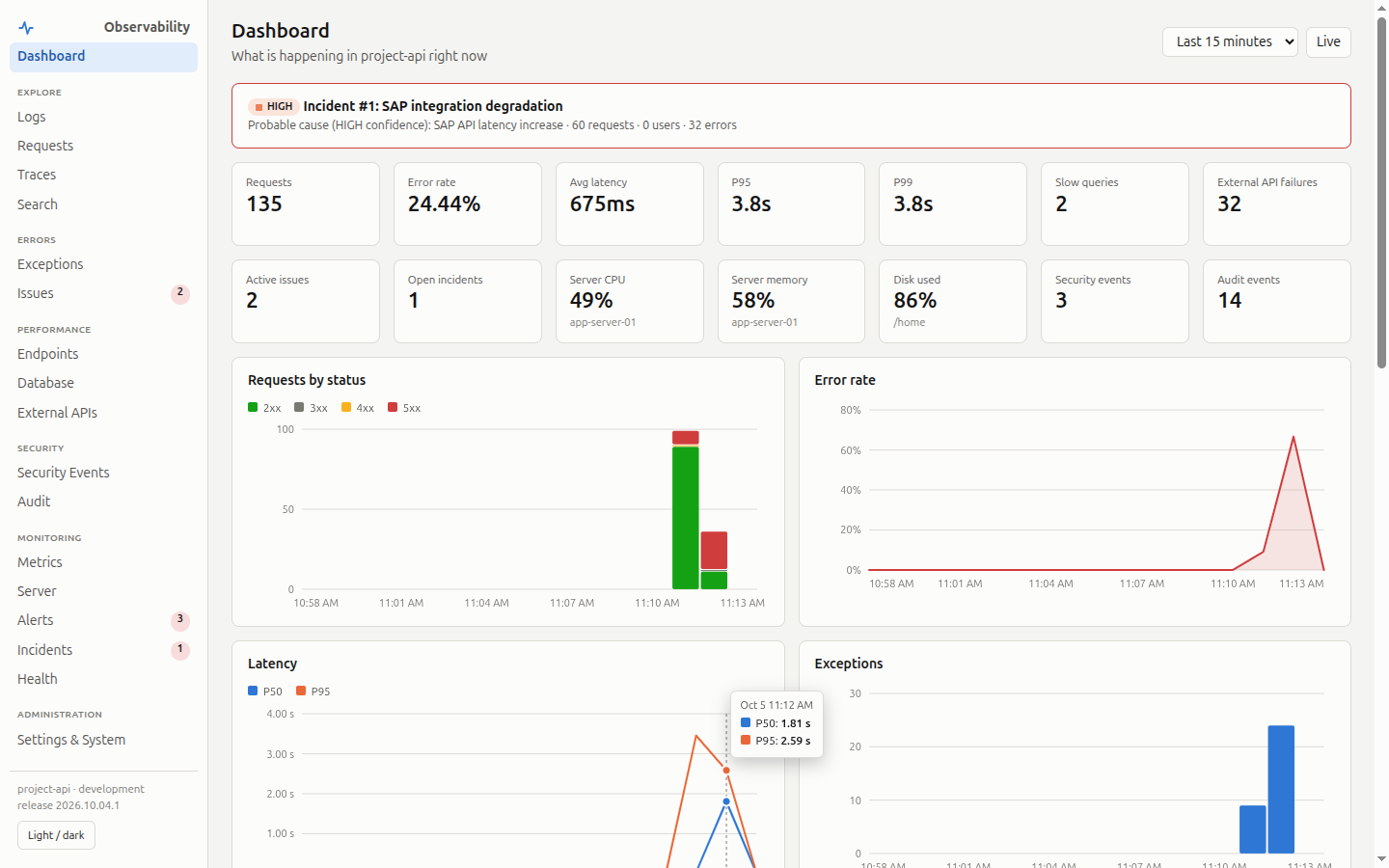
|
|
65
|
+
|
|
66
|
+
## Why
|
|
67
|
+
|
|
68
|
+
Most observability tools answer *what happened*. This one is designed to walk an operator from there to
|
|
69
|
+
*where*, *what caused it*, *who was affected* and *what to look at next* — inside the application it is
|
|
70
|
+
monitoring.
|
|
71
|
+
|
|
72
|
+
| | |
|
|
73
|
+
|---|---|
|
|
74
|
+
| **Zero infrastructure** | Python + Django + your existing database. One background thread per process. |
|
|
75
|
+
| **Offline first** | No outbound network calls, no CDN, no external assets. Works air-gapped. |
|
|
76
|
+
| **Django aware** | Request → view → template → ORM → SQL → external API, correlated automatically. |
|
|
77
|
+
| **Explains incidents** | Deterministic rules turn correlated signals into one incident with evidence. No AI. |
|
|
78
|
+
| **Private by default** | Bodies, cookies, auth headers and SQL parameters are never stored; secrets are redacted. |
|
|
79
|
+
| **Cannot take you down** | If observability fails, your application keeps serving. This is tested explicitly. |
|
|
80
|
+
|
|
81
|
+
## Features
|
|
82
|
+
|
|
83
|
+
- **Logs** – your existing `logging` calls are captured with no configuration; structured `observe.info(...)` API
|
|
84
|
+
- **Requests** – every request gets a request id and trace id (`X-Request-ID`, `X-Trace-ID` response headers)
|
|
85
|
+
- **Traces** – waterfall of view, templates, SQL and outbound HTTP; manual `span()` and `@task`
|
|
86
|
+
- **SQL** – normalised statements, fingerprints, slow-query detection, N+1 hints, drill-down to the request
|
|
87
|
+
- **External APIs** – `urllib`, `requests`, `httpx`: latency and failure rate per service
|
|
88
|
+
- **Exceptions and issues** – grouping by stable fingerprint, lifecycle with regression detection, breadcrumbs
|
|
89
|
+
- **Metrics** – counters, gauges, histograms, timers, percentiles; automatic rollups
|
|
90
|
+
- **Server resources** – CPU, memory and disk per host
|
|
91
|
+
- **Security events** – logins, failed logins, permission denied, CSRF failures, password changes
|
|
92
|
+
- **Audit trail** – append-only, hash-chained, tamper-evident, separately permissioned
|
|
93
|
+
- **Alerts** – rules with deduplication and cooldown; in-app, email, webhook
|
|
94
|
+
- **Incidents** – correlated detection with probable cause, confidence, impact and evidence
|
|
95
|
+
- **Causal analysis** – "Why is this slow?" / "Why did this fail?" on every request
|
|
96
|
+
- **Query language** – `status:>=500 AND duration:>1000 NOT path:/health*`
|
|
97
|
+
- **Exports and API** – CSV, JSON, NDJSON; read-only JSON API
|
|
98
|
+
- **OpenTelemetry** – W3C Trace Context in and out; OTLP/HTTP export without the SDK
|
|
99
|
+
|
|
100
|
+
## Quick start
|
|
101
|
+
|
|
102
|
+
```bash
|
|
103
|
+
pip install django-observatory
|
|
104
|
+
```
|
|
105
|
+
|
|
106
|
+
```python
|
|
107
|
+
# settings.py
|
|
108
|
+
INSTALLED_APPS = [
|
|
109
|
+
# ...
|
|
110
|
+
"django_observatory",
|
|
111
|
+
]
|
|
112
|
+
|
|
113
|
+
MIDDLEWARE = [
|
|
114
|
+
"django_observatory.middleware.ObservabilityMiddleware", # first, so it times the whole stack
|
|
115
|
+
# ...
|
|
116
|
+
]
|
|
117
|
+
```
|
|
118
|
+
|
|
119
|
+
```python
|
|
120
|
+
# urls.py
|
|
121
|
+
from django.urls import include, path
|
|
122
|
+
|
|
123
|
+
urlpatterns = [
|
|
124
|
+
# ...
|
|
125
|
+
path("observability/", include("django_observatory.urls")),
|
|
126
|
+
]
|
|
127
|
+
```
|
|
128
|
+
|
|
129
|
+
```bash
|
|
130
|
+
python manage.py migrate
|
|
131
|
+
python manage.py observability_test # verifies every component in your environment
|
|
132
|
+
python manage.py runserver
|
|
133
|
+
```
|
|
134
|
+
|
|
135
|
+
Open <http://localhost:8000/observability/> as a staff user. That is the whole setup.
|
|
136
|
+
|
|
137
|
+
Optional extras: `pip install "django-observatory[process]"` adds `psutil` (CPU and memory readings on every
|
|
138
|
+
platform, per-process memory).
|
|
139
|
+
|
|
140
|
+
## Use it from your code
|
|
141
|
+
|
|
142
|
+
Nothing is required: requests, SQL, outbound HTTP, exceptions and `logging` are captured automatically.
|
|
143
|
+
The API is for what only you know.
|
|
144
|
+
|
|
145
|
+
```python
|
|
146
|
+
import logging
|
|
147
|
+
from django_observatory import observe, span, task, metrics, audit, security
|
|
148
|
+
|
|
149
|
+
logging.getLogger(__name__).info("material created", extra={"material_code": "A1023"}) # just works
|
|
150
|
+
observe.warning("stock_low", material_code="A1023", quantity=4)
|
|
151
|
+
|
|
152
|
+
with span("generate_monthly_report", report_type="monthly"):
|
|
153
|
+
generate_report()
|
|
154
|
+
|
|
155
|
+
@task
|
|
156
|
+
def nightly_sync(): ...
|
|
157
|
+
|
|
158
|
+
metrics.increment("invoice.processed")
|
|
159
|
+
metrics.gauge("queue.depth", 42)
|
|
160
|
+
with metrics.timer("invoice.processing"):
|
|
161
|
+
process_invoice()
|
|
162
|
+
|
|
163
|
+
audit.record(action="UPDATE", object_type="Material", object_id="A1023",
|
|
164
|
+
changes={"quantity": {"before": 120, "after": 80}})
|
|
165
|
+
security.record(event="PERMISSION_DENIED", resource="/api/materials/", reason="Missing permission")
|
|
166
|
+
```
|
|
167
|
+
|
|
168
|
+
## From a symptom to a cause
|
|
169
|
+
|
|
170
|
+
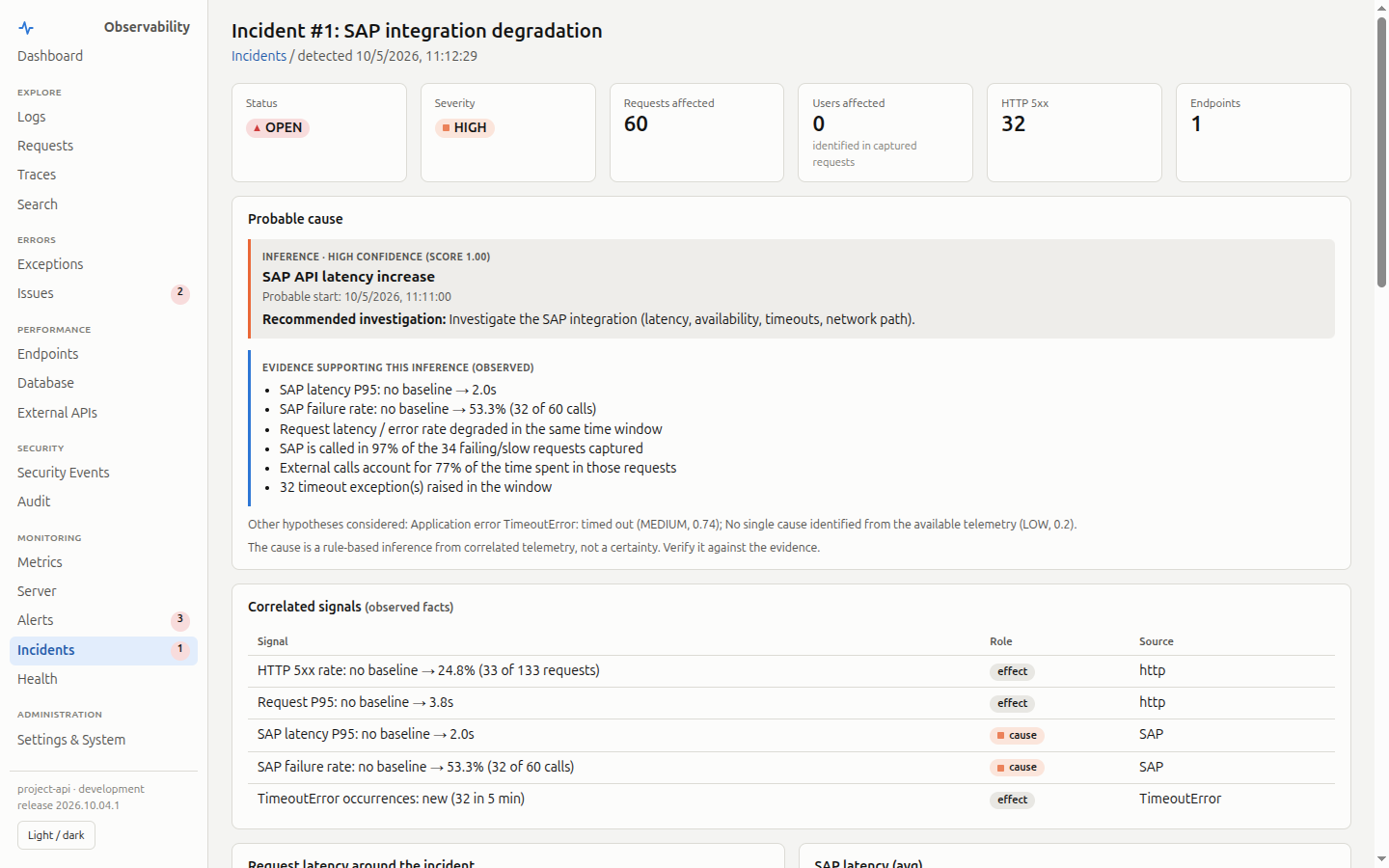
A dependency slows down. Within a minute the dashboard shows one incident instead of a wall of alerts:
|
|
171
|
+
|
|
172
|
+
|
|
173
|
+
|
|
174
|
+
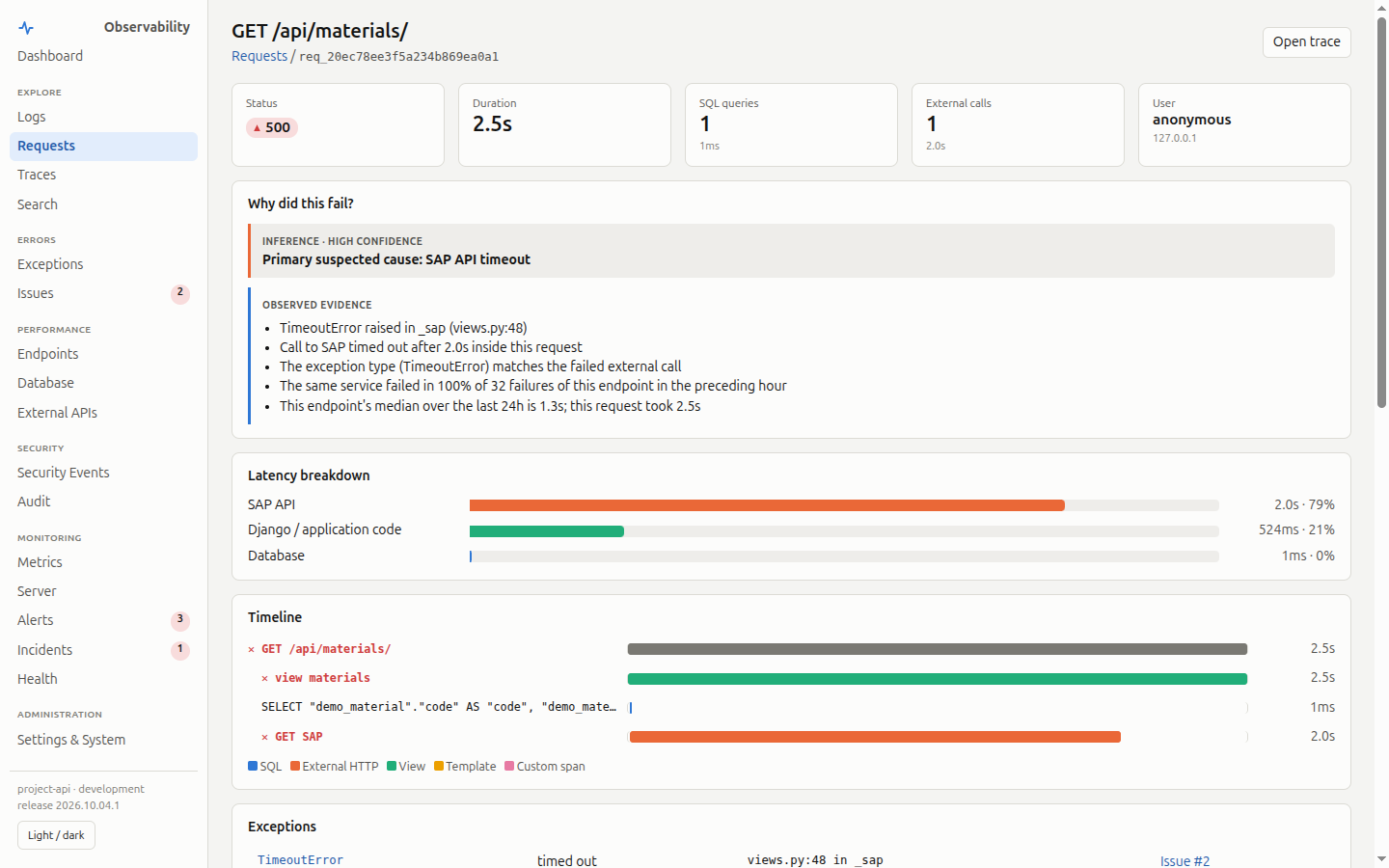
The probable cause is an inference and is labelled as one, with its confidence. The evidence beneath it is
|
|
175
|
+
observed fact: the numbers before and after, the share of failing requests that call the service, the
|
|
176
|
+
exceptions raised. Opening any affected request shows where its time went:
|
|
177
|
+
|
|
178
|
+
|
|
179
|
+
|
|
180
|
+
More screenshots: [endpoints](docs/images/performance.png) · [server](docs/images/server.png) ·
|
|
181
|
+
[logs](docs/images/logs.png) · [database, dark mode](docs/images/database-dark.png)
|
|
182
|
+
|
|
183
|
+
## Documentation
|
|
184
|
+
|
|
185
|
+
| Start here | Reference | Operate |
|
|
186
|
+
|---|---|---|
|
|
187
|
+
| [Getting started](docs/getting-started.md) | [Configuration](docs/configuration.md) | [Deployment](docs/deployment.md) |
|
|
188
|
+
| [User guide to the UI](docs/user-guide.md) | [Python API](docs/instrumentation.md) | [Alerts](docs/alerts.md) |
|
|
189
|
+
| [FAQ](docs/faq.md) | [Query language](docs/query-language.md) | [Incident correlation](docs/incident-correlation.md) |
|
|
190
|
+
| | [JSON API and exports](docs/api.md) | [Server monitoring](docs/server-monitoring.md) |
|
|
191
|
+
| | [Management commands](docs/commands.md) | [Security](docs/security.md) · [Privacy](docs/privacy.md) |
|
|
192
|
+
| | [Data model](docs/data-model.md) | [OpenTelemetry](docs/opentelemetry.md) |
|
|
193
|
+
| | [Architecture](docs/architecture.md) | [Troubleshooting](docs/troubleshooting.md) |
|
|
194
|
+
|
|
195
|
+
Full index: [docs/index.md](docs/index.md)
|
|
196
|
+
|
|
197
|
+
## Requirements
|
|
198
|
+
|
|
199
|
+
- Python 3.10 – 3.13
|
|
200
|
+
- Django 4.2, 5.2 or 6.x
|
|
201
|
+
- Any database Django supports. Tested on SQLite; designed for PostgreSQL and SQL Server (portable column
|
|
202
|
+
types, no database-specific SQL)
|
|
203
|
+
- Windows, Linux or macOS; WSGI or ASGI
|
|
204
|
+
|
|
205
|
+
## Try the demo
|
|
206
|
+
|
|
207
|
+
```bash
|
|
208
|
+
git clone https://github.com/AzeemQidwai/django-observatory.git
|
|
209
|
+
cd django-observatory/example
|
|
210
|
+
pip install -e ..
|
|
211
|
+
python manage.py migrate
|
|
212
|
+
python manage.py createsuperuser
|
|
213
|
+
python manage.py runserver
|
|
214
|
+
```
|
|
215
|
+
|
|
216
|
+
Browse `/api/materials/` a few times, open `/sap/degrade/?on=1` to make the simulated SAP dependency slow,
|
|
217
|
+
call `/api/materials/` again, and watch `/observability/` open an incident named after the cause.
|
|
218
|
+
|
|
219
|
+
## What this is not
|
|
220
|
+
|
|
221
|
+
It is not the first observability tool for Django, and it does not replace OpenTelemetry, or Sentry in
|
|
222
|
+
every scenario. Django Silk, Django Debug Toolbar, Sentry and the OpenTelemetry integrations are excellent
|
|
223
|
+
at what they do. This package combines Django-native instrumentation, local storage, security and audit
|
|
224
|
+
monitoring, and incident correlation into something you can deploy anywhere Django runs — and it exports
|
|
225
|
+
to those ecosystems when you outgrow it.
|
|
226
|
+
|
|
227
|
+
Scaling limits are documented honestly in [Architecture](docs/architecture.md#deliberate-limits) and
|
|
228
|
+
[Deployment](docs/deployment.md#sizing-and-retention).
|
|
229
|
+
|
|
230
|
+
## Contributing
|
|
231
|
+
|
|
232
|
+
Issues and pull requests are welcome. Read [CONTRIBUTING.md](CONTRIBUTING.md) and the
|
|
233
|
+
[Code of Conduct](CODE_OF_CONDUCT.md). Security reports go through [SECURITY.md](SECURITY.md).
|
|
234
|
+
|
|
235
|
+
## License
|
|
236
|
+
|
|
237
|
+
[MIT](LICENSE)
|
|
@@ -0,0 +1,194 @@
|
|
|
1
|
+
# django-observatory
|
|
2
|
+
|
|
3
|
+
[](https://pypi.org/project/django-observatory/)
|
|
4
|
+
[](https://pypi.org/project/django-observatory/)
|
|
5
|
+
[](https://www.djangoproject.com/)
|
|
6
|
+
[](https://github.com/AzeemQidwai/django-observatory/actions/workflows/ci.yml)
|
|
7
|
+
[](LICENSE)
|
|
8
|
+
|
|
9
|
+
**Production observability for Django without a separate observability infrastructure.**
|
|
10
|
+
|
|
11
|
+
`pip install`, three settings, `migrate` — and `/observability/` is a complete operations console for your
|
|
12
|
+
application: logs, requests, traces, SQL, exceptions, metrics, server resources, security and audit events,
|
|
13
|
+
alerts, and incidents with a probable cause. Everything is stored in your own database and rendered by
|
|
14
|
+
Django. No Docker, Redis, Elasticsearch, Prometheus, Grafana, Sentry, agent, collector or cloud service.
|
|
15
|
+
|
|
16
|
+
It was built for places where the usual stack is not an option: Windows servers, air-gapped networks,
|
|
17
|
+
regulated environments where telemetry must not leave the organisation, and teams that are only allowed to
|
|
18
|
+
install Python packages. It stays compatible with the wider ecosystem through W3C Trace Context and OTLP
|
|
19
|
+
export.
|
|
20
|
+
|
|
21
|
+

|
|
22
|
+
|
|
23
|
+
## Why
|
|
24
|
+
|
|
25
|
+
Most observability tools answer *what happened*. This one is designed to walk an operator from there to
|
|
26
|
+
*where*, *what caused it*, *who was affected* and *what to look at next* — inside the application it is
|
|
27
|
+
monitoring.
|
|
28
|
+
|
|
29
|
+
| | |
|
|
30
|
+
|---|---|
|
|
31
|
+
| **Zero infrastructure** | Python + Django + your existing database. One background thread per process. |
|
|
32
|
+
| **Offline first** | No outbound network calls, no CDN, no external assets. Works air-gapped. |
|
|
33
|
+
| **Django aware** | Request → view → template → ORM → SQL → external API, correlated automatically. |
|
|
34
|
+
| **Explains incidents** | Deterministic rules turn correlated signals into one incident with evidence. No AI. |
|
|
35
|
+
| **Private by default** | Bodies, cookies, auth headers and SQL parameters are never stored; secrets are redacted. |
|
|
36
|
+
| **Cannot take you down** | If observability fails, your application keeps serving. This is tested explicitly. |
|
|
37
|
+
|
|
38
|
+
## Features
|
|
39
|
+
|
|
40
|
+
- **Logs** – your existing `logging` calls are captured with no configuration; structured `observe.info(...)` API
|
|
41
|
+
- **Requests** – every request gets a request id and trace id (`X-Request-ID`, `X-Trace-ID` response headers)
|
|
42
|
+
- **Traces** – waterfall of view, templates, SQL and outbound HTTP; manual `span()` and `@task`
|
|
43
|
+
- **SQL** – normalised statements, fingerprints, slow-query detection, N+1 hints, drill-down to the request
|
|
44
|
+
- **External APIs** – `urllib`, `requests`, `httpx`: latency and failure rate per service
|
|
45
|
+
- **Exceptions and issues** – grouping by stable fingerprint, lifecycle with regression detection, breadcrumbs
|
|
46
|
+
- **Metrics** – counters, gauges, histograms, timers, percentiles; automatic rollups
|
|
47
|
+
- **Server resources** – CPU, memory and disk per host
|
|
48
|
+
- **Security events** – logins, failed logins, permission denied, CSRF failures, password changes
|
|
49
|
+
- **Audit trail** – append-only, hash-chained, tamper-evident, separately permissioned
|
|
50
|
+
- **Alerts** – rules with deduplication and cooldown; in-app, email, webhook
|
|
51
|
+
- **Incidents** – correlated detection with probable cause, confidence, impact and evidence
|
|
52
|
+
- **Causal analysis** – "Why is this slow?" / "Why did this fail?" on every request
|
|
53
|
+
- **Query language** – `status:>=500 AND duration:>1000 NOT path:/health*`
|
|
54
|
+
- **Exports and API** – CSV, JSON, NDJSON; read-only JSON API
|
|
55
|
+
- **OpenTelemetry** – W3C Trace Context in and out; OTLP/HTTP export without the SDK
|
|
56
|
+
|
|
57
|
+
## Quick start
|
|
58
|
+
|
|
59
|
+
```bash
|
|
60
|
+
pip install django-observatory
|
|
61
|
+
```
|
|
62
|
+
|
|
63
|
+
```python
|
|
64
|
+
# settings.py
|
|
65
|
+
INSTALLED_APPS = [
|
|
66
|
+
# ...
|
|
67
|
+
"django_observatory",
|
|
68
|
+
]
|
|
69
|
+
|
|
70
|
+
MIDDLEWARE = [
|
|
71
|
+
"django_observatory.middleware.ObservabilityMiddleware", # first, so it times the whole stack
|
|
72
|
+
# ...
|
|
73
|
+
]
|
|
74
|
+
```
|
|
75
|
+
|
|
76
|
+
```python
|
|
77
|
+
# urls.py
|
|
78
|
+
from django.urls import include, path
|
|
79
|
+
|
|
80
|
+
urlpatterns = [
|
|
81
|
+
# ...
|
|
82
|
+
path("observability/", include("django_observatory.urls")),
|
|
83
|
+
]
|
|
84
|
+
```
|
|
85
|
+
|
|
86
|
+
```bash
|
|
87
|
+
python manage.py migrate
|
|
88
|
+
python manage.py observability_test # verifies every component in your environment
|
|
89
|
+
python manage.py runserver
|
|
90
|
+
```
|
|
91
|
+
|
|
92
|
+
Open <http://localhost:8000/observability/> as a staff user. That is the whole setup.
|
|
93
|
+
|
|
94
|
+
Optional extras: `pip install "django-observatory[process]"` adds `psutil` (CPU and memory readings on every
|
|
95
|
+
platform, per-process memory).
|
|
96
|
+
|
|
97
|
+
## Use it from your code
|
|
98
|
+
|
|
99
|
+
Nothing is required: requests, SQL, outbound HTTP, exceptions and `logging` are captured automatically.
|
|
100
|
+
The API is for what only you know.
|
|
101
|
+
|
|
102
|
+
```python
|
|
103
|
+
import logging
|
|
104
|
+
from django_observatory import observe, span, task, metrics, audit, security
|
|
105
|
+
|
|
106
|
+
logging.getLogger(__name__).info("material created", extra={"material_code": "A1023"}) # just works
|
|
107
|
+
observe.warning("stock_low", material_code="A1023", quantity=4)
|
|
108
|
+
|
|
109
|
+
with span("generate_monthly_report", report_type="monthly"):
|
|
110
|
+
generate_report()
|
|
111
|
+
|
|
112
|
+
@task
|
|
113
|
+
def nightly_sync(): ...
|
|
114
|
+
|
|
115
|
+
metrics.increment("invoice.processed")
|
|
116
|
+
metrics.gauge("queue.depth", 42)
|
|
117
|
+
with metrics.timer("invoice.processing"):
|
|
118
|
+
process_invoice()
|
|
119
|
+
|
|
120
|
+
audit.record(action="UPDATE", object_type="Material", object_id="A1023",
|
|
121
|
+
changes={"quantity": {"before": 120, "after": 80}})
|
|
122
|
+
security.record(event="PERMISSION_DENIED", resource="/api/materials/", reason="Missing permission")
|
|
123
|
+
```
|
|
124
|
+
|
|
125
|
+
## From a symptom to a cause
|
|
126
|
+
|
|
127
|
+
A dependency slows down. Within a minute the dashboard shows one incident instead of a wall of alerts:
|
|
128
|
+
|
|
129
|
+

|
|
130
|
+
|
|
131
|
+
The probable cause is an inference and is labelled as one, with its confidence. The evidence beneath it is
|
|
132
|
+
observed fact: the numbers before and after, the share of failing requests that call the service, the
|
|
133
|
+
exceptions raised. Opening any affected request shows where its time went:
|
|
134
|
+
|
|
135
|
+

|
|
136
|
+
|
|
137
|
+
More screenshots: [endpoints](docs/images/performance.png) · [server](docs/images/server.png) ·
|
|
138
|
+
[logs](docs/images/logs.png) · [database, dark mode](docs/images/database-dark.png)
|
|
139
|
+
|
|
140
|
+
## Documentation
|
|
141
|
+
|
|
142
|
+
| Start here | Reference | Operate |
|
|
143
|
+
|---|---|---|
|
|
144
|
+
| [Getting started](docs/getting-started.md) | [Configuration](docs/configuration.md) | [Deployment](docs/deployment.md) |
|
|
145
|
+
| [User guide to the UI](docs/user-guide.md) | [Python API](docs/instrumentation.md) | [Alerts](docs/alerts.md) |
|
|
146
|
+
| [FAQ](docs/faq.md) | [Query language](docs/query-language.md) | [Incident correlation](docs/incident-correlation.md) |
|
|
147
|
+
| | [JSON API and exports](docs/api.md) | [Server monitoring](docs/server-monitoring.md) |
|
|
148
|
+
| | [Management commands](docs/commands.md) | [Security](docs/security.md) · [Privacy](docs/privacy.md) |
|
|
149
|
+
| | [Data model](docs/data-model.md) | [OpenTelemetry](docs/opentelemetry.md) |
|
|
150
|
+
| | [Architecture](docs/architecture.md) | [Troubleshooting](docs/troubleshooting.md) |
|
|
151
|
+
|
|
152
|
+
Full index: [docs/index.md](docs/index.md)
|
|
153
|
+
|
|
154
|
+
## Requirements
|
|
155
|
+
|
|
156
|
+
- Python 3.10 – 3.13
|
|
157
|
+
- Django 4.2, 5.2 or 6.x
|
|
158
|
+
- Any database Django supports. Tested on SQLite; designed for PostgreSQL and SQL Server (portable column
|
|
159
|
+
types, no database-specific SQL)
|
|
160
|
+
- Windows, Linux or macOS; WSGI or ASGI
|
|
161
|
+
|
|
162
|
+
## Try the demo
|
|
163
|
+
|
|
164
|
+
```bash
|
|
165
|
+
git clone https://github.com/AzeemQidwai/django-observatory.git
|
|
166
|
+
cd django-observatory/example
|
|
167
|
+
pip install -e ..
|
|
168
|
+
python manage.py migrate
|
|
169
|
+
python manage.py createsuperuser
|
|
170
|
+
python manage.py runserver
|
|
171
|
+
```
|
|
172
|
+
|
|
173
|
+
Browse `/api/materials/` a few times, open `/sap/degrade/?on=1` to make the simulated SAP dependency slow,
|
|
174
|
+
call `/api/materials/` again, and watch `/observability/` open an incident named after the cause.
|
|
175
|
+
|
|
176
|
+
## What this is not
|
|
177
|
+
|
|
178
|
+
It is not the first observability tool for Django, and it does not replace OpenTelemetry, or Sentry in
|
|
179
|
+
every scenario. Django Silk, Django Debug Toolbar, Sentry and the OpenTelemetry integrations are excellent
|
|
180
|
+
at what they do. This package combines Django-native instrumentation, local storage, security and audit
|
|
181
|
+
monitoring, and incident correlation into something you can deploy anywhere Django runs — and it exports
|
|
182
|
+
to those ecosystems when you outgrow it.
|
|
183
|
+
|
|
184
|
+
Scaling limits are documented honestly in [Architecture](docs/architecture.md#deliberate-limits) and
|
|
185
|
+
[Deployment](docs/deployment.md#sizing-and-retention).
|
|
186
|
+
|
|
187
|
+
## Contributing
|
|
188
|
+
|
|
189
|
+
Issues and pull requests are welcome. Read [CONTRIBUTING.md](CONTRIBUTING.md) and the
|
|
190
|
+
[Code of Conduct](CODE_OF_CONDUCT.md). Security reports go through [SECURITY.md](SECURITY.md).
|
|
191
|
+
|
|
192
|
+
## License
|
|
193
|
+
|
|
194
|
+
[MIT](LICENSE)
|
|
@@ -0,0 +1,26 @@
|
|
|
1
|
+
# Security policy
|
|
2
|
+
|
|
3
|
+
## Reporting a vulnerability
|
|
4
|
+
|
|
5
|
+
Please report suspected vulnerabilities **privately**:
|
|
6
|
+
<https://github.com/AzeemQidwai/django-observatory/security/advisories/new>
|
|
7
|
+
|
|
8
|
+
Do not open a public issue. Include the affected version, a description and steps to reproduce. You will
|
|
9
|
+
receive an acknowledgement within five working days, and a fix or mitigation plan as soon as the report is
|
|
10
|
+
confirmed. You will be credited in the release notes unless you prefer otherwise.
|
|
11
|
+
|
|
12
|
+
Of particular interest:
|
|
13
|
+
|
|
14
|
+
- telemetry storing an unredacted secret under the default configuration
|
|
15
|
+
- access to observability data without the required permission
|
|
16
|
+
- modification of audit records that `AuditEvent.verify_chain()` does not detect
|
|
17
|
+
- any input that makes observability fail, block or noticeably slow the host application
|
|
18
|
+
- cross-site scripting through stored telemetry, or injection through the query language
|
|
19
|
+
|
|
20
|
+
## Supported versions
|
|
21
|
+
|
|
22
|
+
Security fixes are released for the latest minor version.
|
|
23
|
+
|
|
24
|
+
## Security model
|
|
25
|
+
|
|
26
|
+
See [docs/security.md](docs/security.md) and [docs/privacy.md](docs/privacy.md).
|
|
@@ -0,0 +1,79 @@
|
|
|
1
|
+
"""Measure the synchronous overhead observability adds to a request.
|
|
2
|
+
|
|
3
|
+
python benchmarks/overhead.py (from the repository root)
|
|
4
|
+
|
|
5
|
+
Compares the same views with observability disabled and enabled (asynchronous pipeline,
|
|
6
|
+
the production configuration), plus logging and SQL-monitoring cost in isolation.
|
|
7
|
+
"""
|
|
8
|
+
import logging
|
|
9
|
+
import os
|
|
10
|
+
import statistics
|
|
11
|
+
import sys
|
|
12
|
+
import tempfile
|
|
13
|
+
import time
|
|
14
|
+
from pathlib import Path
|
|
15
|
+
|
|
16
|
+
sys.path.insert(0, str(Path(__file__).resolve().parent.parent))
|
|
17
|
+
os.environ["DJANGO_SETTINGS_MODULE"] = "tests.settings"
|
|
18
|
+
|
|
19
|
+
import django # noqa: E402
|
|
20
|
+
from django.conf import settings # noqa: E402
|
|
21
|
+
|
|
22
|
+
django.setup()
|
|
23
|
+
settings.DATABASES["default"]["NAME"] = os.path.join(tempfile.mkdtemp(), "bench.sqlite3")
|
|
24
|
+
|
|
25
|
+
from django.core.management import call_command # noqa: E402
|
|
26
|
+
from django.db import connection # noqa: E402
|
|
27
|
+
from django.test import Client, override_settings # noqa: E402
|
|
28
|
+
|
|
29
|
+
from django_observatory import pipeline # noqa: E402
|
|
30
|
+
|
|
31
|
+
N = 400
|
|
32
|
+
ASYNC = {"SCHEDULER": {"ENABLED": False}, "LOGGING": {"AUTO_ATTACH": False}}
|
|
33
|
+
|
|
34
|
+
|
|
35
|
+
def timed(fn, n=N):
|
|
36
|
+
for _ in range(20):
|
|
37
|
+
fn()
|
|
38
|
+
samples = []
|
|
39
|
+
for _ in range(n):
|
|
40
|
+
t0 = time.perf_counter()
|
|
41
|
+
fn()
|
|
42
|
+
samples.append((time.perf_counter() - t0) * 1000)
|
|
43
|
+
samples.sort()
|
|
44
|
+
return statistics.mean(samples), samples[int(n * 0.95)]
|
|
45
|
+
|
|
46
|
+
|
|
47
|
+
def run(label, fn, variants):
|
|
48
|
+
results = {}
|
|
49
|
+
for name, obs in variants.items():
|
|
50
|
+
with override_settings(OBSERVABILITY=obs):
|
|
51
|
+
results[name] = timed(fn)
|
|
52
|
+
pipeline.flush(30)
|
|
53
|
+
base = results["off"][0]
|
|
54
|
+
print(f"\n{label}")
|
|
55
|
+
for name, (mean, p95) in results.items():
|
|
56
|
+
delta = f" (+{mean - base:.3f} ms)" if name != "off" else ""
|
|
57
|
+
print(f" {name:<28} mean {mean:7.3f} ms p95 {p95:7.3f} ms{delta}")
|
|
58
|
+
|
|
59
|
+
|
|
60
|
+
def main():
|
|
61
|
+
connection.close()
|
|
62
|
+
call_command("migrate", verbosity=0)
|
|
63
|
+
client = Client()
|
|
64
|
+
log = logging.getLogger("bench")
|
|
65
|
+
log.setLevel(logging.INFO)
|
|
66
|
+
log.propagate = False
|
|
67
|
+
from django_observatory.logging import ObservabilityHandler
|
|
68
|
+
|
|
69
|
+
log.addHandler(ObservabilityHandler())
|
|
70
|
+
off = {**ASYNC, "ENABLED": False}
|
|
71
|
+
print(f"{N} iterations each, asynchronous pipeline, SQLite file database")
|
|
72
|
+
run("Request with 2 SQL queries (/sql/)", lambda: client.get("/sql/"), {
|
|
73
|
+
"off": off, "on": ASYNC, "on, SQL monitoring disabled": {**ASYNC, "DATABASE": {"ENABLED": False}},
|
|
74
|
+
"on, 10% request sampling": {**ASYNC, "SAMPLING": {"requests": 0.1}}})
|
|
75
|
+
run("Logging: logger.info() with extra", lambda: log.info("bench %s", 1, extra={"k": "v"}), {"off": off, "on": ASYNC})
|
|
76
|
+
|
|
77
|
+
|
|
78
|
+
if __name__ == "__main__":
|
|
79
|
+
main()
|