django-explain-errors 0.7.0__tar.gz → 0.8.0__tar.gz
This diff represents the content of publicly available package versions that have been released to one of the supported registries. The information contained in this diff is provided for informational purposes only and reflects changes between package versions as they appear in their respective public registries.
- {django_explain_errors-0.7.0/django_explain_errors.egg-info → django_explain_errors-0.8.0}/PKG-INFO +128 -31
- {django_explain_errors-0.7.0 → django_explain_errors-0.8.0}/README.md +127 -30
- {django_explain_errors-0.7.0 → django_explain_errors-0.8.0/django_explain_errors.egg-info}/PKG-INFO +128 -31
- {django_explain_errors-0.7.0 → django_explain_errors-0.8.0}/django_explain_errors.egg-info/SOURCES.txt +3 -0
- {django_explain_errors-0.7.0 → django_explain_errors-0.8.0}/explain_errors/client.py +3 -2
- django_explain_errors-0.8.0/explain_errors/debug_page.py +172 -0
- {django_explain_errors-0.7.0 → django_explain_errors-0.8.0}/explain_errors/management/commands/build_error_index.py +2 -2
- {django_explain_errors-0.7.0 → django_explain_errors-0.8.0}/explain_errors/middleware.py +66 -11
- {django_explain_errors-0.7.0 → django_explain_errors-0.8.0}/setup.py +1 -1
- {django_explain_errors-0.7.0 → django_explain_errors-0.8.0}/tests/test_build_error_index.py +1 -1
- {django_explain_errors-0.7.0 → django_explain_errors-0.8.0}/tests/test_client.py +3 -2
- django_explain_errors-0.8.0/tests/test_debug_page.py +402 -0
- {django_explain_errors-0.7.0 → django_explain_errors-0.8.0}/tests/test_middleware.py +1 -1
- django_explain_errors-0.8.0/tests/test_print_stdout.py +130 -0
- {django_explain_errors-0.7.0 → django_explain_errors-0.8.0}/LICENSE +0 -0
- {django_explain_errors-0.7.0 → django_explain_errors-0.8.0}/MANIFEST.in +0 -0
- {django_explain_errors-0.7.0 → django_explain_errors-0.8.0}/django_explain_errors.egg-info/dependency_links.txt +0 -0
- {django_explain_errors-0.7.0 → django_explain_errors-0.8.0}/django_explain_errors.egg-info/requires.txt +0 -0
- {django_explain_errors-0.7.0 → django_explain_errors-0.8.0}/django_explain_errors.egg-info/top_level.txt +0 -0
- {django_explain_errors-0.7.0 → django_explain_errors-0.8.0}/explain_errors/__init__.py +0 -0
- {django_explain_errors-0.7.0 → django_explain_errors-0.8.0}/explain_errors/management/__init__.py +0 -0
- {django_explain_errors-0.7.0 → django_explain_errors-0.8.0}/explain_errors/management/commands/__init__.py +0 -0
- {django_explain_errors-0.7.0 → django_explain_errors-0.8.0}/explain_errors/rag/__init__.py +0 -0
- {django_explain_errors-0.7.0 → django_explain_errors-0.8.0}/explain_errors/rag/indexer.py +0 -0
- {django_explain_errors-0.7.0 → django_explain_errors-0.8.0}/explain_errors/rag/retriever.py +0 -0
- {django_explain_errors-0.7.0 → django_explain_errors-0.8.0}/explain_errors/rag/store.py +0 -0
- {django_explain_errors-0.7.0 → django_explain_errors-0.8.0}/explain_errors/sanitize.py +0 -0
- {django_explain_errors-0.7.0 → django_explain_errors-0.8.0}/explain_errors/throttle.py +0 -0
- {django_explain_errors-0.7.0 → django_explain_errors-0.8.0}/explain_errors/tracebacks.py +0 -0
- {django_explain_errors-0.7.0 → django_explain_errors-0.8.0}/setup.cfg +0 -0
- {django_explain_errors-0.7.0 → django_explain_errors-0.8.0}/tests/test_eval_fixtures.py +0 -0
- {django_explain_errors-0.7.0 → django_explain_errors-0.8.0}/tests/test_eval_judge.py +0 -0
- {django_explain_errors-0.7.0 → django_explain_errors-0.8.0}/tests/test_eval_run.py +0 -0
- {django_explain_errors-0.7.0 → django_explain_errors-0.8.0}/tests/test_language.py +0 -0
- {django_explain_errors-0.7.0 → django_explain_errors-0.8.0}/tests/test_rag.py +0 -0
- {django_explain_errors-0.7.0 → django_explain_errors-0.8.0}/tests/test_sanitize.py +0 -0
- {django_explain_errors-0.7.0 → django_explain_errors-0.8.0}/tests/test_signals.py +0 -0
- {django_explain_errors-0.7.0 → django_explain_errors-0.8.0}/tests/test_throttle.py +0 -0
- {django_explain_errors-0.7.0 → django_explain_errors-0.8.0}/tests/test_tracebacks.py +0 -0
- {django_explain_errors-0.7.0 → django_explain_errors-0.8.0}/tests/test_truncation.py +0 -0
{django_explain_errors-0.7.0/django_explain_errors.egg-info → django_explain_errors-0.8.0}/PKG-INFO
RENAMED
|
@@ -1,6 +1,6 @@
|
|
|
1
1
|
Metadata-Version: 2.4
|
|
2
2
|
Name: django-explain-errors
|
|
3
|
-
Version: 0.
|
|
3
|
+
Version: 0.8.0
|
|
4
4
|
Summary: Django middleware that explains unhandled exceptions in DEBUG using an LLM, optionally grounded in your own project source via a local vector index. Works with OpenAI, Claude, or any OpenAI-compatible endpoint including local models.
|
|
5
5
|
Home-page: https://github.com/topunix/django-explain-errors
|
|
6
6
|
Author: topunix
|
|
@@ -45,17 +45,23 @@ Dynamic: summary
|
|
|
45
45
|
# Django Explain Errors Middleware
|
|
46
46
|
|
|
47
47
|
This Django middleware captures unhandled errors and exceptions, sends them
|
|
48
|
-
to a language model for explanation, and
|
|
49
|
-
|
|
50
|
-
|
|
51
|
-
|
|
52
|
-
|
|
53
|
-
|
|
54
|
-
|
|
55
|
-
|
|
56
|
-
|
|
57
|
-
|
|
58
|
-
|
|
48
|
+
to a language model for explanation, and, when debug mode is enabled, shows
|
|
49
|
+
the explanation on Django's debug page directly under the exception
|
|
50
|
+
headline, as well as printing it to stdout. It works with the OpenAI API
|
|
51
|
+
out of the box, with Anthropic's Claude models through Anthropic's
|
|
52
|
+
OpenAI-compatible endpoint, and with any other OpenAI-compatible endpoint
|
|
53
|
+
(Ollama, LM Studio, Azure, or a corporate gateway) by setting a base URL,
|
|
54
|
+
so explanations can run entirely on a local model if you prefer not to send
|
|
55
|
+
code off your machine.
|
|
56
|
+
|
|
57
|
+
Enabling RAG is strongly recommended. With it, the middleware retrieves the
|
|
58
|
+
relevant parts of your own project source from a local vector index, so
|
|
59
|
+
explanations name the actual file and function that failed instead of
|
|
60
|
+
guessing. In the package's eval harness, RAG-grounded explanations won 35
|
|
61
|
+
of 43 blind comparisons, with the gap concentrated in pointing at the right
|
|
62
|
+
fix location and not inventing details (see "Does RAG actually help?"
|
|
63
|
+
below). It is off by default because it needs an optional extra and a
|
|
64
|
+
one-time index build.
|
|
59
65
|
|
|
60
66
|
The middleware supports both synchronous (WSGI) and asynchronous (ASGI)
|
|
61
67
|
views. It auto-detects the view chain at startup and routes requests through
|
|
@@ -63,11 +69,17 @@ the matching path, so no extra configuration is required for either server
|
|
|
63
69
|
type. Tracebacks are sanitized before leaving the process, and API calls are
|
|
64
70
|
rate limited.
|
|
65
71
|
|
|
72
|
+
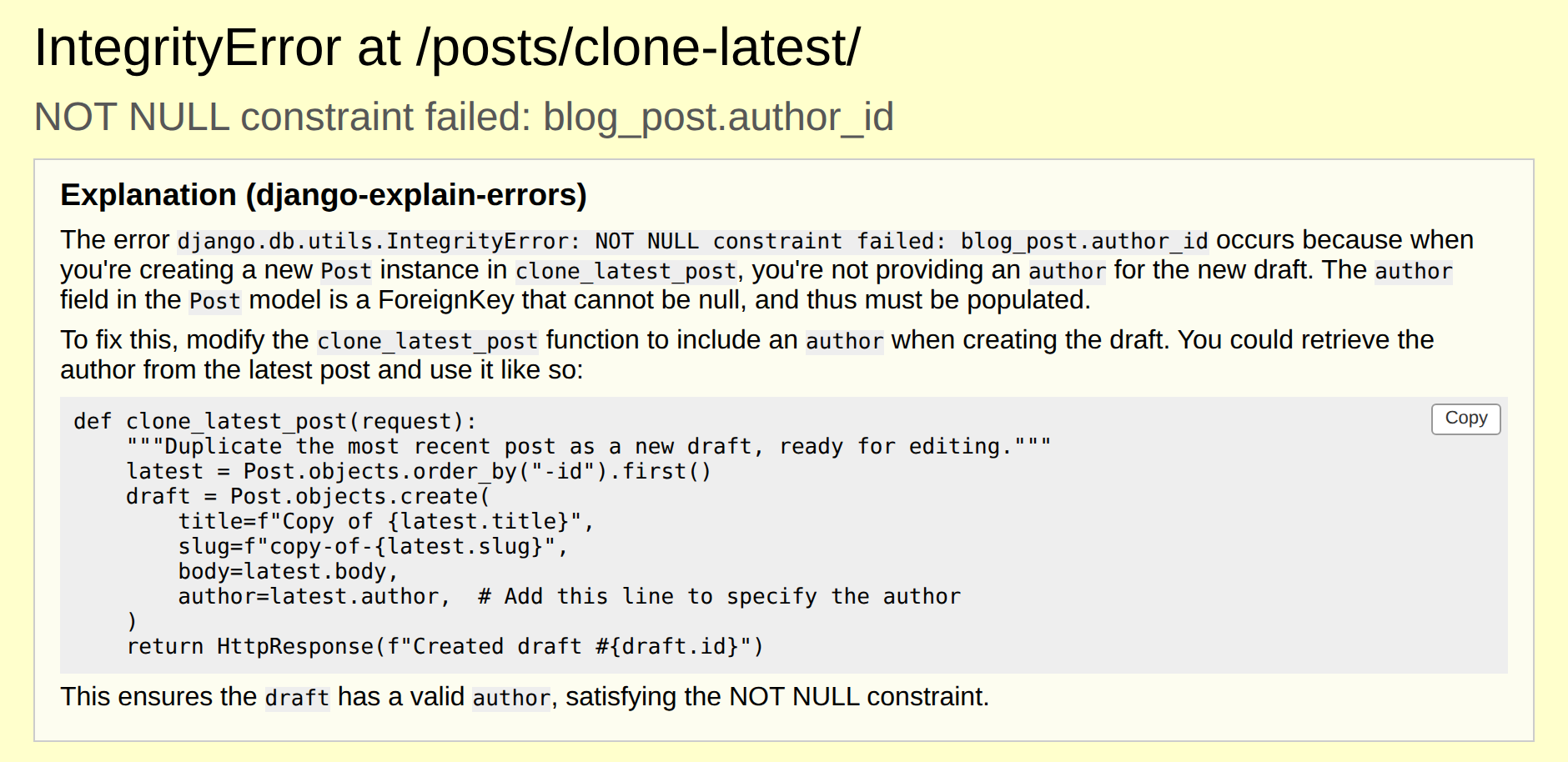
|
|
73
|
+
|
|
74
|
+
*Real `gpt-4o-mini` output with RAG enabled, recorded by the eval harness
|
|
75
|
+
on its `missing_fk` fixture.*
|
|
76
|
+
|
|
66
77
|
## Scope
|
|
67
78
|
|
|
68
79
|
This package explains errors for a person, not for a coding agent to consume
|
|
69
|
-
programmatically. The explanation is written for a human reader,
|
|
70
|
-
|
|
80
|
+
programmatically. The explanation is written for a human reader, on Django's
|
|
81
|
+
debug page in the browser or in a terminal, and the output format assumes
|
|
82
|
+
that reader.
|
|
71
83
|
|
|
72
84
|
If a coding agent is doing the debugging, it does not need this. Agents read tracebacks directly,
|
|
73
85
|
and tools that expose live runtime state (debugger-over-MCP servers, `mcp-django`) serve that case
|
|
@@ -78,9 +90,16 @@ Local development only. It requires `DEBUG = True` and is inert otherwise.
|
|
|
78
90
|
## Features
|
|
79
91
|
|
|
80
92
|
- Captures Django errors and exceptions
|
|
93
|
+
- Shows the explanation on Django's debug page, directly under the
|
|
94
|
+
exception headline (`EXPLAIN_ERRORS_INJECT_DEBUG_PAGE`, on by default)
|
|
95
|
+
- Prints the explanation to stdout, for terminal workflows and logs
|
|
96
|
+
(`EXPLAIN_ERRORS_PRINT_STDOUT`, on by default)
|
|
97
|
+
- Optional JSON 500 response instead of the debug page
|
|
98
|
+
(`EXPLAIN_ERRORS_PRESERVE_DEBUG_PAGE = False`)
|
|
81
99
|
- Explains errors using OpenAI, Anthropic's Claude models, or any other
|
|
82
100
|
OpenAI-compatible endpoint (Ollama, LM Studio, Azure, gateways) via `OPENAI_BASE_URL`
|
|
83
|
-
-
|
|
101
|
+
- Codebase-aware explanations via RAG over a local sqlite-vec index
|
|
102
|
+
(recommended; see "Codebase-aware explanations" below)
|
|
84
103
|
- Explanations in your language via `EXPLAIN_ERRORS_LANGUAGE`, with exception names,
|
|
85
104
|
identifiers, and code kept in English
|
|
86
105
|
- Redacts secrets, tokens, and emails from tracebacks before sending
|
|
@@ -97,13 +116,16 @@ pip install django-explain-errors
|
|
|
97
116
|
|
|
98
117
|
2. **Add the middleware to your Django project**:
|
|
99
118
|
|
|
100
|
-
- Open your `settings.py` file and
|
|
119
|
+
- Open your `settings.py` file and register the middleware only when `DEBUG` is on (see
|
|
120
|
+
Production Safety below for why):
|
|
101
121
|
|
|
102
122
|
```python
|
|
103
123
|
MIDDLEWARE = [
|
|
104
124
|
...
|
|
105
|
-
'explain_errors.middleware.ExplainErrorsMiddleware',
|
|
106
125
|
]
|
|
126
|
+
|
|
127
|
+
if DEBUG:
|
|
128
|
+
MIDDLEWARE.append('explain_errors.middleware.ExplainErrorsMiddleware')
|
|
107
129
|
```
|
|
108
130
|
|
|
109
131
|
In the default preserve mode, `process_exception` returns `None`, so exception handling
|
|
@@ -117,15 +139,39 @@ pip install django-explain-errors
|
|
|
117
139
|
|
|
118
140
|
3. **Set up environment variables**:
|
|
119
141
|
|
|
120
|
-
- Create a `.env` file in your project's root directory and add your
|
|
142
|
+
- Create a `.env` file in your project's root directory and add your API key. Alternatively, you can set it in `settings.py`:
|
|
121
143
|
|
|
122
144
|
```plaintext
|
|
123
|
-
OPENAI_API_KEY=
|
|
145
|
+
OPENAI_API_KEY=your_api_key_here
|
|
124
146
|
```
|
|
125
147
|
|
|
126
148
|
The API key is not required if you set `OPENAI_BASE_URL` to a local
|
|
127
149
|
server such as Ollama, which does not authenticate requests.
|
|
128
150
|
|
|
151
|
+
## Production Safety
|
|
152
|
+
|
|
153
|
+
This middleware is intended for local development only. When active, it sends exception
|
|
154
|
+
tracebacks to the configured LLM provider, which may include source code, file paths, and
|
|
155
|
+
local variable values. Keep it out of production.
|
|
156
|
+
|
|
157
|
+
**Primary safeguard:** register the middleware only when `DEBUG` is on, or only in your
|
|
158
|
+
development settings module:
|
|
159
|
+
|
|
160
|
+
```python
|
|
161
|
+
# settings.py
|
|
162
|
+
if DEBUG:
|
|
163
|
+
MIDDLEWARE.append("explain_errors.middleware.ExplainErrorsMiddleware")
|
|
164
|
+
```
|
|
165
|
+
|
|
166
|
+
See Installation above for where the middleware can sit in `MIDDLEWARE`.
|
|
167
|
+
|
|
168
|
+
**Secondary safeguard:** run Django's deployment checks in CI against your production settings.
|
|
169
|
+
This fails the build if `DEBUG = True` (`security.W018`):
|
|
170
|
+
|
|
171
|
+
```bash
|
|
172
|
+
python manage.py check --deploy --fail-level WARNING
|
|
173
|
+
```
|
|
174
|
+
|
|
129
175
|
## Usage
|
|
130
176
|
|
|
131
177
|
1. **Ensure DEBUG is set to True**:
|
|
@@ -138,17 +184,59 @@ pip install django-explain-errors
|
|
|
138
184
|
|
|
139
185
|
2. **Trigger an error in your Django application**:
|
|
140
186
|
|
|
141
|
-
The middleware captures the error, sends it to the configured model for explanation,
|
|
187
|
+
The middleware captures the error, sends it to the configured model for explanation, prints the explanation to stdout, and adds it as a banner on Django's debug page. By default (`EXPLAIN_ERRORS_PRESERVE_DEBUG_PAGE=True`), exception handling then continues normally, so Django (or whatever else is watching, such as `runserver_plus` or Sentry, see Compatibility below) renders its usual response. The only change is the banner on Django's own debug page. Set `EXPLAIN_ERRORS_INJECT_DEBUG_PAGE = False` to remove it, or `EXPLAIN_ERRORS_PRESERVE_DEBUG_PAGE = False` to instead get a JSON `500` response containing the error message and the explanation.
|
|
188
|
+
|
|
189
|
+
In the terminal, the explanation is printed with the model that produced it:
|
|
190
|
+
|
|
191
|
+
```
|
|
192
|
+
Error explanation (gpt-4o-mini):
|
|
193
|
+
The view raised a ValueError because ...
|
|
194
|
+
```
|
|
142
195
|
|
|
143
196
|
## Async Support
|
|
144
197
|
|
|
145
198
|
The middleware exposes both `sync_capable = True` and `async_capable = True`. At initialization it inspects `get_response` to decide whether it is part of a sync or async chain:
|
|
146
199
|
|
|
147
200
|
- Under WSGI (for example `runserver` with sync views), requests flow through the synchronous handler.
|
|
148
|
-
- Under ASGI (for example with async views), requests are awaited through the async handler. The blocking
|
|
201
|
+
- Under ASGI (for example with async views), requests are awaited through the async handler. The blocking model API call is offloaded with `asgiref.sync.sync_to_async` so the event loop is not blocked.
|
|
149
202
|
|
|
150
203
|
No additional settings are needed. See Installation above for where to place the middleware in `MIDDLEWARE`.
|
|
151
204
|
|
|
205
|
+
## Debug page injection
|
|
206
|
+
|
|
207
|
+
When Django renders its debug page for a 500, `explain_errors` also inserts a banner
|
|
208
|
+
containing the explanation directly under the exception headline, in addition to printing
|
|
209
|
+
it to stdout.
|
|
210
|
+
|
|
211
|
+
Controlled by `EXPLAIN_ERRORS_INJECT_DEBUG_PAGE`, default `True`. Injection happens only
|
|
212
|
+
when all of the following hold:
|
|
213
|
+
|
|
214
|
+
- `DEBUG` is `True`
|
|
215
|
+
- `EXPLAIN_ERRORS_INJECT_DEBUG_PAGE` is `True` (the default)
|
|
216
|
+
- `EXPLAIN_ERRORS_PRESERVE_DEBUG_PAGE` is `True` (the default). With
|
|
217
|
+
`EXPLAIN_ERRORS_PRESERVE_DEBUG_PAGE=False`, the JSON 500 path runs instead and there is
|
|
218
|
+
no debug page to inject into.
|
|
219
|
+
- an explanation was actually produced (not throttled, and the API call succeeded)
|
|
220
|
+
|
|
221
|
+
The banner appears only on the HTML debug page, styled inline (bordered box, light
|
|
222
|
+
background) so it reads on Django's page. The explanation is HTML-escaped first, then a small
|
|
223
|
+
Markdown subset (inline code, code blocks, bold, lists) is rendered as HTML. Nothing from the
|
|
224
|
+
model is ever marked safe.
|
|
225
|
+
|
|
226
|
+
**Fails open.** Any problem building or inserting the banner (a missing request, an
|
|
227
|
+
unexpected debug page layout, anything else) logs one warning and leaves Django's normal
|
|
228
|
+
debug page untouched. This code can never turn a working debug page into a broken one.
|
|
229
|
+
|
|
230
|
+
**Custom exception reporters.** If your project already sets a custom
|
|
231
|
+
`DEFAULT_EXCEPTION_REPORTER`, or something earlier in the request sets
|
|
232
|
+
`request.exception_reporter_class`, `explain_errors` leaves it alone and skips injection
|
|
233
|
+
(logged at debug level) rather than overriding it.
|
|
234
|
+
|
|
235
|
+
**Upgrading.** Turning this on, or upgrading to a version where it defaults on, changes
|
|
236
|
+
what Django's debug page looks like: a new section appears above the request metadata
|
|
237
|
+
table. If you rely on the debug page's exact markup (a scraper, a screenshot test), account
|
|
238
|
+
for this.
|
|
239
|
+
|
|
152
240
|
## Compatibility
|
|
153
241
|
|
|
154
242
|
How this middleware interacts with other error-handling and debugging tools, in the default
|
|
@@ -156,10 +244,10 @@ preserve mode and with `EXPLAIN_ERRORS_PRESERVE_DEBUG_PAGE=False`:
|
|
|
156
244
|
|
|
157
245
|
| Package | Preserve mode (default) | `EXPLAIN_ERRORS_PRESERVE_DEBUG_PAGE=False` |
|
|
158
246
|
| ------- | ------------------------ | ------------------------------------------- |
|
|
159
|
-
| Django Debug Toolbar | Works — Django renders its
|
|
247
|
+
| Django Debug Toolbar | Works — Django renders its debug page (with the explanation banner, unless `EXPLAIN_ERRORS_INJECT_DEBUG_PAGE = False`), and Debug Toolbar injects into it. | Broken — the JSON 500 response has no HTML to inject into. |
|
|
160
248
|
| Sentry, Rollbar | Work — the exception propagates and Django re-raises it, so `got_request_exception` fires. | Broken — returning a response ends exception handling before `got_request_exception` fires. |
|
|
161
249
|
| Django REST Framework | Partial — only exceptions DRF does not already handle itself reach this middleware. | Partial, same reason. |
|
|
162
|
-
| Silk and other profiling panels | Timings are inflated by the
|
|
250
|
+
| Silk and other profiling panels | Timings are inflated by the model API call, since `process_exception` blocks the request path. | Same. |
|
|
163
251
|
| CORS, GZip, WhiteNoise | No interaction. | No interaction. |
|
|
164
252
|
| `runserver_plus` / Werkzeug debugger | Works — returning `None` re-raises the original exception, and `django-extensions` replaces Django's debug-page renderer with one that re-raises instead, so Werkzeug's WSGI wrapper catches it and shows the interactive debugger. | Broken — the JSON 500 response ends exception handling before it reaches `runserver_plus`'s exception hook, so the Werkzeug debugger never appears. |
|
|
165
253
|
|
|
@@ -183,9 +271,11 @@ developer is actually investigating.
|
|
|
183
271
|
| `DEBUG` | Yes | The middleware is only active when `DEBUG=True`. When `False`, requests pass through untouched. |
|
|
184
272
|
| `OPENAI_MODEL` | No | Model used for explanations. Defaults to `gpt-4o-mini`. |
|
|
185
273
|
| `OPENAI_MAX_TOKENS` | No | Ceiling on tokens generated for the explanation, not a target — the system prompt itself asks for a concise answer. Defaults to `1000`; scales up automatically when `EXPLAIN_ERRORS_LANGUAGE` is set (see below), unless you set this explicitly, which always overrides the scaling. |
|
|
186
|
-
| `OPENAI_TIMEOUT` | No | Request timeout in seconds for
|
|
274
|
+
| `OPENAI_TIMEOUT` | No | Request timeout in seconds for model API calls. Defaults to `10`. |
|
|
187
275
|
| `OPENAI_MAX_TRACEBACK_CHARS` | No | Total character budget for the traceback sent to the model. Application frames (your own code, as opposed to Django, the standard library, or installed packages) are always kept; library frames fill whatever budget remains, nearest the raise point first, with an `... N library frames omitted ...` line where frames are dropped. If the application frames alone exceed the budget, falls back to keeping the last N characters of the raw traceback. Defaults to `3000`. |
|
|
188
|
-
| `EXPLAIN_ERRORS_PRESERVE_DEBUG_PAGE` | No | When `True` (the default), the middleware
|
|
276
|
+
| `EXPLAIN_ERRORS_PRESERVE_DEBUG_PAGE` | No | When `True` (the default), the middleware returns `None` (after printing the explanation to stdout, unless `EXPLAIN_ERRORS_PRINT_STDOUT = False`), so exception handling continues normally and Django renders its debug page (with the explanation banner, controlled by `EXPLAIN_ERRORS_INJECT_DEBUG_PAGE`). Set to `False` to instead return a JSON 500 response, which ends exception handling early (see Compatibility above). |
|
|
277
|
+
| `EXPLAIN_ERRORS_INJECT_DEBUG_PAGE` | No | When `True` (the default), also injects the explanation as a banner into Django's debug page, in addition to stdout. Requires `EXPLAIN_ERRORS_PRESERVE_DEBUG_PAGE=True` (the default); see Debug Page Injection above. |
|
|
278
|
+
| `EXPLAIN_ERRORS_PRINT_STDOUT` | No | When `True` (the default), prints the explanation to stdout. Set to `False` to suppress it, for example when `EXPLAIN_ERRORS_INJECT_DEBUG_PAGE` already shows it in the browser. The failure message (when the model API call itself errors) always prints. For requests where nobody views the debug page (API clients, which get Django's plain-text error response, and `fetch`/HTMX requests, whose HTML response is never displayed), stdout is the only channel that shows the explanation, so turn this off only in browser-first workflows. |
|
|
189
279
|
| `OPENAI_BASE_URL` (env or settings) | No | Base URL for any OpenAI-compatible API (for example Ollama at `http://localhost:11434/v1`). When set, a missing API key is replaced with a placeholder since local servers do not require one. |
|
|
190
280
|
| `EXPLAIN_ERRORS_MAX_CALLS` | No | Together with `EXPLAIN_ERRORS_WINDOW_SECONDS`, caps API spend to at most this many explanations within a rolling window; once the cap is hit, further errors in that window are not sent for explanation until an earlier call ages out. Defaults to `5`. |
|
|
191
281
|
| `EXPLAIN_ERRORS_WINDOW_SECONDS` | No | Length in seconds of the rolling window `EXPLAIN_ERRORS_MAX_CALLS` is measured against. Defaults to `60` (with the defaults, at most 5 explanations per 60-second window). |
|
|
@@ -299,7 +389,9 @@ also retrieves the most relevant chunks of your own project's source code
|
|
|
299
389
|
from a local vector index and includes them in the prompt, so explanations
|
|
300
390
|
can reference your actual functions and classes instead of guessing at them.
|
|
301
391
|
|
|
302
|
-
|
|
392
|
+
Recommended for most projects. It is opt-in only because setup takes three
|
|
393
|
+
steps (install the extra, build the index, enable it), and it adds no
|
|
394
|
+
dependencies or behavior until you do.
|
|
303
395
|
|
|
304
396
|
### Install the extra
|
|
305
397
|
|
|
@@ -322,7 +414,7 @@ python manage.py build_error_index
|
|
|
322
414
|
|
|
323
415
|
This walks your project, chunks Python files by top-level function/class
|
|
324
416
|
(and other text files by fixed-size line windows), embeds each chunk with
|
|
325
|
-
the
|
|
417
|
+
the configured endpoint's embeddings API, and writes them to a local index file. Re-run it
|
|
326
418
|
whenever your source changes meaningfully. Indexing is not automatic.
|
|
327
419
|
Rebuilding is idempotent: it builds into a temp file and atomically replaces
|
|
328
420
|
the previous index.
|
|
@@ -342,15 +434,14 @@ EXPLAIN_ERRORS_RAG_ENABLED = True
|
|
|
342
434
|
| `EXPLAIN_ERRORS_RAG_ENABLED` | `False` | Master switch for the RAG layer. |
|
|
343
435
|
| `EXPLAIN_ERRORS_RAG_INDEX_PATH` | `<BASE_DIR>/.explain_errors_index.db` | Path to the local vector index file. |
|
|
344
436
|
| `EXPLAIN_ERRORS_RAG_TOP_K` | `4` | Number of chunks retrieved and injected into the prompt. |
|
|
345
|
-
| `EXPLAIN_ERRORS_RAG_EMBED_MODEL` | `"text-embedding-3-small"` |
|
|
437
|
+
| `EXPLAIN_ERRORS_RAG_EMBED_MODEL` | `"text-embedding-3-small"` | Embedding model used for indexing and retrieval. Must exist on the configured endpoint. |
|
|
346
438
|
| `EXPLAIN_ERRORS_RAG_INCLUDE` | `None` (defaults to `BASE_DIR`) | List of directories to index. |
|
|
347
439
|
| `EXPLAIN_ERRORS_RAG_EXCLUDE` | migrations, venvs, `node_modules`, static, media, `.git` | Directory names to skip while indexing. |
|
|
348
440
|
| `EXPLAIN_ERRORS_RAG_MAX_PROMPT_CHARS` | `6000` | Combined character budget for the traceback + retrieved source sections of the prompt. |
|
|
349
441
|
|
|
350
442
|
Every chunk of source code and every retrieval query is passed through the
|
|
351
443
|
same `sanitize_traceback()` redaction used for tracebacks, which strips
|
|
352
|
-
patterns that look like secrets, tokens, and emails before anything is sent
|
|
353
|
-
to OpenAI or written to the index. It's a pattern-based filter, not a
|
|
444
|
+
patterns that look like secrets, tokens, and emails before anything is sent to the model API or written to the index. It's a pattern-based filter, not a
|
|
354
445
|
guarantee: it catches recognizable secret shapes, not arbitrary sensitive
|
|
355
446
|
data that doesn't match one.
|
|
356
447
|
|
|
@@ -380,6 +471,12 @@ required `author` foreign key. The traceback the model actually received
|
|
|
380
471
|
was already truncated to `OPENAI_MAX_TRACEBACK_CHARS`, so it contains no
|
|
381
472
|
application code at all, only Django/SQLite internals:
|
|
382
473
|
|
|
474
|
+
This example was recorded before 0.7.0, when tracebacks were trimmed to
|
|
475
|
+
their last N characters. Since 0.7.0 your application's frames are always
|
|
476
|
+
kept, so a traceback-only explanation would now see `clone_latest_post`
|
|
477
|
+
too. The measured results in "Does RAG actually help?" below were run
|
|
478
|
+
after that change.
|
|
479
|
+
|
|
383
480
|
```
|
|
384
481
|
...(truncated)...
|
|
385
482
|
File ".../django/db/models/base.py", line 904, in save
|
|
@@ -486,5 +583,5 @@ Contributions are welcome! Please open an issue or submit a pull request for any
|
|
|
486
583
|
## Acknowledgements
|
|
487
584
|
|
|
488
585
|
- [Django](https://www.djangoproject.com/)
|
|
489
|
-
- [OpenAI](https://
|
|
586
|
+
- [OpenAI Python SDK](https://github.com/openai/openai-python)
|
|
490
587
|
- [python-dotenv](https://github.com/theskumar/python-dotenv)
|
|
@@ -1,17 +1,23 @@
|
|
|
1
1
|
# Django Explain Errors Middleware
|
|
2
2
|
|
|
3
3
|
This Django middleware captures unhandled errors and exceptions, sends them
|
|
4
|
-
to a language model for explanation, and
|
|
5
|
-
|
|
6
|
-
|
|
7
|
-
|
|
8
|
-
|
|
9
|
-
|
|
10
|
-
|
|
11
|
-
|
|
12
|
-
|
|
13
|
-
|
|
14
|
-
|
|
4
|
+
to a language model for explanation, and, when debug mode is enabled, shows
|
|
5
|
+
the explanation on Django's debug page directly under the exception
|
|
6
|
+
headline, as well as printing it to stdout. It works with the OpenAI API
|
|
7
|
+
out of the box, with Anthropic's Claude models through Anthropic's
|
|
8
|
+
OpenAI-compatible endpoint, and with any other OpenAI-compatible endpoint
|
|
9
|
+
(Ollama, LM Studio, Azure, or a corporate gateway) by setting a base URL,
|
|
10
|
+
so explanations can run entirely on a local model if you prefer not to send
|
|
11
|
+
code off your machine.
|
|
12
|
+
|
|
13
|
+
Enabling RAG is strongly recommended. With it, the middleware retrieves the
|
|
14
|
+
relevant parts of your own project source from a local vector index, so
|
|
15
|
+
explanations name the actual file and function that failed instead of
|
|
16
|
+
guessing. In the package's eval harness, RAG-grounded explanations won 35
|
|
17
|
+
of 43 blind comparisons, with the gap concentrated in pointing at the right
|
|
18
|
+
fix location and not inventing details (see "Does RAG actually help?"
|
|
19
|
+
below). It is off by default because it needs an optional extra and a
|
|
20
|
+
one-time index build.
|
|
15
21
|
|
|
16
22
|
The middleware supports both synchronous (WSGI) and asynchronous (ASGI)
|
|
17
23
|
views. It auto-detects the view chain at startup and routes requests through
|
|
@@ -19,11 +25,17 @@ the matching path, so no extra configuration is required for either server
|
|
|
19
25
|
type. Tracebacks are sanitized before leaving the process, and API calls are
|
|
20
26
|
rate limited.
|
|
21
27
|
|
|
28
|
+

|
|
29
|
+
|
|
30
|
+
*Real `gpt-4o-mini` output with RAG enabled, recorded by the eval harness
|
|
31
|
+
on its `missing_fk` fixture.*
|
|
32
|
+
|
|
22
33
|
## Scope
|
|
23
34
|
|
|
24
35
|
This package explains errors for a person, not for a coding agent to consume
|
|
25
|
-
programmatically. The explanation is written for a human reader,
|
|
26
|
-
|
|
36
|
+
programmatically. The explanation is written for a human reader, on Django's
|
|
37
|
+
debug page in the browser or in a terminal, and the output format assumes
|
|
38
|
+
that reader.
|
|
27
39
|
|
|
28
40
|
If a coding agent is doing the debugging, it does not need this. Agents read tracebacks directly,
|
|
29
41
|
and tools that expose live runtime state (debugger-over-MCP servers, `mcp-django`) serve that case
|
|
@@ -34,9 +46,16 @@ Local development only. It requires `DEBUG = True` and is inert otherwise.
|
|
|
34
46
|
## Features
|
|
35
47
|
|
|
36
48
|
- Captures Django errors and exceptions
|
|
49
|
+
- Shows the explanation on Django's debug page, directly under the
|
|
50
|
+
exception headline (`EXPLAIN_ERRORS_INJECT_DEBUG_PAGE`, on by default)
|
|
51
|
+
- Prints the explanation to stdout, for terminal workflows and logs
|
|
52
|
+
(`EXPLAIN_ERRORS_PRINT_STDOUT`, on by default)
|
|
53
|
+
- Optional JSON 500 response instead of the debug page
|
|
54
|
+
(`EXPLAIN_ERRORS_PRESERVE_DEBUG_PAGE = False`)
|
|
37
55
|
- Explains errors using OpenAI, Anthropic's Claude models, or any other
|
|
38
56
|
OpenAI-compatible endpoint (Ollama, LM Studio, Azure, gateways) via `OPENAI_BASE_URL`
|
|
39
|
-
-
|
|
57
|
+
- Codebase-aware explanations via RAG over a local sqlite-vec index
|
|
58
|
+
(recommended; see "Codebase-aware explanations" below)
|
|
40
59
|
- Explanations in your language via `EXPLAIN_ERRORS_LANGUAGE`, with exception names,
|
|
41
60
|
identifiers, and code kept in English
|
|
42
61
|
- Redacts secrets, tokens, and emails from tracebacks before sending
|
|
@@ -53,13 +72,16 @@ pip install django-explain-errors
|
|
|
53
72
|
|
|
54
73
|
2. **Add the middleware to your Django project**:
|
|
55
74
|
|
|
56
|
-
- Open your `settings.py` file and
|
|
75
|
+
- Open your `settings.py` file and register the middleware only when `DEBUG` is on (see
|
|
76
|
+
Production Safety below for why):
|
|
57
77
|
|
|
58
78
|
```python
|
|
59
79
|
MIDDLEWARE = [
|
|
60
80
|
...
|
|
61
|
-
'explain_errors.middleware.ExplainErrorsMiddleware',
|
|
62
81
|
]
|
|
82
|
+
|
|
83
|
+
if DEBUG:
|
|
84
|
+
MIDDLEWARE.append('explain_errors.middleware.ExplainErrorsMiddleware')
|
|
63
85
|
```
|
|
64
86
|
|
|
65
87
|
In the default preserve mode, `process_exception` returns `None`, so exception handling
|
|
@@ -73,15 +95,39 @@ pip install django-explain-errors
|
|
|
73
95
|
|
|
74
96
|
3. **Set up environment variables**:
|
|
75
97
|
|
|
76
|
-
- Create a `.env` file in your project's root directory and add your
|
|
98
|
+
- Create a `.env` file in your project's root directory and add your API key. Alternatively, you can set it in `settings.py`:
|
|
77
99
|
|
|
78
100
|
```plaintext
|
|
79
|
-
OPENAI_API_KEY=
|
|
101
|
+
OPENAI_API_KEY=your_api_key_here
|
|
80
102
|
```
|
|
81
103
|
|
|
82
104
|
The API key is not required if you set `OPENAI_BASE_URL` to a local
|
|
83
105
|
server such as Ollama, which does not authenticate requests.
|
|
84
106
|
|
|
107
|
+
## Production Safety
|
|
108
|
+
|
|
109
|
+
This middleware is intended for local development only. When active, it sends exception
|
|
110
|
+
tracebacks to the configured LLM provider, which may include source code, file paths, and
|
|
111
|
+
local variable values. Keep it out of production.
|
|
112
|
+
|
|
113
|
+
**Primary safeguard:** register the middleware only when `DEBUG` is on, or only in your
|
|
114
|
+
development settings module:
|
|
115
|
+
|
|
116
|
+
```python
|
|
117
|
+
# settings.py
|
|
118
|
+
if DEBUG:
|
|
119
|
+
MIDDLEWARE.append("explain_errors.middleware.ExplainErrorsMiddleware")
|
|
120
|
+
```
|
|
121
|
+
|
|
122
|
+
See Installation above for where the middleware can sit in `MIDDLEWARE`.
|
|
123
|
+
|
|
124
|
+
**Secondary safeguard:** run Django's deployment checks in CI against your production settings.
|
|
125
|
+
This fails the build if `DEBUG = True` (`security.W018`):
|
|
126
|
+
|
|
127
|
+
```bash
|
|
128
|
+
python manage.py check --deploy --fail-level WARNING
|
|
129
|
+
```
|
|
130
|
+
|
|
85
131
|
## Usage
|
|
86
132
|
|
|
87
133
|
1. **Ensure DEBUG is set to True**:
|
|
@@ -94,17 +140,59 @@ pip install django-explain-errors
|
|
|
94
140
|
|
|
95
141
|
2. **Trigger an error in your Django application**:
|
|
96
142
|
|
|
97
|
-
The middleware captures the error, sends it to the configured model for explanation,
|
|
143
|
+
The middleware captures the error, sends it to the configured model for explanation, prints the explanation to stdout, and adds it as a banner on Django's debug page. By default (`EXPLAIN_ERRORS_PRESERVE_DEBUG_PAGE=True`), exception handling then continues normally, so Django (or whatever else is watching, such as `runserver_plus` or Sentry, see Compatibility below) renders its usual response. The only change is the banner on Django's own debug page. Set `EXPLAIN_ERRORS_INJECT_DEBUG_PAGE = False` to remove it, or `EXPLAIN_ERRORS_PRESERVE_DEBUG_PAGE = False` to instead get a JSON `500` response containing the error message and the explanation.
|
|
144
|
+
|
|
145
|
+
In the terminal, the explanation is printed with the model that produced it:
|
|
146
|
+
|
|
147
|
+
```
|
|
148
|
+
Error explanation (gpt-4o-mini):
|
|
149
|
+
The view raised a ValueError because ...
|
|
150
|
+
```
|
|
98
151
|
|
|
99
152
|
## Async Support
|
|
100
153
|
|
|
101
154
|
The middleware exposes both `sync_capable = True` and `async_capable = True`. At initialization it inspects `get_response` to decide whether it is part of a sync or async chain:
|
|
102
155
|
|
|
103
156
|
- Under WSGI (for example `runserver` with sync views), requests flow through the synchronous handler.
|
|
104
|
-
- Under ASGI (for example with async views), requests are awaited through the async handler. The blocking
|
|
157
|
+
- Under ASGI (for example with async views), requests are awaited through the async handler. The blocking model API call is offloaded with `asgiref.sync.sync_to_async` so the event loop is not blocked.
|
|
105
158
|
|
|
106
159
|
No additional settings are needed. See Installation above for where to place the middleware in `MIDDLEWARE`.
|
|
107
160
|
|
|
161
|
+
## Debug page injection
|
|
162
|
+
|
|
163
|
+
When Django renders its debug page for a 500, `explain_errors` also inserts a banner
|
|
164
|
+
containing the explanation directly under the exception headline, in addition to printing
|
|
165
|
+
it to stdout.
|
|
166
|
+
|
|
167
|
+
Controlled by `EXPLAIN_ERRORS_INJECT_DEBUG_PAGE`, default `True`. Injection happens only
|
|
168
|
+
when all of the following hold:
|
|
169
|
+
|
|
170
|
+
- `DEBUG` is `True`
|
|
171
|
+
- `EXPLAIN_ERRORS_INJECT_DEBUG_PAGE` is `True` (the default)
|
|
172
|
+
- `EXPLAIN_ERRORS_PRESERVE_DEBUG_PAGE` is `True` (the default). With
|
|
173
|
+
`EXPLAIN_ERRORS_PRESERVE_DEBUG_PAGE=False`, the JSON 500 path runs instead and there is
|
|
174
|
+
no debug page to inject into.
|
|
175
|
+
- an explanation was actually produced (not throttled, and the API call succeeded)
|
|
176
|
+
|
|
177
|
+
The banner appears only on the HTML debug page, styled inline (bordered box, light
|
|
178
|
+
background) so it reads on Django's page. The explanation is HTML-escaped first, then a small
|
|
179
|
+
Markdown subset (inline code, code blocks, bold, lists) is rendered as HTML. Nothing from the
|
|
180
|
+
model is ever marked safe.
|
|
181
|
+
|
|
182
|
+
**Fails open.** Any problem building or inserting the banner (a missing request, an
|
|
183
|
+
unexpected debug page layout, anything else) logs one warning and leaves Django's normal
|
|
184
|
+
debug page untouched. This code can never turn a working debug page into a broken one.
|
|
185
|
+
|
|
186
|
+
**Custom exception reporters.** If your project already sets a custom
|
|
187
|
+
`DEFAULT_EXCEPTION_REPORTER`, or something earlier in the request sets
|
|
188
|
+
`request.exception_reporter_class`, `explain_errors` leaves it alone and skips injection
|
|
189
|
+
(logged at debug level) rather than overriding it.
|
|
190
|
+
|
|
191
|
+
**Upgrading.** Turning this on, or upgrading to a version where it defaults on, changes
|
|
192
|
+
what Django's debug page looks like: a new section appears above the request metadata
|
|
193
|
+
table. If you rely on the debug page's exact markup (a scraper, a screenshot test), account
|
|
194
|
+
for this.
|
|
195
|
+
|
|
108
196
|
## Compatibility
|
|
109
197
|
|
|
110
198
|
How this middleware interacts with other error-handling and debugging tools, in the default
|
|
@@ -112,10 +200,10 @@ preserve mode and with `EXPLAIN_ERRORS_PRESERVE_DEBUG_PAGE=False`:
|
|
|
112
200
|
|
|
113
201
|
| Package | Preserve mode (default) | `EXPLAIN_ERRORS_PRESERVE_DEBUG_PAGE=False` |
|
|
114
202
|
| ------- | ------------------------ | ------------------------------------------- |
|
|
115
|
-
| Django Debug Toolbar | Works — Django renders its
|
|
203
|
+
| Django Debug Toolbar | Works — Django renders its debug page (with the explanation banner, unless `EXPLAIN_ERRORS_INJECT_DEBUG_PAGE = False`), and Debug Toolbar injects into it. | Broken — the JSON 500 response has no HTML to inject into. |
|
|
116
204
|
| Sentry, Rollbar | Work — the exception propagates and Django re-raises it, so `got_request_exception` fires. | Broken — returning a response ends exception handling before `got_request_exception` fires. |
|
|
117
205
|
| Django REST Framework | Partial — only exceptions DRF does not already handle itself reach this middleware. | Partial, same reason. |
|
|
118
|
-
| Silk and other profiling panels | Timings are inflated by the
|
|
206
|
+
| Silk and other profiling panels | Timings are inflated by the model API call, since `process_exception` blocks the request path. | Same. |
|
|
119
207
|
| CORS, GZip, WhiteNoise | No interaction. | No interaction. |
|
|
120
208
|
| `runserver_plus` / Werkzeug debugger | Works — returning `None` re-raises the original exception, and `django-extensions` replaces Django's debug-page renderer with one that re-raises instead, so Werkzeug's WSGI wrapper catches it and shows the interactive debugger. | Broken — the JSON 500 response ends exception handling before it reaches `runserver_plus`'s exception hook, so the Werkzeug debugger never appears. |
|
|
121
209
|
|
|
@@ -139,9 +227,11 @@ developer is actually investigating.
|
|
|
139
227
|
| `DEBUG` | Yes | The middleware is only active when `DEBUG=True`. When `False`, requests pass through untouched. |
|
|
140
228
|
| `OPENAI_MODEL` | No | Model used for explanations. Defaults to `gpt-4o-mini`. |
|
|
141
229
|
| `OPENAI_MAX_TOKENS` | No | Ceiling on tokens generated for the explanation, not a target — the system prompt itself asks for a concise answer. Defaults to `1000`; scales up automatically when `EXPLAIN_ERRORS_LANGUAGE` is set (see below), unless you set this explicitly, which always overrides the scaling. |
|
|
142
|
-
| `OPENAI_TIMEOUT` | No | Request timeout in seconds for
|
|
230
|
+
| `OPENAI_TIMEOUT` | No | Request timeout in seconds for model API calls. Defaults to `10`. |
|
|
143
231
|
| `OPENAI_MAX_TRACEBACK_CHARS` | No | Total character budget for the traceback sent to the model. Application frames (your own code, as opposed to Django, the standard library, or installed packages) are always kept; library frames fill whatever budget remains, nearest the raise point first, with an `... N library frames omitted ...` line where frames are dropped. If the application frames alone exceed the budget, falls back to keeping the last N characters of the raw traceback. Defaults to `3000`. |
|
|
144
|
-
| `EXPLAIN_ERRORS_PRESERVE_DEBUG_PAGE` | No | When `True` (the default), the middleware
|
|
232
|
+
| `EXPLAIN_ERRORS_PRESERVE_DEBUG_PAGE` | No | When `True` (the default), the middleware returns `None` (after printing the explanation to stdout, unless `EXPLAIN_ERRORS_PRINT_STDOUT = False`), so exception handling continues normally and Django renders its debug page (with the explanation banner, controlled by `EXPLAIN_ERRORS_INJECT_DEBUG_PAGE`). Set to `False` to instead return a JSON 500 response, which ends exception handling early (see Compatibility above). |
|
|
233
|
+
| `EXPLAIN_ERRORS_INJECT_DEBUG_PAGE` | No | When `True` (the default), also injects the explanation as a banner into Django's debug page, in addition to stdout. Requires `EXPLAIN_ERRORS_PRESERVE_DEBUG_PAGE=True` (the default); see Debug Page Injection above. |
|
|
234
|
+
| `EXPLAIN_ERRORS_PRINT_STDOUT` | No | When `True` (the default), prints the explanation to stdout. Set to `False` to suppress it, for example when `EXPLAIN_ERRORS_INJECT_DEBUG_PAGE` already shows it in the browser. The failure message (when the model API call itself errors) always prints. For requests where nobody views the debug page (API clients, which get Django's plain-text error response, and `fetch`/HTMX requests, whose HTML response is never displayed), stdout is the only channel that shows the explanation, so turn this off only in browser-first workflows. |
|
|
145
235
|
| `OPENAI_BASE_URL` (env or settings) | No | Base URL for any OpenAI-compatible API (for example Ollama at `http://localhost:11434/v1`). When set, a missing API key is replaced with a placeholder since local servers do not require one. |
|
|
146
236
|
| `EXPLAIN_ERRORS_MAX_CALLS` | No | Together with `EXPLAIN_ERRORS_WINDOW_SECONDS`, caps API spend to at most this many explanations within a rolling window; once the cap is hit, further errors in that window are not sent for explanation until an earlier call ages out. Defaults to `5`. |
|
|
147
237
|
| `EXPLAIN_ERRORS_WINDOW_SECONDS` | No | Length in seconds of the rolling window `EXPLAIN_ERRORS_MAX_CALLS` is measured against. Defaults to `60` (with the defaults, at most 5 explanations per 60-second window). |
|
|
@@ -255,7 +345,9 @@ also retrieves the most relevant chunks of your own project's source code
|
|
|
255
345
|
from a local vector index and includes them in the prompt, so explanations
|
|
256
346
|
can reference your actual functions and classes instead of guessing at them.
|
|
257
347
|
|
|
258
|
-
|
|
348
|
+
Recommended for most projects. It is opt-in only because setup takes three
|
|
349
|
+
steps (install the extra, build the index, enable it), and it adds no
|
|
350
|
+
dependencies or behavior until you do.
|
|
259
351
|
|
|
260
352
|
### Install the extra
|
|
261
353
|
|
|
@@ -278,7 +370,7 @@ python manage.py build_error_index
|
|
|
278
370
|
|
|
279
371
|
This walks your project, chunks Python files by top-level function/class
|
|
280
372
|
(and other text files by fixed-size line windows), embeds each chunk with
|
|
281
|
-
the
|
|
373
|
+
the configured endpoint's embeddings API, and writes them to a local index file. Re-run it
|
|
282
374
|
whenever your source changes meaningfully. Indexing is not automatic.
|
|
283
375
|
Rebuilding is idempotent: it builds into a temp file and atomically replaces
|
|
284
376
|
the previous index.
|
|
@@ -298,15 +390,14 @@ EXPLAIN_ERRORS_RAG_ENABLED = True
|
|
|
298
390
|
| `EXPLAIN_ERRORS_RAG_ENABLED` | `False` | Master switch for the RAG layer. |
|
|
299
391
|
| `EXPLAIN_ERRORS_RAG_INDEX_PATH` | `<BASE_DIR>/.explain_errors_index.db` | Path to the local vector index file. |
|
|
300
392
|
| `EXPLAIN_ERRORS_RAG_TOP_K` | `4` | Number of chunks retrieved and injected into the prompt. |
|
|
301
|
-
| `EXPLAIN_ERRORS_RAG_EMBED_MODEL` | `"text-embedding-3-small"` |
|
|
393
|
+
| `EXPLAIN_ERRORS_RAG_EMBED_MODEL` | `"text-embedding-3-small"` | Embedding model used for indexing and retrieval. Must exist on the configured endpoint. |
|
|
302
394
|
| `EXPLAIN_ERRORS_RAG_INCLUDE` | `None` (defaults to `BASE_DIR`) | List of directories to index. |
|
|
303
395
|
| `EXPLAIN_ERRORS_RAG_EXCLUDE` | migrations, venvs, `node_modules`, static, media, `.git` | Directory names to skip while indexing. |
|
|
304
396
|
| `EXPLAIN_ERRORS_RAG_MAX_PROMPT_CHARS` | `6000` | Combined character budget for the traceback + retrieved source sections of the prompt. |
|
|
305
397
|
|
|
306
398
|
Every chunk of source code and every retrieval query is passed through the
|
|
307
399
|
same `sanitize_traceback()` redaction used for tracebacks, which strips
|
|
308
|
-
patterns that look like secrets, tokens, and emails before anything is sent
|
|
309
|
-
to OpenAI or written to the index. It's a pattern-based filter, not a
|
|
400
|
+
patterns that look like secrets, tokens, and emails before anything is sent to the model API or written to the index. It's a pattern-based filter, not a
|
|
310
401
|
guarantee: it catches recognizable secret shapes, not arbitrary sensitive
|
|
311
402
|
data that doesn't match one.
|
|
312
403
|
|
|
@@ -336,6 +427,12 @@ required `author` foreign key. The traceback the model actually received
|
|
|
336
427
|
was already truncated to `OPENAI_MAX_TRACEBACK_CHARS`, so it contains no
|
|
337
428
|
application code at all, only Django/SQLite internals:
|
|
338
429
|
|
|
430
|
+
This example was recorded before 0.7.0, when tracebacks were trimmed to
|
|
431
|
+
their last N characters. Since 0.7.0 your application's frames are always
|
|
432
|
+
kept, so a traceback-only explanation would now see `clone_latest_post`
|
|
433
|
+
too. The measured results in "Does RAG actually help?" below were run
|
|
434
|
+
after that change.
|
|
435
|
+
|
|
339
436
|
```
|
|
340
437
|
...(truncated)...
|
|
341
438
|
File ".../django/db/models/base.py", line 904, in save
|
|
@@ -442,5 +539,5 @@ Contributions are welcome! Please open an issue or submit a pull request for any
|
|
|
442
539
|
## Acknowledgements
|
|
443
540
|
|
|
444
541
|
- [Django](https://www.djangoproject.com/)
|
|
445
|
-
- [OpenAI](https://
|
|
542
|
+
- [OpenAI Python SDK](https://github.com/openai/openai-python)
|
|
446
543
|
- [python-dotenv](https://github.com/theskumar/python-dotenv)
|