cmapkit 0.1.0__tar.gz
This diff represents the content of publicly available package versions that have been released to one of the supported registries. The information contained in this diff is provided for informational purposes only and reflects changes between package versions as they appear in their respective public registries.
- cmapkit-0.1.0/LICENSE +21 -0
- cmapkit-0.1.0/NOTICE +34 -0
- cmapkit-0.1.0/PKG-INFO +363 -0
- cmapkit-0.1.0/README.md +332 -0
- cmapkit-0.1.0/cmapkit/__init__.py +17 -0
- cmapkit-0.1.0/cmapkit/_machado.py +50 -0
- cmapkit-0.1.0/cmapkit/bounds.py +257 -0
- cmapkit-0.1.0/cmapkit/calibrate.py +181 -0
- cmapkit-0.1.0/cmapkit/hdrmaps/__init__.py +33 -0
- cmapkit-0.1.0/cmapkit/hdrmaps/curve.py +313 -0
- cmapkit-0.1.0/cmapkit/hdrmaps/data/maps.json +746 -0
- cmapkit-0.1.0/cmapkit/hdrmaps/library.py +130 -0
- cmapkit-0.1.0/cmapkit/hdrmaps/measure.py +62 -0
- cmapkit-0.1.0/cmapkit/hdrmaps/noise.py +176 -0
- cmapkit-0.1.0/cmapkit/hdrmaps/paths.py +143 -0
- cmapkit-0.1.0/cmapkit/mccp/__init__.py +6 -0
- cmapkit-0.1.0/cmapkit/mccp/data/palettes.json +5782 -0
- cmapkit-0.1.0/cmapkit/mccp/figures.py +222 -0
- cmapkit-0.1.0/cmapkit/mccp/optimise.py +914 -0
- cmapkit-0.1.0/cmapkit/mccp/order.py +124 -0
- cmapkit-0.1.0/cmapkit/mpl.py +180 -0
- cmapkit-0.1.0/cmapkit/space.py +314 -0
- cmapkit-0.1.0/cmapkit.egg-info/PKG-INFO +363 -0
- cmapkit-0.1.0/cmapkit.egg-info/SOURCES.txt +33 -0
- cmapkit-0.1.0/cmapkit.egg-info/dependency_links.txt +1 -0
- cmapkit-0.1.0/cmapkit.egg-info/requires.txt +17 -0
- cmapkit-0.1.0/cmapkit.egg-info/top_level.txt +1 -0
- cmapkit-0.1.0/pyproject.toml +41 -0
- cmapkit-0.1.0/setup.cfg +4 -0
- cmapkit-0.1.0/tests/test_cache.py +54 -0
- cmapkit-0.1.0/tests/test_figures.py +43 -0
- cmapkit-0.1.0/tests/test_hdrmaps.py +230 -0
- cmapkit-0.1.0/tests/test_mpl.py +131 -0
- cmapkit-0.1.0/tests/test_optimise.py +175 -0
- cmapkit-0.1.0/tests/test_space.py +77 -0
cmapkit-0.1.0/LICENSE
ADDED
|
@@ -0,0 +1,21 @@
|
|
|
1
|
+
MIT License
|
|
2
|
+
|
|
3
|
+
Copyright (c) 2026 David Lister
|
|
4
|
+
|
|
5
|
+
Permission is hereby granted, free of charge, to any person obtaining a copy
|
|
6
|
+
of this software and associated documentation files (the "Software"), to deal
|
|
7
|
+
in the Software without restriction, including without limitation the rights
|
|
8
|
+
to use, copy, modify, merge, publish, distribute, sublicense, and/or sell
|
|
9
|
+
copies of the Software, and to permit persons to whom the Software is
|
|
10
|
+
furnished to do so, subject to the following conditions:
|
|
11
|
+
|
|
12
|
+
The above copyright notice and this permission notice shall be included in all
|
|
13
|
+
copies or substantial portions of the Software.
|
|
14
|
+
|
|
15
|
+
THE SOFTWARE IS PROVIDED "AS IS", WITHOUT WARRANTY OF ANY KIND, EXPRESS OR
|
|
16
|
+
IMPLIED, INCLUDING BUT NOT LIMITED TO THE WARRANTIES OF MERCHANTABILITY,
|
|
17
|
+
FITNESS FOR A PARTICULAR PURPOSE AND NONINFRINGEMENT. IN NO EVENT SHALL THE
|
|
18
|
+
AUTHORS OR COPYRIGHT HOLDERS BE LIABLE FOR ANY CLAIM, DAMAGES OR OTHER
|
|
19
|
+
LIABILITY, WHETHER IN AN ACTION OF CONTRACT, TORT OR OTHERWISE, ARISING FROM,
|
|
20
|
+
OUT OF OR IN CONNECTION WITH THE SOFTWARE OR THE USE OR OTHER DEALINGS IN THE
|
|
21
|
+
SOFTWARE.
|
cmapkit-0.1.0/NOTICE
ADDED
|
@@ -0,0 +1,34 @@
|
|
|
1
|
+
MCCP includes data derived from third-party work:
|
|
2
|
+
|
|
3
|
+
mccp/_machado.py
|
|
4
|
+
Colour-vision-deficiency simulation matrices of Machado, Oliveira and
|
|
5
|
+
Fernandes (2009), "A physiologically-based model for simulation of color
|
|
6
|
+
vision deficiency", IEEE TVCG 15(6), 1291-1298, as tabulated in
|
|
7
|
+
colour-science (https://www.colour-science.org) under the BSD 3-Clause
|
|
8
|
+
licence:
|
|
9
|
+
|
|
10
|
+
Copyright 2013 Colour Developers
|
|
11
|
+
|
|
12
|
+
Redistribution and use in source and binary forms, with or without
|
|
13
|
+
modification, are permitted provided that the following conditions are
|
|
14
|
+
met:
|
|
15
|
+
1. Redistributions of source code must retain the above copyright notice,
|
|
16
|
+
this list of conditions and the following disclaimer.
|
|
17
|
+
2. Redistributions in binary form must reproduce the above copyright
|
|
18
|
+
notice, this list of conditions and the following disclaimer in the
|
|
19
|
+
documentation and/or other materials provided with the distribution.
|
|
20
|
+
3. Neither the name of the copyright holder nor the names of its
|
|
21
|
+
contributors may be used to endorse or promote products derived from
|
|
22
|
+
this software without specific prior written permission.
|
|
23
|
+
|
|
24
|
+
THIS SOFTWARE IS PROVIDED BY THE COPYRIGHT HOLDERS AND CONTRIBUTORS "AS
|
|
25
|
+
IS" AND ANY EXPRESS OR IMPLIED WARRANTIES, INCLUDING, BUT NOT LIMITED TO,
|
|
26
|
+
THE IMPLIED WARRANTIES OF MERCHANTABILITY AND FITNESS FOR A PARTICULAR
|
|
27
|
+
PURPOSE ARE DISCLAIMED. IN NO EVENT SHALL THE COPYRIGHT HOLDER OR
|
|
28
|
+
CONTRIBUTORS BE LIABLE FOR ANY DIRECT, INDIRECT, INCIDENTAL, SPECIAL,
|
|
29
|
+
EXEMPLARY, OR CONSEQUENTIAL DAMAGES (INCLUDING, BUT NOT LIMITED TO,
|
|
30
|
+
PROCUREMENT OF SUBSTITUTE GOODS OR SERVICES; LOSS OF USE, DATA, OR
|
|
31
|
+
PROFITS; OR BUSINESS INTERRUPTION) HOWEVER CAUSED AND ON ANY THEORY OF
|
|
32
|
+
LIABILITY, WHETHER IN CONTRACT, STRICT LIABILITY, OR TORT (INCLUDING
|
|
33
|
+
NEGLIGENCE OR OTHERWISE) ARISING IN ANY WAY OUT OF THE USE OF THIS
|
|
34
|
+
SOFTWARE, EVEN IF ADVISED OF THE POSSIBILITY OF SUCH DAMAGE.
|
cmapkit-0.1.0/PKG-INFO
ADDED
|
@@ -0,0 +1,363 @@
|
|
|
1
|
+
Metadata-Version: 2.4
|
|
2
|
+
Name: cmapkit
|
|
3
|
+
Version: 0.1.0
|
|
4
|
+
Summary: Colour maps designed in CAM16-UCS: categorical palettes whose closest pair is as distinct as possible, and long maps for images of high dynamic range, both for colour-blind readers too
|
|
5
|
+
License-Expression: MIT
|
|
6
|
+
Project-URL: Repository, https://github.com/DavidLister/cmapkit
|
|
7
|
+
Classifier: Development Status :: 3 - Alpha
|
|
8
|
+
Classifier: Intended Audience :: Science/Research
|
|
9
|
+
Classifier: Programming Language :: Python :: 3
|
|
10
|
+
Classifier: Topic :: Scientific/Engineering :: Visualization
|
|
11
|
+
Classifier: Framework :: Matplotlib
|
|
12
|
+
Requires-Python: >=3.10
|
|
13
|
+
Description-Content-Type: text/markdown
|
|
14
|
+
License-File: LICENSE
|
|
15
|
+
License-File: NOTICE
|
|
16
|
+
Requires-Dist: numpy>=1.24
|
|
17
|
+
Requires-Dist: scipy>=1.10
|
|
18
|
+
Provides-Extra: matplotlib
|
|
19
|
+
Requires-Dist: matplotlib>=3.7; extra == "matplotlib"
|
|
20
|
+
Provides-Extra: test
|
|
21
|
+
Requires-Dist: pytest; extra == "test"
|
|
22
|
+
Requires-Dist: colour-science; extra == "test"
|
|
23
|
+
Requires-Dist: matplotlib>=3.7; extra == "test"
|
|
24
|
+
Provides-Extra: bench
|
|
25
|
+
Requires-Dist: matplotlib; extra == "bench"
|
|
26
|
+
Requires-Dist: colour-science; extra == "bench"
|
|
27
|
+
Requires-Dist: colorspacious; extra == "bench"
|
|
28
|
+
Requires-Dist: glasbey; extra == "bench"
|
|
29
|
+
Requires-Dist: qualpal; extra == "bench"
|
|
30
|
+
Dynamic: license-file
|
|
31
|
+
|
|
32
|
+
# cmapkit
|
|
33
|
+
|
|
34
|
+
cmapkit is a Python package for designing colour maps in CAM16-UCS, a colour
|
|
35
|
+
space in which equal distances look equally different. Version 0.1 contains
|
|
36
|
+
two methods. The first, MCCP (maximum contrast colour picking), chooses the
|
|
37
|
+
colours of a categorical plot. Given the number of data series N, it chooses N
|
|
38
|
+
colours so that the two least distinct colours are as distinct as its
|
|
39
|
+
optimiser can make them. The colours are chosen for that N and for the
|
|
40
|
+
background of the plot. They are also kept apart for readers with the common
|
|
41
|
+
deficiencies of colour vision, to a stated fraction of the separation that
|
|
42
|
+
normal vision receives. cmapkit works with matplotlib.
|
|
43
|
+
|
|
44
|
+
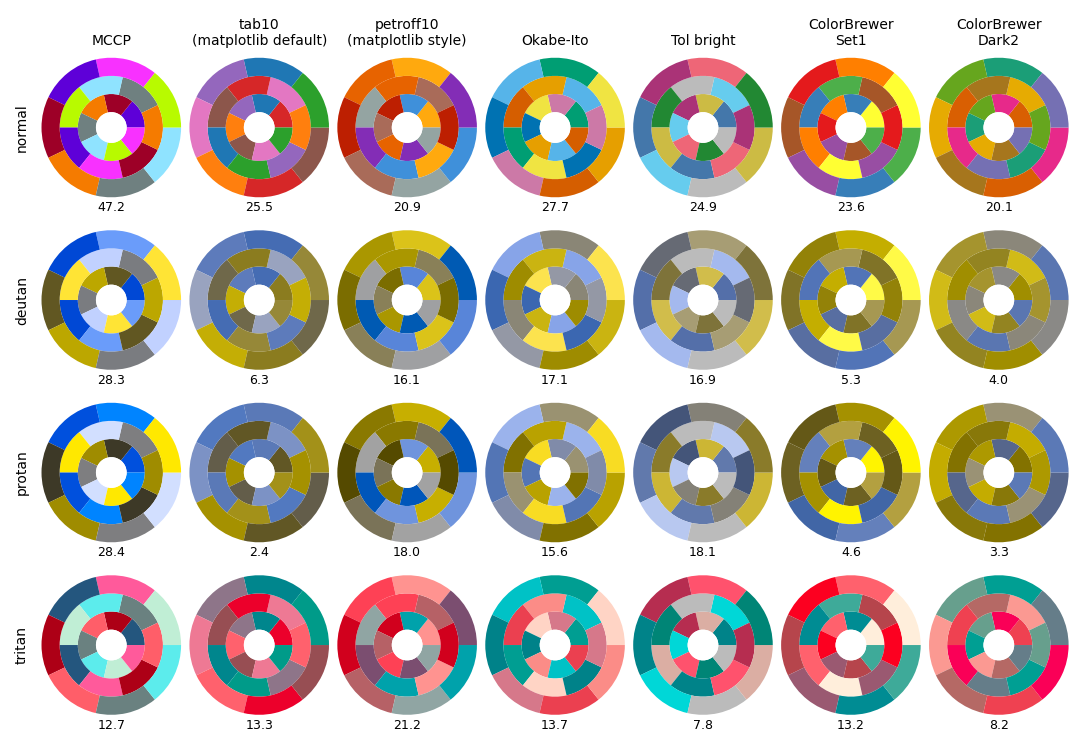
The first figure below compares a palette of seven colours from MCCP, on
|
|
45
|
+
white, with six common palettes, of which the longer ones give their first
|
|
46
|
+
seven colours. Each disc holds every colour of a palette once in each ring,
|
|
47
|
+
arranged so that every pair of colours meets at least twice
|
|
48
|
+
([docs/test-figures.md](https://github.com/DavidLister/cmapkit/blob/main/docs/test-figures.md)). The rows show normal vision
|
|
49
|
+
and simulated deutan, protan and tritan vision. The number under each disc is
|
|
50
|
+
the least colour difference between two colours of the palette for that
|
|
51
|
+
observer, in the measure that MCCP maximises, so that the comparison favours
|
|
52
|
+
MCCP by construction; [docs/results.md](https://github.com/DavidLister/cmapkit/blob/main/docs/results.md) compares the
|
|
53
|
+
palettes under other measures. MCCP's colours are the most distinct for
|
|
54
|
+
normal, deutan and protan vision. For tritan vision, to which it gives a
|
|
55
|
+
lower priority (Section 3), its least difference of 12.7 is close to those
|
|
56
|
+
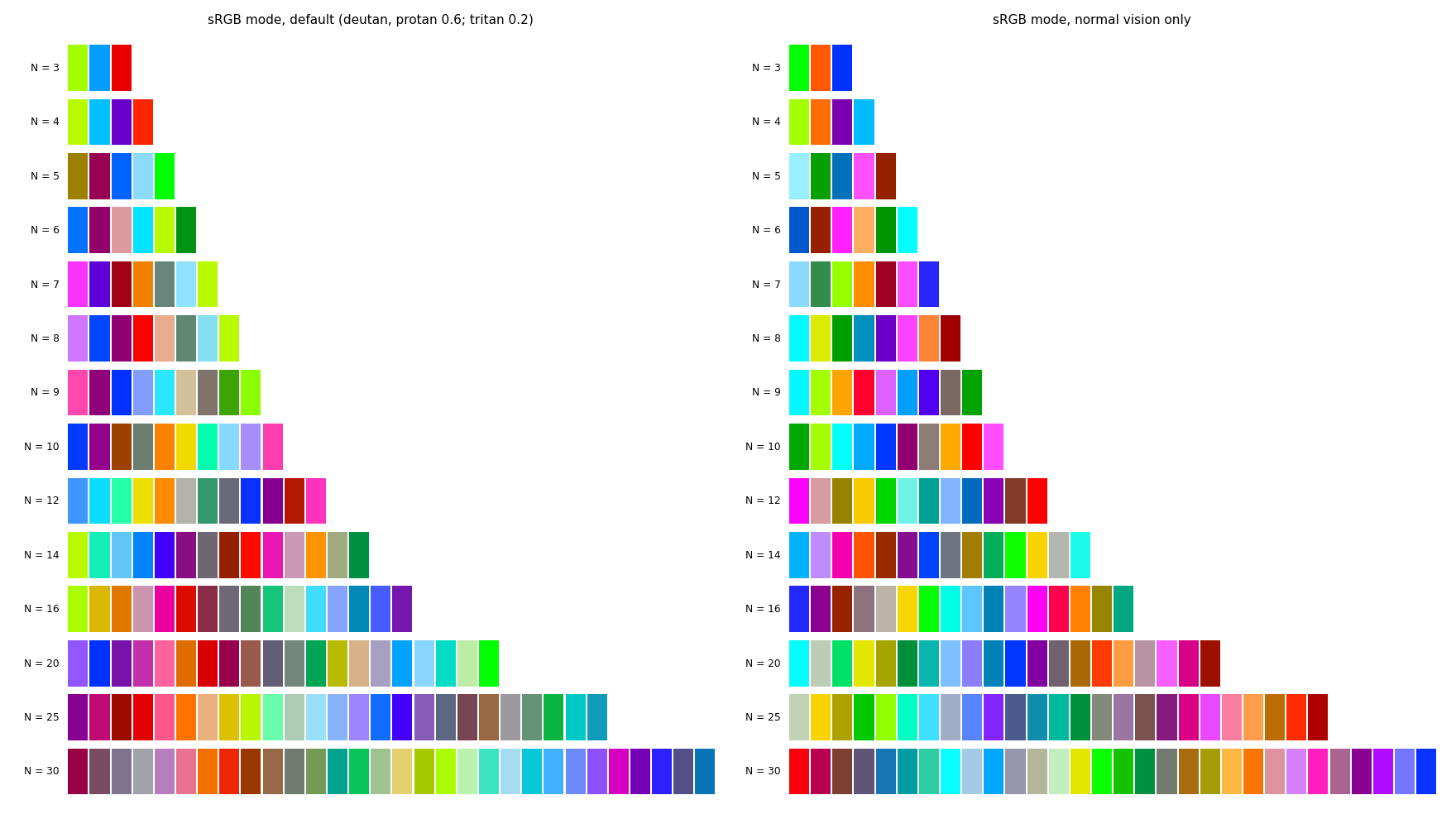
of tab10 and Okabe–Ito and below the 21.2 of petroff10. The second figure
|
|
57
|
+
shows the default palettes for N from 3 to 30. `tools/palette_rings.py` draws
|
|
58
|
+
the first.
|
|
59
|
+
|
|
60
|
+
|
|
61
|
+
|
|
62
|
+
|
|
63
|
+
|
|
64
|
+
The second method, hdrmaps, is experimental. It gives long colour maps for
|
|
65
|
+
images of high dynamic range, such as electron micrographs, that are uniform
|
|
66
|
+
in contrast for normal and colour-deficient vision, with a length that can
|
|
67
|
+
be matched to the noise of the image. It is described in
|
|
68
|
+
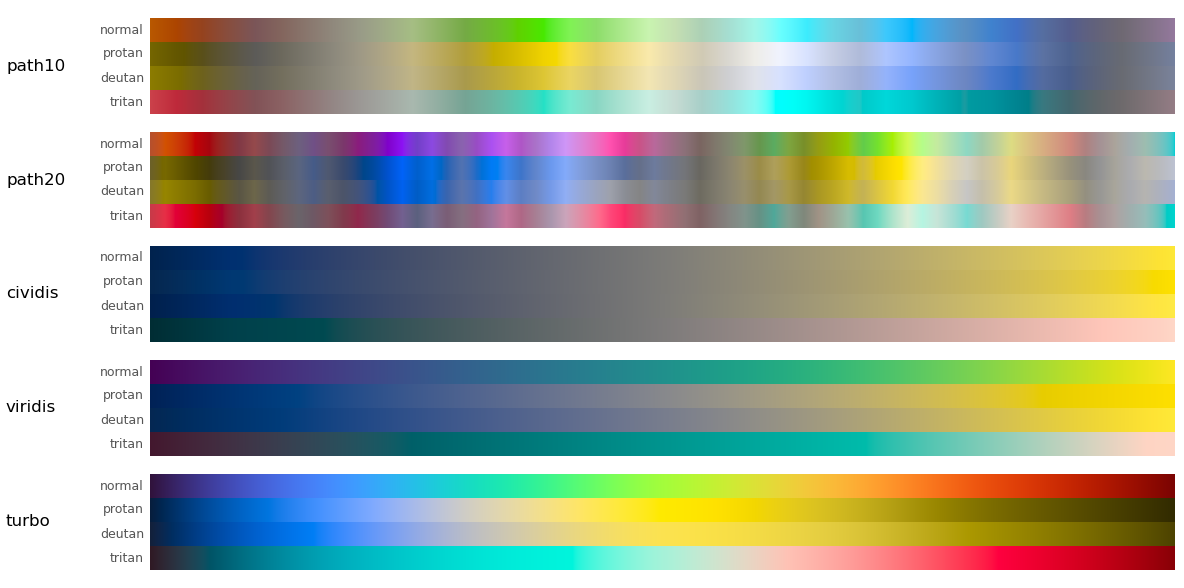
[docs/hdrmaps.md](https://github.com/DavidLister/cmapkit/blob/main/docs/hdrmaps.md). The first figure below shows the two
|
|
69
|
+
shipped maps, path10 and path20, beside three established maps, in normal
|
|
70
|
+
vision and in simulated protan, deutan and tritan vision.
|
|
71
|
+
|
|
72
|
+
|
|
73
|
+
|
|
74
|
+
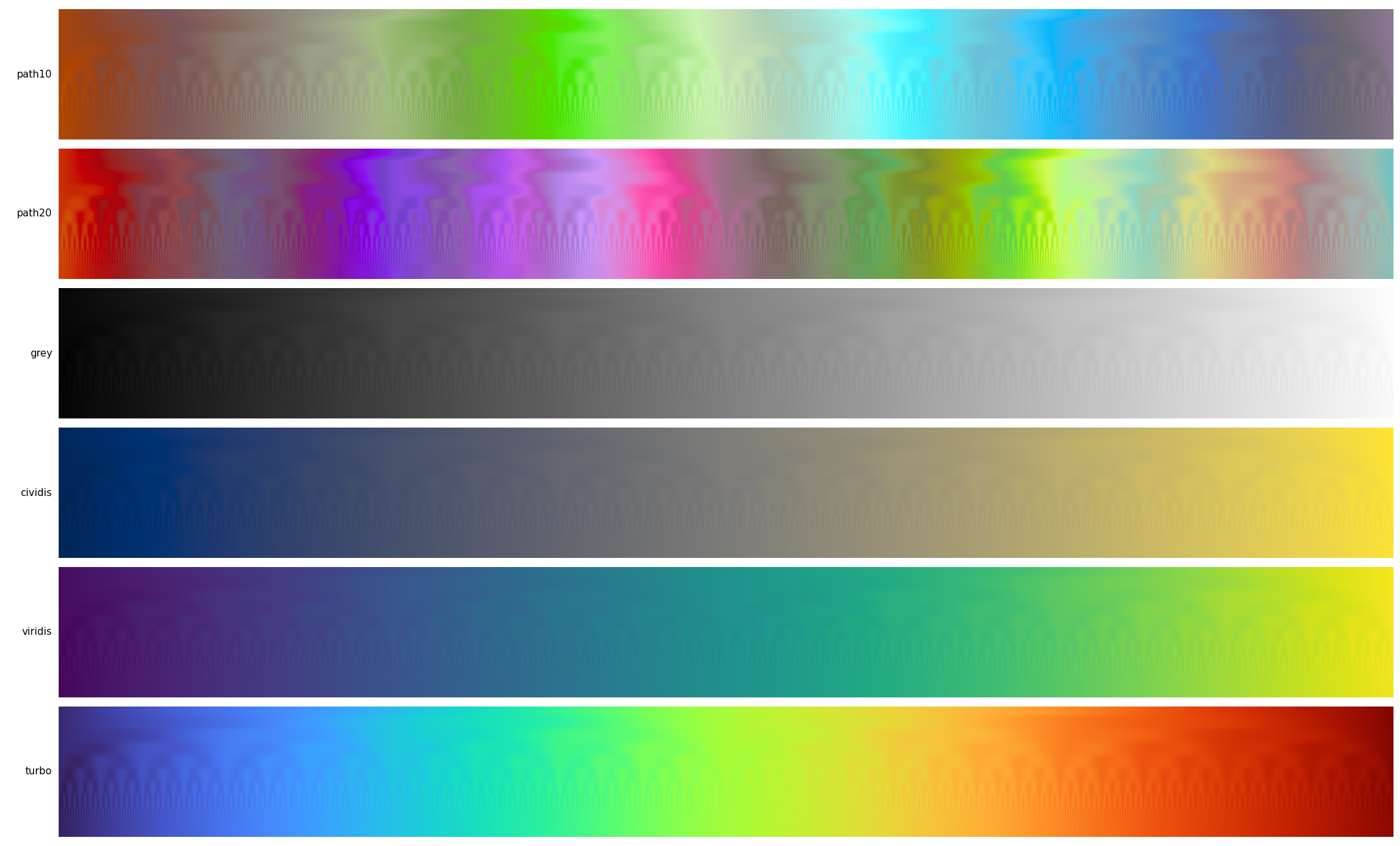
The second figure, a variant of the test image of Kovesi (2015), shows how
|
|
75
|
+
plainly each map shows a small difference in the data. In each band the data
|
|
76
|
+
rise from left to right and carry a sine of constant amplitude, 0.01 of the
|
|
77
|
+
range, whose period halves in ten strips from 1024 pixels at the top to 2 at
|
|
78
|
+
the bottom. In the lower half of each strip but the last, its sine fades out
|
|
79
|
+
as that of the next fades in, so that one strip passes into the next without
|
|
80
|
+
an edge. The colour difference by which a map shows the sine is proportional
|
|
81
|
+
to its speed there, the colour difference per unit of data, so a uniform map
|
|
82
|
+
shows it equally plainly across the band, and a long map shows it more plainly
|
|
83
|
+
than a short one. Turbo shows the sine most plainly at its blue end, where its
|
|
84
|
+
speed is about 400, and least in its green middle, where it is about 150 (in
|
|
85
|
+
normal vision); grey and cividis are nearly uniform, but at about 110 they
|
|
86
|
+
show it faintly throughout. The eye sees the sine most plainly at the middle
|
|
87
|
+
periods. In the strips of shortest period it averages the sine away, as it
|
|
88
|
+
averages the noise of an image, and sees the mean colour; in those of longest
|
|
89
|
+
period the sine is a slow change that it hardly notices. The bands are 2048
|
|
90
|
+
pixels wide, and the figure should be viewed at full size
|
|
91
|
+
(`tools/hdrmaps_figures.py` draws both figures).
|
|
92
|
+
|
|
93
|
+
|
|
94
|
+
|
|
95
|
+
The package is at the alpha stage (version 0.1.0), and its interface
|
|
96
|
+
may change.
|
|
97
|
+
|
|
98
|
+
## 1. Installation
|
|
99
|
+
|
|
100
|
+
```
|
|
101
|
+
pip install cmapkit
|
|
102
|
+
```
|
|
103
|
+
|
|
104
|
+
cmapkit requires numpy and scipy. The matplotlib helpers also require
|
|
105
|
+
matplotlib, which `pip install "cmapkit[matplotlib]"` installs with it. The
|
|
106
|
+
version under development is installed with
|
|
107
|
+
`pip install git+https://github.com/DavidLister/cmapkit`.
|
|
108
|
+
|
|
109
|
+
## 2. Use
|
|
110
|
+
|
|
111
|
+
```python
|
|
112
|
+
import cmapkit
|
|
113
|
+
|
|
114
|
+
pal = cmapkit.palette(8) # eight colours for a white background
|
|
115
|
+
pal.hex # ['#...', ...]
|
|
116
|
+
pal.min_distance # least distance between two colours
|
|
117
|
+
|
|
118
|
+
cmapkit.palette(8, background="#000000") # for a black background
|
|
119
|
+
cmapkit.palette(8, order="contrasting") # neighbours as different as possible
|
|
120
|
+
```
|
|
121
|
+
|
|
122
|
+
With matplotlib:
|
|
123
|
+
|
|
124
|
+
```python
|
|
125
|
+
import matplotlib.pyplot as plt
|
|
126
|
+
|
|
127
|
+
cmapkit.use(8) # colour cycle for figures drawn from now on
|
|
128
|
+
|
|
129
|
+
fig, ax = plt.subplots()
|
|
130
|
+
for y in data:
|
|
131
|
+
ax.plot(y, label=...)
|
|
132
|
+
ax.legend()
|
|
133
|
+
cmapkit.recolor(ax) # recolour the series already drawn, and the legend
|
|
134
|
+
```
|
|
135
|
+
|
|
136
|
+
`use` takes the background from the current matplotlib style. `recolor`
|
|
137
|
+
takes it from the axes, and accepts a list of axes or a whole figure, so that
|
|
138
|
+
series on twin axes or several panels are coloured together.
|
|
139
|
+
|
|
140
|
+
With default settings, palettes with N from 1 to 50 on white, black and
|
|
141
|
+
#333333 (a common dark-grey plot background) are precomputed and are
|
|
142
|
+
returned at once. Other palettes are computed when asked for, which takes
|
|
143
|
+
from a few seconds at small N to one or two minutes at N = 50.
|
|
144
|
+
|
|
145
|
+
The functions above belong to MCCP and are also available as `cmapkit.mccp`,
|
|
146
|
+
for example `cmapkit.mccp.palette`. The colour space, observers and lightness
|
|
147
|
+
limits (`cmapkit.space`, `cmapkit.bounds`) are shared with hdrmaps.
|
|
148
|
+
|
|
149
|
+
For an image of high dynamic range:
|
|
150
|
+
|
|
151
|
+
```python
|
|
152
|
+
import matplotlib.pyplot as plt
|
|
153
|
+
import cmapkit.hdrmaps as hdr
|
|
154
|
+
|
|
155
|
+
rgb, details = hdr.render(image) # 'path20', no blur
|
|
156
|
+
plt.imshow(rgb)
|
|
157
|
+
|
|
158
|
+
cmap = hdr.colormap("path10") # a matplotlib colormap
|
|
159
|
+
plt.imshow(hdr.scale(image, "sqrt"), cmap=cmap)
|
|
160
|
+
```
|
|
161
|
+
|
|
162
|
+
`render` returns sRGB values in [0, 1], and in `details` the noise of the
|
|
163
|
+
image, the blur applied in pixels (none unless `blur` is given) and the length
|
|
164
|
+
of the map. A colour map from `colormap` is applied to the image after
|
|
165
|
+
`scale`, which clips it at the 0.1 and 99.9 percentiles and takes its square
|
|
166
|
+
root, as `render` does. Section 8 of [docs/hdrmaps.md](https://github.com/DavidLister/cmapkit/blob/main/docs/hdrmaps.md) gives
|
|
167
|
+
the other functions, and `tools/compare_images.py` compares two maps on an
|
|
168
|
+
image.
|
|
169
|
+
|
|
170
|
+
## 3. Method
|
|
171
|
+
|
|
172
|
+
Fixed palettes such as matplotlib's tab10 have a set number of colours K. If
|
|
173
|
+
a plot has more series than K, colours repeat. If it has fewer, the first N
|
|
174
|
+
colours are used, and these are not the best set of N. MCCP computes a set
|
|
175
|
+
for each N.
|
|
176
|
+
|
|
177
|
+
Colour difference is measured in CAM16-UCS (Li et al. 2017). Lightness
|
|
178
|
+
differences are divided by K_L = 0.77, the lightness weight that Luo et
|
|
179
|
+
al. (2006) fitted to large colour differences. Without it, pairs differing
|
|
180
|
+
mainly in lightness looked more distinct, and pale pairs of equal lightness
|
|
181
|
+
less distinct, than the measure predicted, when test figures were inspected
|
|
182
|
+
by eye.
|
|
183
|
+
|
|
184
|
+
A colour is admitted only if it shows well against the background. How light
|
|
185
|
+
or dark a colour may be depends on its hue: yellows and greens can be light,
|
|
186
|
+
blues and violets dark. This follows the shape of the range of colours a
|
|
187
|
+
screen can show. These limits were judged by eye (Section 4).
|
|
188
|
+
|
|
189
|
+
About 8 % of men and 0.4 % of women of European descent have a red–green
|
|
190
|
+
deficiency of colour vision (Birch 2012). MCCP simulates the three kinds of
|
|
191
|
+
dichromat (Machado et al. 2009):
|
|
192
|
+
|
|
193
|
+
- deutans and protans, who lack the medium- or the long-wavelength cones;
|
|
194
|
+
- tritans, who lack the short-wavelength cones, which is rare.
|
|
195
|
+
|
|
196
|
+
Each simulated observer must see every pair of colours at least a stated
|
|
197
|
+
fraction of the separation required for normal vision: 0.6 for deutans and
|
|
198
|
+
protans, and 0.2 for tritans, because tritan deficiency is rare. Requiring
|
|
199
|
+
the full separation for every observer confines a palette to lightness and
|
|
200
|
+
blue–yellow differences. The fraction 0.6 keeps most of the separation for
|
|
201
|
+
normal vision.
|
|
202
|
+
|
|
203
|
+
MCCP maximises the least separation by numerical optimisation and then
|
|
204
|
+
spreads apart the colours that do not limit it. The colours are rounded to
|
|
205
|
+
8-bit values. The formulation and method are given in
|
|
206
|
+
[docs/design.md](https://github.com/DavidLister/cmapkit/blob/main/docs/design.md).
|
|
207
|
+
|
|
208
|
+
## 4. Calibration
|
|
209
|
+
|
|
210
|
+
The lightness limits were judged by the author on an LG DualUp monitor in a
|
|
211
|
+
moderately lit room, on white, black and #333333 backgrounds. The monitor was
|
|
212
|
+
in a wide-gamut (DCI-P3) mode at the time, which showed colours somewhat more
|
|
213
|
+
saturated than a standard sRGB display does. On two sRGB monitors the charts
|
|
214
|
+
and palettes looked very similar; docs/calibration.md estimates the
|
|
215
|
+
effect. For other
|
|
216
|
+
backgrounds the limits are interpolated in the background's lightness, and
|
|
217
|
+
MCCP warns when this happens for a mid-tone background, where the
|
|
218
|
+
interpolation is least certain. `diagnostics["bounds"]` states which applies.
|
|
219
|
+
The procedure and the measured values are given in
|
|
220
|
+
[docs/calibration.md](https://github.com/DavidLister/cmapkit/blob/main/docs/calibration.md),
|
|
221
|
+
with instructions for calibrating another background or display.
|
|
222
|
+
|
|
223
|
+
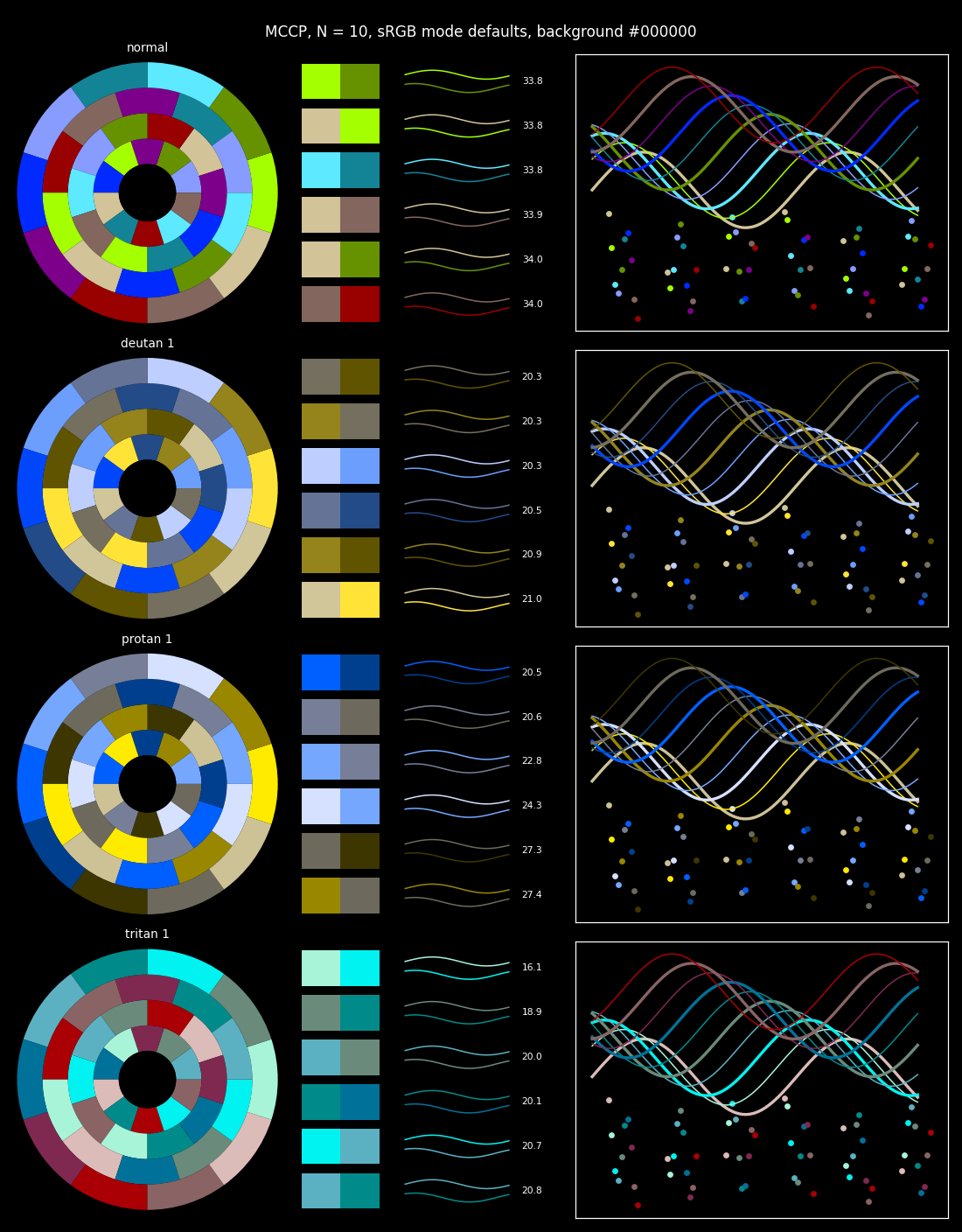
|
|
224
|
+
|
|
225
|
+
The figure shows a ten-colour palette on black, as seen with normal vision
|
|
226
|
+
(top row) and by the three simulated dichromats. In each row:
|
|
227
|
+
|
|
228
|
+
- left: a ring figure, in which every pair of colours touches twice
|
|
229
|
+
([docs/test-figures.md](https://github.com/DavidLister/cmapkit/blob/main/docs/test-figures.md));
|
|
230
|
+
- centre: the six closest pairs, with their distances;
|
|
231
|
+
- right: a sample plot.
|
|
232
|
+
|
|
233
|
+
`cmapkit.mccp.figures.report_figure` draws it for any palette.
|
|
234
|
+
|
|
235
|
+
## 5. Results
|
|
236
|
+
|
|
237
|
+
At N = 10 on white, compared with matplotlib's tab10:
|
|
238
|
+
|
|
239
|
+
- the closest pair in the default MCCP palette is 1.6 times as far apart in
|
|
240
|
+
MCCP's own measure, and 1.5 times in OKLab (Ottosson 2020), a colour space
|
|
241
|
+
that neither palette was designed in;
|
|
242
|
+
- for a simulated deuteranope, it is 4.7 times as far apart;
|
|
243
|
+
- its least contrast ratio with white is lower: 1.3 against 2.0.
|
|
244
|
+
|
|
245
|
+
tab10 was designed for other qualities, such as moderate colourfulness, so
|
|
246
|
+
the comparison favours MCCP.
|
|
247
|
+
|
|
248
|
+
The default palettes give up some separation for normal vision in exchange
|
|
249
|
+
for separation for colour-deficient readers. For N from 3 to 30, normal
|
|
250
|
+
vision keeps 81 to 99 % of the separation it has when MCCP designs for
|
|
251
|
+
normal vision alone (`observers=[]`). The least separation for deutans and
|
|
252
|
+
protans stays at 0.6 of the normal-vision separation, against 0.02 to 0.44
|
|
253
|
+
for those normal-vision-only palettes.
|
|
254
|
+
|
|
255
|
+
The palette generators glasbey and Qualpal design for normal vision alone by
|
|
256
|
+
default. MCCP's defaults are ahead of them in MCCP's own measure at 12 to 14
|
|
257
|
+
of 14 values of N. Part of that lead is built in, since the measure's
|
|
258
|
+
lightness weight was chosen by the same eye that judged the palettes. In
|
|
259
|
+
OKLab, MCCP's defaults are ahead of Qualpal but behind glasbey. In the
|
|
260
|
+
measures that glasbey and Qualpal optimise, those programs lead. For
|
|
261
|
+
simulated deuteranopes, MCCP's least separation is four to eight times
|
|
262
|
+
larger (median over N), although Qualpal's default is ahead at 2 of 14
|
|
263
|
+
values. Against glasbey's colour-blind-safe mode, MCCP's defaults are ahead
|
|
264
|
+
in nearly every measure at every N from 3 to 12.
|
|
265
|
+
|
|
266
|
+
These figures are distances in models of colour difference. They have not
|
|
267
|
+
been tested in a study of readers.
|
|
268
|
+
[docs/results.md](https://github.com/DavidLister/cmapkit/blob/main/docs/results.md)
|
|
269
|
+
gives the comparisons in full.
|
|
270
|
+
|
|
271
|
+
## 6. Options
|
|
272
|
+
|
|
273
|
+
| Argument | Meaning |
|
|
274
|
+
|---|---|
|
|
275
|
+
| `n` | Number of colours. |
|
|
276
|
+
| `background` | Background colour, as `'#rrggbb'`, a matplotlib name, or an RGB triple. Default white. |
|
|
277
|
+
| `text` | Colour of text and axes, kept clear of. Default black on light backgrounds, white on dark ones. |
|
|
278
|
+
| `order` | None (the default): no particular order. `'similar'`: neighbouring colours alike. `'contrasting'`: neighbours as different as possible. An integer G: groups of G colours, each well separated, for example to pair with line styles. |
|
|
279
|
+
| `observers` | Simulated observers, for example `[cmapkit.Observer("deutan", 1.0, 0.6)]`: type, severity from 0 to 1, and fraction of the normal-vision separation guaranteed. `[]` designs for normal vision alone. |
|
|
280
|
+
| `radii` | One number per colour. A colour with a larger radius is kept further from the others and from the background. |
|
|
281
|
+
| `fixed` | Colours already in use, which the new colours are kept apart from. |
|
|
282
|
+
| `anchors` | Further colours to keep clear of, each `cmapkit.Anchor(colour, clearance)`, added to the background and text anchors (clearances 20 and 15). `replace_anchors=True` replaces those. |
|
|
283
|
+
| `mode` | `'auto'` (the default, currently the same as `'srgb'`), `'srgb'`, or `'standard'`. The standard mode uses unweighted CAM16-UCS, one lightness limit for all hues, and normal vision only unless observers are given. |
|
|
284
|
+
|
|
285
|
+
Each palette carries `min_distance`, the least distance between two of its
|
|
286
|
+
colours for normal vision, and `diagnostics`, which include:
|
|
287
|
+
|
|
288
|
+
- the least distance for each observer;
|
|
289
|
+
- the scale achieved, which is the least distance divided by twice the
|
|
290
|
+
observer's fraction;
|
|
291
|
+
- the pairs and conditions that limit it;
|
|
292
|
+
- the source of its lightness limits.
|
|
293
|
+
|
|
294
|
+
## 7. Limitations
|
|
295
|
+
|
|
296
|
+
- The lightness limits rest on one observer. They were measured on one display
|
|
297
|
+
in a wide-gamut mode and checked on two sRGB monitors. Backgrounds other
|
|
298
|
+
than white, black and #333333 use interpolated limits not checked by eye.
|
|
299
|
+
- No measure of colour difference has been validated for differences as
|
|
300
|
+
large as those between palette colours.
|
|
301
|
+
- To keep colours distinct, MCCP admits colours of low luminance contrast
|
|
302
|
+
with the background when they remain clearly visible, such as bright green
|
|
303
|
+
on white. On white, the least contrast ratio is 1.25 to 1.37 at every N
|
|
304
|
+
tested (tab10: 2.0 to 2.5). This is well below the 3 to 1 that the Web
|
|
305
|
+
Content Accessibility Guidelines (W3C 2018) ask for graphical objects.
|
|
306
|
+
- The optimum found is local. Different starting points give results within
|
|
307
|
+
about 1 % of one another.
|
|
308
|
+
- `recolor` handles lines and single-colour scatter plots. Error bars, bars,
|
|
309
|
+
histograms, filled areas, box plots and colour-mapped scatter plots are
|
|
310
|
+
refused.
|
|
311
|
+
- Palettes may differ slightly between platforms. They are reproducible for
|
|
312
|
+
the same inputs, package version and platform.
|
|
313
|
+
|
|
314
|
+
## 8. Related work
|
|
315
|
+
|
|
316
|
+
Several programs maximise the least distance between colours for any N,
|
|
317
|
+
among them Qualpal (Larsson 2025), glasbey (McInnes) and maxdistcolor for
|
|
318
|
+
MATLAB. MCCP differs from them in three ways:
|
|
319
|
+
|
|
320
|
+
- its lightness-weighted CAM16-UCS measure;
|
|
321
|
+
- its lightness limits by hue for each background;
|
|
322
|
+
- its guarantees for simulated colour-deficient observers.
|
|
323
|
+
|
|
324
|
+
[docs/prior-work.md](https://github.com/DavidLister/cmapkit/blob/main/docs/prior-work.md)
|
|
325
|
+
reviews earlier work.
|
|
326
|
+
|
|
327
|
+
## 9. Use of AI
|
|
328
|
+
|
|
329
|
+
The code, tests, benchmarks and documentation, including the review of the
|
|
330
|
+
literature, were written by an AI system (Claude, from Anthropic) under the
|
|
331
|
+
author's direction. The author set the aims, chose among the alternatives
|
|
332
|
+
proposed, supplied the papers, made every visual judgement (the calibration,
|
|
333
|
+
and the comparisons by eye reported in docs/results.md), reviewed the
|
|
334
|
+
results, and read the code before its release. Citations were checked
|
|
335
|
+
against the sources by the AI system where these were available; those not
|
|
336
|
+
confirmed are marked in docs/prior-work.md. The CAM16
|
|
337
|
+
implementation is tested against the colour-science package.
|
|
338
|
+
|
|
339
|
+
## References
|
|
340
|
+
|
|
341
|
+
- Birch, J. (2012). Worldwide prevalence of red-green color deficiency.
|
|
342
|
+
Journal of the Optical Society of America A 29(3), 313–320.
|
|
343
|
+
- Kovesi, P. (2015). Good colour maps: how to design them. arXiv:1509.03700.
|
|
344
|
+
- Larsson, J. (2025). Qualpal: qualitative color palettes for everyone.
|
|
345
|
+
Journal of Open Source Software 10(114), 8936.
|
|
346
|
+
- Li, C., Li, Z., Wang, Z., Xu, Y., Luo, M. R., Cui, G., Melgosa, M., Brill,
|
|
347
|
+
M. H., and Pointer, M. (2017). Comprehensive color solutions: CAM16, CAT16,
|
|
348
|
+
and CAM16-UCS. Color Research and Application 42(6), 703–718.
|
|
349
|
+
- Luo, M. R., Cui, G., and Li, C. (2006). Uniform colour spaces based on
|
|
350
|
+
CIECAM02 colour appearance model. Color Research and Application 31(4),
|
|
351
|
+
320–330.
|
|
352
|
+
- Machado, G. M., Oliveira, M. M., and Fernandes, L. A. F. (2009). A
|
|
353
|
+
physiologically-based model for simulation of color vision deficiency.
|
|
354
|
+
IEEE Transactions on Visualization and Computer Graphics 15(6), 1291–1298.
|
|
355
|
+
- Ottosson, B. (2020). A perceptual color space for image processing. Web
|
|
356
|
+
article, https://bottosson.github.io/posts/oklab/.
|
|
357
|
+
- W3C (2018). Web Content Accessibility Guidelines (WCAG) 2.1.
|
|
358
|
+
|
|
359
|
+
## Licence
|
|
360
|
+
|
|
361
|
+
MIT. See [LICENSE](https://github.com/DavidLister/cmapkit/blob/main/LICENSE).
|
|
362
|
+
[NOTICE](https://github.com/DavidLister/cmapkit/blob/main/NOTICE) lists
|
|
363
|
+
third-party data included in the package.
|