causilo 1.0.2__tar.gz → 1.5.0__tar.gz
This diff represents the content of publicly available package versions that have been released to one of the supported registries. The information contained in this diff is provided for informational purposes only and reflects changes between package versions as they appear in their respective public registries.
- {causilo-1.0.2 → causilo-1.5.0}/MANIFEST.in +1 -0
- causilo-1.5.0/PKG-INFO +127 -0
- causilo-1.5.0/README.md +91 -0
- causilo-1.5.0/docs/assets/benchmark-overview.png +0 -0
- causilo-1.5.0/docs/assets/causilo-banner-compact.png +0 -0
- causilo-1.5.0/docs/assets/causilo-banner.png +0 -0
- causilo-1.5.0/docs/assets/causilo-logo.png +0 -0
- causilo-1.5.0/docs/benchmarks/README.md +20 -0
- causilo-1.5.0/docs/checkpoints.md +55 -0
- causilo-1.5.0/docs/inference.md +325 -0
- causilo-1.5.0/examples/_model_options.py +10 -0
- causilo-1.5.0/examples/batched_prediction.py +30 -0
- {causilo-1.0.2 → causilo-1.5.0}/examples/cached_prediction.py +4 -1
- {causilo-1.0.2 → causilo-1.5.0}/examples/classification.py +4 -1
- {causilo-1.0.2 → causilo-1.5.0}/examples/regression.py +4 -1
- {causilo-1.0.2 → causilo-1.5.0}/examples/save_restore.py +7 -5
- {causilo-1.0.2 → causilo-1.5.0}/pyproject.toml +7 -4
- {causilo-1.0.2 → causilo-1.5.0}/src/causilo/__init__.py +2 -2
- causilo-1.5.0/src/causilo/batch.py +71 -0
- causilo-1.5.0/src/causilo/checkpoint_io.py +36 -0
- causilo-1.5.0/src/causilo/estimators.py +397 -0
- causilo-1.5.0/src/causilo/model_selection.py +110 -0
- causilo-1.5.0/src/causilo/serialization.py +154 -0
- causilo-1.5.0/src/causilo/v1_0/__init__.py +1 -0
- causilo-1.5.0/src/causilo/v1_0/batch.py +22 -0
- causilo-1.5.0/src/causilo/v1_0/checkpoints.py +60 -0
- {causilo-1.0.2/src/causilo → causilo-1.5.0/src/causilo/v1_0}/data/dataset.py +18 -3
- {causilo-1.0.2/src/causilo → causilo-1.5.0/src/causilo/v1_0}/data/encoding.py +6 -7
- causilo-1.5.0/src/causilo/v1_0/data/frequency.py +127 -0
- causilo-1.5.0/src/causilo/v1_0/data/normalization.py +264 -0
- {causilo-1.0.2/src/causilo → causilo-1.5.0/src/causilo/v1_0}/ecoc.py +46 -29
- {causilo-1.0.2/src/causilo → causilo-1.5.0/src/causilo/v1_0}/engine.py +67 -84
- causilo-1.5.0/src/causilo/v1_0/execution/batched.py +221 -0
- causilo-1.5.0/src/causilo/v1_0/execution/cached.py +94 -0
- {causilo-1.0.2/src/causilo → causilo-1.5.0/src/causilo/v1_0}/execution/chunks.py +27 -11
- {causilo-1.0.2/src/causilo → causilo-1.5.0/src/causilo/v1_0}/execution/direct.py +61 -87
- {causilo-1.0.2/src/causilo → causilo-1.5.0/src/causilo/v1_0}/execution/memory.py +22 -0
- {causilo-1.0.2/src/causilo → causilo-1.5.0/src/causilo/v1_0}/execution/recompute.py +22 -17
- {causilo-1.0.2/src/causilo → causilo-1.5.0/src/causilo/v1_0}/execution/runner.py +77 -22
- {causilo-1.0.2/src/causilo → causilo-1.5.0/src/causilo/v1_0}/model.py +1 -1
- causilo-1.5.0/src/causilo/v1_0/nn/cache.py +51 -0
- {causilo-1.0.2/src/causilo → causilo-1.5.0/src/causilo/v1_0}/nn/column.py +14 -7
- {causilo-1.0.2/src/causilo → causilo-1.5.0/src/causilo/v1_0}/nn/layers/attention.py +38 -10
- {causilo-1.0.2/src/causilo → causilo-1.5.0/src/causilo/v1_0}/nn/layers/scaling.py +9 -3
- {causilo-1.0.2/src/causilo → causilo-1.5.0/src/causilo/v1_0}/nn/prediction.py +9 -7
- {causilo-1.0.2/src/causilo → causilo-1.5.0/src/causilo/v1_0}/nn/row.py +17 -10
- causilo-1.5.0/src/causilo/v1_0/outputs.py +42 -0
- causilo-1.5.0/src/causilo/v1_0/prediction.py +84 -0
- {causilo-1.0.2/src/causilo → causilo-1.5.0/src/causilo/v1_0}/quantiles.py +0 -11
- causilo-1.5.0/src/causilo/v1_0/runtime.py +38 -0
- {causilo-1.0.2/src/causilo → causilo-1.5.0/src/causilo/v1_0}/serialization.py +39 -60
- causilo-1.5.0/src/causilo/v1_5/__init__.py +1 -0
- causilo-1.5.0/src/causilo/v1_5/batch.py +9 -0
- causilo-1.5.0/src/causilo/v1_5/checkpoints.py +55 -0
- causilo-1.5.0/src/causilo/v1_5/data/__init__.py +1 -0
- causilo-1.5.0/src/causilo/v1_5/data/categorical.py +217 -0
- causilo-1.5.0/src/causilo/v1_5/data/columns.py +123 -0
- causilo-1.5.0/src/causilo/v1_5/data/context_sampling.py +66 -0
- causilo-1.5.0/src/causilo/v1_5/data/dataset.py +243 -0
- causilo-1.5.0/src/causilo/v1_5/data/encoding.py +169 -0
- causilo-1.5.0/src/causilo/v1_5/data/ensemble.py +108 -0
- causilo-1.5.0/src/causilo/v1_5/data/feature_views.py +198 -0
- causilo-1.5.0/src/causilo/v1_5/data/frequency.py +40 -0
- causilo-1.5.0/src/causilo/v1_5/data/normalization.py +103 -0
- causilo-1.5.0/src/causilo/v1_5/data/schema.py +66 -0
- causilo-1.5.0/src/causilo/v1_5/data/target.py +26 -0
- causilo-1.5.0/src/causilo/v1_5/engine.py +177 -0
- causilo-1.5.0/src/causilo/v1_5/execution/__init__.py +5 -0
- causilo-1.5.0/src/causilo/v1_5/execution/cache.py +82 -0
- causilo-1.5.0/src/causilo/v1_5/execution/chunks.py +235 -0
- causilo-1.5.0/src/causilo/v1_5/execution/column.py +135 -0
- causilo-1.5.0/src/causilo/v1_5/execution/device_mean.py +82 -0
- causilo-1.5.0/src/causilo/v1_5/execution/direct.py +481 -0
- causilo-1.5.0/src/causilo/v1_5/execution/fit.py +157 -0
- causilo-1.5.0/src/causilo/v1_5/execution/memory.py +303 -0
- causilo-1.5.0/src/causilo/v1_5/execution/outputs.py +108 -0
- causilo-1.5.0/src/causilo/v1_5/execution/parallel.py +194 -0
- causilo-1.5.0/src/causilo/v1_5/execution/precision.py +40 -0
- causilo-1.5.0/src/causilo/v1_5/execution/prediction.py +162 -0
- causilo-1.5.0/src/causilo/v1_5/execution/predictor.py +98 -0
- causilo-1.5.0/src/causilo/v1_5/execution/quantiles.py +56 -0
- causilo-1.5.0/src/causilo/v1_5/execution/recompute.py +472 -0
- causilo-1.5.0/src/causilo/v1_5/execution/row.py +37 -0
- causilo-1.5.0/src/causilo/v1_5/execution/runner.py +235 -0
- causilo-1.5.0/src/causilo/v1_5/execution/sampled.py +132 -0
- causilo-1.5.0/src/causilo/v1_5/execution/serialization.py +80 -0
- causilo-1.5.0/src/causilo/v1_5/execution/transfers.py +128 -0
- causilo-1.5.0/src/causilo/v1_5/kernels/__init__.py +5 -0
- causilo-1.5.0/src/causilo/v1_5/kernels/triton/__init__.py +1 -0
- causilo-1.5.0/src/causilo/v1_5/kernels/triton/cls_attention.py +105 -0
- causilo-1.5.0/src/causilo/v1_5/kernels/triton/cls_readout.py +110 -0
- causilo-1.5.0/src/causilo/v1_5/kernels/triton/head_normalization.py +64 -0
- causilo-1.5.0/src/causilo/v1_5/kernels/triton/query_gain.py +48 -0
- causilo-1.5.0/src/causilo/v1_5/kernels/triton/regression_mean.py +44 -0
- causilo-1.5.0/src/causilo/v1_5/kernels/triton/residual_normalization.py +77 -0
- causilo-1.5.0/src/causilo/v1_5/kernels/triton/swiglu.py +24 -0
- causilo-1.5.0/src/causilo/v1_5/nn/__init__.py +1 -0
- causilo-1.5.0/src/causilo/v1_5/nn/cache.py +41 -0
- causilo-1.5.0/src/causilo/v1_5/nn/checkpoint.py +37 -0
- causilo-1.5.0/src/causilo/v1_5/nn/column.py +71 -0
- causilo-1.5.0/src/causilo/v1_5/nn/ecdf.py +90 -0
- causilo-1.5.0/src/causilo/v1_5/nn/embeddings.py +68 -0
- causilo-1.5.0/src/causilo/v1_5/nn/frequency.py +25 -0
- causilo-1.5.0/src/causilo/v1_5/nn/layers/__init__.py +1 -0
- causilo-1.5.0/src/causilo/v1_5/nn/layers/attention.py +170 -0
- causilo-1.5.0/src/causilo/v1_5/nn/layers/feedforward.py +56 -0
- causilo-1.5.0/src/causilo/v1_5/nn/layers/functional.py +119 -0
- causilo-1.5.0/src/causilo/v1_5/nn/layers/normalization.py +62 -0
- causilo-1.5.0/src/causilo/v1_5/nn/layers/scaling.py +85 -0
- causilo-1.5.0/src/causilo/v1_5/nn/model.py +21 -0
- causilo-1.5.0/src/causilo/v1_5/nn/model_config.py +40 -0
- causilo-1.5.0/src/causilo/v1_5/nn/prediction.py +81 -0
- causilo-1.5.0/src/causilo/v1_5/nn/row.py +108 -0
- causilo-1.5.0/src/causilo/v1_5/runtime.py +25 -0
- causilo-1.5.0/src/causilo/v1_5/serialization.py +59 -0
- causilo-1.5.0/src/causilo/validation.py +22 -0
- causilo-1.5.0/src/causilo.egg-info/PKG-INFO +127 -0
- causilo-1.5.0/src/causilo.egg-info/SOURCES.txt +170 -0
- causilo-1.5.0/tests/api/test_batched_api.py +379 -0
- causilo-1.5.0/tests/api/test_checkpoints.py +390 -0
- causilo-1.5.0/tests/api/test_context_persistence.py +160 -0
- causilo-1.5.0/tests/api/test_logits.py +268 -0
- causilo-1.0.2/tests/test_fitted_contract.py → causilo-1.5.0/tests/api/test_pretrained_context.py +92 -56
- {causilo-1.0.2/tests → causilo-1.5.0/tests/api}/test_quantiles.py +33 -22
- causilo-1.5.0/tests/conftest.py +113 -0
- causilo-1.5.0/tests/execution/test_batch_scheduler.py +157 -0
- causilo-1.5.0/tests/execution/test_batched_runner.py +137 -0
- causilo-1.5.0/tests/execution/test_context_transfers.py +194 -0
- causilo-1.5.0/tests/execution/test_device_mean.py +82 -0
- {causilo-1.0.2/tests → causilo-1.5.0/tests/execution}/test_embedding.py +2 -3
- causilo-1.5.0/tests/execution/test_host_cache_reuse.py +153 -0
- causilo-1.5.0/tests/execution/test_inference_cache.py +356 -0
- causilo-1.5.0/tests/execution/test_inference_memory.py +245 -0
- causilo-1.5.0/tests/execution/test_inference_precision.py +238 -0
- {causilo-1.0.2/tests → causilo-1.5.0/tests/execution}/test_memory.py +3 -3
- causilo-1.5.0/tests/execution/test_multi_device_inference.py +372 -0
- {causilo-1.0.2/tests → causilo-1.5.0/tests/execution}/test_partitioning.py +34 -5
- causilo-1.5.0/tests/execution/test_query_replay.py +177 -0
- causilo-1.5.0/tests/execution/test_query_scaling.py +95 -0
- {causilo-1.0.2/tests → causilo-1.5.0/tests/execution}/test_recompute.py +63 -79
- {causilo-1.0.2/tests → causilo-1.5.0/tests/execution}/test_row.py +4 -8
- causilo-1.5.0/tests/execution/test_sampled_retries.py +71 -0
- {causilo-1.0.2 → causilo-1.5.0}/tests/helpers/restore_probe.py +2 -2
- causilo-1.5.0/tests/preprocessing/test_categorical_features.py +138 -0
- causilo-1.5.0/tests/preprocessing/test_context_sampling.py +300 -0
- causilo-1.0.2/tests/test_ecoc.py → causilo-1.5.0/tests/preprocessing/test_ecoc_codec.py +2 -2
- causilo-1.5.0/tests/preprocessing/test_ensemble_views.py +221 -0
- causilo-1.5.0/tests/preprocessing/test_feature_views.py +212 -0
- causilo-1.5.0/tests/preprocessing/test_input_precision.py +93 -0
- causilo-1.5.0/tests/preprocessing/test_input_schema.py +107 -0
- causilo-1.5.0/tests/preprocessing/test_many_class_context.py +192 -0
- causilo-1.5.0/tests/preprocessing/test_numeric_preprocessing.py +45 -0
- causilo-1.0.2/tests/test_normalization.py → causilo-1.5.0/tests/preprocessing/test_power_normalization.py +6 -6
- causilo-1.5.0/tests/weights/test_frequency_attention.py +211 -0
- causilo-1.5.0/tests/weights/test_frequency_integration.py +124 -0
- causilo-1.5.0/tests/weights/test_frequency_normalization.py +158 -0
- causilo-1.5.0/tests/weights/test_frequency_preparation.py +182 -0
- causilo-1.5.0/tests/weights/test_frequency_pretrained.py +61 -0
- causilo-1.5.0/tests/weights/test_frequency_weights.py +195 -0
- causilo-1.0.2/PKG-INFO +0 -154
- causilo-1.0.2/README.md +0 -121
- causilo-1.0.2/src/causilo/checkpoints.py +0 -54
- causilo-1.0.2/src/causilo/data/normalization.py +0 -161
- causilo-1.0.2/src/causilo/estimators.py +0 -186
- causilo-1.0.2/src/causilo/execution/cached.py +0 -87
- causilo-1.0.2/src/causilo/nn/cache.py +0 -28
- causilo-1.0.2/src/causilo.egg-info/PKG-INFO +0 -154
- causilo-1.0.2/src/causilo.egg-info/SOURCES.txt +0 -56
- causilo-1.0.2/tests/test_input_precision.py +0 -93
- causilo-1.0.2/tests/test_inputs.py +0 -86
- {causilo-1.0.2 → causilo-1.5.0}/LICENSE +0 -0
- {causilo-1.0.2 → causilo-1.5.0}/setup.cfg +0 -0
- {causilo-1.0.2/src/causilo → causilo-1.5.0/src/causilo/v1_0}/data/__init__.py +0 -0
- {causilo-1.0.2/src/causilo → causilo-1.5.0/src/causilo/v1_0}/data/ensemble.py +0 -0
- {causilo-1.0.2/src/causilo → causilo-1.5.0/src/causilo/v1_0}/execution/__init__.py +0 -0
- {causilo-1.0.2/src/causilo → causilo-1.5.0/src/causilo/v1_0}/execution/precision.py +0 -0
- {causilo-1.0.2/src/causilo → causilo-1.5.0/src/causilo/v1_0}/nn/__init__.py +0 -0
- {causilo-1.0.2/src/causilo → causilo-1.5.0/src/causilo/v1_0}/nn/embeddings.py +0 -0
- {causilo-1.0.2/src/causilo → causilo-1.5.0/src/causilo/v1_0}/nn/layers/__init__.py +0 -0
- {causilo-1.0.2/src/causilo → causilo-1.5.0/src/causilo/v1_0}/nn/layers/feedforward.py +0 -0
- {causilo-1.0.2 → causilo-1.5.0}/src/causilo.egg-info/dependency_links.txt +0 -0
- {causilo-1.0.2 → causilo-1.5.0}/src/causilo.egg-info/requires.txt +0 -0
- {causilo-1.0.2 → causilo-1.5.0}/src/causilo.egg-info/top_level.txt +0 -0
causilo-1.5.0/PKG-INFO
ADDED
|
@@ -0,0 +1,127 @@
|
|
|
1
|
+
Metadata-Version: 2.4
|
|
2
|
+
Name: causilo
|
|
3
|
+
Version: 1.5.0
|
|
4
|
+
Summary: Tabular classification and regression with a scikit-learn API
|
|
5
|
+
Author-email: "Nums AI Inc." <contact@nums.world>
|
|
6
|
+
License-Expression: Apache-2.0
|
|
7
|
+
Project-URL: Repository, https://github.com/nums-ai/causilo
|
|
8
|
+
Project-URL: Issues, https://github.com/nums-ai/causilo/issues
|
|
9
|
+
Project-URL: Models, https://huggingface.co/nums-ai/causilo-1.5
|
|
10
|
+
Classifier: Programming Language :: Python :: 3.10
|
|
11
|
+
Classifier: Programming Language :: Python :: 3.11
|
|
12
|
+
Classifier: Programming Language :: Python :: 3.12
|
|
13
|
+
Classifier: Programming Language :: Python :: 3.13
|
|
14
|
+
Classifier: Programming Language :: Python :: 3.14
|
|
15
|
+
Classifier: Operating System :: POSIX :: Linux
|
|
16
|
+
Classifier: Operating System :: MacOS :: MacOS X
|
|
17
|
+
Classifier: Topic :: Scientific/Engineering :: Artificial Intelligence
|
|
18
|
+
Requires-Python: <3.15,>=3.10
|
|
19
|
+
Description-Content-Type: text/markdown
|
|
20
|
+
License-File: LICENSE
|
|
21
|
+
Requires-Dist: torch>=2.13
|
|
22
|
+
Requires-Dist: numpy
|
|
23
|
+
Requires-Dist: pandas
|
|
24
|
+
Requires-Dist: scipy
|
|
25
|
+
Requires-Dist: scikit-learn>=1.6
|
|
26
|
+
Requires-Dist: safetensors>=0.8
|
|
27
|
+
Requires-Dist: huggingface-hub>=0.28
|
|
28
|
+
Requires-Dist: psutil
|
|
29
|
+
Provides-Extra: dev
|
|
30
|
+
Requires-Dist: pytest>=8; extra == "dev"
|
|
31
|
+
Requires-Dist: ruff; extra == "dev"
|
|
32
|
+
Requires-Dist: build; extra == "dev"
|
|
33
|
+
Requires-Dist: twine; extra == "dev"
|
|
34
|
+
Requires-Dist: joblib; extra == "dev"
|
|
35
|
+
Dynamic: license-file
|
|
36
|
+
|
|
37
|
+
<h1 align="center">
|
|
38
|
+
<picture>
|
|
39
|
+
<source media="(max-width: 640px)" srcset="https://raw.githubusercontent.com/nums-ai/causilo/main/docs/assets/causilo-banner-compact.png">
|
|
40
|
+
<img src="https://raw.githubusercontent.com/nums-ai/causilo/main/docs/assets/causilo-banner.png" alt="Causilo 1.5. A New Standard for Prediction." width="100%">
|
|
41
|
+
</picture>
|
|
42
|
+
</h1>
|
|
43
|
+
|
|
44
|
+
<p align="center">Tabular classification and regression with a scikit-learn API.</p>
|
|
45
|
+
|
|
46
|
+
<p align="center">
|
|
47
|
+
<a href="https://pypi.org/project/causilo/"><img src="https://img.shields.io/pypi/v/causilo?label=PyPI&color=brightgreen&style=flat" alt="Causilo package version on PyPI"></a>
|
|
48
|
+
<a href="#documentation"><img src="https://img.shields.io/badge/Docs-Python-blue?style=flat" alt="Causilo Python documentation"></a>
|
|
49
|
+
<a href="https://arxiv.org/abs/2609.22866"><img src="https://img.shields.io/badge/Technical%20report-arXiv-913f47?style=flat" alt="Causilo Technical Report on arXiv"></a>
|
|
50
|
+
<br>
|
|
51
|
+
<a href="#license"><img src="https://img.shields.io/badge/License-Code%20%2F%20weights-646b73?style=flat" alt="Code and model weights licenses"></a>
|
|
52
|
+
<a href="https://nums.world/"><img src="https://img.shields.io/badge/Nums%20AI-Website-283442?style=flat" alt="Nums AI website"></a>
|
|
53
|
+
<a href="#installation"><img src="https://img.shields.io/badge/Python-3.10%E2%80%933.14-646b73?style=flat" alt="Python 3.10–3.14"></a>
|
|
54
|
+
<a href="#installation"><img src="https://img.shields.io/badge/PyTorch-2.13%2B-646b73?style=flat" alt="PyTorch 2.13 or newer"></a>
|
|
55
|
+
</p>
|
|
56
|
+
|
|
57
|
+
## Quick start
|
|
58
|
+
|
|
59
|
+
### Installation
|
|
60
|
+
|
|
61
|
+
Install [Causilo 1.5 from PyPI](https://pypi.org/project/causilo/1.5.0/).
|
|
62
|
+
|
|
63
|
+
```sh
|
|
64
|
+
python -m pip install causilo==1.5.0
|
|
65
|
+
```
|
|
66
|
+
|
|
67
|
+
The first `fit` downloads the [public Causilo 1.5 checkpoint](https://huggingface.co/nums-ai/causilo-1.5) for the estimator's task. No Hugging Face account is required.
|
|
68
|
+
|
|
69
|
+
### Classification
|
|
70
|
+
|
|
71
|
+
```python
|
|
72
|
+
from causilo import CausiloClassifier
|
|
73
|
+
|
|
74
|
+
clf = CausiloClassifier()
|
|
75
|
+
clf.fit(X_train, y_train)
|
|
76
|
+
labels = clf.predict(X_test)
|
|
77
|
+
```
|
|
78
|
+
|
|
79
|
+
### Regression
|
|
80
|
+
|
|
81
|
+
```python
|
|
82
|
+
from causilo import CausiloRegressor
|
|
83
|
+
|
|
84
|
+
reg = CausiloRegressor()
|
|
85
|
+
reg.fit(X_train, y_train)
|
|
86
|
+
predictions = reg.predict(X_test)
|
|
87
|
+
```
|
|
88
|
+
|
|
89
|
+
**Causilo 1.5** uses the full training context by default. Set `mode="light"`
|
|
90
|
+
on either estimator for **Causilo 1.5 (Light)**. To sample from larger tables,
|
|
91
|
+
set `max_context=200_000`. Set `model_version="1.0"` to use **Causilo 1.0**.
|
|
92
|
+
|
|
93
|
+
`fit` prepares preprocessing and an inference context from your labeled table. `predict` uses that context with fixed model weights.
|
|
94
|
+
|
|
95
|
+
## Benchmarks
|
|
96
|
+
|
|
97
|
+
|
|
98
|
+
|
|
99
|
+
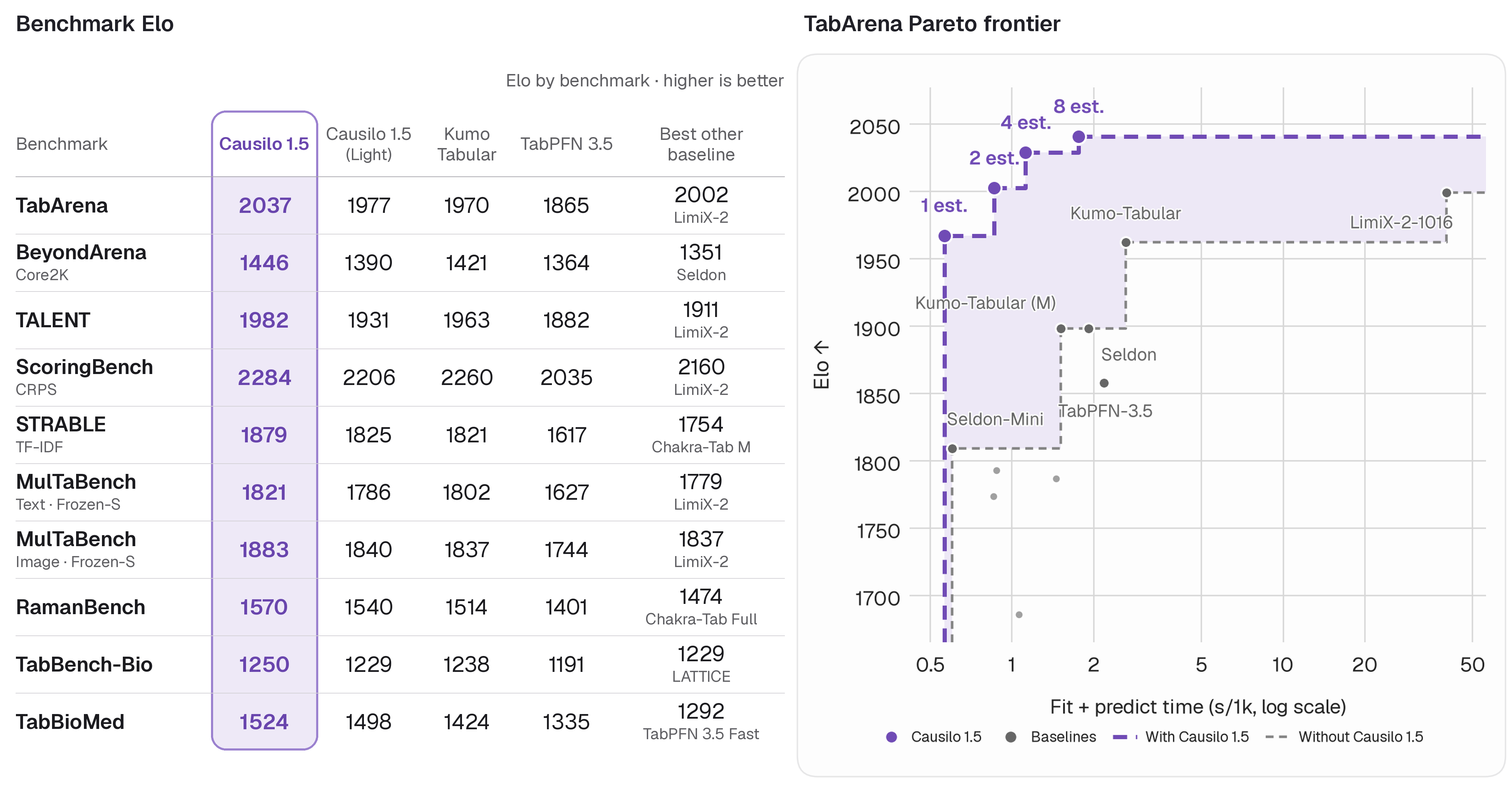
Both frontiers use one Elo fit across all 816 official splits, with 112 official models and four Causilo settings. The chart shows the ten official peers with published timings. Causilo times were measured on RTX PRO 6000 with KV cache off. Peer totals are estimated from published per-dataset timings and use the peers’ own cache settings. The table’s TabArena scores compare Default and Light together.
|
|
100
|
+
|
|
101
|
+
[Pareto data](https://huggingface.co/nums-ai/causilo-1.5/blob/4ca2275bae85014a19422e8c18fcf8f24c5c14e1/benchmarks/tabarena/pareto-comparison.csv) · [Detailed results and evaluation protocols](https://huggingface.co/nums-ai/causilo-1.5/blob/4ca2275bae85014a19422e8c18fcf8f24c5c14e1/benchmarks/README.md)
|
|
102
|
+
|
|
103
|
+
## Documentation
|
|
104
|
+
|
|
105
|
+
[Python inference](https://github.com/nums-ai/causilo/blob/main/docs/inference.md) · [Checkpoints](https://github.com/nums-ai/causilo/blob/main/docs/checkpoints.md) · [Examples](https://github.com/nums-ai/causilo/blob/main/examples/)
|
|
106
|
+
|
|
107
|
+
## License
|
|
108
|
+
|
|
109
|
+
Code is licensed under [Apache-2.0](https://github.com/nums-ai/causilo/blob/main/LICENSE).
|
|
110
|
+
|
|
111
|
+
Causilo 1.5 weights are licensed under the [Nums AI Model License](https://huggingface.co/nums-ai/causilo-1.5/blob/4ca2275bae85014a19422e8c18fcf8f24c5c14e1/LICENSE).
|
|
112
|
+
|
|
113
|
+
## Citation
|
|
114
|
+
|
|
115
|
+
If you use Causilo in research, please cite:
|
|
116
|
+
|
|
117
|
+
```bibtex
|
|
118
|
+
@misc{cho2026causilotechnicalreport,
|
|
119
|
+
title={Causilo Technical Report},
|
|
120
|
+
author={Minyong Cho and Minho Jeong and Dooho Lee and Jinmo Lee and Jaemin Yoo},
|
|
121
|
+
year={2026},
|
|
122
|
+
eprint={2609.22866},
|
|
123
|
+
archivePrefix={arXiv},
|
|
124
|
+
primaryClass={cs.LG},
|
|
125
|
+
url={https://arxiv.org/abs/2609.22866},
|
|
126
|
+
}
|
|
127
|
+
```
|
causilo-1.5.0/README.md
ADDED
|
@@ -0,0 +1,91 @@
|
|
|
1
|
+
<h1 align="center">
|
|
2
|
+
<picture>
|
|
3
|
+
<source media="(max-width: 640px)" srcset="https://raw.githubusercontent.com/nums-ai/causilo/main/docs/assets/causilo-banner-compact.png">
|
|
4
|
+
<img src="https://raw.githubusercontent.com/nums-ai/causilo/main/docs/assets/causilo-banner.png" alt="Causilo 1.5. A New Standard for Prediction." width="100%">
|
|
5
|
+
</picture>
|
|
6
|
+
</h1>
|
|
7
|
+
|
|
8
|
+
<p align="center">Tabular classification and regression with a scikit-learn API.</p>
|
|
9
|
+
|
|
10
|
+
<p align="center">
|
|
11
|
+
<a href="https://pypi.org/project/causilo/"><img src="https://img.shields.io/pypi/v/causilo?label=PyPI&color=brightgreen&style=flat" alt="Causilo package version on PyPI"></a>
|
|
12
|
+
<a href="#documentation"><img src="https://img.shields.io/badge/Docs-Python-blue?style=flat" alt="Causilo Python documentation"></a>
|
|
13
|
+
<a href="https://arxiv.org/abs/2609.22866"><img src="https://img.shields.io/badge/Technical%20report-arXiv-913f47?style=flat" alt="Causilo Technical Report on arXiv"></a>
|
|
14
|
+
<br>
|
|
15
|
+
<a href="#license"><img src="https://img.shields.io/badge/License-Code%20%2F%20weights-646b73?style=flat" alt="Code and model weights licenses"></a>
|
|
16
|
+
<a href="https://nums.world/"><img src="https://img.shields.io/badge/Nums%20AI-Website-283442?style=flat" alt="Nums AI website"></a>
|
|
17
|
+
<a href="#installation"><img src="https://img.shields.io/badge/Python-3.10%E2%80%933.14-646b73?style=flat" alt="Python 3.10–3.14"></a>
|
|
18
|
+
<a href="#installation"><img src="https://img.shields.io/badge/PyTorch-2.13%2B-646b73?style=flat" alt="PyTorch 2.13 or newer"></a>
|
|
19
|
+
</p>
|
|
20
|
+
|
|
21
|
+
## Quick start
|
|
22
|
+
|
|
23
|
+
### Installation
|
|
24
|
+
|
|
25
|
+
Install [Causilo 1.5 from PyPI](https://pypi.org/project/causilo/1.5.0/).
|
|
26
|
+
|
|
27
|
+
```sh
|
|
28
|
+
python -m pip install causilo==1.5.0
|
|
29
|
+
```
|
|
30
|
+
|
|
31
|
+
The first `fit` downloads the [public Causilo 1.5 checkpoint](https://huggingface.co/nums-ai/causilo-1.5) for the estimator's task. No Hugging Face account is required.
|
|
32
|
+
|
|
33
|
+
### Classification
|
|
34
|
+
|
|
35
|
+
```python
|
|
36
|
+
from causilo import CausiloClassifier
|
|
37
|
+
|
|
38
|
+
clf = CausiloClassifier()
|
|
39
|
+
clf.fit(X_train, y_train)
|
|
40
|
+
labels = clf.predict(X_test)
|
|
41
|
+
```
|
|
42
|
+
|
|
43
|
+
### Regression
|
|
44
|
+
|
|
45
|
+
```python
|
|
46
|
+
from causilo import CausiloRegressor
|
|
47
|
+
|
|
48
|
+
reg = CausiloRegressor()
|
|
49
|
+
reg.fit(X_train, y_train)
|
|
50
|
+
predictions = reg.predict(X_test)
|
|
51
|
+
```
|
|
52
|
+
|
|
53
|
+
**Causilo 1.5** uses the full training context by default. Set `mode="light"`
|
|
54
|
+
on either estimator for **Causilo 1.5 (Light)**. To sample from larger tables,
|
|
55
|
+
set `max_context=200_000`. Set `model_version="1.0"` to use **Causilo 1.0**.
|
|
56
|
+
|
|
57
|
+
`fit` prepares preprocessing and an inference context from your labeled table. `predict` uses that context with fixed model weights.
|
|
58
|
+
|
|
59
|
+
## Benchmarks
|
|
60
|
+
|
|
61
|
+

|
|
62
|
+
|
|
63
|
+
Both frontiers use one Elo fit across all 816 official splits, with 112 official models and four Causilo settings. The chart shows the ten official peers with published timings. Causilo times were measured on RTX PRO 6000 with KV cache off. Peer totals are estimated from published per-dataset timings and use the peers’ own cache settings. The table’s TabArena scores compare Default and Light together.
|
|
64
|
+
|
|
65
|
+
[Pareto data](https://huggingface.co/nums-ai/causilo-1.5/blob/4ca2275bae85014a19422e8c18fcf8f24c5c14e1/benchmarks/tabarena/pareto-comparison.csv) · [Detailed results and evaluation protocols](https://huggingface.co/nums-ai/causilo-1.5/blob/4ca2275bae85014a19422e8c18fcf8f24c5c14e1/benchmarks/README.md)
|
|
66
|
+
|
|
67
|
+
## Documentation
|
|
68
|
+
|
|
69
|
+
[Python inference](https://github.com/nums-ai/causilo/blob/main/docs/inference.md) · [Checkpoints](https://github.com/nums-ai/causilo/blob/main/docs/checkpoints.md) · [Examples](https://github.com/nums-ai/causilo/blob/main/examples/)
|
|
70
|
+
|
|
71
|
+
## License
|
|
72
|
+
|
|
73
|
+
Code is licensed under [Apache-2.0](https://github.com/nums-ai/causilo/blob/main/LICENSE).
|
|
74
|
+
|
|
75
|
+
Causilo 1.5 weights are licensed under the [Nums AI Model License](https://huggingface.co/nums-ai/causilo-1.5/blob/4ca2275bae85014a19422e8c18fcf8f24c5c14e1/LICENSE).
|
|
76
|
+
|
|
77
|
+
## Citation
|
|
78
|
+
|
|
79
|
+
If you use Causilo in research, please cite:
|
|
80
|
+
|
|
81
|
+
```bibtex
|
|
82
|
+
@misc{cho2026causilotechnicalreport,
|
|
83
|
+
title={Causilo Technical Report},
|
|
84
|
+
author={Minyong Cho and Minho Jeong and Dooho Lee and Jinmo Lee and Jaemin Yoo},
|
|
85
|
+
year={2026},
|
|
86
|
+
eprint={2609.22866},
|
|
87
|
+
archivePrefix={arXiv},
|
|
88
|
+
primaryClass={cs.LG},
|
|
89
|
+
url={https://arxiv.org/abs/2609.22866},
|
|
90
|
+
}
|
|
91
|
+
```
|
|
Binary file
|
|
Binary file
|
|
Binary file
|
|
Binary file
|
|
@@ -0,0 +1,20 @@
|
|
|
1
|
+
# Causilo 1.5 benchmarks
|
|
2
|
+
|
|
3
|
+
[Detailed results and evaluation protocols](https://huggingface.co/nums-ai/causilo-1.5/blob/4ca2275bae85014a19422e8c18fcf8f24c5c14e1/benchmarks/README.md) · [Checkpoints](../checkpoints.md)
|
|
4
|
+
|
|
5
|
+
Each entry shows overall rank and Elo. The benchmark links contain dataset scores, split results, and full leaderboards.
|
|
6
|
+
|
|
7
|
+
| Benchmark | 1.5 | 1.5 (Light) |
|
|
8
|
+
| --- | ---: | ---: |
|
|
9
|
+
| [TabArena](https://huggingface.co/nums-ai/causilo-1.5/tree/4ca2275bae85014a19422e8c18fcf8f24c5c14e1/benchmarks/tabarena) | #1 · 2,037.1 | #3 · 1,976.8 |
|
|
10
|
+
| [BeyondArena Core2K](https://huggingface.co/nums-ai/causilo-1.5/tree/4ca2275bae85014a19422e8c18fcf8f24c5c14e1/benchmarks/beyondarena) | #1 · 1,446.4 | #3 · 1,390.4 |
|
|
11
|
+
| [ScoringBench](https://huggingface.co/nums-ai/causilo-1.5/tree/4ca2275bae85014a19422e8c18fcf8f24c5c14e1/benchmarks/scoringbench) | #1 · 2,284.0 | #3 · 2,205.9 |
|
|
12
|
+
| [MulTaBench Image](https://huggingface.co/nums-ai/causilo-1.5/tree/4ca2275bae85014a19422e8c18fcf8f24c5c14e1/benchmarks/multabench-image) | #1 · 1,883.0 | #2 · 1,840.4 |
|
|
13
|
+
| [MulTaBench Text](https://huggingface.co/nums-ai/causilo-1.5/tree/4ca2275bae85014a19422e8c18fcf8f24c5c14e1/benchmarks/multabench-text) | #1 · 1,820.7 | #3 · 1,786.1 |
|
|
14
|
+
| [RamanBench](https://huggingface.co/nums-ai/causilo-1.5/tree/4ca2275bae85014a19422e8c18fcf8f24c5c14e1/benchmarks/ramanbench) | #1 · 1,570.4 | #2 · 1,540.4 |
|
|
15
|
+
| [STRABLE](https://huggingface.co/nums-ai/causilo-1.5/tree/4ca2275bae85014a19422e8c18fcf8f24c5c14e1/benchmarks/strable) | #1 · 1,878.8 | #2 · 1,825.4 |
|
|
16
|
+
| [TabBench-Bio](https://huggingface.co/nums-ai/causilo-1.5/tree/4ca2275bae85014a19422e8c18fcf8f24c5c14e1/benchmarks/tabbench-bio) | #1 · 1,250.0 | #3 · 1,229.0 |
|
|
17
|
+
| [TabBioMed](https://huggingface.co/nums-ai/causilo-1.5/tree/4ca2275bae85014a19422e8c18fcf8f24c5c14e1/benchmarks/tabbiomed) | #1 · 1,524.2 | #2 · 1,497.7 |
|
|
18
|
+
| [TALENT](https://huggingface.co/nums-ai/causilo-1.5/tree/4ca2275bae85014a19422e8c18fcf8f24c5c14e1/benchmarks/talent) | #1 · 1,982.4 | #3 · 1,930.9 |
|
|
19
|
+
|
|
20
|
+
[TabArena timings](https://huggingface.co/nums-ai/causilo-1.5/blob/4ca2275bae85014a19422e8c18fcf8f24c5c14e1/benchmarks/tabarena/timing.csv) · [Evaluated checkpoints](https://huggingface.co/nums-ai/causilo-1.5/blob/4ca2275bae85014a19422e8c18fcf8f24c5c14e1/benchmarks/README.md#checkpoints-and-inference)
|
|
@@ -0,0 +1,55 @@
|
|
|
1
|
+
# Checkpoints
|
|
2
|
+
|
|
3
|
+
`model_version` selects the hosted checkpoint for the estimator's task.
|
|
4
|
+
Both weights and configuration are pinned to the revision in this table.
|
|
5
|
+
|
|
6
|
+
| Model | Task | Hugging Face revision | Files | Access |
|
|
7
|
+
| --- | --- | --- | --- | --- |
|
|
8
|
+
| 1.5 (default) | Classification | [4ca2275](https://huggingface.co/nums-ai/causilo-1.5/tree/4ca2275bae85014a19422e8c18fcf8f24c5c14e1/classifier) | `classifier/` | Public |
|
|
9
|
+
| 1.5 (default) | Regression | [4ca2275](https://huggingface.co/nums-ai/causilo-1.5/tree/4ca2275bae85014a19422e8c18fcf8f24c5c14e1/regressor) | `regressor/` | Public |
|
|
10
|
+
| 1.0 | Classification | [94f2bd9](https://huggingface.co/nums-ai/causilo/tree/94f2bd91db0737d4da59f347910662905ecb5a09/classifier) | `classifier/` | Public |
|
|
11
|
+
| 1.0 | Regression | [94f2bd9](https://huggingface.co/nums-ai/causilo/tree/94f2bd91db0737d4da59f347910662905ecb5a09/regressor) | `regressor/` | Public |
|
|
12
|
+
|
|
13
|
+
The default and Light modes use the same checkpoint for each task.
|
|
14
|
+
|
|
15
|
+
## Model licenses
|
|
16
|
+
|
|
17
|
+
- **Causilo 1.0** classifier and regressor weights are covered by the
|
|
18
|
+
[license included in the original Causilo 1.0 release](https://huggingface.co/nums-ai/causilo/resolve/94f2bd91db0737d4da59f347910662905ecb5a09/LICENSE).
|
|
19
|
+
- **Causilo 1.5 Classifier** and **Causilo 1.5 Regressor** weights are covered by
|
|
20
|
+
the [Nums AI Model License](https://huggingface.co/nums-ai/causilo-1.5/blob/4ca2275bae85014a19422e8c18fcf8f24c5c14e1/LICENSE).
|
|
21
|
+
|
|
22
|
+
## Download and load
|
|
23
|
+
|
|
24
|
+
The first fit downloads and caches the files for the estimator's task. The
|
|
25
|
+
checkpoints are public and do not require signing in. Construction and
|
|
26
|
+
scikit-learn cloning defer weight loading until fit.
|
|
27
|
+
|
|
28
|
+
For a manual download, use the revision listed for your task. Keep `config.json`
|
|
29
|
+
beside `model.safetensors` and pass the directory or weights file as
|
|
30
|
+
`checkpoint_path`. Download both files from the same revision. The package
|
|
31
|
+
checks that the weights match the configuration and prediction task before
|
|
32
|
+
loading the model.
|
|
33
|
+
|
|
34
|
+
```python
|
|
35
|
+
from causilo import CausiloClassifier, CausiloRegressor
|
|
36
|
+
|
|
37
|
+
regressor = CausiloRegressor(checkpoint_path="checkpoints/regressor")
|
|
38
|
+
classifier = CausiloClassifier(checkpoint_path="checkpoints/classifier", mode="light")
|
|
39
|
+
```
|
|
40
|
+
|
|
41
|
+
The 1.5 `config.json` identifies the architecture, checkpoint format,
|
|
42
|
+
configuration version, task and model dimensions. Its exact file bytes are
|
|
43
|
+
bound to `model.safetensors` through the `config_sha256` metadata field.
|
|
44
|
+
|
|
45
|
+
## File checksums
|
|
46
|
+
|
|
47
|
+
SHA-256 for the release files at the pinned revisions above. The
|
|
48
|
+
[benchmark details](benchmarks/README.md) record the checksums used for evaluation.
|
|
49
|
+
|
|
50
|
+
| Checkpoint | `config.json` | `model.safetensors` |
|
|
51
|
+
| --- | --- | --- |
|
|
52
|
+
| 1.5 classification | `900b2bbbab73ae8e681bab2e418ce8a38143785706e092505b691544cea68764` | `b378d856b0d4cf894426b5d2023db186c44b5e0d1b9261046ccb1f433bc99bf2` |
|
|
53
|
+
| 1.5 regression | `489670f1c479fa4aa49e77cf1080ae9f8899cad1ecf9dac3215dca77f243da97` | `0f4e40f1ca671dd5d85cbb159e7e638606274f02bc73cdf861265a10fedbf3be` |
|
|
54
|
+
| 1.0 classification | `89aa44afe34233013f5c38a7dd89f233d26d18585096fcf32dec250abd48b77d` | `2fe50487b33ef6b4ed65d1dab1e48888b86f9ed604317a4b596fea4dd462b7f6` |
|
|
55
|
+
| 1.0 regression | `af78b2d23ac28534ab6c16f75d8d2d2f4dc38ca45c643d70a6324320847480a7` | `9a4197d7c1060d187c19b62d4d83c74ce986c1f3911825576eb58c2ae4f0057d` |
|
|
@@ -0,0 +1,325 @@
|
|
|
1
|
+
# Inference details
|
|
2
|
+
|
|
3
|
+
The classifier and regressor use Causilo 1.5 by default. Choose
|
|
4
|
+
`mode="light"` for one ensemble member or `mode="default"` for eight, which
|
|
5
|
+
is also the behavior when both options are omitted. Both modes work with
|
|
6
|
+
`model_version="1.0"`.
|
|
7
|
+
|
|
8
|
+
To set an explicit ensemble size, pass `n_estimators`. Passing both `mode`
|
|
9
|
+
and `n_estimators` with non-None values raises a `ValueError` at fit time.
|
|
10
|
+
|
|
11
|
+
See [checkpoints](checkpoints.md) for the weights, revisions, and access
|
|
12
|
+
instructions for each task and model version.
|
|
13
|
+
|
|
14
|
+
`fit(X, y)` prepares preprocessing and the inference context from the labeled
|
|
15
|
+
rows in `X` and `y`. When enabled, it also prepares the context cache.
|
|
16
|
+
`predict(X)` applies the fitted preprocessing and uses the fixed checkpoint
|
|
17
|
+
to make predictions for query rows.
|
|
18
|
+
|
|
19
|
+
## Context size
|
|
20
|
+
|
|
21
|
+
Both modes of Causilo 1.5 use all eligible context rows by default
|
|
22
|
+
(`max_context=None`). Set a positive integer to cap the number of rows per
|
|
23
|
+
estimator. Sampling can reduce memory use and runtime on large tables.
|
|
24
|
+
|
|
25
|
+
```python
|
|
26
|
+
classifier = CausiloClassifier(max_context=200_000)
|
|
27
|
+
```
|
|
28
|
+
|
|
29
|
+
Tables at or below the cap use all eligible rows. For larger tables, each estimator
|
|
30
|
+
draws its own rows without replacement during `fit`. Feature types, retained
|
|
31
|
+
columns, and their order come from all eligible rows. Category mappings,
|
|
32
|
+
frequency values, and normalization are fitted on each estimator’s selected
|
|
33
|
+
rows. A fixed `random_state` reproduces the draws. Classification
|
|
34
|
+
keeps every observed class, so the cap must be at least the number of classes.
|
|
35
|
+
Many-class ECOC code rows share one sampled context. All predictions reuse
|
|
36
|
+
the rows selected during fit. When `sample_count` is supplied, only positive-count
|
|
37
|
+
rows are eligible and each selected row keeps its original count. The cap
|
|
38
|
+
has no effect on Causilo 1.0.
|
|
39
|
+
|
|
40
|
+
## Input columns
|
|
41
|
+
|
|
42
|
+
With 1.5, fit and predict with the same unique DataFrame column labels. Query
|
|
43
|
+
columns can be reordered because prediction aligns them by name. With 1.0,
|
|
44
|
+
use the same names in the same order. Array queries use the fitted column
|
|
45
|
+
positions. In object arrays, a column with numeric values and optional missing
|
|
46
|
+
cells is treated as numeric. Strings and booleans can still be categorical
|
|
47
|
+
features in the same array.
|
|
48
|
+
|
|
49
|
+
With 1.0, encode datetime and duration columns before fitting. With 1.5, encode
|
|
50
|
+
datetime, duration, period, complex, and other unsupported column types as
|
|
51
|
+
numeric or categorical features before fitting or predicting.
|
|
52
|
+
|
|
53
|
+
In 1.5, the labeled context determines how categorical features are encoded.
|
|
54
|
+
An unseen numeric category between two observed numeric levels is encoded by
|
|
55
|
+
linearly interpolating their codes. Any frequency feature uses the same weights.
|
|
56
|
+
Missing values, unseen text categories, and numeric categories outside the observed
|
|
57
|
+
range keep their usual encoding. Keep feature types consistent between fit and prediction.
|
|
58
|
+
|
|
59
|
+
## Feature preprocessing
|
|
60
|
+
|
|
61
|
+
Causilo 1.5 classification and regression use the same feature views.
|
|
62
|
+
|
|
63
|
+
| `n_estimators` | Feature views |
|
|
64
|
+
| --- | --- |
|
|
65
|
+
| 1 (Light) | Base |
|
|
66
|
+
| 2 | Base, Robust |
|
|
67
|
+
| 3 | Base × 2, Robust |
|
|
68
|
+
| 4 | Base × 2, Robust × 2 |
|
|
69
|
+
| 5 | Base × 3, Robust × 2 |
|
|
70
|
+
| 8 | Base × 4, Robust × 2, Rank-Gaussian × 2 |
|
|
71
|
+
|
|
72
|
+
Base and Robust start with standardization fitted on observed context cells.
|
|
73
|
+
Robust then applies median and interquartile scaling with a soft limit.
|
|
74
|
+
Rank-Gaussian uses the Causilo 1.0 Rank2Gaussian transform. It temporarily
|
|
75
|
+
fills missing context cells with their feature mean, fits mid-ranks on the
|
|
76
|
+
encoded values, then standardizes the Gaussian scores. All three views use
|
|
77
|
+
context-fitted `arcsinh` tail compression and preserve missing values.
|
|
78
|
+
|
|
79
|
+
When the number of distinct member permutations limits a fit, the shared
|
|
80
|
+
recipe scales the view counts to the fitted ensemble size.
|
|
81
|
+
Regression trims one value from each end for every four fitted members.
|
|
82
|
+
|
|
83
|
+
## Classification outputs
|
|
84
|
+
|
|
85
|
+
For a fitted `CausiloClassifier`, choose the prediction method for the output
|
|
86
|
+
you need:
|
|
87
|
+
|
|
88
|
+
| Method | Output | Shape |
|
|
89
|
+
| --- | --- | --- |
|
|
90
|
+
| `predict(X)` | Predicted class labels | `(n_samples,)` |
|
|
91
|
+
| `predict_proba(X)` | Class probabilities | `(n_samples, n_classes)` |
|
|
92
|
+
| `predict_logits(X)` | Combined logits before softmax | `(n_samples, n_classes)` |
|
|
93
|
+
|
|
94
|
+
```python
|
|
95
|
+
labels = classifier.predict(X_test)
|
|
96
|
+
probabilities = classifier.predict_proba(X_test)
|
|
97
|
+
logits = classifier.predict_logits(X_test)
|
|
98
|
+
```
|
|
99
|
+
|
|
100
|
+
All three methods return NumPy arrays. Probability and logit columns follow
|
|
101
|
+
`classes_`, with two columns for binary classification. Applying
|
|
102
|
+
`scipy.special.softmax(logits, axis=1)` matches `predict_proba(X_test)`.
|
|
103
|
+
|
|
104
|
+
The 1.5 ensemble aligns each member's logits to the fitted class order first.
|
|
105
|
+
For each row and class, it averages the logits of all fitted members.
|
|
106
|
+
|
|
107
|
+
`predict_logits` supports single-table fits within the checkpoint's native
|
|
108
|
+
class limit (10 for the hosted checkpoints). Beyond that limit, use
|
|
109
|
+
`predict_proba` or `predict` for the fitted many-class classifier.
|
|
110
|
+
|
|
111
|
+
For 1.5, contexts with up to ten classes use the configured ensemble. With
|
|
112
|
+
more than ten, the classifier uses error-correcting output codes (ECOC).
|
|
113
|
+
Each code row runs one estimator, including with the default `n_estimators=8`.
|
|
114
|
+
Code rows run on the first selected device. In 1.0, each code row uses the
|
|
115
|
+
configured ensemble.
|
|
116
|
+
|
|
117
|
+
## Regression outputs
|
|
118
|
+
|
|
119
|
+
For `CausiloRegressor`, choose the prediction output with `output_type`:
|
|
120
|
+
|
|
121
|
+
| `output_type` | Output | Shape |
|
|
122
|
+
| --- | --- | --- |
|
|
123
|
+
| `"mean"` (default) | Mean prediction | `(n_samples,)` |
|
|
124
|
+
| `"median"` | Ensemble's 0.5 quantile | `(n_samples,)` |
|
|
125
|
+
| `"quantiles"` | Quantiles at the requested probabilities | `(n_samples, n_quantiles)` |
|
|
126
|
+
| `"raw"` | All native quantiles | `(n_samples, n_native_quantiles)` |
|
|
127
|
+
|
|
128
|
+
```python
|
|
129
|
+
mean = regressor.predict(X_test)
|
|
130
|
+
median = regressor.predict(X_test, output_type="median")
|
|
131
|
+
quantiles = regressor.predict(
|
|
132
|
+
X_test, output_type="quantiles", quantiles=[0.05, 0.5, 0.95]
|
|
133
|
+
)
|
|
134
|
+
```
|
|
135
|
+
|
|
136
|
+
Quantile prediction preserves the order and duplicates in the requested list.
|
|
137
|
+
A single probability still returns a two-dimensional array. Probabilities
|
|
138
|
+
must be finite and strictly between 0 and 1. Both versions interpolate
|
|
139
|
+
linearly between native quantiles. Beyond either end, the two nearest native
|
|
140
|
+
quantiles determine the slope in log-probability space. Extreme probabilities
|
|
141
|
+
can produce large values.
|
|
142
|
+
|
|
143
|
+
`predict(X, output_type="raw")` returns the combined quantiles at the
|
|
144
|
+
checkpoint's native levels. The hosted models have 999 levels. Use
|
|
145
|
+
`output_type="quantiles"` to choose the probabilities.
|
|
146
|
+
|
|
147
|
+
1.5 centers and scales targets in float64 before conversion for the model
|
|
148
|
+
and returns float64 predictions in the original target units.
|
|
149
|
+
|
|
150
|
+
The 1.5 ensemble restores each member's target orientation before averaging.
|
|
151
|
+
At each quantile, the ensemble drops one prediction from each end for every
|
|
152
|
+
four fitted members. E4 averages the middle two predictions, E5 the middle
|
|
153
|
+
three, and E8 the middle four. When trimming is applied,
|
|
154
|
+
the mean prediction integrates this quantile distribution with endpoints that
|
|
155
|
+
include the fitted target range. Ensembles with fewer than four members
|
|
156
|
+
average all available predictions.
|
|
157
|
+
|
|
158
|
+
## Independent table batches
|
|
159
|
+
|
|
160
|
+
Use `fit_batched` with nonempty string IDs to share model weights across
|
|
161
|
+
independent tables. Row counts, feature schemas, and class sets can differ.
|
|
162
|
+
|
|
163
|
+
```python
|
|
164
|
+
regressor.fit_batched({
|
|
165
|
+
"sales": (X_train_sales, y_train_sales),
|
|
166
|
+
"price": (X_train_price, y_train_price),
|
|
167
|
+
})
|
|
168
|
+
predictions = regressor.predict_batched({
|
|
169
|
+
"sales": X_test_sales, # mean output
|
|
170
|
+
"price": {"X": X_test_price, "output_type": "quantiles", "quantiles": [0.1, 0.5, 0.9]},
|
|
171
|
+
})
|
|
172
|
+
```
|
|
173
|
+
|
|
174
|
+
Regression output options follow [Regression outputs](#regression-outputs)
|
|
175
|
+
and can differ by table; passing `X` alone returns mean predictions.
|
|
176
|
+
|
|
177
|
+
For classification, use `predict_batched({id: X})` for labels or
|
|
178
|
+
`predict_proba_batched({id: X})` for probabilities. Probability columns follow
|
|
179
|
+
`classes_batched_[id]`.
|
|
180
|
+
|
|
181
|
+
Query any subset of fitted IDs; results preserve query ID order. Each query
|
|
182
|
+
must match its fitted schema and contain at least one row. An empty mapping
|
|
183
|
+
returns `{}`.
|
|
184
|
+
|
|
185
|
+
1.0 can group compatible members from different tables into one model call.
|
|
186
|
+
1.5 processes tables in order and batches ensemble members within each table.
|
|
187
|
+
The same batch can therefore have different throughput and peak memory use
|
|
188
|
+
across the two versions.
|
|
189
|
+
|
|
190
|
+
Constructor options apply to all tables. Both `fit` and `fit_batched` replace
|
|
191
|
+
the previous fit; a failed refit leaves the estimator unfitted. Use the
|
|
192
|
+
prediction methods matching the fitted mode.
|
|
193
|
+
|
|
194
|
+
See the runnable [batch example](../examples/batched_prediction.py).
|
|
195
|
+
|
|
196
|
+
## Precision and reproducibility
|
|
197
|
+
|
|
198
|
+
CUDA inference uses mixed precision. CPU and MPS use FP32. Use the same inputs,
|
|
199
|
+
`n_estimators`, and an integer `random_state` to reproduce the ensemble
|
|
200
|
+
selection and ECOC codebook. 1.0 requires an integer seed. In 1.5,
|
|
201
|
+
`random_state=None` leaves both unseeded. The number of 1.5 ensemble members
|
|
202
|
+
is limited by the available distinct views of the features and targets.
|
|
203
|
+
Floating-point results can vary with execution device and batch shape.
|
|
204
|
+
|
|
205
|
+
## Memory use
|
|
206
|
+
|
|
207
|
+
Causilo can reduce execution batches or split query rows when memory is tight.
|
|
208
|
+
Each query still uses the fitted context and ensemble. Large contexts can
|
|
209
|
+
exceed device memory.
|
|
210
|
+
|
|
211
|
+
On Linux, 1.5 sizes host allocations using both available RAM and the memory
|
|
212
|
+
limit of the process's cgroup. If a shared query batch exceeds host memory,
|
|
213
|
+
1.5 retries it with fewer rows. On multiple GPUs, a device allocation failure
|
|
214
|
+
retries the affected GPU's work.
|
|
215
|
+
|
|
216
|
+
1.0 uses one execution device. For 1.5, pass an ordered CUDA device list to
|
|
217
|
+
distribute ensemble members. One estimator uses the first device. Set
|
|
218
|
+
`device_memory_budget_bytes` to guide batch sizing on each GPU. Allow
|
|
219
|
+
additional memory for model weights and tensors already on the device.
|
|
220
|
+
|
|
221
|
+
```python
|
|
222
|
+
model = CausiloRegressor(
|
|
223
|
+
n_estimators=8,
|
|
224
|
+
device=["cuda:0", "cuda:1"],
|
|
225
|
+
device_memory_budget_bytes={"cuda:0": 64 * 1024**3, "cuda:1": 48 * 1024**3},
|
|
226
|
+
)
|
|
227
|
+
```
|
|
228
|
+
|
|
229
|
+
Use `use_kv_cache=True` to reuse the context across repeated predictions.
|
|
230
|
+
Cache memory grows with the context, ensemble size, and number of fitted
|
|
231
|
+
tables. 1.0 stores the cache on the execution device. On CUDA, 1.5 can also
|
|
232
|
+
use host memory for caches when device memory is limited. Fitting a large
|
|
233
|
+
cache can pin part of the available host RAM to overlap transfers with GPU
|
|
234
|
+
work. Each GPU can stage two layers at a time and share a layer's keys and
|
|
235
|
+
values across query chunks for its ensemble members. This also applies when
|
|
236
|
+
the fitted context uses row frequencies supplied through `sample_count`.
|
|
237
|
+
|
|
238
|
+
With `use_kv_cache=False`, the memory-bounded path can reuse each member's
|
|
239
|
+
context encoding and sorted feature values within a prediction call. A change
|
|
240
|
+
in tile size can reuse the encoding if it fits the current device budget.
|
|
241
|
+
For classification with more than ten classes, 1.5 can process several query
|
|
242
|
+
chunks with one codebook row's context at a time. Temporary state is released
|
|
243
|
+
when the call returns.
|
|
244
|
+
|
|
245
|
+
In 1.0, `retain_preprocessing=False` keeps the encoded training table and rebuilds
|
|
246
|
+
normalized copies as needed. In 1.5, the default stores one float32 table
|
|
247
|
+
for each fitted view. Setting it
|
|
248
|
+
to `False` stores the encoded float64 table and applies the fitted transforms
|
|
249
|
+
when the context is needed.
|
|
250
|
+
|
|
251
|
+
## Restoring a fitted estimator
|
|
252
|
+
|
|
253
|
+
Save the fitted context with `save_context()` and select the execution device
|
|
254
|
+
when you load it. By default, the loader uses `device="auto"` on the current host.
|
|
255
|
+
You can also pass `device_memory_budget_bytes` for selected 1.5 CUDA devices.
|
|
256
|
+
|
|
257
|
+
```python
|
|
258
|
+
classifier.save_context("context.pkl")
|
|
259
|
+
restored = CausiloClassifier.load_context("context.pkl", device="cpu")
|
|
260
|
+
labels = restored.predict(X_test)
|
|
261
|
+
```
|
|
262
|
+
|
|
263
|
+
The saved context includes batch IDs, preprocessing, and optional attention
|
|
264
|
+
caches. Restore uses the checkpoint that produced the fitted context. Changes
|
|
265
|
+
to `model_version` or `checkpoint_path` apply at the next `fit()`. 1.5 may
|
|
266
|
+
rebuild the cache when restoring on a different device.
|
|
267
|
+
|
|
268
|
+
Load fitted-state files from trusted sources with matching Causilo and
|
|
269
|
+
dependency versions. Refit from the original training data to replace an earlier
|
|
270
|
+
saved fit. Python pickle and joblib round trips of the estimator use the device
|
|
271
|
+
and memory settings in the saved estimator parameters.
|
|
272
|
+
|
|
273
|
+
## Local checkpoints
|
|
274
|
+
|
|
275
|
+
Pass `checkpoint_path` with the weights file or directory described in
|
|
276
|
+
[Download and load](checkpoints.md#download-and-load). The local configuration
|
|
277
|
+
selects the runtime.
|
|
278
|
+
|
|
279
|
+
A saved fitted estimator records the absolute local path and a digest of the
|
|
280
|
+
configuration and weights. Restoration requires the same files at that path and
|
|
281
|
+
rejects changed contents before reusing fitted context or attention caches.
|
|
282
|
+
The absolute path is used when restoring from another working directory.
|
|
283
|
+
|
|
284
|
+
Changing `checkpoint_path` with `set_params` takes effect on the next fit. Until
|
|
285
|
+
then, prediction and saved fitted state use the previously loaded weights. Keep
|
|
286
|
+
local checkpoint files unchanged while using a fitted estimator; to load updated
|
|
287
|
+
weights at the same path, construct a new estimator. Relocating the files for
|
|
288
|
+
restoration is not supported by this interface.
|
|
289
|
+
|
|
290
|
+
## Aggregated observations and repetition counts
|
|
291
|
+
|
|
292
|
+
Both estimators accept optional `sample_count` in `fit`. Each entry is an
|
|
293
|
+
**integer repetition count**: a row with count 30 represents 30 identical
|
|
294
|
+
observations with the same features and target. Counts are not loss weights or
|
|
295
|
+
arbitrary importance scores. Omitting them keeps the usual `fit(X, y)` behavior.
|
|
296
|
+
`fit_batched` does not accept counts.
|
|
297
|
+
|
|
298
|
+
For binomial data, represent each group by a success row and a failure row:
|
|
299
|
+
|
|
300
|
+
```python
|
|
301
|
+
import numpy as np
|
|
302
|
+
from causilo import CausiloClassifier
|
|
303
|
+
|
|
304
|
+
# X_group contains one feature row per group; successes and trials are counts.
|
|
305
|
+
# This indexing works for a NumPy feature table.
|
|
306
|
+
rows = np.repeat(np.arange(len(X_group)), 2)
|
|
307
|
+
X = X_group[rows]
|
|
308
|
+
y = np.tile([1, 0], len(X_group))
|
|
309
|
+
counts = np.column_stack([successes, trials - successes]).ravel()
|
|
310
|
+
|
|
311
|
+
classifier = CausiloClassifier(model_version="1.0").fit(X, y, sample_count=counts)
|
|
312
|
+
p_success = classifier.predict_proba(X_test)[:, list(classifier.classes_).index(1)]
|
|
313
|
+
```
|
|
314
|
+
|
|
315
|
+
For a DataFrame, use `X_group.iloc[rows]` to preserve column names and types.
|
|
316
|
+
This creates at most two rows per group, regardless of its trial count. Different
|
|
317
|
+
observations can only be combined when their features **and target** are identical;
|
|
318
|
+
the estimator does not automatically group rows. Success proportions alone do
|
|
319
|
+
not recover the individual observations when features vary within a group.
|
|
320
|
+
|
|
321
|
+
Counts must be finite nonnegative integers, one per input row, with a positive
|
|
322
|
+
sum no larger than `2**53`. Integer-valued floats are accepted. Zero-count rows
|
|
323
|
+
are skipped when fitting. Both versions store one row per supplied observation
|
|
324
|
+
with a positive count. Results can differ from explicit repetition because of
|
|
325
|
+
floating-point rounding. Saved estimators retain their row counts.
|
|
@@ -0,0 +1,10 @@
|
|
|
1
|
+
import argparse
|
|
2
|
+
|
|
3
|
+
|
|
4
|
+
def model_options(description):
|
|
5
|
+
parser = argparse.ArgumentParser(description=description)
|
|
6
|
+
parser.add_argument(
|
|
7
|
+
"--model-version", choices=("1.0", "1.5"), default=argparse.SUPPRESS,
|
|
8
|
+
help="Defaults to Causilo 1.5. Select 1.0 to use the public checkpoints.",
|
|
9
|
+
)
|
|
10
|
+
return vars(parser.parse_args())
|