aggregationslib 0.2.6__tar.gz → 0.2.7__tar.gz
This diff represents the content of publicly available package versions that have been released to one of the supported registries. The information contained in this diff is provided for informational purposes only and reflects changes between package versions as they appear in their respective public registries.
- {aggregationslib-0.2.6/aggregationslib.egg-info → aggregationslib-0.2.7}/PKG-INFO +23 -12
- {aggregationslib-0.2.6 → aggregationslib-0.2.7}/README.md +70 -14
- {aggregationslib-0.2.6 → aggregationslib-0.2.7}/README.rst +17 -11
- {aggregationslib-0.2.6 → aggregationslib-0.2.7}/aggregation_classification.html +14 -14
- {aggregationslib-0.2.6 → aggregationslib-0.2.7}/aggregationslib/aggregation.py +35 -13
- aggregationslib-0.2.7/aggregationslib/cli.py +81 -0
- {aggregationslib-0.2.6 → aggregationslib-0.2.7}/aggregationslib/decimalaggregations.py +38 -18
- aggregationslib-0.2.7/aggregationslib/ndarray.py +200 -0
- {aggregationslib-0.2.6 → aggregationslib-0.2.7/aggregationslib.egg-info}/PKG-INFO +23 -12
- {aggregationslib-0.2.6 → aggregationslib-0.2.7}/aggregationslib.egg-info/SOURCES.txt +17 -1
- aggregationslib-0.2.7/aggregationslib.egg-info/entry_points.txt +2 -0
- {aggregationslib-0.2.6 → aggregationslib-0.2.7}/aggregationslib.egg-info/requires.txt +6 -0
- {aggregationslib-0.2.6 → aggregationslib-0.2.7}/aggregationslib.egg-info/scm_file_list.json +16 -1
- aggregationslib-0.2.7/aggregationslib.egg-info/scm_version.json +8 -0
- {aggregationslib-0.2.6 → aggregationslib-0.2.7}/aggregationslib.egg-info/top_level.txt +1 -0
- aggregationslib-0.2.7/apps/shiny/README.md +118 -0
- aggregationslib-0.2.7/apps/shiny/app.py +513 -0
- aggregationslib-0.2.7/apps/shiny/column-selection.js +128 -0
- aggregationslib-0.2.7/apps/shiny/core.py +170 -0
- aggregationslib-0.2.7/apps/shiny/evaluation.py +98 -0
- aggregationslib-0.2.7/apps/shiny/example.csv +21 -0
- {aggregationslib-0.2.6/docs/assets → aggregationslib-0.2.7}/diagram-aggregation-classification.svg +18 -18
- {aggregationslib-0.2.6 → aggregationslib-0.2.7}/diagram-klasyfikacja-agregacji.svg +22 -22
- {aggregationslib-0.2.6 → aggregationslib-0.2.7}/docs/aggregation_classification.html +14 -14
- {aggregationslib-0.2.6 → aggregationslib-0.2.7/docs/assets}/diagram-aggregation-classification.svg +18 -18
- {aggregationslib-0.2.6 → aggregationslib-0.2.7}/docs/assets/diagram-klasyfikacja-agregacji.svg +22 -22
- {aggregationslib-0.2.6 → aggregationslib-0.2.7/docs}/klasyfikacja_agregacji.html +14 -14
- {aggregationslib-0.2.6/docs → aggregationslib-0.2.7}/klasyfikacja_agregacji.html +14 -14
- {aggregationslib-0.2.6 → aggregationslib-0.2.7}/pyproject.toml +8 -1
- aggregationslib-0.2.7/tests/data/README.md +54 -0
- aggregationslib-0.2.7/tests/data/wolfram_measure_reference.json +1983 -0
- aggregationslib-0.2.7/tests/test_exponential_cardinality.py +53 -0
- aggregationslib-0.2.7/tests/test_ndarray.py +243 -0
- aggregationslib-0.2.7/tests/test_shiny_app.py +101 -0
- aggregationslib-0.2.7/tests/test_shiny_evaluation.py +63 -0
- aggregationslib-0.2.7/tests/test_wolfram_measures.py +111 -0
- aggregationslib-0.2.6/aggregationslib.egg-info/scm_version.json +0 -8
- {aggregationslib-0.2.6 → aggregationslib-0.2.7}/.gitignore +0 -0
- {aggregationslib-0.2.6 → aggregationslib-0.2.7}/LICENSE +0 -0
- {aggregationslib-0.2.6 → aggregationslib-0.2.7}/README.pl.md +0 -0
- {aggregationslib-0.2.6 → aggregationslib-0.2.7}/aggregationslib/__init__.py +0 -0
- {aggregationslib-0.2.6 → aggregationslib-0.2.7}/aggregationslib/aggregations.py +0 -0
- {aggregationslib-0.2.6 → aggregationslib-0.2.7}/aggregationslib/conjuctive/__init__.py +0 -0
- {aggregationslib-0.2.6 → aggregationslib-0.2.7}/aggregationslib/conjuctive/purepython.py +0 -0
- {aggregationslib-0.2.6 → aggregationslib-0.2.7}/aggregationslib/disjunctive/__init__.py +0 -0
- {aggregationslib-0.2.6 → aggregationslib-0.2.7}/aggregationslib/example.py +0 -0
- {aggregationslib-0.2.6 → aggregationslib-0.2.7}/aggregationslib/feature_selection/__init__.py +0 -0
- {aggregationslib-0.2.6 → aggregationslib-0.2.7}/aggregationslib/feature_selection/binary_fuzzy_entropy.py +0 -0
- {aggregationslib-0.2.6 → aggregationslib-0.2.7}/aggregationslib/feature_selection/fuzzy_com_entropy.py +0 -0
- {aggregationslib-0.2.6 → aggregationslib-0.2.7}/aggregationslib/models/__init__.py +0 -0
- {aggregationslib-0.2.6 → aggregationslib-0.2.7}/aggregationslib/models/ensemble/__init__.py +0 -0
- {aggregationslib-0.2.6 → aggregationslib-0.2.7}/aggregationslib/models/ensemble/aggregation_regressor.py +0 -0
- {aggregationslib-0.2.6 → aggregationslib-0.2.7}/aggregationslib/models/single/__init__.py +0 -0
- {aggregationslib-0.2.6 → aggregationslib-0.2.7}/aggregationslib/purepython.py +0 -0
- {aggregationslib-0.2.6 → aggregationslib-0.2.7}/aggregationslib.egg-info/dependency_links.txt +0 -0
- {aggregationslib-0.2.6 → aggregationslib-0.2.7}/assets/icons/icon.ico +0 -0
- {aggregationslib-0.2.6 → aggregationslib-0.2.7}/assets/icons/icon.png +0 -0
- {aggregationslib-0.2.6 → aggregationslib-0.2.7}/assets/icons/icon.svg +0 -0
- {aggregationslib-0.2.6 → aggregationslib-0.2.7}/build_docs.ps1 +0 -0
- {aggregationslib-0.2.6 → aggregationslib-0.2.7}/commands.md +0 -0
- {aggregationslib-0.2.6 → aggregationslib-0.2.7}/diagram-implikacja-agregacja.svg +0 -0
- {aggregationslib-0.2.6 → aggregationslib-0.2.7}/diagram-odwzorowanie.svg +0 -0
- {aggregationslib-0.2.6 → aggregationslib-0.2.7}/docs/.nojekyll +0 -0
- {aggregationslib-0.2.6 → aggregationslib-0.2.7}/docs/aggregation-classes.md +0 -0
- {aggregationslib-0.2.6 → aggregationslib-0.2.7}/docs/aggregation-plots.md +0 -0
- {aggregationslib-0.2.6 → aggregationslib-0.2.7}/docs/assets/aggregation-surfaces-all.png +0 -0
- {aggregationslib-0.2.6 → aggregationslib-0.2.7}/docs/assets/aggregation-surfaces.png +0 -0
- {aggregationslib-0.2.6 → aggregationslib-0.2.7}/docs/assets/aggregations/A_amn_p=0.5.png +0 -0
- {aggregationslib-0.2.6 → aggregationslib-0.2.7}/docs/assets/aggregations/A_amx_p=0.5.png +0 -0
- {aggregationslib-0.2.6 → aggregationslib-0.2.7}/docs/assets/aggregations/A_ar.png +0 -0
- {aggregationslib-0.2.6 → aggregationslib-0.2.7}/docs/assets/aggregations/A_ex2_p=2,q=2.png +0 -0
- {aggregationslib-0.2.6 → aggregationslib-0.2.7}/docs/assets/aggregations/A_ex3_p=2,q=1.5.png +0 -0
- {aggregationslib-0.2.6 → aggregationslib-0.2.7}/docs/assets/aggregations/A_ex_r=1.png +0 -0
- {aggregationslib-0.2.6 → aggregationslib-0.2.7}/docs/assets/aggregations/A_gm.png +0 -0
- {aggregationslib-0.2.6 → aggregationslib-0.2.7}/docs/assets/aggregations/A_hm.png +0 -0
- {aggregationslib-0.2.6 → aggregationslib-0.2.7}/docs/assets/aggregations/A_lm_r=2.png +0 -0
- {aggregationslib-0.2.6 → aggregationslib-0.2.7}/docs/assets/aggregations/A_lo.png +0 -0
- {aggregationslib-0.2.6 → aggregationslib-0.2.7}/docs/assets/aggregations/A_md.png +0 -0
- {aggregationslib-0.2.6 → aggregationslib-0.2.7}/docs/assets/aggregations/A_mn.png +0 -0
- {aggregationslib-0.2.6 → aggregationslib-0.2.7}/docs/assets/aggregations/A_mx.png +0 -0
- {aggregationslib-0.2.6 → aggregationslib-0.2.7}/docs/assets/aggregations/A_ol.png +0 -0
- {aggregationslib-0.2.6 → aggregationslib-0.2.7}/docs/assets/aggregations/A_oln_p=1.png +0 -0
- {aggregationslib-0.2.6 → aggregationslib-0.2.7}/docs/assets/aggregations/A_pr.png +0 -0
- {aggregationslib-0.2.6 → aggregationslib-0.2.7}/docs/assets/aggregations/A_pw_r=2.png +0 -0
- {aggregationslib-0.2.6 → aggregationslib-0.2.7}/docs/assets/aggregations/A_qd.png +0 -0
- {aggregationslib-0.2.6 → aggregationslib-0.2.7}/docs/assets/site.css +0 -0
- {aggregationslib-0.2.6 → aggregationslib-0.2.7}/docs/en/index.html +0 -0
- {aggregationslib-0.2.6 → aggregationslib-0.2.7}/docs/fuzzy-integrals.md +0 -0
- {aggregationslib-0.2.6 → aggregationslib-0.2.7}/docs/index.html +0 -0
- {aggregationslib-0.2.6 → aggregationslib-0.2.7}/docs/pl/index.html +0 -0
- {aggregationslib-0.2.6 → aggregationslib-0.2.7}/generate_aggregation_plots.py +0 -0
- {aggregationslib-0.2.6 → aggregationslib-0.2.7}/setup.cfg +0 -0
- {aggregationslib-0.2.6 → aggregationslib-0.2.7}/tests/__init__.py +0 -0
- {aggregationslib-0.2.6 → aggregationslib-0.2.7}/tests/data/wolfram_integral_reference.json +0 -0
- {aggregationslib-0.2.6 → aggregationslib-0.2.7}/tests/test_aggregations.py +0 -0
- {aggregationslib-0.2.6 → aggregationslib-0.2.7}/tests/test_decimal_exponential_mean.py +0 -0
- {aggregationslib-0.2.6 → aggregationslib-0.2.7}/tests/test_decimal_fuzzy_integrals.py +0 -0
- {aggregationslib-0.2.6 → aggregationslib-0.2.7}/tests/test_fuzzy_integrals.py +0 -0
|
@@ -1,6 +1,6 @@
|
|
|
1
1
|
Metadata-Version: 2.4
|
|
2
2
|
Name: aggregationslib
|
|
3
|
-
Version: 0.2.
|
|
3
|
+
Version: 0.2.7
|
|
4
4
|
Summary: Python implementation of Arithmetic, quasi arithmetic and other aggregating functions
|
|
5
5
|
Author: wgalka
|
|
6
6
|
Project-URL: Homepage, https://github.com/wgalka/Means
|
|
@@ -12,12 +12,17 @@ Requires-Python: >=3.14
|
|
|
12
12
|
Description-Content-Type: text/x-rst
|
|
13
13
|
License-File: LICENSE
|
|
14
14
|
Requires-Dist: numpy>=2.2.2
|
|
15
|
+
Requires-Dist: packaging
|
|
15
16
|
Requires-Dist: pynverse
|
|
16
17
|
Requires-Dist: scikit-learn
|
|
17
18
|
Requires-Dist: pandas
|
|
18
19
|
Requires-Dist: scipy
|
|
19
20
|
Provides-Extra: test
|
|
20
21
|
Requires-Dist: pytest>=8.3.4; extra == "test"
|
|
22
|
+
Provides-Extra: app
|
|
23
|
+
Requires-Dist: shiny<2,>=1.9; extra == "app"
|
|
24
|
+
Requires-Dist: pygments<3,>=2.19; extra == "app"
|
|
25
|
+
Requires-Dist: matplotlib<4,>=3.9; extra == "app"
|
|
21
26
|
Dynamic: license-file
|
|
22
27
|
|
|
23
28
|
Means
|
|
@@ -30,12 +35,15 @@ Documentation:
|
|
|
30
35
|
- English: https://wgalka.github.io/Means/en/
|
|
31
36
|
- Polski: https://wgalka.github.io/Means/pl/
|
|
32
37
|
|
|
33
|
-
|
|
38
|
+
Aggregation functions can be classified in several ways. A familiar distinction
|
|
39
|
+
is between three types of behaviour:
|
|
34
40
|
|
|
35
|
-
-
|
|
36
|
-
|
|
37
|
-
-
|
|
38
|
-
|
|
41
|
+
- Conjunctive — an AND-like combination of the inputs.
|
|
42
|
+
- Averaging — a result between the smallest and largest input values.
|
|
43
|
+
- Disjunctive — an OR-like combination of the inputs.
|
|
44
|
+
|
|
45
|
+
These are not the only possibilities: aggregation functions can also exhibit
|
|
46
|
+
mixed behaviour. The diagram below presents a broader classification.
|
|
39
47
|
|
|
40
48
|
.. image:: https://raw.githubusercontent.com/wgalka/Means/main/docs/assets/diagram-aggregation-classification.svg
|
|
41
49
|
:alt: Classification of aggregation functions
|
|
@@ -106,7 +114,7 @@ intervals. ``[0,1]`` means only the unit interval. These are
|
|
|
106
114
|
mathematical properties; most callable objects do not validate input
|
|
107
115
|
bounds at runtime. Some tags depend on parameters or the fuzzy measure.
|
|
108
116
|
|
|
109
|
-
:math:`\mathbf{A_{ch}^{(\mu)}}` **- Choquet integral [1]**
|
|
117
|
+
:math:`\mathbf{A_{ch}^{(\mu)}}` **- Discrete Choquet integral [1]**
|
|
110
118
|
|
|
111
119
|
Tags: ``averaging`` ``aggregation interval: [0,1]``
|
|
112
120
|
``symmetric if μ is symmetric``
|
|
@@ -142,8 +150,10 @@ Each constructor returns a monotone fuzzy measure with
|
|
|
142
150
|
:math:`\mu(A)=\sum_{j=1}^{|A|}w_j`. The normalized weights are applied
|
|
143
151
|
by descending value rank, so the first belongs to the largest value;
|
|
144
152
|
with the Choquet integral this capacity gives the OWA aggregation.
|
|
145
|
-
- **Exponential cardinality
|
|
146
|
-
|
|
153
|
+
- **Exponential cardinality** (``exponential_cardinality_measure(n, q=1)``):
|
|
154
|
+
:math:`\mu(A)=(|A|/n)^q`, where ``q`` must be finite and :math:`q>0`.
|
|
155
|
+
For :math:`q=1`, this is the uniform/cardinality measure, and the discrete
|
|
156
|
+
Choquet integral equals the arithmetic mean.
|
|
147
157
|
|
|
148
158
|
The constructors are in ``aggregationslib.aggregation``; Decimal
|
|
149
159
|
equivalents are available in ``aggregationslib.decimalaggregations``.
|
|
@@ -157,7 +167,7 @@ two-argument function ``O(x, mu)`` as ``quasi_overlap`` to
|
|
|
157
167
|
``choquet_integral`` or ``A_ch``. The default remains the classical
|
|
158
168
|
product-based Choquet integral.
|
|
159
169
|
|
|
160
|
-
:math:`\mathbf{A_{sg}^{(\mu)}}` **- Sugeno integral [1]**
|
|
170
|
+
:math:`\mathbf{A_{sg}^{(\mu)}}` **- Discrete Sugeno integral [1]**
|
|
161
171
|
|
|
162
172
|
Tags: ``averaging`` ``aggregation interval: [0,1]``
|
|
163
173
|
``symmetric if μ is symmetric``
|
|
@@ -196,8 +206,9 @@ available in ``aggregationslib.aggregation`` and
|
|
|
196
206
|
by descending value rank, so the first belongs to the largest value.
|
|
197
207
|
In the Sugeno integral this capacity is used in the max–min formula;
|
|
198
208
|
the result is not the OWA aggregation.
|
|
199
|
-
- **Exponential cardinality
|
|
200
|
-
|
|
209
|
+
- **Exponential cardinality** (``exponential_cardinality_measure(n, q=1)``):
|
|
210
|
+
:math:`\mu(A)=(|A|/n)^q`, where ``q`` must be finite and :math:`q>0`.
|
|
211
|
+
For :math:`q=1`, this is the uniform/cardinality measure.
|
|
201
212
|
|
|
202
213
|
:math:`\mathbf{A_{ar}}` **- Arithmetic mean**
|
|
203
214
|
|
|
@@ -6,14 +6,20 @@ Documentation:
|
|
|
6
6
|
- English: https://wgalka.github.io/Means/en/
|
|
7
7
|
- Polski: https://wgalka.github.io/Means/pl/
|
|
8
8
|
|
|
9
|
-
|
|
10
|
-
|
|
11
|
-
|
|
12
|
-
|
|
13
|
-
|
|
14
|
-
|
|
15
|
-
|
|
16
|
-
|
|
9
|
+
Aggregation functions can be classified in several ways. A familiar distinction
|
|
10
|
+
is between three types of behaviour:
|
|
11
|
+
|
|
12
|
+
- Conjunctive — an AND-like combination of the inputs.
|
|
13
|
+
- Averaging — a result between the smallest and largest input values.
|
|
14
|
+
- Disjunctive — an OR-like combination of the inputs.
|
|
15
|
+
|
|
16
|
+
These are not the only possibilities: aggregation functions can also exhibit
|
|
17
|
+
mixed behaviour. The diagram below presents a broader classification.
|
|
18
|
+
|
|
19
|
+
[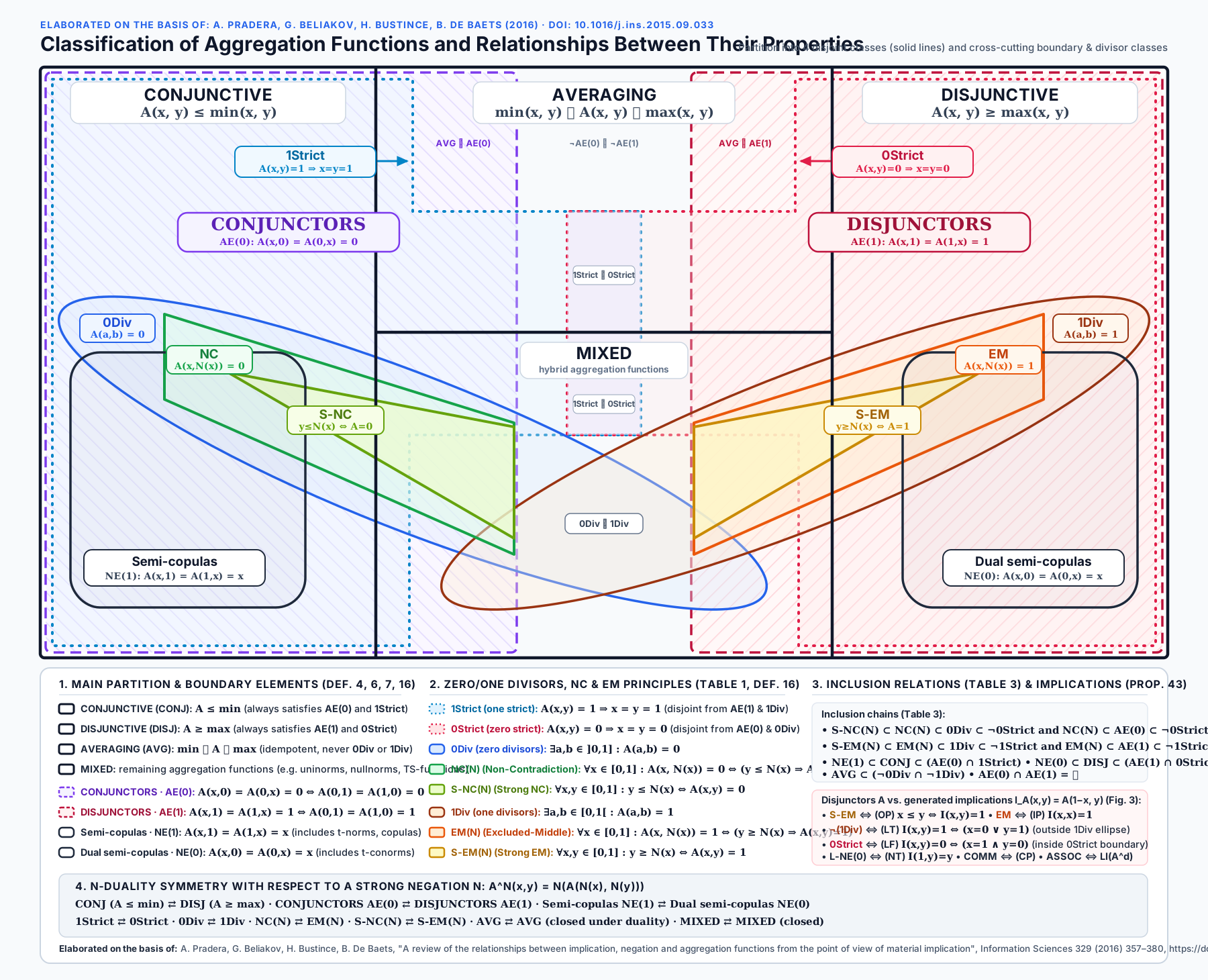](https://wgalka.github.io/Means/aggregation_classification.html)
|
|
20
|
+
|
|
21
|
+
*Diagram elaborated on the basis of: A. Pradera, G. Beliakov, H. Bustince, B. De Baets, "A review of the relationships between implication, negation and aggregation functions from the point of view of material implication", Information Sciences 329 (2016) 357–380, [DOI: 10.1016/j.ins.2015.09.033](https://doi.org/10.1016/j.ins.2015.09.033).*
|
|
22
|
+
|
|
17
23
|
An interactive version of this diagram is available at: https://wgalka.github.io/Means/aggregation_classification.html
|
|
18
24
|
|
|
19
25
|
#### Example 1:
|
|
@@ -51,6 +57,47 @@ print(func3.__repr__()) # function parameters are printed in order: func1, func2
|
|
|
51
57
|
|
|
52
58
|
|
|
53
59
|
|
|
60
|
+
## Multidimensional arrays
|
|
61
|
+
|
|
62
|
+
`aggregationslib.ndarray` provides the same `A_...` objects as
|
|
63
|
+
`aggregationslib.aggregations`, with additional constructor options `axis`
|
|
64
|
+
and `keepdims`. It applies the existing vector implementation separately
|
|
65
|
+
to each vector along the selected axis.
|
|
66
|
+
|
|
67
|
+
```python
|
|
68
|
+
import numpy as np
|
|
69
|
+
from aggregationslib.ndarray import A_ar, A_ch
|
|
70
|
+
from aggregationslib import weighted_measure
|
|
71
|
+
|
|
72
|
+
X = np.array([[0.2, 0.6, 0.9], [0.9, 0.2, 0.6]])
|
|
73
|
+
A_ar(axis=1)(X) # shape (2,): one value per row
|
|
74
|
+
A_ar(axis=0)(X) # shape (3,): one value per column
|
|
75
|
+
A_ar(axis=1, keepdims=True)(X) # shape (2, 1)
|
|
76
|
+
A_ar()(X) # scalar: aggregate all elements
|
|
77
|
+
|
|
78
|
+
mu = weighted_measure([0.5, 0.3, 0.2])
|
|
79
|
+
A_ch(measure=mu, axis=-1)(X) # array([0.46, 0.63])
|
|
80
|
+
```
|
|
81
|
+
|
|
82
|
+
`axis=None` (the default) flattens the input in C order. An integer axis,
|
|
83
|
+
including a negative index, reduces that axis; tuples of axes are not
|
|
84
|
+
supported. For an input of shape `(m, n)`, `axis=1` returns shape `(m,)`,
|
|
85
|
+
including `(1,)` when there is just one row. `keepdims=True` retains reduced
|
|
86
|
+
dimensions with length one. A complete reduction returns a scalar unless
|
|
87
|
+
`keepdims=True`.
|
|
88
|
+
|
|
89
|
+
Choquet and Sugeno use the same measure for each vector. Its size must match
|
|
90
|
+
the selected axis length, or the total element count for `axis=None`.
|
|
91
|
+
Choquet's `quasi_overlap` continues to accept scalar callbacks.
|
|
92
|
+
`Combine2Aggregations` accepts vector callables or objects from this module;
|
|
93
|
+
the combination's own `axis` and `keepdims` control the reduction.
|
|
94
|
+
|
|
95
|
+
Empty vectors are rejected. An empty batch of nonempty vectors returns an
|
|
96
|
+
empty floating-point array of the appropriate shape. The mathematical
|
|
97
|
+
domains, parameter rules and numerical behavior are inherited from the
|
|
98
|
+
vector implementations. This module uses iteration over vectors, not
|
|
99
|
+
vectorized implementations of the aggregation formulas.
|
|
100
|
+
|
|
54
101
|
## Aggregation functions
|
|
55
102
|
|
|
56
103
|
An aggregation function on the unit interval [1] is an increasing mapping
|
|
@@ -71,7 +118,7 @@ intervals. `[0,1]` means only the unit interval. These are mathematical
|
|
|
71
118
|
properties; most callable objects do not validate input bounds at runtime.
|
|
72
119
|
Some tags depend on parameters or the fuzzy measure.
|
|
73
120
|
|
|
74
|
-
$\mathbf{A_{ch}^{(\mu)}}$ **- Choquet integral [1]**
|
|
121
|
+
$\mathbf{A_{ch}^{(\mu)}}$ **- Discrete Choquet integral [1]**
|
|
75
122
|
|
|
76
123
|
Tags: `averaging` `aggregation interval: [0,1]` `symmetric if μ is symmetric`
|
|
77
124
|
|
|
@@ -102,8 +149,10 @@ $\mu(\emptyset)=0$ and $\mu(N)=1$.
|
|
|
102
149
|
$\mu(A)=\sum_{j=1}^{|A|}w_j$. The normalized weights are applied by
|
|
103
150
|
descending value rank, so the first belongs to the largest value; with the
|
|
104
151
|
Choquet integral this capacity gives the OWA aggregation.
|
|
105
|
-
- **Exponential cardinality
|
|
106
|
-
|
|
152
|
+
- **Exponential cardinality** (`exponential_cardinality_measure(n, q=1)`):
|
|
153
|
+
$\mu(A)=(|A|/n)^q$, where `q` must be finite and $q>0$.
|
|
154
|
+
For $q=1$, this is the uniform/cardinality measure, and the discrete
|
|
155
|
+
Choquet integral equals the arithmetic mean.
|
|
107
156
|
|
|
108
157
|
The constructors are in `aggregationslib.aggregation`; Decimal equivalents
|
|
109
158
|
are available in `aggregationslib.decimalaggregations`.
|
|
@@ -115,7 +164,7 @@ For the quasi-overlap generalization from Equation (9), pass a two-argument
|
|
|
115
164
|
function `O(x, mu)` as `quasi_overlap` to `choquet_integral` or `A_ch`. The
|
|
116
165
|
default remains the classical product-based Choquet integral.
|
|
117
166
|
|
|
118
|
-
$\mathbf{A_{sg}^{(\mu)}}$ **- Sugeno integral [1]**
|
|
167
|
+
$\mathbf{A_{sg}^{(\mu)}}$ **- Discrete Sugeno integral [1]**
|
|
119
168
|
|
|
120
169
|
Tags: `averaging` `aggregation interval: [0,1]` `symmetric if μ is symmetric`
|
|
121
170
|
|
|
@@ -149,8 +198,9 @@ $\mu(\emptyset)=0$ and $\mu(N)=1$. The same constructors are available in
|
|
|
149
198
|
descending value rank, so the first belongs to the largest value. In the
|
|
150
199
|
Sugeno integral this capacity is used in the max–min formula; the result is
|
|
151
200
|
not the OWA aggregation.
|
|
152
|
-
- **Exponential cardinality
|
|
153
|
-
|
|
201
|
+
- **Exponential cardinality** (`exponential_cardinality_measure(n, q=1)`):
|
|
202
|
+
$\mu(A)=(|A|/n)^q$, where `q` must be finite and $q>0$.
|
|
203
|
+
For $q=1$, this is the uniform/cardinality measure.
|
|
154
204
|
|
|
155
205
|
$\mathbf{A_{ar}}$ **- Arithmetic mean**
|
|
156
206
|
|
|
@@ -305,3 +355,9 @@ We can construct covex combination of aggregation functions as $A^{(p)}_{A_1,A_2
|
|
|
305
355
|
|
|
306
356
|
1. Beliakov, G., Bustince, H., and Calvo, T.: *A Practical Guide to Averaging Functions*. Berlin: Springer, vol. 329, 2016.
|
|
307
357
|
2. [Mustonen, Seppo. (2010). Logarithmic mean for several arguments. ](https://www.researchgate.net/publication/228886844_Logarithmic_mean_for_several_arguments)
|
|
358
|
+
# Shiny app
|
|
359
|
+
|
|
360
|
+
A local interface lets you upload a CSV table, select columns and an
|
|
361
|
+
aggregation, add input vectors, and download row-wise results. It also
|
|
362
|
+
generates the equivalent Python code using `aggregationslib.ndarray`.
|
|
363
|
+
See [setup and usage](apps/shiny/README.md).
|
|
@@ -8,12 +8,15 @@ Documentation:
|
|
|
8
8
|
- English: https://wgalka.github.io/Means/en/
|
|
9
9
|
- Polski: https://wgalka.github.io/Means/pl/
|
|
10
10
|
|
|
11
|
-
|
|
11
|
+
Aggregation functions can be classified in several ways. A familiar distinction
|
|
12
|
+
is between three types of behaviour:
|
|
12
13
|
|
|
13
|
-
-
|
|
14
|
-
|
|
15
|
-
-
|
|
16
|
-
|
|
14
|
+
- Conjunctive — an AND-like combination of the inputs.
|
|
15
|
+
- Averaging — a result between the smallest and largest input values.
|
|
16
|
+
- Disjunctive — an OR-like combination of the inputs.
|
|
17
|
+
|
|
18
|
+
These are not the only possibilities: aggregation functions can also exhibit
|
|
19
|
+
mixed behaviour. The diagram below presents a broader classification.
|
|
17
20
|
|
|
18
21
|
.. image:: https://raw.githubusercontent.com/wgalka/Means/main/docs/assets/diagram-aggregation-classification.svg
|
|
19
22
|
:alt: Classification of aggregation functions
|
|
@@ -84,7 +87,7 @@ intervals. ``[0,1]`` means only the unit interval. These are
|
|
|
84
87
|
mathematical properties; most callable objects do not validate input
|
|
85
88
|
bounds at runtime. Some tags depend on parameters or the fuzzy measure.
|
|
86
89
|
|
|
87
|
-
:math:`\mathbf{A_{ch}^{(\mu)}}` **- Choquet integral [1]**
|
|
90
|
+
:math:`\mathbf{A_{ch}^{(\mu)}}` **- Discrete Choquet integral [1]**
|
|
88
91
|
|
|
89
92
|
Tags: ``averaging`` ``aggregation interval: [0,1]``
|
|
90
93
|
``symmetric if μ is symmetric``
|
|
@@ -120,8 +123,10 @@ Each constructor returns a monotone fuzzy measure with
|
|
|
120
123
|
:math:`\mu(A)=\sum_{j=1}^{|A|}w_j`. The normalized weights are applied
|
|
121
124
|
by descending value rank, so the first belongs to the largest value;
|
|
122
125
|
with the Choquet integral this capacity gives the OWA aggregation.
|
|
123
|
-
- **Exponential cardinality
|
|
124
|
-
|
|
126
|
+
- **Exponential cardinality** (``exponential_cardinality_measure(n, q=1)``):
|
|
127
|
+
:math:`\mu(A)=(|A|/n)^q`, where ``q`` must be finite and :math:`q>0`.
|
|
128
|
+
For :math:`q=1`, this is the uniform/cardinality measure, and the discrete
|
|
129
|
+
Choquet integral equals the arithmetic mean.
|
|
125
130
|
|
|
126
131
|
The constructors are in ``aggregationslib.aggregation``; Decimal
|
|
127
132
|
equivalents are available in ``aggregationslib.decimalaggregations``.
|
|
@@ -135,7 +140,7 @@ two-argument function ``O(x, mu)`` as ``quasi_overlap`` to
|
|
|
135
140
|
``choquet_integral`` or ``A_ch``. The default remains the classical
|
|
136
141
|
product-based Choquet integral.
|
|
137
142
|
|
|
138
|
-
:math:`\mathbf{A_{sg}^{(\mu)}}` **- Sugeno integral [1]**
|
|
143
|
+
:math:`\mathbf{A_{sg}^{(\mu)}}` **- Discrete Sugeno integral [1]**
|
|
139
144
|
|
|
140
145
|
Tags: ``averaging`` ``aggregation interval: [0,1]``
|
|
141
146
|
``symmetric if μ is symmetric``
|
|
@@ -174,8 +179,9 @@ available in ``aggregationslib.aggregation`` and
|
|
|
174
179
|
by descending value rank, so the first belongs to the largest value.
|
|
175
180
|
In the Sugeno integral this capacity is used in the max–min formula;
|
|
176
181
|
the result is not the OWA aggregation.
|
|
177
|
-
- **Exponential cardinality
|
|
178
|
-
|
|
182
|
+
- **Exponential cardinality** (``exponential_cardinality_measure(n, q=1)``):
|
|
183
|
+
:math:`\mu(A)=(|A|/n)^q`, where ``q`` must be finite and :math:`q>0`.
|
|
184
|
+
For :math:`q=1`, this is the uniform/cardinality measure.
|
|
179
185
|
|
|
180
186
|
:math:`\mathbf{A_{ar}}` **- Arithmetic mean**
|
|
181
187
|
|
|
@@ -185,10 +185,10 @@
|
|
|
185
185
|
<clipPath id="clip-0Strict"><path d="M 1722 58 H 1185 V 255 H 845 V 588 H 1190 V 902 H 1722 Z"/></clipPath>
|
|
186
186
|
<clipPath id="clip-0Div"><ellipse cx="615" cy="615" rx="565" ry="115" transform="rotate(21.5 615 615)"/></clipPath>
|
|
187
187
|
<clipPath id="clip-1Div"><ellipse cx="1185" cy="615" rx="565" ry="115" transform="rotate(-21.5 1185 615)"/></clipPath>
|
|
188
|
-
<clipPath id="clip-NC"><path d="M
|
|
189
|
-
<clipPath id="clip-SNC"><path d="M
|
|
190
|
-
<clipPath id="clip-EM"><path d="M
|
|
191
|
-
<clipPath id="clip-SEM"><path d="M
|
|
188
|
+
<clipPath id="clip-NC"><path d="M 245 408 L 766 570 L 766 766 L 245 535 Z"/></clipPath>
|
|
189
|
+
<clipPath id="clip-SNC"><path d="M 340 495 L 766 576 L 766 742 Z"/></clipPath>
|
|
190
|
+
<clipPath id="clip-EM"><path d="M 1555 408 L 1034 570 L 1034 766 L 1555 535 Z"/></clipPath>
|
|
191
|
+
<clipPath id="clip-SEM"><path d="M 1460 495 L 1034 576 L 1034 742 Z"/></clipPath>
|
|
192
192
|
<clipPath id="clip-NE1"><rect x="105" y="465" width="350" height="380" rx="44"/></clipPath>
|
|
193
193
|
<clipPath id="clip-NE0"><rect x="1345" y="465" width="350" height="380" rx="44"/></clipPath>
|
|
194
194
|
|
|
@@ -248,19 +248,19 @@
|
|
|
248
248
|
fill="#ffedd5" fill-opacity="0.36" stroke="#9a3412" stroke-width="3.5"/>
|
|
249
249
|
|
|
250
250
|
<path id="shape-NC" onclick="toggleProperty('NC')" class="region-shape"
|
|
251
|
-
d="M
|
|
251
|
+
d="M 245 408 L 766 570 L 766 766 L 245 535 Z"
|
|
252
252
|
fill="#dcfce7" fill-opacity="0.52" stroke="#16a34a" stroke-width="4" stroke-linejoin="round"/>
|
|
253
253
|
|
|
254
254
|
<path id="shape-SNC" onclick="toggleProperty('SNC')" class="region-shape"
|
|
255
|
-
d="M
|
|
255
|
+
d="M 340 495 L 766 576 L 766 742 Z"
|
|
256
256
|
fill="#ecfccb" fill-opacity="0.68" stroke="#65a30d" stroke-width="4" stroke-linejoin="round"/>
|
|
257
257
|
|
|
258
258
|
<path id="shape-EM" onclick="toggleProperty('EM')" class="region-shape"
|
|
259
|
-
d="M
|
|
259
|
+
d="M 1555 408 L 1034 570 L 1034 766 L 1555 535 Z"
|
|
260
260
|
fill="#ffedd5" fill-opacity="0.55" stroke="#ea580c" stroke-width="4" stroke-linejoin="round"/>
|
|
261
261
|
|
|
262
262
|
<path id="shape-SEM" onclick="toggleProperty('SEM')" class="region-shape"
|
|
263
|
-
d="M
|
|
263
|
+
d="M 1460 495 L 1034 576 L 1034 742 Z"
|
|
264
264
|
fill="#fef9c3" fill-opacity="0.72" stroke="#ca8a04" stroke-width="4" stroke-linejoin="round"/>
|
|
265
265
|
|
|
266
266
|
<!-- 4. Semi-copulas & Dual semi-copulas -->
|
|
@@ -361,38 +361,38 @@
|
|
|
361
361
|
</g>
|
|
362
362
|
|
|
363
363
|
<!-- 0Div, NC, S-NC Labels -->
|
|
364
|
-
<g id="label-0Div" onclick="toggleProperty('0Div')" class="region-shape" transform="translate(
|
|
364
|
+
<g id="label-0Div" onclick="toggleProperty('0Div')" class="region-shape" transform="translate(175, 428)" filter="url(#badge-shadow)">
|
|
365
365
|
<rect x="-56" y="-20" width="112" height="42" rx="9" fill="#eff6ff" stroke="#2563eb" stroke-width="2"/>
|
|
366
366
|
<text x="0" y="-1" text-anchor="middle" class="badge-text" fill="#1d4ed8">0Div</text>
|
|
367
367
|
<text x="0" y="15" text-anchor="middle" class="badge-sub" fill="#2563eb">A(a,b) = 0</text>
|
|
368
368
|
</g>
|
|
369
369
|
|
|
370
|
-
<g id="label-NC" onclick="toggleProperty('NC')" class="region-shape" transform="translate(
|
|
370
|
+
<g id="label-NC" onclick="toggleProperty('NC')" class="region-shape" transform="translate(312, 475)" filter="url(#badge-shadow)">
|
|
371
371
|
<rect x="-64" y="-20" width="128" height="42" rx="9" fill="#f0fdf4" stroke="#16a34a" stroke-width="2"/>
|
|
372
372
|
<text x="0" y="-1" text-anchor="middle" class="badge-text" fill="#15803d">NC</text>
|
|
373
373
|
<text x="0" y="15" text-anchor="middle" class="badge-sub" fill="#16a34a">A(x,N(x)) = 0</text>
|
|
374
374
|
</g>
|
|
375
375
|
|
|
376
|
-
<g id="label-SNC" onclick="toggleProperty('SNC')" class="region-shape" transform="translate(500,
|
|
376
|
+
<g id="label-SNC" onclick="toggleProperty('SNC')" class="region-shape" transform="translate(500, 565)" filter="url(#badge-shadow)">
|
|
377
377
|
<rect x="-72" y="-20" width="144" height="42" rx="9" fill="#f7fee7" stroke="#65a30d" stroke-width="2"/>
|
|
378
378
|
<text x="0" y="-1" text-anchor="middle" class="badge-text" fill="#4d7c0f">S-NC</text>
|
|
379
379
|
<text x="0" y="15" text-anchor="middle" class="badge-sub" fill="#65a30d">y≤N(x) ⇔ A=0</text>
|
|
380
380
|
</g>
|
|
381
381
|
|
|
382
382
|
<!-- 1Div, EM, S-EM Labels -->
|
|
383
|
-
<g id="label-1Div" onclick="toggleProperty('1Div')" class="region-shape" transform="translate(
|
|
383
|
+
<g id="label-1Div" onclick="toggleProperty('1Div')" class="region-shape" transform="translate(1625, 428)" filter="url(#badge-shadow)">
|
|
384
384
|
<rect x="-72" y="-20" width="144" height="42" rx="9" fill="#fff7ed" stroke="#9a3412" stroke-width="2"/>
|
|
385
385
|
<text x="0" y="-1" text-anchor="middle" class="badge-text" fill="#9a3412" id="title-1Div">1Div</text>
|
|
386
386
|
<text x="0" y="15" text-anchor="middle" class="badge-sub" fill="#9a3412" id="sub-1Div">A(a,b) = 1</text>
|
|
387
387
|
</g>
|
|
388
388
|
|
|
389
|
-
<g id="label-EM" onclick="toggleProperty('EM')" class="region-shape" transform="translate(
|
|
389
|
+
<g id="label-EM" onclick="toggleProperty('EM')" class="region-shape" transform="translate(1488, 475)" filter="url(#badge-shadow)">
|
|
390
390
|
<rect x="-76" y="-20" width="152" height="42" rx="9" fill="#fff7ed" stroke="#ea580c" stroke-width="2"/>
|
|
391
391
|
<text x="0" y="-1" text-anchor="middle" class="badge-text" fill="#c2410c" id="title-EM">EM</text>
|
|
392
392
|
<text x="0" y="15" text-anchor="middle" class="badge-sub" fill="#ea580c" id="sub-EM">A(x,N(x)) = 1</text>
|
|
393
393
|
</g>
|
|
394
394
|
|
|
395
|
-
<g id="label-SEM" onclick="toggleProperty('SEM')" class="region-shape" transform="translate(1300,
|
|
395
|
+
<g id="label-SEM" onclick="toggleProperty('SEM')" class="region-shape" transform="translate(1300, 565)" filter="url(#badge-shadow)">
|
|
396
396
|
<rect x="-82" y="-20" width="164" height="42" rx="9" fill="#fefce8" stroke="#ca8a04" stroke-width="2"/>
|
|
397
397
|
<text x="0" y="-1" text-anchor="middle" class="badge-text" fill="#a16207" id="title-SEM">S-EM</text>
|
|
398
398
|
<text x="0" y="15" text-anchor="middle" class="badge-sub" fill="#ca8a04" id="sub-SEM">y≥N(x) ⇔ A=1</text>
|
|
@@ -339,6 +339,25 @@ def uniform_measure(n: int) -> FuzzyMeasure:
|
|
|
339
339
|
return _capacity_from_function(n, lambda subset: len(subset) / n)
|
|
340
340
|
|
|
341
341
|
|
|
342
|
+
def exponential_cardinality_measure(n: int, q: object = 1) -> FuzzyMeasure:
|
|
343
|
+
"""Return ``mu(A) = (|A| / n)**q`` for finite ``q > 0``.
|
|
344
|
+
|
|
345
|
+
For q=1 this is the uniform measure. Increasing q cannot increase
|
|
346
|
+
either classical integral; only Choquet reduces to arithmetic mean at q=1.
|
|
347
|
+
"""
|
|
348
|
+
n = _measure_size(n)
|
|
349
|
+
if isinstance(q, (bool, np.bool_)):
|
|
350
|
+
raise TypeError("q must be a real number, not bool")
|
|
351
|
+
try:
|
|
352
|
+
q = float(q)
|
|
353
|
+
except (ValueError, TypeError, OverflowError) as exc:
|
|
354
|
+
raise ValueError("q must be finite and greater than 0") from exc
|
|
355
|
+
if not isfinite(q) or q <= 0:
|
|
356
|
+
raise ValueError("q must be finite and greater than 0")
|
|
357
|
+
levels = [(size / n) ** q for size in range(n + 1)]
|
|
358
|
+
return _capacity_from_function(n, lambda subset: levels[len(subset)])
|
|
359
|
+
|
|
360
|
+
|
|
342
361
|
def relative_measure(n: int) -> FuzzyMeasure:
|
|
343
362
|
"""Return the relative capacity with singleton weights 1, ..., n."""
|
|
344
363
|
n = _measure_size(n)
|
|
@@ -372,6 +391,15 @@ def owa_measure(weights: object) -> FuzzyMeasure:
|
|
|
372
391
|
)
|
|
373
392
|
|
|
374
393
|
|
|
394
|
+
def _lambda_capacity(weights, parameter):
|
|
395
|
+
# Equivalent to (prod(1 + parameter*w) - 1) / parameter,
|
|
396
|
+
# without cancellation or division by a parameter close to zero.
|
|
397
|
+
value = 0.0
|
|
398
|
+
for weight in weights:
|
|
399
|
+
value = value * (1.0 + parameter * float(weight)) + float(weight)
|
|
400
|
+
return value
|
|
401
|
+
|
|
402
|
+
|
|
375
403
|
def _sugeno_lambda(weights: np.ndarray) -> float:
|
|
376
404
|
total = math.fsum(float(weight) for weight in weights)
|
|
377
405
|
if total == 1.0:
|
|
@@ -384,19 +412,17 @@ def _sugeno_lambda(weights: np.ndarray) -> float:
|
|
|
384
412
|
"singleton weights do not define a normalized k-fuzzy measure"
|
|
385
413
|
)
|
|
386
414
|
|
|
387
|
-
def
|
|
388
|
-
return
|
|
389
|
-
math.log1p(value * float(weight)) for weight in weights
|
|
390
|
-
) - math.log1p(value)
|
|
415
|
+
def gap(value):
|
|
416
|
+
return _lambda_capacity(weights, value) - 1.0
|
|
391
417
|
|
|
392
418
|
lower, upper = 0.0, 1.0
|
|
393
|
-
while
|
|
419
|
+
while gap(upper) <= 0.0:
|
|
394
420
|
upper *= 2.0
|
|
395
421
|
if not isfinite(upper):
|
|
396
422
|
raise ValueError("could not find the k-fuzzy measure parameter")
|
|
397
423
|
for _ in range(100):
|
|
398
424
|
middle = (lower + upper) / 2.0
|
|
399
|
-
if
|
|
425
|
+
if gap(middle) < 0.0:
|
|
400
426
|
lower = middle
|
|
401
427
|
else:
|
|
402
428
|
upper = middle
|
|
@@ -406,13 +432,12 @@ def _sugeno_lambda(weights: np.ndarray) -> float:
|
|
|
406
432
|
return -1.0
|
|
407
433
|
|
|
408
434
|
def gap(value):
|
|
409
|
-
|
|
410
|
-
return product - (1.0 + value)
|
|
435
|
+
return _lambda_capacity(weights, value) - 1.0
|
|
411
436
|
|
|
412
437
|
lower, upper = -1.0, 0.0
|
|
413
438
|
for _ in range(100):
|
|
414
439
|
middle = (lower + upper) / 2.0
|
|
415
|
-
if gap(middle)
|
|
440
|
+
if gap(middle) < 0.0:
|
|
416
441
|
lower = middle
|
|
417
442
|
else:
|
|
418
443
|
upper = middle
|
|
@@ -438,10 +463,7 @@ def k_fuzzy_measure(singleton_weights: object) -> FuzzyMeasure:
|
|
|
438
463
|
subset_weights = [float(vector[index]) for index in subset]
|
|
439
464
|
if parameter == 0.0:
|
|
440
465
|
return math.fsum(subset_weights)
|
|
441
|
-
|
|
442
|
-
return 1.0 - math.prod(1.0 - weight for weight in subset_weights)
|
|
443
|
-
product = math.prod(1.0 + parameter * weight for weight in subset_weights)
|
|
444
|
-
return (product - 1.0) / parameter
|
|
466
|
+
return _lambda_capacity(subset_weights, parameter)
|
|
445
467
|
|
|
446
468
|
values = {}
|
|
447
469
|
for mask in range(1 << n):
|
|
@@ -0,0 +1,81 @@
|
|
|
1
|
+
"""Command line entry point for the Shiny interface."""
|
|
2
|
+
|
|
3
|
+
import argparse
|
|
4
|
+
from importlib import invalidate_caches
|
|
5
|
+
from importlib.metadata import PackageNotFoundError, requires, version
|
|
6
|
+
from pathlib import Path
|
|
7
|
+
import site
|
|
8
|
+
import subprocess
|
|
9
|
+
import sys
|
|
10
|
+
import tomllib
|
|
11
|
+
|
|
12
|
+
from packaging.requirements import Requirement
|
|
13
|
+
|
|
14
|
+
|
|
15
|
+
def _missing_app_requirements():
|
|
16
|
+
try:
|
|
17
|
+
requirements = requires("aggregationslib") or []
|
|
18
|
+
except PackageNotFoundError:
|
|
19
|
+
# Support running the CLI as a module from a source checkout.
|
|
20
|
+
pyproject = Path(__file__).resolve().parents[1] / "pyproject.toml"
|
|
21
|
+
with pyproject.open("rb") as file:
|
|
22
|
+
extras = tomllib.load(file)["project"]["optional-dependencies"]["app"]
|
|
23
|
+
requirements = [f'{item}; extra == "app"' for item in extras]
|
|
24
|
+
|
|
25
|
+
missing = []
|
|
26
|
+
for item in requirements:
|
|
27
|
+
requirement = Requirement(item)
|
|
28
|
+
marker = requirement.marker
|
|
29
|
+
if not marker or not marker.evaluate({"extra": "app"}) or marker.evaluate({"extra": ""}):
|
|
30
|
+
continue
|
|
31
|
+
try:
|
|
32
|
+
if requirement.specifier.contains(version(requirement.name), prereleases=True):
|
|
33
|
+
continue
|
|
34
|
+
except PackageNotFoundError:
|
|
35
|
+
pass
|
|
36
|
+
requirement.marker = None
|
|
37
|
+
missing.append(str(requirement))
|
|
38
|
+
return missing
|
|
39
|
+
|
|
40
|
+
|
|
41
|
+
def main():
|
|
42
|
+
parser = argparse.ArgumentParser(prog="agglib")
|
|
43
|
+
commands = parser.add_subparsers(dest="command", required=True)
|
|
44
|
+
commands.add_parser("start", aliases=["serve"], help="Open the local Shiny app")
|
|
45
|
+
parser.parse_args()
|
|
46
|
+
|
|
47
|
+
missing = _missing_app_requirements()
|
|
48
|
+
if missing:
|
|
49
|
+
if not sys.stdin.isatty():
|
|
50
|
+
parser.exit(
|
|
51
|
+
1,
|
|
52
|
+
'Run agglib start in a terminal or install the app with '
|
|
53
|
+
'python -m pip install "aggregationslib[app]".\n',
|
|
54
|
+
)
|
|
55
|
+
try:
|
|
56
|
+
answer = input("Install the graphical interface? [Y/n] ").strip().lower()
|
|
57
|
+
except EOFError:
|
|
58
|
+
return
|
|
59
|
+
except KeyboardInterrupt:
|
|
60
|
+
parser.exit(130, "\n")
|
|
61
|
+
if answer not in {"", "y", "yes"}:
|
|
62
|
+
return
|
|
63
|
+
|
|
64
|
+
try:
|
|
65
|
+
subprocess.run([sys.executable, "-m", "pip", "install", *missing], check=True)
|
|
66
|
+
except subprocess.CalledProcessError as exc:
|
|
67
|
+
parser.exit(exc.returncode, "Could not install the graphical interface dependencies.\n")
|
|
68
|
+
if site.ENABLE_USER_SITE:
|
|
69
|
+
user_site = site.getusersitepackages()
|
|
70
|
+
if user_site not in sys.path and Path(user_site).is_dir():
|
|
71
|
+
site.addsitedir(user_site)
|
|
72
|
+
invalidate_caches()
|
|
73
|
+
|
|
74
|
+
from shiny import run_app
|
|
75
|
+
from apps.shiny.app import app
|
|
76
|
+
|
|
77
|
+
run_app(app, host="127.0.0.1", launch_browser=True)
|
|
78
|
+
|
|
79
|
+
|
|
80
|
+
if __name__ == "__main__":
|
|
81
|
+
main()
|
|
@@ -340,6 +340,32 @@ def uniform_measure(n):
|
|
|
340
340
|
)
|
|
341
341
|
|
|
342
342
|
|
|
343
|
+
def exponential_cardinality_measure(n, q=1, *, allow_float=False):
|
|
344
|
+
"""Return ``mu(A) = (|A| / n)**q`` using Decimal arithmetic only.
|
|
345
|
+
|
|
346
|
+
q must be finite and positive; floats require allow_float=True and
|
|
347
|
+
are converted through str. The active Decimal context sets precision.
|
|
348
|
+
"""
|
|
349
|
+
n = _decimal_measure_size(n)
|
|
350
|
+
_validate_allow_float(allow_float)
|
|
351
|
+
if isinstance(q, bool):
|
|
352
|
+
raise TypeError("q must be a real number, not bool")
|
|
353
|
+
if not isinstance(q, (Decimal, Integral, str, float)):
|
|
354
|
+
raise TypeError("q must be a Decimal, integer, or decimal string")
|
|
355
|
+
if isinstance(q, float):
|
|
356
|
+
if not allow_float:
|
|
357
|
+
raise TypeError("float q requires allow_float=True")
|
|
358
|
+
q = str(q)
|
|
359
|
+
try:
|
|
360
|
+
q = q if isinstance(q, Decimal) else Decimal(str(q))
|
|
361
|
+
except (InvalidOperation, ValueError, TypeError) as exc:
|
|
362
|
+
raise ValueError("q must be finite and greater than 0") from exc
|
|
363
|
+
if not q.is_finite() or q <= _UNIT_ZERO:
|
|
364
|
+
raise ValueError("q must be finite and greater than 0")
|
|
365
|
+
levels = [_UNIT_ZERO] + [(Decimal(size) / Decimal(n)) ** q for size in range(1, n)] + [_UNIT_ONE]
|
|
366
|
+
return _decimal_measure_from_function(n, lambda subset: levels[len(subset)])
|
|
367
|
+
|
|
368
|
+
|
|
343
369
|
def relative_measure(n):
|
|
344
370
|
"""Return the relative capacity with singleton weights 1, ..., n."""
|
|
345
371
|
n = _decimal_measure_size(n)
|
|
@@ -382,6 +408,14 @@ def owa_measure(weights, *, allow_float=False):
|
|
|
382
408
|
)
|
|
383
409
|
|
|
384
410
|
|
|
411
|
+
def _decimal_lambda_capacity(weights, parameter):
|
|
412
|
+
# Evaluate the product quotient without subtracting nearly equal numbers.
|
|
413
|
+
value = _UNIT_ZERO
|
|
414
|
+
for weight in weights:
|
|
415
|
+
value = value * (_UNIT_ONE + parameter * weight) + weight
|
|
416
|
+
return value
|
|
417
|
+
|
|
418
|
+
|
|
385
419
|
def _decimal_sugeno_lambda(weights):
|
|
386
420
|
total = sum(weights, _UNIT_ZERO)
|
|
387
421
|
if total == _UNIT_ONE:
|
|
@@ -395,10 +429,7 @@ def _decimal_sugeno_lambda(weights):
|
|
|
395
429
|
)
|
|
396
430
|
|
|
397
431
|
def gap(value):
|
|
398
|
-
|
|
399
|
-
for weight in weights:
|
|
400
|
-
product *= _UNIT_ONE + value * weight
|
|
401
|
-
return product - _UNIT_ONE - value
|
|
432
|
+
return _decimal_lambda_capacity(weights, value) - _UNIT_ONE
|
|
402
433
|
|
|
403
434
|
lower, upper = _UNIT_ZERO, _UNIT_ONE
|
|
404
435
|
while gap(upper) <= _UNIT_ZERO:
|
|
@@ -420,10 +451,7 @@ def _decimal_sugeno_lambda(weights):
|
|
|
420
451
|
return -_UNIT_ONE
|
|
421
452
|
|
|
422
453
|
def gap(value):
|
|
423
|
-
|
|
424
|
-
for weight in weights:
|
|
425
|
-
product *= _UNIT_ONE + value * weight
|
|
426
|
-
return product - _UNIT_ONE - value
|
|
454
|
+
return _decimal_lambda_capacity(weights, value) - _UNIT_ONE
|
|
427
455
|
|
|
428
456
|
lower, upper = -_UNIT_ONE, _UNIT_ZERO
|
|
429
457
|
for _ in range(200):
|
|
@@ -433,7 +461,7 @@ def _decimal_sugeno_lambda(weights):
|
|
|
433
461
|
middle_gap = gap(middle)
|
|
434
462
|
if middle_gap == _UNIT_ZERO:
|
|
435
463
|
return middle
|
|
436
|
-
if middle_gap
|
|
464
|
+
if middle_gap < _UNIT_ZERO:
|
|
437
465
|
lower = middle
|
|
438
466
|
else:
|
|
439
467
|
upper = middle
|
|
@@ -458,15 +486,7 @@ def k_fuzzy_measure(singleton_weights, *, allow_float=False):
|
|
|
458
486
|
subset_weights = [vector[index] for index in subset]
|
|
459
487
|
if parameter == _UNIT_ZERO:
|
|
460
488
|
return sum(subset_weights, _UNIT_ZERO)
|
|
461
|
-
|
|
462
|
-
product = _UNIT_ONE
|
|
463
|
-
for weight in subset_weights:
|
|
464
|
-
product *= _UNIT_ONE - weight
|
|
465
|
-
return _UNIT_ONE - product
|
|
466
|
-
product = _UNIT_ONE
|
|
467
|
-
for weight in subset_weights:
|
|
468
|
-
product *= _UNIT_ONE + parameter * weight
|
|
469
|
-
return (product - _UNIT_ONE) / parameter
|
|
489
|
+
return _decimal_lambda_capacity(subset_weights, parameter)
|
|
470
490
|
|
|
471
491
|
return _decimal_measure_from_function(len(vector), capacity)
|
|
472
492
|
|